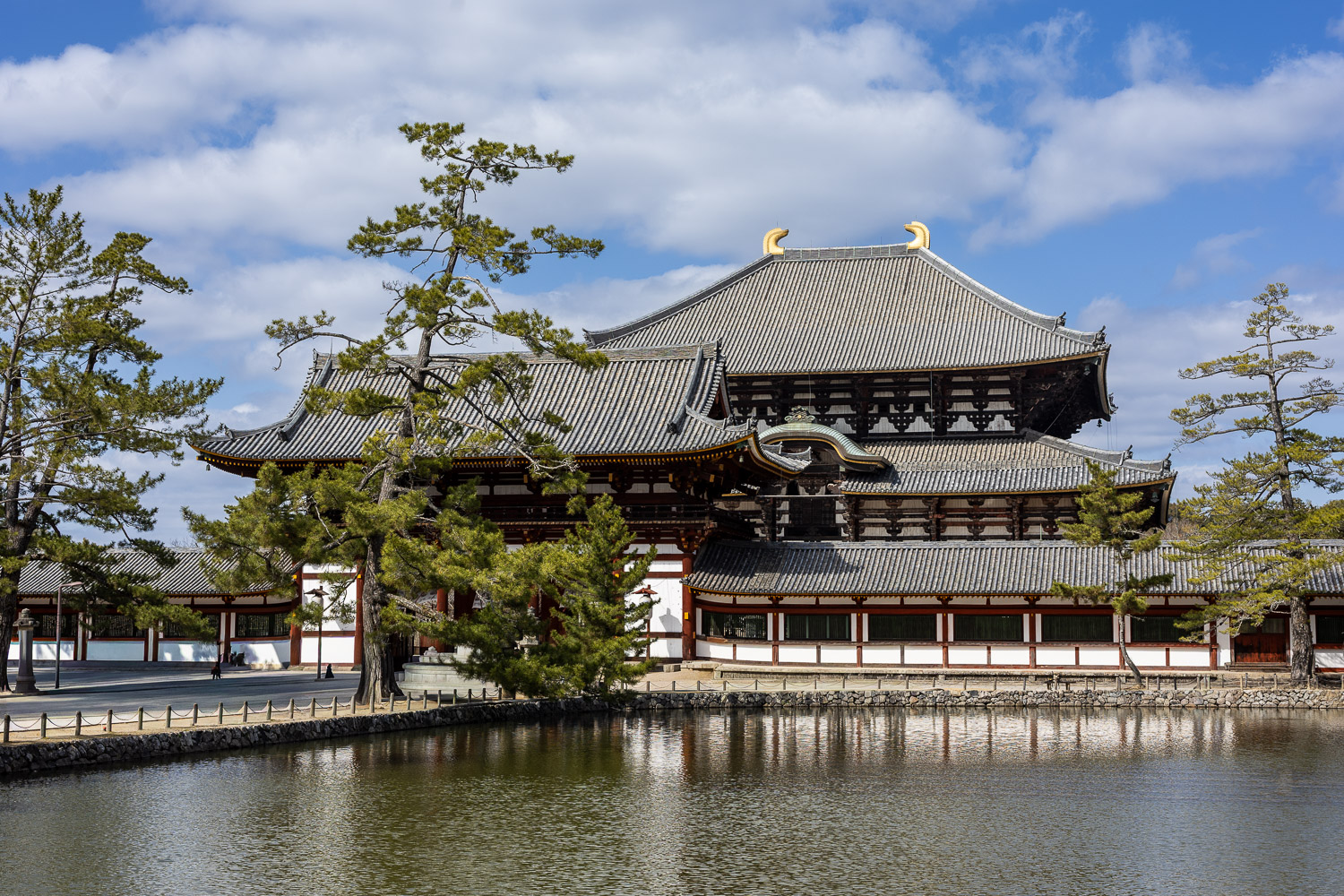
The End of the Silk Road: Why Todaiji Temple Defines Nara
Say “Nara” to any Japanese person. The answer you get back is the Great Buddha. Not the deer. Not Kasuga Taisha. The Great Buddha.
The reason is simple: the school system drills it in. In sixth-grade social studies, Japanese children learn about Tenpyo culture — Emperor Shomu, Todaiji, the Shosoin treasure house, and the phrase “the end of the Silk Road.” They study it again in middle school history. All 120 million Japanese people see a photograph of this Buddha in a textbook before they ever set foot here. What you are about to see is not a tourist attraction to them. It is the place where they finally stand before the real thing they first met on a printed page.
My first visit was a school trip. The Buddha was far larger than the textbook photograph had prepared me for. Why did it have to be this enormous? That was the only question in my head. I don’t remember the teacher’s explanation. I only remember the feeling of being overwhelmed.
There is another phrase the textbooks burn into every Japanese mind: “the end of the Silk Road.”
In the West, the Silk Road runs from Xi’an to the Mediterranean. In Japanese textbooks, it ends in Nara. Here is why.
In the eighth century, Tang Dynasty China was at its peak. Persian, Indian, and Central Asian cultures flowed into Chang’an along the Silk Road, and portions of that cultural wealth traveled onward to Japan through diplomatic missions known as kentoshi. The proof sits behind the Great Buddha Hall in the Shosoin, a storehouse holding roughly 9,000 treasures — Persian glass bowls, an Indian five-stringed lute that exists nowhere else on earth, Central Asian felt carpets woven from sheep’s wool. I cannot show you photographs of these objects. The Shosoin and its contents are managed by the Imperial Household Agency, and use of their images requires permission from the Shosoin Office. If you want to see them, you will have to come here yourself.
“The Shosoin is the last station on the Silk Road.” Scholar Hayashi Ryoichi coined the phrase in 1959, and it has been common knowledge in Japan ever since.
But the phrase is not geographic. No trade route extended to Nara. Along the actual Silk Road, dynasties rose and fell, religions replaced one another, and desert winds eroded what remained. The Shosoin alone kept its treasures for over 1,260 years — inside a building, by human hands, generation after generation. A terminus not in space but in time. That is why Japanese textbooks place the end of the Silk Road in Nara.
And the Shosoin’s story began in 756, when Empress Komyo dedicated Emperor Shomu’s personal belongings to this Buddha — the Vairocana — enshrined in this hall.
It all started here.
Nandaimon Gate: The Wooden Giants You Shouldn’t Rush Past
The first thing you encounter on the approach to the Great Buddha Hall is Nandaimon, the Great South Gate. Twenty-five meters tall.
Most people treat it as a passageway. They get distracted by the deer, they raise their phones, they hurry toward the hall. Stop. Look up.
The two Kongo Rikishi guardian figures flanking the gate were completed by the Kamakura-period sculptors Unkei, Kaikei, and their workshop in roughly sixty-nine days. Each stands about 8.4 meters tall. The one with its mouth open is Agyo; the one with its mouth closed is Ungyo. At most temples, Agyo is on the right and Ungyo is on the left. At Todaiji’s Nandaimon, they are reversed.
The gate itself is unusual. Rebuilt by the monk Chogen using Song Dynasty Chinese architectural techniques, it appears to be two stories from outside but is a single open-frame structure within. Massive straight pillars and horizontal tie beams define its character.
Todaiji Daibutsuden (Great Buddha Hall): A Downsized Behemoth
The Daibutsuden’s main gate — the Chumon — is permanently closed. Visitors enter through an entrance on its west side. Step through, cross the open courtyard, and the Great Buddha Hall fills your field of vision.
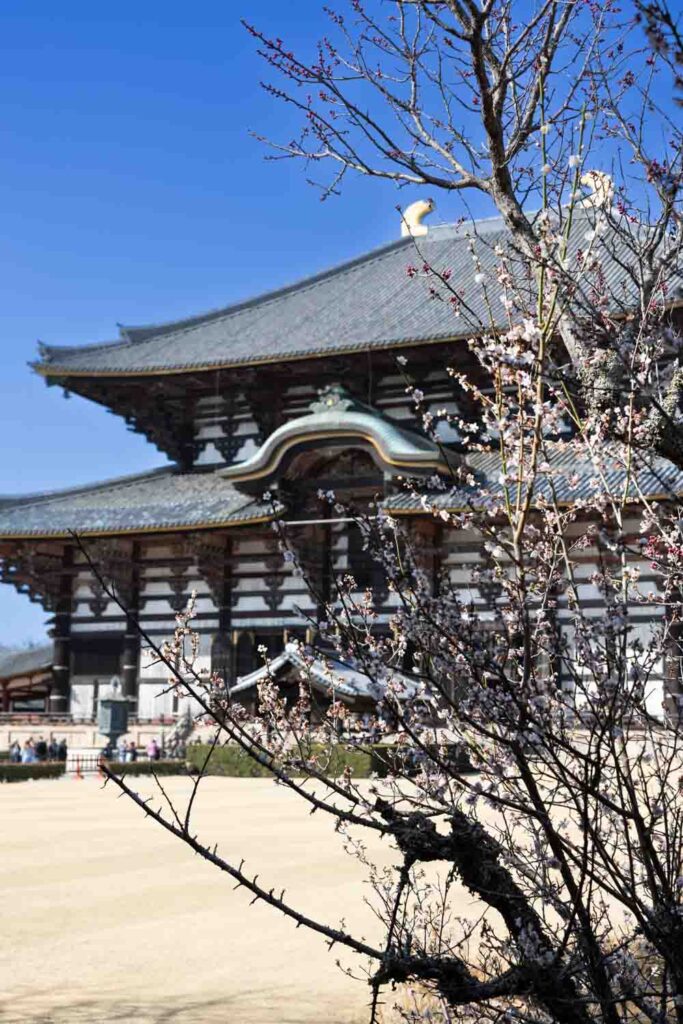
Fifty-seven meters wide. Fifty meters deep. Forty-seven meters tall. Among the largest wooden structures on earth. And yet this building is only two-thirds the size of the original. The first Daibutsuden was eighty-six meters wide.
When the Great Buddha’s eye-opening ceremony was held in 752, the project had quite literally strained the nation’s finances. Resources and labor were drawn from across the country. The hall burned down twice after that — in 1180 during the Taira clan’s assault on the southern capital, and again in 1567 in the fires set by the warlord Matsunaga Hisahide. The current building dates to 1692, scaled down because the budget ran short.
Burned twice. Rebuilt twice. Downsized, and still this enormous. That fact alone tells you how staggering the original must have been.
The Octagonal Lantern: An Open-Air National Treasure
In the center of the courtyard stands a gilt-bronze lantern, 4.6 meters tall.
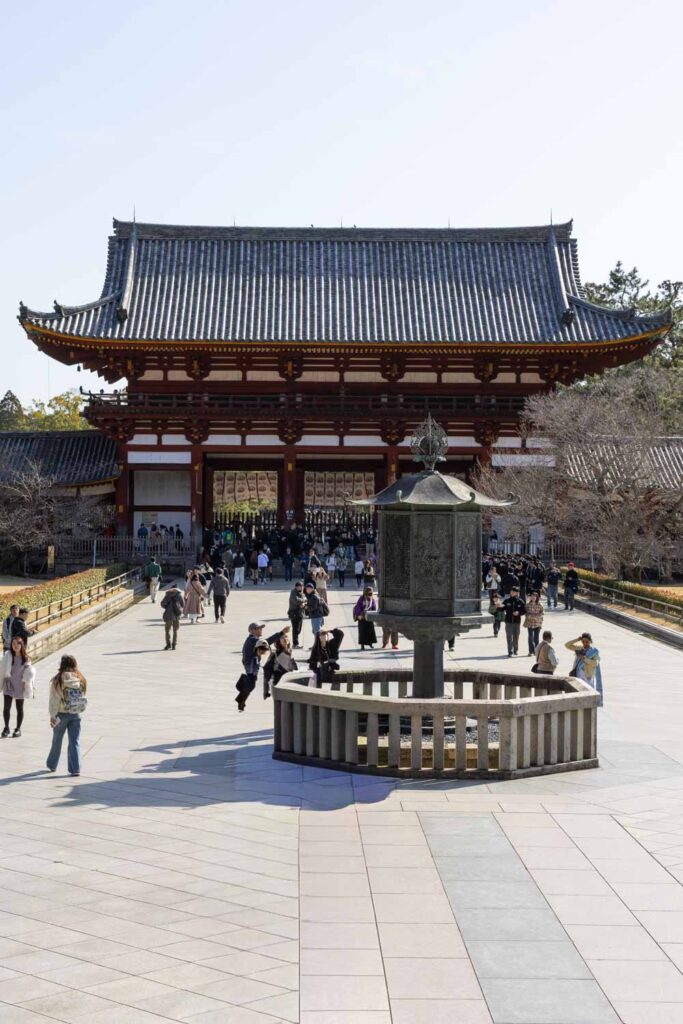
Almost everyone walks past it. They are fixated on the hall ahead and the lantern barely registers. But this is a National Treasure. It was cast around 752 — the same year the Great Buddha’s eyes were opened — and has stood on this exact spot since Todaiji was first built.
The Daibutsuden burned down twice. This lantern did not. The buildings around it became an inferno and it stayed standing. For over 1,200 years, without a roof, without a display case, it has remained right here. This is an eighth-century work of art that belongs behind museum glass. Instead, it stands in the rain and the sun and the open air. To be honest, this worries me. Twelve hundred years of survival outdoors is not a guarantee of the next twelve hundred.
The fire chamber has eight panels. Four are doors with openwork lions. The four between them bear relief carvings of onjo bosatsu — celestial musicians playing the flute, the sho, the shakuhachi, and the bronze cymbals. Their expressions are gentle. Their celestial scarves stream in an invisible wind. The craftsmanship of the Tenpyo era, intact — except for one panel, which was stolen in 1962. A replica now sits in its place. The recovered original is displayed in the Todaiji Museum.
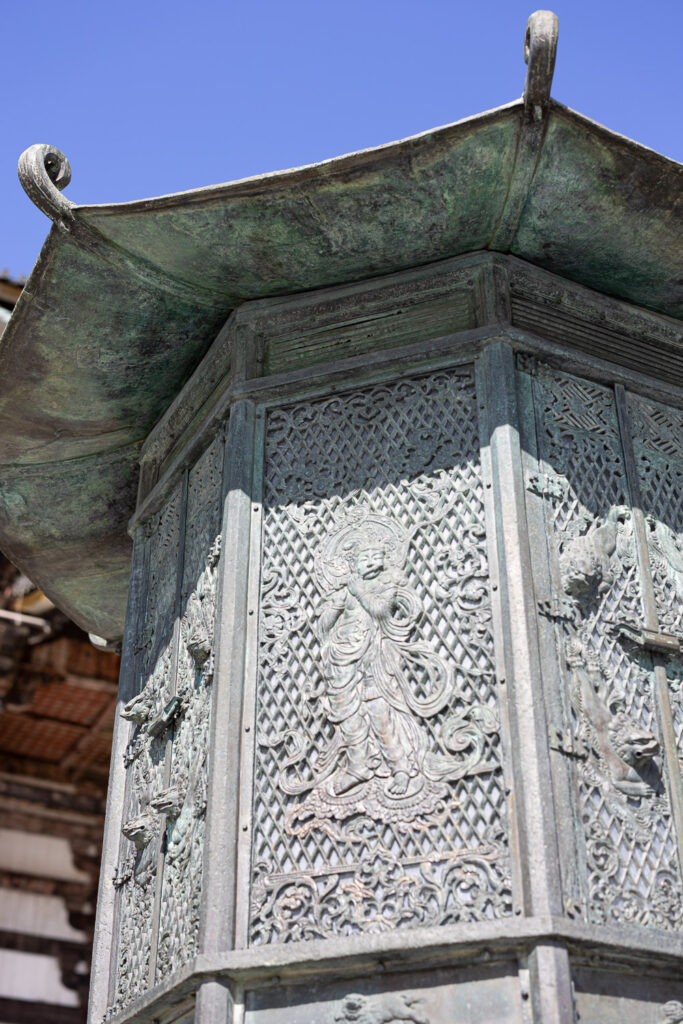
I keep thinking I should stand by this lantern someday and tell every passing visitor: “This is a National Treasure.” I haven’t done it yet. So at the very least, I am writing it here. Before you walk into the Daibutsuden, stop in front of this lantern. Step close and look at the carvings on the fire chamber. Everything inside the Great Buddha Hall is from the reconstruction. This lantern alone has been here since the beginning.
Inside the Hall: Meeting the Todaiji Great Buddha (Photography Allowed)
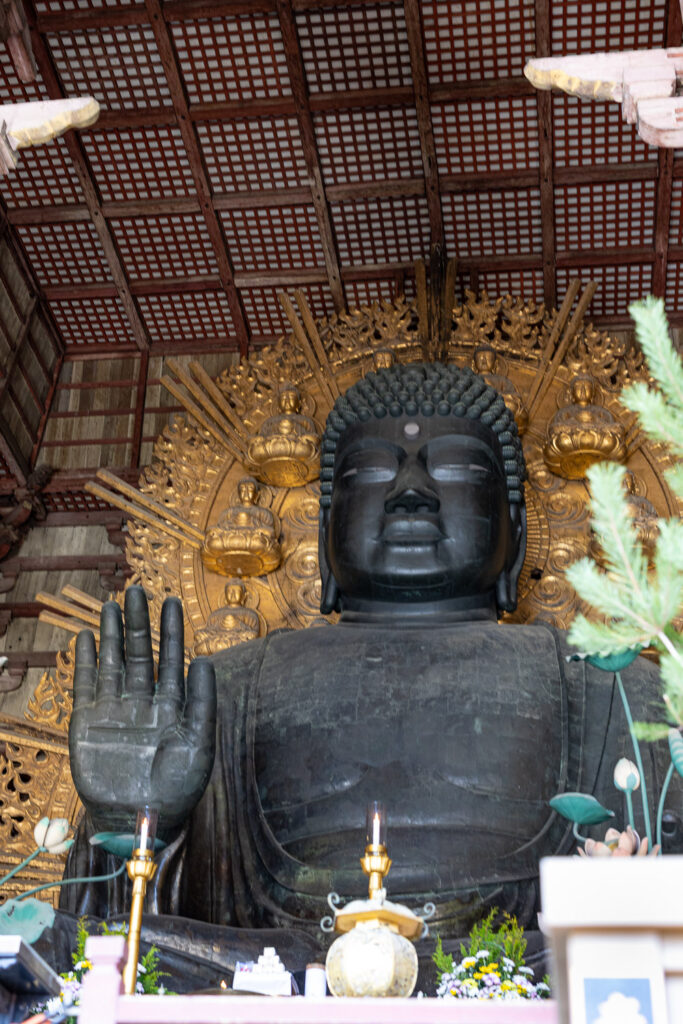
Step inside the Daibutsuden and the Vairocana Buddha is there, directly ahead.
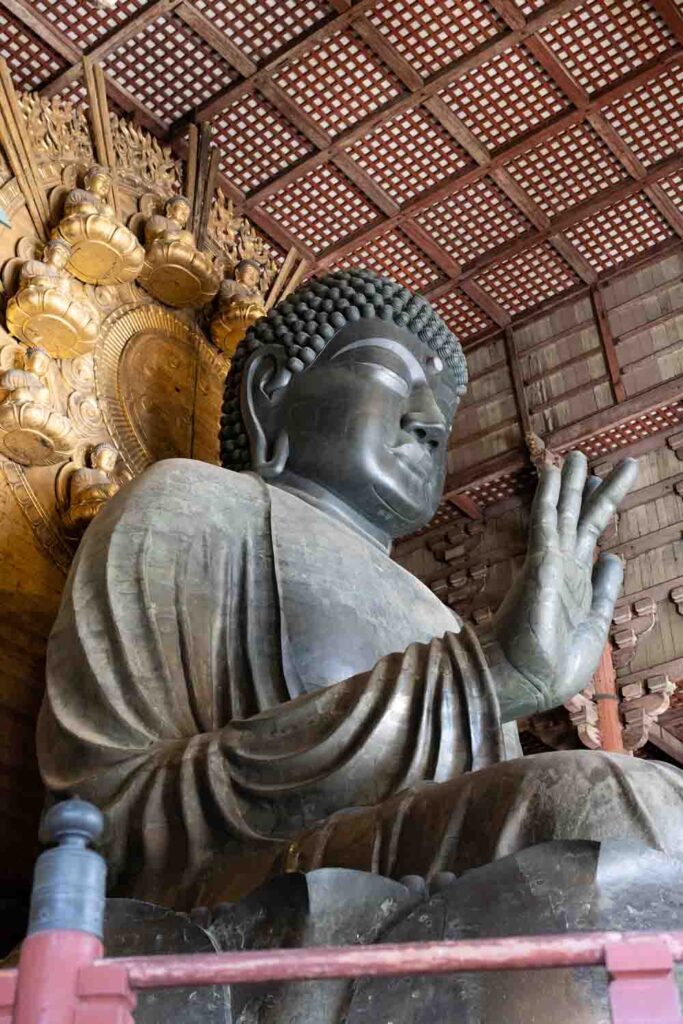
The seated figure is roughly 15 meters tall. One open palm is about the height of an adult human. For the first few seconds, you say nothing. It is not the size exactly — it is a kind of pressure that fills the entire space. A bronze Buddha sitting quietly inside a colossal wooden box. That contrast is the essence of this place, I think.
Photography is prohibited at many Japanese temples and shrines. But at Todaiji, you are allowed to photograph the Great Buddha. For visitors from abroad, this is welcome news. And you will find yourself looking upward longer here than at any other temple in Japan. Ceiling paintings are not a strong tradition in Japanese temple architecture, but in the Daibutsuden it is the sheer height and the joinery of the timber roof structure that hold your gaze. You cannot help looking up.
The Vairocana may overwhelm you, but the other statues in the hall are reasonably large themselves. Kokuzo Bosatsu, Nyoirin Kannon, Komokuten, Tamonten. The figures flanking and surrounding the Buddha would be the main attraction at most other temples. If time permits, walk the full circuit around the Buddha and pause before each one.
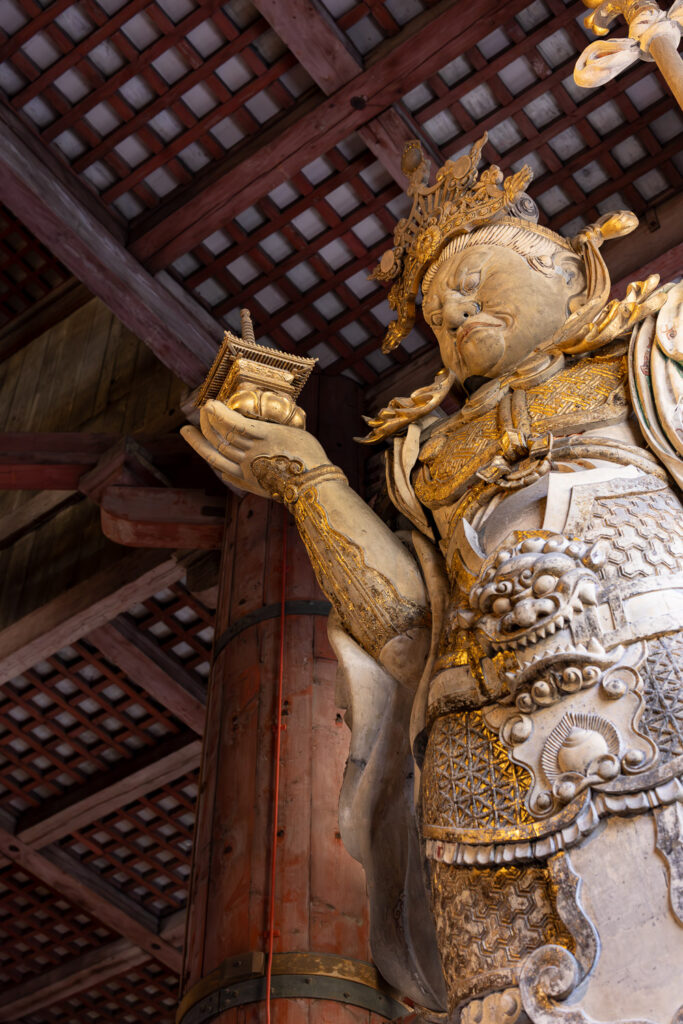
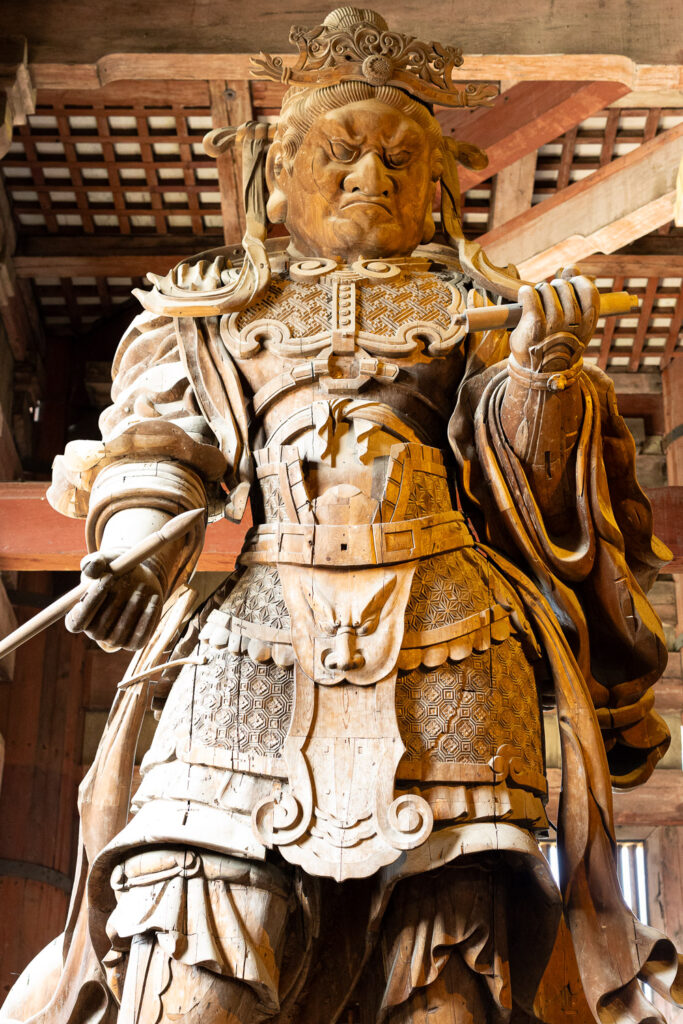
Inside the hall you will also find scale models of the original temple complex, showing what the grounds looked like when two seven-story pagodas — each roughly 100 meters tall — stood on either side of the Daibutsuden. Archaeological work is ongoing at the site of the former east pagoda, and there are discussions about eventual reconstruction.
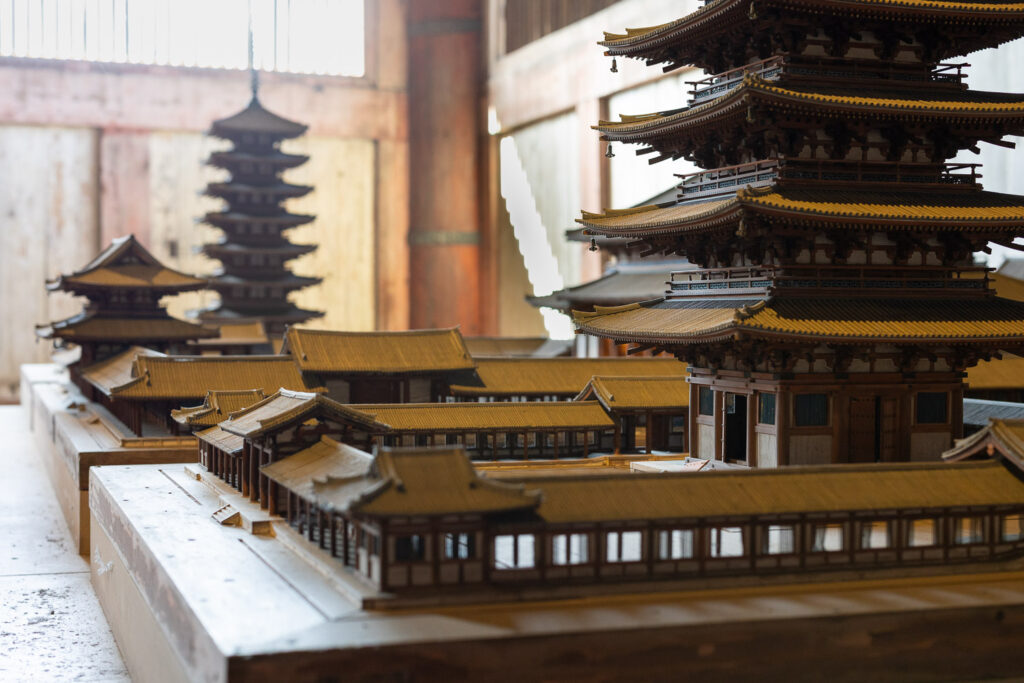
Photography note: The interior is dim and tripods are not allowed. Raise your ISO. A wide-angle lens helps capture the full scale. For a straight-on shot of the Buddha’s face, step back to a position directly in front. From a diagonal angle, you can frame the Buddha’s open hand against a person for a sense of scale.
The Todaiji Pillar Hole: Enlightenment, School Trips, and the Buddha’s Nostril
Walk around the back of the Buddha and you will find a square hole cut into the base of one of the wooden pillars.
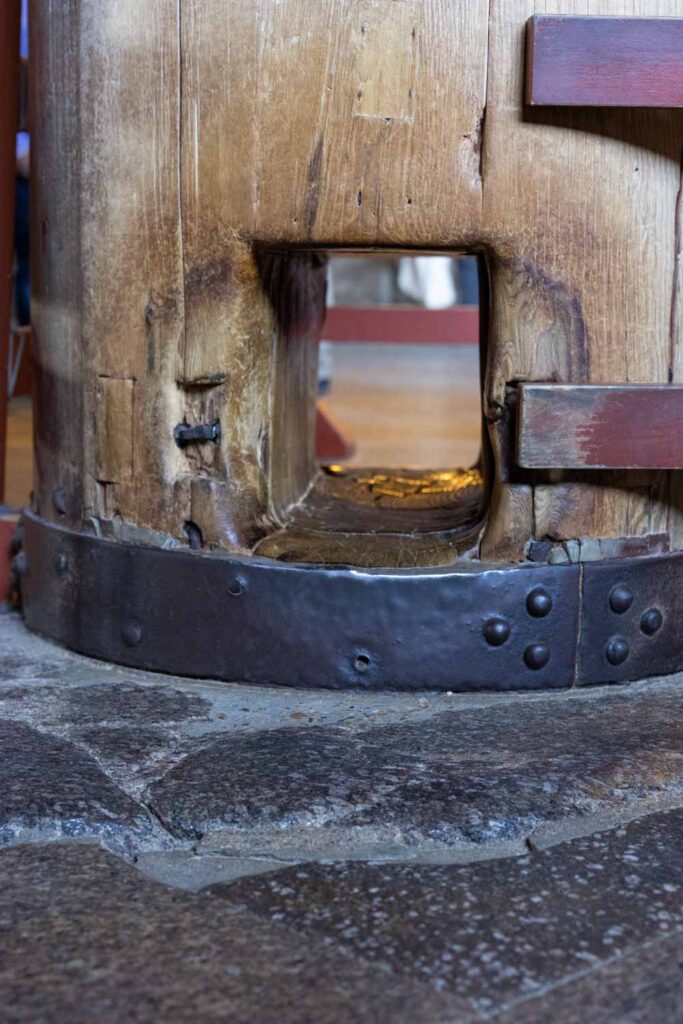
It measures roughly 37 by 30 centimeters and is 110 centimeters deep. The hole is said to be the same size as the Buddha’s nostril. Crawl through it and you will be granted enlightenment in the next life — or, in some versions, good health and protection from misfortune.
There is a line.
Person after person steps in front of my lens, ruining shot after shot. Not one or two — a steady, unbroken stream, as though it were the most natural thing in the world. I cannot argue with any of them. I have no right to be annoyed.
At this pillar hole, what matters most to parents is capturing the exact moment their child enters and the exact moment their child emerges — on camera, on video. Not the Buddha. And they are right. A child’s shriek of joy at this hole is worth more than a thousand photographs of the Great Buddha. My shutter timing is beside the point.
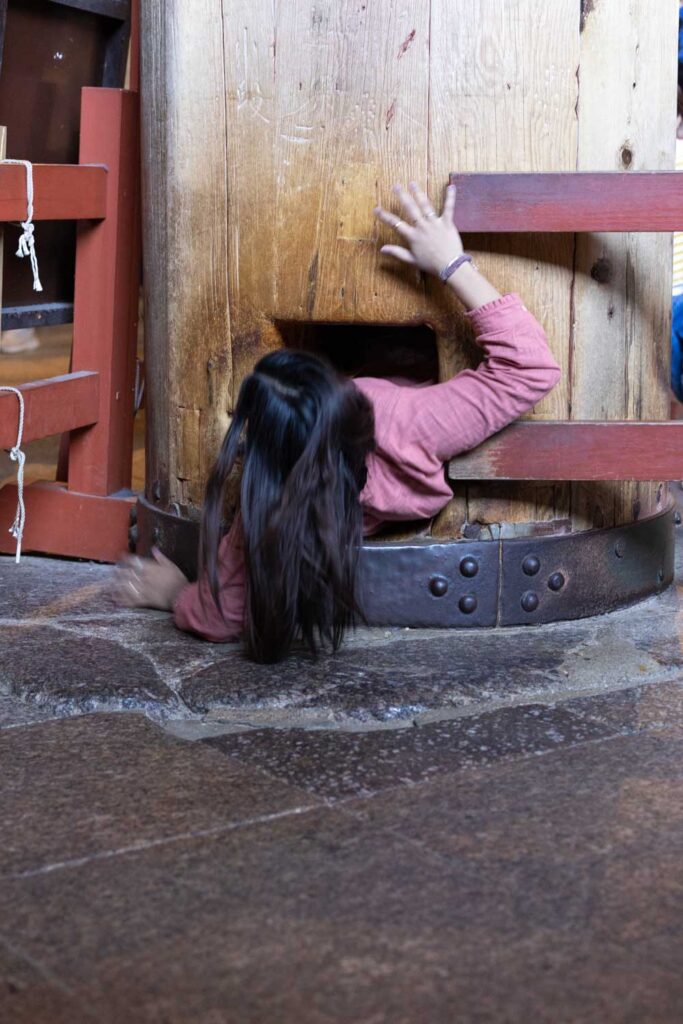
If you see children in matching uniforms forming a long line, you are looking at a shugaku ryoko — a Japanese school trip.
The reason Todaiji is a perennial school trip destination is straightforward: the national curriculum all but points here. Sixth graders study Emperor Shomu and Todaiji in social studies. Middle schoolers study Tenpyo culture and the Shosoin in history class. The top priority on school trips is “historical learning,” and the Kyoto-plus-Nara itinerary is the standard package. These children have come to see the real thing they first encountered in a photograph on a textbook page. Like you, they are being overwhelmed by its actual scale for the first time.
Adults get stuck too. Larger-framed foreign visitors being extracted from the hole by their friends is a routine part of the scenery here. Whether you attempt it is your call. If you don’t make it through, there are other paths to enlightenment. Probably.
Practical Guide: Visiting Todaiji Temple
Hours, Admission, and Tickets
- Admission: Adults (middle school and above) ¥800 / Elementary school students ¥400
- Daibutsuden + Todaiji Museum combo ticket: Adults ¥1,200 / Elementary ¥600 (saves ¥400)
- Hours: April–October 7:30–17:30 / November–March 8:00–17:00
- Time needed: 45 minutes to 1 hour for the Daibutsuden alone
Admission was raised from ¥600 to ¥800 in April 2024. The increase funds renovation of the Nandaimon Gate, upgrades to fire prevention and security systems, and preservation work at the east pagoda site.
How to Get to Todaiji Temple
- From Kintetsu Nara Station: 25–30 minute walk
- From JR Nara Station: 40–45 minute walk
- By bus: Get off at “Todaiji Daibutsuden,” then walk 5–10 minutes
- From Kyoto: Kintetsu express to Kintetsu Nara, approximately 35 minutes
- From Osaka: Kintetsu rapid express from Namba to Kintetsu Nara, approximately 35 minutes
Tips for Your Visit
- Go early or late. The hall is least crowded right after opening. School trip groups tend to concentrate in the late morning through early afternoon.
- Deer crackers are sold along the approach, but best not brought inside the Daibutsuden. The deer come as far as the path.
- Todaiji Museum (beside Nandaimon Gate) houses the Nikko and Gakko Bosatsu statues, relocated from the Hokkedo (Sangatsudo). Worth the combo ticket if you have time. Hours differ from the Daibutsuden (year-round 9:30–17:30, last entry 17:00; closed occasionally for exhibition changeovers). Check the official site for current information.
Beyond the Daibutsuden: Nigatsudo, Hokkedo, and the Shosoin
A five-minute walk from the Daibutsuden, there are buildings that most visitors never see.
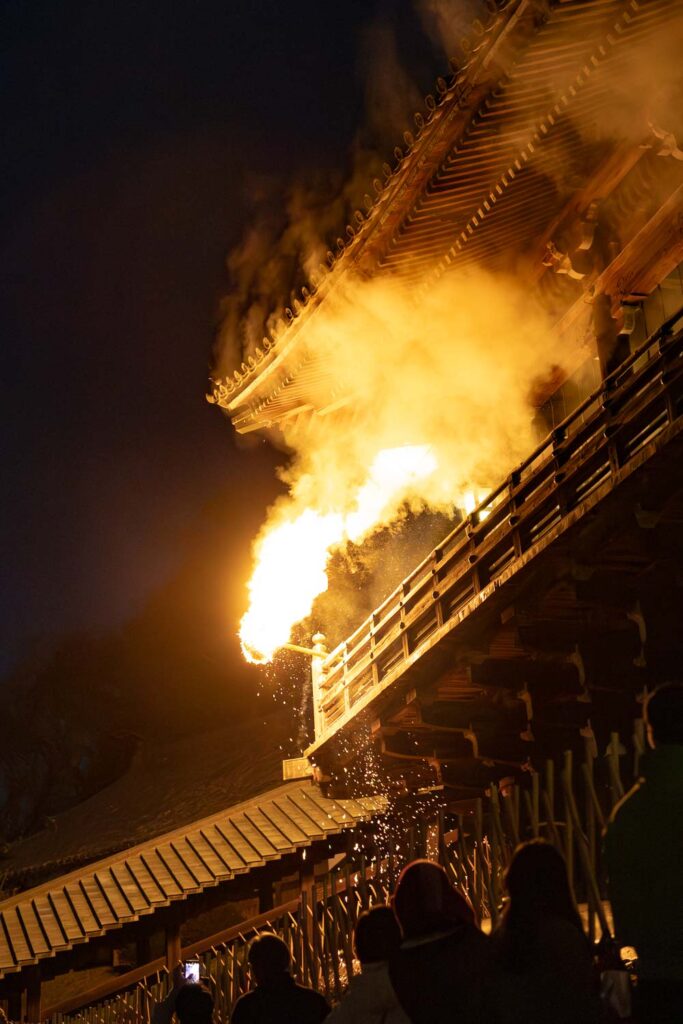
Nigatsudo — The view of the Nara basin from its elevated wooden stage is worth as much as the Daibutsuden itself, if not more. Open 24 hours, no admission fee. Dusk is the best time. Every March, the Shunie (Omizutori) ceremony — a ritual that has continued for over 1,200 years — sends showers of sparks raining from enormous torches on the stage.
Hokkedo (Sangatsudo) — The oldest building at Todaiji. Ten National Treasure Buddhist statues stand inside. The principal image, the Fukukensaku Kannon, has three eyes and eight arms. Its crown is set with roughly 11,000 pieces of jade and other gemstones. The pressure in this room is entirely different from the Daibutsuden. Admission ¥800.
The Shosoin — Behind the Daibutsuden. The azekura-style storehouse can be viewed year-round from outside the fence, free of charge. This is where the Silk Road story from the introduction becomes real. To see the actual treasures, you must visit the annual Shosoin Exhibition, held at Nara National Museum from late October through early November.