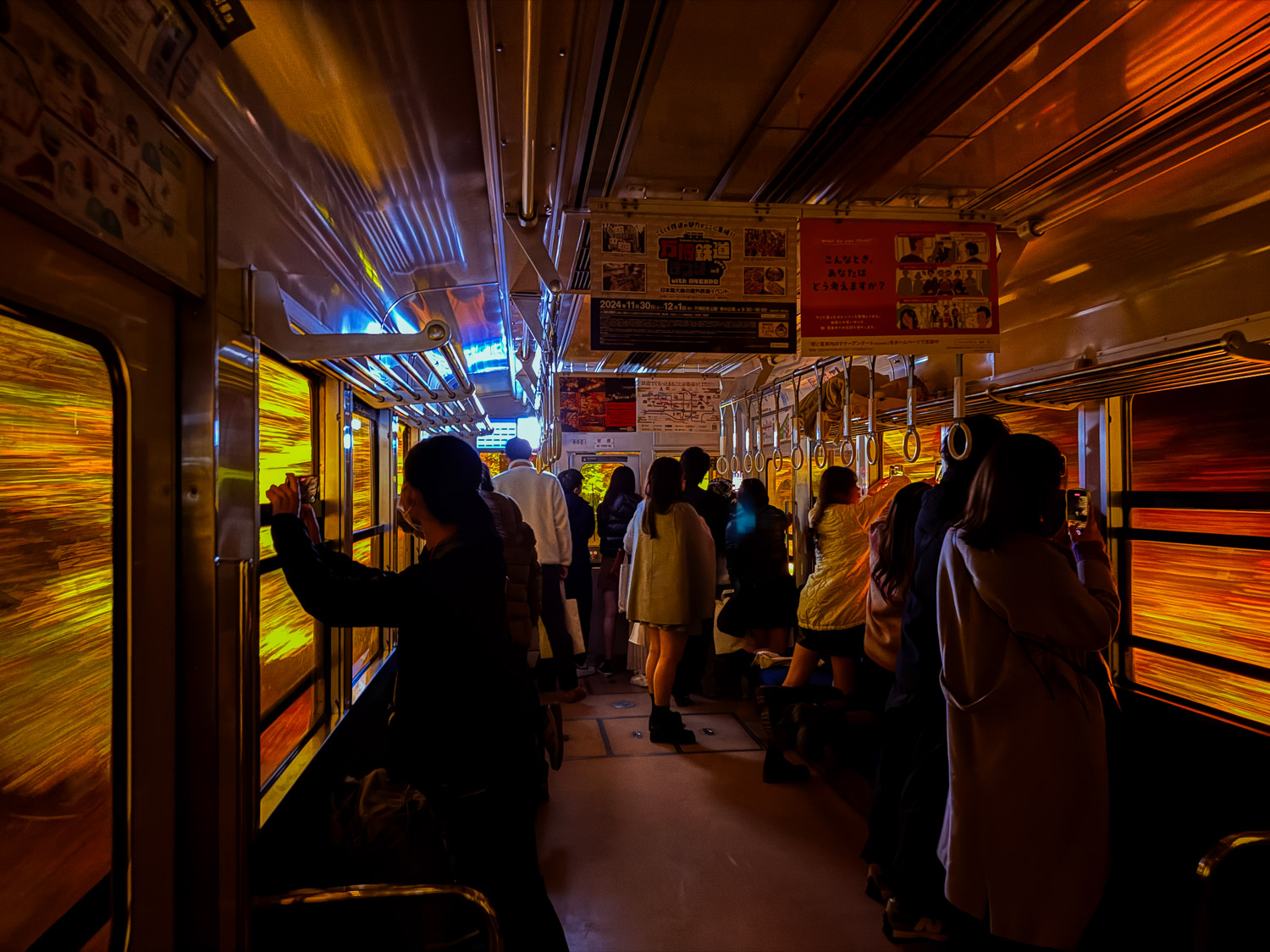
Open a window on a Japanese train and somebody notices. The air conditioning is running. Someone’s hair moves. Most passengers do not think of the window as a thing that opens at all, and anyone raised here learns to read the car before touching it.
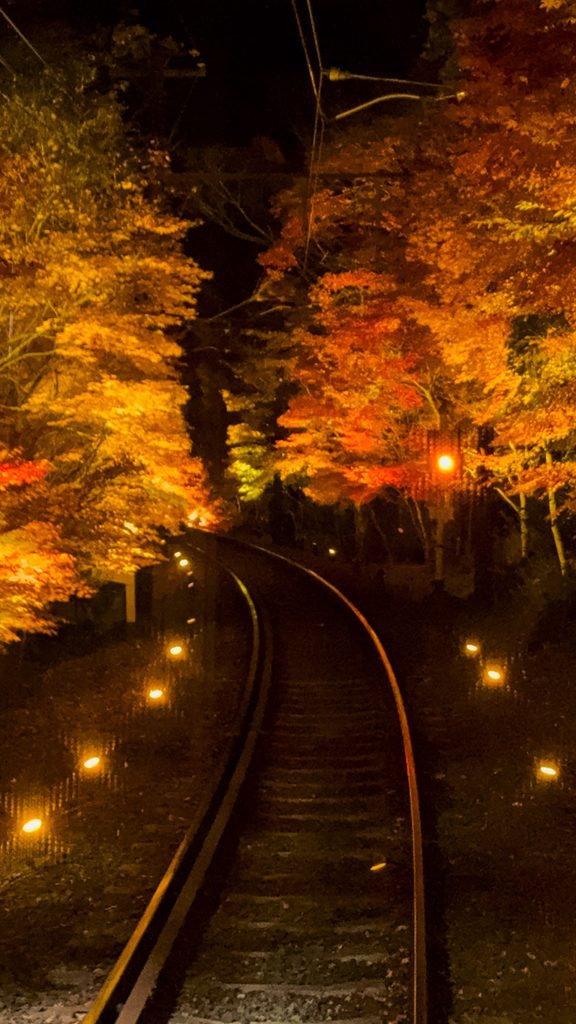
I know of one exception. It runs 250 meters through the maples north of Kyoto, on the Eizan Railway’s Kurama Line between Ichihara and Ninose stations, and it is called the momiji tunnel. Nobody glares here. If a passenger cannot get a window open, you open it for them, and they thank you.
Nine O’Clock at Demachiyanagi
I have ridden this stretch on November 20 two years in a row. Pure coincidence, and I did not notice until the second time.
The first night nearly went wrong. There was an illumination on at Chion-in earlier in the evening and I went, which looked reasonable when I planned it and turned out to be one temple too many. I reached the ticket gate at Demachiyanagi with very little to spare. Not many people arrived after me.
I had a seat on the Autumn Illumination Special Train, which runs after the regular illumination has finished, carries a small number of passengers, and requires an application in advance. Sixty seats. Three thousand five hundred yen, booked weeks earlier through a ticket machine at a convenience store, which is how a surprising amount of Japan gets arranged.
The car they sent that night had bench seating along the walls. A commuter train, in other words, the same boxy thing that carries students home from school, dispatched up a dark mountain on a sightseeing errand. No panorama windows, no premium seating, no view forward.
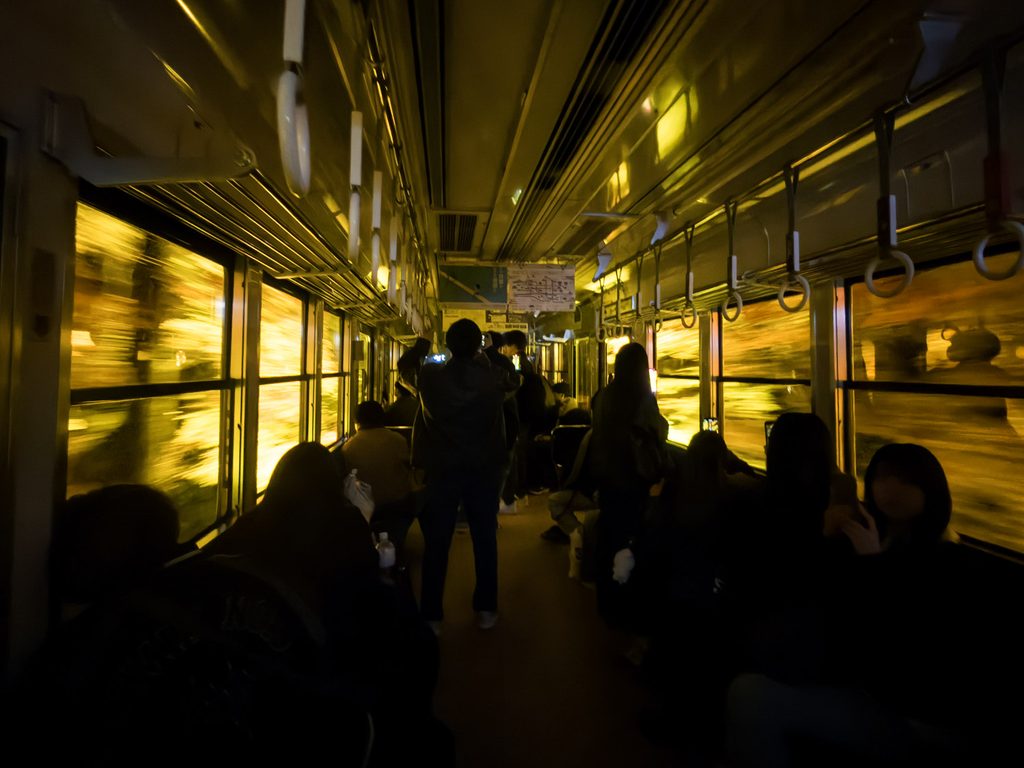
About thirty minutes out of Demachiyanagi, the lights inside the car went off. Then the train stopped. Not slowed. Stopped, in the middle of the tunnel, for roughly three minutes.
The Train Where the Window Is Allowed to Open
Kurama runs a season ahead of central Kyoto.
It is the same city on the map and a different climate in practice, and on a late November night in the valley an open window drops the temperature inside the train immediately. I opened mine first.
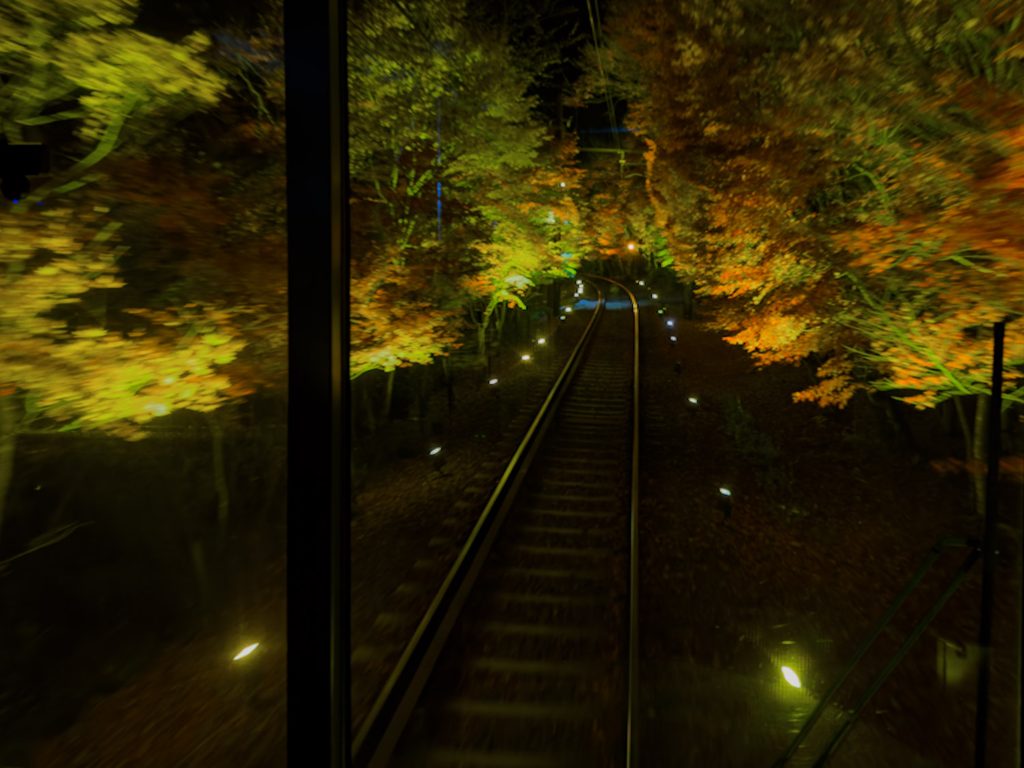
The air that came in was cold the way a walk-in refrigerator is cold, mountain air standing still in a valley all evening and then pouring through one open pane. It carried the smell of wet leaves. It also carried the silence, which was the part I had not expected: a stopped train makes no noise at all, and with the interior lights off there was nothing to hear but the valley and nothing to see but maples, lit from below, close enough to reach. Anyone riding this for the first time probably had me down as a lunatic for about three seconds. Then they understood what the window was for. One or two opened theirs. Then several more did.
The passenger beside me was struggling with the latch. These windows need two catches pushed up at the same moment, and if you have never done it, they simply do not move. I reached over and opened it, and got thanked more warmly than the favor deserved.
The reason is simple. Everyone wants the maples without a pane of glass in front of them. Glass throws the inside of the car back at you, and the railway has just gone to the trouble of switching off the lights so that it won’t. So you open the window, and the cold stops being a topic.
Train manners in Japan work less like a rulebook than people assume. What is acceptable in a given car is whatever that car has silently agreed to prioritize. For those three minutes, this car had agreed on maples.
One Year Later, Same Date, a Window That Does Not Open
The second November 20, I started early.
You do not need a special ticket to see this stretch. Through the autumn, ordinary trains slow down through the tunnel on the regular fare, which is the part most visitors never realize. I rode up to Kurama in the afternoon, turned around, and came back, because I had the time.
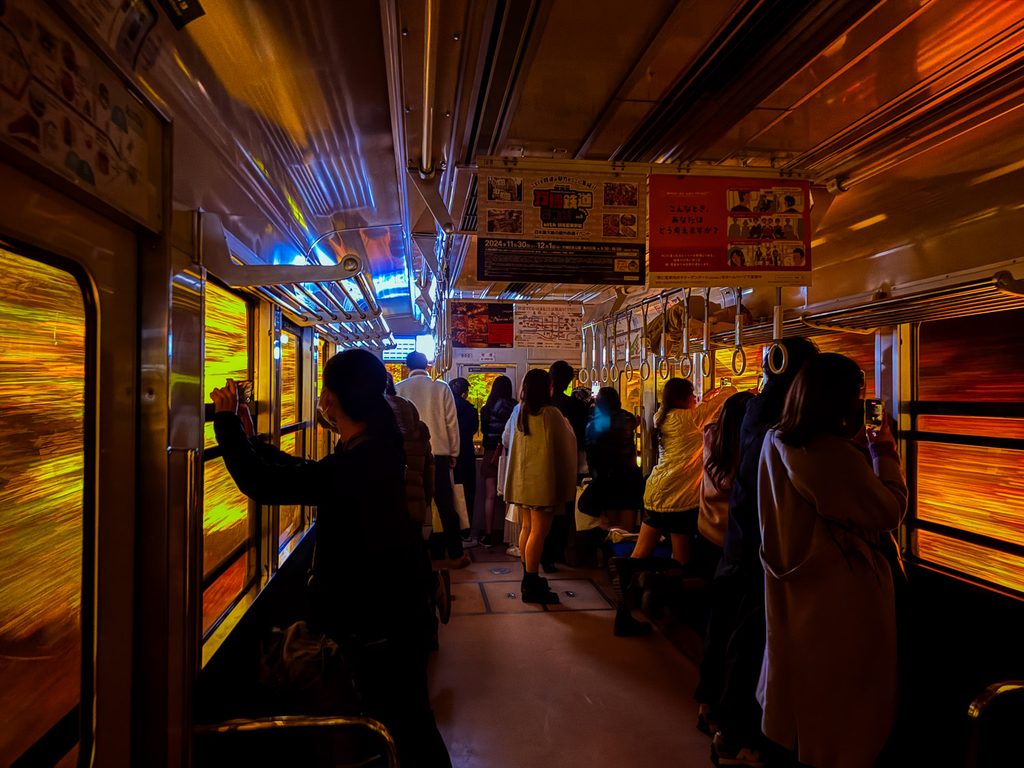
That night’s special train was KIRARA, the 900 series panorama car. Big windows. Eight seats near the middle fixed to face outward, toward the trees rather than toward each other. It looks like a train designed around this one stretch of track, and more or less it is. Reserved seating, 5,500 yen for the outward-facing seats and 4,500 yen for the rest, fifty-five passengers.
KIRARA’s windows do not open.
So I had paid more and gotten a worse window, which is the kind of arithmetic that only makes sense to somebody who has ridden the same stretch of track more times than he is willing to write down.
The Man Who Polished the Windows
A station attendant boarded before we left.
He greeted us and ran through the evening’s schedule, which was expected. Then he told us that he had spent the last while polishing every window in the car so that we could see the maples properly. And if any of them were not spotless, we should feel free to say so, and he would do them again.
The car laughed.
Station staff do not wipe windows for passengers. It is nobody’s job, it is not in any manual, and no one would have noticed if he had skipped it. He had done all of them by hand, for a ride that lasts under half an hour, and then offered to do them a second time, with a completely straight face. That gap between the size of the gesture and the flatness of the delivery is the joke, and it is also, more or less, how service works in this country.
KIRARA’s windows do not open, so the company cleaned them instead. Two Novembers, two answers to the same small problem: get the glass out of the way.
Some passengers did not laugh. This train carries visitors from abroad every year, and the joke went right past them. I wanted to lean over and translate it. He never paused long enough, and there is also this: when you translate a joke and nobody laughs, the failure transfers to you. It stops being his line and becomes your delivery. I sat there and said nothing.
The Driver Made Himself Small
KIRARA goes straight there.
No stops on the way, no chance to get off and look at anything else, which is the one flat note in an otherwise generous evening. Though if there is a person out there who pays 4,500 yen for this train and then wants to break the journey somewhere before the tunnel, I would like to meet him. It is possible I am the only one who has ever thought about it.
I went to the front of the car. The driver, without anyone asking, shifted sideways and folded himself down out of the way so that the passengers behind him could shoot through the front window. He stayed like that for a long time. Through the gap he left, you can watch the line climb: houses thin out, the valley narrows, and somewhere past Ichihara it stops looking like a city at all. To him this is the commute. To everyone standing behind him it is the season, arriving at 30 kilometers an hour.
Then the train began to slow.
You can feel the anticipation climb in a car full of people who know what is coming. The braking is gentle and unmistakable. And at the moment it becomes obvious, the interior lights cut out, a cheer goes up, and both walls of the car go yellow and orange at once and stay that way.
The Night I Stopped Photographing Leaves
I have lost count of how many times I have ridden this stretch.
For a long time I tried to photograph a single leaf just outside the glass, sharp, from a moving train, at night. It went the way you would expect. I have a folder of blurred foliage that could be anything, anywhere, in any season.
What changed was putting the train at the center of the frame and letting the maples smear. The photograph worked the moment I stopped fighting the motion and started using it, and that was the night I decided I might not be an amateur anymore.
The momiji tunnel is not scenery you stand in front of. It is scenery that happens at speed, seen from inside something that is moving, and the subject was the rate at which the color goes past.
The Railway That Hangs Wind Chimes in June
The Eizan Railway is small.
Two short lines out of a single terminus, a modest fleet, nothing that would impress a railway enthusiast on paper. I still cannot name a Japanese railway that works harder for the people riding it. I boarded one day in June and found wind chimes hanging the length of the car, ringing on every curve, in weather that made them feel like a public service.
In early summer they light the same stretch while the maples are still green. In autumn the illumination overlaps with the lantern season up in Kibune, which means one evening can hold both the train and the shrine approach.
Kyoto does not have to try. People come regardless. This company polishes the windows.
What I Could Not Translate
So here it is, a year late.
I have polished every window in this car tonight so that you can see the maples properly. If any of them are not spotless, please tell me, and I will clean them again.
One year I opened a window. The next year, somebody had already cleaned it. I have no idea what the third year holds, but both times, an entire train full of people took a few hundred meters of track completely seriously.
If you want those three minutes for yourself, timing does most of the work and the rest is a short list of decisions: which train, which night, and whether you care about the window opening. Here is everything I have learned the expensive way.
What the Momiji Tunnel Is
The momiji tunnel is a stretch of roughly 250 meters on the Eizan Railway’s Kurama Line, between Ichihara and Ninose stations, planted with about 280 maples that lean in over the rails from both sides. In Japanese it is momiji no tonneru, and the railway signposts it that way on its own maps. The official English name is the Maple Tree Tunnel, though almost nobody uses it.
There is no way to see it from outside the train. No road runs alongside it, no viewpoint overlooks it, and no amount of walking, driving, or taxi fare will get you a look at it. Riding through is the only option, which is the one fact worth knowing before you plan anything else.
When the Momiji Tunnel Peaks
Color usually starts in the first week of November. By mid-month the tunnel is a mix of green, yellow, orange, and red at once, and by the last third of the month it turns properly crimson. Both of my November 20 rides landed in that final stretch by accident, and both years it was worth the date.
The timing can shift by a week or more from year to year. The railway posts conditions on its own site and on its X account, @eizandensha, and in the final days before a visit that is the only source worth checking.
Three Ways to Ride the Momiji Tunnel
| Ordinary train | KIRARA | Special train | |
|---|---|---|---|
| Reservation | No | No | Yes |
| Extra fare | No | No | Yes |
| Windows open | Yes | No | Depends on the car |
| In the tunnel | Slows down | Slows down | Stops for 3 minutes |
| Best for | Flexibility | Large windows, outward-facing seats | Time to look |
1. An ordinary train, on the ordinary fare
Through the autumn season, trains passing through the tunnel slow down for it, and during the evening illumination they also switch off the interior lights. No reservation, no supplement, no planning beyond showing up.
In 2025, the slow running and the illumination both ran from November 7 through November 24, and were then extended to November 30 as the color held. Lighting ran from sunset until around 9:00 p.m. The wider autumn timetable, with extra services on the Kurama Line, continued until December 12.
2. The KIRARA panorama train, also on the ordinary fare
KIRARA is the 900 series, built with oversized windows and eight center seats turned to face outward. On its regular runs it costs nothing extra and takes no reservation, and seating is unreserved. During peak autumn it fills fast, so plan to be at Demachiyanagi an hour before the departure you want. The days KIRARA operates are listed in advance in the railway’s timetable.
3. The Autumn Illumination Special Train, by advance application
This one runs after the regular illumination has ended, with a small passenger list. Outbound, it stops inside the tunnel for about three minutes. On the return it stops at Ninose Station for about five. Passengers gather at Demachiyanagi at 9:00 p.m. and are back by roughly 10:40 p.m. Applications go through Seven Ticket, first come, first served.
Here is how 2025 worked.
| Dates | November 14–24, extended through November 30 |
| Train | KIRARA panorama car (900 series), reserved seating |
| Price | 5,500 yen outward-facing seats / 4,500 yen other seats |
| Capacity | 55 passengers per night |
In 2024 the train varied by date, and November 20 and 21 ran with the bench-seat car instead, unreserved, at 3,500 yen. The rolling stock and the price change from year to year, so check the current announcement rather than any article, including this one.
Passengers get a small gift. Both of my years it was a desk calendar for the coming year and a tote bag, which I would not treat as a guarantee, though it is in character.
Getting to Demachiyanagi
Every one of these trains starts at Demachiyanagi, and Demachiyanagi is the awkward part.
Kyoto Station has no direct rail link to it. The two honest options are a city bus, which is slow in autumn traffic, or JR to Tofukuji and the Keihan Main Line north from there, which takes around 34 minutes and costs 450 yen with an IC card. If you are staying in the Gion or Kawaramachi area, the Keihan line gets you there in a few stops and the problem disappears.
From Demachiyanagi to Kurama is 470 yen one way with an IC card, about 31 minutes. The tunnel comes up roughly twenty minutes out, in the section immediately after Ichihara.
Last train: the last train from Kurama leaves at 23:04 and reaches Demachiyanagi at 23:34. Check it against the current timetable, because the autumn schedule moves.
Day tickets
The Eizan Railway one-day pass, sold as the Ee Kippu, costs 1,200 yen for adults and 600 yen for children and covers the whole network, year-round. There is also a combined subway and Eizan day ticket aimed at Kurama and Kibune, at 2,100 yen, which adds the Kyoto Municipal Subway and the Keihan line between Sanjo and Demachiyanagi. Buses are not included in it.
There are regulars who buy the day pass and ride the Ichihara to Ninose section over and over, getting off, crossing the platform, and going back through. It only works on ordinary trains: KIRARA fills too fast to hop on and off, and the special train never lets you off at all. I have not tried it yet. I can see the logic.
When the Dates Are Announced
The autumn timetable, the illumination period, the slow running, and the special train are usually announced during October on the railway’s site. The 2024 announcement came on October 11 and the 2025 one on October 22, with applications for the special train opening a few days after that.
If you are building an itinerary, check the Eizan Railway’s English site in the second half of October. Nothing else will be current in time.
Which Windows Open
KIRARA’s windows are fixed. The standard bench-seat cars have windows that open.
If you are shooting and want nothing between the lens and the trees, that difference matters more than the price does. The panorama car gives you larger windows and a better view forward. The ordinary car gives you no glass at all for three minutes. You cannot have both on the same ride, and I have now tried it both ways.
Where to Sit
Either side works.
The maples come in from both sides of the track, so there is no lucky side to aim for, and in practice the seat matters less than you would think. When the tunnel comes up, a good number of passengers stand, and people gather at the front and rear of the car. Plenty stay seated, but the car moves around more freely than a Japanese train usually does. If you want the view straight down the track, go to the front window.
One caveat for KIRARA: its seats are fixed and do not rotate, so apart from the outward-facing eight, you will be riding backward in one direction or the other.
Photographing from a Moving Train
- Do not try to freeze a nearby leaf. Compose on the car or the track and let the color streak.
- Night light here is minimal. Bring a body that holds up at high ISO, or commit to motion as the point.
- Reflections drop off sharply when the lens is close to the glass.
- On the special train, the three-minute stop is the one moment you can work calmly.
Making a Day of It: Kurama, Kibune, and Rurikoin
The tunnel sits on the way to somewhere else.
Spend the afternoon at Kurama-dera or Kifune Shrine and ride back after dark, and you pass through the same trees twice in one day, green-lit by daylight on the way up and floodlit on the way down. In most years the autumn illumination overlaps with the lantern season in the Kibune valley. Kurama is the end of the line, so everyone gets off there regardless.
The railway’s other line runs from the same terminus out to Yase-Hieizanguchi, where Rurikoin reflects its maples off a lacquered tabletop. Two lines out of one ticket gate, and a very different kind of autumn at each end.
【画像挿入指示】ここに kurama-tengu-statue-snow-winter-kyoto.jpg を挿入(夜の鞍馬駅の天狗)※ファイル名に snow-winter が入っているため、kurama-tengu-statue-night-kyoto.jpg などにリネームしてからアップロードすること
alt: The tengu statue outside Kurama Station at night, at the end of the Eizan Railway’s Kurama Line
Where the Momiji Tunnel Is
The map below marks the tunnel itself, between Ichihara and Ninose. It is worth a look for one reason: notice what is not there. No parking, no path, no viewpoint. Just track.