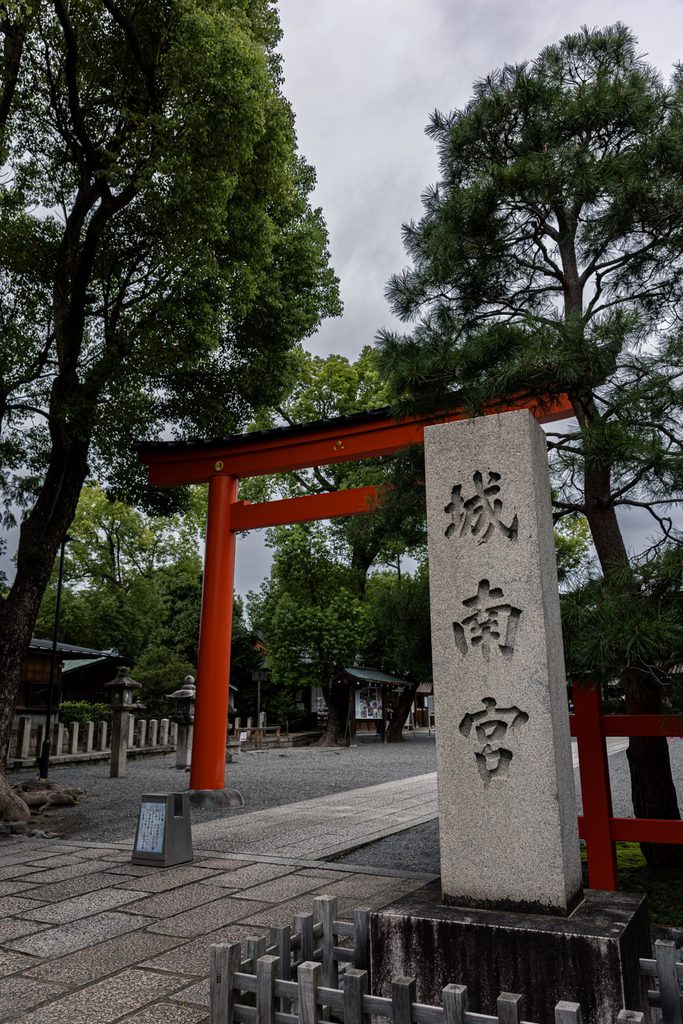
I heard it the moment I stepped through the torii. A norito prayer drifted over from the main hall, and threaded through it was the thin, high line of a kagura flute. It was a Saturday morning in September at Jonangu Shrine, in the south of Kyoto, and apart from the gravel under my shoes, those were the only two sounds in the place.
I’d been here six months earlier. I had no memory of that sound.
Maybe it was playing then, too. But on that day in March, Jonangu was far too crowded for a sound like that to get through.
Led by a Bamboo Pole
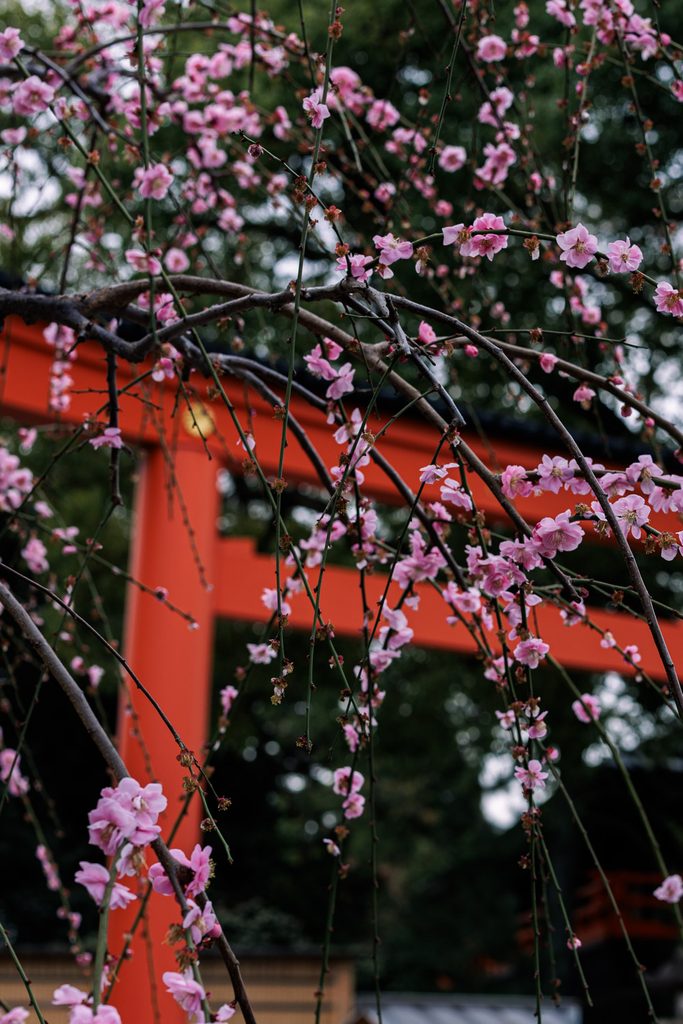
March is plum season. At Jonangu, the weeping plums and camellias bloom for a few weeks, and most of the shrine’s visitors come in that short window. It looked as though everyone too impatient to wait for the cherry blossoms had ended up here.
That year, days of rain had stripped most of the trees. Without the rain, my timing on March 6 would’ve been perfect. The crowds came anyway.
I arrived for the 9:00 opening. I wasn’t first in line, and yet I ended up at the very front.
Inside the garden, a staff member held a length of bamboo sideways and began to walk, very slowly. The bamboo was the rope line, and nobody was supposed to pass it. But camellias were blooming along the path, everyone stopped to look at them, and no one followed the bamboo. The staff member slowed down even more. Still no one. Nobody in that crowd was in any hurry, and I started to wonder what exactly the bamboo was holding back.
So the people behind me nudged me forward until I was walking right behind the pole. I didn’t earn the lead. I was drafted.
The Camellias That Fell Too Neatly
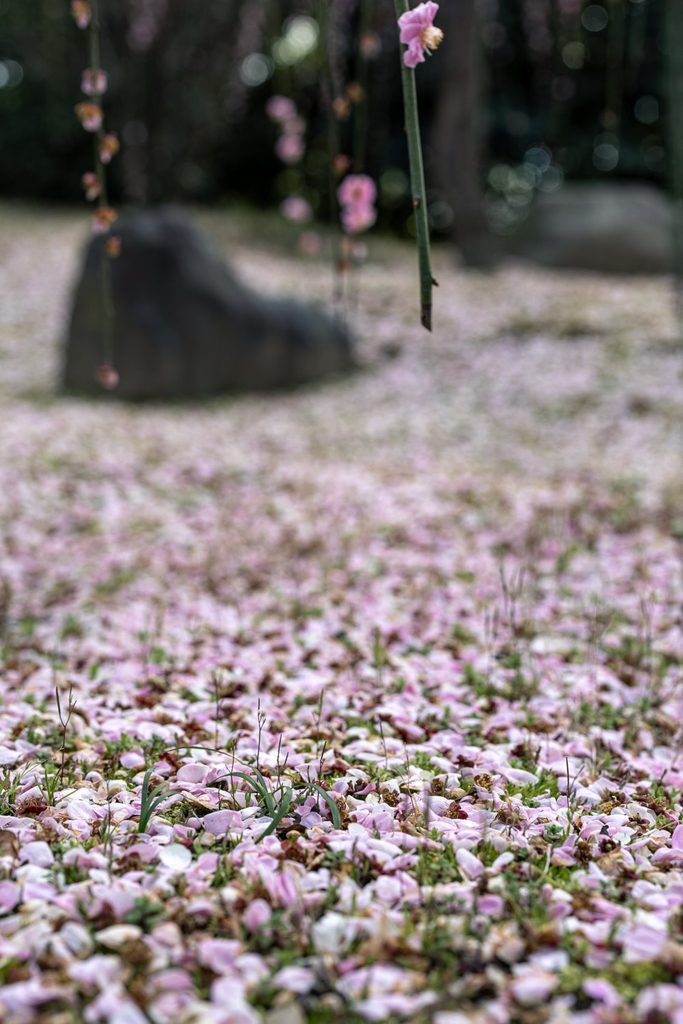
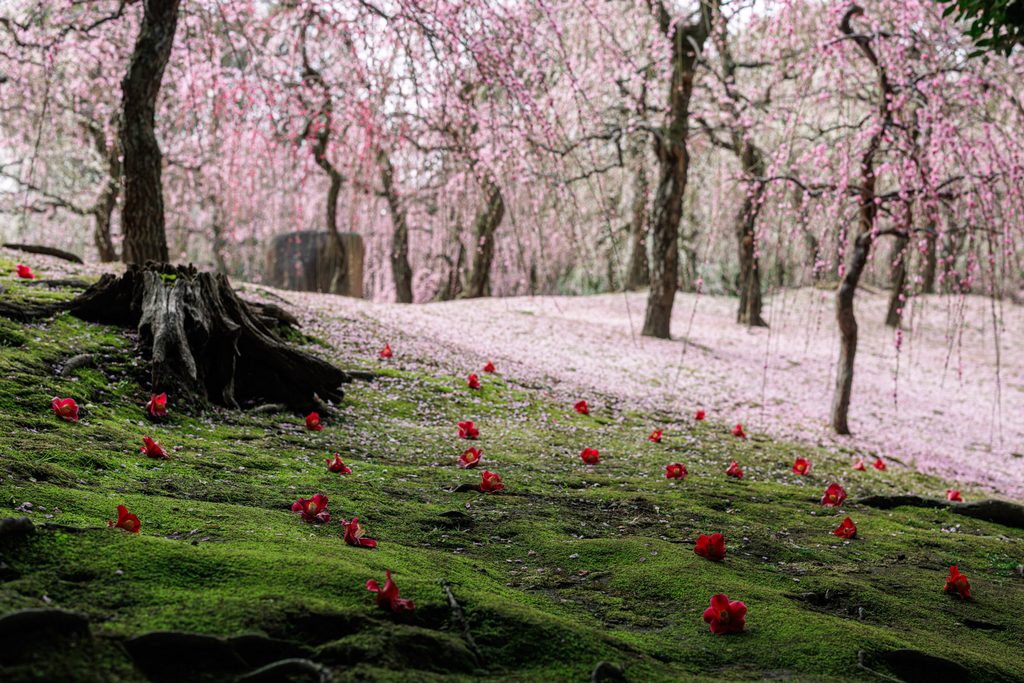
The plums had mostly fallen, but their petals hadn’t gone anywhere. They lay thick across the grass, and there was about as much pink in front of me as there would’ve been with the branches in full bloom.
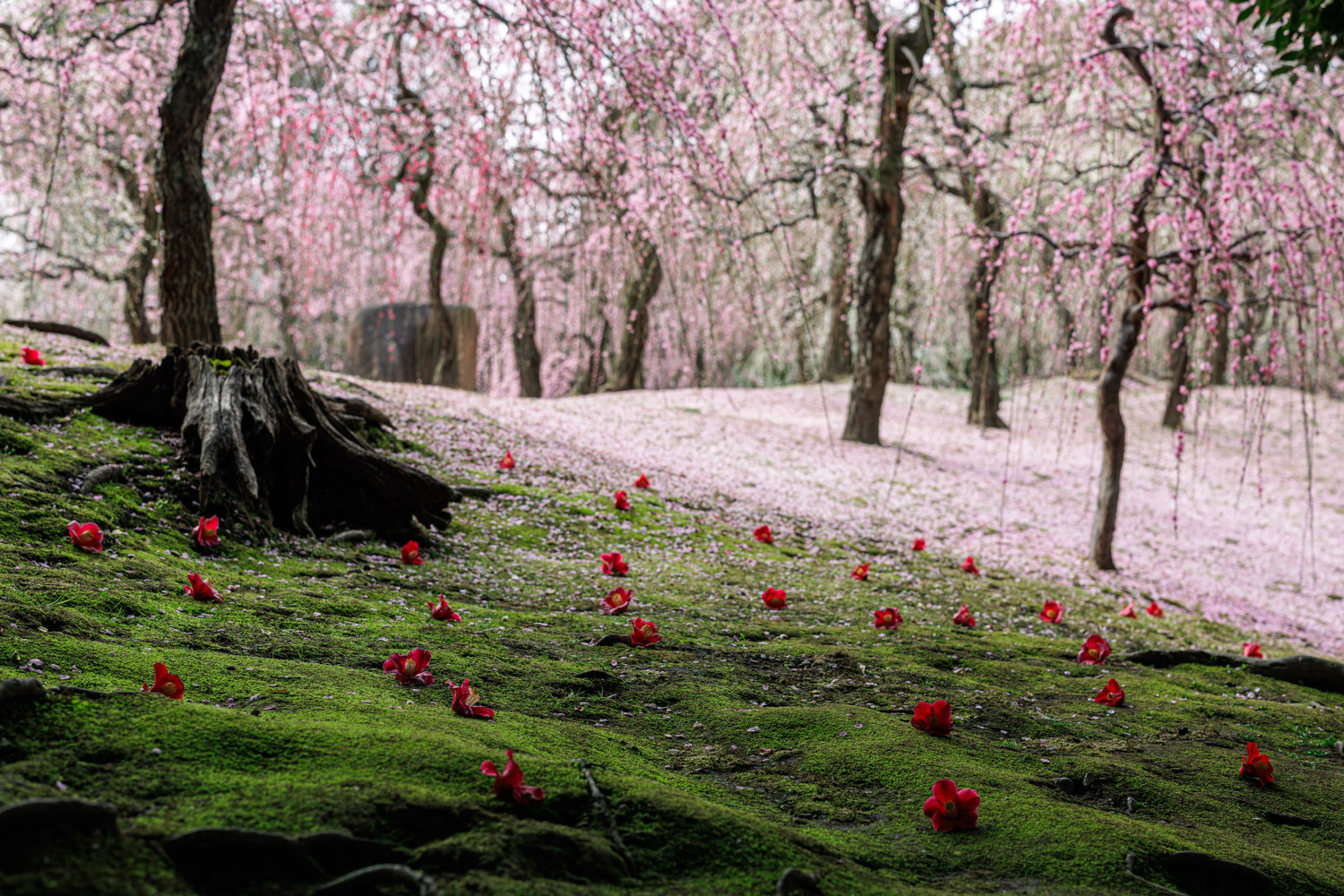
There’s a famous view here: red camellias scattered across green moss, with weeping plums behind them. If you wait a few minutes, anyone can get a clean shot of it.
Near that spot, an older man began to speak up. “It’s strange that the camellias have fallen this neatly,” he said. “It isn’t natural.”
Once he’d said it, they did look arranged for the camera. He kept going, and it seemed he might continue until someone agreed with him.
No one did. I suspect nobody wanted to picture a staff member setting camellias on the moss before the gates opened. Things got a little awkward, and I felt sorry for the family standing beside him.
I don’t know the truth. I’m happy not to.
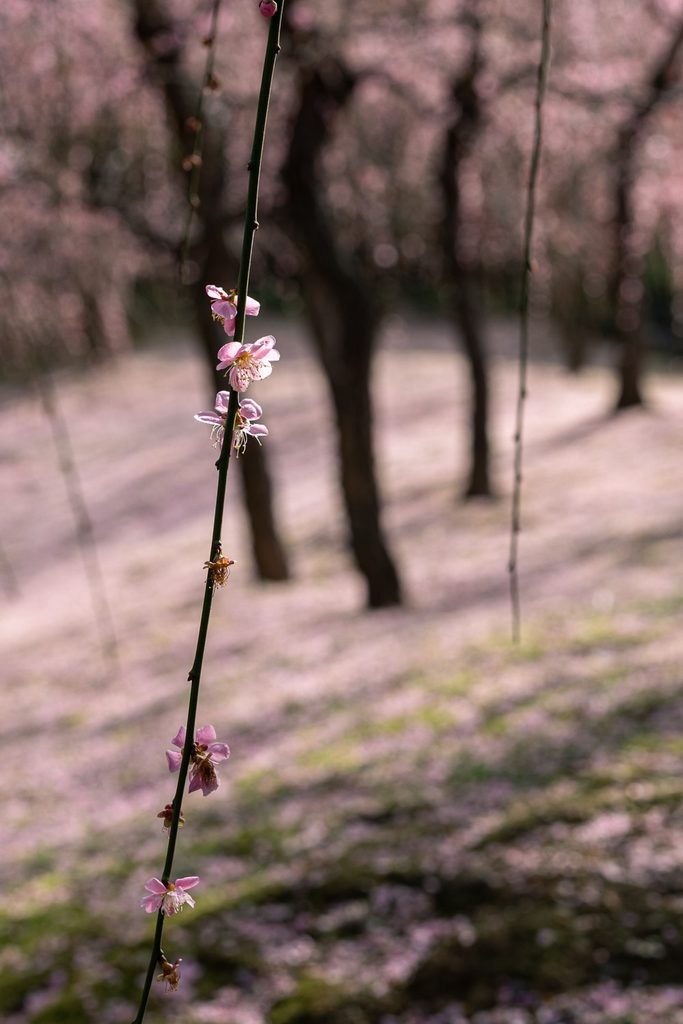
If you’re planning your trip around the blossoms, I’ve written a separate guide to Jonangu’s weeping plum and camellia festival.
Why I Came Back in September
A few things brought me back.
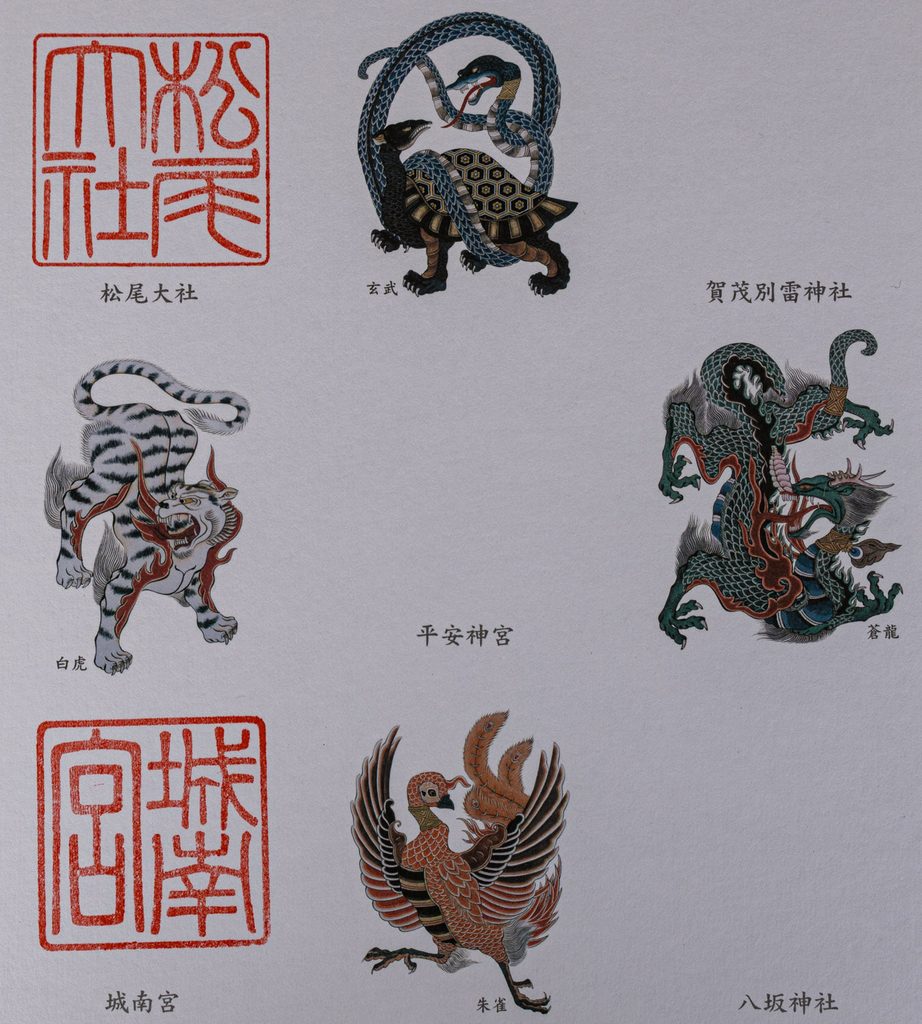
One was a sheet of paper. The Kyoto Gosha Meguri takes you to the five shrines that guard the old capital from its four directions and its center, and you collect a seal from each on a single shikishi board. My first stamp came from the white tiger of the west at Matsuo Taisha. Jonangu is the vermilion bird of the south.
I also wanted to see the dancing. Through the year, the shrine maidens here perform kagura holding the flower of the season: plum, then wisteria, then chrysanthemum. If I was coming back, I wanted it to be on a chrysanthemum day.
The last was plain worry. After the March crowds, I couldn’t shake the idea that most visitors come during those plum weeks, and that the rest of the year the shrine is much quieter. I’d come, in part, to check on a shrine’s feelings.
The Priest Who Answered Before I Asked
At 9:30, a priest’s voice began carrying across the grounds.
The kagura would begin at 10:00 on the stage south of the main hall, he said. Then he said it again, and kept saying it. I figured the repetition was for anyone at the far end of the grounds, so they’d still make it in time.
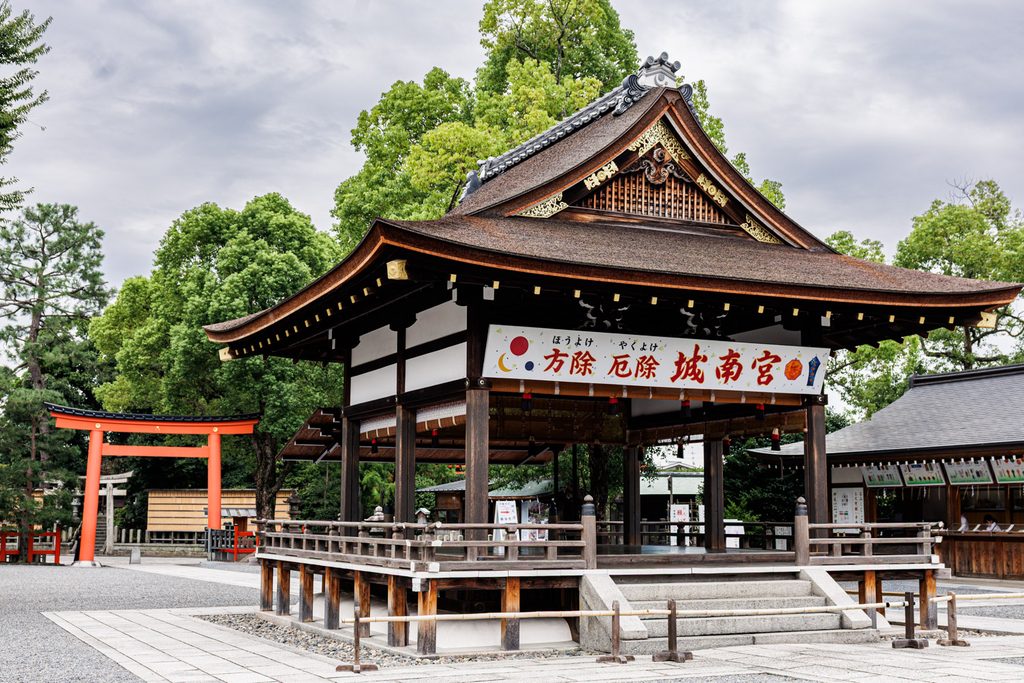
Once a crowd had gathered around the kagura hall, there were still a few minutes to go, so he started talking about the shrine’s history. The talk is in Japanese only, at least for now. There’d been one in March, too, and it was so good that I’d wanted to hear another. This was a different priest, and I was pulled in all over again. I have no idea how Jonangu trains its priests, but they know how to hold a crowd.
Before he began, he’d been standing right next to me. I had a question ready: what does “Jonan” actually mean? I was waiting for the right moment to ask it. The moment never came, because he answered it in his opening lines.
The Shrine South of the Capital
The jo in Jonangu, the priest explained, refers to Heian-kyo, the city founded in 794, so the name simply means south of the capital. Jonangu was built there that same year to guard the new capital and the nation. The shrine describes itself the same way on its official English page. Its three deities watch over the land, over valor and healing, and over safe childbirth, the last embodied by the legendary Empress Jingu.
People come here before they build or extend a house, before they move, and for safety on their commute, on the road, and on their travels. What they’re asking for is hoyoke, protection from misfortune tied to direction. According to the priest, that belief took shape here roughly 900 years ago.
Around the same time, this land became a center of power. Retired Emperor Shirakawa built a villa here covering some two square kilometers, Jonan Rikyu, and made it his political base during the era when retired emperors ruled from behind the throne. He was devoted to the Kumano Sanzan, three great shrines deep in the Kii Peninsula. Before each pilgrimage, he spent about a week in a purification lodge at the villa, purifying himself with water and praying for a safe road. Then he boarded a boat at the port of Toba and went down the Yodo River, at the start of a journey that took more than twenty days.
Later, the shrine held prayers for Emperor Komei in the first, fifth, and ninth months of the year, a custom that survives as Shogokumairi. That’s why Jonangu offers a special goshuin in September. And in January 1868, the Battle of Toba-Fushimi, the clash that decided the Meiji Restoration, opened with cannon fire from a Satsuma camp on the shrine’s approach.
Most of us in Japan don’t live by directional rules anymore. We know them well enough: don’t sleep with your head to the north, and watch out for the northeast, the demon gate. But hardly anyone picks an apartment by them. Jonangu is still at the post it was given twelve centuries ago anyway.
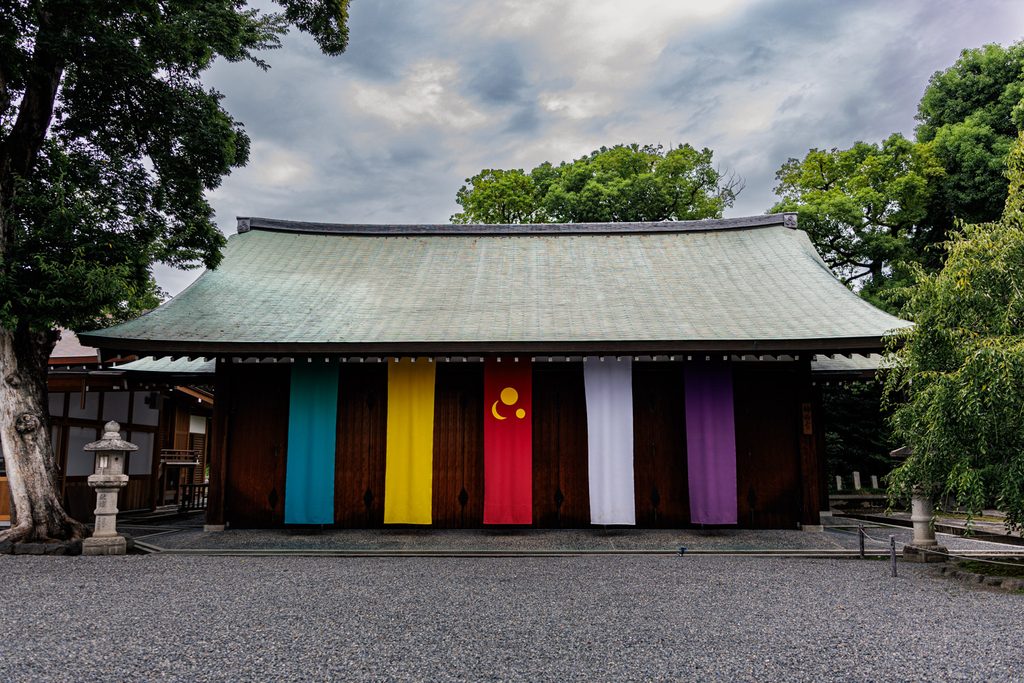
The crest on the red curtain combines the sun, the moon, and a star. It’s said to come from the banner on Empress Jingu’s ship, and it stands for a protection that never goes dark, day or night.
A Fan, Then Bells: The Chrysanthemum Miko Kagura
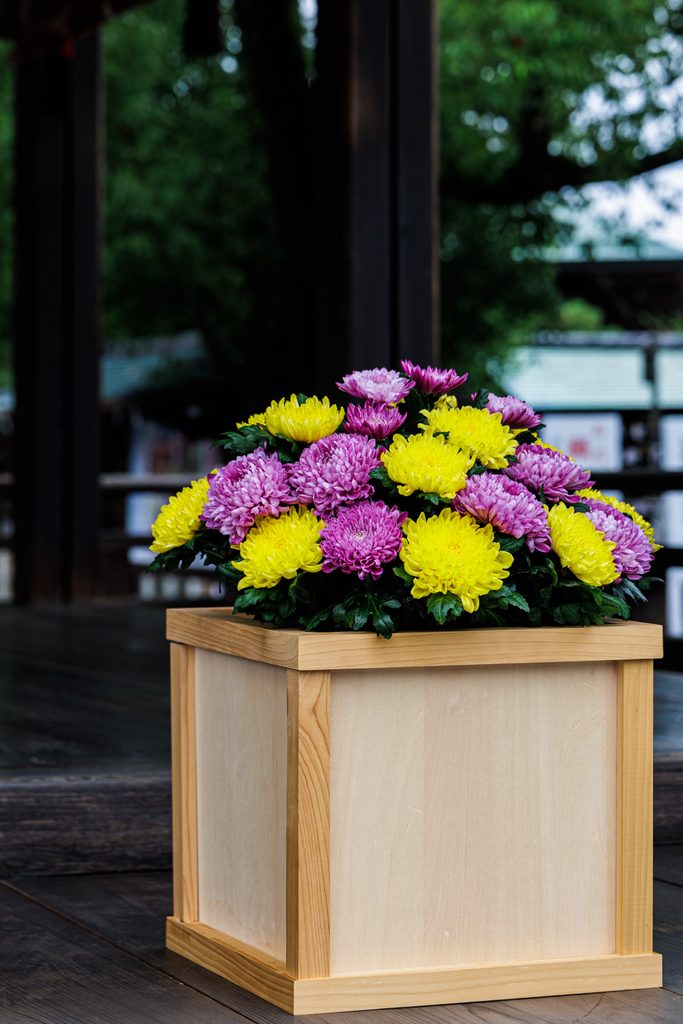
Fresh chrysanthemums, yellow and purple, were banked in a plain wooden box on the kagura stage, and their color was so vivid that I could almost smell them from where I stood. I couldn’t get any closer, so the only scent I have is the one my memory supplied.
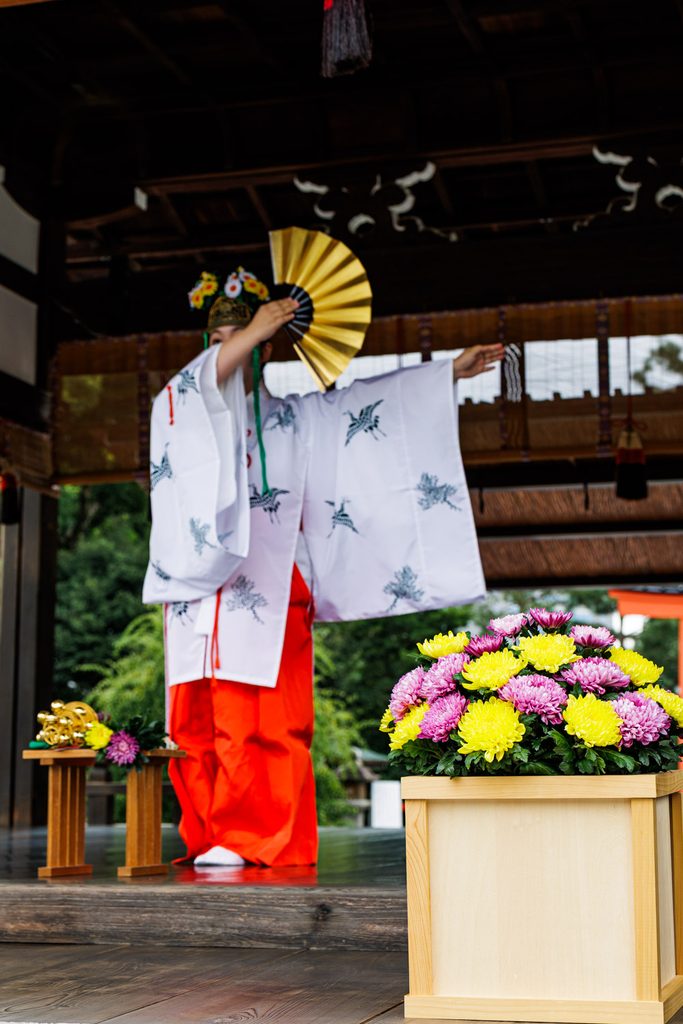
At 10:00, the dancing began. There are two dances, one with a fan and one with bells. The miko wears chrysanthemums in her crown and carries them in her hand, though at this time of year those are artificial. The fan widens toward its edge, a shape read in Japan as good fortune that keeps spreading.
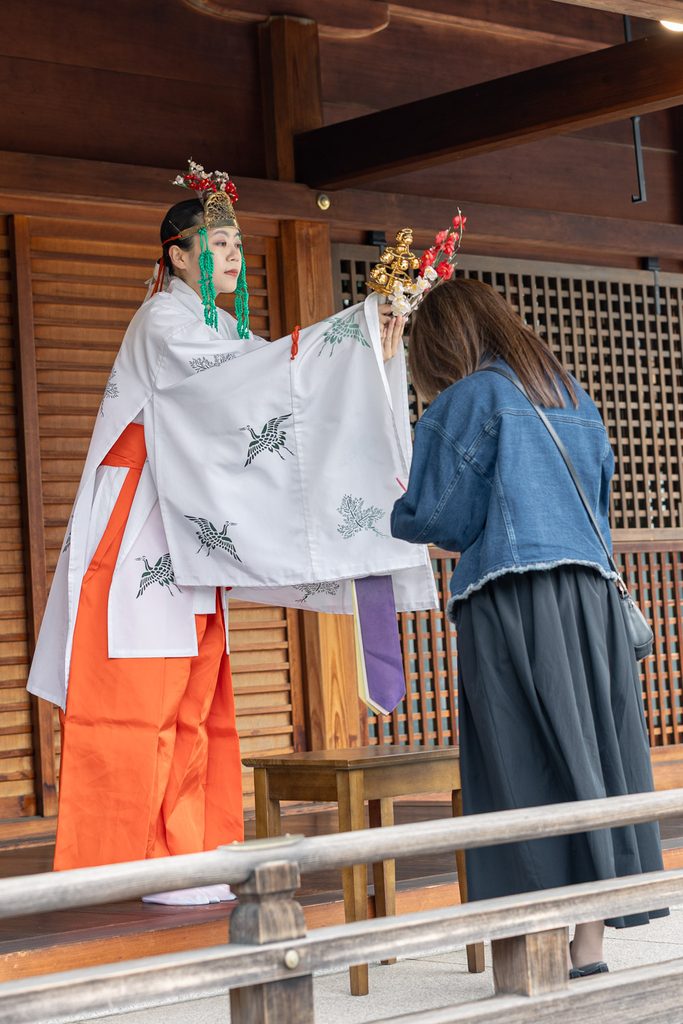
When the dancing ends, anyone who has received the chrysanthemum flower amulet steps forward, one at a time, and the miko purifies each person with a shake of the kagura bells. The wish is for good health and for staying young. The amulet has a chrysanthemum pattern, and the offering is 1,000 yen.
In March, a miko with plum blossoms in her crown had blessed visitors the same way. The bells must have been ringing then, too. They just never reached me.
The Neighbors Who Come for the Water
My worry, as it turned out, was misplaced. September was nothing like plum season, but there were more visitors than I’d expected, and not all of them had come for the kagura. At the purification basin, people from the neighborhood were filling containers with Kikusui Wakamizu, the shrine’s spring water.
According to shrine records, Retired Emperor Reigen drank this water in the early Edo period and found his pain relieved. People still do the ohyakudo here, walking back and forth a hundred times as they pray, and carry the water home afterward. There’s even a legend that the sacred water drawn for the Omizutori ceremony at Todaiji in Nara starts at the Onyu River in Wakasa, runs beneath this spring, and rises again at the Wakasai well of Nigatsu-do.
I tried a sip myself. The water was pleasantly cool and so soft on the tongue that I could have kept drinking it, and I understood why it’s counted among Fushimi’s famous waters.
Nothing here was arranged for the camera. Watching people fill their bottles, I understood that the shrine doesn’t exist only for a few weeks in March.
【画像挿入指示】ファイル名:chozuya-water-purification-jonangu-shrine.jpg/竹の筧から流れ落ちる菊水若水(手水舎)
Alt: Spring water running from bamboo spouts into the Kikusui Wakamizu purification basin at Jonangu Shrine
What I Heard
In March, I came to see Jonangu. In September, I heard it.
The priest calling everyone over. The norito. The flute. The miko’s bells. Water filling someone’s bottle at the basin. Every one of those sounds must have been there in March, too.
I didn’t go into the garden this time. I plan to come back when the maples turn, and I’m curious what I’ll hear then.
If you decide to go, here’s how to plan it.
Jonangu Shrine Visitor Guide
Jonangu Shrine (sometimes written Jonan-gu) stands in Fushimi, in the south of Kyoto. Entry to the shrine grounds is free. It’s known as Kyoto’s shrine for directional protection, it’s the southern stop on the Kyoto Gosha Meguri, and its garden, Rakusuien, is planted with around 80 kinds of plants that appear in The Tale of Genji.
Miko Kagura Schedule by Season (2026)
| Kagura | Dates | Times | Optional offering |
|---|---|---|---|
| Yutate Kagura | January 20 | 3:00 p.m. | Fukuzasa (bamboo branch hung with good-luck charms), 1,000 yen |
| Plum kagura | February 18 to March 22 | 10:00 a.m. and 3:00 p.m. | Plum flower amulet, 1,000 yen |
| Wisteria kagura | May 1–6, 9, 10, 16, 17, 23, 24, 30, 31 | 10:00 a.m. and 3:00 p.m. | Wisteria flower amulet, 1,000 yen |
| Nagoshi kagura | June 25 to July 7 | 10:00 a.m., noon, and 2:00 p.m. | Nagoshi amulet, 1,000 yen |
| Osuzumi kagura | July 20 | Every 15 minutes, 6:00 to 8:00 p.m. | Fukuzasa, 1,000 yen |
| Chrysanthemum kagura | September 1, 5, 6, 9, 12, 13, 19–23, 26, 27 | 10:00 a.m. and 3:00 p.m. | Chrysanthemum flower amulet, 1,000 yen |
Watching is free. At the Yutate Kagura, shrine maidens scatter hot water from a great cauldron with bamboo leaves to drive off bad luck. Dates change every year, so check the shrine’s schedule before you go.
Timing Your Visit
For the 10:00 kagura, aim to arrive by 9:45. On both of my visits, a priest gave a talk before the 10:00 performance, starting once people had gathered at the kagura hall, and it’s worth catching even if you don’t follow the Japanese. If you only want to pray and watch the kagura, about 30 minutes is enough. Add the garden, and plan on a little over an hour.
Rakusuien Garden: Hours and Admission
The garden is open from 9:00 a.m. to 4:30 p.m., with last entry at 4:00 p.m. Admission and the open areas change with the season.
| Period | Adults | Elementary school students | Open areas |
|---|---|---|---|
| February 18 to March 22 (plum and camellia festival) | 1,000 yen | 600 yen | North garden only |
| July 1 to August 31 | 300 yen | 300 yen | North garden only |
| All other dates | 800 yen | 500 yen | Entire garden |
The whole garden reopens on September 1, so autumn visitors can see all of it when the maples turn.
On April 29 at 3:00 p.m., the garden hosts Kyokusui-no-Utage, a recreation of a Heian court poetry gathering. There’s no autumn session. Viewing requires an advance application by return postcard.
Goshuin at Jonangu
These were the goshuin offered when I visited in September 2026.
| Goshuin | How it is given | Offering |
|---|---|---|
| September Shogokumairi goshuin | Written in your goshuin book, or on a pre-made sheet | 500 yen |
| Jonangu main hall | Pre-made sheet only | 500 yen |
| Mahataki Shrine (within the grounds) | Pre-made sheet only | 500 yen |
| Kyokusui-no-Utage paper-cut goshuin | Pre-made sheet only | 1,000 yen |
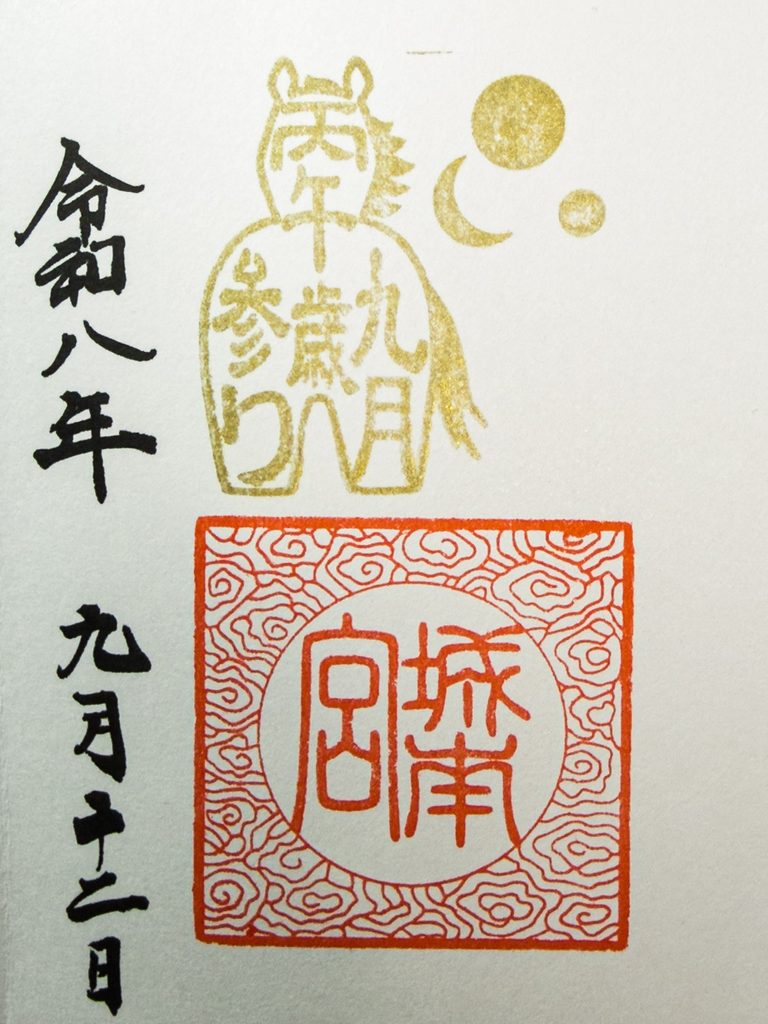
If you bring your own goshuin book in September, the Shogokumairi seal is the only one written directly into it. Its design pairs a golden horse with the sun, moon, and star, since 2026 is a Year of the Horse.
The Mahataki Shrine seal was revived in 2016 to mark 1,200 years since the shrine’s official recognition. The lineup changes through the year, and from October 1 to December 31 the regular Jonangu and Mahataki seals are offered instead. For the current list, see the shrine’s goshuin page (Japanese).
Kyoto Gosha Meguri
The five shrines are Kamigamo Shrine in the north, Yasaka Shrine in the east, Jonangu in the south, Matsuo Taisha in the west, and Heian Jingu at the center. At Matsuo Taisha, where I bought my board, it cost 1,000 yen with that shrine’s seal already stamped. You can read how that first stop went in my Matsuo Taisha guide.
Getting to Jonangu Shrine
The address is 7 Nakajima Tobarikyu-cho, Fushimi-ku, Kyoto. The nearest station is Takeda, on both the Karasuma subway line and the Kintetsu Kyoto Line.
- By taxi from Kyoto Station: about 17 minutes and roughly 2,200 yen for the 5.8 km ride, based on NAVITIME’s fare estimate when I checked. This is the easiest way to arrive in time for the morning kagura.
- By taxi from Takeda Station: the taxi stand is on the north side (Exit 4). The ride takes about 4 minutes.
- On foot from Takeda Station: about 15 minutes from the south side (Exit 6).
- By city bus from Takeda Station: from Exit 4 to the Jonangu Higashiguchi stop, then a 3-minute walk. Buses run about three times an hour.
- From Kyoto Station by Rakunan Express: from stop E1 at the Hachijo exit, about 15 minutes to the Jonangu-mae stop, then a 1-minute walk. Weekdays only; it doesn’t run on weekends or holidays.
- From Kyoto Station by city bus 19: from stop H7 at the Hachijo exit, about 22 minutes to the Jonangu stop, then a 2-minute walk. It runs only once an hour, so check the timetable.