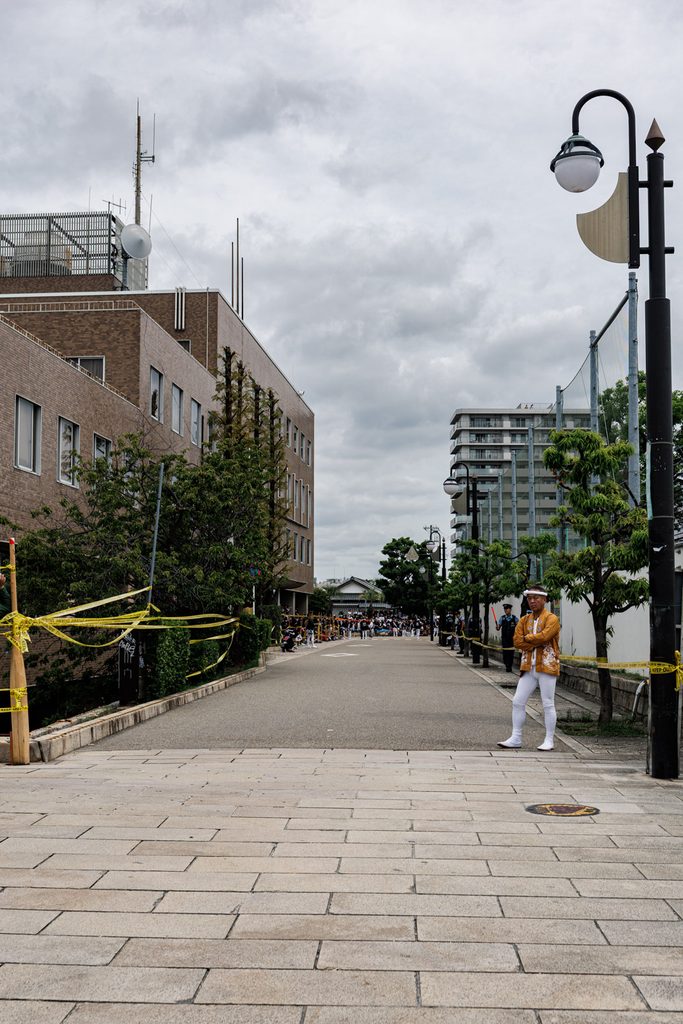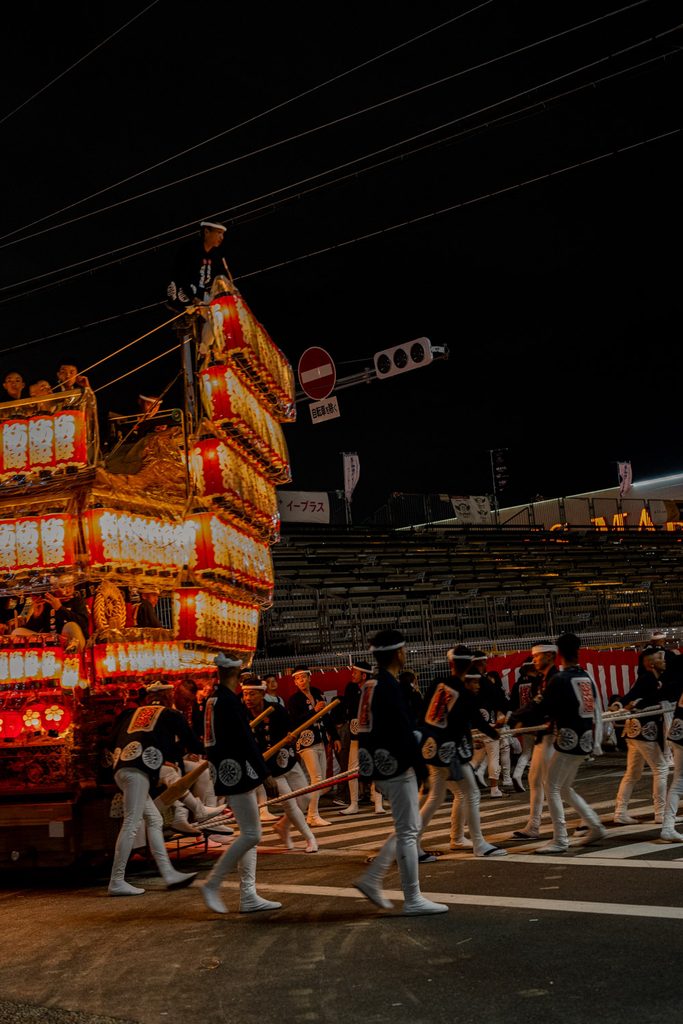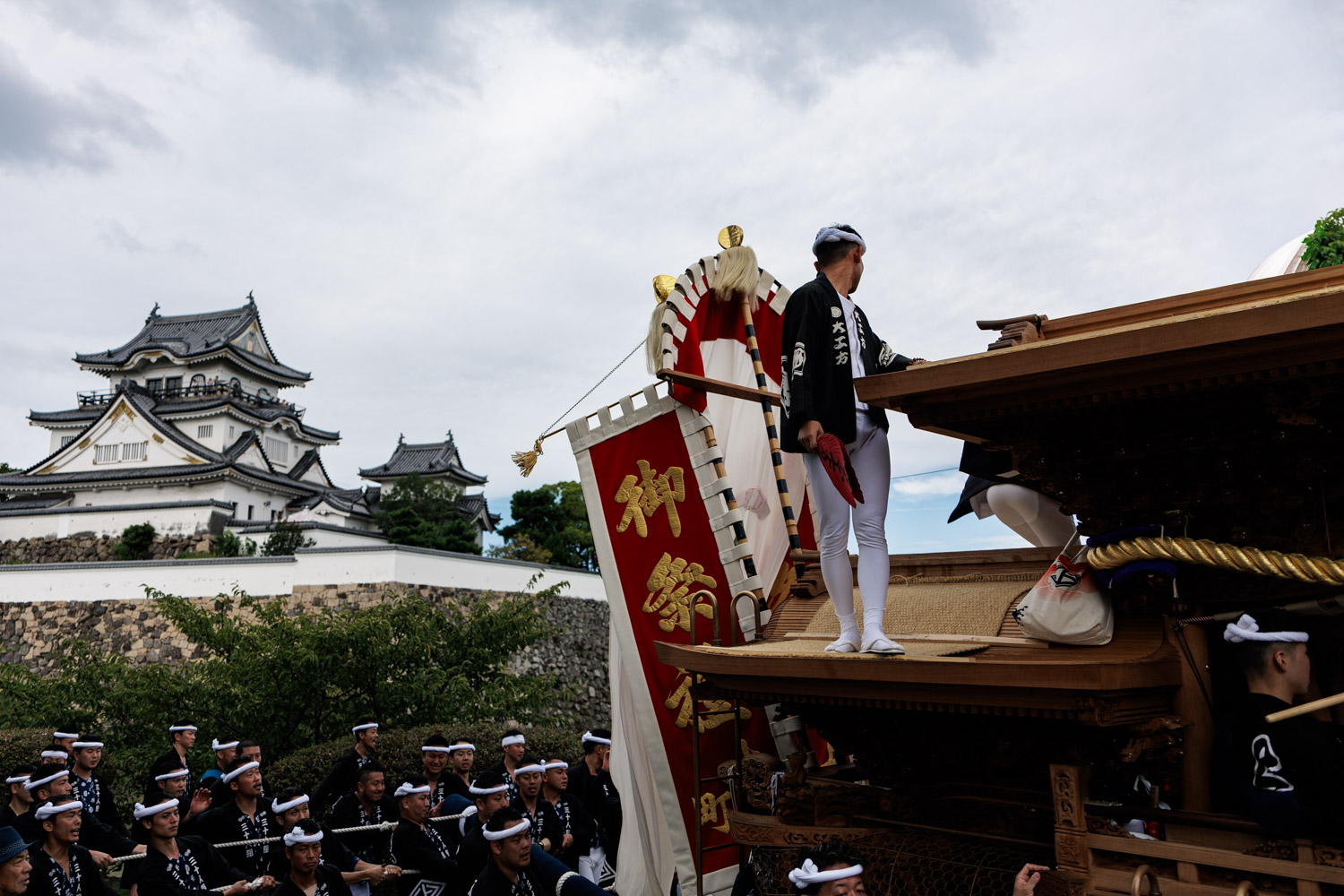
I got off the train at Kishiwada Station a little after 7 p.m. By then, the Kishiwada Danjiri Matsuri had been running for thirteen hours. The floats had rolled out at 6 that morning, and I assumed whatever fire the day started with had burned down long ago. I wasn’t there to chase it. I only wanted to see the danjiri with their lanterns lit.
A danjiri is a carved wooden float, pulled through the streets on long ropes by the people of its neighborhood. Kishiwada, on Osaka Bay south of the city center, has been pulling them for about 300 years, and the Kishiwada Danjiri Festival is the one that has become famous across Japan.
Haircuts for the Occasion
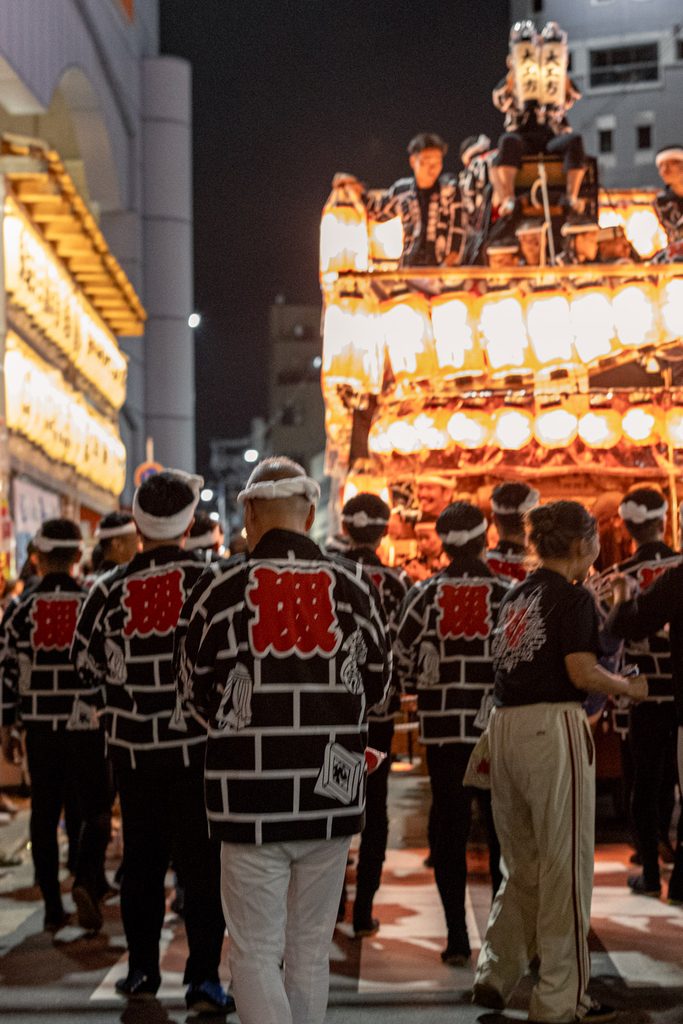
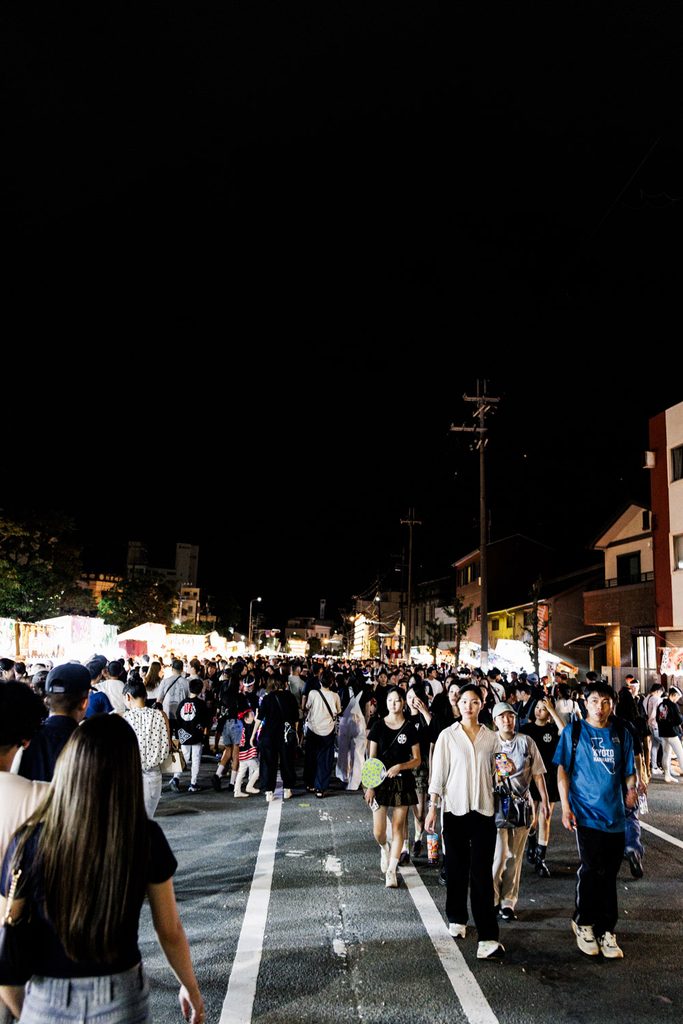
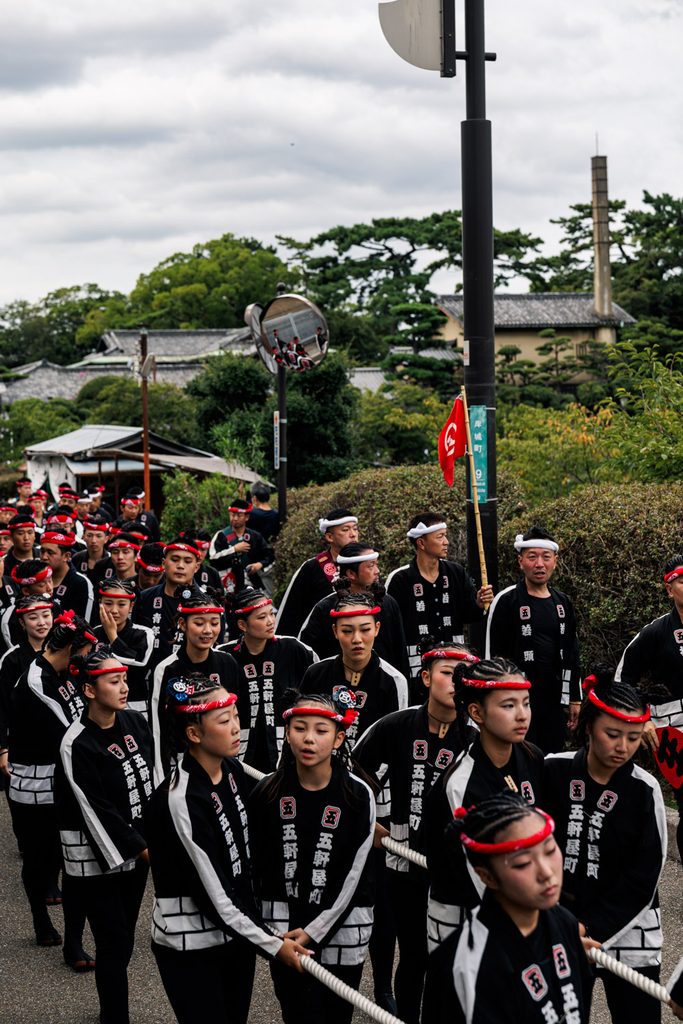
The station was already full. Mixed in with the crowd were people who had come to pull, not to watch. The young men who work the ropes had twisted hachimaki headbands tied around their foreheads, and their hair had clearly been cut for this weekend, shaved tight at the sides. Outside, I saw more of the same: fresh fades, beards trimmed with care. Girls who looked fifteen or sixteen wore their hair in tight, elaborate braids. Nobody here had just rolled out of bed.
Their happi coats told me which neighborhood each group belonged to. Every neighborhood has its own design and its own characters printed across the back, so you can tell at a glance which danjiri a group is pulling.
Every year on this weekend, Kishiwada makes the news across the Kansai region and the rest of Japan. The danjiri have started, the evening broadcasts report.
The danjiri are one of the things that stuck with me after I moved to Osaka. People in Osaka love to tease Kishiwada about them. Kids there skip school during the festival, they say. If a danjiri crashes into your house, that’s good luck, when anywhere else in Japan it would simply be a disaster. There’s even a running joke that wanted fugitives sneak home just for this weekend. How much of it is true, I have no idea.
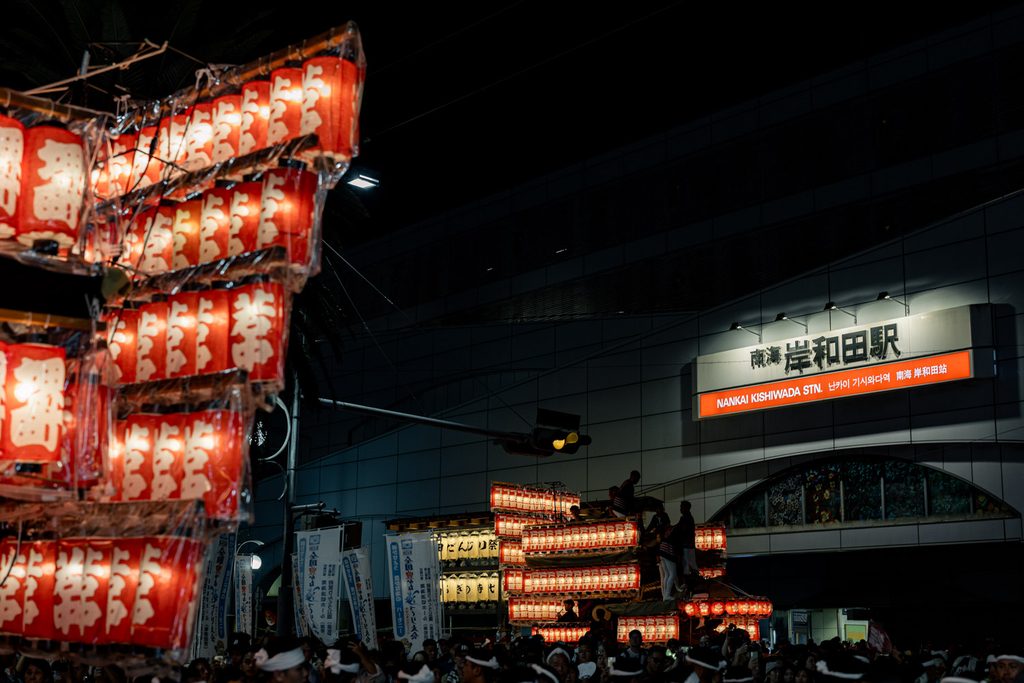
A Cool Wind and a Lot of Noise
Near the station, I found a spot along the roadside railing without having to fight anyone for it. The heat of the festival reached me there, but so did a cool wind, and the crowd around me greeted it with something close to a cheer. Suzushii, someone said. Cool. Was it the sea, not far off, or was this simply what September evenings feel like here?
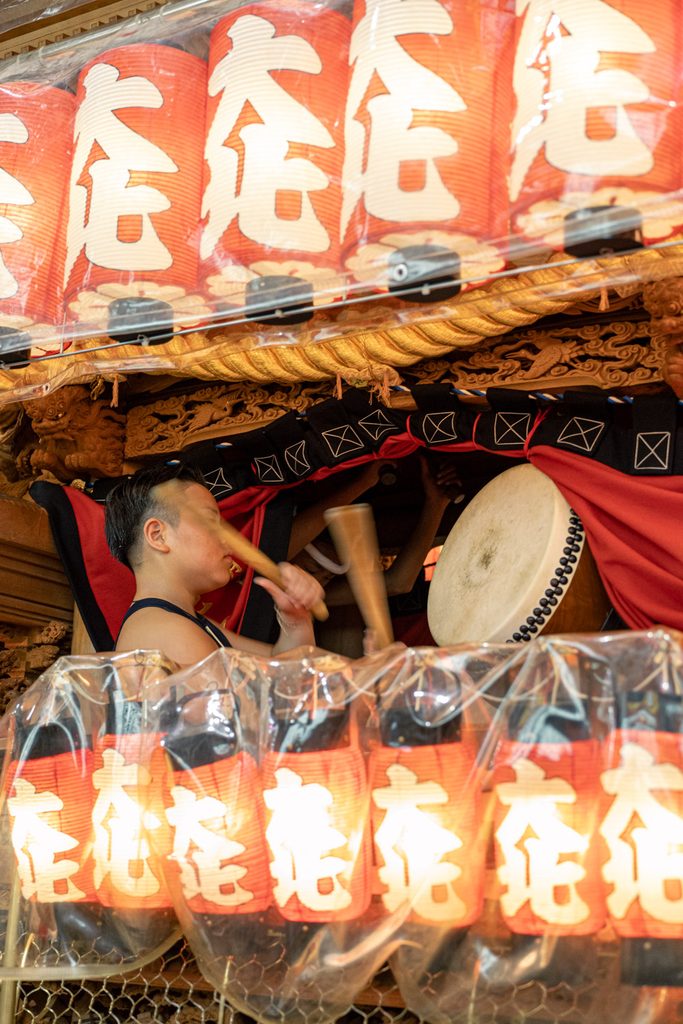
The danjiri cover a lot of ground. There are road closures, but visitors can walk around more freely than you’d expect. You usually hear a float before you see it. The sound of the narimono, the drum and bell players riding inside, reaches you first, hard and fast, and then the lanterns appear.
My worry had been for nothing. The drums had been going since dawn and showed no sign of stopping.
Everyone had a way of cooling down. Kids walked behind the floats eating ice cream. For the adults, the ice cream turned into beer or sake. Along the route, car repair shops and small ironworks had set out tables and chairs in their ground-floor work bays and become pop-up bars for the night. I couldn’t help laughing.
Night at Kankan-ba
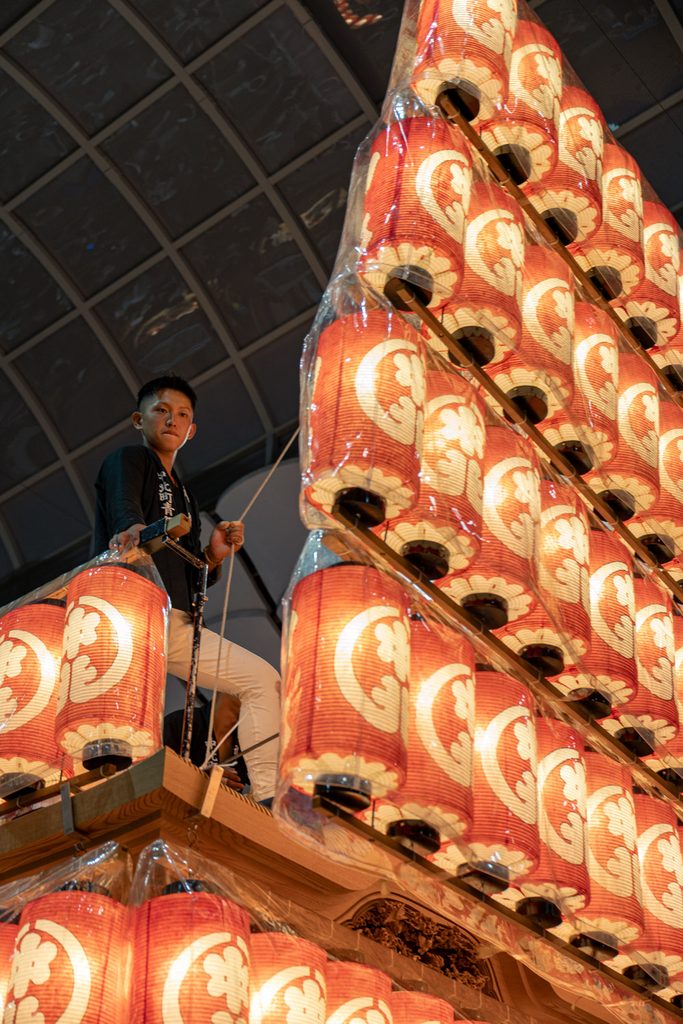
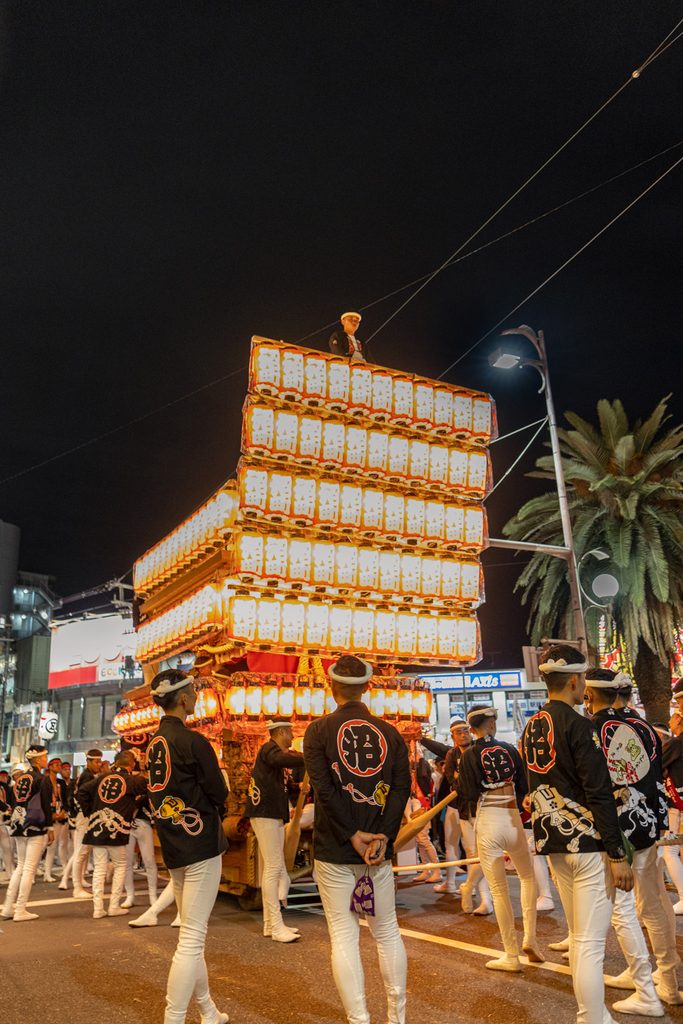
Later that night, I walked to Kankan-ba, the intersection best known for the festival’s high-speed turns. At night, there was none of that. The floats moved at an easier pace, their lanterns stacked high, as if the whole town were holding something back for Sunday.
A Kilometer of Food Stalls and No Plan
To get out of the closed-off area, I followed a group of local high schoolers who clearly knew the shortcut. They were headed for the stalls. From the south side of Kishiwada Station toward the sea, the street is lined with food stalls for more than a kilometer. I can’t think of many places in Japan where you’ll see this many in one line.
The people who had been pulling the floats were here too, refueling for tomorrow. I had no float to pull. Still, I had a morning of shooting ahead, so I took my snack selection seriously.
I wanted something cold. Then the sweet smell of baby castella, bite-size sponge cakes baked in rows, pulled me one way. The smell of yakisoba sauce on a hot griddle pulled me the other. Somewhere between the two, I lost track of what I actually wanted to eat.
Sunday, 9 a.m.: A Good Call and a Bad One
I came back at nine. That turned out to be both the right time and the wrong one.
Konakara-zaka, the slope that is one of the morning’s main sights, had no room left at all. With twenty-two danjiri in the Kishiwada district, I figured the crowd would thin out between them. It did not. I tried the slope three times, at different points in the morning, and each time the wall of people, three and four deep, stayed exactly where it was. My careful snack budget from the night before had been an investment in nothing.
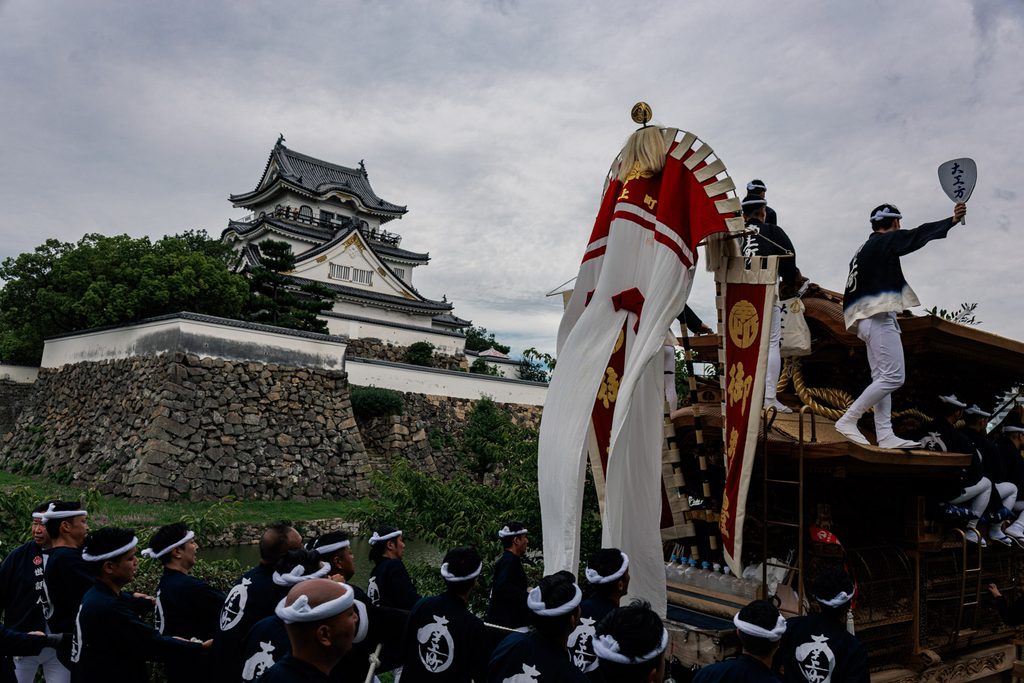
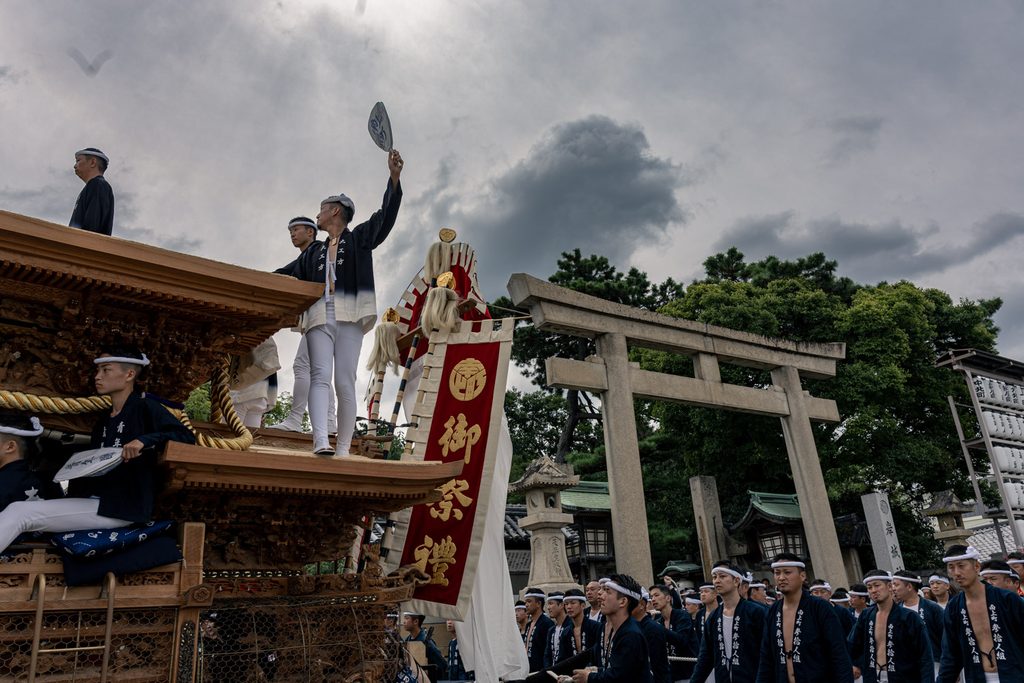
Kishiwada Castle was another story. At nine, I could move freely around the grounds, even walking against the flow of the floats. Later in the day, entry to the area is restricted and that freedom disappears. I watched the miyairi, the moment each danjiri arrives at Kishiki Shrine, from surprisingly close. For an event this size, the usual festival shoving never really came.
Shrine visits have been part of the festival from the start. In 1703, Okabe Nagayasu, the lord of Kishiwada Castle, brought the deity of Fushimi Inari Shrine in Kyoto into the castle grounds and held a festival to pray for a rich harvest of the five grains. In those early years, the townspeople performed niwaka, improvised comic skits, and kyogen plays, then went to pay their respects at the shrines, Kishiki Shrine among them. Harvests matter less to Kishiwada now. What the festival does for its neighborhoods, binding them together once a year, has carried on.
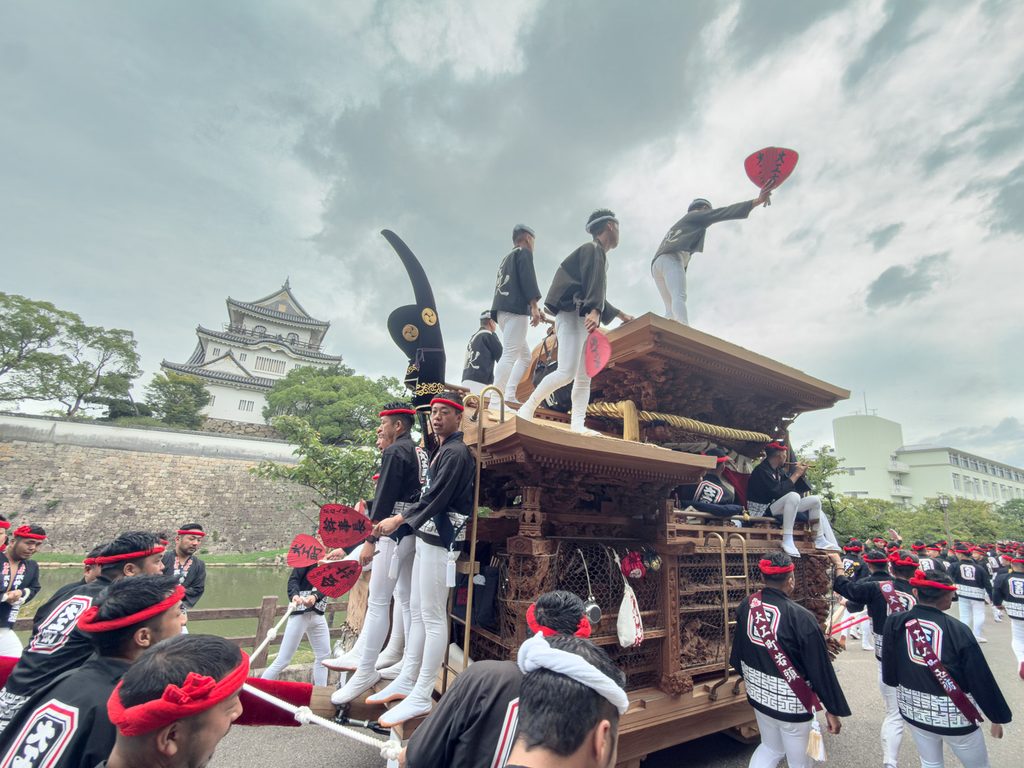
Above the ropes, on the roof of each danjiri, stands the daikugata, the float’s star role. He dances and jumps across the roof and uses a fan to signal which way the float should go.
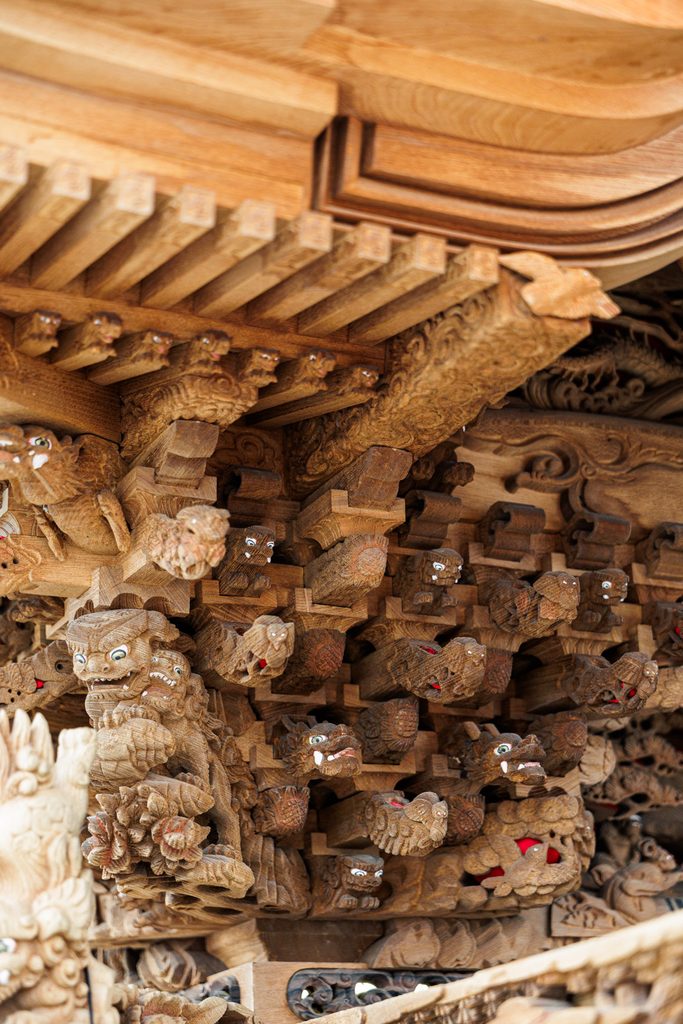
The carvings sat behind protective wire mesh, but I could get a little closer than usual. On a float that weighs around four tons, the delicacy of the work surprised me: layer on layer of lions, dragons, and curling clouds, the kind of detail that disappears once a danjiri is moving.
One more thing caught my eye. The official notices ask visitors not to bring strollers, yet families connected to the floats were pushing strollers right behind their danjiri. Ladders and step stools are banned outright, and plenty of people were standing on them anyway. I suspect the strollers count as festival staff. The ladders, I couldn’t explain. As a visitor, I’d stick to the rules.
The Slope, at Last
Up to that point, I hadn’t seen much of what the festival is famous for: a danjiri running flat out. Not having a paid seat was part of it. So I took the long way around and approached Konakara-zaka from the City Hall side, and this time I got close.
The moment the signal on the main road turned red, pullers poured into the street by the dozens. The bells rang out. For the locals, it may be a familiar sight, but the tourists around me held their breath, afraid to miss it. Then came the waiting. It went on long enough to feel like part of the ritual, the way a sprinter shakes out his legs before the gun. I never saw who was working the lights. At Japanese festivals, it’s often the police.
Then, with a shout, the danjiri came charging in. As it tore up the slope, a huge cheer went up. Behind it, people from the neighborhood ran up at full speed too, young and old, men and women. You don’t have to be pulling a rope for this to be brutal.
I caught one of the runs on video.
There wasn’t much room, so after three danjiri I gave my spot to other tourists. For the record, the three rows of people in front of me never offered me theirs. What surprised me most was that a spot like this cost nothing at all.
I had never seen the danjiri this close before. After that slope, it was easy to understand how some people here think about danjiri all year long.
On paper, I had shown up thirteen hours late. Paid seats aside, I think I caught a fair share of what matters. I even managed to convince myself it had been the best possible timing.
Kishiwada Danjiri Matsuri: Practical Information
Kishiwada Danjiri Matsuri 2027 Dates and Run Times
The festival is held on the weekend before Respect for the Aged Day, the third Monday of September. Saturday is the yoimiya, the first day, and Sunday is the honmiya, the main festival day. Following that pattern, the 2027 festival is expected on Saturday, September 18, and Sunday, September 19. The official dates have not been announced yet.
These were the run times in 2026, from the official city map. The 2027 times may differ.
| Day | Time | What’s happening |
|---|---|---|
| Saturday (yoimiya) | 6:00–7:30 a.m. | Hikidashi (the floats roll out) |
| 9:30–11:30 a.m. | Morning run | |
| 1:00–5:00 p.m. | Parade and afternoon run | |
| 7:00–10:00 p.m. | Lantern-lit evening run | |
| Sunday (honmiya) | 9:00 a.m.–12:30 p.m. | Miyairi (shrine arrivals) |
| 1:00–5:00 p.m. | Afternoon run | |
| 7:00–10:00 p.m. | Lantern-lit evening run |
Twenty-two danjiri take part in the Kishiwada district. On Saturday at 1 p.m., they parade past Kishiwada Station one by one, a new float every five minutes. On Sunday, the arrivals at Kishiki Shrine are the ones that climb Konakara-zaka. In 2026, the first danjiri set off from the foot of the slope at 9:30 a.m. and the last at about 11:20. For the latest schedule, check Kishiwada City’s official danjiri page. It’s in Japanese, but your browser’s translate function handles it well.
Yarimawashi: The Signature Turn
Yarimawashi is the festival’s signature turn. A running danjiri swings through a right-angle turn at an intersection while keeping its momentum. The best-known place to see it is Kankan-ba, on both days. Go during the daytime runs. In the evening, the floats move at a much easier pace.
Where to Watch
- Both days: Kankan-ba, for yarimawashi.
- Sunday: The area around Kishiwada Castle and Kishiki Shrine, during the miyairi.
- Konakara-zaka: Watching here is free. At 9 a.m., half an hour before the first danjiri, the crowd was already three and four deep. Arrive well before that, or approach from the City Hall side, which is how I finally got close.
While the floats are running, it’s hard to move around Kankan-ba and around Kishiwada City Hall. Plan your route so you aren’t trying to cross either area at the wrong moment.