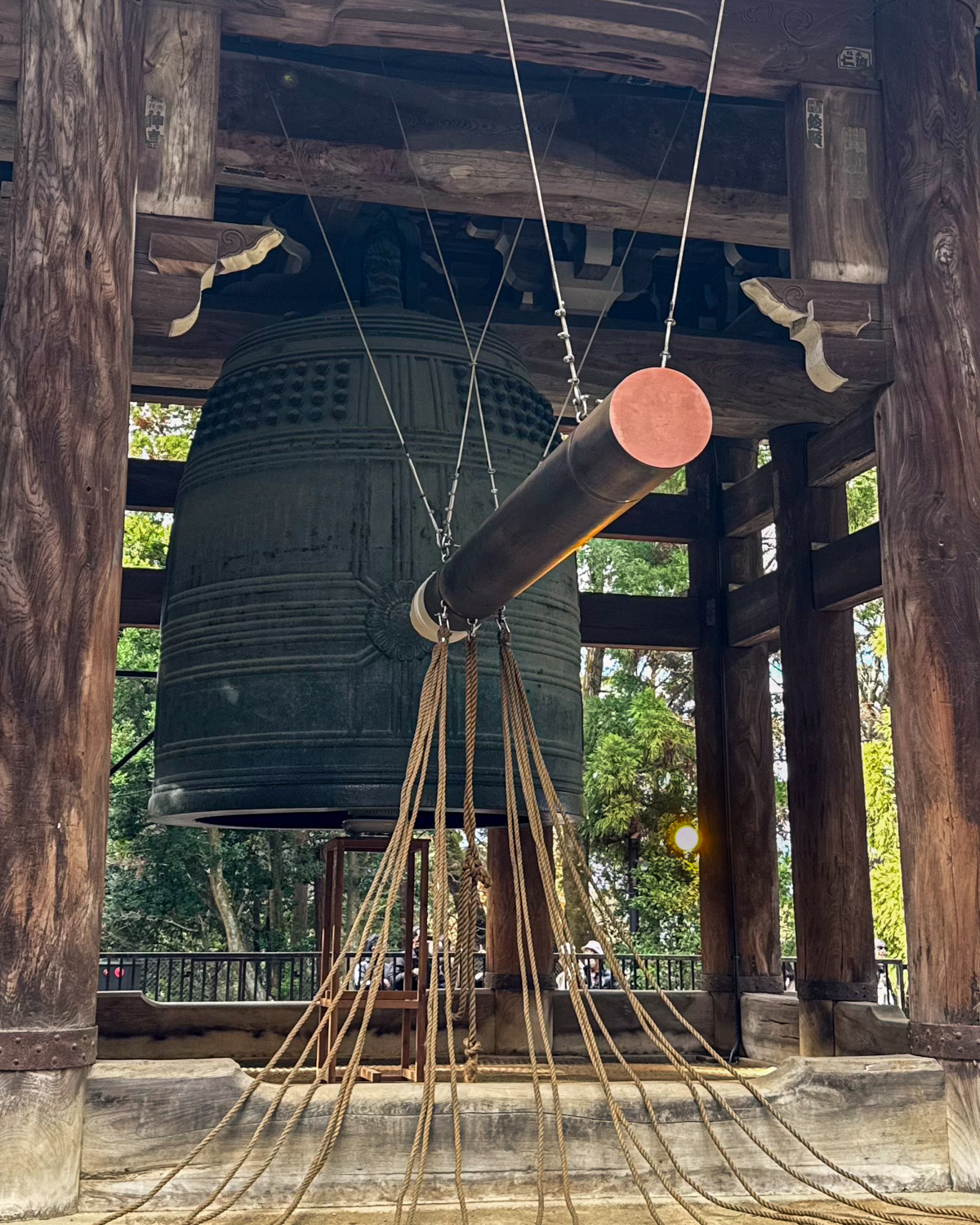
On the last night of the year, Japan rings out the old year. Temples across the country strike their bells 108 times as one year turns into the next, a ritual called Joya no Kane. In Kyoto, no bell draws a crowd like the one at Chion-in, where it takes seventeen monks to ring it.
This is the story of the rehearsal. Every December 27, a few days before the real thing, the monks of Chion-in gather at the great bell and practice. Nobody needs a ticket. Last December, I went, and I brought a chair.
The Bell That Made the News in October
New Year’s Eve usually arrives in Japan in late December, the way it does everywhere else. In 2025, it arrived in October.
That fall, Chion-in announced that watching its Joya no Kane would now require advance registration and a fee of 3,000 yen per person, with numbers capped to control the crowds. It made the national news. For a ritual most Japanese people associate with staying up late, this was a headline.
My first reaction was not very Buddhist. A fee, fine. The New Year’s Eve crowds had become a real problem. But 3,000 yen felt steep for watching someone else ring a bell.
In my defense, I had the theology wrong anyway. For most of my life I assumed the 108 strikes stood for 108 desires, and I privately thought the number was generous. Ten, maybe twenty, on a bad day. I could not imagine finding 108.
Bonno, it turns out, are not just desires. The word means whatever troubles and torments the mind, the afflictions underneath the wanting. Buddhism does not expect you to erase them. They run too deep in us for that. There is even a phrase, bonno soku bodai, which holds that the afflictions themselves can become the path to awakening. A full Buddhist rosary has 108 beads for the same reason. As for why the number is 108, there are several explanations, none of them short. Suddenly 108 did not sound generous at all. My reaction to the fee was probably one of them.
Bonno or not, I made a different plan. On December 27, 2025, I would go to the rehearsal.
Three Hours Early, and Not the Most Prepared
The trial ringing was set for 2:00 p.m. I reached the temple grounds at 10:30 a.m. and stood in front of the great bell a little after eleven.
I had wondered on the way whether this was excessive. Three hours in the cold, for a practice session. Then I arrived and found people already scattered around the belfry, waiting. Only a handful, but enough to show that I was on time rather than early.
I had dressed for a long winter wait, in layers, and I carried a folding chair. I was quietly proud of the chair. Surely, I thought, no one else had planned this carefully. Then I looked around. Folding chairs. Thermal layers. Thermoses. I was not the most prepared person there. I was simply one more member of the same species.
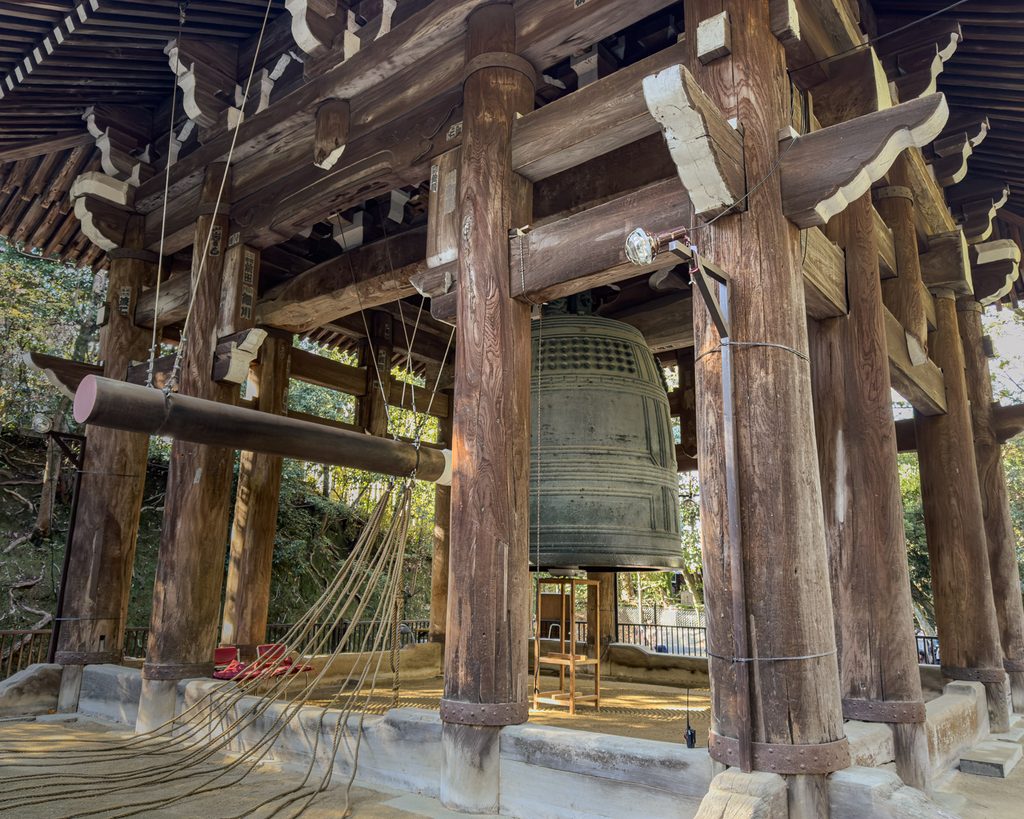
The preparations had already begun. Heaters had been set up around the bell itself, warming the bronze, behind a fence that kept visitors at a distance. Whatever warmth they gave, the bell kept to itself. Chion-in sits on the slope of a hill, and it may run a little colder than the rest of the city. My spot was also in the shade, where the December sun never quite reached.
So I sat, and I looked at the bell. There was a lot of time for looking.
The Chion-in Bell: Seventy Tons, Overhead
The great bell of Chion-in was cast in 1636. According to the temple, it stands about 3.3 meters tall, measures about 2.8 meters across, and weighs roughly seventy tons. Together with the bells of Hokoji in Kyoto and Todaiji in Nara, it is counted among the three great temple bells of Japan. The belfry that holds it, built in 1678, is an Important Cultural Property.
Sitting under it for three hours, I never quite got used to the idea that something this heavy was simply hanging there, as it has for nearly four centuries, held up by wooden beams.
What I could not see from behind the fence was how little the bronze says. A bell this grand might be expected to carry a long dedication: who paid for it, who cast it, and why. Chion-in’s bears only the prayer Namu Amida Butsu and the names of its casters. According to the temple, Reigan, the chief priest who raised the funds, left the rest out on purpose, to spare the bell future disputes and misfortune.
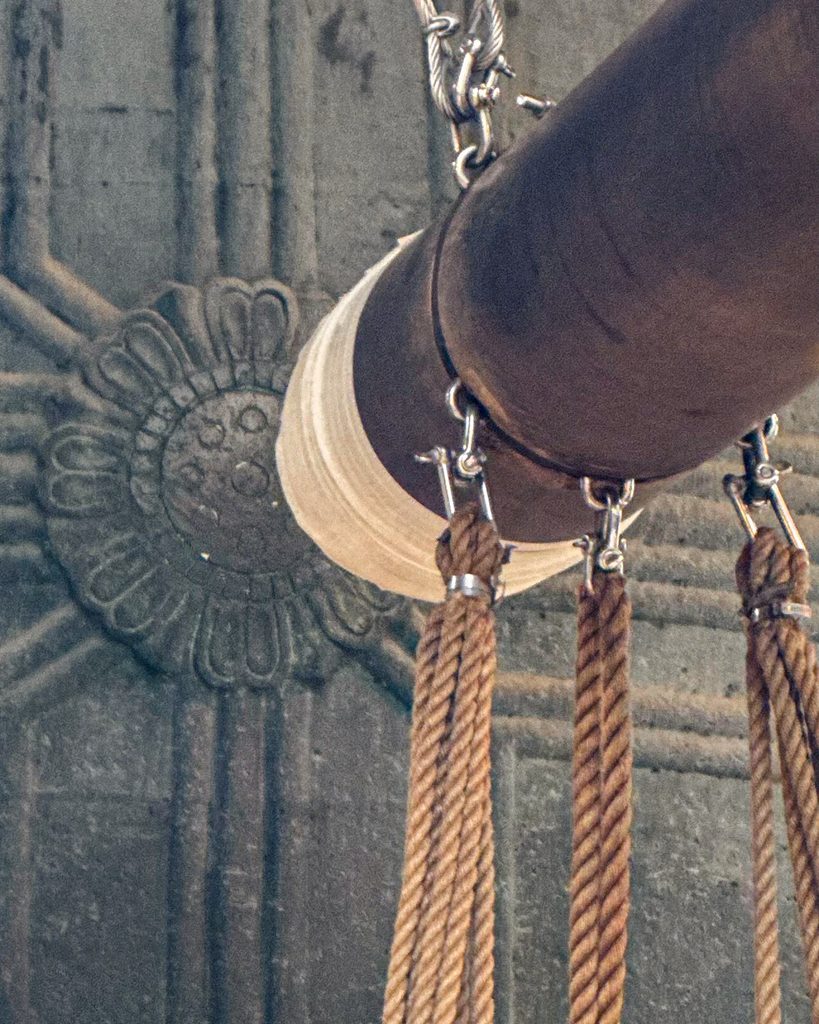
The striker is itself a log, suspended on wires, its tip wrapped in a pale protective pad. It hits the bell at a lotus medallion cast into the bronze. Ropes run down from the log in every direction.
As two o’clock came closer, camera crews began to arrive with tripods and long lenses. When I left my seat to find a restroom, the line stretched all the way down the stone steps. I walked back to my chair feeling, for the first time that day, that arriving early had been the smartest thing I did all year.
“Eeei, Hitotsu!”
Shortly before two, the monks came out and formed a ring around the bell. They wore brown robes over white, and they began to chant. Namu Amida Butsu. Chion-in is the head temple of the Jodo school of Buddhism, and this is its central prayer. They repeated it again and again, low and steady, their breath showing in the cold.
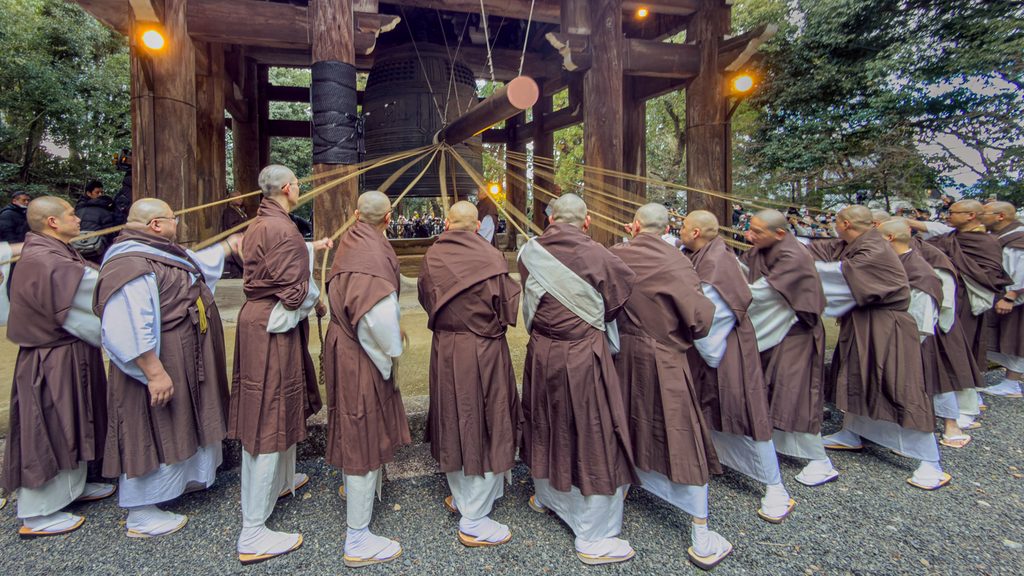
Then they took up the ropes. They swung the log back and forth a few times, warming up, letting it find its rhythm. And then one voice rose above the rest.
“Eeei, hitotsu!“
“Sore!” answered the others, and pulled.
One monk holds the main rope. Sixteen more hold the smaller ropes. On the call, they haul the log back together, and the monk at the front lets his body fall back until he is hanging from the log almost face up, then swings with it into the bell. The sound comes deep and heavy, and it takes a long time to fade. This is the Chion-in way of ringing a bell.
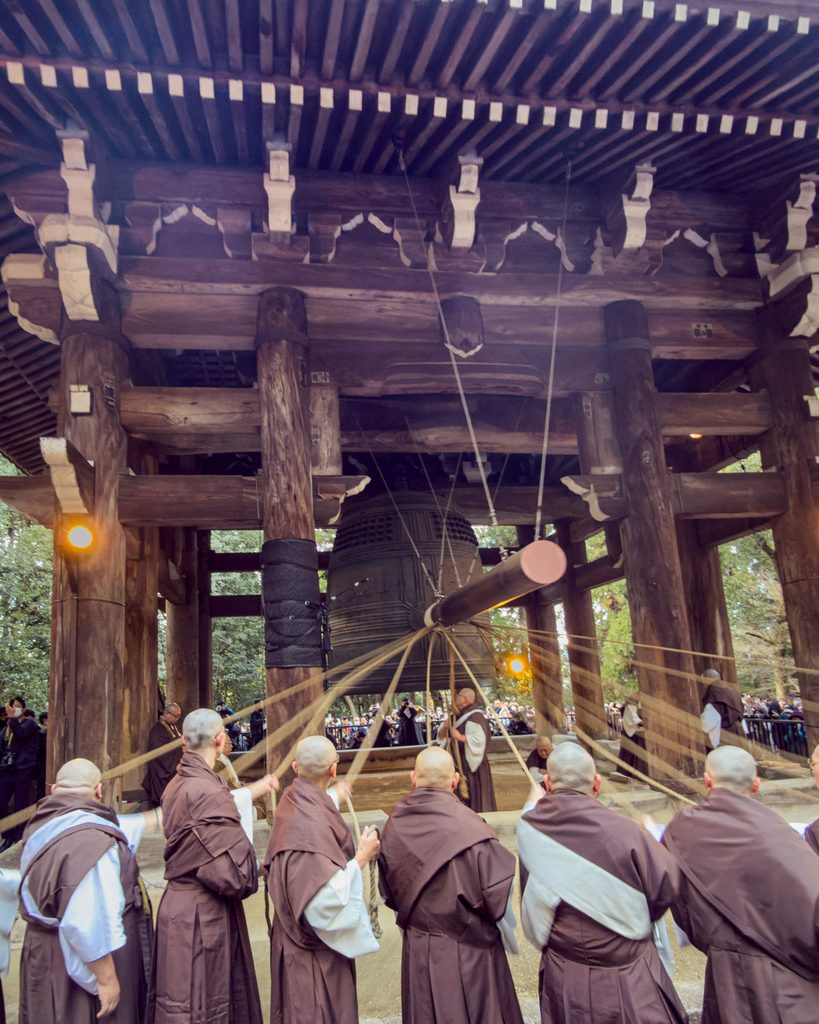
The monks took turns in order, call and answer, pull and strike. I settled in for what I assumed would be an hour of beautiful repetition.
The Swing That Got Away
It was not all repetition.
At one point a monk’s feet slipped out from under him. With no one steadying it, the log swung where it pleased, and he went down. The crowd went quiet, then stirred.
He got back up, took his place again, and tried once more. The strike still would not come right. The log wandered off its line, and the swing never found its rhythm. In the end, it reached the bell and the line moved on. But I had stopped thinking of this as easy. From behind the fence, it had looked like a matter of rhythm and ropes. It is a seventy-ton bell and a log the size of a small tree, and one pair of feet on cold stone is all that keeps the swing under control.
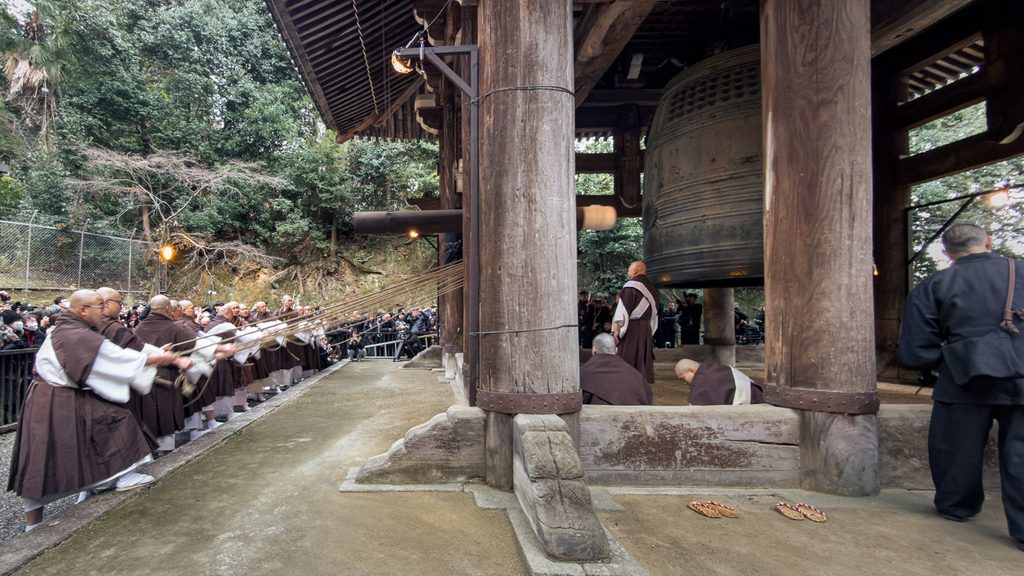
I suspect the monks feel this as a test more than a performance. Beside the bell, others bow fully to the ground. According to the temple, on New Year’s Eve three monks make a full prostration with every strike, while another keeps the count and the timing.
An Hour, and Then It Was Over
The trial ringing lasted about an hour. More people had come than the temple seemed to expect, and staff asked us to take turns and make room for others. By the time the hour was up, the crowd had thinned to a scattering.
Because I had come early, I had watched the whole thing from the best spot I could have hoped for. The chair had been worth it. The cold, mostly, had been worth it too.
Walking down the hill, I kept thinking about the number. One hundred and eight. In a few days, these same monks would do this again, at night, in the cold, for the full count. The practice had taken an hour and one bad slip.
In Japan, the last hour of the year belongs to Yuku Toshi Kuru Toshi, the NHK broadcast that carries the sound of temple bells across the country as the year turns. Most of us half-watch it, somewhere between the last bowl of toshikoshi soba, the buckwheat noodles eaten for a long life, and the first sleep of the new year. That New Year’s Eve, I decided, I would actually watch it.
Watching on television was a start. On December 31, 2026, I will be at Chion-in in person for the full 108 strikes, and I will add that report here in January.
If you are planning New Year’s Eve in Kyoto, there are two ways to see this bell rung, and they work very differently: the free trial ringing in daylight on December 27, and the ticketed ringing on the night itself. Here is what you need to know about each.
Joya no Kane at Chion-in: Practical Guide
Note: The dates, times, and fees below are from 2025. Chion-in updates the same official page with the new details each fall, so check it before you plan.
What Is Joya no Kane?
Joya no Kane is the ringing of temple bells across Japan on New Year’s Eve. Each bell is struck 108 times, once for each of the bonno, the afflictions of the mind that Buddhism says we carry, so the new year can begin clear of them. At Chion-in, the ringing begins before midnight and runs into the new year.
Option 1: The December 27 Trial Ringing
The trial ringing, or tameshi-zuki, starts at 2:00 p.m. on December 27. It is free, and no registration is required. The temple limits entry to the belfry area if too many people arrive at once. It is held in daylight, which makes it far easier to photograph than the real thing, and you see the same call-and-answer ringing by the same monks.
Tips for the Trial Ringing
- Arrive by late morning. I reached the bell a little after 11:00 a.m. for a 2:00 p.m. start, and there were already people waiting. For a spot near the front, earlier is better.
- Dress for standing in the cold. The belfry is on a hillside, and much of the waiting area is in shade. The temple itself asks visitors to prepare for a long, cold wait.
- Bring something to sit on. A folding chair made three hours bearable. Many people brought one.
- Use the restroom early. By 1:45 p.m. the line ran down the stone steps. The temple also asks visitors to use the restroom before entering the belfry area.
- Know the camera rules. Tripods, selfie sticks, drones, flash photography, and live streaming are not allowed. Alcohol is also off limits.
Option 2: New Year’s Eve in Kyoto at Chion-in (Tickets Required)
| Date | December 31 (rituals in the belfry from about 10:20 p.m., ringing from about 10:40 p.m., ending about 12:35 a.m.) |
| Fee | 3,000 yen per person (free for elementary school students and younger) |
| Online registration | Opened December 1 at 2:00 p.m.; 4 groups of 500 people; first come, first served |
| Tickets at the temple | Sold December 8 to 24, 9:00 a.m. to 4:00 p.m., at the Yuzen-en garden reception; 4 groups of 100; cash only |
| Viewing time | About 30 minutes per group |
| Same-day entry | Not available |
| Ringing the bell | Not allowed; viewing only |
Check-in on the night was at the bus parking area in front of the Kuromon Gate, with entry through the gate itself. Once you leave the belfry area, you cannot go back in. For the current year’s details, see Chion-in’s official Joya no Kane page, which includes the key information in English.
Getting There
Chion-in is in Kyoto’s Higashiyama district, a short walk from Gion and Maruyama Park. According to the temple:
- Subway: Higashiyama Station on the Tozai Line, then about 8 minutes on foot.
- Keihan Railway: Gion-Shijo Station, then about 10 minutes on foot.
- Hankyu Railway: Kyoto-Kawaramachi Station, then about 15 minutes on foot.
- From Kyoto Station: City Bus 206 to Chion-in-mae (about 23 minutes), then about 5 minutes on foot. A taxi takes about 15 minutes.
Address: 400 Rinka-cho, Higashiyama-ku, Kyoto. The temple asks visitors not to come by car.