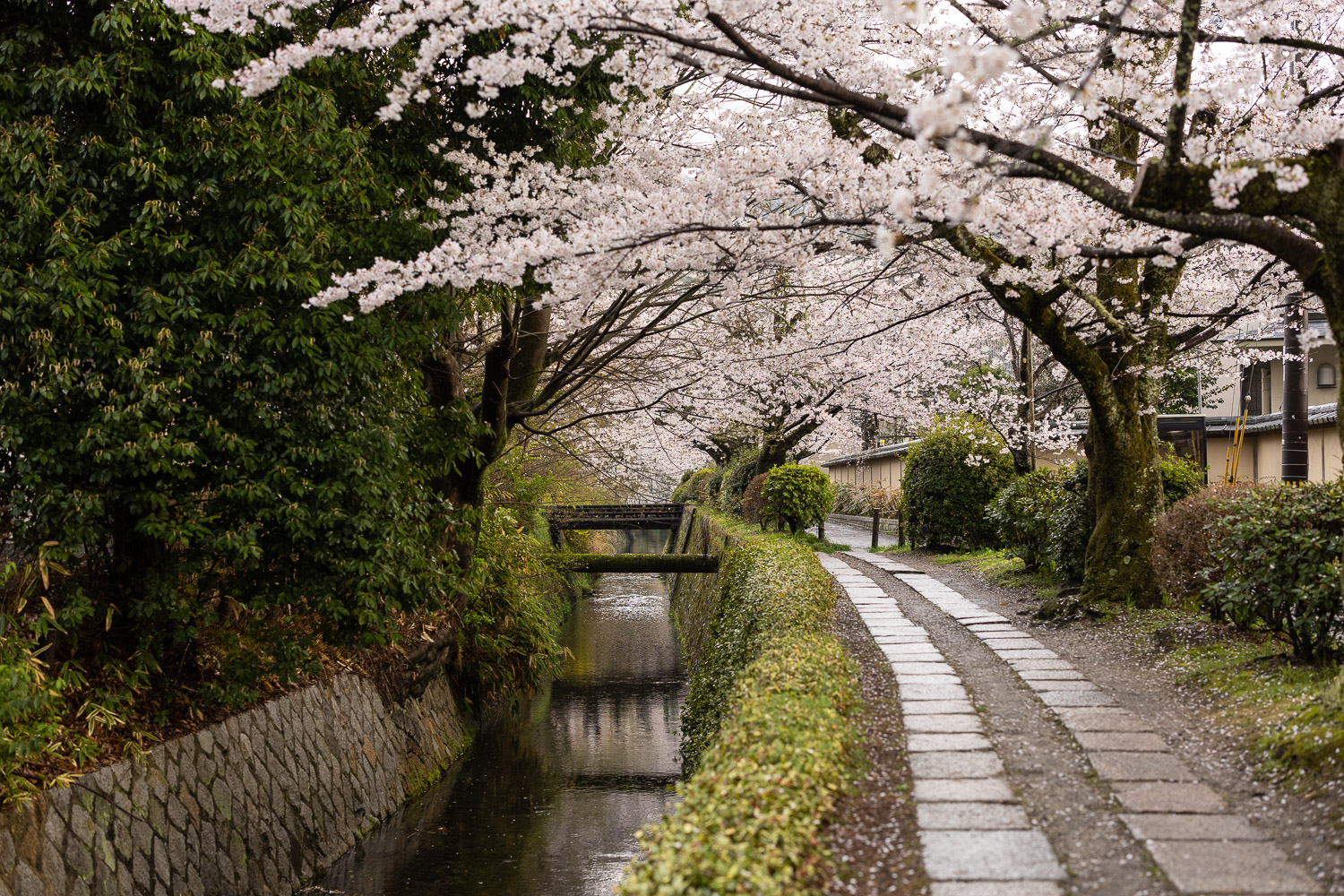
Even for Japanese people, the Philosopher’s Path is an unusual name.
Search the entire country and you won’t find an “Ideology Road” or a “Zen Boulevard” anywhere. The philosopher behind the name — Nishida Kitaro, a Kyoto University professor who walked this canal-side route daily, turning over questions about the nature of reality — remains a figure most modern Japanese couldn’t pick out of a lineup. As a student, I convinced myself that merely setting foot on this path would sharpen my mind. It didn’t. Philosophy stayed exactly where it had always been: beyond reach.
Yet something pulls people here, year after year.
The name intrigues. But what transforms the Philosopher’s Path from a pleasant canal-side walk into one of Kyoto’s most sought-after spring destinations is the canopy overhead — roughly 400 cherry trees arching over 2 kilometers of water, stone, and dappled light.
Why 400 Cherry Trees Line This Canal
The cherry trees along the Philosopher’s Path carry a name of their own: Kansetsu-zakura.
In 1921, the nihonga painter Hashimoto Kansetsu and his wife gathered 300 cherry saplings and entrusted them to the city of Kyoto, asking that they be planted along this stretch of the Lake Biwa Canal. Kansetsu lived nearby, painted nearby, and understood that art sometimes takes root in soil rather than on silk. A century later, the descendants of those saplings still drape the waterway each spring, and the path itself has earned a place among Japan’s 100 Best Roads.
On an ordinary afternoon, the canal-side stones invite exactly the kind of quiet reflection the philosopher practiced — a slow unraveling of thought, measured by the pace of flowing water. During cherry blossom season, forget it. If you can contemplate the nature of existence shoulder-to-shoulder with a thousand visitors all angling for the same photograph, you have already achieved enlightenment.
March 31: Peak Bloom — and Already Falling
I cross-referenced the cherry blossom forecasts and chose March 31 — the day the models pointed to full bloom.
The weather forecast promised heavy rain. Both predictions proved accurate.
The Ginkakuji bus dropped me into a sudden, punishing spring downpour. The rain landed sharp and unseasonably cold, slicking the cobblestones and darkening the bark of every trunk along the canal. I quickened my pace toward the Philosopher’s Path, though I knew the blossoms wouldn’t wait for me — and doubted that an extra few minutes of hurrying would spare a single petal.
For years I had carried a quiet question: do cherry blossoms that have only just opened actually scatter in rain? By dusk, the answer drifted past my face. Petals spiraled down through the grey air, catching the last light as they fell, already surrendering what they had held for less than a week.
What fragility.
Hanaikada: Kyoto’s Cherry Blossom Flower Raft
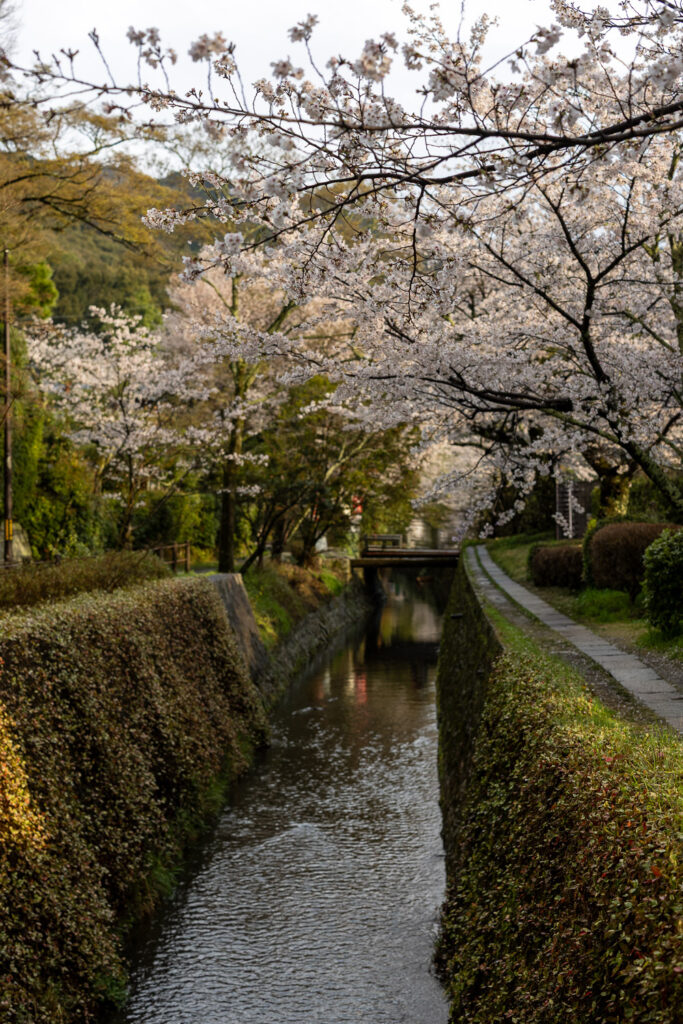
Near a bridge close to the Shirakawa-dori Imadegawa intersection — the point where the Shirakawa stream empties into the canal — the water had changed color.
Thousands of fallen petals had gathered on the surface, clustering and drifting in slow, silent formations until the entire stretch of canal blushed pink. This is hanaikada: “flower raft,” a word that has no equivalent in English. “Hana” is flower. “Ikada” is raft. Neither half, alone, explains why people stop mid-stride at the railing and fall quiet.
I’ve witnessed this at the same spot two years running — the confluence seems to catch and hold petals the way an eddy traps leaves. It may happen here every spring.
But what lingered wasn’t the beauty. It was the arithmetic. Hanaikada means the petals have already left the branch. The season is subtracting itself.
Stand at the edge of this canal and watch the water turn pink, and something unreasonable settles over you — a sadness without evidence, a conviction that it ended too soon.
What You Only See When the Blossoms Are Falling
The rain relented. The crowds thinned. The path exhaled.
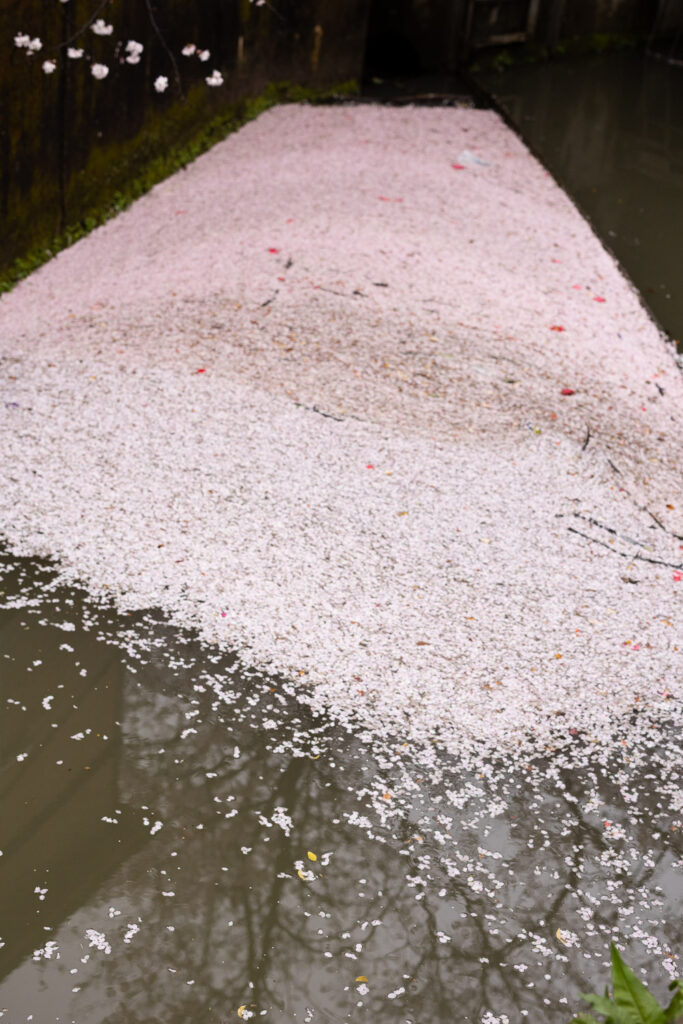
Rainwater pooled in the worn divots of the cobblestones, and in each shallow mirror the cherry branches reappeared — inverted, trembling with every drop that still fell from the leaves above. You didn’t need to look up. The blossoms were at your feet, too.
One puddle stretched too wide to clear in a single step. I walked straight through it. My shoes had already surrendered hours ago; a little more water changed nothing.
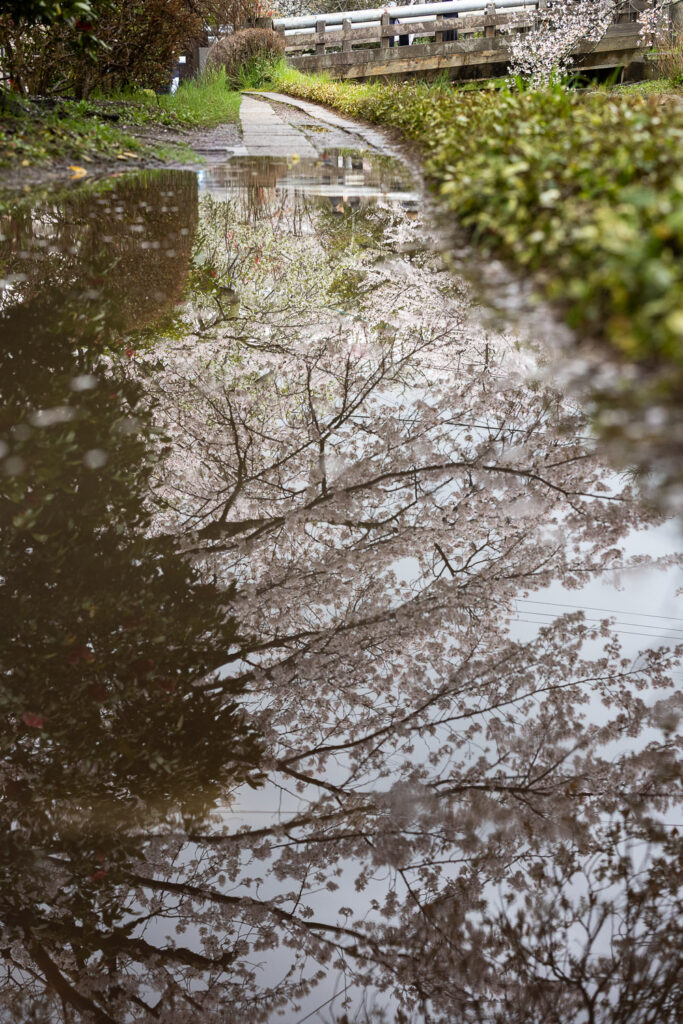
At some point I noticed I had stopped looking up entirely.
A few meters away, the first aomomiji — young green maple leaves, still translucent, still curled at the edges — had begun to unfurl on branches that wouldn’t reach full canopy until June. A handful of cherry blossom petals had settled on those new leaves, pale pink resting on bright green, as if spring had left a note for early summer.
It happens every year. Almost no one notices.
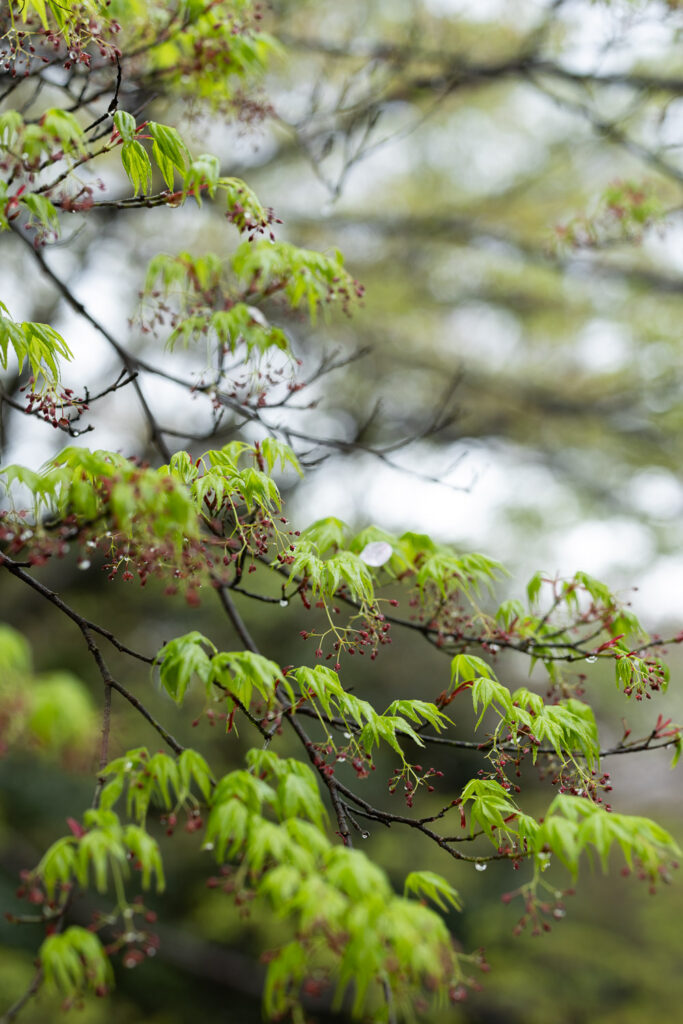
A hundred years ago, Kansetsu’s saplings scattered their first petals onto this same canal. The water carried them the same way. The maples caught them the same way. Whatever Nishida contemplated on his daily walk, this overlapping of endings and beginnings was already underway beneath his feet.
Temples and Shrines Along the Philosopher’s Path
The Philosopher’s Path stretches approximately 2 kilometers from Ginkakuji (Silver Pavilion) at its north end to Nyakuoji Shrine at the south. The cherry-lined canal draws most visitors, but the temples and shrines tucked along the route reward anyone willing to step off the main path.
Honen-in — Camellias, Moss, and Silence
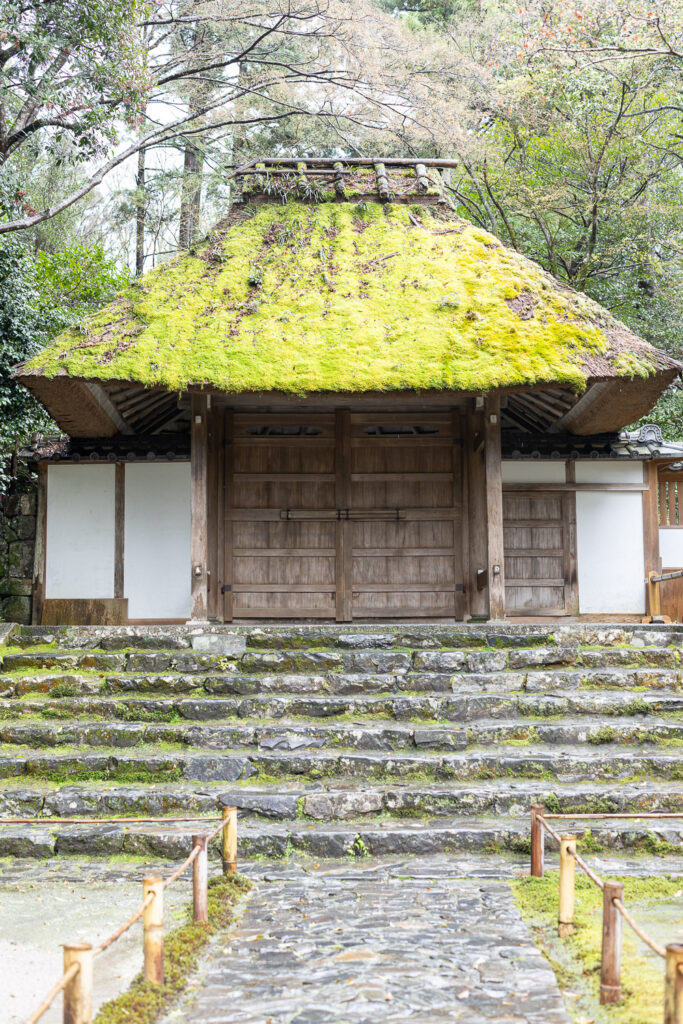
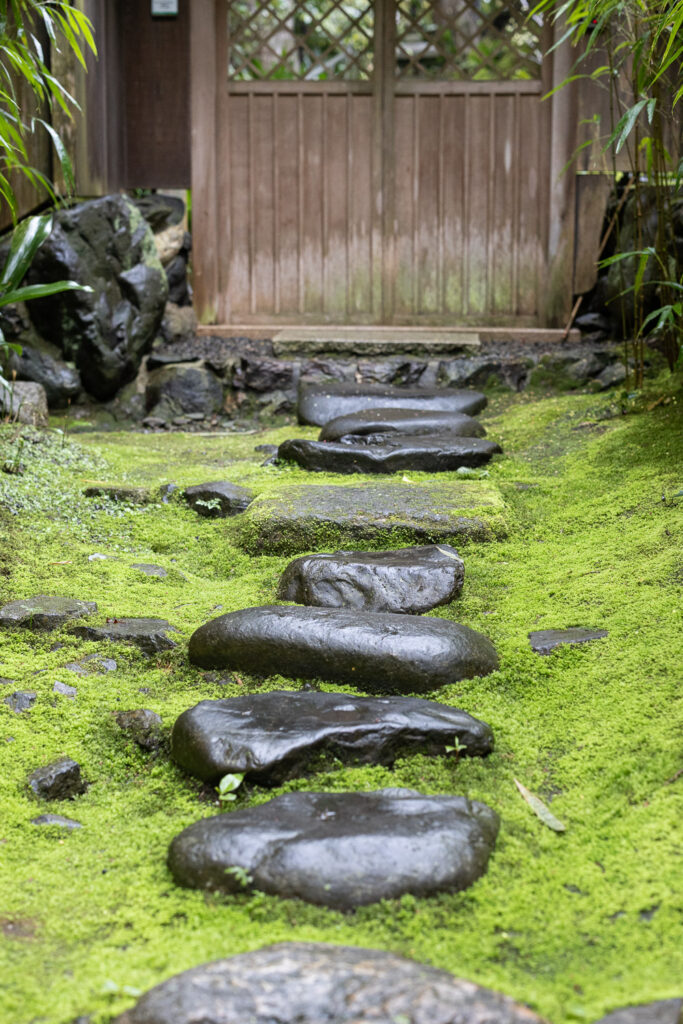
The thatched-roof sanmon gate arrests your stride before you understand why. In spring, camellias punctuate the grounds in deep reds and whites, each bloom sharpened by the surrounding moss — a green so saturated it seems to pull the light inward. In autumn, the maples take over.
The garden is open at all times and free to enter. After 4:00 PM the main gate closes, but a smaller side entrance remains accessible.
Reikan-ji: 100 Varieties of Camellia, Rarely Open
Normally closed to the public, ReikanReikan-ji — 100 Varieties of Camellia, Behind a Rarely Opened Gate
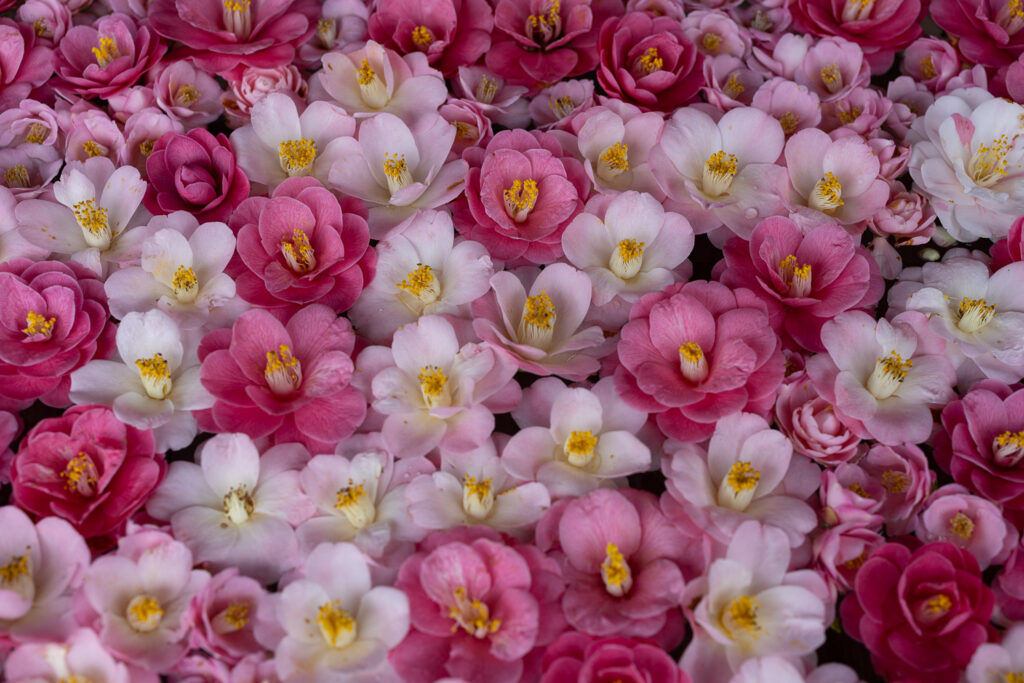
This former imperial convent keeps its gates shut most of the year. Only in spring and autumn does Reikan-ji open for special viewings, revealing approximately 100 varieties of camellia — along with cherry trees in the inner grounds.
I arrived in a downpour. Rows of cut camellias, arranged with the precision of a gallery installation, greeted me at the entrance. The rain didn’t diminish them. If anything, the wet petals held their color more fiercely.
2026 Spring Special Viewing: March 20 – April 12 / 10:00 AM – 4:30 PM (last entry 4:00 PM)
Admission: ¥800 adults / ¥400 elementary school students / ¥720 per person for groups of 15+
Otoyo Shrine — Weeping Cherry and Unusual Guardian Statues
Of all the stops along this path, Otoyo Shrine is the one I’d steer you toward first. A weeping cherry cascades over the entrance — its bloom tends to arrive a few days ahead of the Somei Yoshino along the canal, so timing matters. The shrine sits just far enough off the main route that the noise drops away.
Spend a few minutes with the stone guardians. Beyond the standard komainu dogs, Otoyo keeps a more unusual company: guardian mice, a guardian kite, and a guardian snake — the last of which stands watch year-round. I have not encountered this combination at any other shrine.
Nyakuoji Shrine — Where the Philosopher’s Path Begins (or Ends)
The southern anchor of the path. Small, quiet, easy to overlook — which is precisely why it caught me off guard.
Next to the offering box, a QR code. I scanned it. The screen prompted me to enter an amount. I tapped, confirmed, and made my offering without reaching for a single coin.
Is it possible to measure whether a digital offering carries the same weight as a physical one?
Tradition and technology, sharing the same wooden ledge without any apparent tension. A perfectly contemporary Japanese moment. Whether the gods distinguish between copper and code remains — mercifully — unverifiable.
Philosopher’s Path Is Not a Hanami Spot
There is no grass to sit on. No clearing beneath the branches for a tarp and a cooler of beer. The path is narrow, the crowd moves in one direction, and the cherry blossoms overhead are experienced in motion — frame by frame, step by step.
If what you want is to spread a blanket, unpack food, and spend an afternoon beneath the branches with friends, head to Maruyama Park or the grassy banks of the Kamo River. Both welcome that kind of gathering. The Philosopher’s Path does not.
Practical Information
Getting There
The Philosopher’s Path runs north–south, so your starting point depends on which direction you plan to walk.
Starting from the north end (Ginkaku-ji side) — recommended if you want to visit Ginkaku-ji and Honen-in first, then walk south.
From Kyoto Station by city bus:
Bus 100 → get off at Ginkakuji-mae Bus 17 or 5 → get off at Ginkakuji-michi
Note the difference between the two stops: Ginkakuji-mae (“in front of Ginkaku-ji”) is closer to the temple entrance, while Ginkakuji-michi (“Ginkaku-ji road”) is slightly further south along the approach street. Both work. Bus 100 and Bus 5 get extremely crowded during peak tourist season — transferring from the subway is a better option.
From the subway (recommended during peak season):
Karasuma Line to Marutamachi Station → transfer to Bus 204 → get off at Ginkakuji-michi Karasuma Line to Imadegawa Station → transfer to Bus 203 or 102 → get off at Ginkakuji-michi
From Shijo-Kawaramachi:
Bus 17 or 5 → get off at Ginkakuji-michi Bus 32 → get off at Ginkakuji-mae
Bus 5 gets crowded during peak season.
Starting from the south end (Nanzen-ji side) — recommended if you want to visit Nanzen-ji or Eikan-do first, then walk north.
From Kyoto Station by city bus:
Bus 5 → get off at Nanzenji-Eikando-mae (crowded during peak season) Bus 100 → get off at Miyanomae-cho Bus 93 → get off at Higashi-Tenno-cho
From the subway:
Karasuma Line to Marutamachi Station → transfer to Bus 204 or 93 → get off at Higashi-Tenno-cho Karasuma Line to Karasuma Oike Station → transfer to Tozai Line → get off at Keage Station (walk to Nanzen-ji)
From Shijo-Kawaramachi:
Bus 32 → get off at Miyanomae-cho Bus 203 → get off at Higashi-Tenno-cho
Distance & time: Ginkaku-ji to Nyakuoji Shrine is approximately 2 km. Walking straight through takes 30–40 minutes. Allow 2–3 hours if you plan to visit temples along the way.
Suggested direction: Start at Ginkaku-ji (north) and walk south. From Nyakuoji Shrine, it’s an easy continuation to Nanzen-ji — another excellent cherry blossom destination.
Crowds: Heaviest near Ginkaku-ji. The further south you walk, the quieter it gets.
Food: Cafés and small shops line the Ginkaku-ji approach road. Options along the path itself are limited — eat before or after.
Restrooms: Public facilities near the Ginkaku-ji end. Also available at Otoyo-jinja and Nyakuoji Shrine.
Frequently Asked Questions
When is the best time to see cherry blossoms on the Philosopher’s Path?
Typically late March to early April, though the exact timing shifts each year. In 2026, peak bloom fell on March 31. Check the latest sakura forecast from Japanese weather services for the most accurate timing during your visit.
How long does it take to walk the Philosopher’s Path?
A leisurely walk takes 30–40 minutes without stops. If you visit Honen-in, Reikan-ji, and Otoyo Shrine along the way, allow 2–3 hours.
What is hanaikada?
Hanaikada (花筏, literally “flower raft”) describes the phenomenon of fallen cherry blossom petals gathering on the water’s surface, turning the canal pink. On the Philosopher’s Path, this can be seen near a bridge close to the Shirakawa-dori Imadegawa intersection.
Can I have a hanami picnic on the Philosopher’s Path?
No. The path is a narrow walking trail with no space to spread a blanket. For a traditional hanami experience with food and friends, Maruyama Park and the banks of the Kamo River are better options.
Is Honen-in open during cherry blossom season?
The garden is open year-round with free admission. The main gate closes after 4:00 PM, but you can enter through a side entrance. For special viewings of the main hall and other buildings, check the Honen-in official website.