I stepped off the train at Keihan Uji Station and heard — nothing.
Not the compressed silence of a countryside town, but something more intentional. Uji simply refuses to be rushed. The only sound cutting through was the iron railway bridge upstream, its metal joints rattling against the river air with a clamor that felt completely out of place. Either the bridge is very old, or Uji is very quiet. Probably both.
I had come for the wisteria.
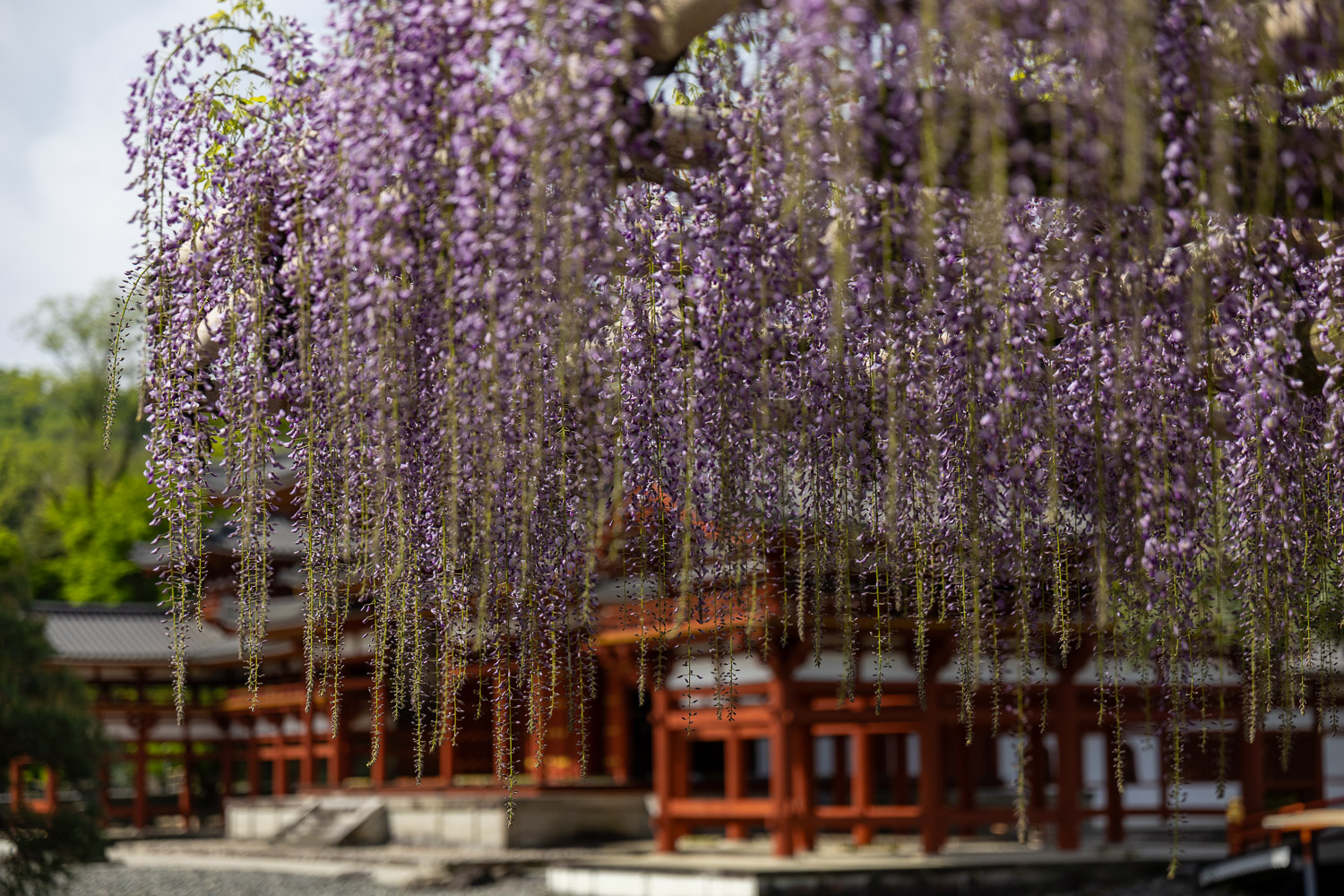
Most people associate Byodo-in Temple with cherry blossoms — or with the image on the ten-yen coin. Both are fair. But April, when the Byodo-in wisteria opens, is when this 1,000-year-old temple quietly outperforms itself.
In 2026, the Byodo-in wisteria peaked around April 18 — nearly a week earlier than usual, according to the temple’s official website. I arrived on April 19. The blooms were at, or just past, their absolute peak. The timing, for once, had worked out.
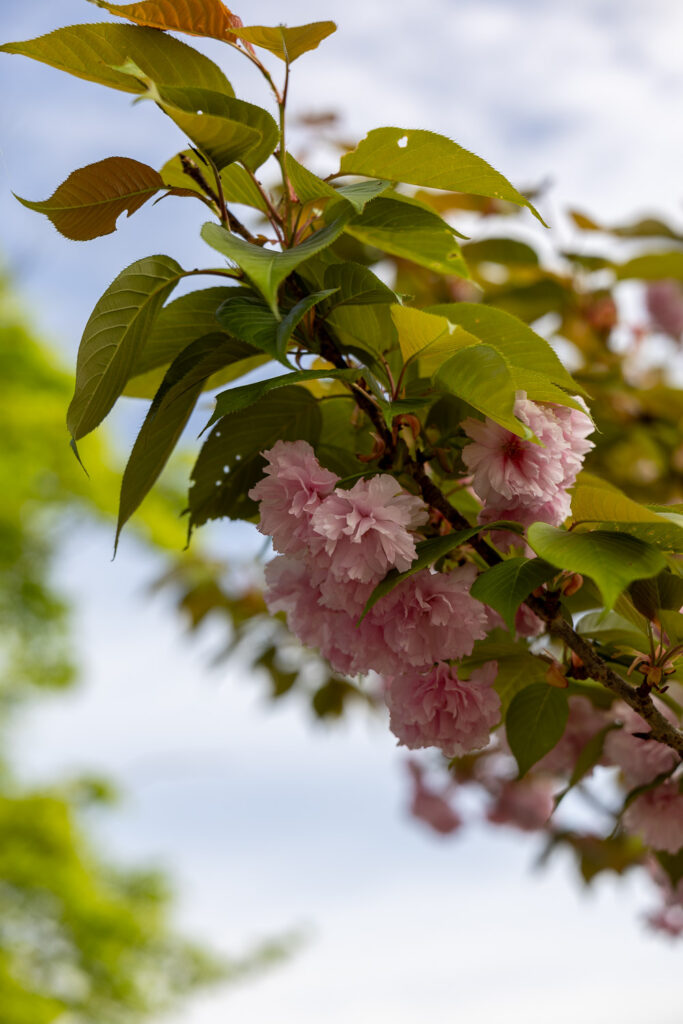
Walking along the Uji River toward the temple, I passed a single late-blooming double cherry tree — yaezakura — still clinging to the season. Everything else had already moved on. The river path that draws crowds of hanami picnickers in late March was nearly empty. That felt right. Today wasn’t about cherry blossoms.
Byodo-in Wisteria: Three Trellises — Don’t Miss the One Outside
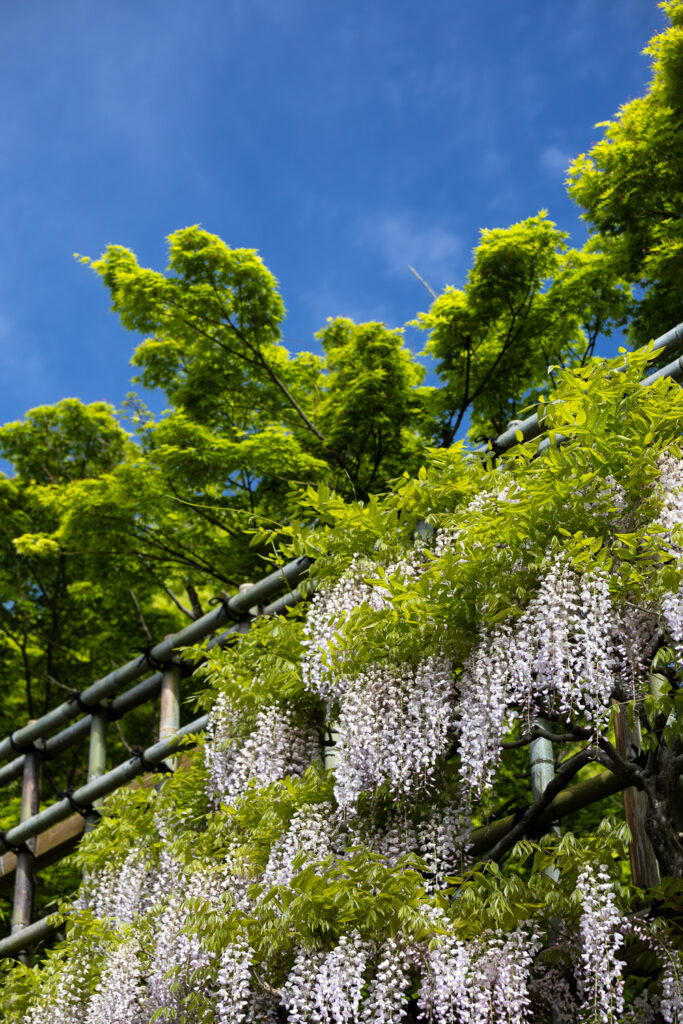
Byodo-in has three wisteria trellises. Most visitors find two of them.
On my previous visit, I had entered through the main gate. This time I used the south gate — and nearly walked past the third trellis entirely. It sits just outside the south gate entrance, right alongside the ticketing queue. If you’re focused on getting inside, you’ll miss it.
Here’s the simplest routing advice: enter through the main gate, exit through the south gate. That one adjustment covers all three trellises without backtracking.
While I waited in the south gate queue, a group of high school students on a class trip stood directly beside one of the trellises. Not one of them looked at it. They were comparing photos of each other — checking angles, fixing hair. I didn’t judge. There’s a specific age at which a 1,000-year-old flowering vine cannot compete with a front camera.
The Bees Know Something You Don’t
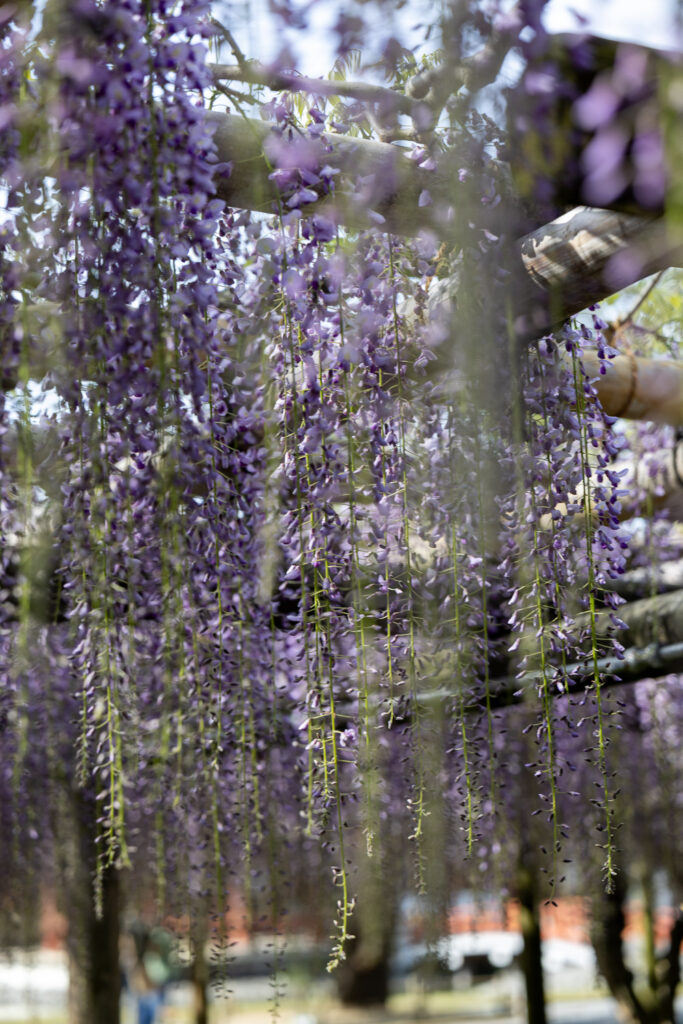
Inside the garden, the wisteria trellises were alive — and I mean that literally.
Carpenter bees (kuma-bachi in Japanese) were working through the blossoms in numbers. This is not coincidence. Wisteria flowers have a rigid, closed structure that most insects cannot penetrate. Carpenter bees, with their size and strength, are among the few that can. In return, the flowers get reliable pollination. It’s a negotiated arrangement that’s been running longer than the temple itself.
I was setting up a shot — Phoenix Hall behind the wisteria, tight composition, waiting for the light — when roughly twenty other photographers and visitors gathered to do the same thing. Then a woman wandered into the frame, absorbed in her phone, and stopped directly between the trellis and the hall.
She stood there for about a minute. Eventually, one of the photographers said, quietly: “Sumimasen.”
She looked up with a startled expression that was, objectively, very funny. The group laughed. It was the kind of small moment that makes a crowd feel briefly like a community.
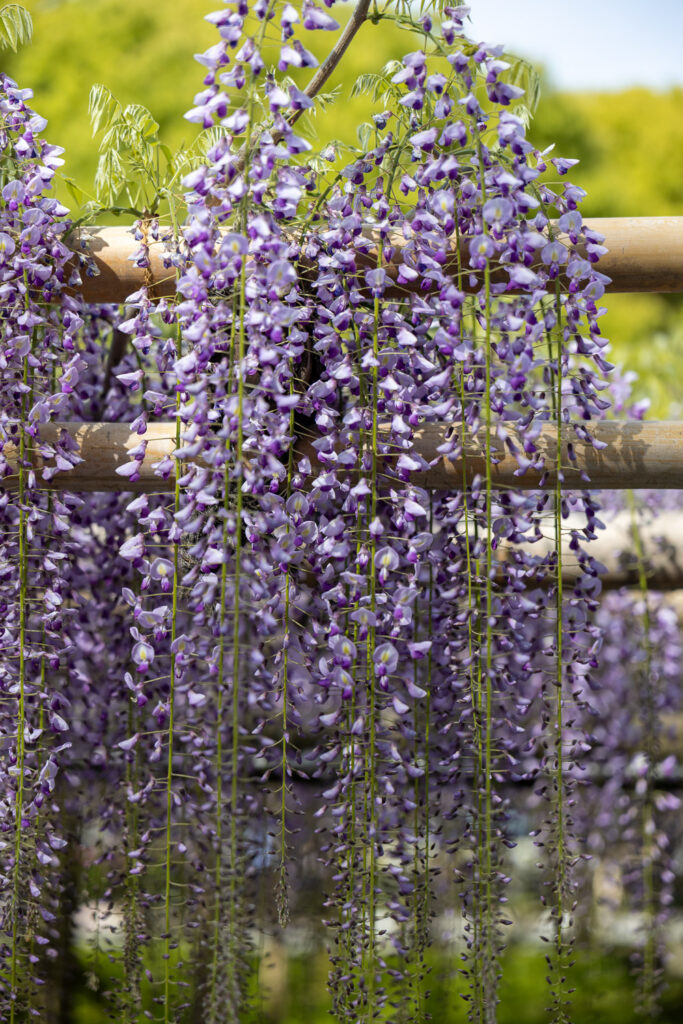
One more observation: Byodo-in is pet-friendly. Near the wisteria, I watched a man hold his dog up high to pose for a photo. The dog’s expression suggested it had opinions about this arrangement.
The Yellow Nobody Expected
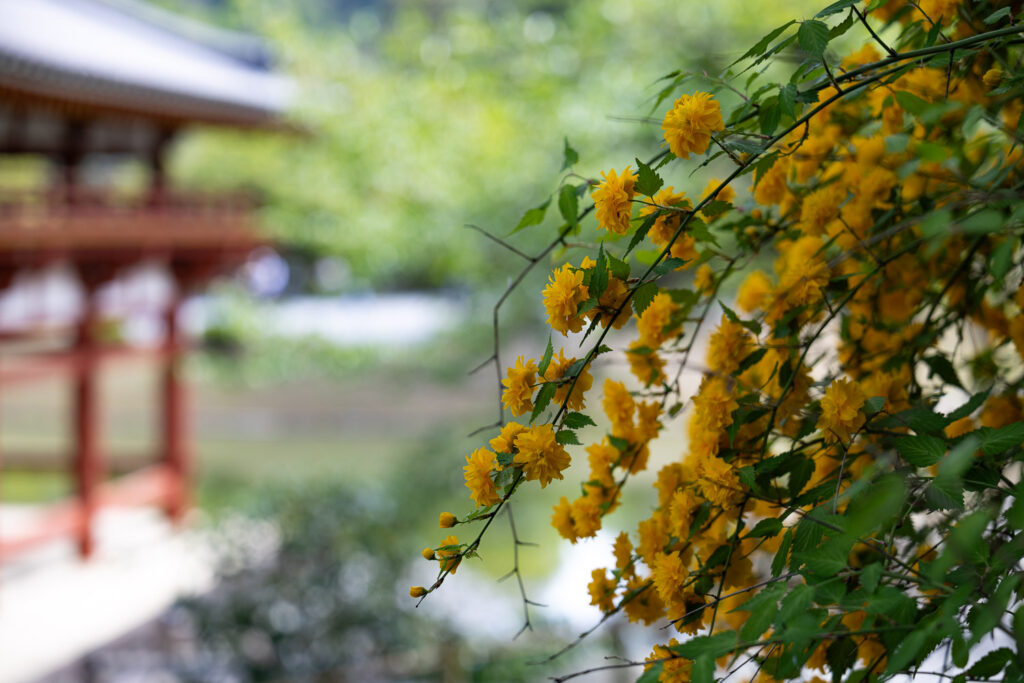
I was moving away from the main trellis when a flash of yellow stopped me.
Yamabuki. Japanese kerria.
I hadn’t expected to find it here — not at Byodo-in, not in this season, not competing with the purple of the wisteria and the crimson of the azaleas. And yet there it was, its branches bowing under the weight of the blossoms, completely unconcerned with whether it belonged.
Japan’s spring works in overlapping layers. Cherry blossoms fall before the wisteria fully opens. Wisteria peaks while the kerria is still bright. By the time everything has finished, you realize you’ve been watching a relay, not a single event. Byodo-in, with its varied plantings and its ancient garden design, shows you all of it at once.
The yellow against the vermilion of the hall’s pillars was a contrast that shouldn’t have worked. It did.
The Coin, the Hall, the Reflection
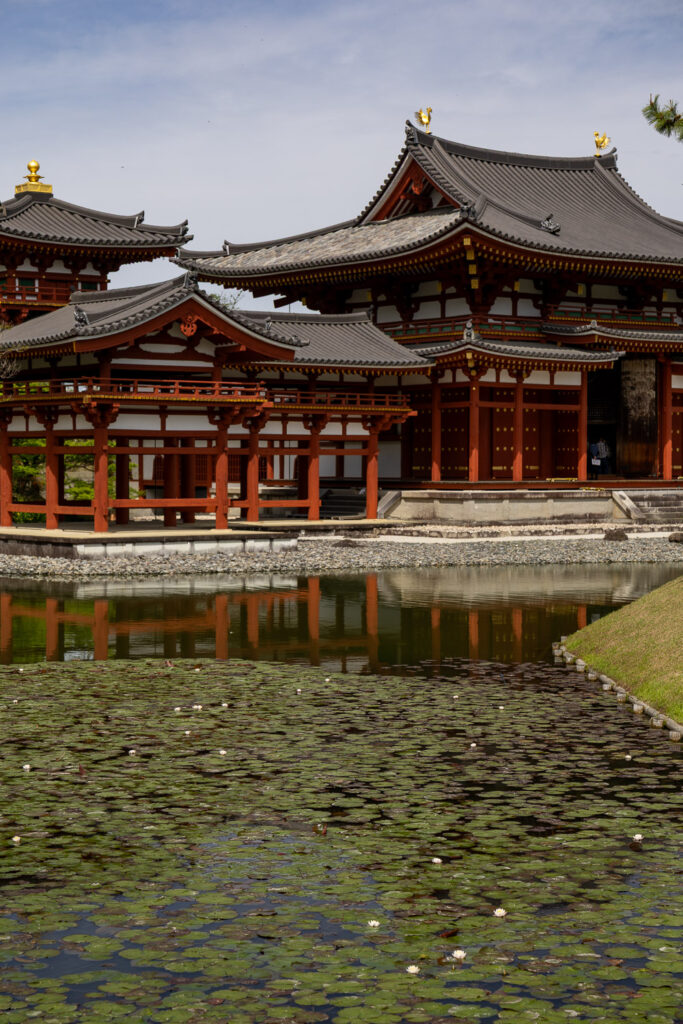
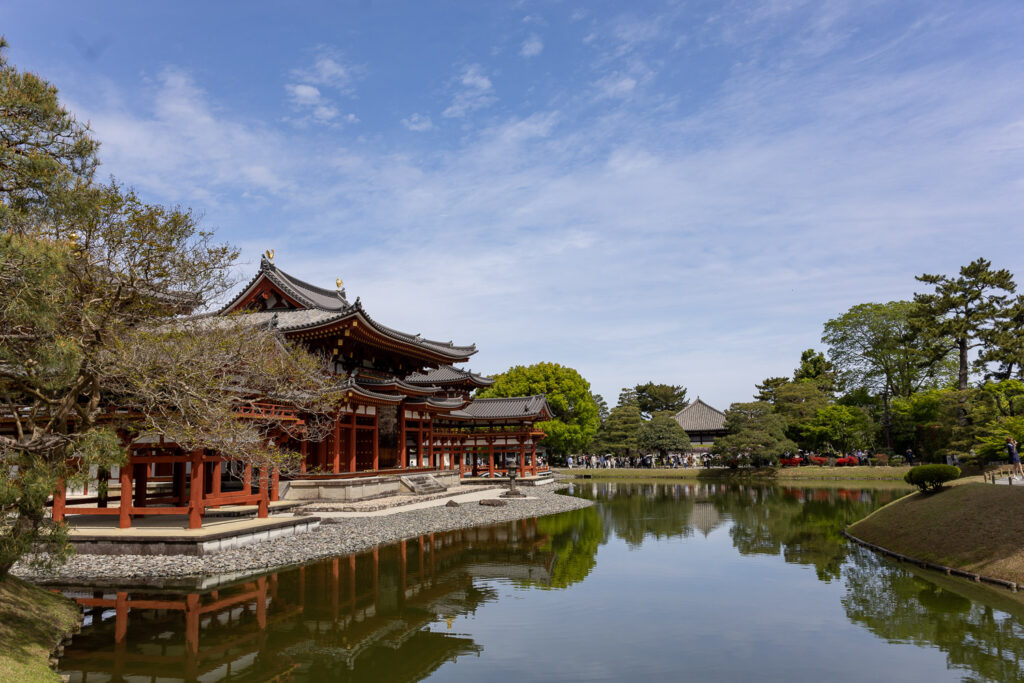
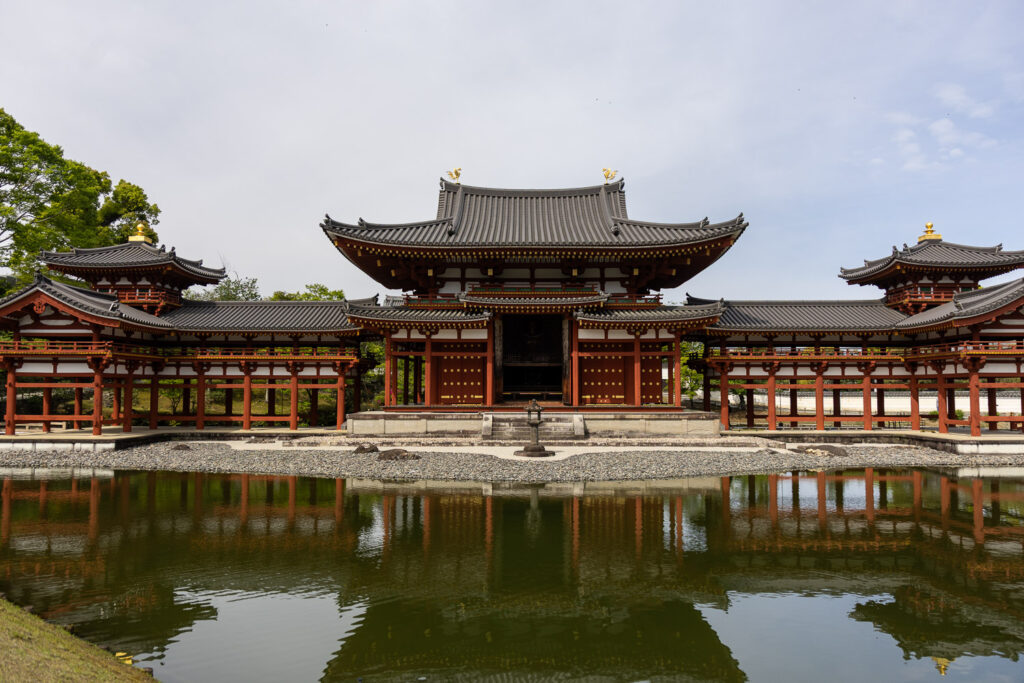
Every Japanese person over a certain age recognizes Byodo-in from the ten-yen coin. The image on the coin — the Phoenix Hall, centered, reflected in water — is something children see before they ever visit the temple itself. Standing at the edge of the pond and holding up the coin until the design aligns with the building in front of you: it’s a minor ritual, and people do it with genuine delight.
That reflection is not accidental. Byodo-in was built in 1053 by Fujiwara no Yorimichi as a representation of the Pure Land — the paradise of Amida Buddha, which in Buddhist tradition lies across a body of water. The pond is not decorative. It’s cosmological.
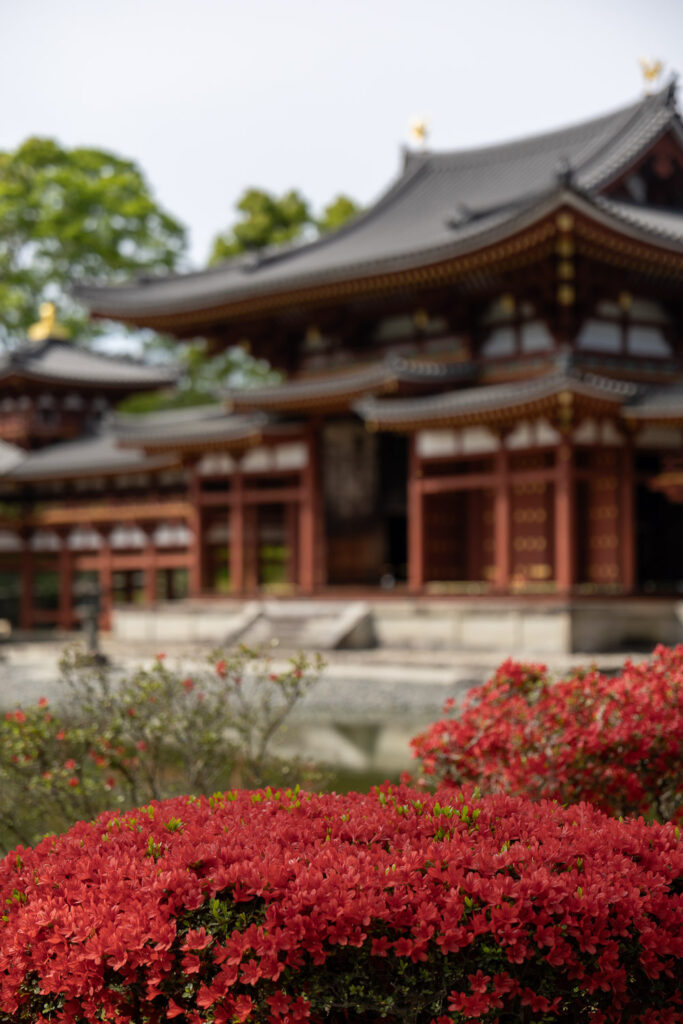
In mid-April, the azaleas along the pond edge are also in bloom — deep red, clipped into low mounds. The combination of vermilion architecture, purple wisteria, and crimson azaleas should be too much. It isn’t. The garden holds it.
Green Before Red: The Season Nobody Talks About
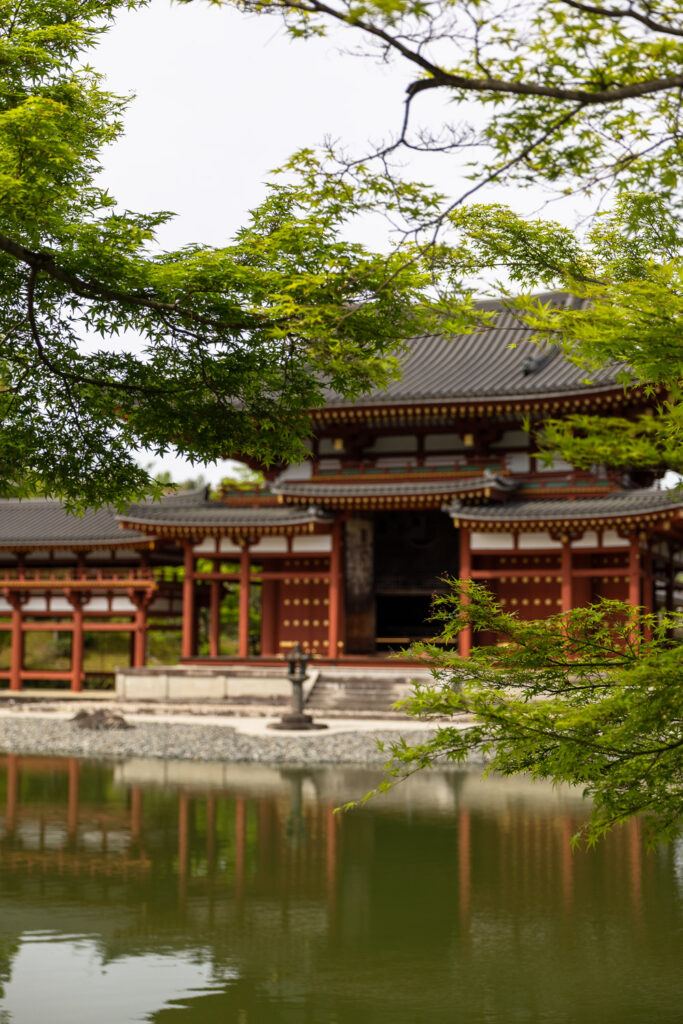
Byodo-in in autumn draws visitors for the red maples. What fewer people realize is that the same trees, in mid-April, are just as extraordinary.
aomomiji— fresh green maple. The leaves emerge in a yellow-green so saturated it reads almost as neon against the grey sky. They are soft, translucent, and impermanent in a way that autumn leaves, for all their drama, are not. Against the vermilion of the Phoenix Hall, the effect is a color pairing that has no business being this precise. The hall is ancient. The trees are doing what trees do every spring. And yet the combination looks considered, curated, deliberate.
It is none of those things. It is just what happens here every April, and has for a thousand years.
Inside the Phoenix Hall and the Museum
Getting inside the Phoenix Hall itself requires an additional ¥300 — cash only — on top of the garden admission. In peak season (April–May, October–November), expect a wait. On my visit, the board outside the hall ticket window read 90 minutes. The move is to collect your numbered ticket at the hall reception first, then spend the wait time on the garden and museum.
The museum — Hoshokan — is included in the main admission price and is, frankly, the biggest surprise of the visit.
I’ve visited more temples and shrines than I can accurately count. The reconstructed wall paintings inside the museum stopped me. The interior of the Phoenix Hall, as it appeared in the Heian period, was not the faded, elegant structure most visitors imagine. It was vivid — almost hallucinatory — in its original colors. The reconstruction shows what time has removed. If you see the hall first, then the museum, the gap between the two versions is genuinely startling.
Also in the museum: the kumo-za — cloud-riding bodhisattvas, small gilt figures that originally lined the interior walls of the hall. I have seen similar figures described in guidebooks. I had not seen them in person before. They are strange and beautiful in equal measure.
Forty minutes is enough for the museum. The gift shop, attached, carries items you will not find elsewhere — items worth looking at even if you are not a buyer.
On Matcha
The garden has a teahouse: Sabnou-touka. Authentic Uji matcha, served properly, in the ¥800–¥1,200 range. Uji is the origin point for some of Japan’s finest matcha; drinking it here is not a tourist performance but a reasonable geographic decision. Closed Monday, Tuesday, and Wednesday (open on public holidays).
Practical Information
Admission
- Garden + Museum (Hoshokan): Adults ¥700 / Junior & Senior High School ¥400 / Elementary ¥300
- Phoenix Hall interior: ¥300 additional — cash only
Hours
- Garden: 8:45 AM – 5:30 PM (last entry 5:15 PM)
- Phoenix Hall interior tours: 9:30 AM – 4:10 PM (50 persons per session; tickets from 9:10 AM, first-come)
- Museum Hoshokan: 9:00 AM – 5:00 PM (last entry 4:45 PM)
- Museum Shop: 9:00 AM – 5:00 PM
- Teahouse Chaboufujika: 10:00 AM – 4:30 PM (last order 4:00 PM) — closed Mon, Tue, Wed
- Stamp Office: 9:10 AM – 5:00 PM (last entry 4:45 PM)
Getting There
- Keihan Uji Station: 10-minute walk
- JR Uji Station: 10-minute walk
From Keihan Uji Station, the walk to the temple passes along the Uji River — and if you have an extra twenty minutes, take the detour through Uji Park. The park occupies a narrow island in the middle of the river, connected by footbridges on both ends. It works equally well as a warm-up before the temple or a quiet wind-down after. Either direction, the river light in spring is worth the detour.
What’s Blooming When
| Season | Flowers |
|---|---|
| Feb – Mar | Muromachi camellia |
| March | Japanese quince, cherry |
| Apr – May | Wisteria, azalea |
| Late May – Sep | Water lily |
| Jun – Aug | Byodo-in lotus, lotus |
| Aug – early Sep | Crape myrtle |
| Mid Nov – early Dec | Autumn foliage |
| Dec – Feb | Sasanqua camellia |
Good to Know
- Pets welcome in the garden
- Strollers permitted; note gravel paths and some steps
- Credit cards and IC cards accepted throughout — except Phoenix Hall interior (cash only)
- South gate entry is recommended in wisteria season to avoid missing the third trellis
Frequently Asked Questions
When is the best time to see the Byodo-in wisteria?
Typically mid-to-late April, though the timing shifts by a week or more depending on the year. In 2026, peak bloom arrived around April 18 — nearly a week earlier than usual. Check the temple’s official website before your visit; they post regular updates with photos during the season.
How long should I plan to spend at Byodo-in?
The garden alone takes 45–60 minutes at a relaxed pace. Add the Phoenix Hall interior tour and the museum, and budget 1.5 to 2 hours including wait time. In peak season, the hall queue can run 90 minutes or more — collect your numbered ticket at the hall reception first, then use the wait for the garden and museum.
What time should I arrive to avoid crowds?
Opening time — 8:45 AM — is consistently the least crowded. On spring weekends, the garden begins to fill noticeably after 10:00 AM. If the Phoenix Hall interior is on your list, arriving at opening gives you the best chance of a shorter wait.
Are there other things to do in Uji?
Several. Ujigami Shrine (a UNESCO World Heritage Site, about 15 minutes on foot) and the Tale of Genji Museum (also about 15 minutes) are natural complements to Byodo-in. The Uji River island park — a narrow strip of land in the middle of the river connected by footbridges — makes for a pleasant walk before or after the temple. The approach street has multiple long-established Uji matcha shops worth stopping at.
Also in Uji: the Nintendo Museum, which traces the history of Nintendo from playing cards to the present day. Both Keihan Uji Station and JR Uji Station connect to the museum via Kyoto Keihan Bus Route 64 (Uji-Ogura Line, bound for Kintetsu Ogura) — approximately 10 minutes from either station, with the museum stop just steps from the entrance. Note that entry requires advance lottery tickets through Nintendo’s official website; walk-in admission is not available.
Is English signage available on-site?
The museum displays include English text. Signage throughout the garden and approach is bilingual. Staff English varies — the temple’s official website has a solid English version worth reviewing before your visit.
Just across the Uji River, Ujigami Shrine — Japan’s oldest surviving shrine and a UNESCO World Heritage Site — is an 8-minute walk from Byodoin. Most visitors never make the crossing. You should.
Byodo-in Temple, Uji / 宇治市宇治蓮華116