The bus stopped. The doors opened. I just couldn’t get on.
People were packed all the way to the standing room. So I gave up. I’d walk. I had already prayed my way from Kitano Tenmangu to Hirano Shrine, and Kinkakuji was barely a kilometer beyond — not an unreasonable distance, I told myself, and started walking.
Two minutes later, a bus bound for Kinkakuji passed me. Nearly empty.
Five minutes later, another one passed. Passengers with entire rows to themselves.
Ten minutes later, another.
I had simply needed to wait for one more bus. The only crowded bus in northwest Kyoto that morning was, of course, the exact one I had tried to board.
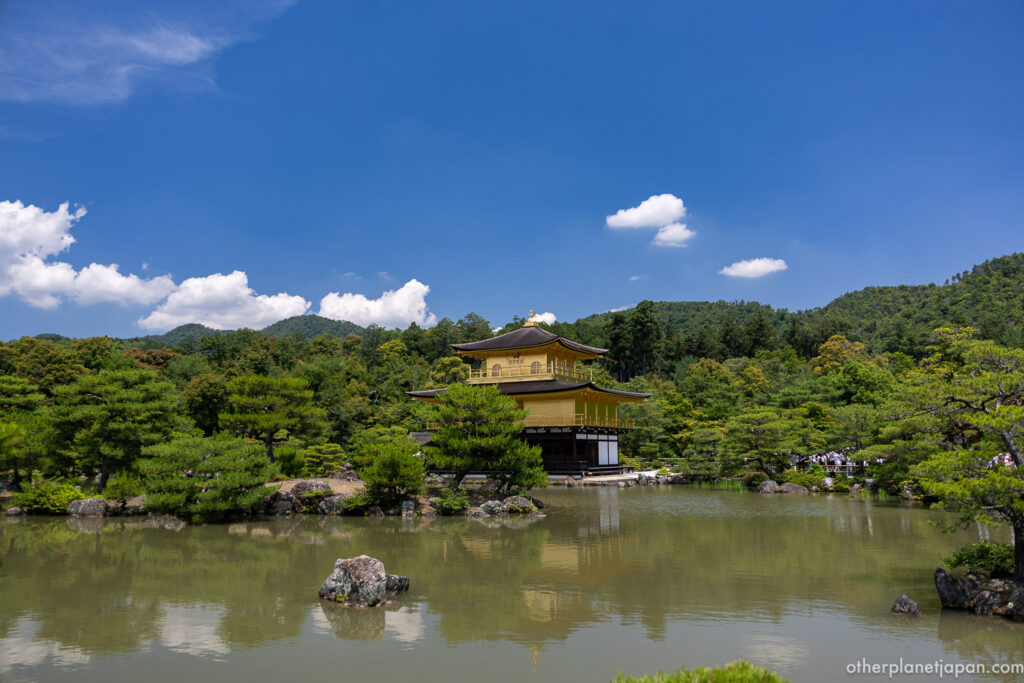
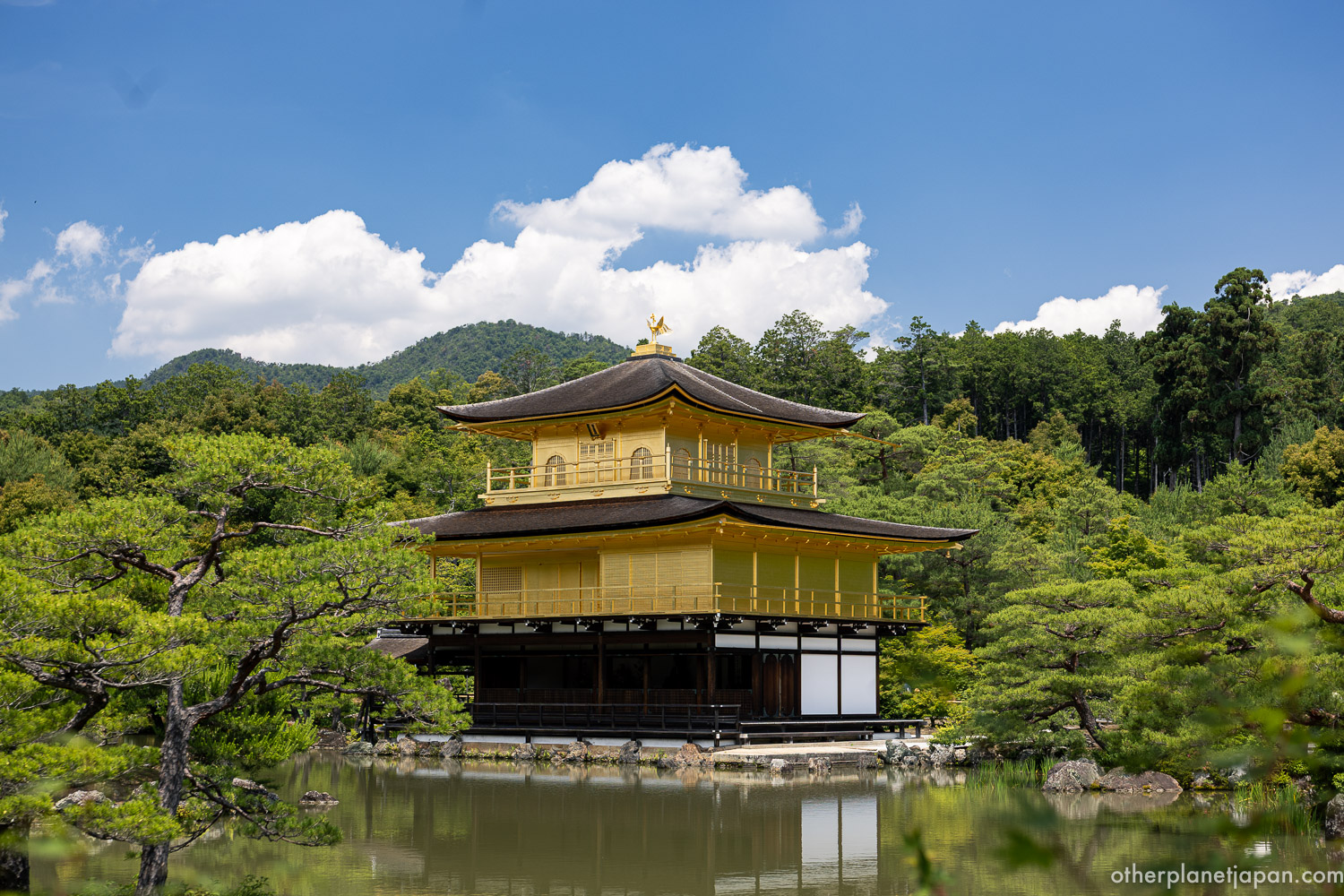
The moment the shariden appeared through the trees — that unreasonable flash of gold — I remembered what I had forgotten.
Mishima. On my last visit, I had sworn to myself that I would read The Temple of the Golden Pavilion before coming back. The novel about a young monk who, unable to bear the distance between himself and the building’s beauty, finally sets it on fire. I hadn’t read it. Standing at the edge of Kyoko-chi pond with the gold blazing in front of me, I made the same vow again — to the same unreliable version of myself.
Maybe next time it will be autumn leaves. Maybe a morning after snow. I don’t know yet. But I’ll have read it by then. That’s what I said last time, too.
What Is Kinkakuji, Really?
The Golden Pavilion isn’t even its real name.
Officially, this is Rokuonji (鹿苑寺), a Rinzai Zen temple of the Shokokuji school. “Kinkakuji” — the name everyone uses — simply means “temple of the golden pavilion,” a nickname for the gold-leafed shariden that became so universal the formal name was all but forgotten. Ask a Kyoto local where Rokuonji is, and you may get a brief, polite pause.
The pavilion was built in 1397 as the retirement villa of Ashikaga Yoshimitsu, the third shogun of the Muromachi shogunate. After his death, per his wishes, the estate became a Zen temple. The building survived the chaos of the Onin War, stood for centuries — and then, in 1950, was burned to the ground by a 21-year-old novice monk. His obsession with the pavilion’s beauty became the subject of Yukio Mishima’s novel The Temple of the Golden Pavilion.
What you see today was rebuilt in 1955, with additional gold leaf applied in 1987. It is, in a sense, the restoration of a reconstruction of a retirement villa. And it is still, somehow, beautiful.
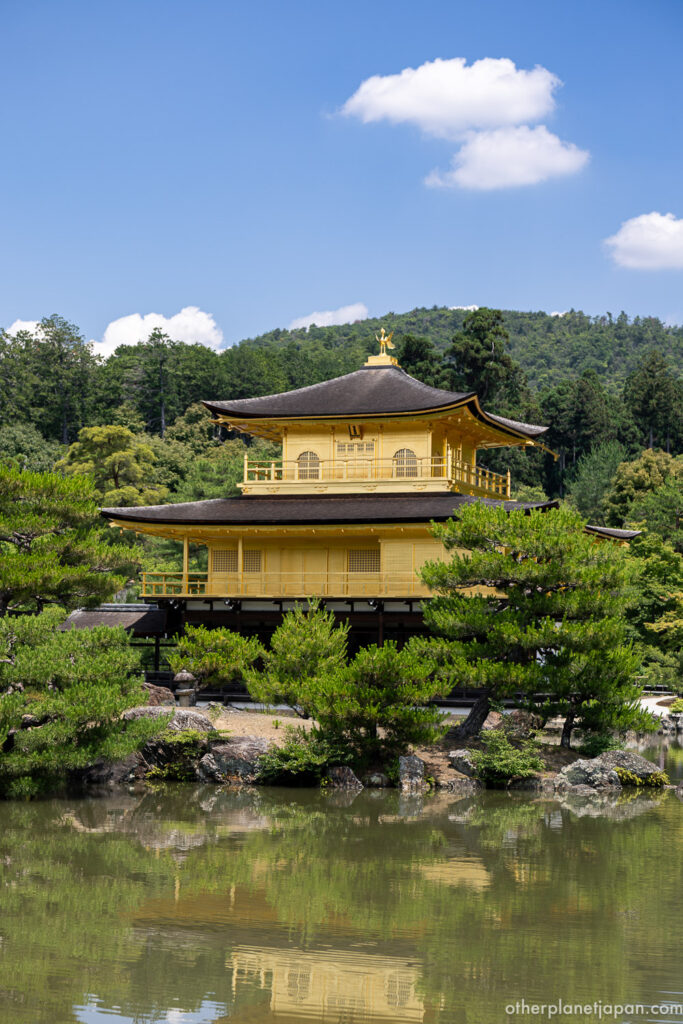
Look closely and you’ll see that each of the three floors is built in a different architectural style. The first floor, left ungilded, is shinden-zukuri, the style of Heian aristocratic residences. The gold-leafed second floor is buke-zukuri, the style of samurai residences. The third, also gold-clad, is zenshu-butsuden-zukuri, the Chinese Zen temple style. Three eras stacked into one building — a structure that can’t quite make up its mind, and is all the more striking for it.
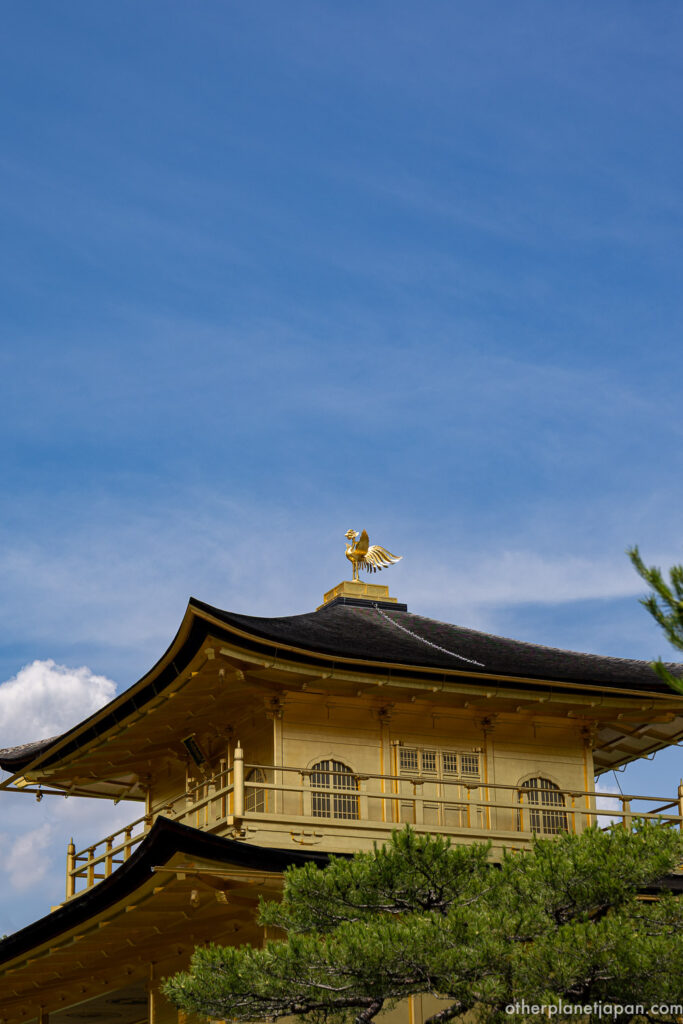
At the very top stands a gilded bronze hō-ō (phoenix), the auspicious mythological bird that symbolizes imperial authority and good fortune. On a clear summer morning, with the gold catching the full light, the bird looked ready to take flight.
A Temple That Feels Like a Garden
My first thought was that this is less a temple than a landscape.
At its center sits Kyoko-chi (鏡湖池), the Mirror Pond, wrapping the pavilion on three sides so the gold reflects in the still water. Small islands dot the surface; carefully shaped pines lean toward the water at impossible angles, as if to get a better look at themselves.
Somewhere behind me, a bell rang at irregular intervals — unhurried, unannounced. Even amid the murmur of the crowd, that sound alone seemed to be living on a different clock.
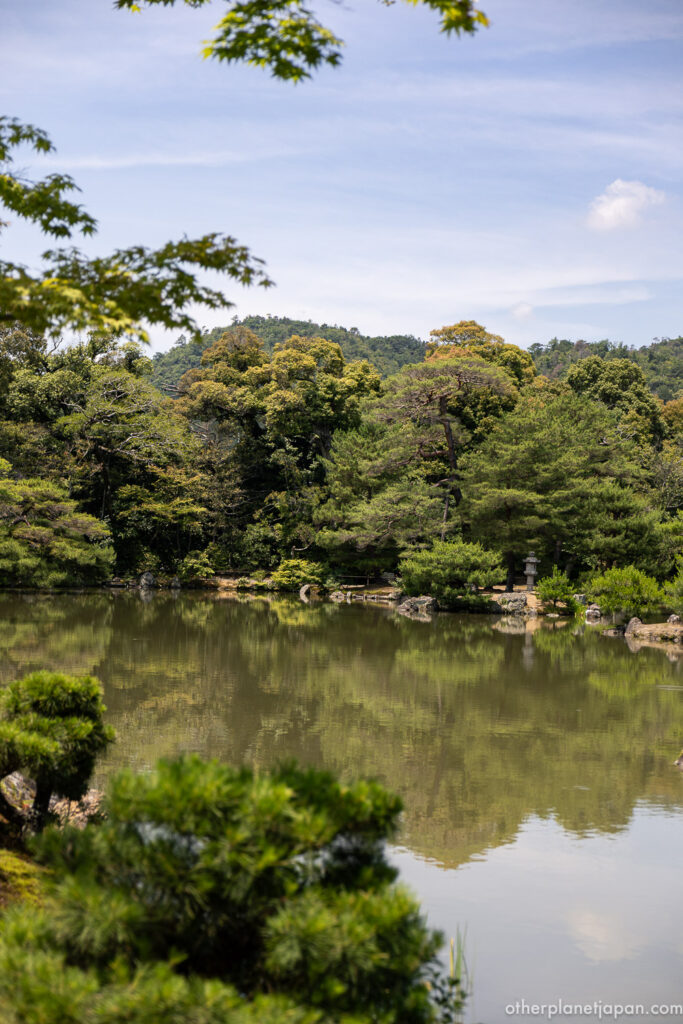
The grounds follow a one-way circuit. You enter, walk the set path, and exit — no backtracking. You’d expect bottlenecks given the crowds, but the one-directional flow keeps things surprisingly smooth. The garden lets you move at its own pace.
Before you start up the approach, look to your right: on a clear day you can make out Daimonji-yama in the distance, the mountain where the giant character 大 is lit each August for the Obon farewell fires. There was something quietly moving about seeing the mountain of a seasonal ritual from the grounds of a building made to last forever.
The Details Worth Slowing Down For
Most people circle the pond, photograph the pavilion, and move on.
That’s fair enough. But spend a moment on the things that aren’t gold, and the grounds gain a different kind of depth.
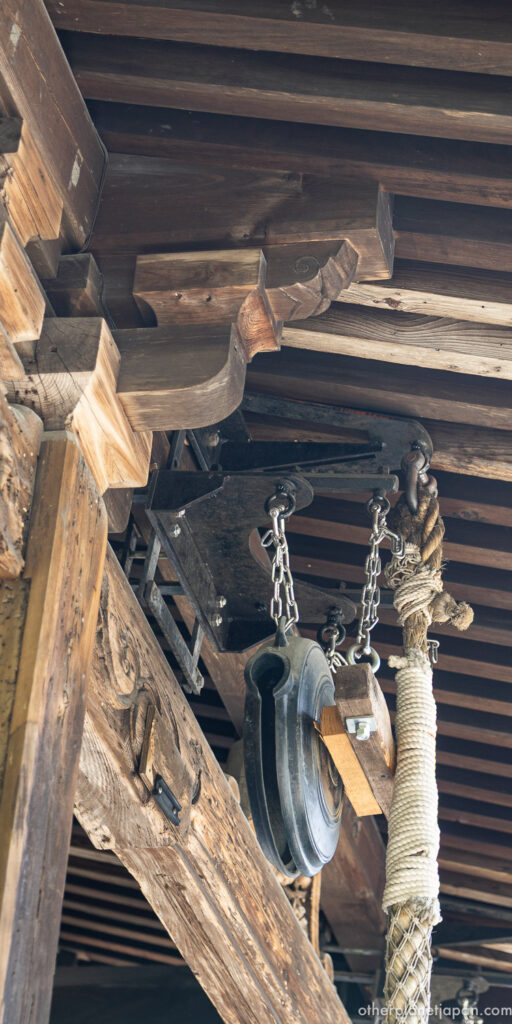
Partway along the circuit stands the Fudo-do hall. Look up beneath the eaves and you’ll see a bronze waniguchi — a flat, round gong suspended on a thick chain, sounded by visitors pulling a rope. Plain and heavy, it carries a quiet weight in a place otherwise defined by gold. I realized, later, that the bell sound following me through the grounds had probably come from here.
Continue on and you pass Sekkatei (夕佳亭), an Edo-period tea house counted among the three great tea rooms of Kyoto. You can’t go inside, but you can take in its understated form from the path.
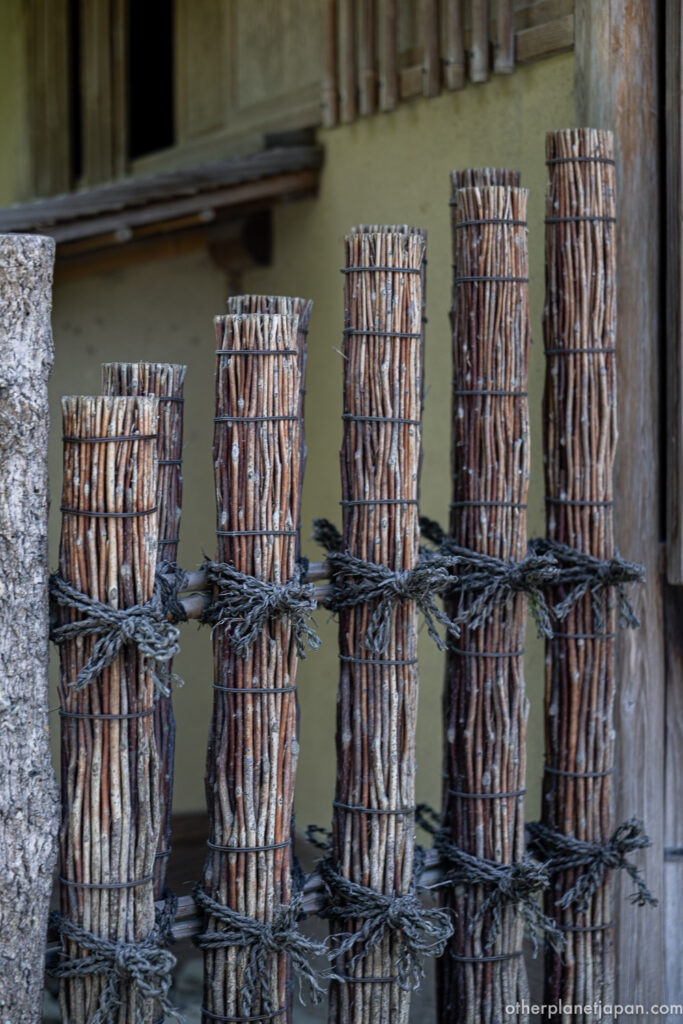
In front of Sekkatei stands a fence made from bundled twigs, each cylinder bound with dark wire and old rope, set in a vertical row. The work of a gardener, standing there without a sign to explain it.
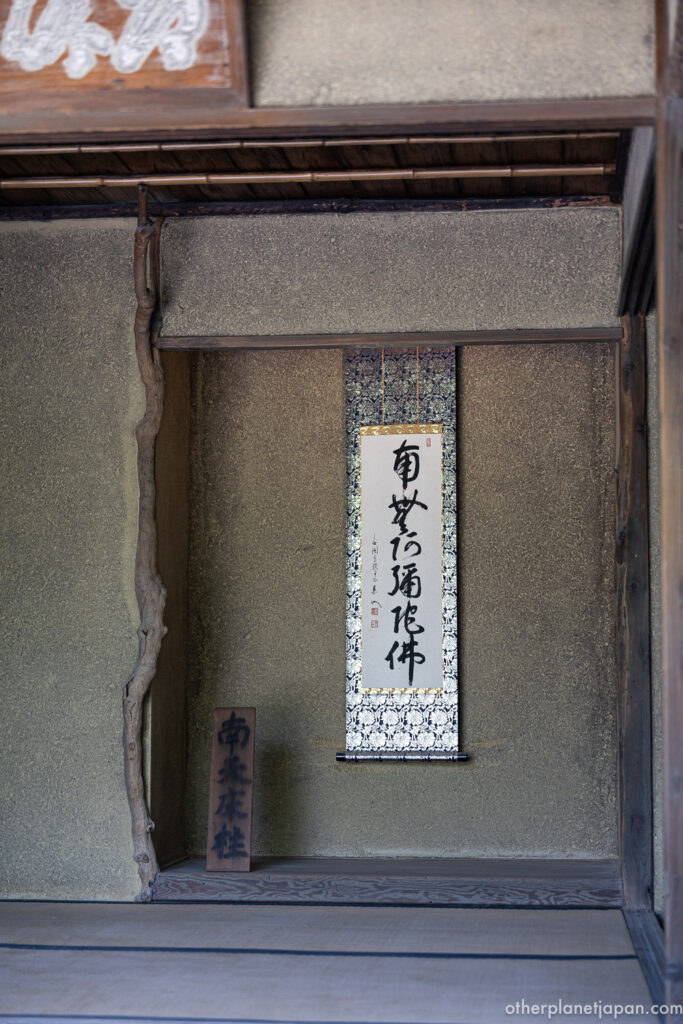
Peer through the lattice into Sekkatei and you’ll see a tokonoma alcove holding a single hanging scroll, with a curved, unpolished branch of natural wood set beside it. The earthen wall is slightly frayed at the edges, and left that way. Everything the shariden is not — understated, impermanent, untroubled by either. Two opposite aesthetics, sharing the same grounds.
The Upper Garden: Waterfall, Lotus, and Iris
The path leaves the pond and climbs a wooded hillside.
The visual vocabulary shifts — from gold and water to stone and green. The upper garden feels older somehow, more enclosed, as if you’ve crossed from the temple’s public face into its private interior.
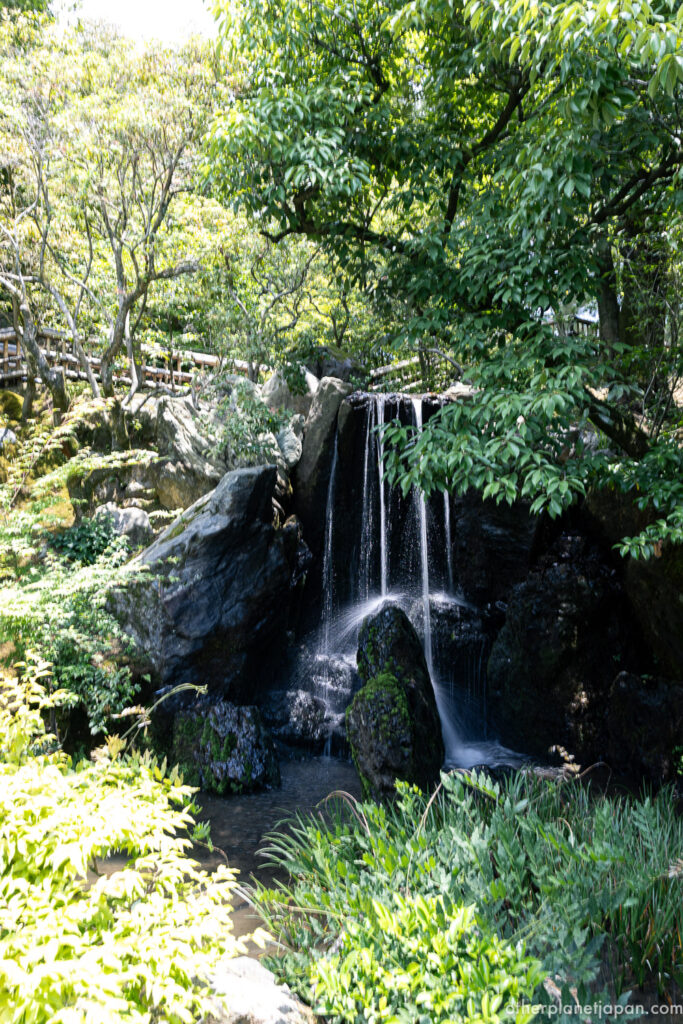
Climb far enough and you reach Ryumon-baku (龍門瀑), the Dragon Gate Waterfall. Water falls over dark stone into a shallow pool, and at its base sits a stone shaped like a carp — the creature from the Chinese legend of the “dragon gate,” in which a carp that ascends the falls becomes a dragon. In a Zen garden, the meaning is left to whoever is standing there.
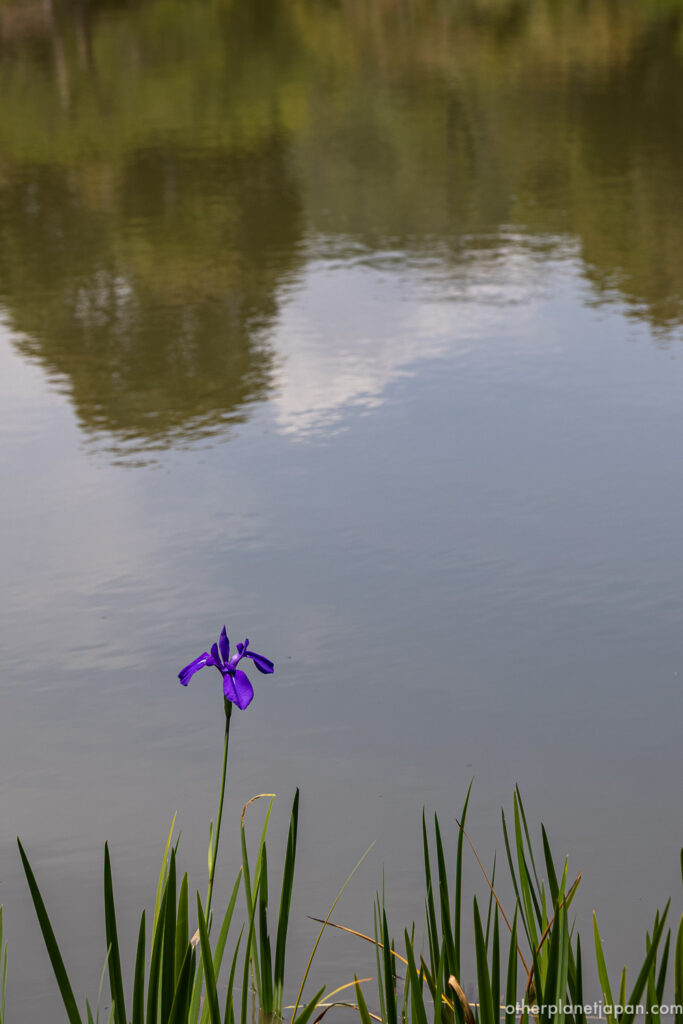
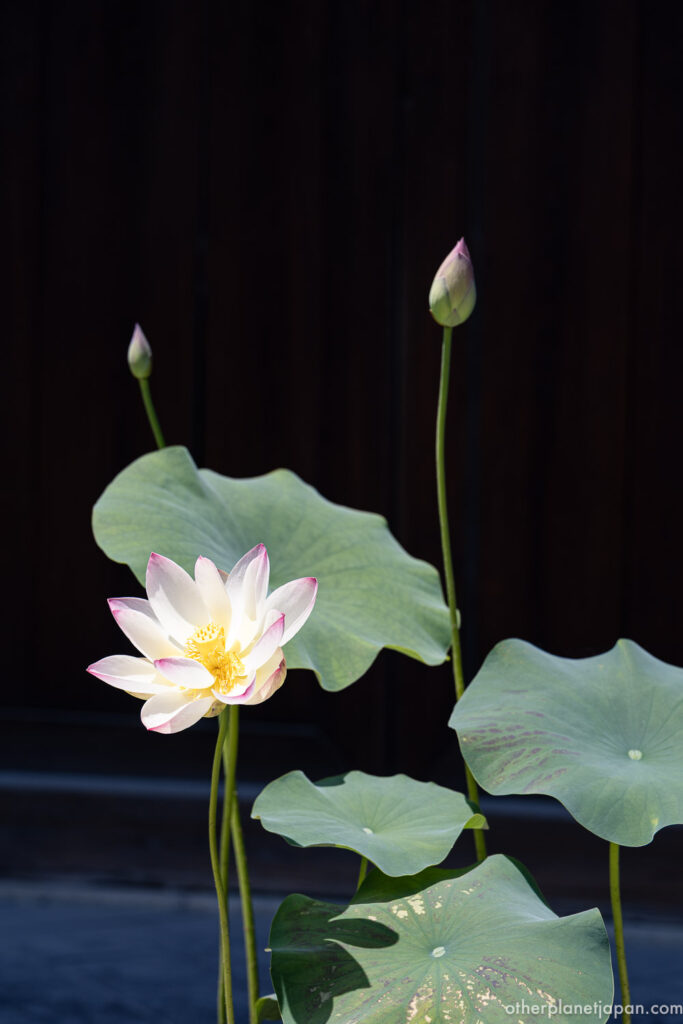
Visit in June or July and you may find lotus blooming in the stone water basins near the upper structures. Rooted in mud yet flowering above the surface, the lotus is one of Buddhism’s most enduring symbols of enlightenment. In a garden built to represent the Pure Land, finding one in bloom feels less like luck than inevitability.
The Admission Ticket Is an O-Fuda
Pay your admission, then look at what you’re handed.
It isn’t a ticket in the usual sense. It’s an o-fuda (お札) — a paper talisman bearing the image of Kinkakuji and a Buddhist invocation, the same kind sold as a protective charm at temple and shrine shops. Here it serves as your admission slip. What you’ve paid for is both entry and a blessing.
Kinukake-no-Michi: The Road That Connects It All
Kinkakuji sits at the eastern end of a road worth knowing.
Kinukake-no-Michi (きぬかけの路) runs roughly 2.5 kilometers, linking three of northwest Kyoto’s significant temples. The name — loosely, “the silk-draping road” — comes from a legend in which Emperor Uda had snow draped over Mt. Kinugasa to cool a summer day, then had white silk draped in its place once the snow melted.
Walk its full length and you go from Kinkakuji west to Ryoanji, home of Japan’s most famous dry rock garden, and finally to Ninnaji, with its five-story pagoda and late-blooming cherry trees. The three temples are distinct enough that the road reads like a single, unhurried argument about what Kyoto chose to keep.
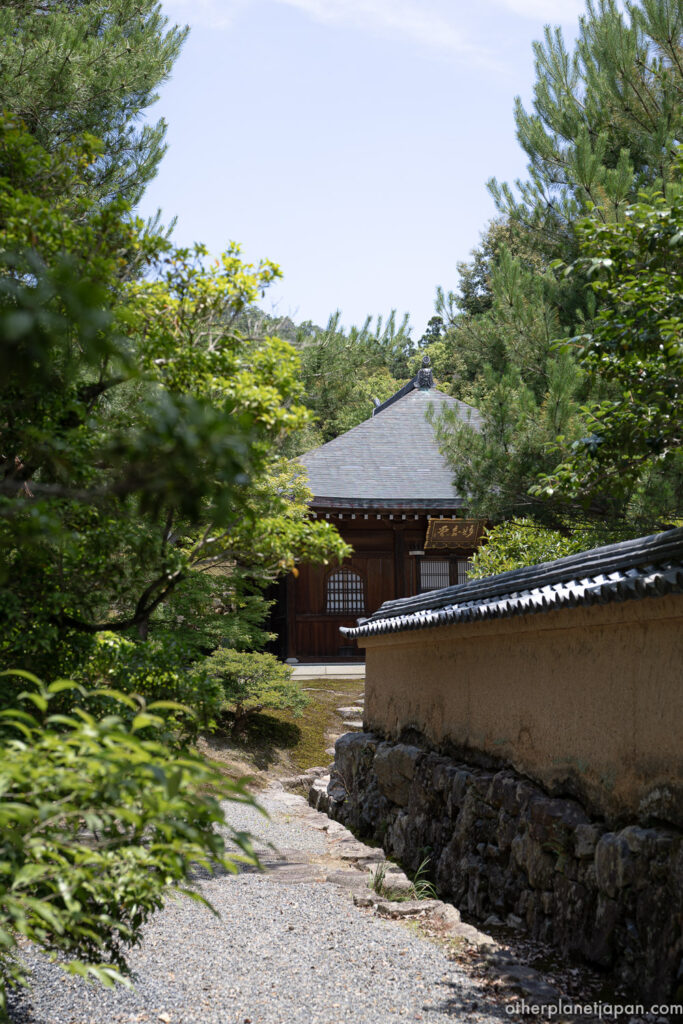
If you’re walking all three, allow 3 to 4 hours at an unhurried pace. Kinkakuji takes the most time; Ryoanji rewards standing still in front of the rock garden; Ninnaji is for wandering. The road itself is an ordinary city street — save your energy for the grounds.
If you happen to be visiting between late March and mid-April, there is one more destination worth the detour. Haradanien (原谷苑), a private cherry blossom garden tucked into the hills north of Kinkakuji, opens to the public only during the brief spring bloom. It is not a temple, not a park — just a hillside dense with weeping cherry trees that, at peak bloom, feels like standing inside a pink cloud. The 2026 season ran from March 23 to April 20; dates for 2027 have not yet been announced.
Practical Information
Everything above is the experience. What follows is how to give yourself the best shot at it — the hours, the crowds, the rules nobody mentions until you’re stopped at the gate.
Hours
Kinkakuji is open daily, 9:00 a.m. to 5:00 p.m., year-round. During special viewing periods the hours can differ, so check the official website if you’re visiting around a major seasonal event.
Admission
Adults (high school age and up): ¥500. Elementary and junior high students: ¥300. As noted above, your ticket comes in the form of an o-fuda talisman.
Goshuin
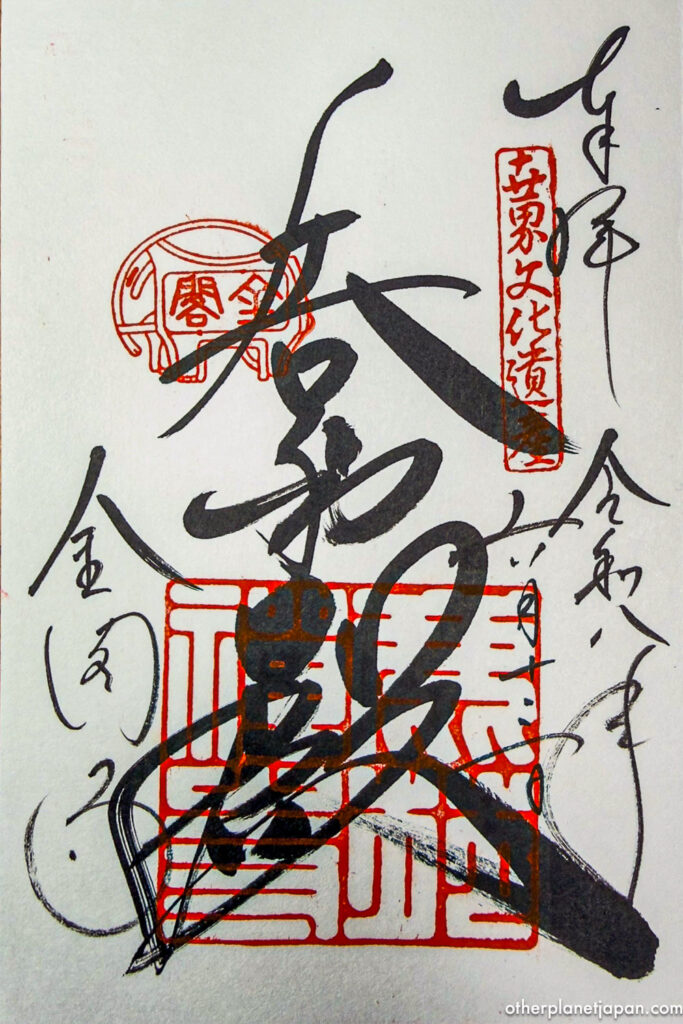
Kinkakuji offers two goshuin (temple seal stamps for collectors’ books).
The standard Kinkakuji goshuin is available as a direct inscription (直書き) in your goshuin-cho for ¥300. The stamp office sits near the end of the circuit, before the exit.
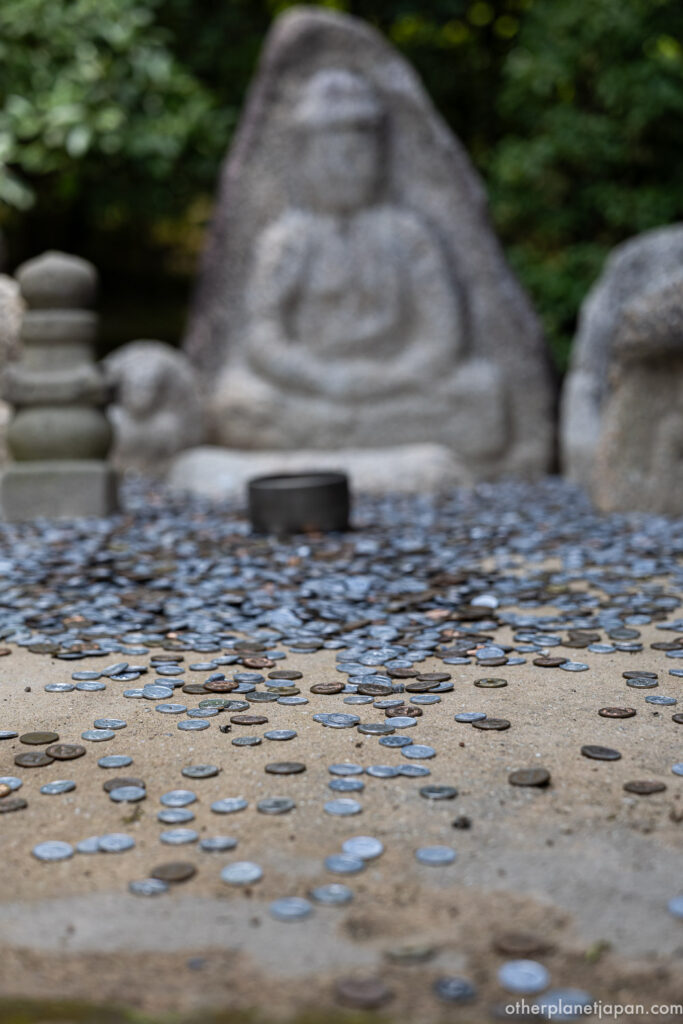
A second goshuin for Ishi-Fudo Myo-o (石不動明王), the stone Fudo deity within the grounds, is available as a pre-written paper insert (書き置き) only, also ¥300. This one cannot be inscribed directly into your book.
Time Required
The one-way circuit takes most visitors 45 minutes to 1 hour at a comfortable pace. Allow 90 minutes if you’re stopping to photograph.
Best Time of Day
Opening time (9:00 a.m.) is when the grounds are emptiest. Tour groups begin arriving in earnest about 20 to 30 minutes later.
Photography
Monopods and tripods are prohibited within the grounds — this is clearly posted at the entrance. What is not on the official website, as of my visit, is that gimbals are also prohibited. A staff member stopped me when I tried to use one, and Japanese visitors report the same in online reviews. Plan to film handheld.
Note too that the circuit is one-way: you can’t double back to re-shoot something you passed, so compose as you go.
Accessibility
You can reach the area right beside the shariden without major steps, close enough to view it well. Beyond the pavilion, however, there is a staircase. Wheelchair and stroller users turn back before it and exit via the entrance.
Note also that there are no benches or seating anywhere on the grounds. Make sure you have the stamina to walk the full circuit before entering — worth keeping in mind for anyone with limited mobility or small children.
How to Get There
Kinkakuji has no nearby train station. From central Kyoto:
By bus: Kyoto City Bus routes 12, 59, 205, and M1 stop at Kinkakuji-michi (金閣寺道), a short walk from the gate. From Kyoto Station, route 205 is convenient; from Shijo-Karasuma, route 12 or 59. Budget 30 to 50 minutes depending on traffic. Buses can fill up on weekends and in peak season, but they run frequently — miss one and the next is close behind.
By taxi: Roughly 25 to 35 minutes from Kyoto Station, about ¥1,500 to ¥2,000 depending on traffic. A good option for an early arrival ahead of the bus crowds.
On foot from Kitano Tenmangu: If you’re combining the two — which I’d recommend — it’s about 1.2 kilometers, 15 to 20 minutes. The route has little shade, so carry water in summer.
Tea on the Grounds
For matcha, head to the Kinkakuji Fudo Kama Jasho (金閣寺不動釜茶所), the temple’s tea house, where matcha with a traditional sweet runs ¥500 — a good place to rest after walking the circuit.
Official Website
For the latest information on hours, admission, and seasonal viewing, visit the official Kinkakuji website. Note that the site is in Japanese only — use your browser’s translation function if needed.
Frequently Asked Questions
When can I see Kinkakuji in snow?
Snow at Kinkakuji is possible, but not guaranteed in any given year. Kyoto sees snow mainly between late December and mid-February, with January the likeliest month. The combination of snow on the gold and a whitened garden is considered one of Japan’s great winter scenes, and floods social media whenever it happens.
If you’re hoping to catch it, watch the local forecast closely. Kyoto snow is often short-lived — it can settle in the morning and melt by noon. Your best bet is to arrive at opening time the morning after a snowfall. The temple opens on its normal schedule regardless of weather.
In recent years, accumulating snow has fallen only about three or four days per winter, so a garden white enough for the classic shot is far from a sure thing.
Can I go inside the shariden?
No. The interior of the pavilion is closed to visitors; you view it only from across the pond. That distance — and the reflection — are part of how the building was meant to be seen.
How long should I budget for a visit?
The one-way circuit takes most people 45 minutes to 1 hour at a normal pace. Allow 90 minutes if you’re photographing carefully.
Can I visit with a wheelchair or stroller?
You can reach the area right beside the shariden without major steps and view it up close. There is a staircase beyond the pavilion, however; wheelchair and stroller users turn back before it and exit through the entrance.
Which season is best?
Each season has its own face. Autumn (late November to early December) sets red maples against the gold — arguably the most photogenic combination. Winter brings the chance of snow and far thinner crowds. Spring adds fresh green and a few cherry blossoms in the garden. Summer (when I visited) brings lotus in bloom and gold so bright in the strong light it’s almost hard to look at — along with the heaviest crowds of the year.
No season is wrong. There’s only the season you have.