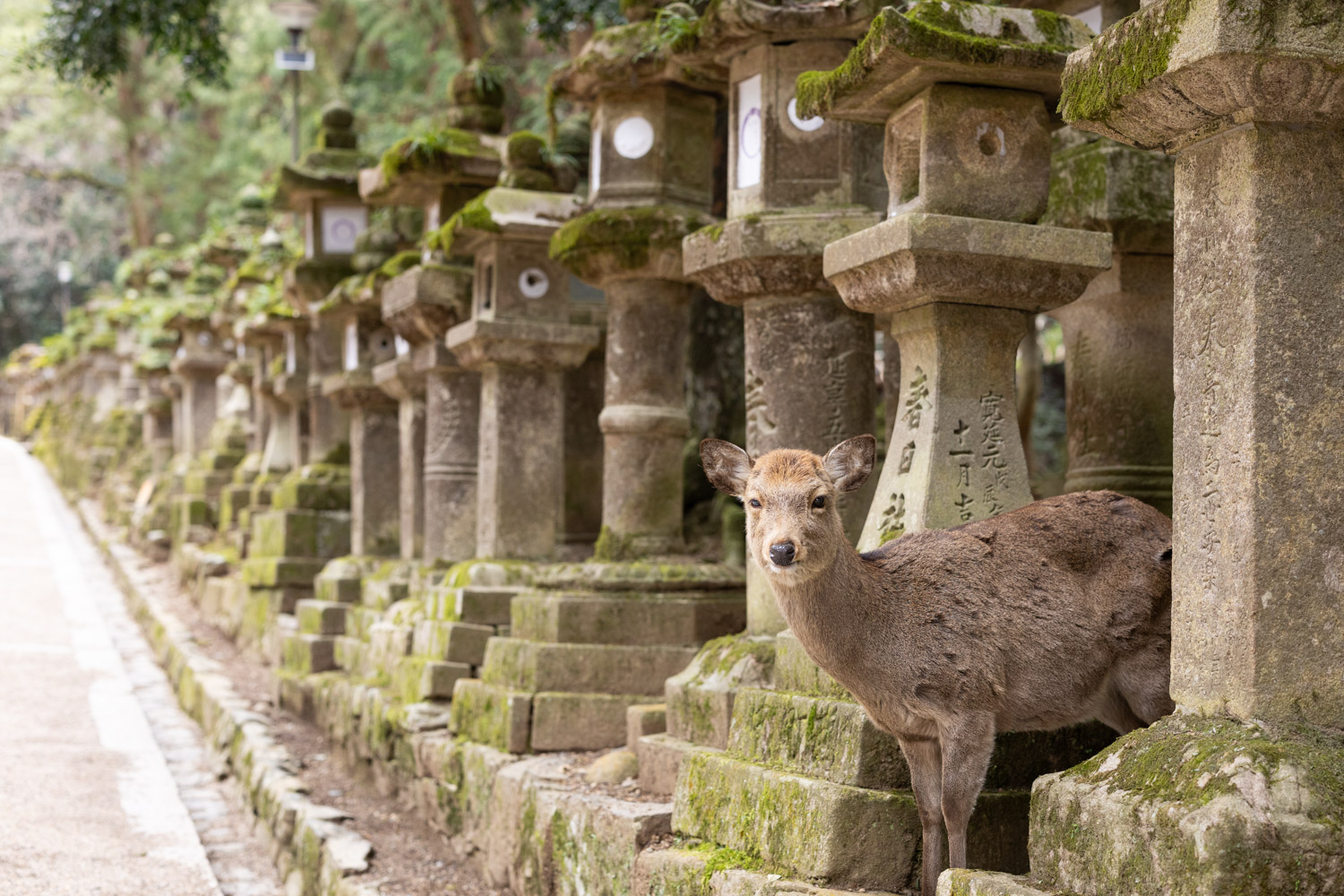
I did not yet know what would happen at Kasuga Taisha that morning.
The Empty Approach at Dawn
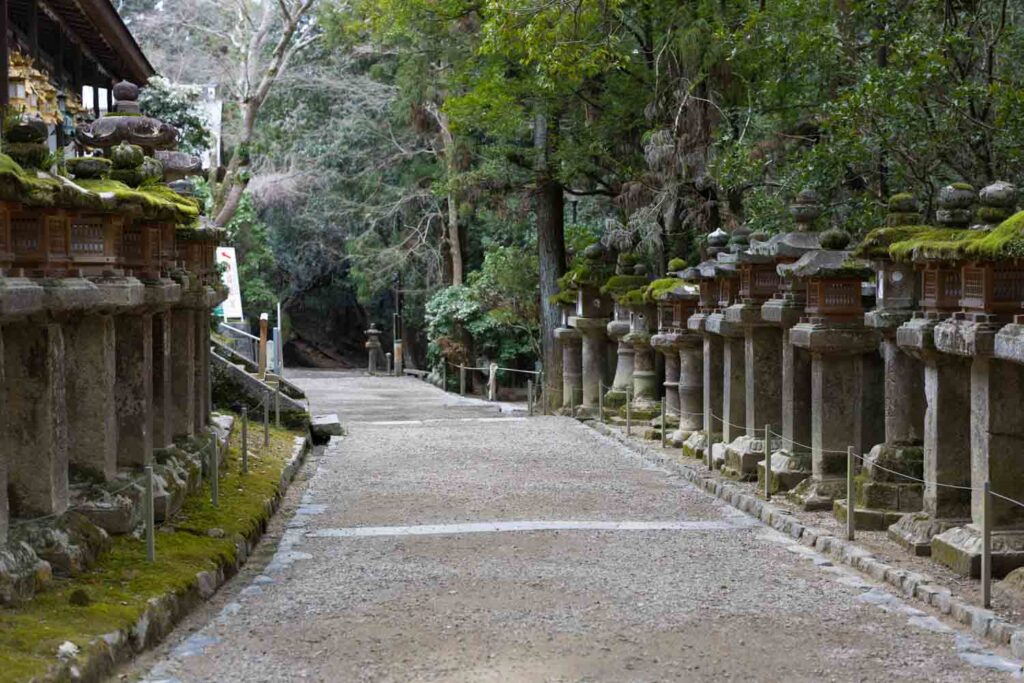
The real purpose of the day was the Shunie ceremony at Todai-ji, beginning at seven in the evening. I arrived at Kintetsu Nara Station at 7:50 in the morning. Kasuga Taisha holds a daily ritual called chōhai — a morning worship that visitors can join — and I wanted to make the 8:50 gathering. Thirty minutes on foot from the station. Plenty of time.
The approach was beautifully, almost suspiciously, empty. A few deer watched me from the side of the path but offered no bows. They seemed to know I carried no shika senbei — or perhaps they already knew the cracker vendors hadn’t arrived yet. I tried to photograph them against the deserted sandō, envisioning one of those serene, tourist-free compositions. The deer were not interested in modeling on credit. The promise of future crackers, it turns out, does not constitute a binding agreement in the deer economy.
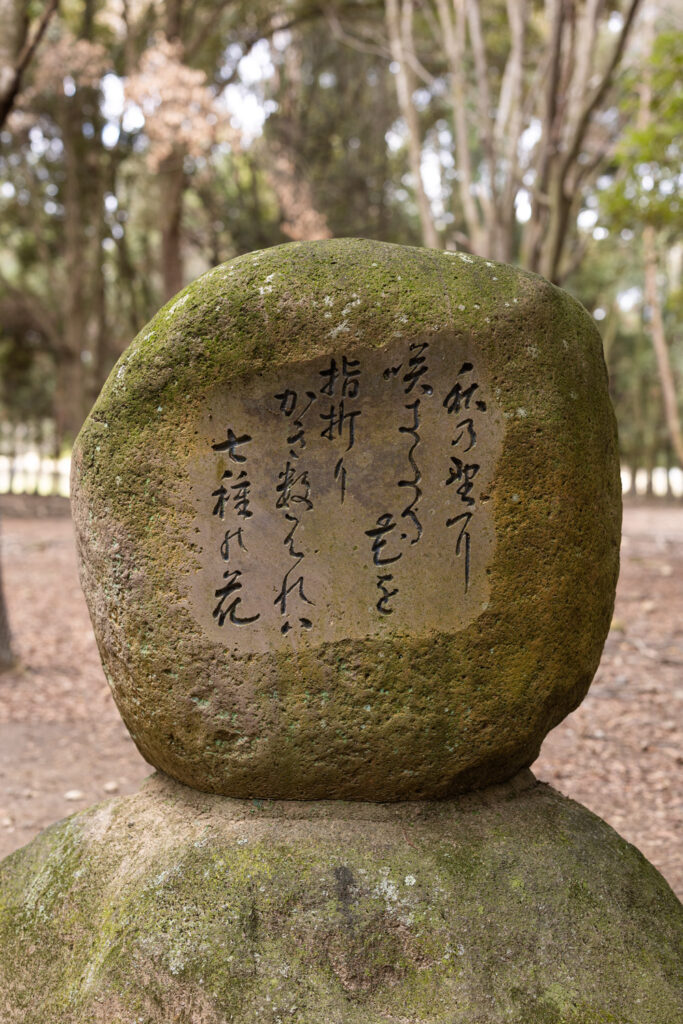
Halfway along the path, I noticed a stone monument. A Man’yōshū poem by Yamanoue no Okura — the one that gave us the Seven Flowers of Autumn. Counting on my fingers the flowers blooming in the autumn fields, I find seven kinds. Thirteen centuries ago, a poet stood in this same stretch of forest and counted wildflowers on his fingers. This felt like the sort of thing you want to tell someone. But there was no one around. Only deer. And deer, as I had just established, are not interested in anything you cannot eat.
Chōhai: A 1,300-Year Morning Worship You Can Join
I made it to the morning worship just in time. I had seen the chōhai mentioned on Kasuga Taisha’s website and had long wanted to attend, though I had no clear picture of what it would actually be. Inside the Naorai-den hall, roughly thirty worshippers were already seated. After the norito prayers, the shinto priest spoke. It was March 8th, and the subject was Todai-ji’s Shunie. Eleven monks, he explained, perform the rite on behalf of the entire nation — praying for peace and an abundant harvest, carrying the weight of that prayer for everyone. A Shinto priest, at a Shinto shrine, explaining why eleven Buddhist monks at the temple next door matter. In Nara, the gods and the Buddhas are still on speaking terms.
But it was the closing words that stayed. The priest explained that this morning worship has continued without interruption since the Heian period — and so has the register. It is still kept with brush and ink. The reason, he said, is simple: the records from thirteen hundred years ago were written that way, and they survive. So the method continues. Not because it is efficient, but because it is unbroken. Today’s count of roughly thirty would be entered into that ledger — the same kind of ink, the same kind of brush, the same kind of entry that someone made in the age of emperors and court poetry. The chōhai was opened to the general public after the 2011 Great East Japan Earthquake, an act of communal prayer in the wake of unimaginable loss. Eleven monks praying for a nation. Thirty strangers reciting a purification prayer at dawn.
The newest line in a thousand-year-old book. The morning prayer was a far grander thing than I had imagined.
Eleven Monks, Thirty Strangers, and a Thousand-Year Ledger
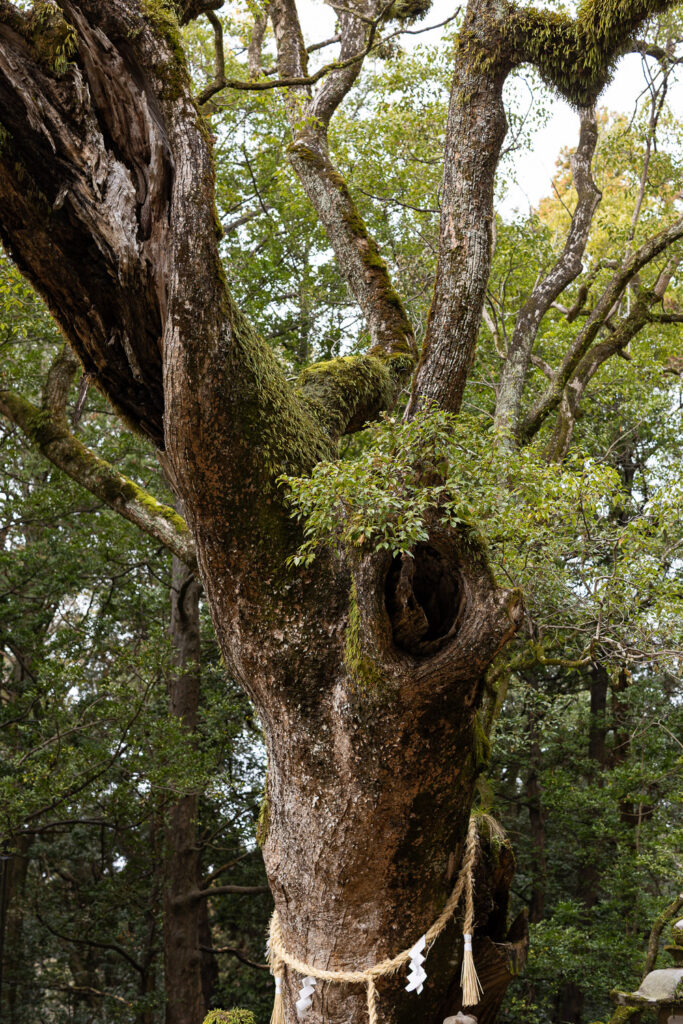
After the morning worship, a second shinto priest offered a guided walk through the shrine grounds — visiting the subsidiary shrines one by one, explaining each as we went. This had not been on my itinerary.
Nearly all thirty worshippers stayed.
At Wakamiya shrine, the priest described the era in which it was built. The people of that time, he said, believed the world was ending. Buddhist eschatology — the doctrine of mappō, the final age of dharma — had saturated the culture with a sense that salvation was slipping beyond reach. Into that despair, a new deity appeared. Or perhaps it is more accurate to say that the despair itself called the deity into being. This was not a story I had encountered in any historical drama or novel, nor in any classroom. Standing in front of the shrine where it happened, hearing it from a priest who tells it every morning, the distance between knowing history and standing inside it collapsed entirely.
The tour lasted a full hour. An unplanned hour. And all of it — the morning worship, the guided walk, the priest’s stories — was free.
The shrine grounds hold sixty-two subsidiary shrines, and visitors are asked to contribute toward their upkeep. Half of the donations, the priest explained, would go toward rebuilding a Kasuga shrine in Suzu, Ishikawa Prefecture — one of the shrines in the Kasuga network — that collapsed in the Noto Peninsula earthquake on New Year’s Day, 2024. I made a contribution. A modest one, embarrassingly so, given the hour of undivided attention we had just received.
There is, I learned, a tradition at the shrine: a kagura dance performed by a miko, offered on behalf of a worshipper whose prayer has been answered. It was once enormously popular. I made a quiet promise to myself. Someday, I would come back for that.
Kasuga Taisha keeps certain things in reserve for those who arrive before the crowds do.
Three Thousand Lanterns in Darkness
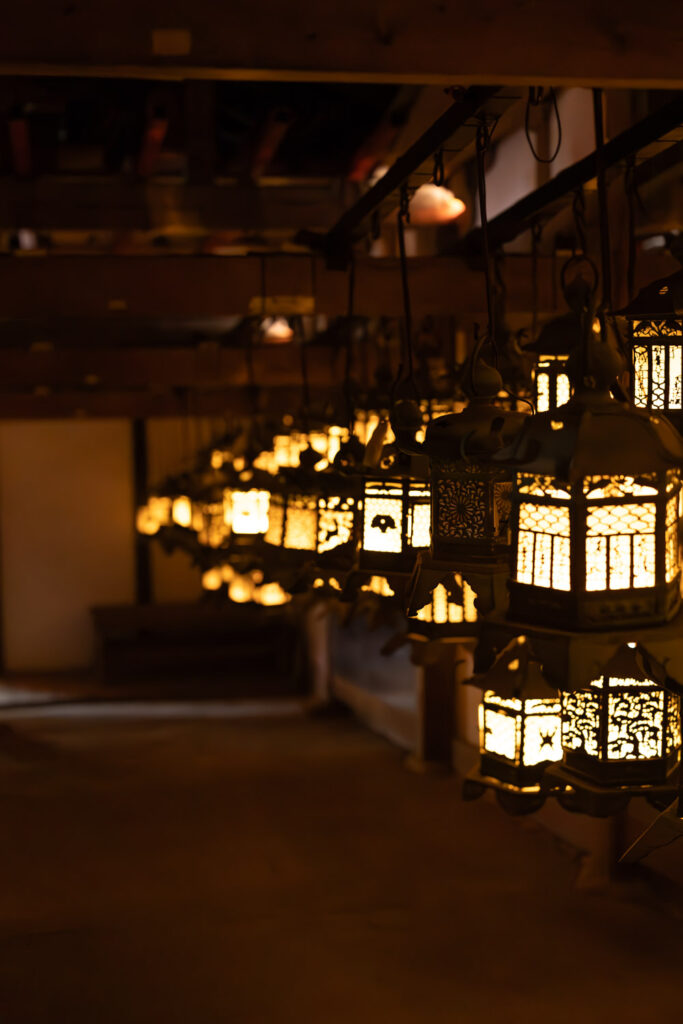
There are roughly three thousand lanterns at Kasuga Taisha. About two thousand are stone, lining the approach and the shrine grounds. Another thousand are bronze, hanging in rows from the eaves of the covered corridors. Donated over centuries by worshippers of every station — shoguns and merchants, farmers and court nobles — each one represents a prayer made permanent in stone or metal. Some bear dates from the Kamakura period. Others carry the crests of families that no longer exist.
But numbers do not prepare you for the corridors.
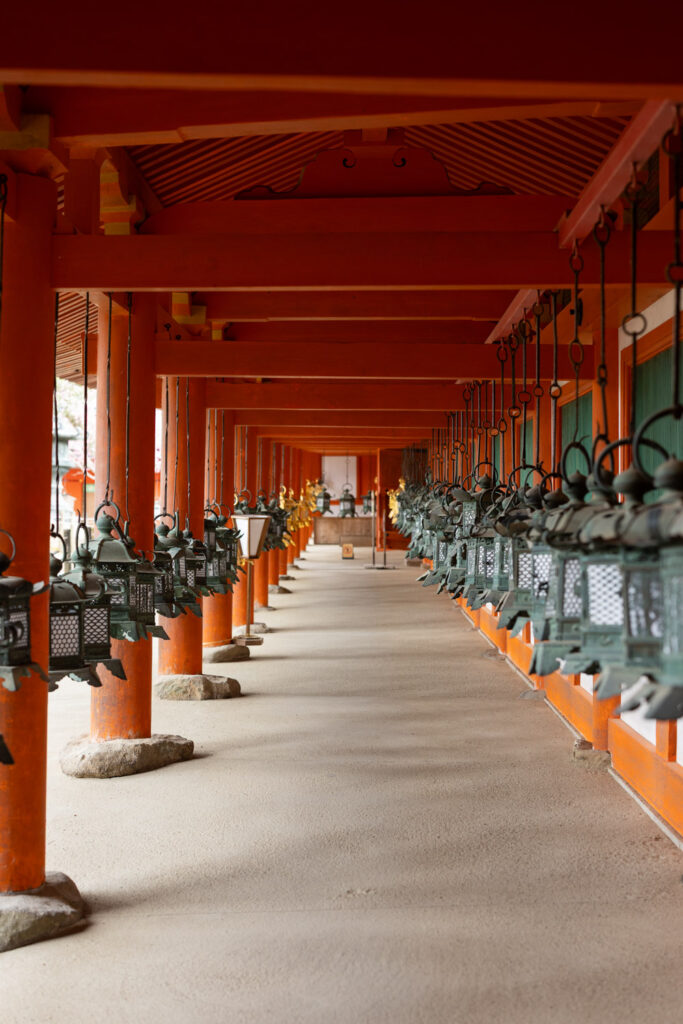
[IMAGE — kasuga-taisha-vermilion-corridor-bronze-lanterns-nara.jpg / Alt: Vermilion pillars and bronze lanterns line the covered corridor of Kasuga Taisha]
The kairo — the covered walkways that encircle the inner shrine — are dim even in daylight. Bronze lanterns hang at eye level in dense rows, close enough to touch, stretching ahead in a perspective that seems to narrow into darkness. The effect is not decorative. It is atmospheric in the original sense of the word: the air itself changes. You are no longer outside. You are inside something.
Twice a year, every lantern in the shrine is lit. On the evening of Setsubun in early February and during the Obon festival in August, the corridors fill with the light of a thousand small flames. The event is called Mantoro — ten thousand lanterns, though three thousand is closer to the truth. The Japanese, when they want to say “more than you can count,” reach for ten thousand.
I went to the Setsubun Mantoro on a February evening. The darkness was not something that was simply there; it was something the lanterns created. Each flame carved a small circle of warm light in the surrounding black, and the bronze surfaces caught and multiplied it, so that the corridors seemed to breathe. There was no sound except footsteps on stone and the occasional rustle of a coat sleeve. No one spoke. It was the kind of silence that does not need to be enforced because no one wants to break it.
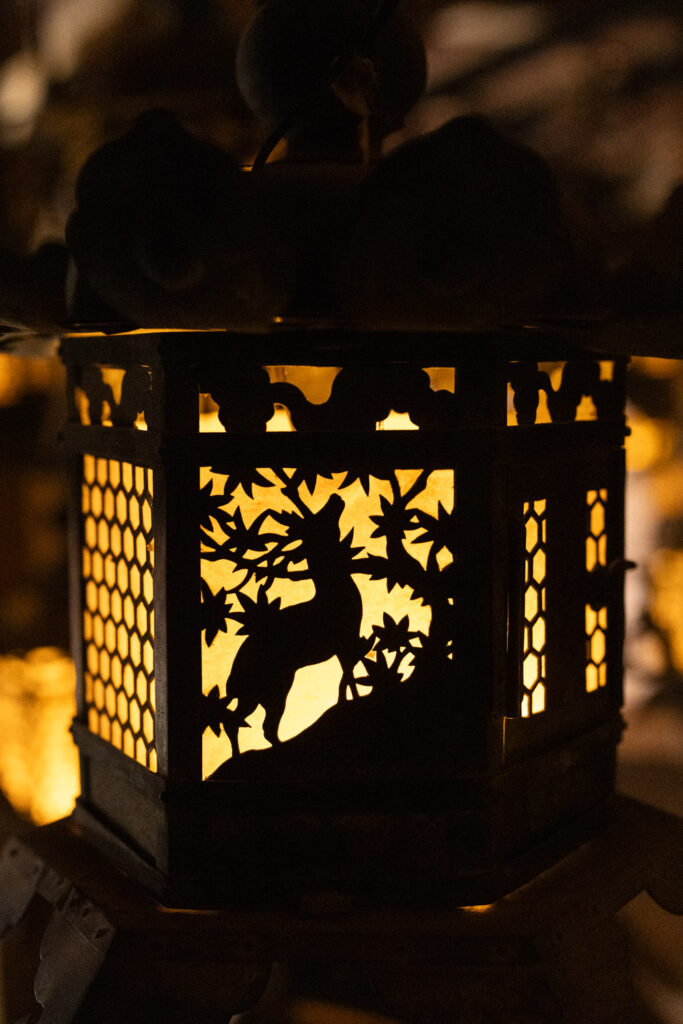
For those who cannot time their visit to Setsubun or Obon, the Fujinami-no-ya hall offers a year-round approximation. A darkened room with a selection of lanterns lit inside it, giving a sense of what the full Mantoro feels like. It is not the same. But it is enough to understand what three thousand flames might do to a corridor, and to a person standing in it.
The Forest That Has Never Been Cut
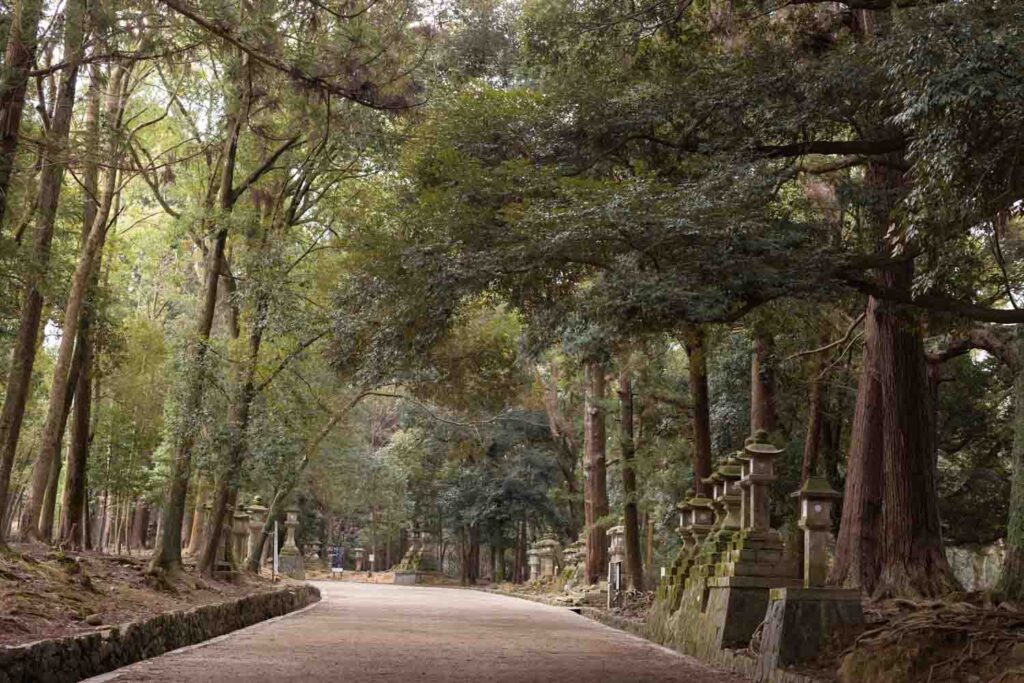
Behind Kasuga Taisha, rising steeply into the hills east of Nara, is a forest that has been protected from logging for over a thousand years. Kasugayama Primeval Forest is part of the UNESCO World Heritage designation “Historic Monuments of Ancient Nara,” and its survival is not an accident of geography. It is an act of sustained intention. The forest is sacred ground — the domain of the shrine’s deities — and the prohibition on cutting its trees has been enforced since at least the ninth century.
You do not need to hike deep into the forest to feel its presence. Walking the sandō from the first torii gate to the shrine, the trees close in gradually. The light changes. The temperature drops. The canopy thickens overhead until the path feels less like an approach to a building and more like an entrance into something older than the building itself. Cryptomeria, evergreen oaks, and species that have had centuries to grow without interference stand in a density that urban Japan makes you forget is possible.
For those who want to go further, the Takisaka-no-michi trail leads deeper into the mountain, past moss-covered stone Buddhas and along a route that has been walked by pilgrims for centuries. The full circuit of Kasugayama takes several hours and rewards with views, silence, and the particular quality of light that filters through a canopy untouched by human calculation. I have not yet walked it. The morning had already given me more than I had planned for. But the forest does not go anywhere. It has been waiting for a thousand years. It can wait a little longer.
Getting There and Practical Tips
Kasuga Taisha is a fifteen-minute bus ride or a thirty-minute walk from Kintetsu Nara Station. The walk, along a path through Nara Park, is the better choice. You pass through the deer, under the first torii, and into the forest approach without ever feeling like you are commuting. By the time you reach the shrine, the city has already disappeared behind you.
The shrine grounds are open daily, generally from 6:30 AM to 5:30 PM from March through October, and from 7:00 AM to 5:00 PM from November through February. The chōhai morning worship gathers at approximately 8:50 AM at the Naorai-den hall, adjacent to the main worship hall. It is free, requires no reservation, and lasts about thirty minutes. The guided walk of the subsidiary shrines that follows is also free and lasts roughly an hour. Both are conducted in Japanese, but the experience transcends language — the prayers, the architecture, and the priest’s presence communicate in a register that does not require translation.
Special worship of the inner sanctuary (Tokubetsu Sanpai) is available for a fee of 500 yen and gives access to the corridors where the bronze lanterns hang. This is worth doing regardless of the season. The Fujinami-no-ya hall, which offers a simulated Mantoro experience in a darkened room, is included.
The full Mantoro takes place twice a year: on Setsubun (February 3rd) and during Obon (August 14th–15th). Arrive early. Both events draw significant crowds, and the corridors are experienced best when you are not pressed shoulder to shoulder with other visitors. Setsubun Mantoro has a particular quality — winter darkness falls early, the February air is sharp, and the warmth of the flames is not merely visual.
In late April through early May, the sunazuri-no-fuji wisteria blooms beside the main hall. The flower clusters hang so low they nearly touch the sand — hence the name. I have not yet seen it in season. It is another reason to return.
Kasuga Taisha’s position in Nara makes it a natural companion to Todai-ji, a ten-minute walk to the northwest. If you are visiting during March, the Shunie fire ceremonies at Todai-ji’s Nigatsu-do hall are a powerful pairing — a Buddhist ritual of repentance performed nightly for two weeks, mere minutes from a Shinto shrine whose morning worship has never stopped. The proximity is not coincidental. In Nara, these traditions grew up together, and they remain, quite literally, neighbors.
For those with more time, the Nara Park area holds enough to fill two days without repeating a single step. Kofuku-ji, with its five-story pagoda and National Treasure hall. The Nara National Museum, particularly during the autumn Shoso-in exhibition. And the deer — always the deer — who will be considerably more attentive to you in the afternoon, once the cracker vendors have opened and the economy of bowing has resumed.
I arrived at Kasuga Taisha for a morning prayer and stayed until nearly noon. I came for the Shunie ceremony at Todai-ji and left with a thousand-year-old entry in a ledger, a memory of lanterns breathing in darkness, and a quiet promise to return for a dance I have not yet earned.
The shrine has been here since 768 AD. It has survived earthquakes, fires, wars, and the slow erosion of centuries. Every twenty years, its buildings are ritually renewed in a process called Shikinen Zōtai — the same philosophy of perpetual renewal that governs Ise Grand Shrine. The wood changes. The form remains. The prayers continue.
The newest line in a thousand-year-old book. Written in brush and ink, because that is how the first line was written, and every line since.