Matcha, matcha, matcha.
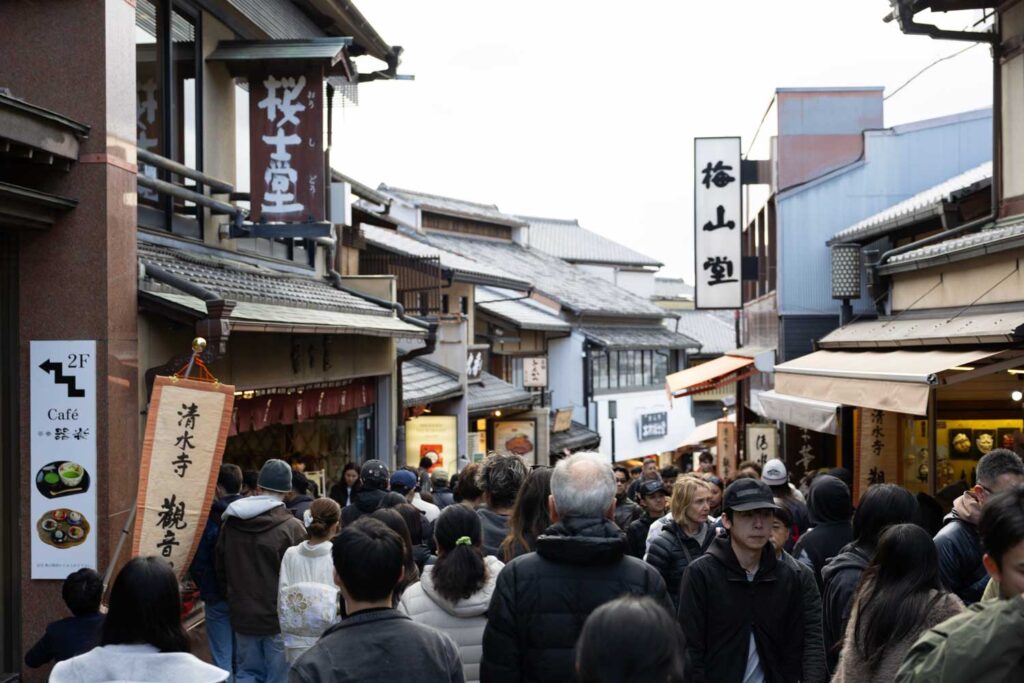
The hands of everyone walking along Kiyomizu-zaka carry matcha soft serve. There are lines outside every shop. Matcha on every sign. Vanilla, chocolate, matcha — that is the standard hierarchy of soft serve flavors in Japan, but on Kiyomizu-zaka, the order flips. Here, matcha takes the lead.
March 15. Kyoto’s cherry blossoms are still weeks away, yet the air has already fast-forwarded into spring. Travelers walk uphill with soft serve in one hand and a shed jacket draped over the other arm, eyes scanning both sides of the street so as not to miss a single shop.
I had to resist the temptation of matcha. Kiyomizu-zaka was so packed that day it was hard to move, and I wanted to avoid standing for an hour on the evening train back to Osaka.
Then, halfway down the slope, my feet stopped.
A faint smell of something scorched. Not sweetness. Something nostalgic — oil and the umami of fish, tangled together. My nose reacted first. My brain had not caught up.
I had been rushing to leave, but two shops past the source, I turned back. Smell has its own gravity. This was the kind of pull you cannot resist.
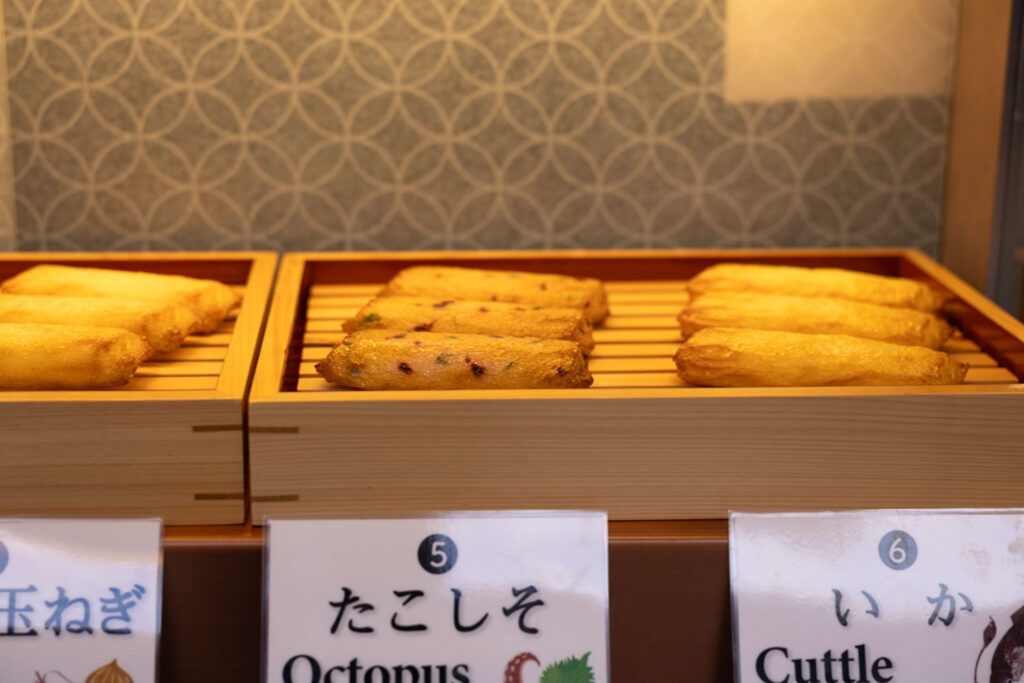
I looked at the food samples lined up in the storefront, and it finally clicked. Satsuma-age — deep-fried fish cake. Steam carrying the savory scent of fried surimi drifted thin above the crowds on Kiyomizu-zaka.
Five hundred yen at a world-famous tourist destination. I knew it was tourist pricing, but there was no hesitation. Inside the shop, I was surprised to find so many customers. Foreign travelers, drawn by the same gravity, were trying to identify the source of an unfamiliar smell.
I decided to slow down and follow the lead of the tourists around me.
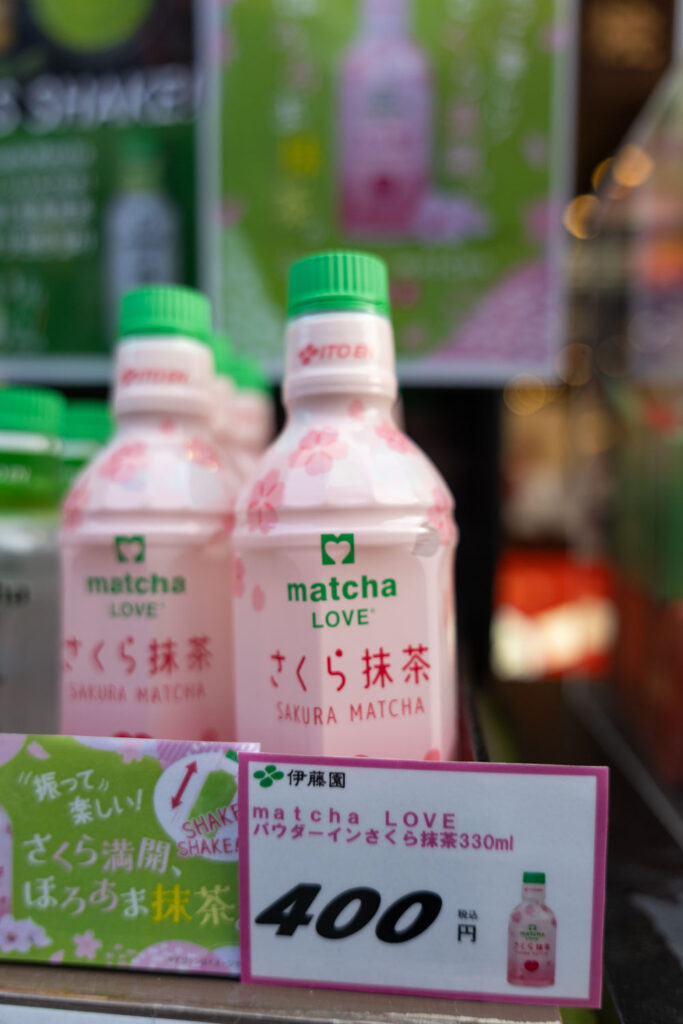
Among the matcha displays, pink had staged a quiet takeover. Sakura-flavored yatsuhashi. Sakura matcha in plastic bottles. Lightly salted, subtly floral — flavors available only during this narrow window of the year.
Japan has a phrase: sakura saku — “the cherry blossoms bloom,” which doubles as slang for passing an exam. Every spring, that logic extends to Kit Kats and instant ramen, lining the shelves of convenience stores and supermarkets across the country as edible good-luck charms for exam season.
That much makes sense. But when beer arrives wearing cherry blossom packaging, the reasoning shifts. Apparently, that is simply an act of respect for the season. The beer, I should mention, does not taste like cherry blossoms.
The next thing that caught my ear was the sound of a wind chime. A clear, high note sliced through the noise of the street for just a moment. For Japanese people, the sound of a wind chime is coolness itself. The sound does not actually change the temperature. But our brains have been trained to feel that way over hundreds of years.
The wind, however, was not real. A small electric fan, placed at the storefront, was dutifully blowing air toward the chime. Without wind, a wind chime can only stay silent. Having to rely on artificial wind to prove its own existence struck me as slightly pitiful.
For a moment, I felt the urge to explain the meaning of this sound to the foreign travelers passing by. That any Japanese person who hears this high-pitched ringing instantly feels cooler. But in the crowds of Kiyomizu-zaka, I was the only one who had stopped in front of the wind chime.
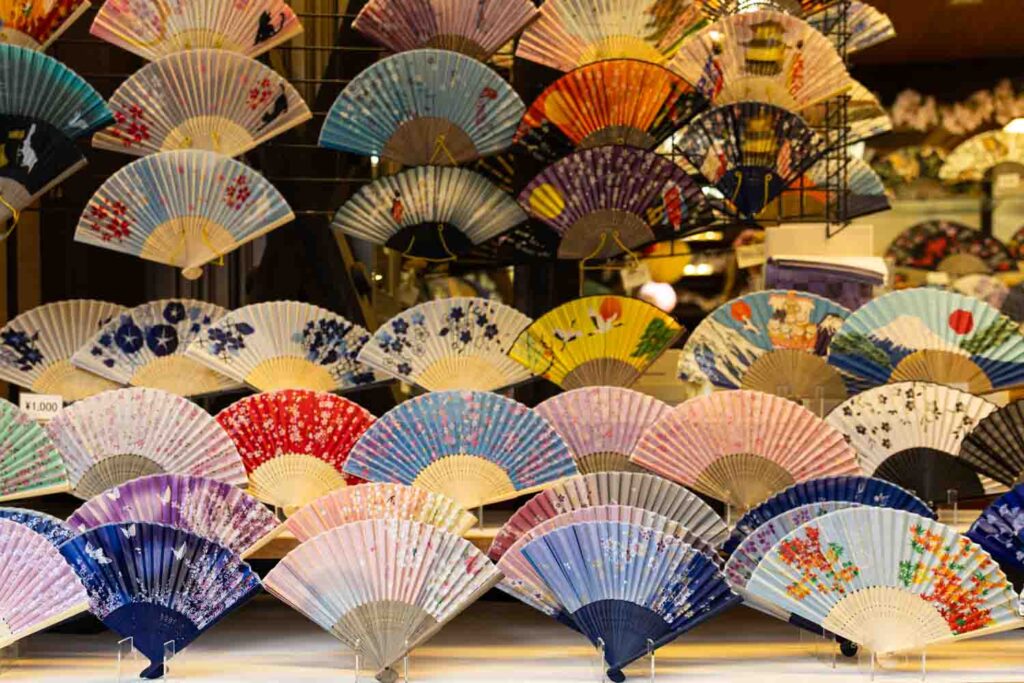
Fans covered an entire wall of the shop. Red, blue, gold, white — colors that belong to no particular season. Even without any intention to buy, my hands wanted to reach out. Patterns too early for spring were already on display. And yet I found myself wondering which one to choose.
A group of foreign women, wearing kimono they had likely put on for the first time in their lives, were taking photos of each other against the backdrop of the bustling slope. They were probably heading up to Kiyomizu-dera. The sight of them changing into kimono and climbing the hill reminded me of athletes pulling on their game jersey before stepping onto the field. If they were athletes, those smiles in the photos would be a career-high performance.
Turning off Kiyomizu-zaka onto a side street, the flow of people did not let up. The shops along Sannen-zaka had a slightly different feel from the standard souvenir stores on the main slope. Things I had never seen before — and I am Japanese — were casually arranged on shelves.
A shichimi togarashi specialty shop, for instance. A blend called “Maiko-han Hii Hii,” made with domestic habanero peppers, communicates its heat through the name alone. Kyoto has had a long tradition of shichimi spice blending, but the fact that the city has embraced habanero speaks to its quiet willingness to absorb anything.
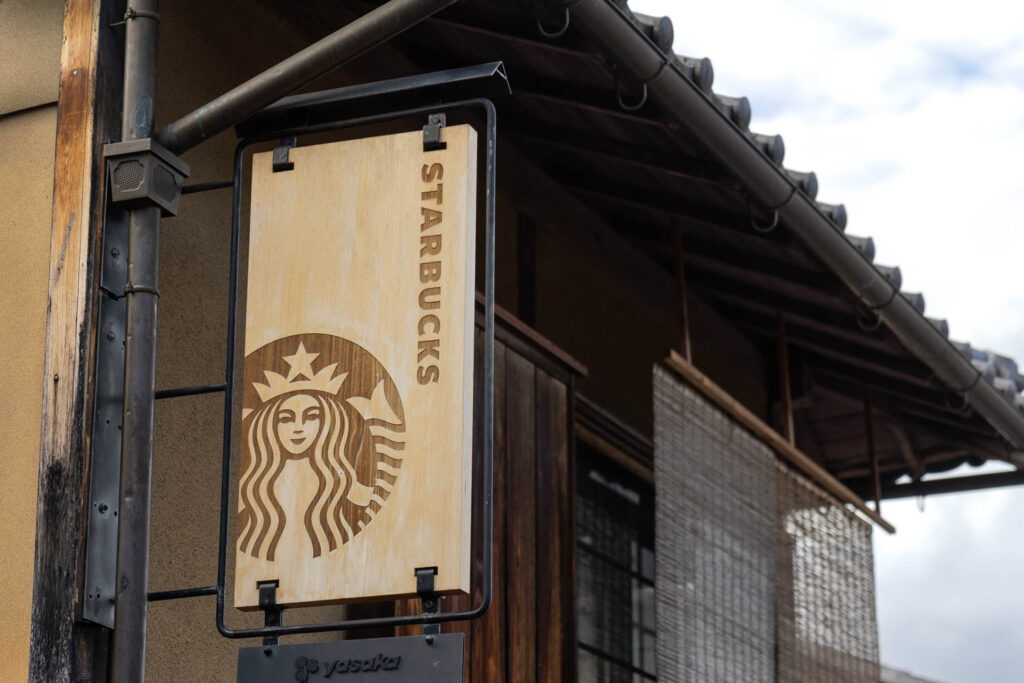
Walking further to Ninen-zaka, a Starbucks logo appeared — branded onto a wooden sign as if scorched by a hot iron. The shop occupies a traditional machiya over a hundred years old, and it blends so completely into the stone-paved streetscape that many travelers walk right past without noticing. I stopped to raise my camera. Within moments, several other travelers reached for their smartphones, apparently taking their cue from me. I like to think I made a modest contribution to their portrait albums.
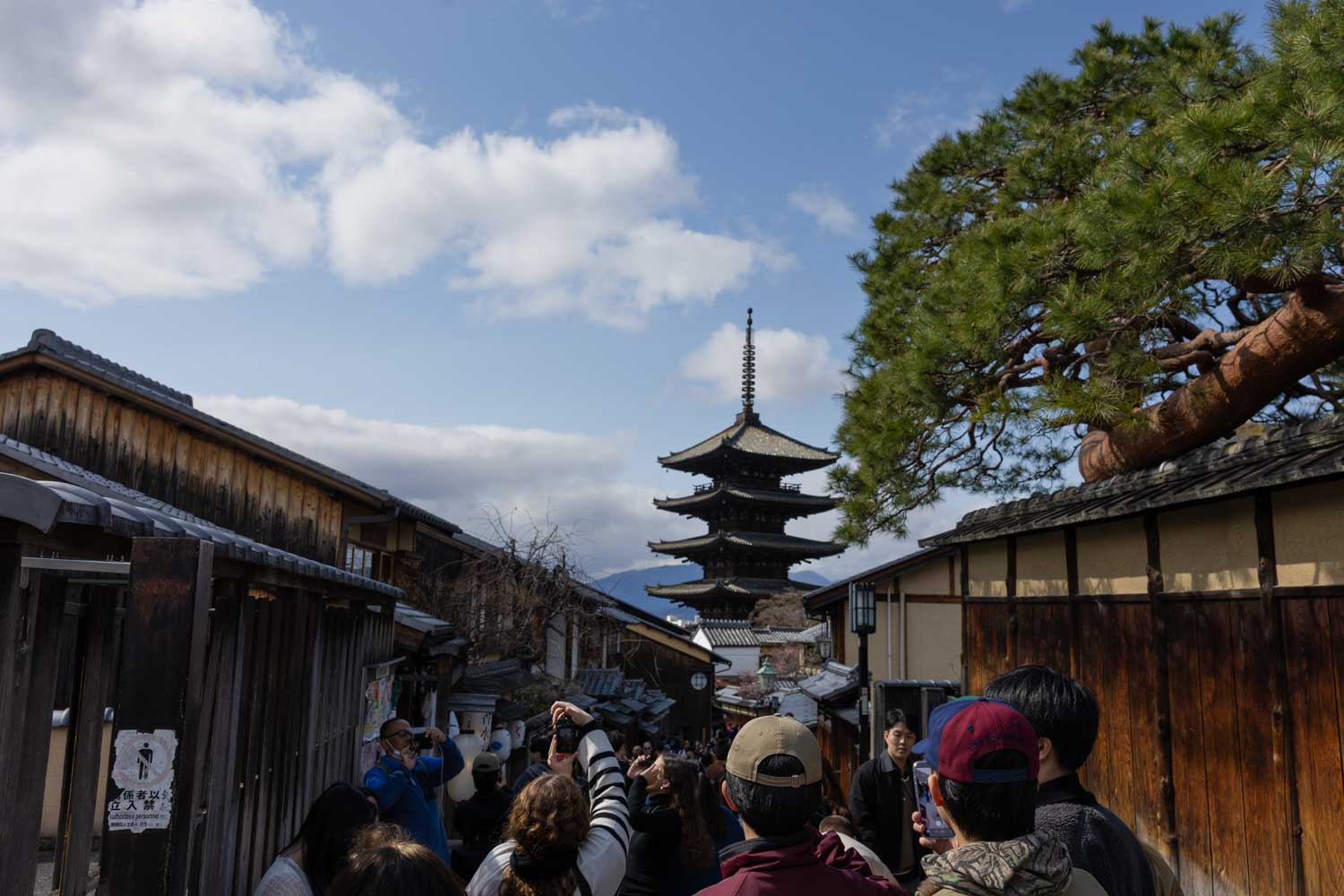
Leaving the crowds of Ninen-zaka behind, I turned onto Ishin-no-Michi — the Path of Restoration. The flow of tourists thinned almost immediately. The noise of the stone-paved lanes fell away. Looking up, Yasaka Pagoda rose above the Kyoto rooftops, the city spreading out beneath it. The overcast sky was a disappointment. Some might argue that clouds suit this view better than blue sky. For me, the light was missing.
Back on Sannen-zaka. The slope where Yasaka Pagoda looms close — one of the most photographed spots in Kyoto, if not all of Japan — was packed beyond movement. Come at dusk, I thought. On this day, I could only hurry past, careful not to step into anyone’s frame.
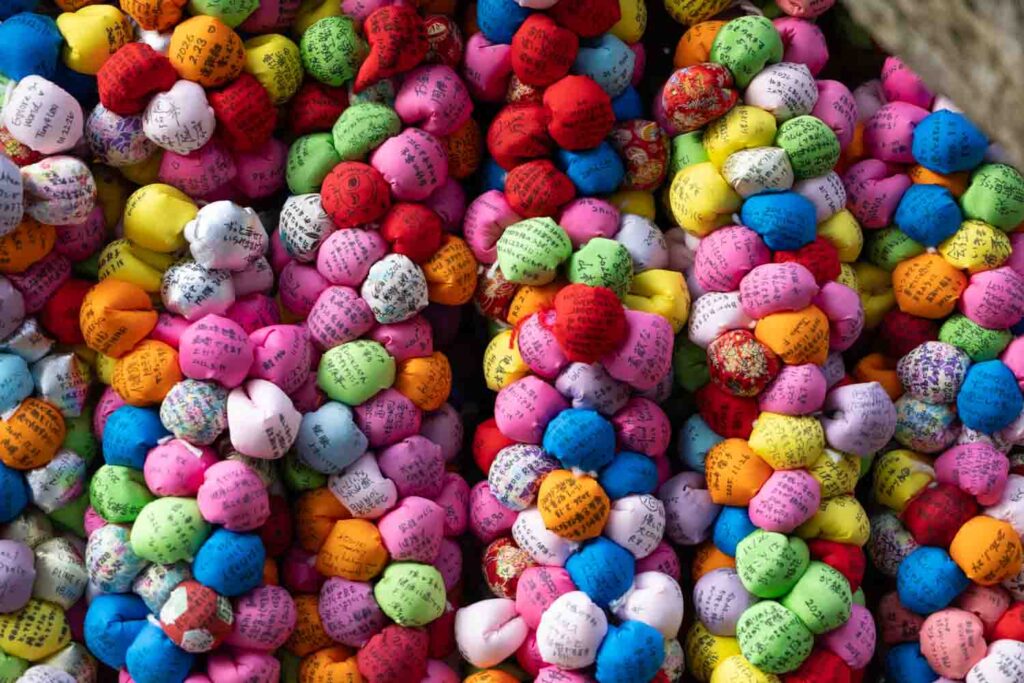
A little further down the slope from Yasaka Pagoda, Yasaka Koshindo temple appeared, decorated with vivid, colorful cloth balls. In the midst of Higashiyama’s historic streets, this tiny temple radiates something entirely its own. It, too, was overflowing with travelers trying to capture that burst of color in a photograph.
Families carrying souvenir bags in both hands, couples photographing half-eaten skewers, groups of women stopping for samples at every storefront. Everyone was savoring every minute of this slope.
The time of the evening train back to Osaka no longer mattered.
Visiting a city as a tourist, but unable to fully become one. This awkward in-between feeling always follows when a person living in Japan walks through Kyoto.
Matcha soft serve is available everywhere on Kiyomizu-zaka. But what stops your feet is the smell you did not plan for.
Walking Higashiyama: A Practical Guide
Getting to Kiyomizu-dera
From Kyoto Station, take City Bus 206 or Express Bus 86 from the Karasuma exit and get off at either Gojo-zaka or Kiyomizu-michi. The ride takes roughly 15 to 20 minutes depending on traffic. From the bus stop, the walk to the entrance of Kiyomizu-dera takes another 10 to 15 minutes up an atmospheric slope.
From Osaka, there are two main routes. On the Keihan Line, take the express from Yodoyabashi Station to Kiyomizu-Gojo Station, about 50 minutes, then walk approximately 20 minutes. On JR, take the Special Rapid from Osaka Station to Kyoto Station in about 30 minutes, then transfer to a bus or taxi.
A taxi from Kyoto Station costs roughly 1,500 to 2,000 yen. During busy periods, cars cannot reach the top of the slope, so expect to be dropped off near the Gojo-zaka intersection.
How to Avoid the Crowds
The single biggest variable in a Higashiyama walk is congestion.
Between 6 and 8 in the morning, the district is at its quietest. You can walk the stone-paved streets at your own pace, and photographs come without strangers in the frame. After 9 a.m., school groups and organized tours begin to arrive. Noon to 3 p.m. is peak time — the kind of crowd described earlier in this article, where moving forward becomes a negotiation.
After 4 p.m., the flow starts to thin. Past 5 p.m., most day-trippers and tour groups head for their buses, and the streets transform. The walls of traditional machiya catch the last light, lanterns begin to glow along the stone paths. Higashiyama at dusk is an entirely different place from Higashiyama at noon.
Weekdays are noticeably easier to navigate. On weekends and holidays, expect heavy crowds all day. The most intense periods of the year are cherry blossom season from late March to early April and autumn foliage from mid-November to early December — times when even getting on a bus can be a challenge.
Street Food on Kiyomizu-zaka and Sannen-zaka
The shop that stopped me in my tracks was Hokyuan, where handmade satsuma-age — deep-fried fish cakes, a traditional Japanese savory treat — are served hot for about 500 yen each. In a street dominated by sweets, this is a welcome counterpoint of salt and umami.
On Sannen-zaka, the shichimi togarashi specialist Ochanokosaisai (3-316-4 Kiyomizu, Higashiyama-ku, Kyoto) sells the “Maiko-han Hii Hii” series, made with domestically grown habanero peppers. For travelers who love spice, few souvenirs are more distinctly Kyoto than this.
Wearing Kimono in Higashiyama
Travelers in rented kimono have become part of Higashiyama’s landscape.
Standard polyester kimono rentals range from 3,000 to 5,000 yen. Premium plans featuring authentic silk kimono with professional location photography run from 10,000 to 30,000 yen. Against the backdrop of Higashiyama — a designated historic preservation district — the investment delivers.
Allow about one hour for dressing and hair styling, three to four hours for walking, and plan on half a day overall. Premium rental shops often offer cushioned zori sandals as an option, which matters on the stone steps of Sannen-zaka and Ninen-zaka.
Advance reservations are essential. Quality kimono and English-speaking staff book up fast.
Landmarks Worth a Stop
Yasaka Pagoda (Hokan-ji Temple) — The five-story pagoda visible from almost anywhere in Higashiyama is the symbol of this district. Photography is primarily from the outside, though interior viewing is occasionally available for around 400 yen. The composition of the pagoda framed by the slope of Sannen-zaka is one of Kyoto’s most photographed scenes.
Yasaka Koshindo Temple — A small but unforgettable temple just below Yasaka Pagoda. Admission is free. The grounds are covered with colorful hanging cloth charms called kukurizaru, each representing a wish made by sacrificing one personal desire. Photographs are welcome, but remember this is an active place of worship.
Starbucks Kyoto Ninenzaka Yasaka Chaya — A Starbucks built inside a machiya over a century old. Open from 8 a.m. to 8 p.m. It features a rare tatami seating area where you remove your shoes to drink your coffee. The store blends so seamlessly into Ninen-zaka that finding it feels like a small discovery in itself.
How Long the Walk Takes
From Gion-Shijo Station to Kiyomizu-dera is about 25 to 30 minutes on foot, roughly two kilometers of gentle uphill. From Kiyomizu-dera down Kiyomizu-zaka to Sannen-zaka takes 5 to 10 minutes. Sannen-zaka to Ninen-zaka is about 5 minutes. Ninen-zaka to Yasaka Pagoda, another 5 minutes.
The distances are short on paper, but add in a visit to Kiyomizu-dera, street food stops, kimono photo sessions, and souvenir browsing, and 3 to 4 hours will disappear before you notice. Do not rush. The magic of this district lives in the space to stop for a smell or a sound you did not expect.