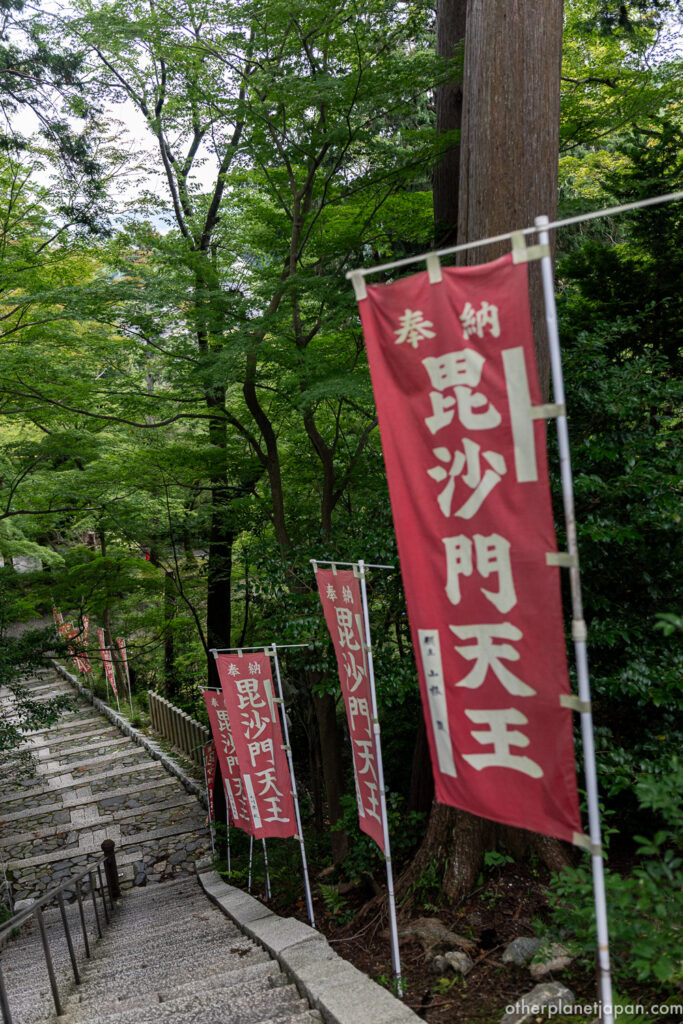
Bishamonten first entered my life as a battle flag.
The warlord Uesugi Kenshin flew that single character—毘, for Bishamonten, guardian god of warriors—above his armies. Kenshin was never the most popular samurai to admire. But say you like him, and people decide you must be the serious sort of history buff. As a boy I cared a great deal what people decided about me, so I said I liked Uesugi Kenshin. That is where my long, slow relationship with Bishamonten began. And then I put it off for decades. Whatever faith I had as a boy has thinned to almost nothing now—I’d like to blame that on all the other history I’ve learned since, if you’ll let me.
So when a young man passed me at the gate of Bishamondo Temple, and it had barely opened, I nearly turned around too. The sign said 1,000 yen. A thousand yen? For this? I had wanted to come in autumn, when the maples burn. Then spring’s green tempted me, and I kept postponing until, somehow, it was July. I stood there doing the math, half-tempted to just ask an AI whether it was worth it and go home.
I went in. I’m glad I did.
A Temple Most Visitors Have Never Heard Of
Bishamondo sits in Yamashina, one hill east of Kyoto’s center.
Most foreign visitors never make it here, and that is the whole point of the place. The temple was founded in 703, by imperial decree, and it belongs to a rare circle: one of the five monzeki temples of the Tendai school, its head priests drawn from the imperial family or the highest nobility. The name comes from Bishamonten—my boyhood flag, enshrined in the main hall. After centuries of fire and relocation, the temple was rebuilt on this Yamashina slope in 1665. Most Japanese still know it by one image: the crimson stairway in late autumn, made famous by a railway poster. Almost no one arrives, as I did, in the green quiet of July.
The Climb, and the First Vermilion
The path rises.
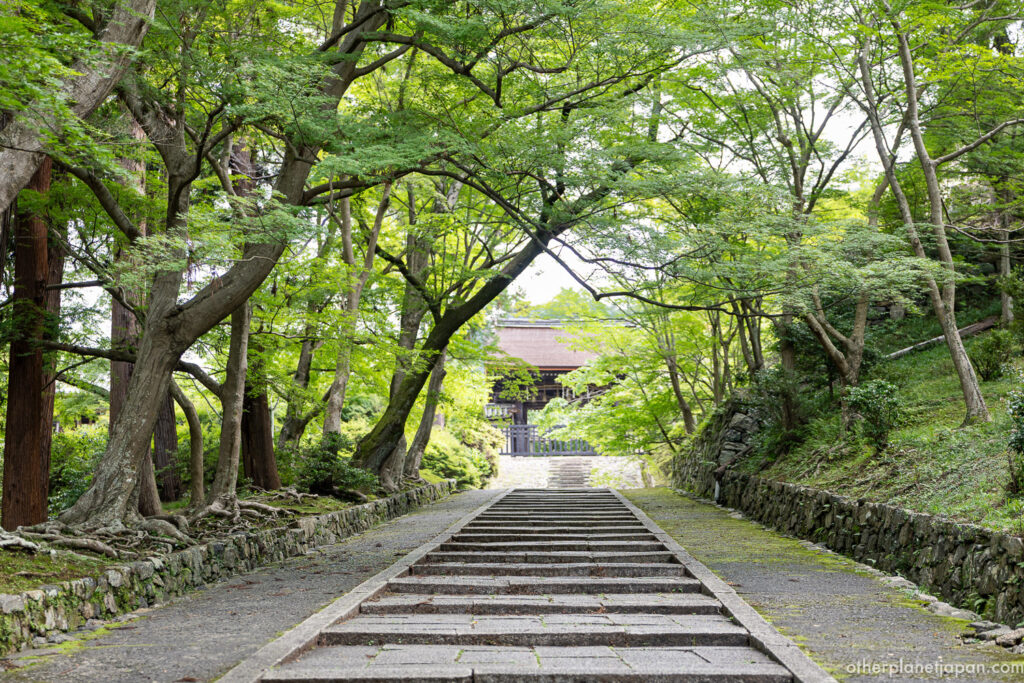
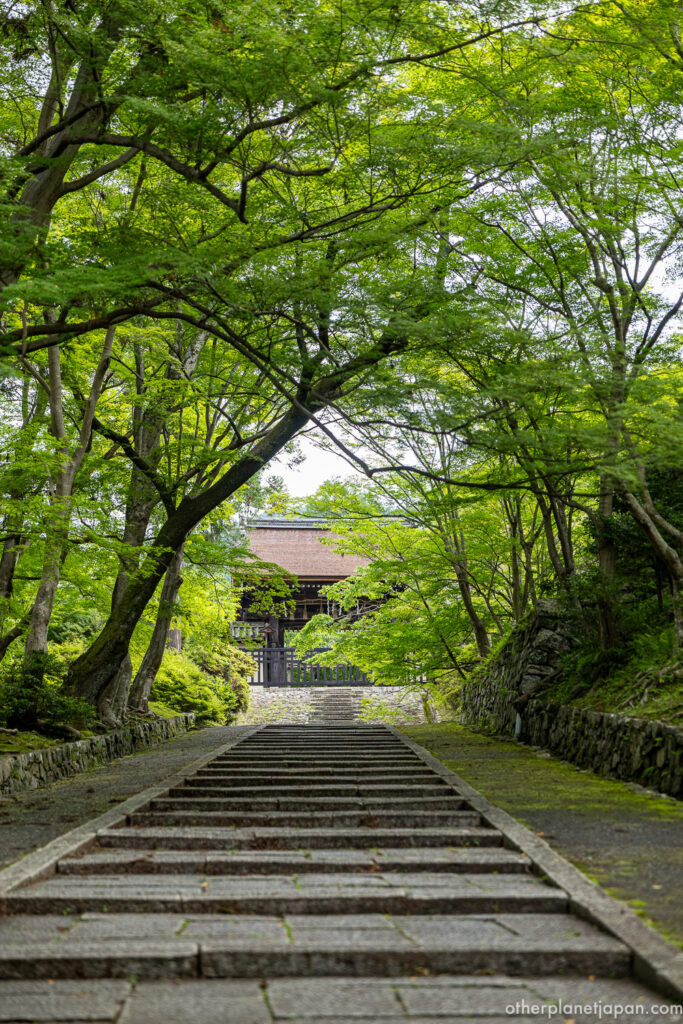
A steep flight of stone steps climbs toward the Niomon gate, lined with crimson banners for Bishamonten. In July the whole ascent is roofed in green—maples not yet turned, arching over the stairs. There is a strange gift in coming at the wrong time of year. If the leaves are this good now, ordinary and unripe, autumn must be something else again. At the first landing I stopped seeing the green and started seeing the red that would replace it.
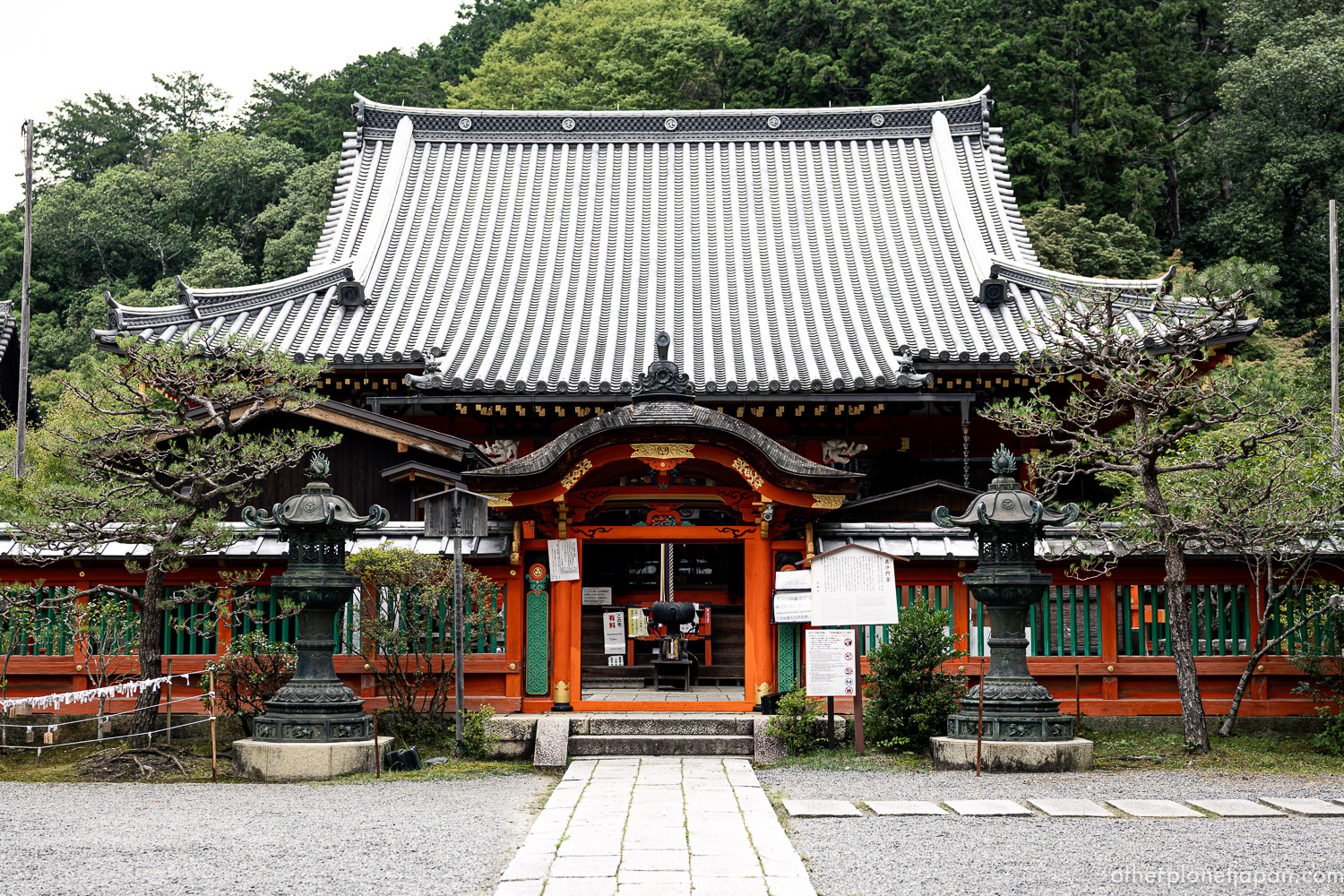
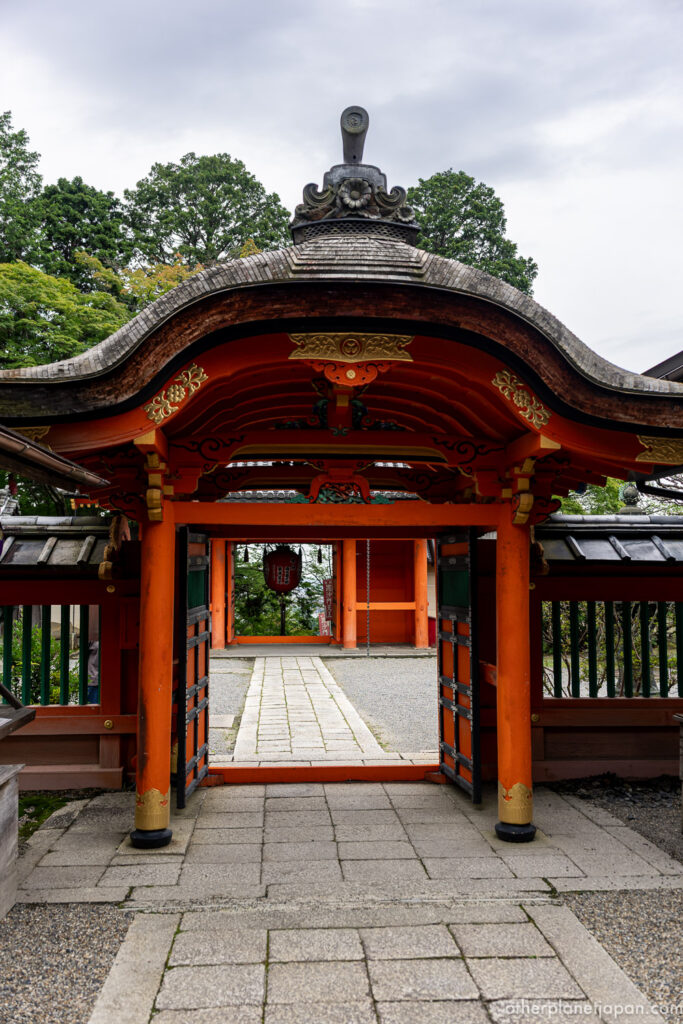
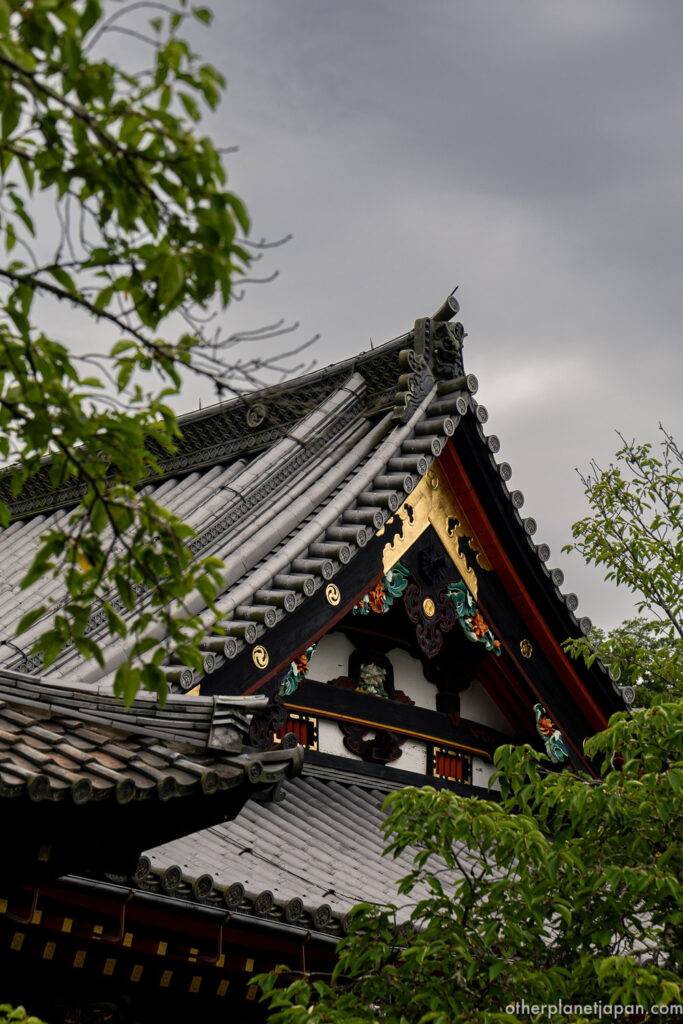
At the top, the Niomon opens onto the main hall—a black tiled roof pressing down over walls of orange lacquer and green lattice, two bronze lanterns keeping watch on the gravel. Even under cloud, the color holds.
Inside the Main Hall: Soot, and a Very Small God
The doors open onto darkness.
Step inside and the first surprise is scale. The Bishamonten here is tiny—far smaller than the hall around it—a secret image with a stand-in statue set before it. To its left waits Fudo Myo-o, the immovable wisdom king. But it isn’t the statues that hold you. It’s the soot. Centuries of candles and incense have blackened the beams and walls, and you find yourself doing a different kind of math than the one at the gate: how many tens of thousands of flames does it take to darken wood like this? That was when I stopped begrudging the thousand yen.
A sign told me the hall was built in the style of Nikko Toshogu, the Tokugawa mausoleum in the mountains north of Tokyo. I’ll confess the comparison meant nothing to me at first—I’ve never been to Nikko. The ornament, the color, the gold: I couldn’t place them. Then the sign might as well have said Kunozan Toshogu, the shrine on the hill back home in Shizuoka, and something loosened in my memory. Yes. Like that. Whichever cousin you know, this is the flamboyant branch of the family—a look you rarely see among the sober temple halls of Kyoto. A mandala hangs close enough to study. One warning before you go in: photography is forbidden in every hall, and English signage barely exists. Whatever you take from these rooms, you carry out in your head.
Sliding a Paper Door, and Closing It Behind You
How long had it been?
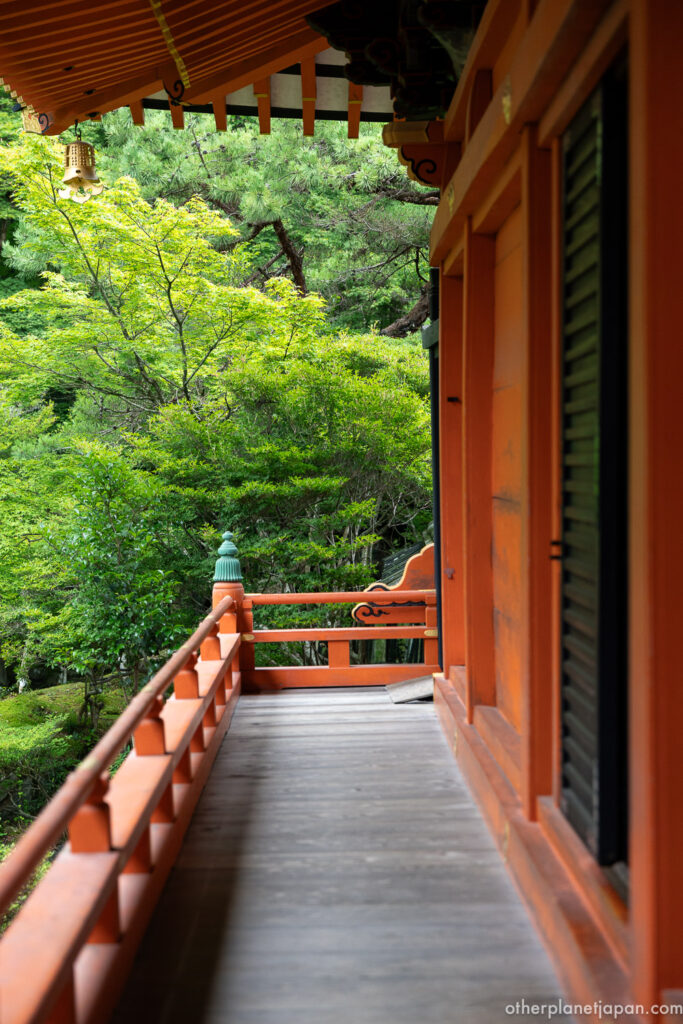
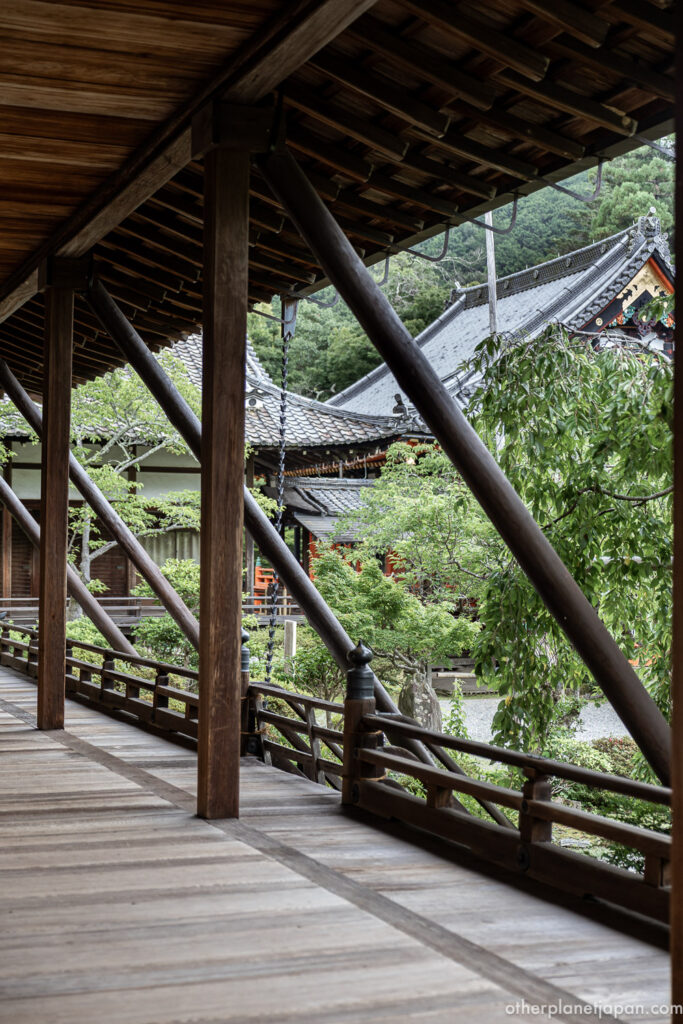
To enter the Shinden and Reiden halls, you slide open a shoji screen with your own hands. Then, for the sake of what’s inside, you slide it shut behind you. Such a small thing. And I couldn’t remember the last time I’d done it—opened a paper door, stepped through, sealed it closed. The gesture slows you down on its own. Inside waits a dragon painted across the ceiling, its eyes following you as you move. An Amida Buddha. A large painting of the Buddha’s death beside it, and, nearby, a few manga panels retelling his teachings for anyone who might otherwise walk straight past.
The Room Where the Paintings Move: Bishamondo’s Reverse Perspective
This is why you come.
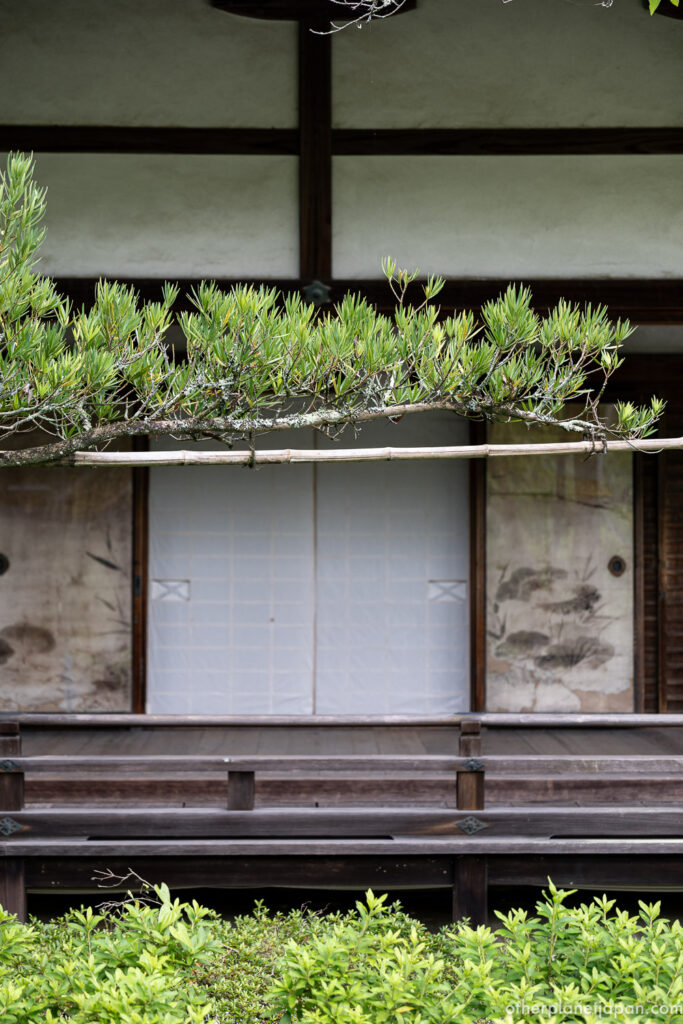
In the room called Kuro-no-ma, all 116 sliding-door panels were painted by Kano Masunobu, adopted son of the great Kano Tanyu and founder of the Surugadai branch. They are Registered Cultural Properties of Kyoto, and they use a technique called reverse perspective: wherever you stand, the painting arranges itself around you as the center. Look at the desk on the panel. Walk to its left, and the desk turns and lengthens, swinging toward you. A boy who should read as older than ten looks about eight. On another panel, a carp changes size depending on whether you approach from the right or the left. You don’t have to take my word for it—or the temple’s. Just listen to the floor. One stretch of tatami in front of the carp creaks where nothing else does, worn soft by generations of visitors walking back and forth, checking.
Let me be honest about something. It is rare to find paintings like these in any temple, and I was stunned by how little is written about them—no English at all, barely any Japanese. Panels of this quality, this strangeness, and almost nothing to tell you they’re here. It bothers me, frankly, because it makes them hard to hand to you. I can point. I can tell you where the floor creaks. The rest you’ll have to see for yourself.
One panel keeps a small riddle. Convention pairs plum blossoms with a bush warbler, bamboo with a sparrow. Here the painter mismatched them on purpose—plum with a mountain crow, bamboo with a brown-eared bulbul. Locals call it the “mismatched room.” Why the master broke the rule is left, politely, to you.
A Shrine Inside the Temple
Behind the halls, the ground opens into green.
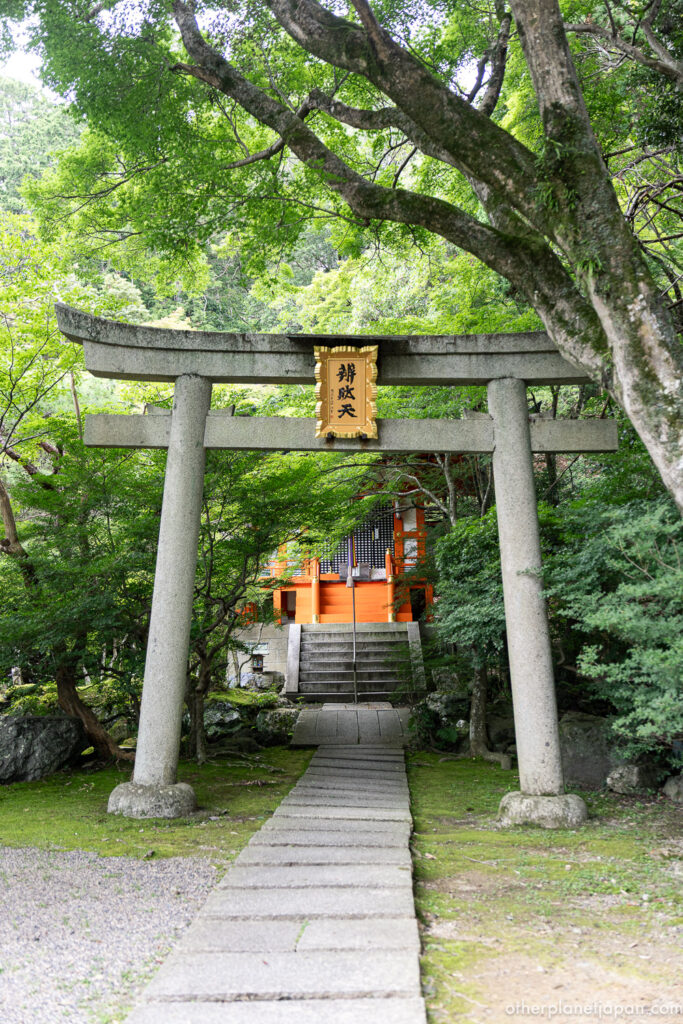
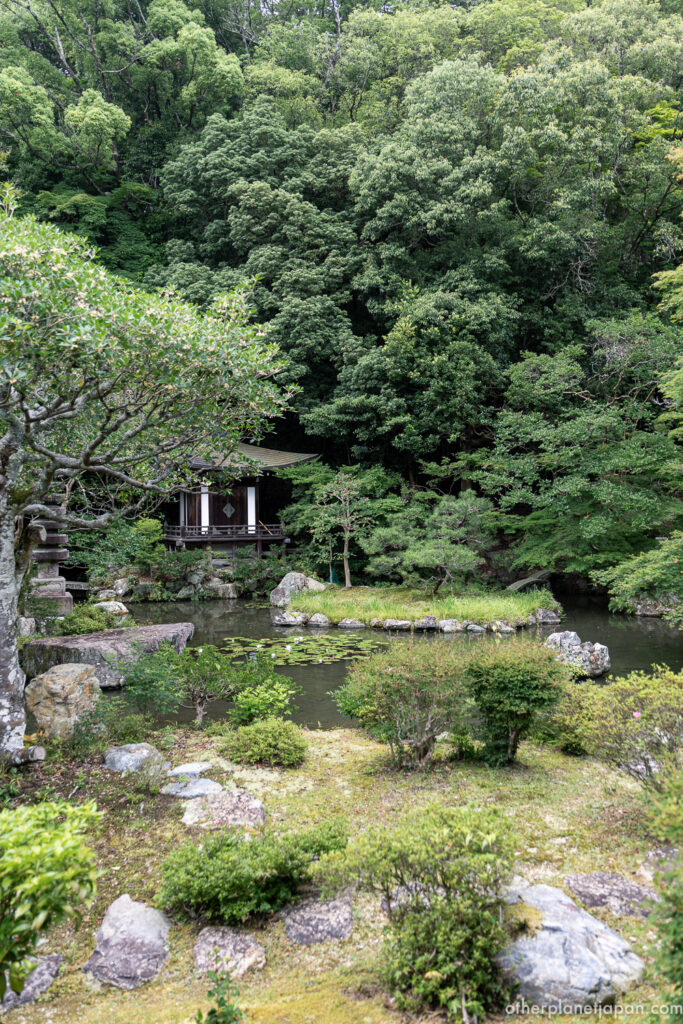
There is a Shinto shrine inside this Buddhist temple. That sounds stranger than it is; at old, established temples the two faiths often share a hillside, and Bishamondo is no exception. I only understood what I was looking at after I read the pamphlet—a stone torii, a small vermilion hall by the pond, easy to walk past. I’m glad I didn’t. This is Kodai Benzaiten, goddess of water and music. Her story runs back to Osaka Castle: first enshrined by the mother of the warlord Toyotomi Hideyoshi, later moved by his widow to Kodaiji Temple in Kyoto, and finally brought here for the good luck of the people around it. In summer the vermilion glows against the blue-green maples. In November the same corner turns to fire.
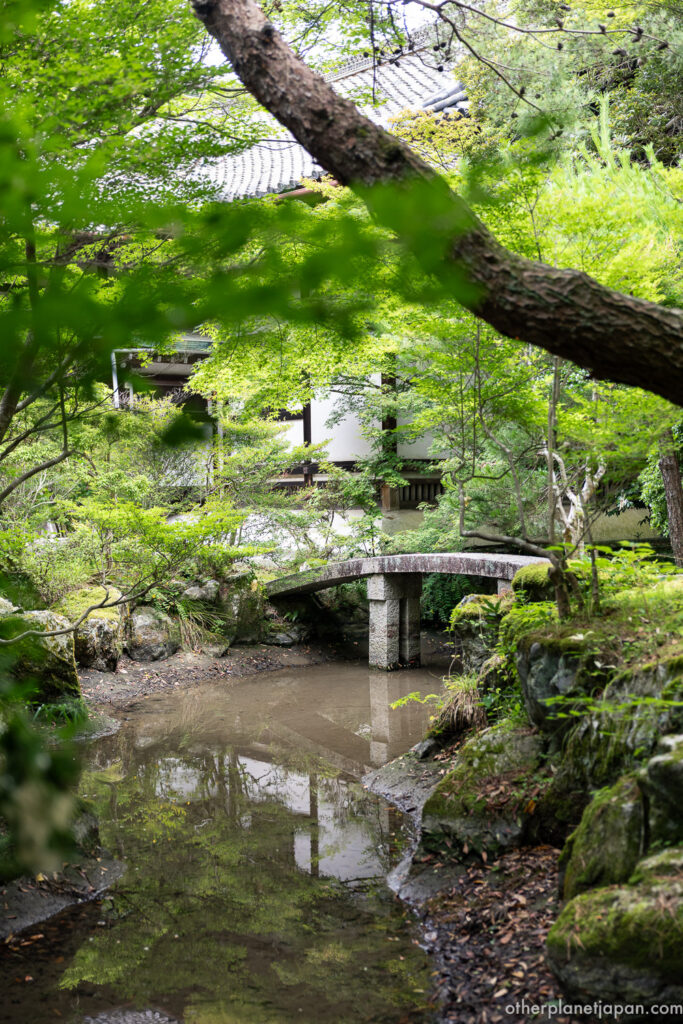
The garden that holds her is called Bansui-en, laid out in the early Edo period around a pond shaped—if someone points it out—like the mirror image of the character for “heart.” Moss, still water, a stone bridge going soft at the edges. Water lilies held the pond’s surface without troubling it. I stood there longer than I’d meant to.
The Demon Cherry, and a Slope of Fire
In front of the Shinden stands a tree too big for my lens.
It’s a weeping cherry, over 150 years old, now in its fifth planted generation. The branches lean on wooden crutches and still spread some thirty meters across. The locals gave it two names. For the blossoms, they call it “a thousand gold pieces at a glance.” They also call it the Hannya Cherry—after the Hannya-kai, the volunteer group that tended it for years. That second name sits oddly. To a Japanese ear, hannya is also the horned female demon of Noh drama, all bared teeth and grief. A demon’s name, on the gentlest tree in the garden. I stood a long way back and still couldn’t fit it in one frame.
Truthfully, I was relieved it wasn’t cherry season—you’d need an ultra-wide lens for this tree alone, and you’d be sharing every inch of it with a crowd. There are eighty-odd more cherries on the grounds, so spring here is no minor affair. But the tree was bare, and so was the path, and both were mine.
Then there’s the famous stairway. You’ve seen it even if you don’t know its name—stone steps carpeted in fallen red maple, one of the most photographed autumn scenes in Kyoto. I couldn’t find it at first. I walked the whole grounds before I climbed high enough to look down and see it plain: it’s the stairway up to the Chokushimon, the Imperial Messenger’s Gate. Not a walkway. The gate is the temple’s formal entrance, moved here from the Kyoto Imperial Palace, and it stays shut except on the rarest occasions—so the steps lead to a door you can’t pass through. Around a hundred maples and dodan azaleas line them. In late November their leaves fall and stain the stone red. In July the same steps were green and empty, and I had them to myself for as long as I wanted.
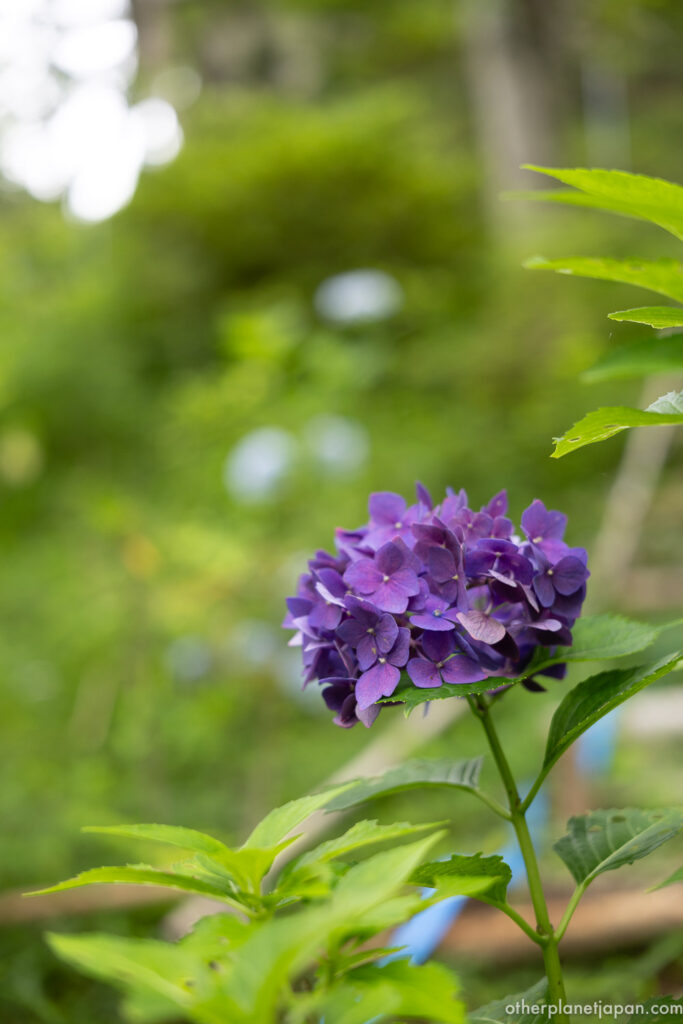
On my way out, at the desk where I collected my goshuin, the attendant let me in on something. Down by the stairs the hydrangeas were blooming, and I was free to open the little fence and step inside. The fence, she said, was to keep the deer from eating the flowers. So I opened it. Purple and blue-violet clusters leaned into the green, heavy with the wet season.
It was a Saturday, and the grounds were almost silent. From the direction of the Imperial Messenger’s Gate came the voices of children—a boys’ baseball or soccer club, calling through some drill. Whether that’s quite the thing to do in front of an imperial gate, I couldn’t say. But it was that peaceful. That undisturbed.
That silence is the reason to come. Everything below is how to keep it: when to arrive, what it costs, and what not to expect.
Practical Information
Admission
I hesitated at that thousand yen. Here is what it buys. Entry to the halls is 1,000 yen for adults, 500 yen for high school students, and 300 yen for elementary and junior high students. If you skip the halls, the grounds themselves are free—and you can walk right up to the famous stone stairway below the Imperial Messenger’s Gate at no charge. Inside the halls, photography is prohibited and English signage is almost nonexistent, which is why the notes below matter more than they usually would.
Hours
The gate keeps different hours by season. Time your arrival to the last-entry column, not the closing time.
| Season | Hall viewing | Gate closes | Last entry |
| March–November | 9:00–16:30 | 17:00 | 16:00 |
| December–February | 9:00–16:00 | 16:30 | 15:30 |
Goshuin (Temple Seals)
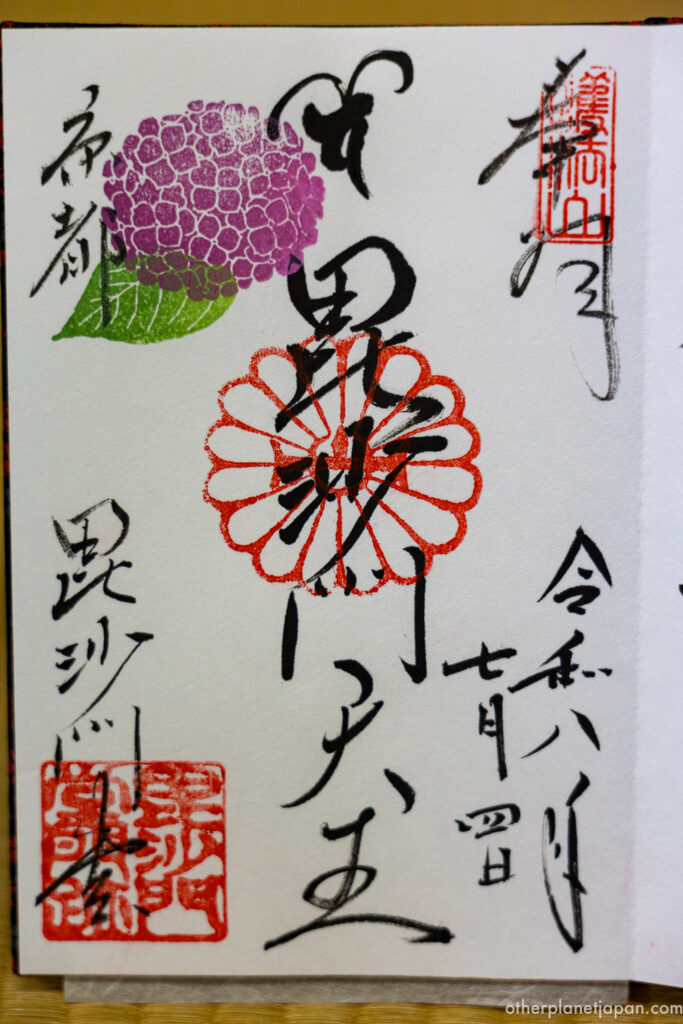
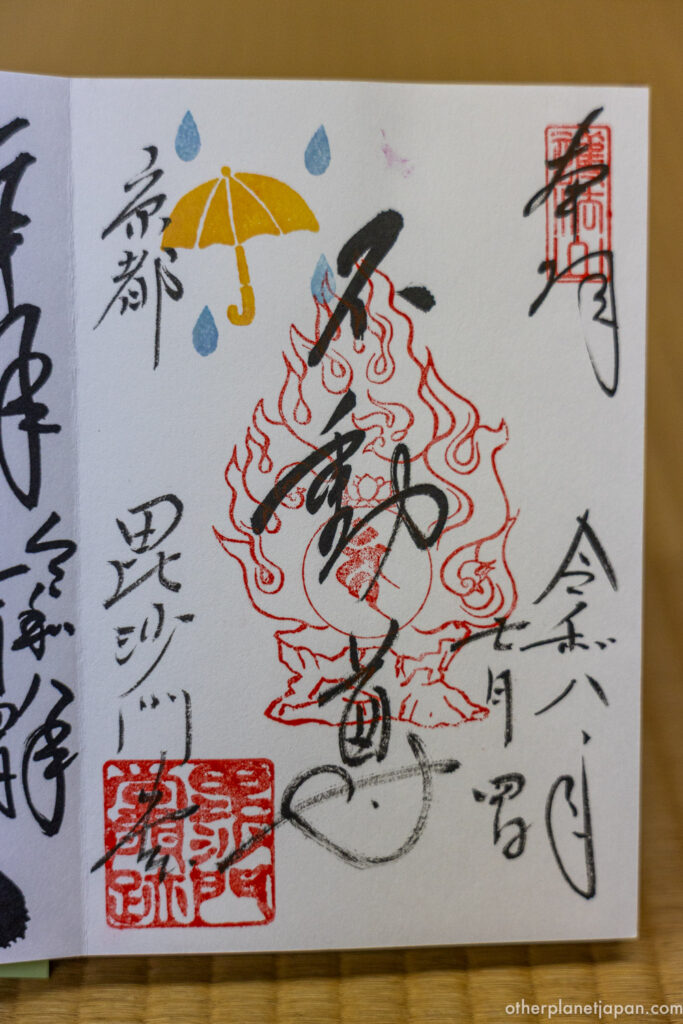
The seal desk was where I got my only real conversation of the visit. Three goshuin are offered—Bishamonten, Fudo Myo-o, and Benzaiten—each 400 yen and hand-brushed on the spot. You hand over your seal book on the way in and collect it, finished, on the way out. The designs change with the season; mine came stamped with a July Tanabata star-festival motif.
How Long to Allow
Give it 30 to 60 minutes for the main hall, the Shinden, and the grounds together. The tatami rooms aren’t places to sit and linger—they’re for looking closely, then moving on. Budget your time toward the trick paintings; that’s where the minutes are worth spending.
Getting There
Bishamondo is about a 15-to-20-minute walk north from Yamashina Station, served by the JR line, the Kyoto Municipal Subway Tozai Line, and the Keihan line. Yamashina is only five minutes from Kyoto Station by JR, which makes this one of the easiest “hidden” temples in Kyoto to reach. The walk is a gentle, steady uphill, and the signs along the way are clear.
Best Time to Visit
This is really the whole question, so let me answer it plainly. Late November brings the crimson stairway the temple is known for—spectacular, and crowded. Late March to early April brings the Hannya weeping cherry into bloom, an Edohigan that opens a touch earlier than the Somei-yoshino. June and July bring hydrangeas and deep green quiet, with almost no one around. Want the postcard? Come in autumn. Want the temple to yourself? Come in summer, the way I did.
For current details and seasonal closures, see the official Bishamondo Temple website.
Map
Frequently Asked Questions
Are the goshuin hand-brushed?
Yes—brushed by hand, right into your book. Leave the book at the desk when you arrive and pick it up on your way out.
How long does a visit take?
Thirty minutes to an hour covers the main hall, the Shinden, and the grounds. Not a place for lingering—but give the trick paintings the extra time.
How much is admission to Bishamondo Temple?
1,000 yen for adults. High schoolers pay 500, younger students 300. The outer grounds—including that famous stairway below the Imperial Messenger’s Gate—are free.
Cherry blossoms or autumn leaves—which is better?
Depends what you’re after. Late November is the crimson maple stairway. Late March to early April is the 150-year-old weeping cherry. And if you’d rather have the place nearly to yourself, come for the June–July hydrangeas.
Can you take photos inside Bishamondo Temple?
No—the halls are off-limits for photography, including the reverse-perspective paintings. The gardens and outer grounds are fair game.