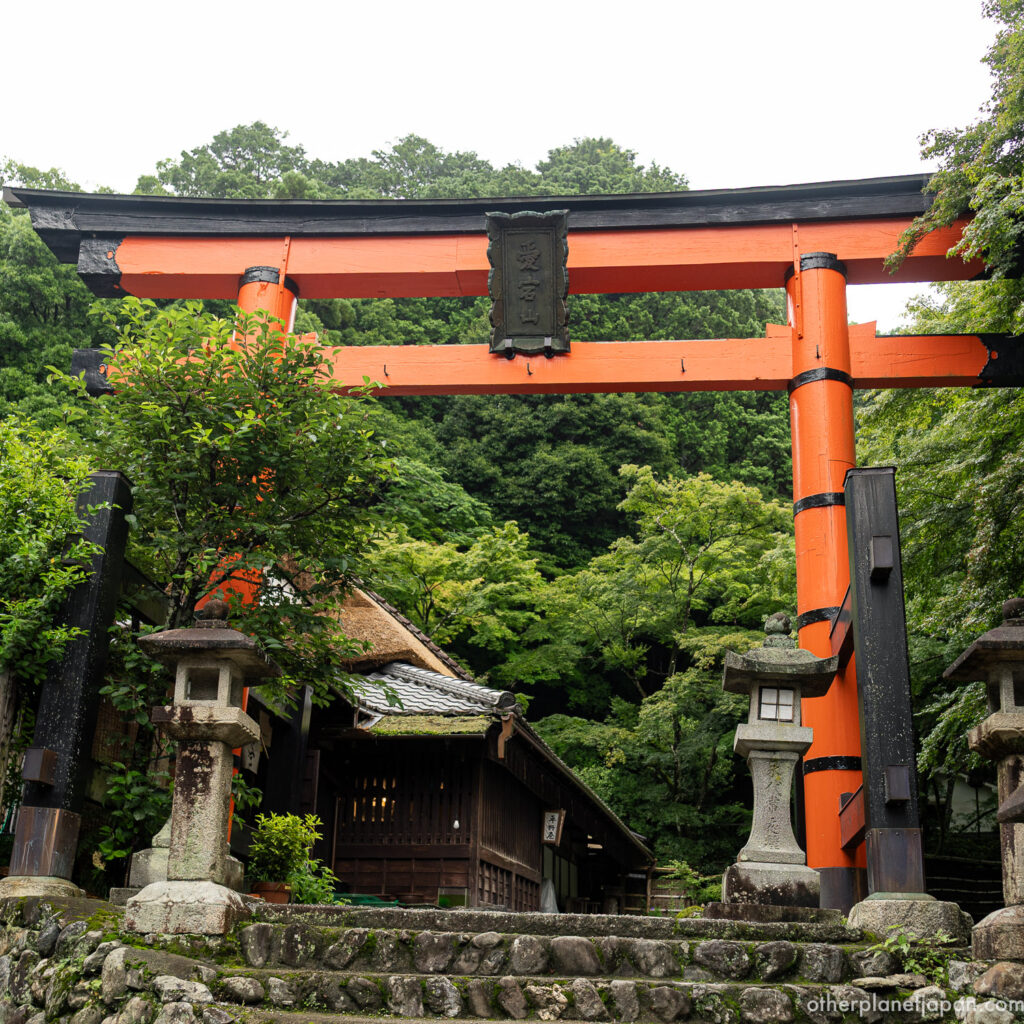
The grand vermilion torii of Mount Atago stands about five minutes on foot below the temple gate, at the top of the Saga Toriimoto preserved street. On this particular morning, for the first time in all my visits, there was not a single car parked beneath it. Usually I stand there wrestling with the same question. Is it really acceptable to park your car directly in front of a sacred gate? That morning, the question never came up. Just the torii, an old thatched teahouse behind it, and wet green mountains. Coming early was already paying off.
By 8:40, twenty minutes before the gate opened, a few people were already waiting ahead of me at Otagi Nenbutsuji. I had chosen this temple as the starting point of my day for a practical reason. It sits at the far edge of the Saga-Arashiyama area, which means everything else is downhill from here. Everyone waiting with me was a Westerner. I suspect they had the same plan. I ran into several of them again later at Adashino Nenbutsuji, ten minutes down the road.
Then I stepped inside, and the plan stopped mattering.
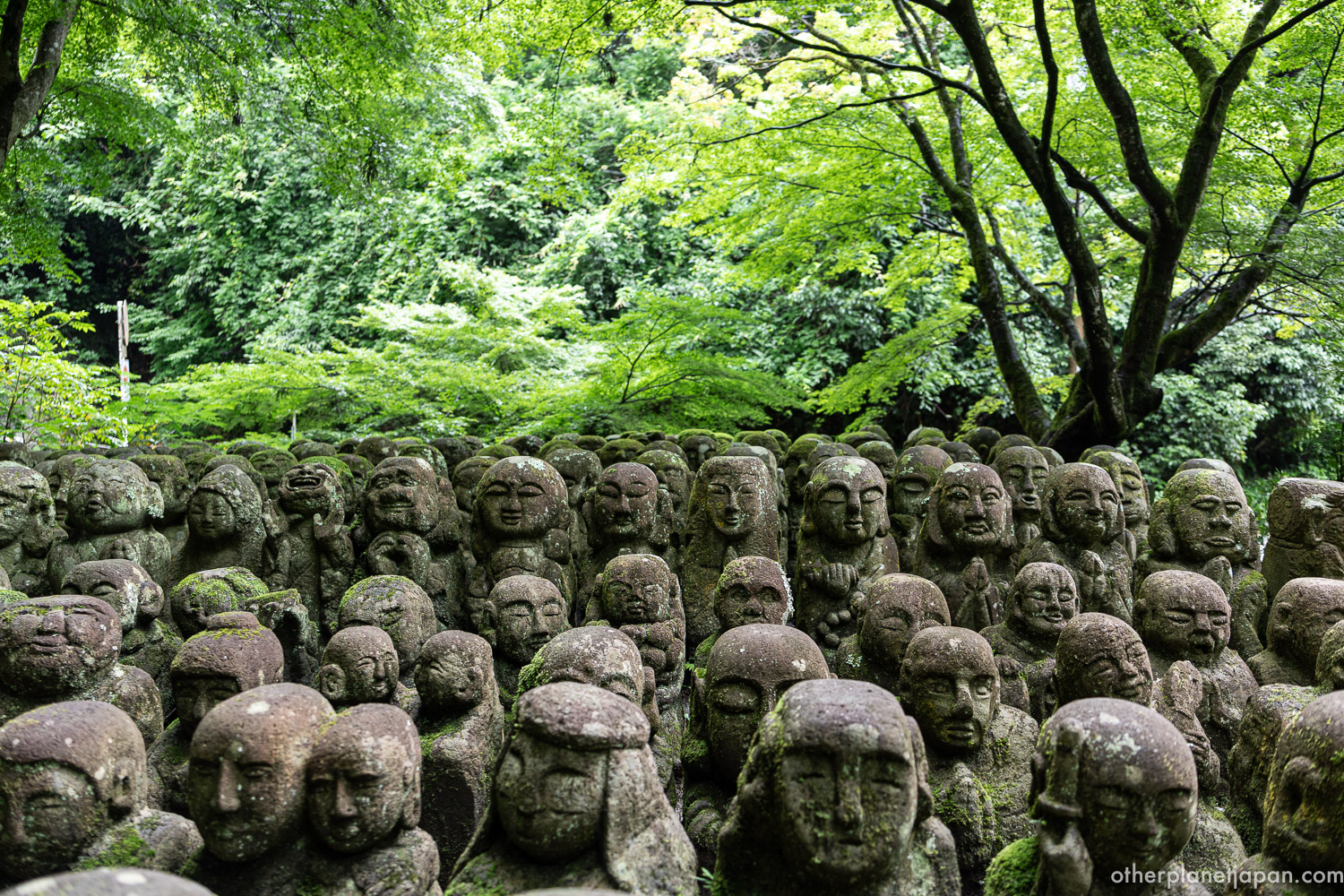
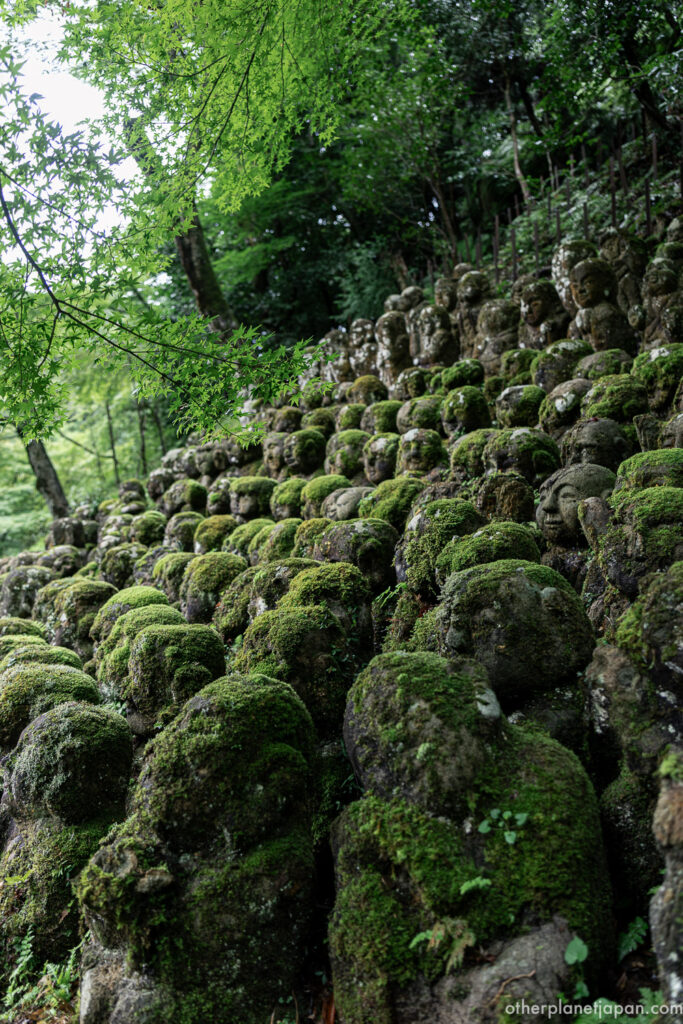
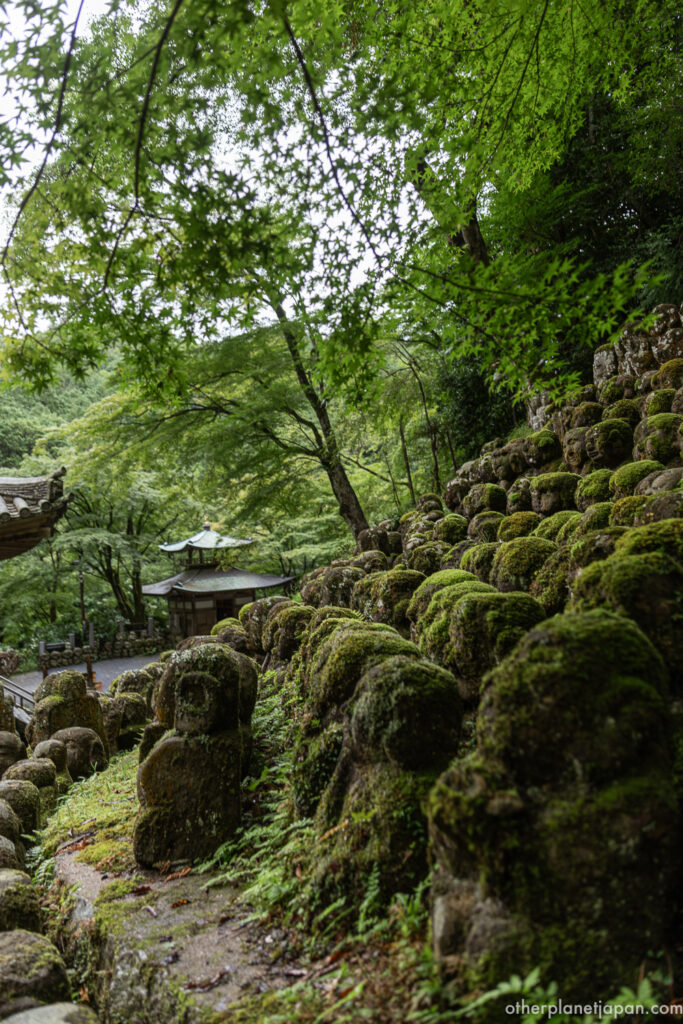
Stone figures covered the hillside. Hundreds of them, well over a thousand, every one wearing a coat of moss. How many centuries, I wondered, does it take to gather this many buddhas on one slope? The word that came to mind was ancient. One of the statues appeared to be winking at me. I raised my camera and lost track of time.
That was when I noticed the names carved into their backs. Oddly modern names. I had a bad feeling about this. I checked another statue, then another. And then I saw it: 1982.
These were carved in 1982? I could read almost every name without effort. No faded medieval script, just ordinary names of ordinary people. Modern donors, then. Five minutes earlier I had been communing with deep time. Now I was standing in what was, technically speaking, a community art project younger than I am.
The pamphlet confirmed it. The famous rakan statues of Otagi Nenbutsuji were carved from around 1980, as part of the temple’s restoration, by ordinary worshippers. Most of them were holding a chisel for the first time in their lives. Each person carved their own rakan, a disciple of the Buddha, and left it here. The mystery evaporated on the spot. But something warmer took its place. What I had mistaken for the weight of centuries was really the fingerprints of more than a thousand amateurs, each one a little clumsy, each one sincere.
Why Otagi Nenbutsuji Has So Many Statues
The temple carries real history. It was founded in 766, in the Nara period, by Empress Shotoku, originally in Kyoto’s Higashiyama district. A flood on the Kamo River later destroyed it, the priest Senkan rebuilt it in the tenth century, and its main hall, an Important Cultural Property, dates to the mid-Kamakura period, roughly 750 years ago. The whole structure was dismantled and moved here to Sagano in 1922. So the bones of the place are genuinely old.
The faces are not, and there is a reason for that. By the mid-twentieth century the temple had fallen on hard times, left without a resident priest, and a typhoon in 1950 nearly finished it off. In 1955 a man named Kocho Nishimura arrived to take over. He was a priest, but he was also one of Japan’s finest Buddhist sculptors, and he had an unusual idea about how to bring the ruin back to life. Rather than simply install statues and ask people to admire them, he invited ordinary visitors to carve their own rakan, so that they would leave a piece of themselves behind and feel the temple was partly theirs.
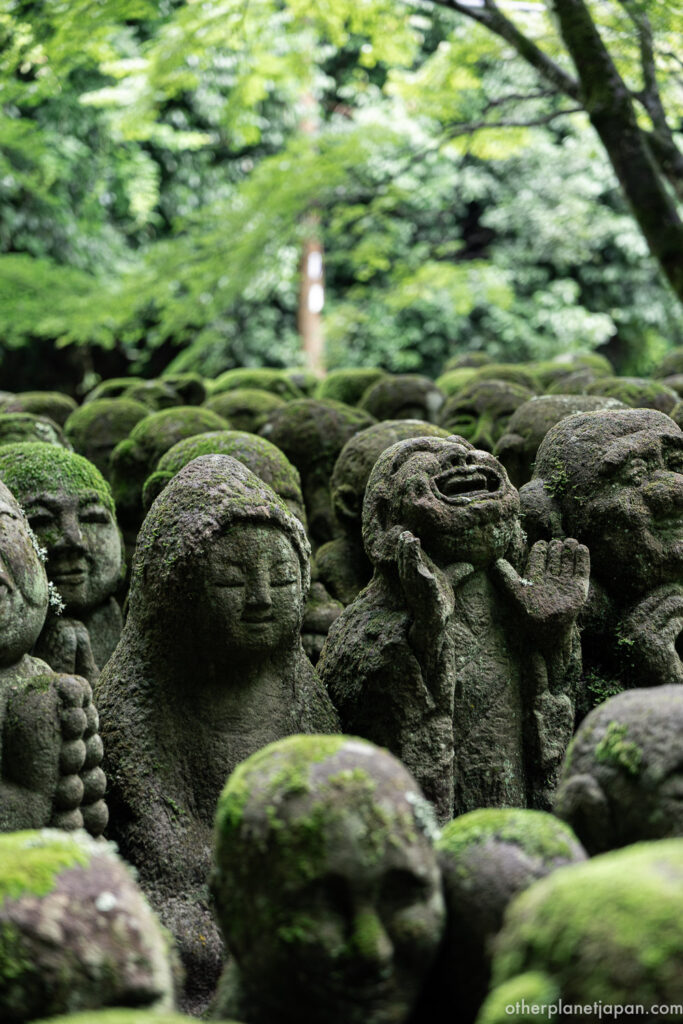
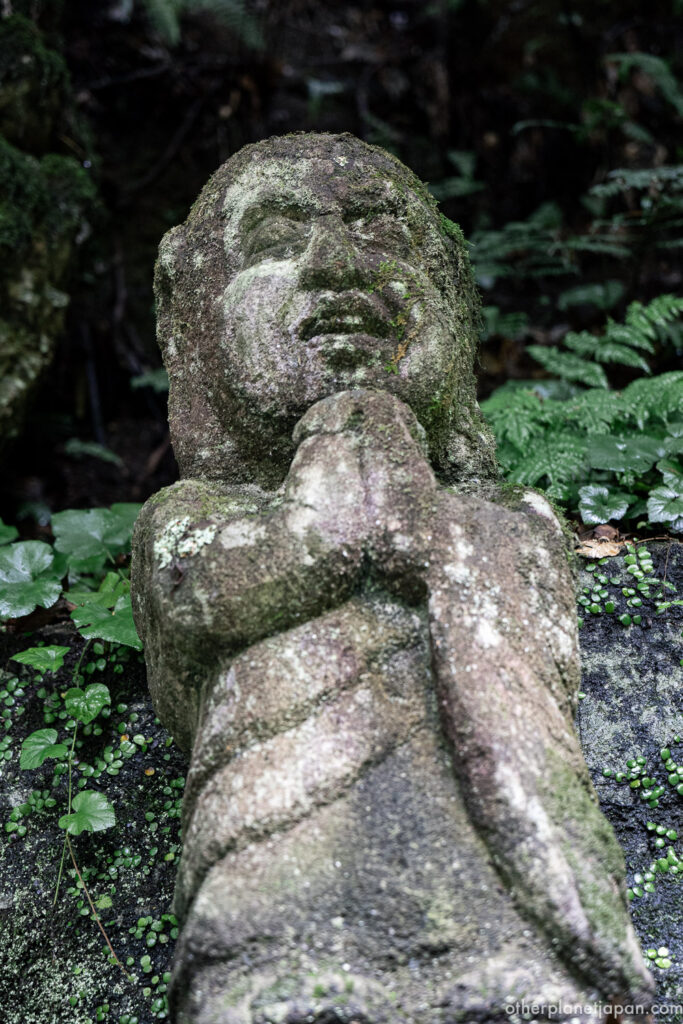
The idea caught on far beyond what he expected. The plan started at 500 statues. So many people wanted to carve one that the figures kept multiplying, and by around 1981 there were more than 1,200 of them lining the slope. Each carver worked the stone their own way, which is why no two faces match. Some press their palms together in prayer. Some tip their heads back and laugh. That mix of devotion and mischief is exactly why locals came to call this the healing temple.
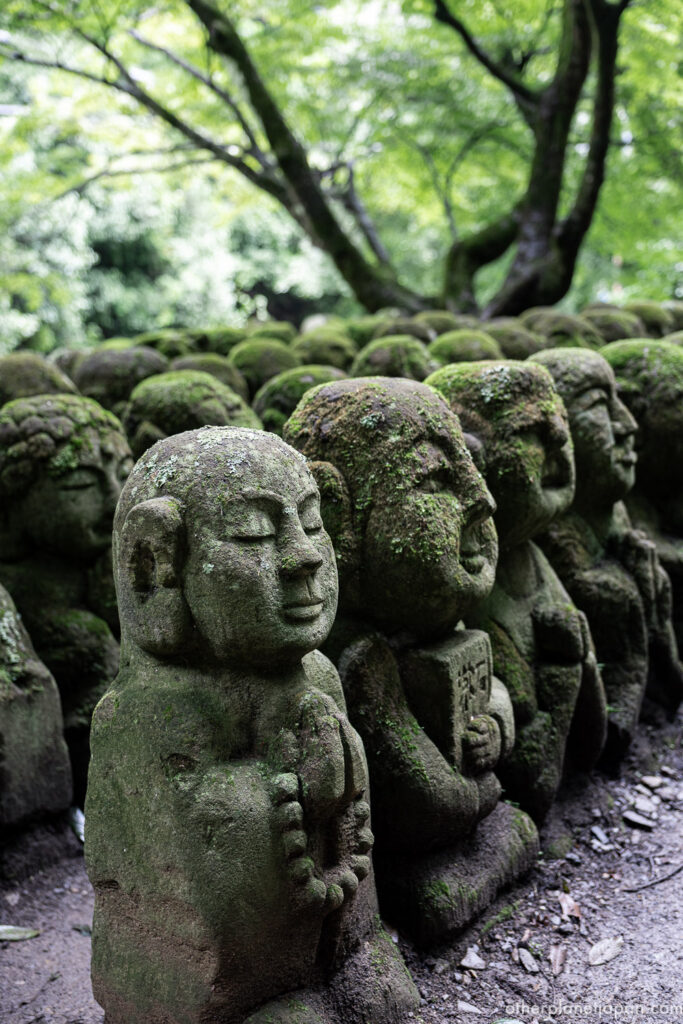
The moss is what completes the illusion. It drapes each statue in the costume of antiquity, so convincingly that visitors like me arrive and feel centuries that are not really there. A statue that looks ancient but is younger than I am is a strange and slightly funny thing to stand in front of. In Kyoto, time usually runs one direction. Here it wears a disguise, and I found I liked it better once I knew.
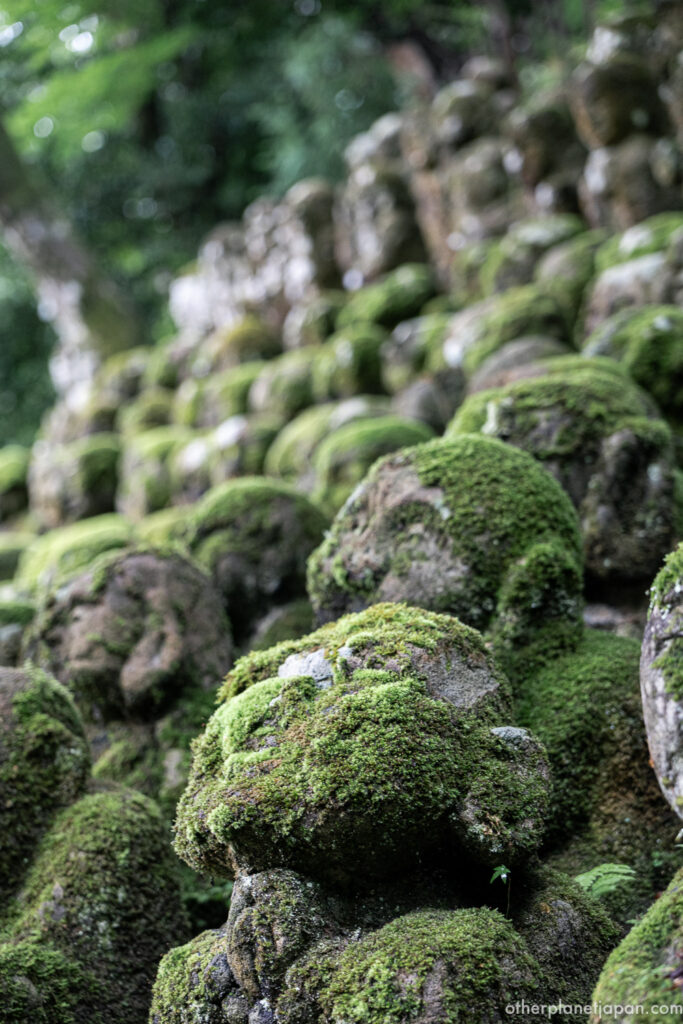
I watched a Western visitor rest a hand on one of the statues and felt a small jolt. Most Japanese would call that bachi-atari, the kind of irreverence that invites bad luck. Then I remembered these particular buddhas were younger than most of the tourists touching them, and I said nothing. As a general rule, though, better to keep your hands to yourself.
There is one deliberate exception. Near the main hall stands the Fureai Kannon, a statue made specifically to be touched, so that blind and visually impaired visitors can feel the form of the Buddha with their hands. Anyone may touch this one. It is a small and generous gesture, of a piece with a temple that was rebuilt by amateur hands in the first place.
The Three Bells of Otagi Nenbutsuji
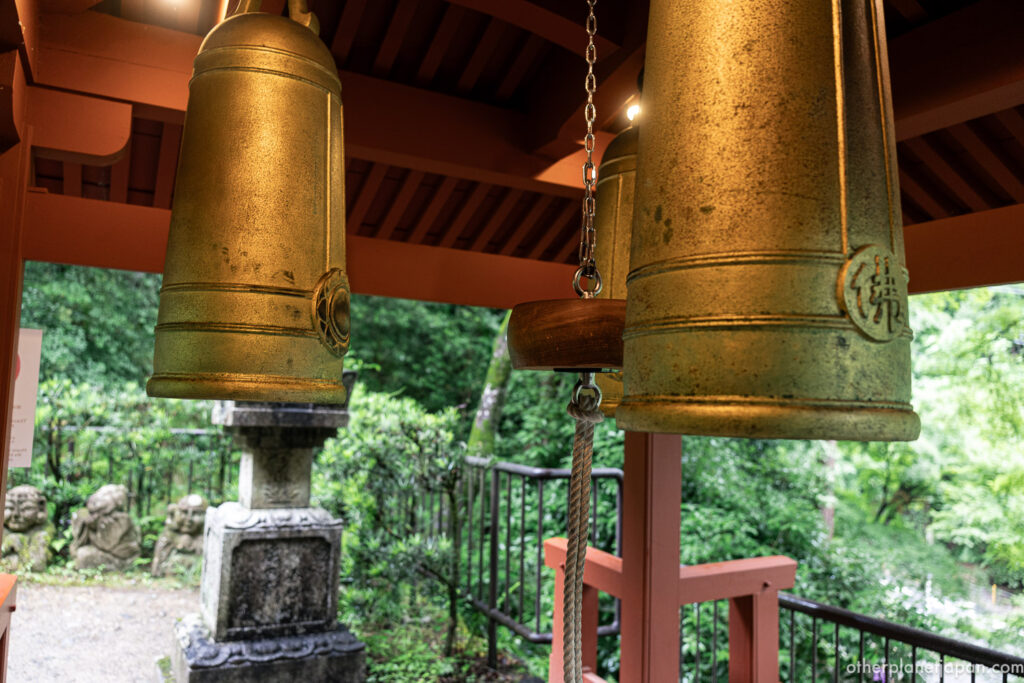
Partway up the grounds stands a small vermilion bell tower holding three golden bells. A sign, in Japanese only, tells you to ring them in a set order: Bu (the Buddha), Ho (the Dharma), So (the Sangha), the Three Jewels of Buddhism. Each bell carries its character on the side, so if you can spot the kanji 佛, 法, and 僧, you can ring them in the intended sequence, Buddha first, then Dharma, then Sangha. The three tones are pitched differently, and struck in order they are said to settle the mind.
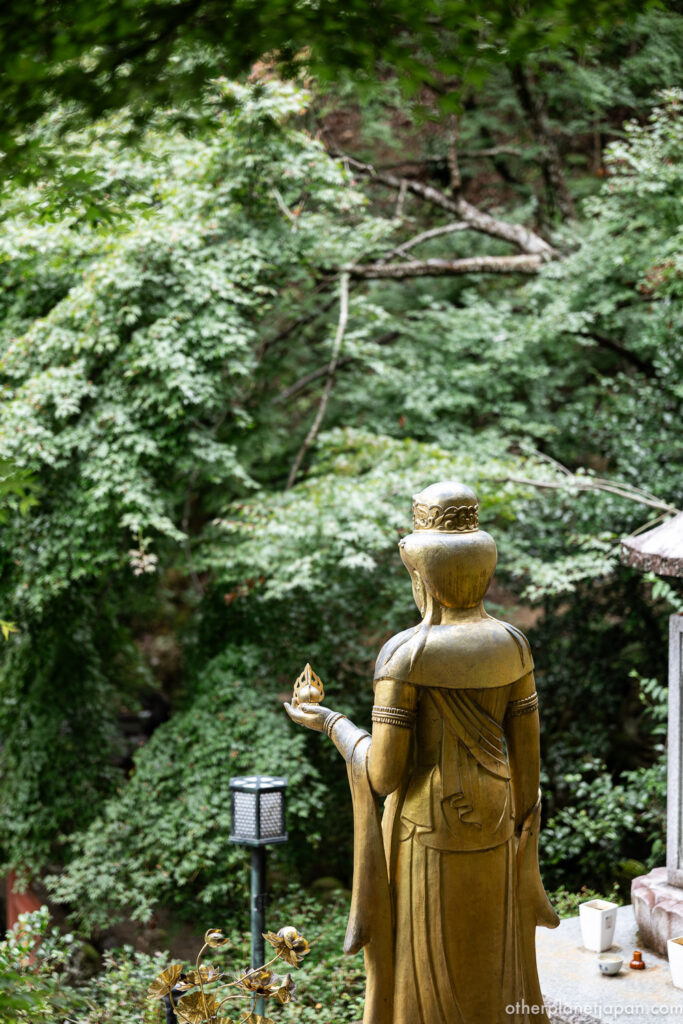
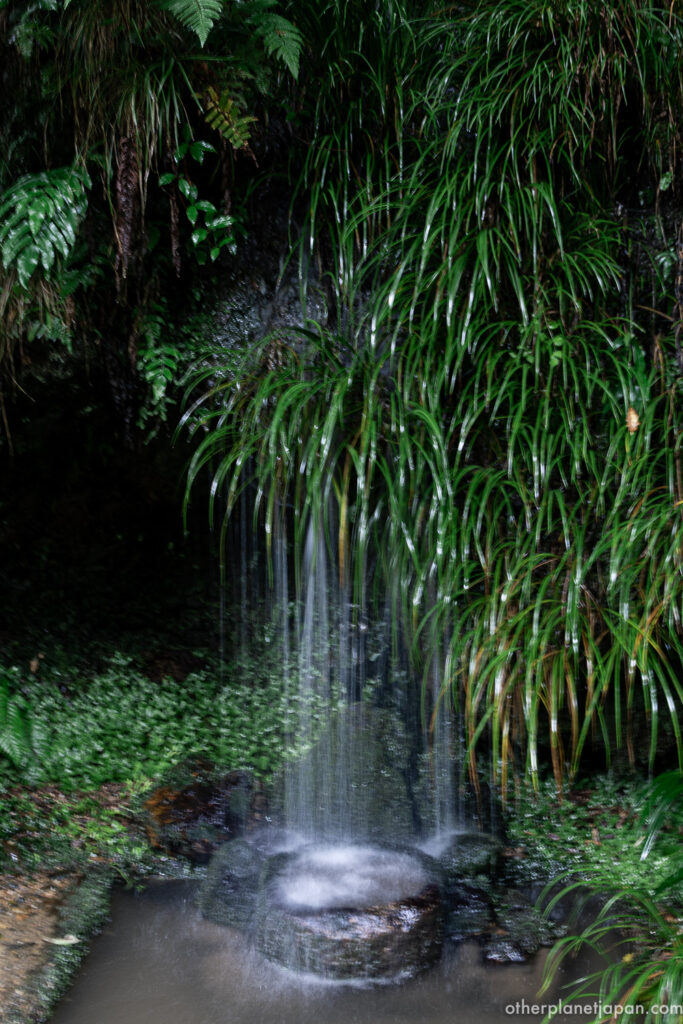
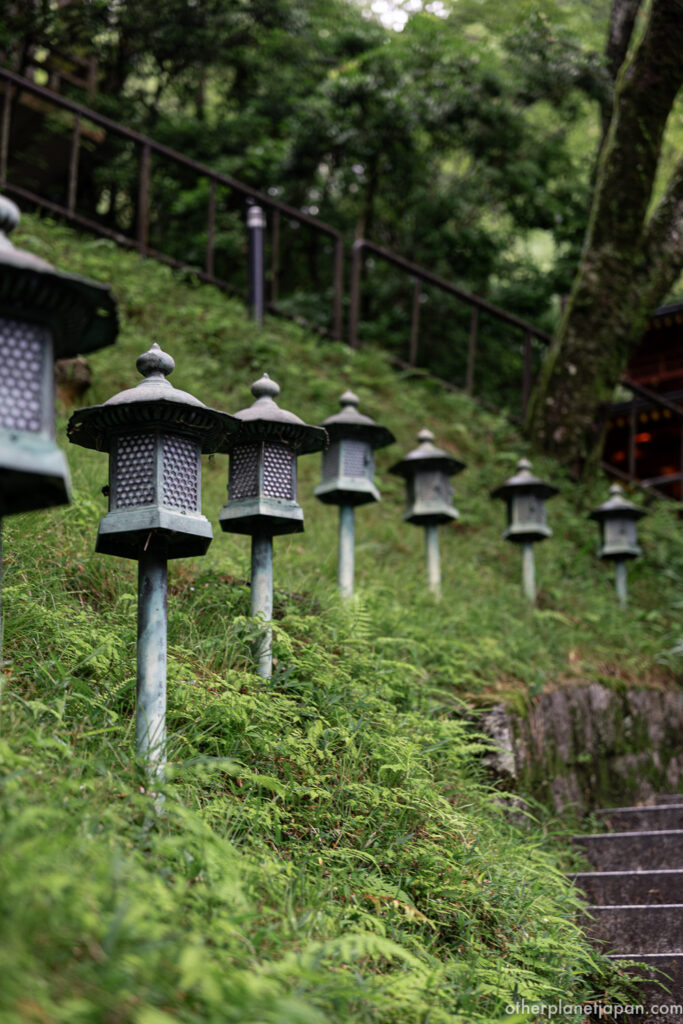
Beyond the bells, the grounds reward slow walking. A golden Kannon stands on the hillside with her back to the path, holding a lotus bud and facing the valley, as though she came for the view too. Below her a thin waterfall slides down a fern-covered rock, and a line of small metal lanterns climbs the mossy slope beside the stairs. None of it is grand. On a wet morning, with every green turned up to full, it does not need to be.
On the day I visited, the main hall was closed. Other visitors’ recent posts show days when you can step inside the Kamakura-period hall itself, so treat it as a possibility rather than a promise. The grounds draw a steady stream of people, but I never felt crowded. With a thousand faces scattered across the hillside, everyone’s gaze lands somewhere different, and the place seems to make room.
Autumn at Otagi Nenbutsuji
The temple sits in the mountains at the very edge of Sagano, which earns it one small advantage every November. Its maples turn about a week earlier than those in central Arashiyama, with the best color usually arriving in early to mid-November. Time it right and you get crimson canopies over moss-green rakan while the rest of Arashiyama is still waiting its turn.
Goshuin at Otagi Nenbutsuji
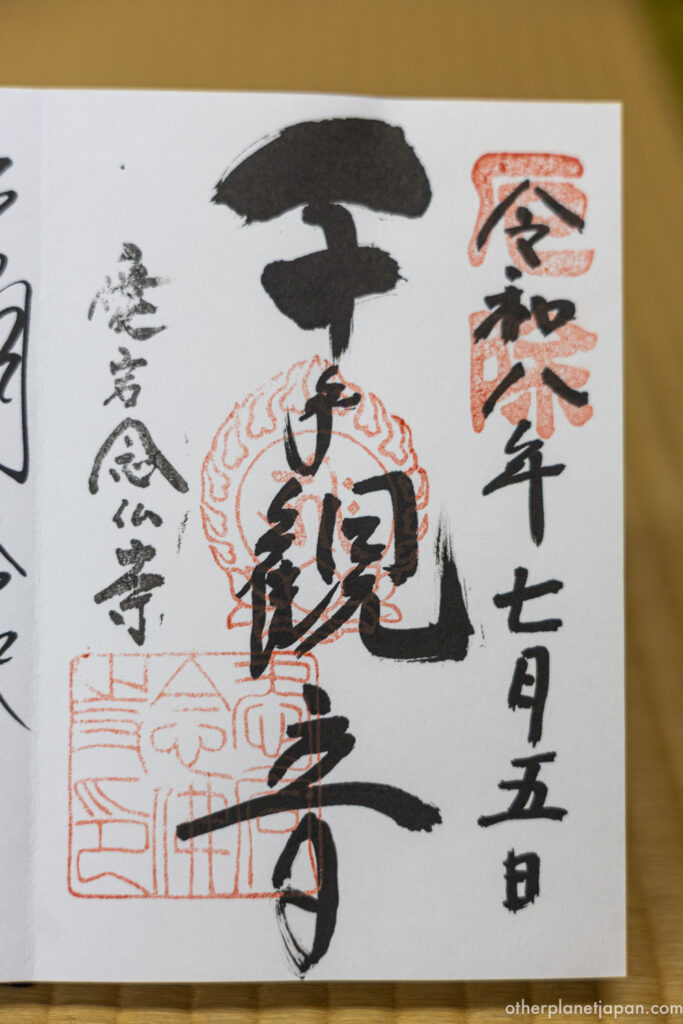
The temple offers a goshuin (temple seal) for 500 yen, handled in a way I had not seen before. You hand over your goshuin book right after entering, they inscribe it while you wander, and you collect it on the way out. By the time I picked mine up, I had spent far longer among the rakan than I meant to, which I suspect is the point. They also gave me a small sticker with it, an unexpected little souvenir.
Practical Information
| Admission | 1,000 yen (free for children 10 and under) |
| Hours | 9:00 a.m. – 4:00 p.m. |
| Closed | Every Wednesday and Saturday (open on December 31 and January 1) |
| Goshuin | 500 yen (deposit your book at the entrance, collect it on the way out) |
| Address | 2-5 Sagatoriimoto Fukatanicho, Ukyo Ward, Kyoto 616-8439 |
| Website | Official site (Japanese and English) |
Note the closing days carefully. A temple with regular days off is rare in Japan, and the Wednesday and Saturday closures have caught more than a few travelers off guard. Confirm before you build your Sagano day around it.
Getting there
By taxi: about 5 minutes from the north exit of JR Saga-Arashiyama Station (around 1,500 yen).
By bus: take Kyoto Bus #62, #92, or #94 bound for Kiyotaki and get off at Otagidera-mae, directly in front of the temple. From Hankyu Arashiyama Station via Randen Arashiyama Station, the ride takes about 25 minutes and costs 230 yen for adults. Buses run only about once an hour, so check the timetable before you commit.
On foot: about 1 hour uphill from JR Saga-Arashiyama Station, or roughly 3 kilometers (a bit over 30 minutes) from the Arashiyama Bamboo Grove.
My recommendation is the one the temple makes itself. Treat Otagi Nenbutsuji as the start of a Sagano walk rather than the finish. Begin up here and let the day run downhill, from Adashino Nenbutsuji ten minutes on, through the thatched streetscape of Saga Toriimoto, into the bamboo grove, and out at Togetsukyo Bridge. You save your legs, and you stay a step ahead of the crowds the whole way down.