I have been to Eikando four times. I don’t plan on a fifth.
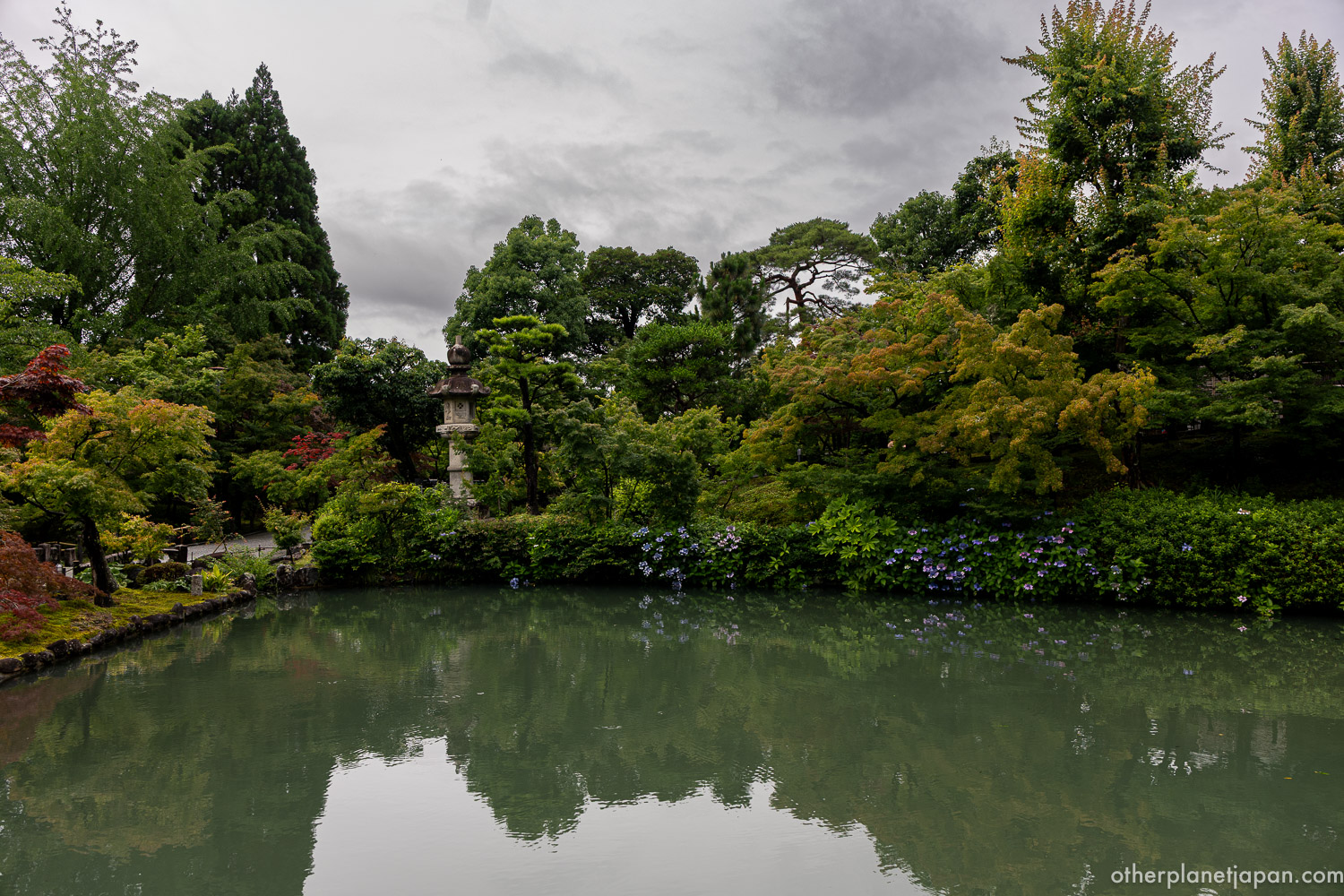
The first visit was in the green season. Rain had just lifted, the stone approach was still dark with water, and overhead the young maple leaves filtered the light until the whole temple felt submerged in a green aquarium. Eikando is rarely mentioned without its epithet—momiji no Eikando, “Eikando of the maples”—and its three thousand maple trees have made it one of the most celebrated autumn destinations in Kyoto. Standing under all that green, I made the obvious promise to myself: I would come back when it burned red.
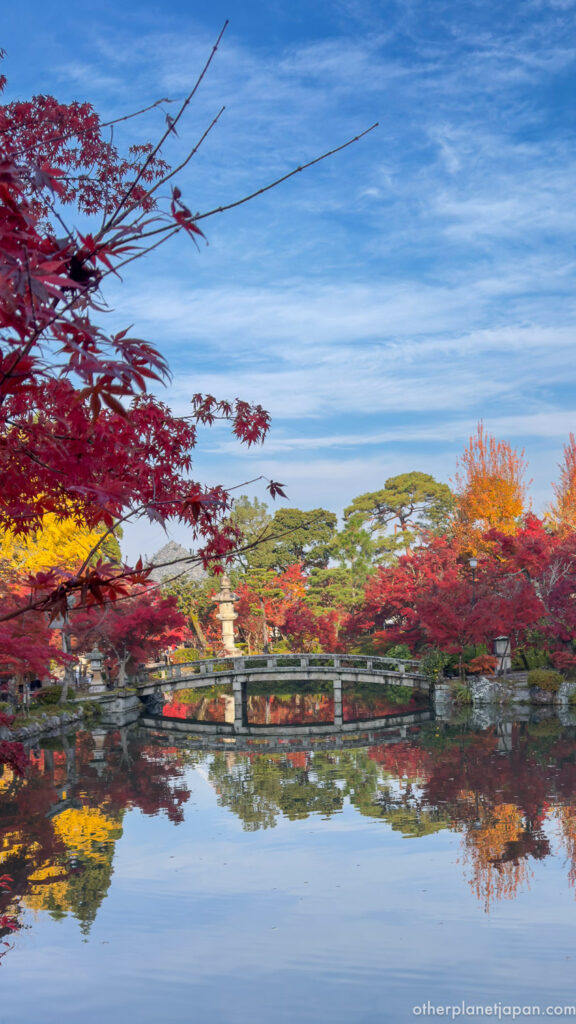
I kept the promise. My second visit came in late November, and the garden was everything the photographs claim. I know of no other garden in Kyoto so completely composed for autumn—maples layered over water, stone, and rooflines as if the whole compound were a single painting. What the photographs do not show is the crowd that arrives to see it. The approach moved at the pace of a queue. Along the edge of the pond, a silent territorial struggle was playing out over every decent vantage point. I remember thinking, clearly and without much regret: not this season again.
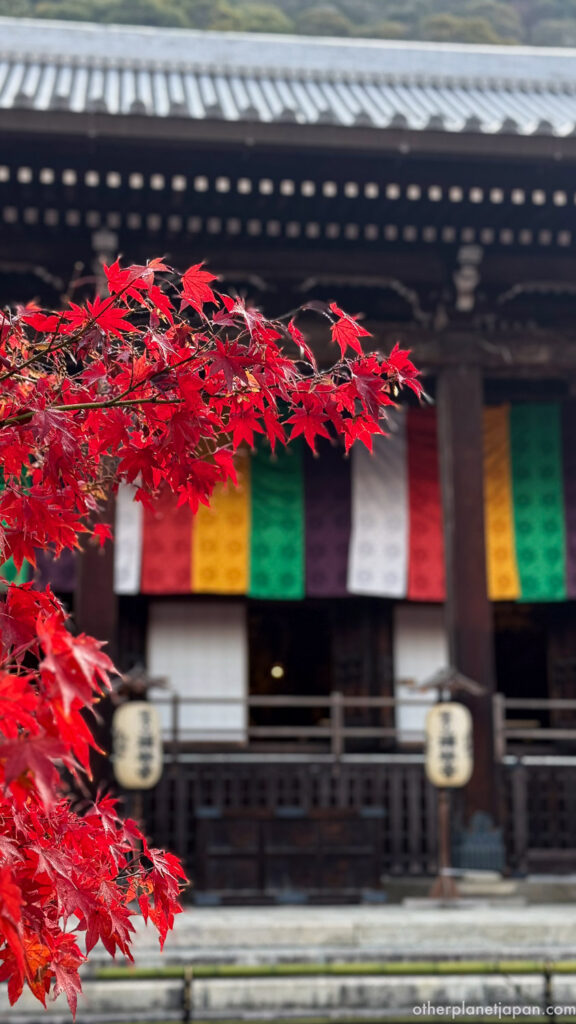
Still, there was the night illumination, and I told myself it deserved one chance. The night illumination became visit three. The maples floating in the dark were genuinely otherworldly; the crush of people beneath them was exactly the same as at noon. So I revised my promise once more. No more autumn, no more evenings. I would go back to where it all started—the green season, on a rainy weekday, when surely the temple would return to being itself.
The fourth visit is the one I will remember longest, and not for the reasons I hoped.
It happened in front of the Shakado, the Sakyamuni Hall, rebuilt in 1895. Directly before it, someone had planted a full tripod and was working through compositions at leisure, as though a century-old wooden building were a studio backdrop. The irony is that Eikando is famously strict about photography—tripods are prohibited, and signs say so—a stark contrast to easygoing Nanzenji ten minutes down the road, where the rules are far more relaxed. Here, the rules existed, the signs existed, and a staff member stood a few steps away, saying nothing. A little further on, on the steps of the main hall, another visitor was carrying on a loud conversation over speakerphone. In Japan, holding a speakerphone conversation in public is not a gray area; it is plainly bad manners, and inside a temple—a place that trades in silence—it borders on contempt.
I kept walking, past all of it, toward the pond. And there, the visit delivered its final, strangest gift.
The Gokurakubashi—the “bridge of paradise” that arches across the Hojo Pond—was empty. I have never, in all my visits, had that bridge to myself. I stood on it for a while, watching the carp move without hurry beneath me, taking photographs in the soft light after the rain. It was the closest thing to the temple I had first fallen for.
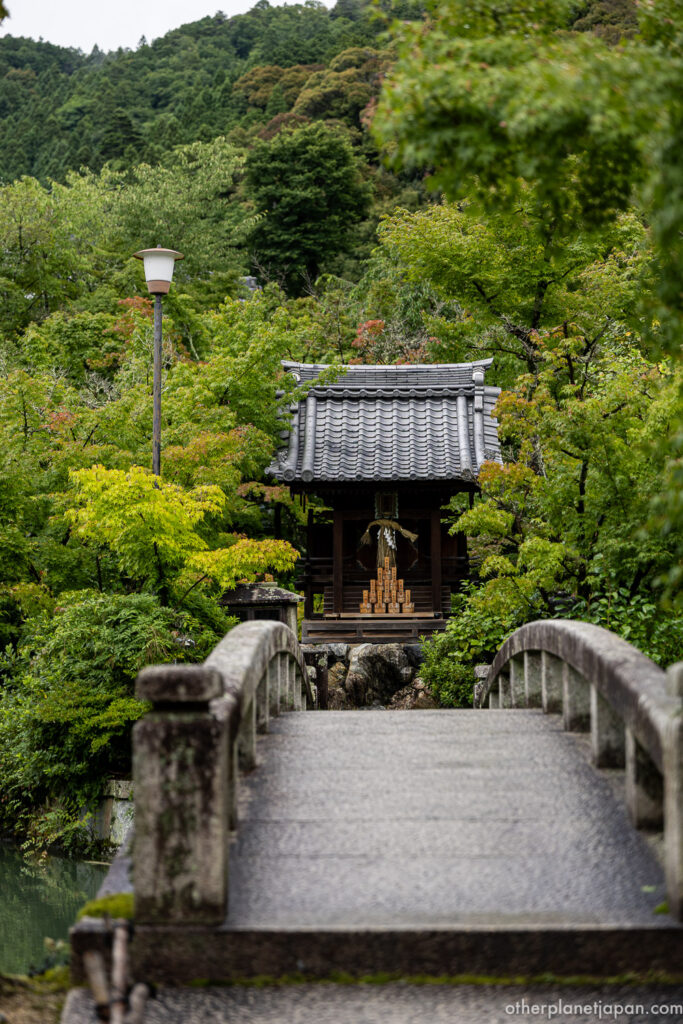
Then a bridal couple stepped into view. White gown, black tails, a photographer working around them. Location photography of this kind is not permitted at Eikando, or at most temples and shrines in Kyoto. The three of them behaved as though I—the one visitor actually there to see the temple—were in their way. Of course, the ones breaking the rules were them. I almost said something. I swallowed it. And for the first time in my life, I found myself missing the queue of autumn tourists I had spent three visits resenting. With that many people around, the couple would have given up and gone elsewhere.
That was the moment I decided I was done.
So let me be honest with you. In autumn, the crowds overwhelm the very beauty everyone has come for. In every other season, the crowds thin, but the manners of too many visitors do not improve. The garden is first-rate. The architecture is first-rate. That is precisely why it stings to write this—and why I cannot, in good conscience, tell you to go.
But I know some of you will go anyway. Eikando is on the list, the list is long, and Kyoto is a once-in-a-lifetime trip. Fair enough. What follows is a guide for you: what to see, when to go, and how to give yourself the best chance at the temple I fell for on that first rainy morning.
The Mikaeri Amida: The Buddha Who Looks Back
Eikando is a nickname. Formally, this is Zenrin-ji, head temple of the Seizan branch of Jodo-shu Buddhism, with a history reaching back to the ninth century—though in Kyoto, almost no one calls it anything but Eikando.
What separates it from every other temple in Kyoto is its principal image: the Mikaeri Amida, the “Amida Looking Back.”
Most Amida statues face straight ahead. Eikando’s Amida turns his face over his left shoulder, glancing behind him. Temple legend traces the pose to the monk Eikan, who was circling the altar in prayer when the statue stepped down and walked ahead of him—then turned, and said, “Eikan, you are slow.” A Buddha who looks back for the ones falling behind. Whatever your beliefs, it is difficult to stand in front of this statue and feel nothing.
One practical note that most visitors miss: the statue’s face is best seen from the right-hand side. From straight on, you see only his profile. Circle to the right before you leave the hall.
While you are in the Amida Hall, slow down. The building rewards the patient eye: celestial maidens painted across the sliding doors, patterned pillars, carved lotus ornaments tucked into the woodwork—details fine enough that most visitors walk past them entirely. There is also a mandala so convincing I took it for the original; it is a reproduction, but do not let that stop you from looking. In a temple this crowded with famous sights, the quiet craftsmanship is the part almost everyone misses.
There is a second Amida worth knowing about here, quietly overshadowed by the first: the Hiyoke no Amida, the fire-warding Amida. Kyoto burned many times over the centuries, and this image is credited with sparing the temple from the flames. It has drawn prayers against fire and misfortune ever since. It lacks the drama of the Mikaeri Amida’s story, but it carries something older and plainer—the long human habit of asking to be kept safe.
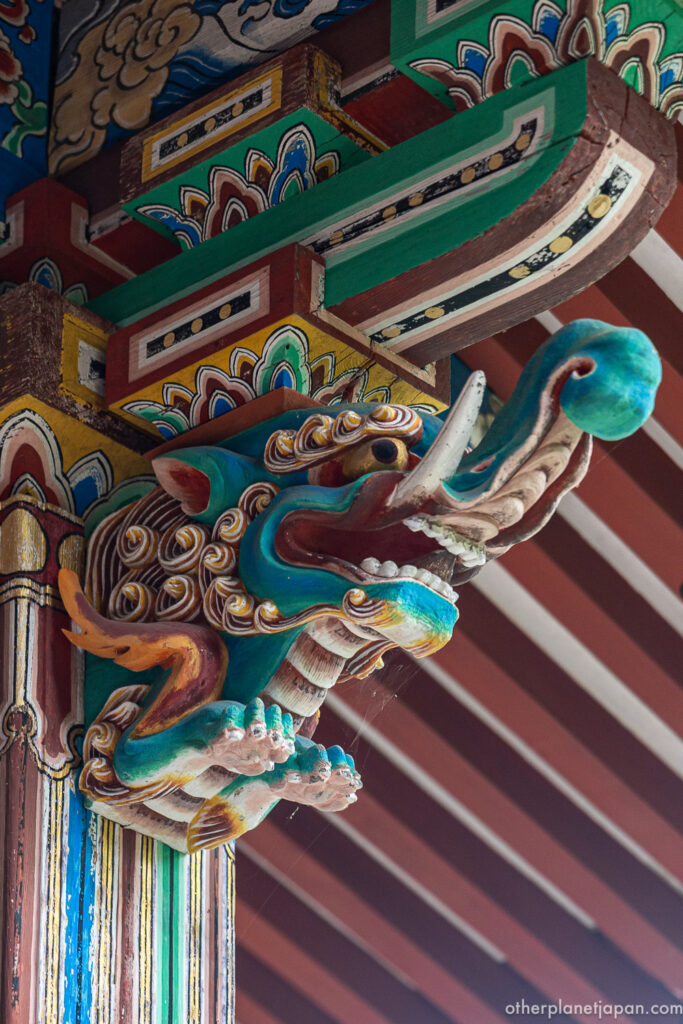
Eikando in the Green Season: Maples, Moss, and Hydrangeas
A rainy weekday morning. I passed through the main gate.
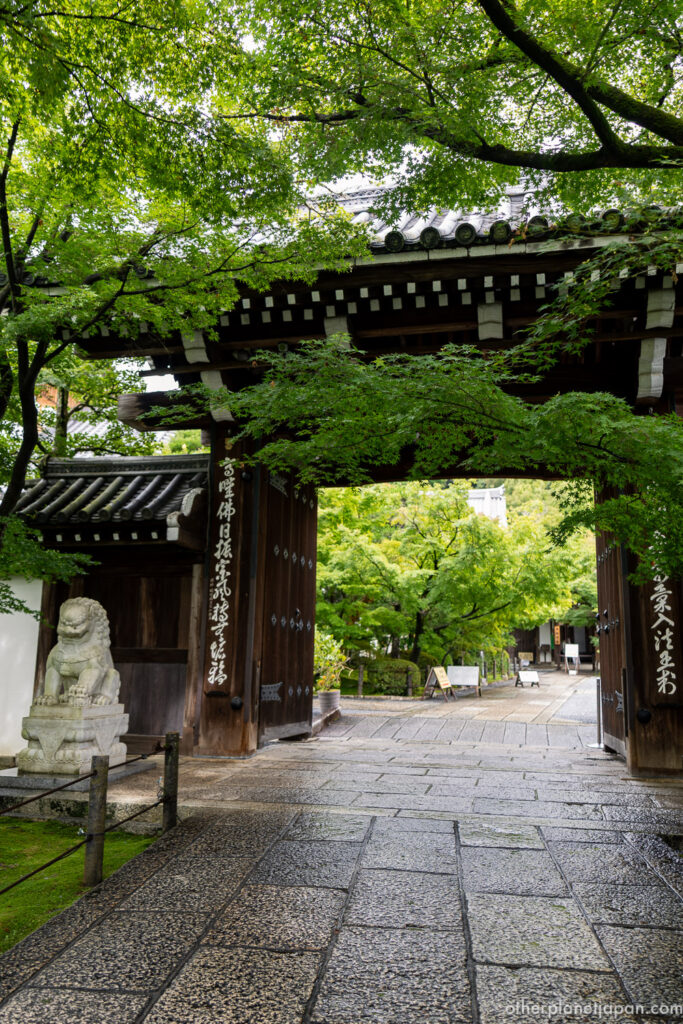
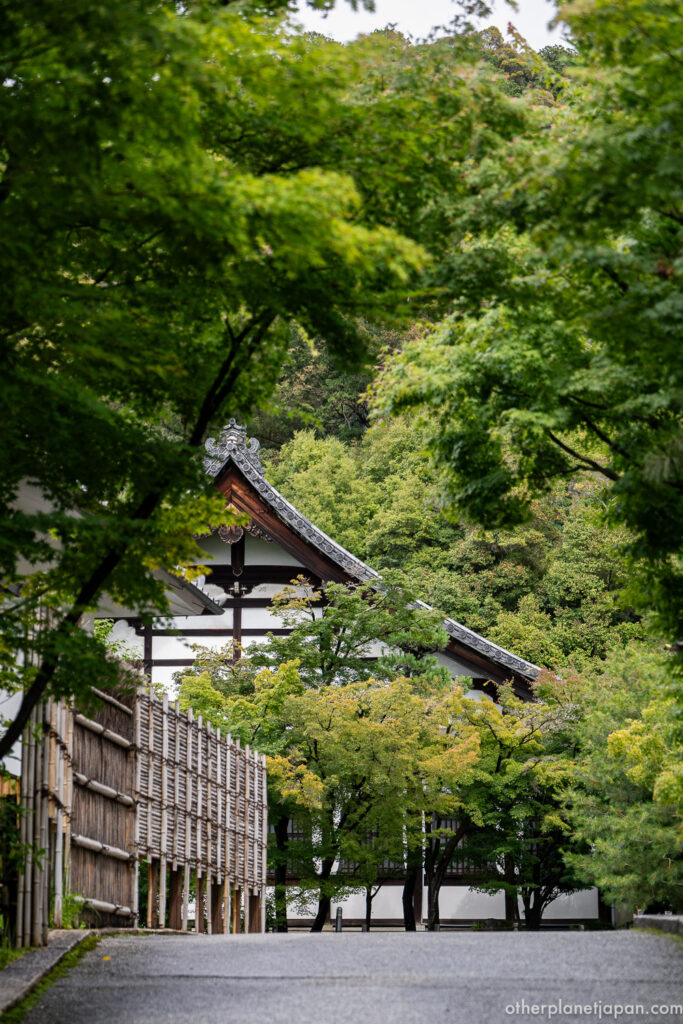
In November this approach becomes a river of people. On this morning, the paving stones shone with rain and I walked them alone. The maples overhead were still green, and even that green had registers to it—the deep tone of fully opened leaves, the pale, almost yellow shade of new ones. Rain fell from the leaf tips one drop at a time.
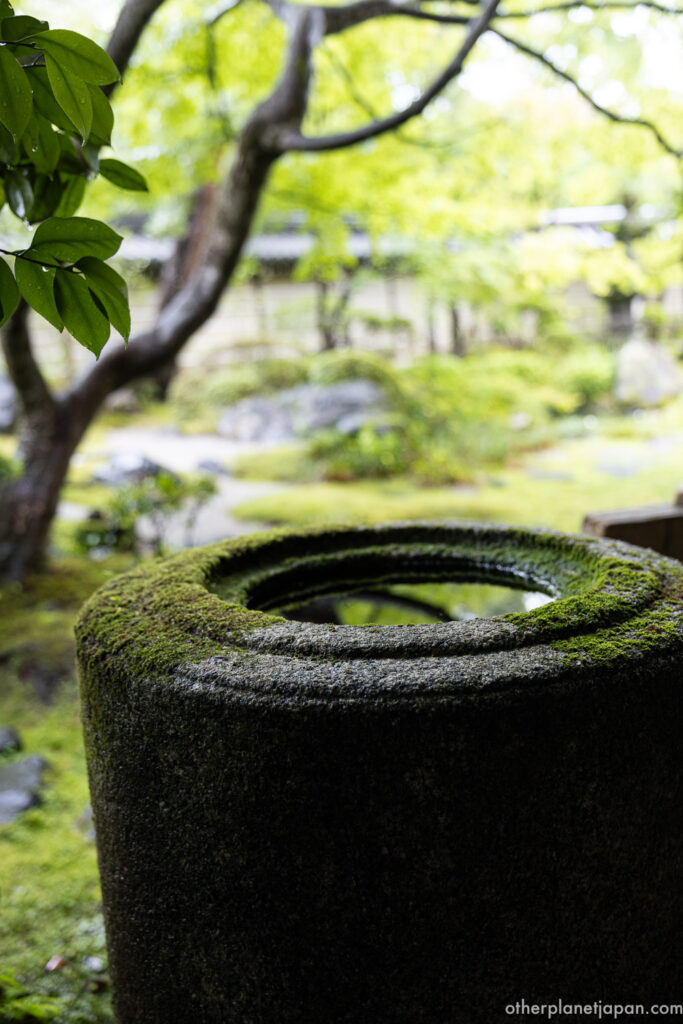
Deeper into the grounds, I found a stone water basin, moss thickened along its rim, young leaves reflected on the still surface. Someone has tended this quiet arrangement for centuries. You stand a little straighter in front of it.
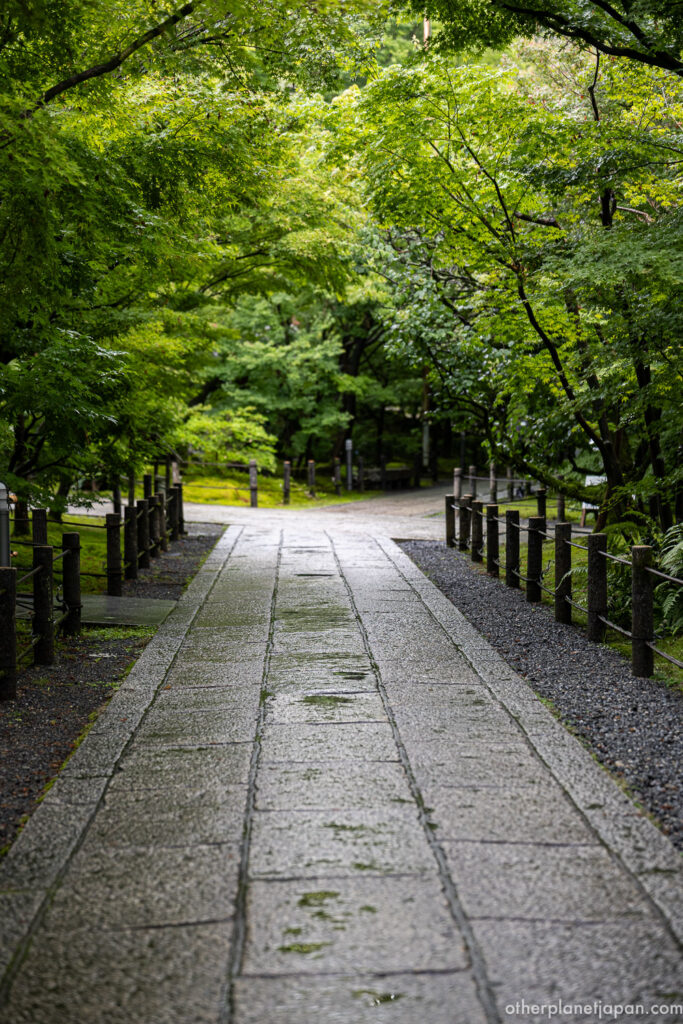
Eikando’s halls are linked by covered wooden corridors, and walking them is half the pleasure of the place. The floorboards have been polished by feet for so long that they hold a dark shine, and the garden slides past on one side like slow scenery from a train window.
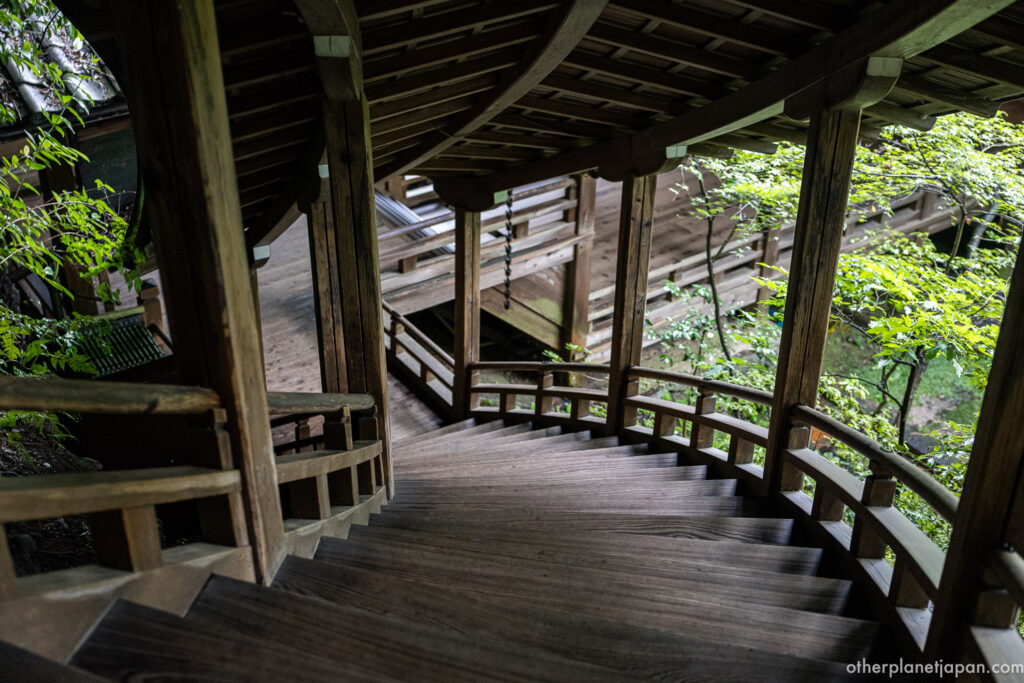
Then there is the Garyuro, the “Reclining Dragon Corridor”—a covered stairway that climbs the hillside in long wooden curves, built to follow the terrain and assembled without nails. Climbing it produces a peculiar sensation: you are indoors, and yet unmistakably ascending a mountain.
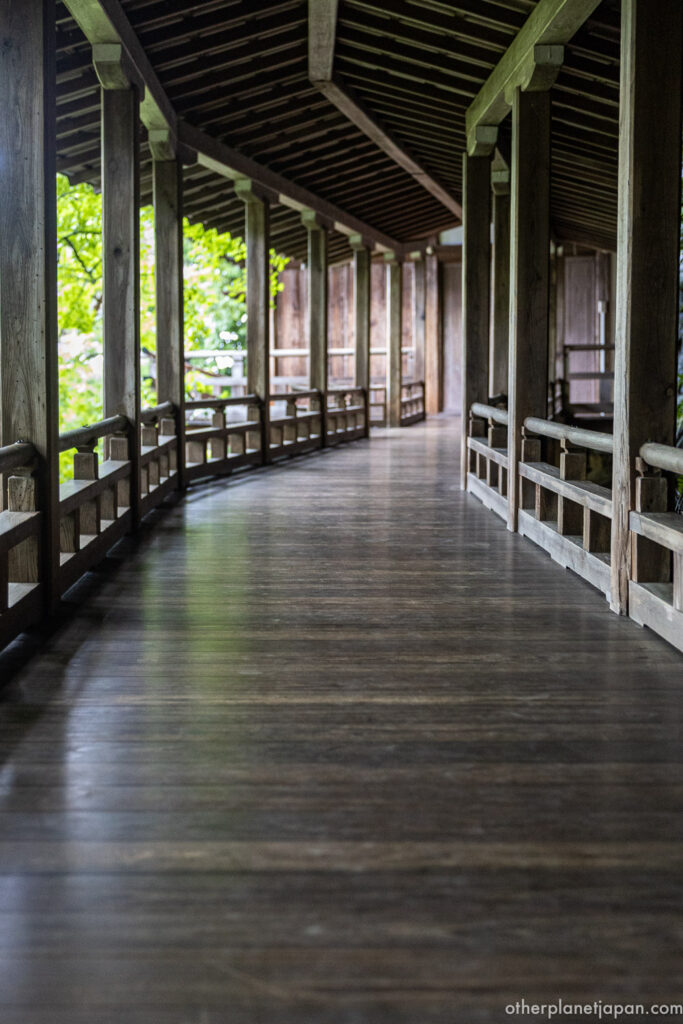
The path to the Tahoto pagoda, up on the hill with its view over the city, was closed that day—the rain, most likely.
Down at the lower edge of the grounds lies the Hojo Pond.
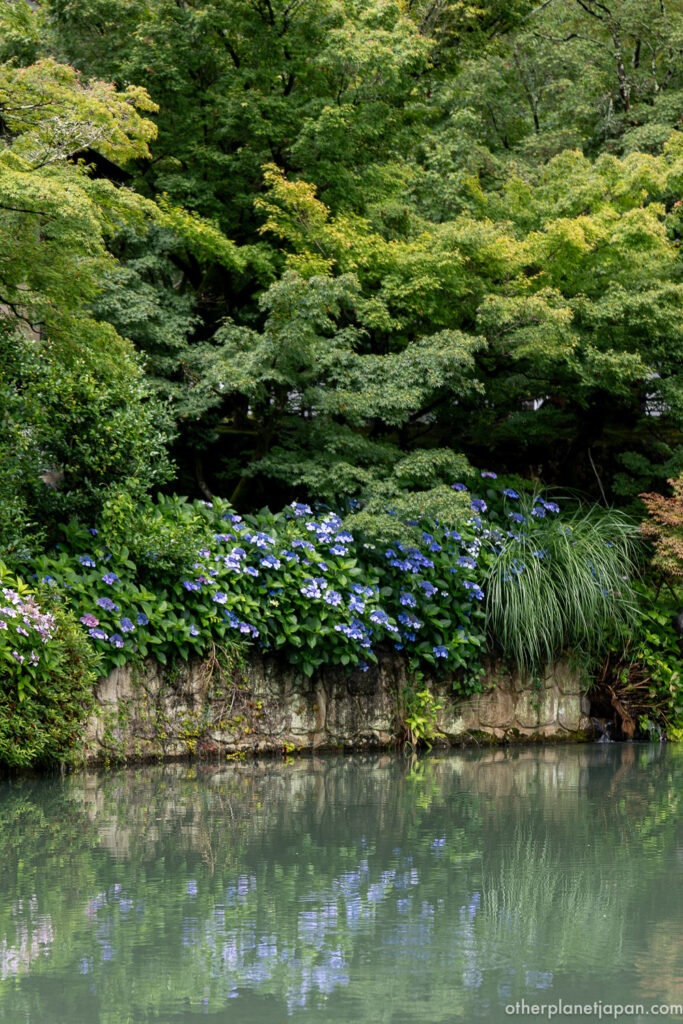
If you come in June, this is the quiet reward: hydrangeas in blue and violet spilling over the old stone embankment, doubled in the still water. And in the wooded rise above the pond, a stone pagoda stands half-sunk in moss. Few people walk this far.
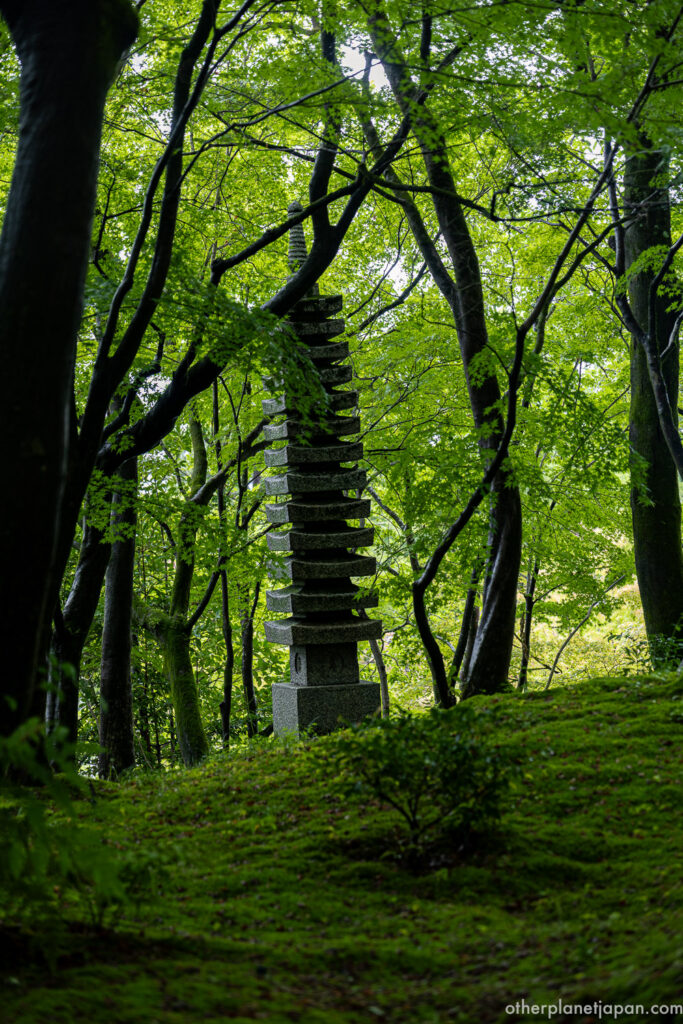
Eikando of the maples hides places like this in the shadow of its own name.
The Goshuin and the Goshuincho: A Small Ritual Worth Doing Right
Eikando has a practical system for temple stamps. You leave your goshuincho at the building to the right just inside the entrance before you tour the grounds, and collect it, freshly inscribed, on your way out.
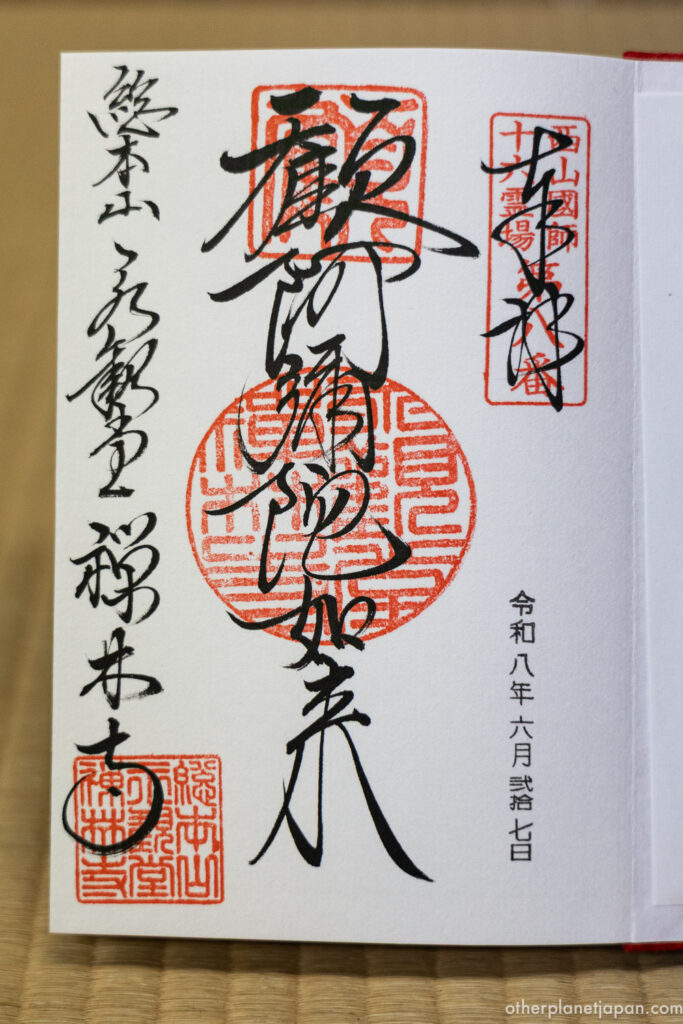
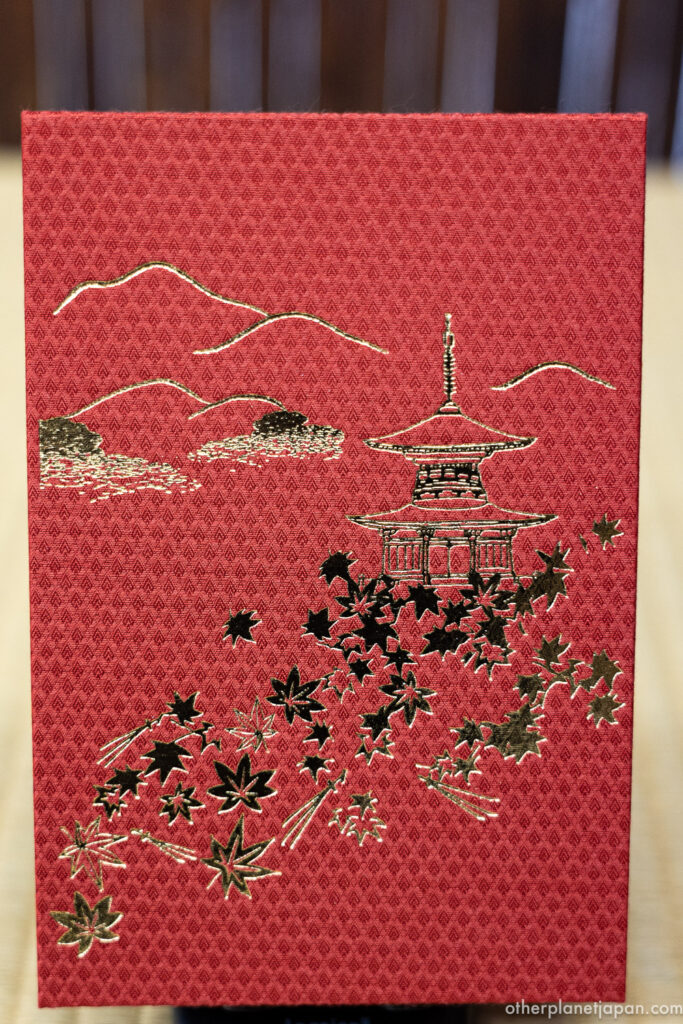
A hand-brushed goshuin costs 500 yen. I walked in with no plan to buy anything, and walked out with the temple’s own stamp book under my arm. Deep crimson cloth, a pagoda and drifting maple leaves stamped in gold—I told myself it was research. It was not research.
How to Visit Eikando Wisely
If you have decided to go, here is how I would go if I were you.
Skip the two obvious seasons. Autumn foliage and the November night illumination are the postcards; they are also where the crowds and the manners issues are at their worst. If you want the temple, not the queue, choose another window.
Aim for the green season. Late May through late June is my recommendation. The maples are at their most luminous, the hydrangeas open around the pond in June, and the compound has room to breathe. A rainy weekday morning is best of all—rain deepens the moss and thins the visitors in the same stroke.
Go at opening. The gates open at 9:00 a.m. Be at the ticket window when they do. Even in the busy months, the first hour is measurably calmer than the rest of the day.
Do the goshuincho first, then walk. Drop it off on your way in and let it be inscribed while you tour the grounds—you save yourself a line at the end.
Circle to the right of the Mikaeri Amida. As above—it is the whole point of coming.
Pair it with Nanzenji. Ten minutes on foot. Do Eikando first, when it is quietest, then drift over to Nanzenji
Practical Information
Admission: 1,000 yen (daytime, outside the illumination period)
Hours: 9:00 a.m.–5:00 p.m. (last entry 4:00 p.m.). Give it 60 to 90 minutes at minimum—any less and you will be hurrying through the corridors, which defeats the point of them.
Getting there: The subway is the smart move—15 minutes on foot from Keage Station on the Tozai line, or 10 minutes on foot from Nanzenji. From JR Kyoto Station, City Bus 5 stops at Nanzenji-Eikando-michi (a 3-minute walk), but be warned: this route crawls through some of Kyoto’s worst traffic, and in busy seasons the bus is standing-room only. By taxi, simply say “Eikando”—every driver in Kyoto knows it.
Address: 48 Eikando-cho, Sakyo-ku, Kyoto
Address: 48 Eikando-cho, Sakyo-ku, Kyoto