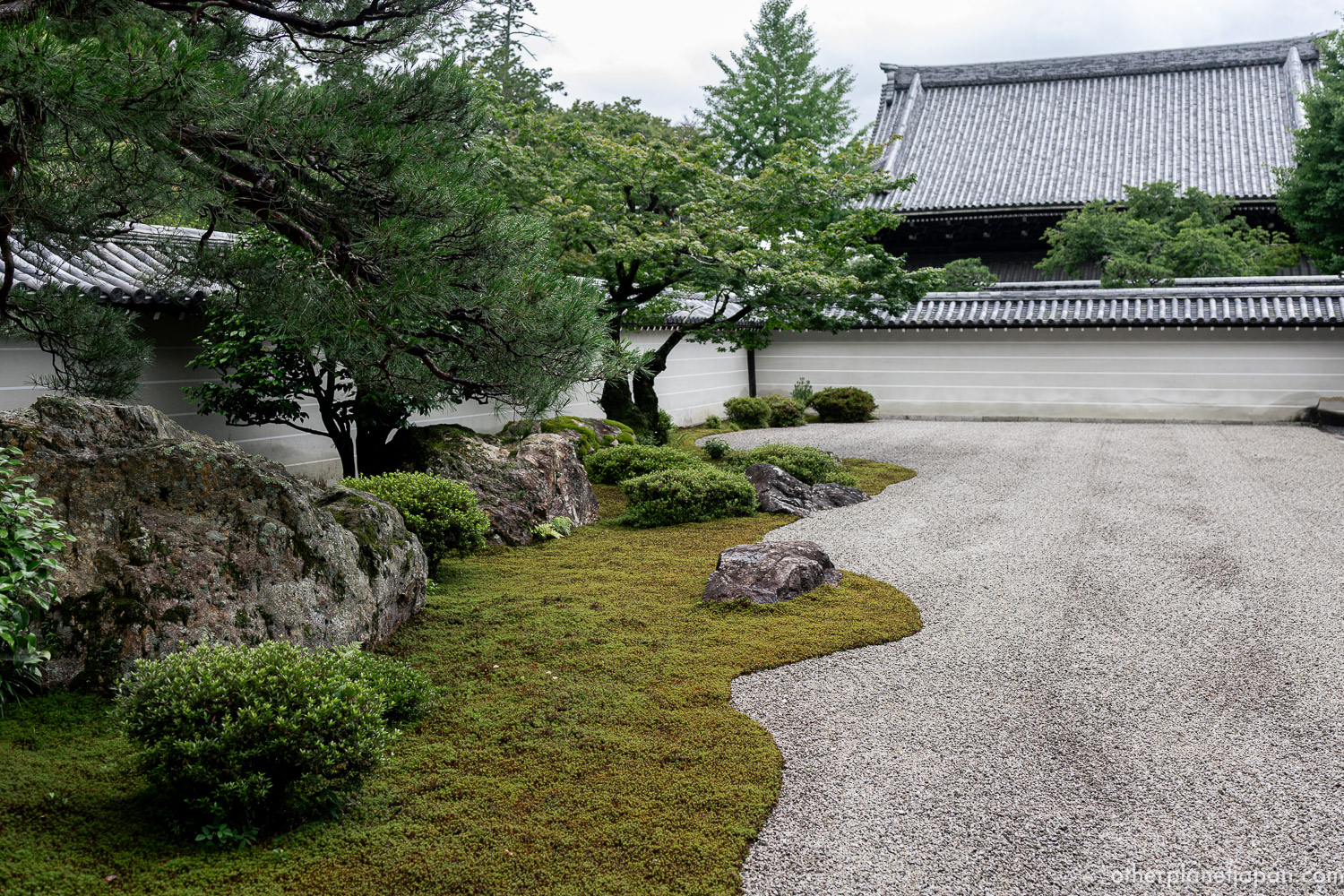
A bowl of freshly whisked matcha served with a wagashi sweet on a red lacquer tray inside the Hojo tea room at Nanzenji temple in Kyoto.
Seven hundred yen for a bowl of matcha. About five dollars — the same amount I spend on lunch every day at the company cafeteria.
I had walked past this tea room at Nanzenji’s Hojo at least five times before. Each time I had an excuse. Too crowded. Somewhere else to be. Hungry. The truth was simpler: 700 yen felt like a lot for one cup, even one made with care.
This time I had no excuse. I had time. The temple was empty. The room behind the receptionist glowed with that particular green light that only happens in Kyoto in June — the kind that filters through fresh maple leaves and makes the tatami look slightly underwater. A typhoon had passed through the night before, and the waterfall in the inner garden was running at twice its usual volume.
I told myself the 700 yen included the room, the waterfall, the new green leaves, and the tatami. I told myself the swollen waterfall was a bonus tipping the scales. I paid.
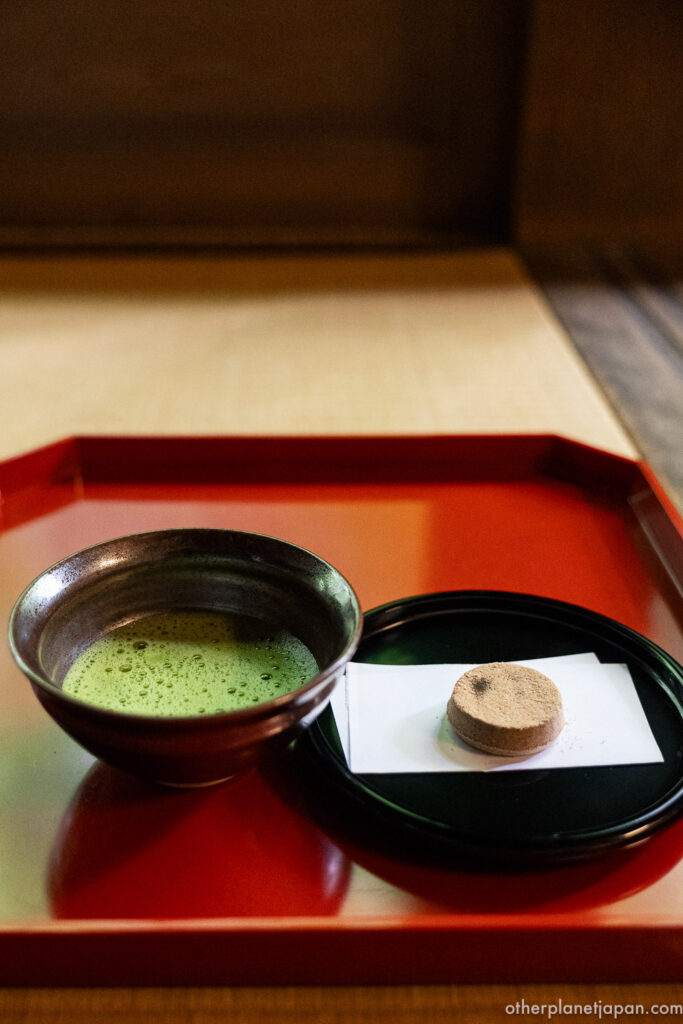
A small waterfall runs at high volume through dense green foliage in the inner garden of Nanzenji Hojo, the day after a typhoon passed through Kyoto.
On a dry day I probably would have kept walking. But Kyoto temples do that — they catch you on the right afternoon and suddenly you are sitting down with a bowl you had not planned to order.
How to Reach the Hojo
I came in the wrong way.
The proper approach to Nanzenji is through the Sanmon, the enormous two-tiered gate that frames the temple like a stage curtain. That day I had walked down from the Philosopher’s Path, and the Sanmon was a detour. Too big, too far, too much of a backtrack. I walked past it on the gravel path toward the main hall.
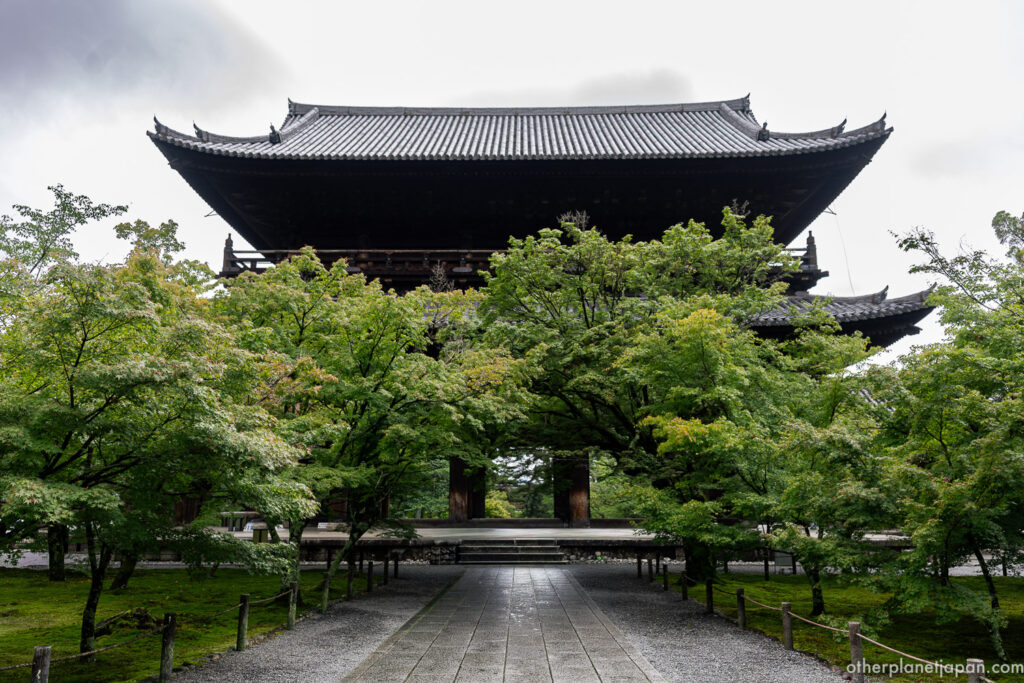
The massive two-tiered Sanmon gate of Nanzenji temple rises above fresh green maple trees in Kyoto, framed by stone paving.
In front of the Hatto, the lecture hall, a group of high school students on a school trip were clapping their hands twice before the altar. Their guide stopped them mid-clap. Clapping is for Shinto shrines, she explained. Not for Buddhist temples. At a temple, you simply bow.
The clapping was wrong, yes. But I thought about it for a moment. When I was their age, I had never once visited a temple on my own. These students at least chose to stand here and try. That is more than I could say about my seventeen-year-old self.
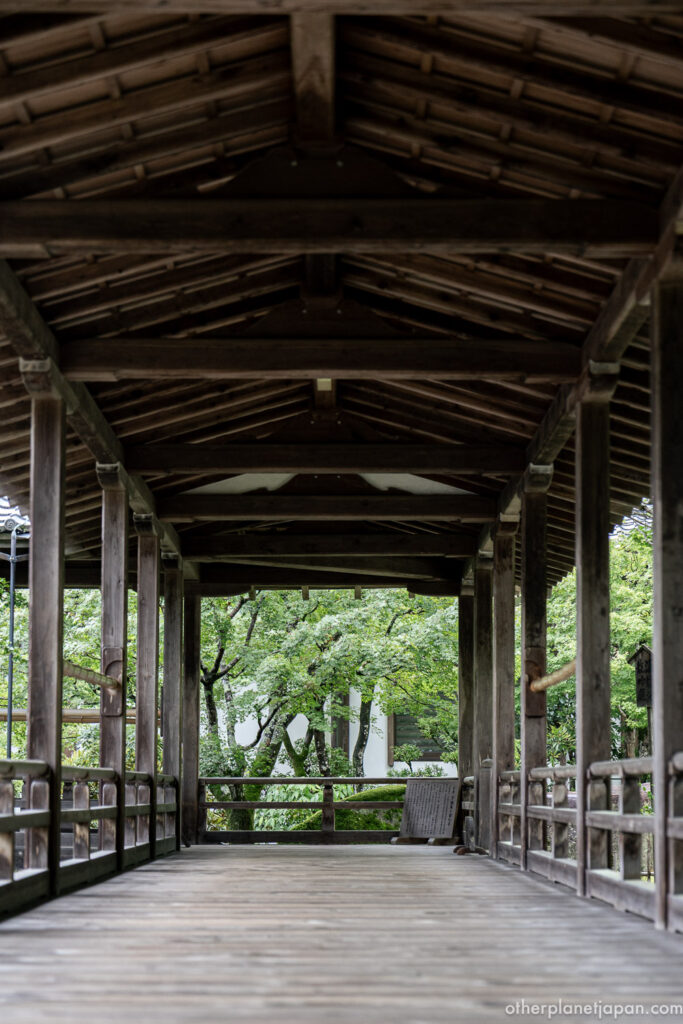
A long covered wooden corridor connecting buildings of Nanzenji’s Hojo, leading toward a small framed view of green maples in Kyoto.
The Hojo entrance is past the Hatto, on the right, marked by a covered wooden walkway that smells of old cedar. You pay at the reception. Matcha tickets are also purchased here.
What Is the Nanzenji Hojo?
The Hojo is the abbot’s quarters. In English that sounds modest. In Kyoto it almost never is.
Nanzenji’s Hojo consists of two connected buildings — the Daihojo, or great hall, and the Shohojo, the small hall, attached at its rear. The Daihojo was rebuilt in 1611 from a donated palace structure. Temple tradition says it was moved from the Seiryoden of the imperial palace, dating to the Tensho era between 1573 and 1592. Other scholars argue it came from a different palace building — the audience hall of a former empress’s residence. So yes — it is a palace, regardless of which one.
The Shohojo behind it is younger. Built during the Kan’ei era, between 1624 and 1644, it was reportedly relocated from Fushimi Castle.
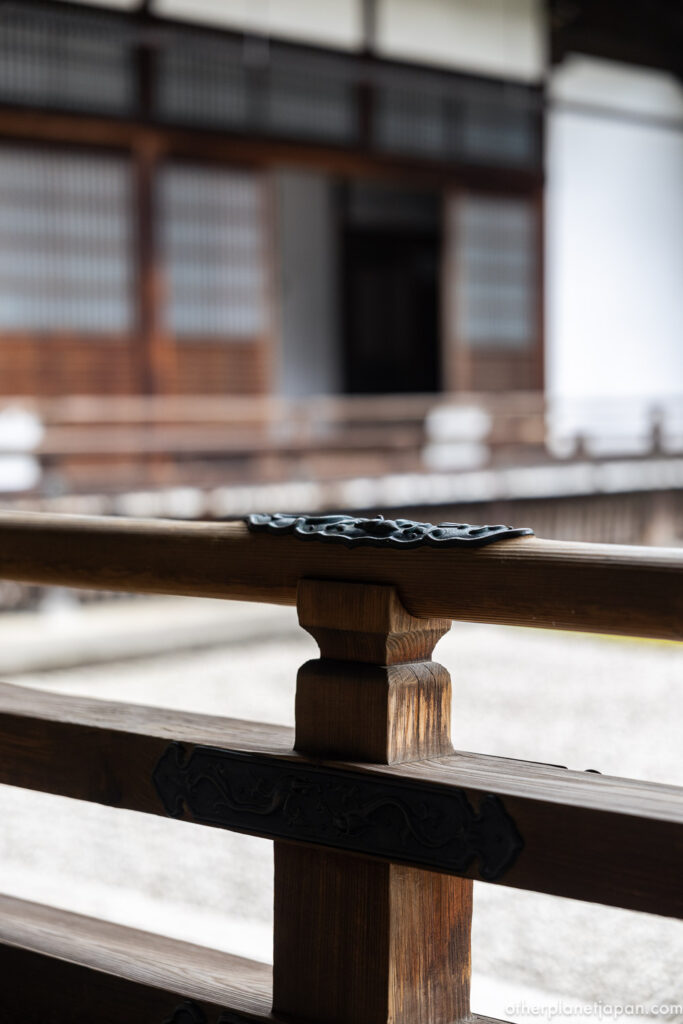
An intricately cast iron fitting decorates the wooden railing of Nanzenji Hojo, an example of early Edo-period craftsmanship preserved at the Kyoto temple.
The central south room of the Daihojo still carries its old palace name — the Ohiruma, the daytime room, where the emperor once received visitors. The carved transoms above the veranda, the coffered ceiling, the formal wooden doors — all of it is a working specimen of early modern palace architecture. I can think of maybe three other places in Japan where you can see this.
The problem with the Nanzenji Hojo is that there is too much history in one building. A palanquin associated with Emperor Go-Daigo. Kano-school paintings on every sliding door. A karesansui garden attributed to a legendary designer. After a while my understanding of what I was looking at stopped keeping up with what was in front of me. Most visitors walk past these rooms heading straight for the garden. I cannot blame them — but the rooms are what I kept thinking about afterward.
The Garden — Tiger Cub Crossing
The main garden faces the Daihojo’s south veranda. It is called Tora no Ko Watashi no Niwa — the Tiger Cub Crossing Garden — and it is attributed to Kobori Enshu, the legendary garden designer who worked for shoguns and emperors.
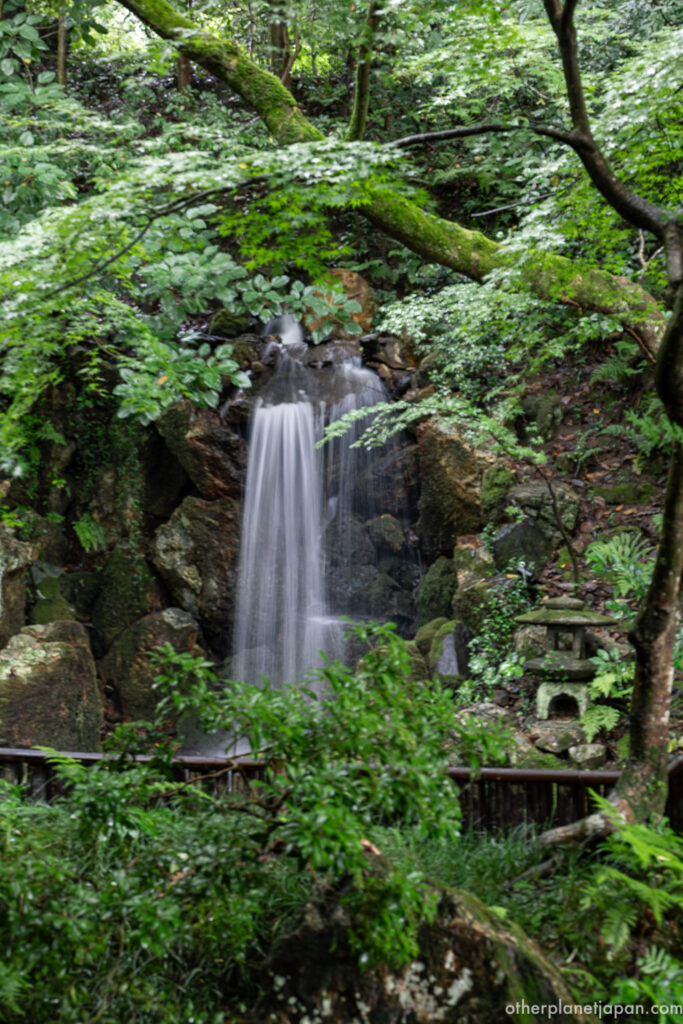
The wide karesansui rock garden of Nanzenji Hojo, with raked white gravel, dark stones, and a pine tree along the back wall in Kyoto.
The story behind the name: a mother tiger is leading her cubs across a river. One of the cubs is a leopard who would eat the others if left alone. The stones represent the impossible logic of getting them all across safely. A Buddhist parable about right action, dressed up as a garden.
I will admit something. I have looked at this garden many times and I have never quite located the leopard. I am not sure anyone does, on the first pass. The stones sit at the far edge of the white gravel, against a long earthen wall, with a single pine softening the line.
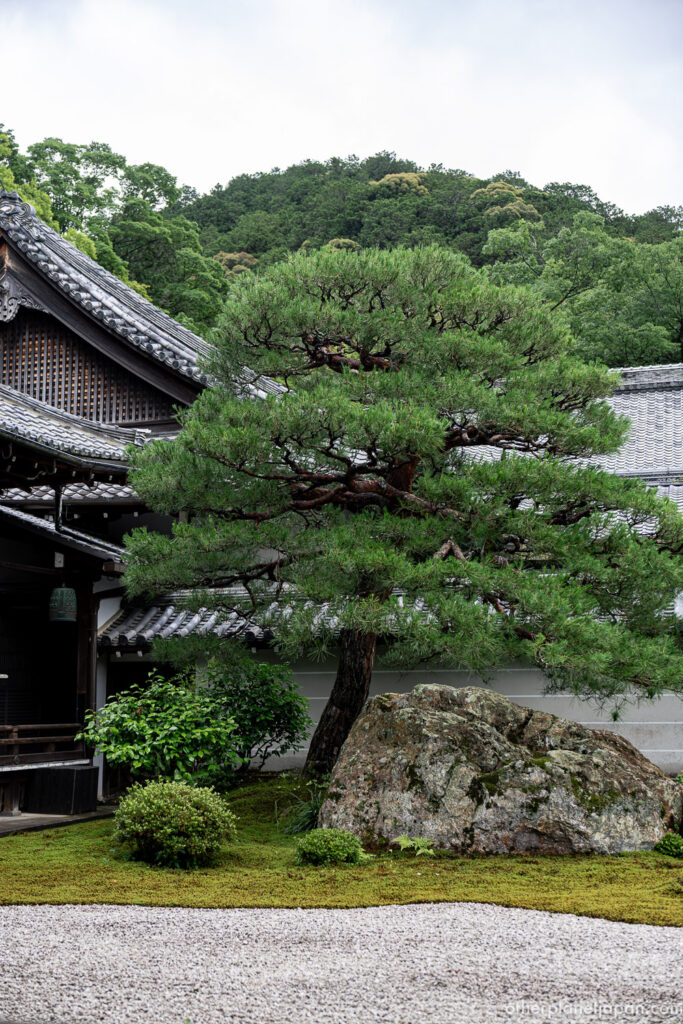
A meticulously trained Japanese black pine grows beside a large mossy boulder along the back wall of Nanzenji Hojo’s Tiger Cub Crossing Garden in Kyoto.
What I will also admit is that finding a good photo angle is harder than it should be. The garden was not designed for cameras. It was designed for one specific point of view — the seated abbot’s, looking out from the veranda. Walk a few meters to the left and the composition collapses. Walk a few meters to the right and a downspout enters the frame. The garden is doing what it was meant to do. You are the one standing in the wrong place.
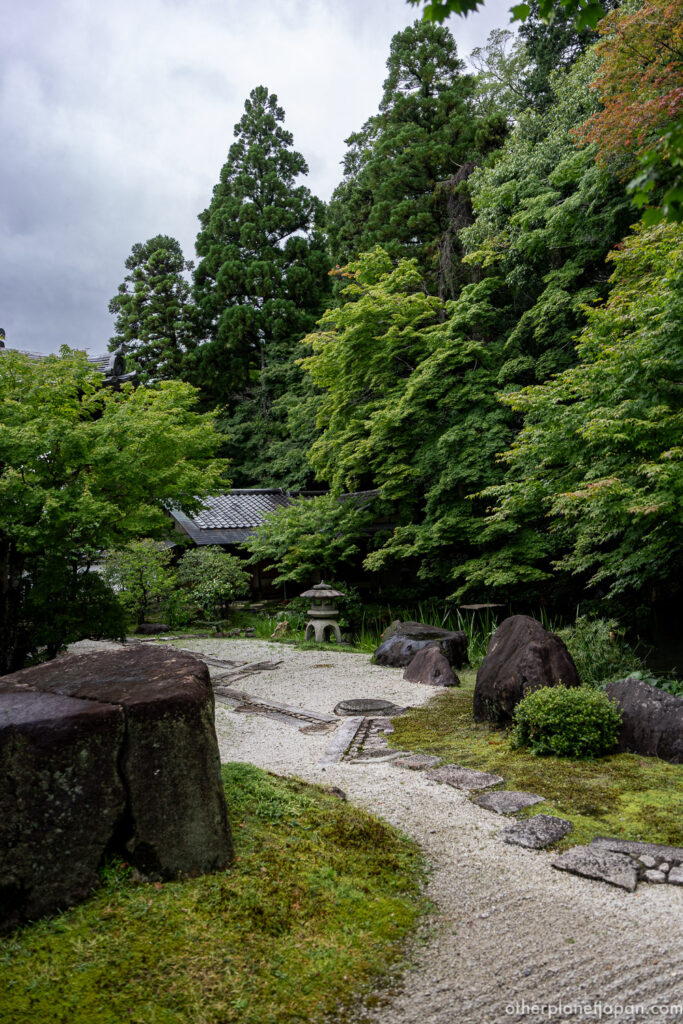
A quieter corner of the Nanzenji Hojo garden in late spring, with raked gravel, moss-edged stones, and a stone lantern half-hidden among fresh maple leaves in Kyoto.
Sit. Do not walk. The garden will start working on you within about two minutes.
The Paintings You Cannot Photograph
Most of what is inside the Hojo, you cannot photograph.
I understood why as soon as I looked. The sliding doors are covered in gold-leaf paintings by the Kano school — the same Kano school that any Japanese student meets in their high school history textbook, somewhere between the chapter on Oda Nobunaga and the rise of the Edo shogunate. To see those paintings in a textbook is one thing. To see them in the dim room they were painted for, behind a wooden cordon, is another.
The Daihojo’s panels were painted in the early Momoyama period, in the late sixteenth century. Four hundred years of seasons had taken their toll. In December 2011, the temple moved 84 of the 124 original panels into a climate-controlled storehouse. What you see today is a reconstruction — digitally photographed, then repainted in the color palette of the early-to-middle Edo period, the way the originals would have looked when they were still young.
The reconstruction is not a copy. It is a careful guess at how the gold and the pigments looked when the abbot first walked into the room. Not what the painting is now, but what it once was. I stood there longer than I expected to.
The Shohojo behind it has a different treasure. Forty panels attributed to Kano Tan’yu, called the Gunko-zu, or Tigers in a Bamboo Grove. This room is called, simply, the Tora no Ma — the Tiger Room. The tigers look like they could move. They are painted in such a way that the eyes follow you. I peered in from the outside walkway, behind the cordon, and thought: I would not want to sleep in this room. Even with the lights on. Even with friends.
The Matcha Experience
Now we are back to the 700 yen.
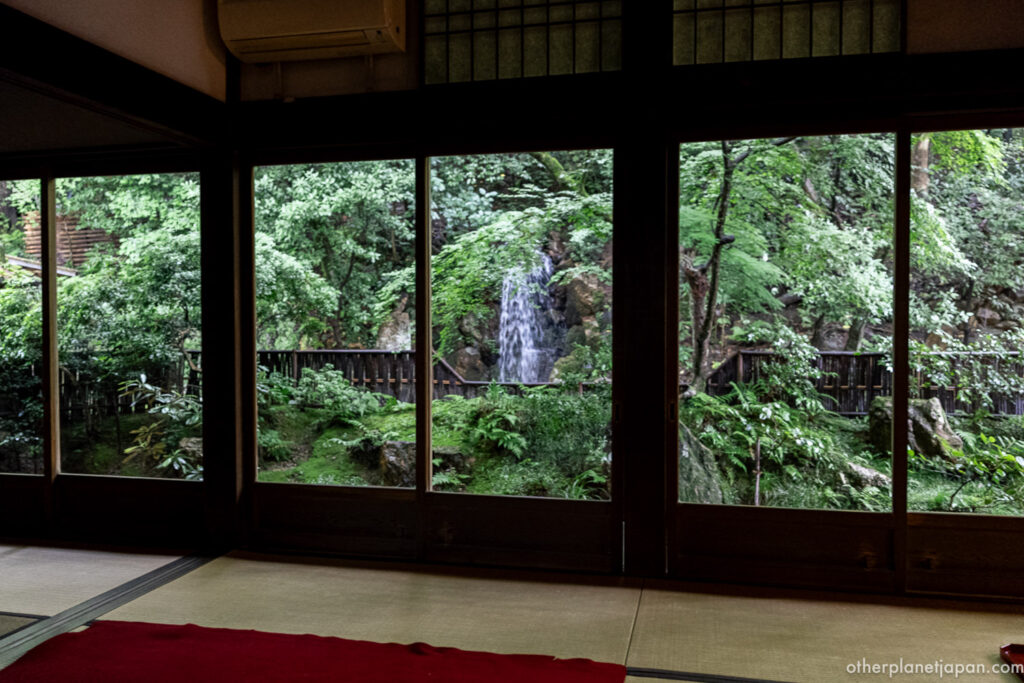
The tatami tea room inside Nanzenji Hojo, with floor-to-ceiling glass doors framing a view of the inner garden’s waterfall and dense green foliage in Kyoto.
The tea room is a wide tatami space with floor-to-ceiling glass doors that frame the inner garden like a folding screen. You sit on a red felt mat. A staff member brings the tray. The matcha arrives in a dark glazed bowl, paired with a small wagashi — a soft seasonal sweet that you eat before the tea, so the bitterness lands on a sweet palate.
There is no formal tea ceremony here. No host whisking. No bows. You drink at your own pace. People around you whisper. The waterfall does the rest of the work.
I sat for about twenty minutes. By the time the bowl was empty, the 700 yen had quietly stopped mattering.
The Suirokaku Aqueduct
You cannot leave Nanzenji without seeing the Suirokaku.
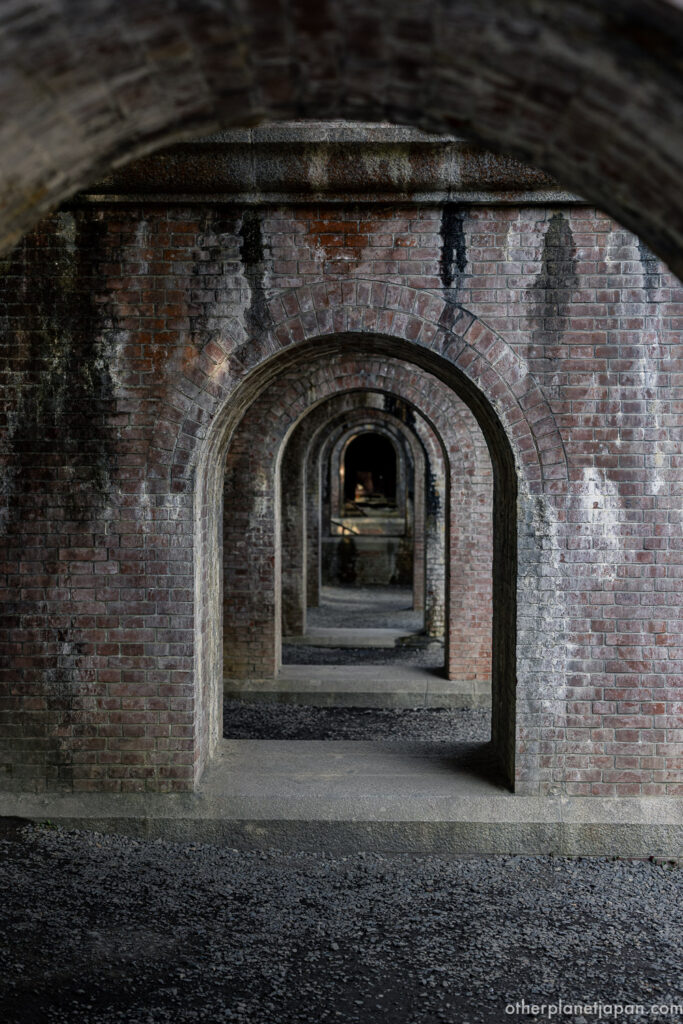
The brick arches of the Suirokaku aqueduct recede into shadow at Nanzenji, a Meiji-period engineering work still in use today in Kyoto.
It sits at the rear of the temple grounds, completely incongruous — a long red-brick Roman-style aqueduct running through the middle of a Zen Buddhist temple complex. It was built in 1888 as part of the Lake Biwa Canal, the engineering project that brought water from Lake Biwa over the mountains into Kyoto. It is still in use.
After an hour of moss and tatami and silence, the aqueduct hits you like a different century walking into the room. Stand under the arches and look up. You can see why every Kyoto photographer eventually shoots here, and why it appears in roughly half the Japanese television dramas set in the city.
The rain had left the bricks wet, and I noticed something for the first time — the color was deeper, richer, almost burgundy instead of the usual faded pink. I had never seen the Suirokaku look this good. My camera battery had died somewhere in the Hojo, so all I have is a short video clip. You can watch it here.
It is also, mercifully, free.
The Nanzen-ji Goshuin and Goshuincho: A Tiger in the Bamboo
I have a weakness for a well-made goshuincho, and Nanzen-ji’s is one of the few I have carried home twice. The cover is gold leaf, a tiger slipping through green bamboo — a small folding screen you can hold in one hand. If the tiger looks familiar once you step into the Hojo, that is rather the point: it answers the tiger screens the Kano painters left on the abbot’s quarters, the ones that seem to prowl a little whenever the afternoon light shifts.
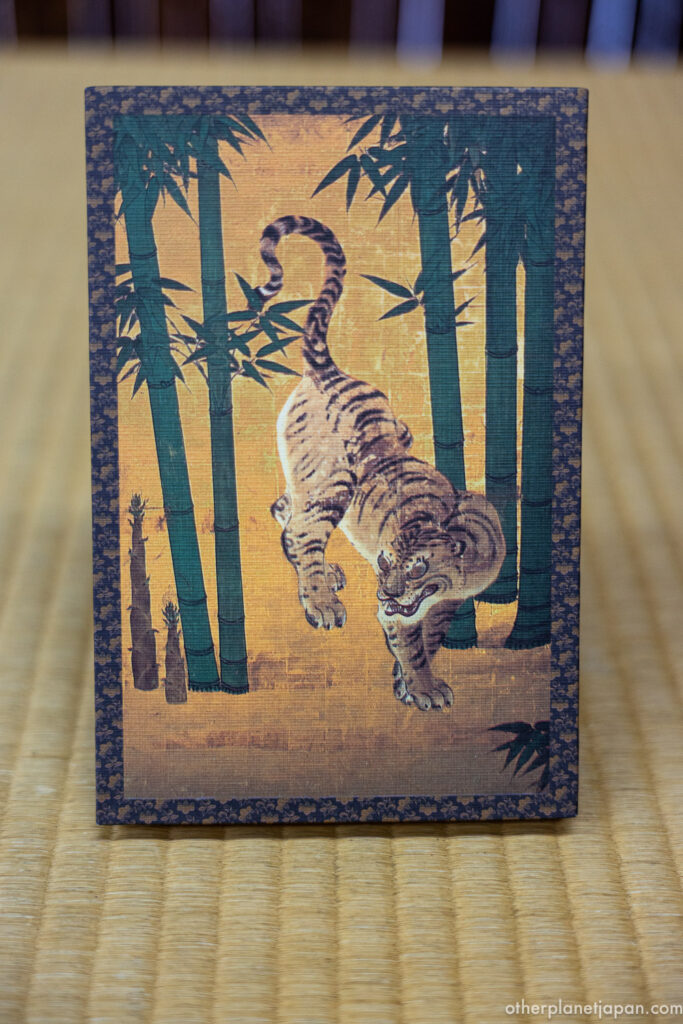
The Nanzen-ji goshuincho is ¥2,500, and here is the detail worth knowing before you reach for your wallet: that price already includes one goshuin brushed into the book. Put plainly, you are paying roughly ¥2,000 for the cover and ¥500 for the calligraphy that comes with it — a quietly generous arrangement I wish more temples would copy.
Open the cover and the first spread is not a stamp at all, but a poem. As the calligraphy itself notes, this is the death verse of Nanzen-ji’s founder, Mukan Fumon (無関普門), posthumously honored as Busshin Daimin Kokushi (佛心大明國師). Mine was transcribed by the temple’s current chief abbot and dated the twenty-seventh of June — a small thrill, to open a new book and find it already inhabited.
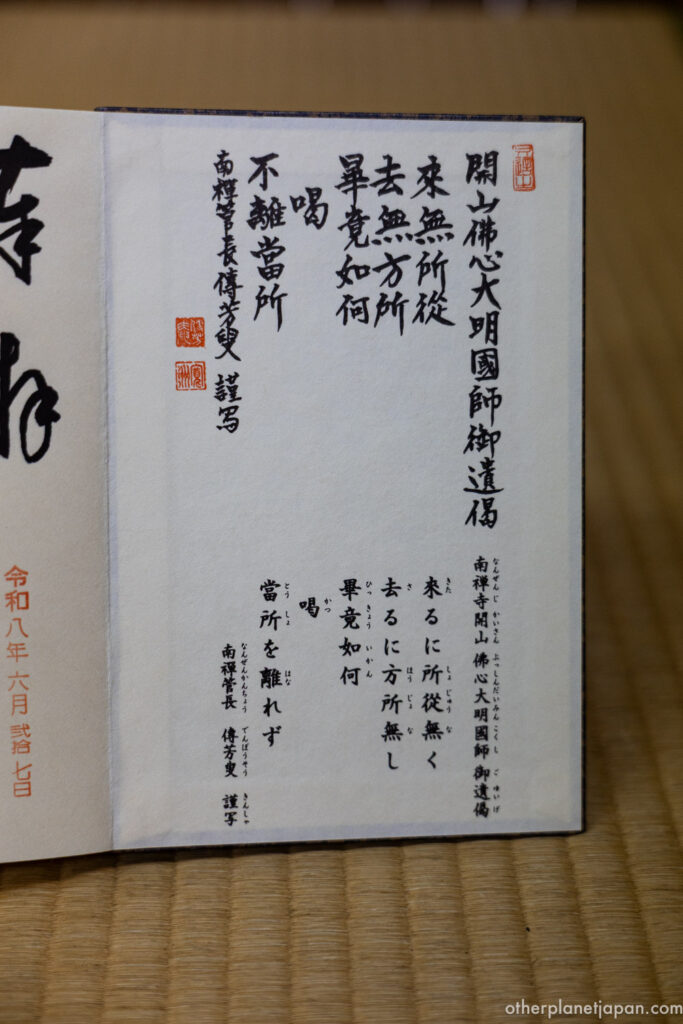
The verse runs: 来無所従 去無方所 畢竟如何 喝 不離当所. My own plain reading — offered as interpretation rather than scholarship — goes something like: coming, it comes from nowhere; going, it goes to no place; and in the end, what is it? A single shout — katsu! — and then: it is never apart from right here. It is a fitting thing to keep in your bag as you walk the temple grounds.
The facing page carries the goshuin proper — bold sumi strokes laid over a vermilion temple seal, dated in the old formal style. This is the calligraphy your ¥2,500 secured, and it is the reason the book feels less like a souvenir than a small commission.
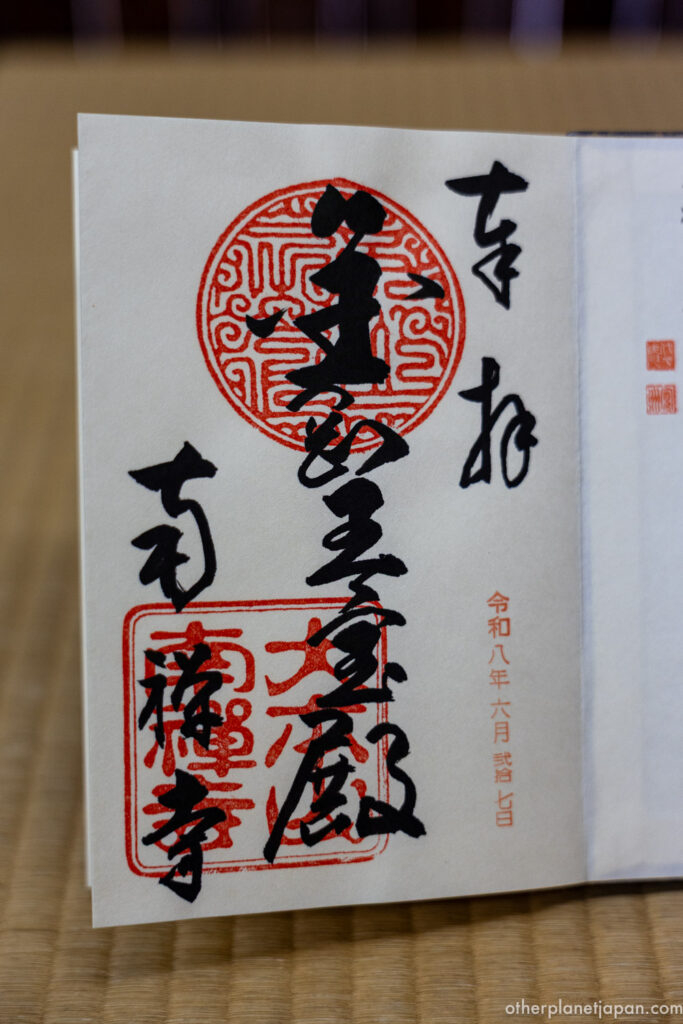
One thing to understand about the Nanzen-ji goshuin: the temple offers stand-alone stamps only as kakioki — pre-brushed slips you paste into your own book — priced at ¥500, or ¥800 for a version with a colored background. If you want the calligraphy written directly into your book, the only path is to buy the Nanzen-ji goshuincho, which, as above, arrives pre-inscribed. There is no on-the-spot brushwork here; the beauty is prepared in advance, and I have come to find that its own kind of quiet.
Nanzen-ji Goshuin: The Essentials
| Goshuincho (book) | ¥2,500, includes one goshuin (effectively ¥2,000 for the book) |
| Kakioki goshuin (slip) | ¥500, or ¥800 with a colored background |
| Direct writing (chokugaki) | Available only by purchasing the goshuincho |
| Where to buy | Temple shop — no need to enter the Hojo |
| Payment | The temple shop accepts credit cards for the goshuin and goshuincho — a convenience worth noting, since admission to the Hojo itself is cash only |
Practical Information
Admission (Hojo) cash only
General 600 yen, high school 500 yen, junior high and younger 400 yen.
Matcha Tea Set cash only
700 yen, purchased separately at the Hojo reception.
Hours
Hojo: 8:40–17:00 (March–November), 8:40–16:30 (December–February). Closed December 28–31.
Tea Room Hours
9:30–15:30. Closed 12:00–13:00.
Combination Tickets
None. The Sanmon, Tenjuan, and Hojo are sold as separate tickets.
Temple Grounds
Open 24 hours. Free of charge. Only the Hojo, Sanmon, and sub-temples require admission.
Photography
Allowed in the gardens. Prohibited inside the Hojo rooms. Tripods and monopods are prohibited everywhere on the grounds, indoors and out. Commercial photography (modeling, bridal, etc.) is prohibited.
Goshuin (Temple Stamp)
Paper goshuin: 500 yen or 800 yen depending on style. If you purchase a temple stamp book at the reception, a pre-written goshuin is included and the priest will write the date on the spot.
Best Season
Late April to early May for fresh maples. Mid-November for autumn color. Early morning on weekdays for the quietest experience.
Allow
60–90 minutes for the Hojo. Add 30 minutes if you stop for matcha. Add another 30 minutes if you walk down to the Suirokaku.
Access
Subway: Keage Station on the Tozai Line, about 10 minutes on foot. Walk through the brick tunnel called Nejirimanpo for the shortest route.
Bus: City Bus route 5 to Higashi-Tennocho or Nanzenji-Eikando-michi, about 10 minutes on foot.