Nisonin Temple sits at the foot of Mount Ogura, and most visitors walk right past it. They come to Arashiyama for the Bamboo Grove, for Togetsukyo Bridge, for the crush of selfie sticks and rickshaws. But keep walking north through the quieter lanes of Sagano, past Jojakko-ji and into the leafy stillness beyond, and you will find one of the most understated and historically layered temples in all of Kyoto.
What makes Nison-in unusual is right there in the name. “Nison” means two honored ones. Where nearly every Buddhist temple in Japan enshrines a single principal image, this one places two side by side: Shaka Nyorai and Amida Nyorai, one to send you off from this world and one to welcome you into the next. It is a theological concept made physical—two gilded figures standing together in the dim light of a hall rebuilt five centuries ago, watching over the same stretch of Sagano they have watched over since the Kamakura period.
Founded in the 830s–840s by order of Emperor Saga, Nison-in has survived the Onin War, imperial patronage, and the slow accumulation of poets, merchants, and warlords who have chosen this hillside as their final resting place. Its formal name is Ogurasan Nisonkyoin Kedaiji—a mouthful that locals have long since shortened to simply Nison-in.
The Approach — Momiji no Baba
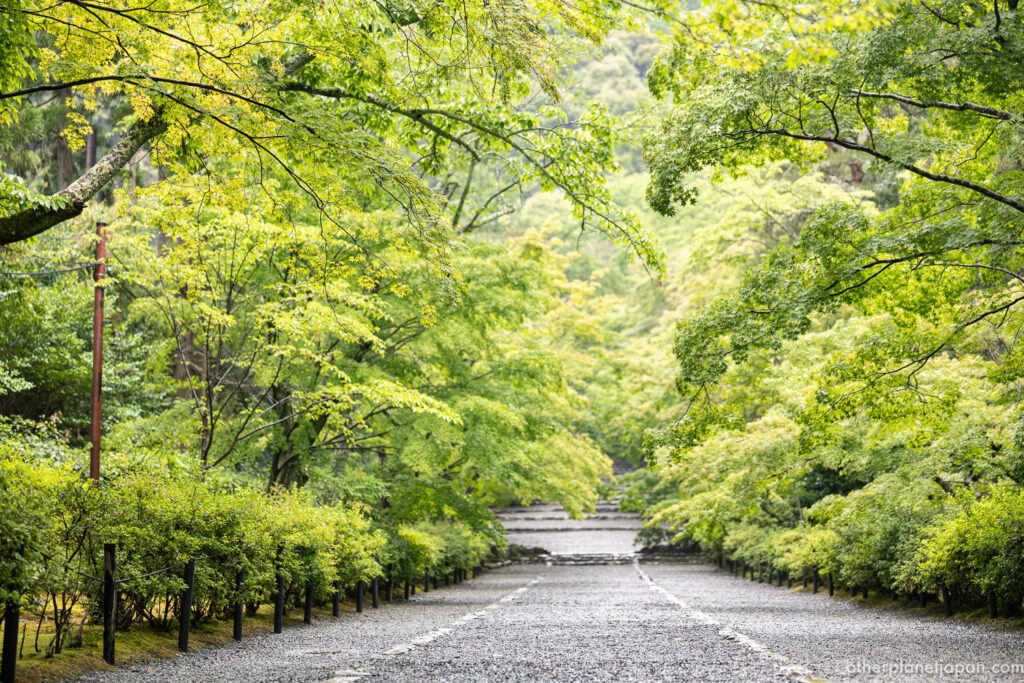
The first thing you notice is the width. Most temple approaches in Kyoto are narrow, hemmed in by walls and hedges. The one at Nison-in is broad and straight, stretching roughly a hundred meters from the main gate to the stone steps beyond. This is Momiji no Baba—the “riding ground of autumn leaves”—and in late November it becomes a tunnel of red and gold that draws photographers from across the country.
But come in early summer, as I did, and you will find something equally striking. The maples that line both sides of the path are a deep, almost electric green, their branches arching overhead to filter the light into soft, shifting patterns on the gravel below. No crowds. No tripods. Just the crunch of your own footsteps and the occasional distant clang of the temple bell.
The main gate itself—the Somon—deserves a second look. It was originally a yakuimon gate at Fushimi Castle, donated by the merchant Suminokura Ryoi in 1613 and designated a Kyoto City Cultural Property. If you have visited the castle sites around Fushimi, you are walking through a piece of that history every time you step through it.
Cherry trees and maples are planted alternately along the Baba, so spring brings its own spectacle. Look for the Nison-in Fugen-zo cherry—a rare late-blooming variety said to carry up to 130 petals per flower.
The Twin Buddhas
Two Buddhas. Not one.
The theological idea is elegant. Shaka Nyorai—the “Sending Shakyamuni”—stands on the right, releasing the departed from this shore. Amida Nyorai—the “Welcoming Amitabha”—stands on the left, receiving them at the other shore. Together they are called the Kengo Nison, the “Two Honored Ones of Sending and Welcoming.” The concept traces back to the Chinese Tang Dynasty monk Shandao and his parable of the “Two Rivers and White Path,” later adopted by the Japanese monk Honen, who is deeply connected to this temple’s history.
Both statues date to the mid-Kamakura period and are attributed to the Kasuga school of Buddhist sculptors. Gold-lacquered, with inlaid crystal eyes, they stand in near-identical symmetry in the center of the main hall—a hall that was itself rebuilt in 1521 after the devastation of the Onin War, and underwent its first major restoration in roughly 350 years in 2016. Both are designated Important Cultural Properties of Japan.
The Gardens
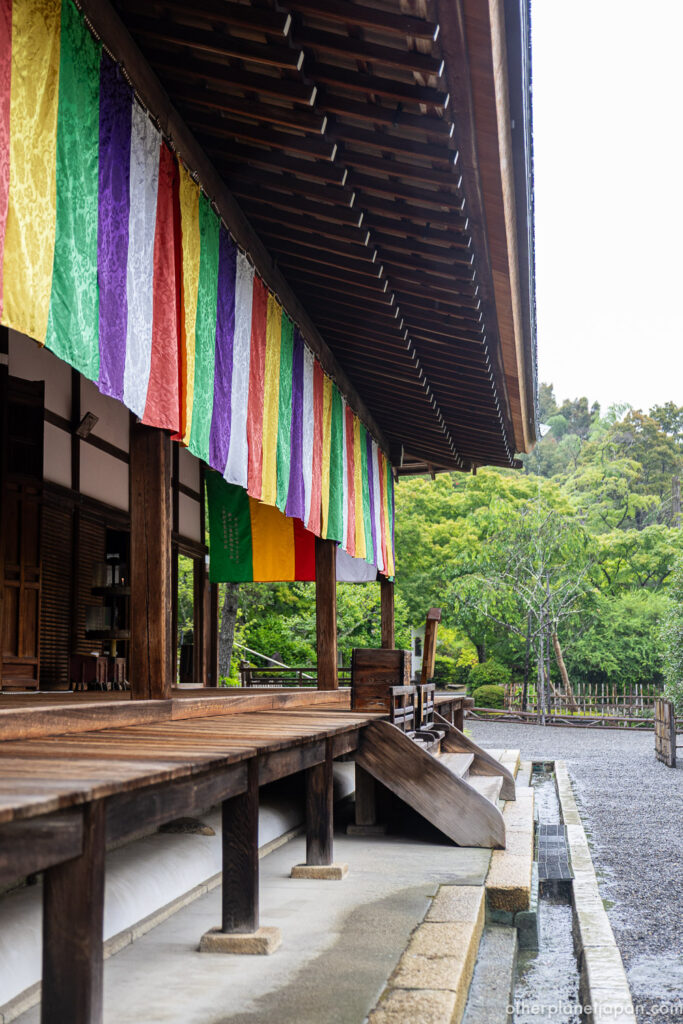
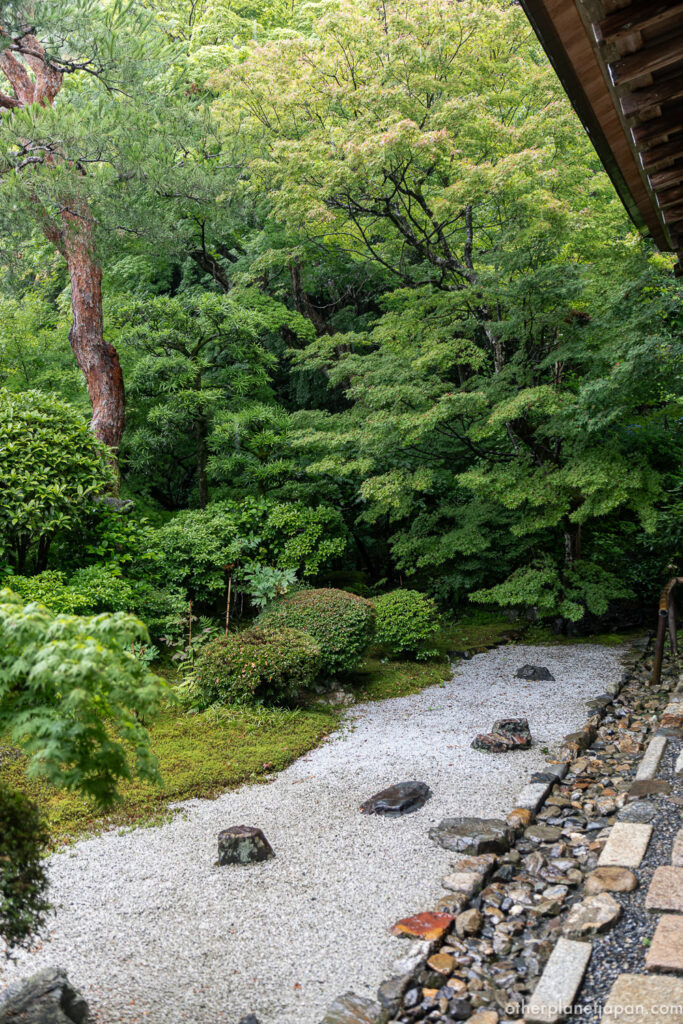
Quiet is the operative word here. The garden in front of the main hall—called the Ryujin no Niwa, or Garden of the Dragon God—is a dry landscape composition of white gravel and scattered stones, backed by a dense curtain of green. It is compact and unhurried, the kind of garden that rewards sitting still.
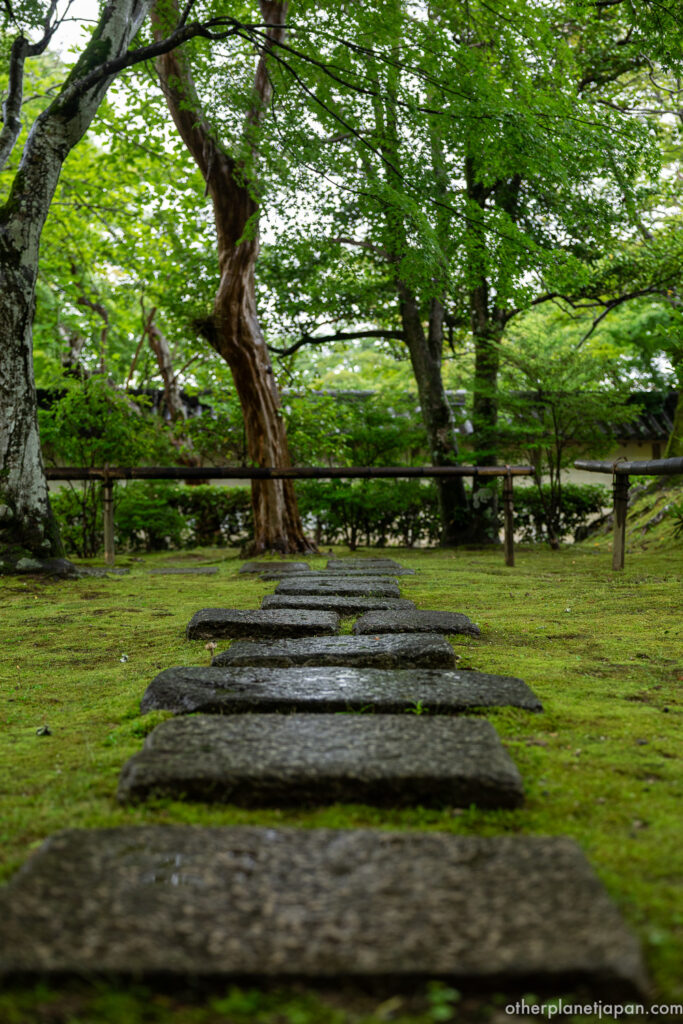
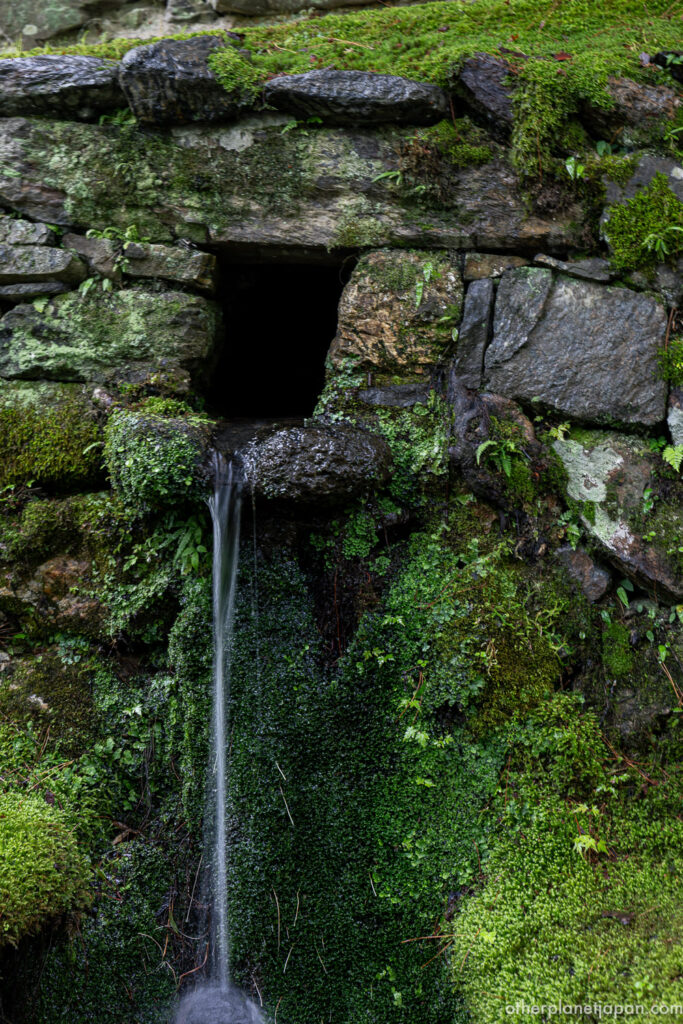
Around the back of the hall, the grounds shift into moss and stepping stones—a softer, more intimate landscape. Water trickles from a small opening in a moss-covered stone wall, barely louder than a whisper. In the humidity of Kyoto’s rainy season, every surface seems to breathe green.
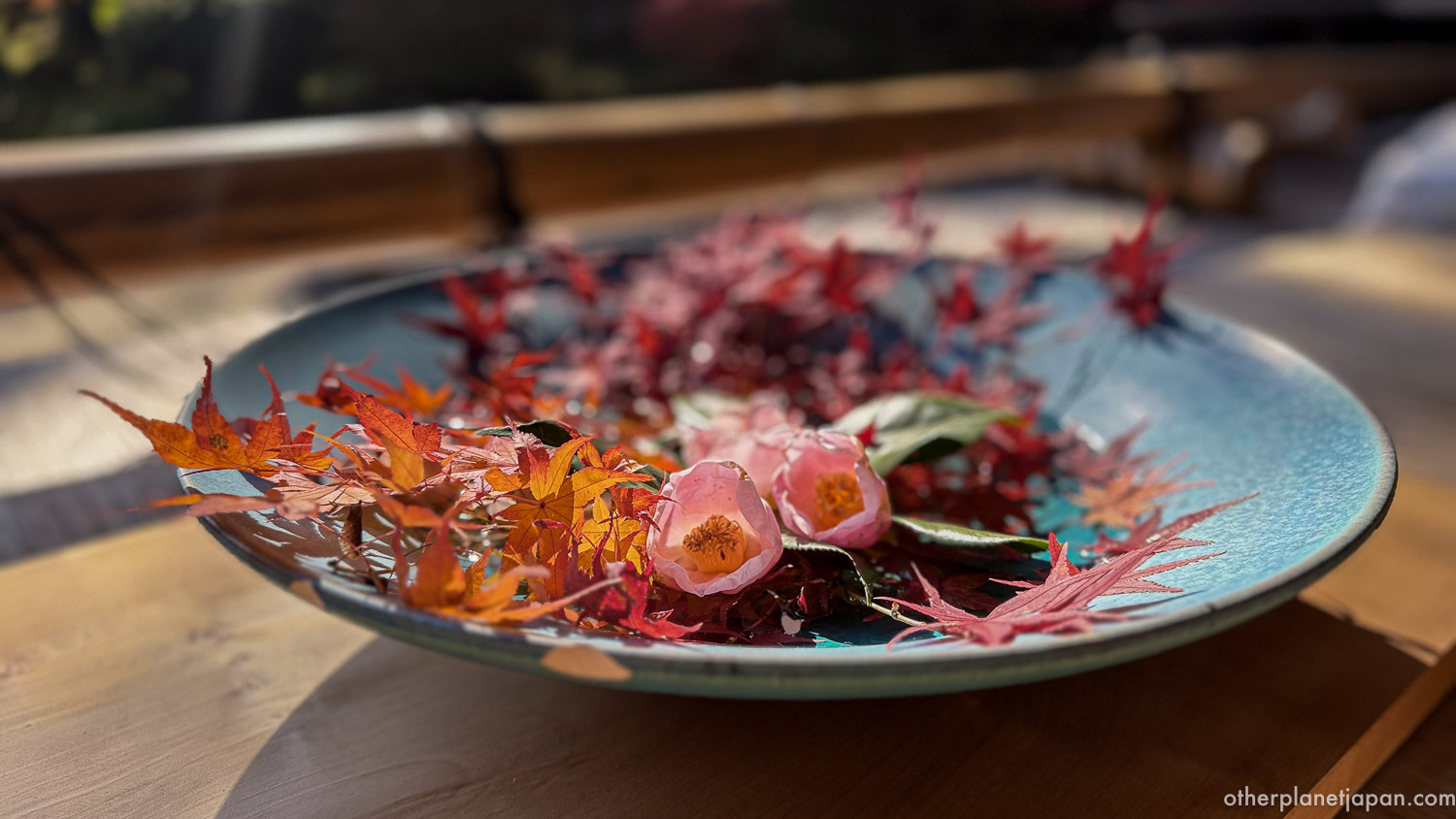
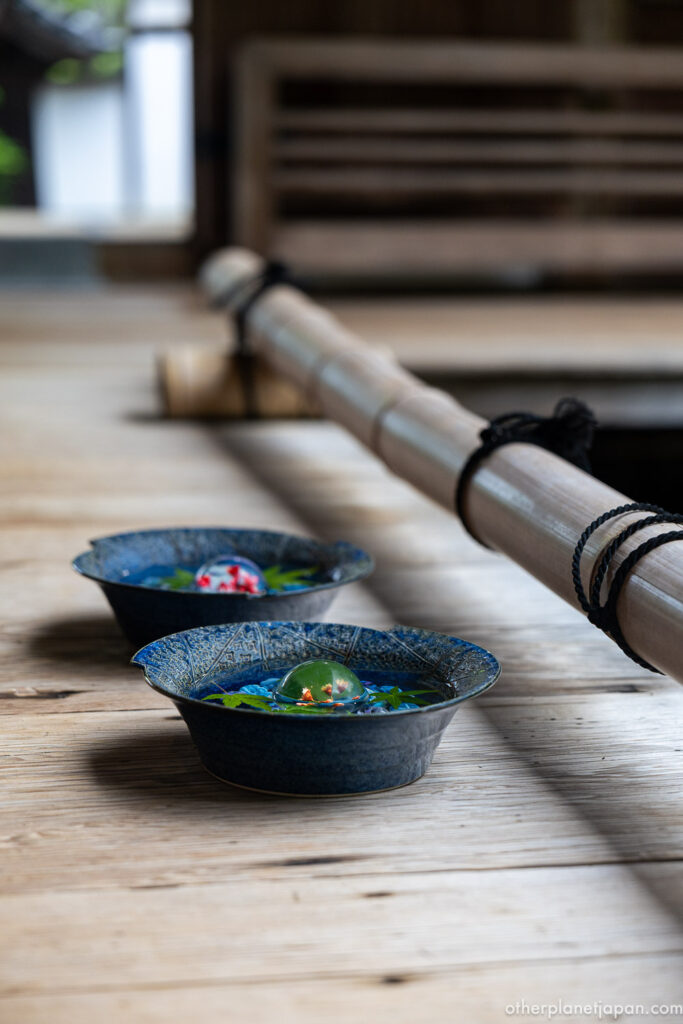
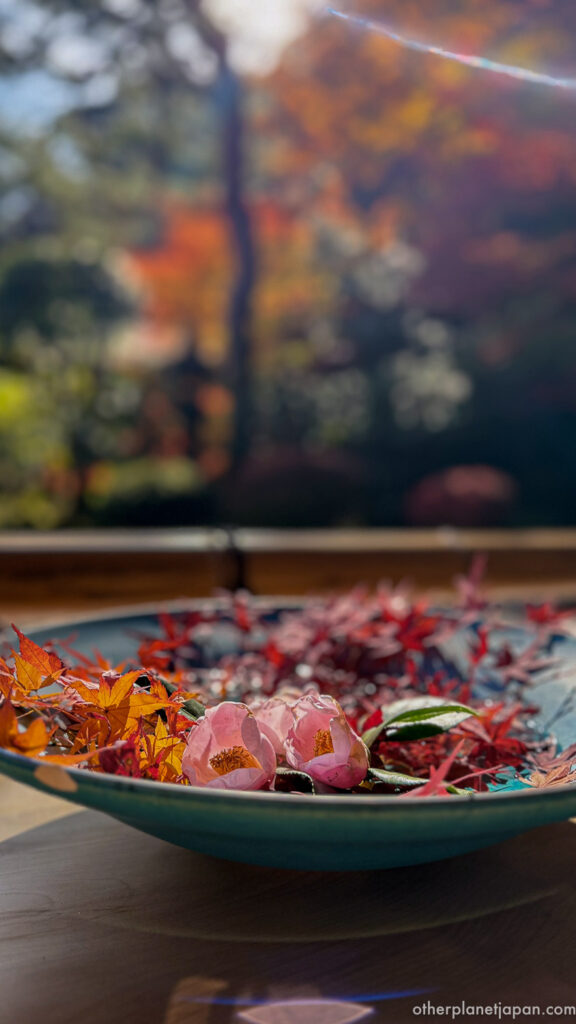
What I find most charming are the seasonal touches the temple sets out on the veranda. In summer, small ceramic bowls filled with water hold glass ornaments shaped like goldfish, resting on beds of green maple leaves—a fleeting, handmade installation that captures the Japanese instinct for marking the passing seasons in the smallest of gestures. In autumn, the same bowls hold fallen maple leaves and camellia blossoms, turning an ordinary wooden ledge into a miniature still life.
Nison-in also has a tea room called Misono-tei, originally the dressing chamber of Princess Yoshiko, a daughter of Emperor Go-Mizunoo. The room was given to the Nijo family and later relocated here. It opens to visitors only during Golden Week and the autumn foliage season—worth checking the temple’s schedule if your visit coincides.
The Hilltop — Shigure-tei and the View
The climb is worth it. Behind the main hall, a path leads up Mount Ogura through a landscape that grows quieter with every step. You will pass the Sankyo Tombs—the shared resting place of three emperors (Tsuchimikado, Go-Saga, and Kameyama), whose cremated remains are said to be interred here. A little further, the grave of Suminokura Ryoi, the Edo-period merchant who opened the Hozu River to commercial traffic and donated the very gate you walked through at the entrance.
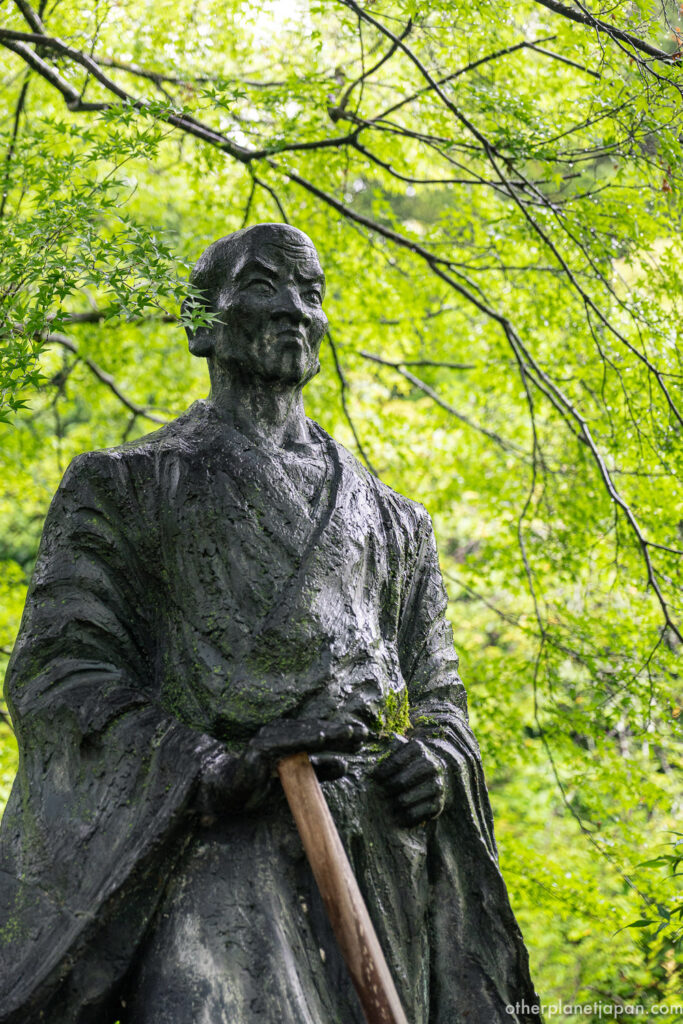
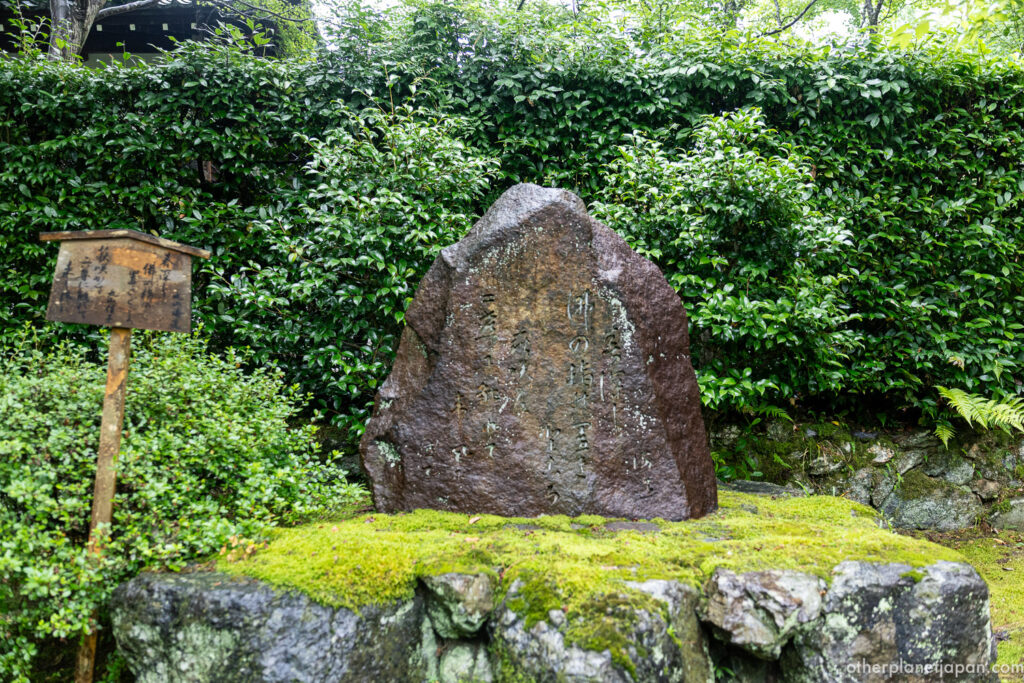
At the top, a small clearing marks the site of Shigure-tei—the mountain villa where the poet Fujiwara no Teika is believed to have compiled the Ogura Hyakunin Isshu, the famed anthology of one hundred poems by one hundred poets. Whether Teika’s actual villa stood here, at nearby Jojakko-ji, or at the hermitage of Enri-an down the hill, scholars have debated for centuries. The ambiguity, somehow, only adds to the atmosphere.
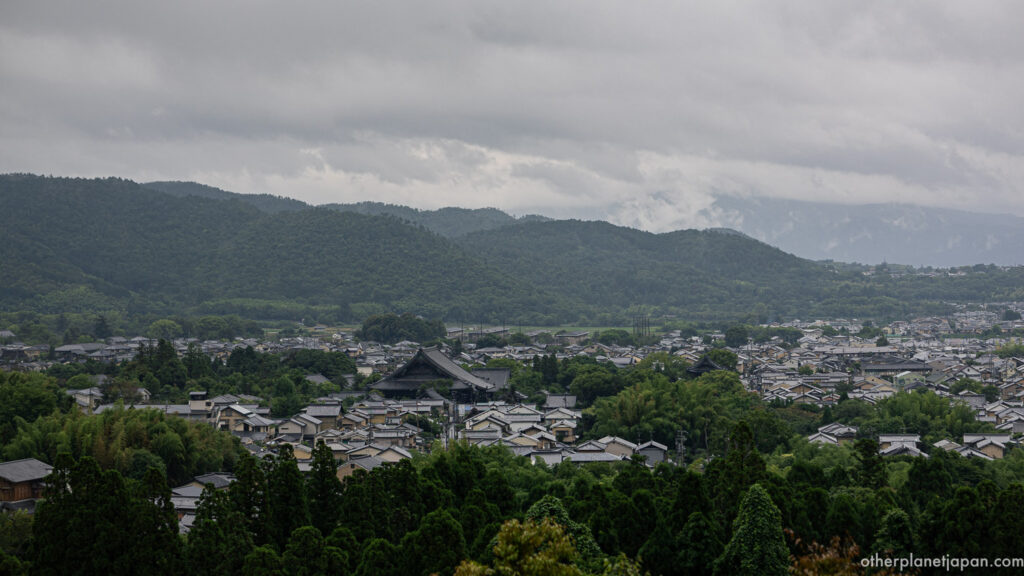
What is not ambiguous is the view. From this vantage point, you look out across the rooftops of Saga and the green hills beyond—Kyoto stretching eastward under a canopy of clouds. On a clear day, it is one of the quietest panoramas in the city.
Goshuin (Temple Seal)
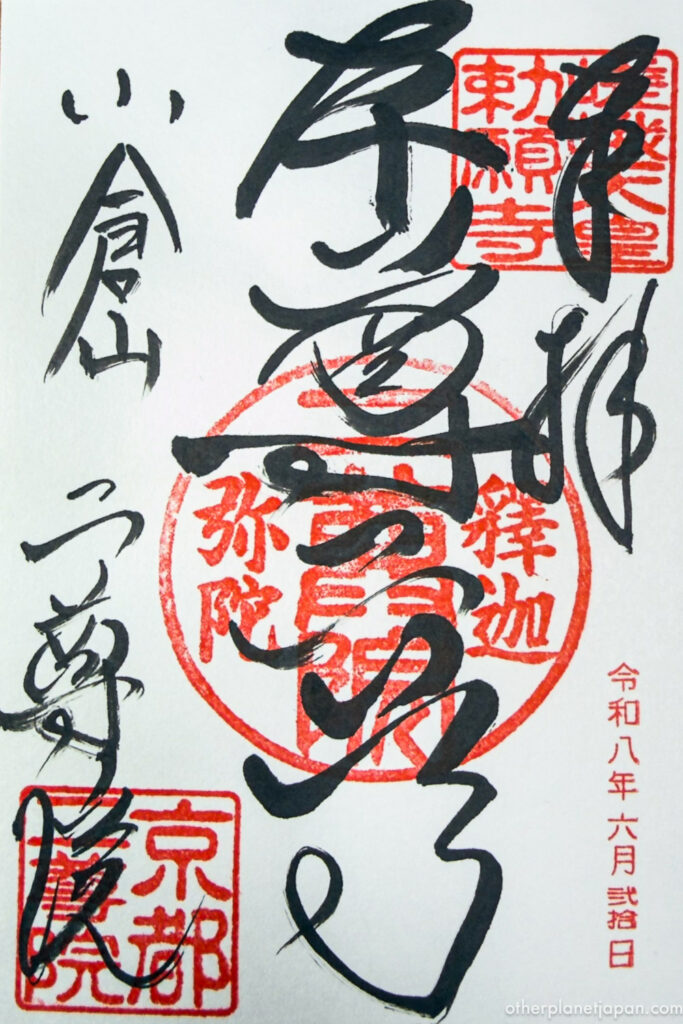
Four types. All hand-brushed, all 500 yen, cash only.
The standard goshuin reads “Honzon Nison”—the two principal Buddhas. The others are Enko Daishi (marking Nison-in as the 17th stop on the 25-site Honen Pilgrimage), Goei-ka (a devotional poem), and Kuzuryu Benzaiten (the Nine-Headed Dragon deity enshrined on the grounds). Spring and autumn bring seasonal limited-edition designs.
The system here is practical and unhurried. Leave your goshuin book at the reception desk inside the main hall entrance, go explore the grounds, and pick it up on the way out. No waiting in line, no hovering while the calligrapher works. It is a small grace that makes the visit feel less transactional.
Visitor Information
| Formal name | Ogurasan Nisonkyoin Kedaiji (小倉山二尊教院華臺寺) |
| Denomination | Tendai sect |
| Principal images | Shaka Nyorai & Amida Nyorai (Important Cultural Properties) |
| Hours | 9:00 AM – 4:30 PM (last entry) |
| Admission | Adults (junior high and older): ¥600 / Children (elementary and younger): Free |
| Payment | Cash only |
| Closed | Open year-round |
| Address | 27 Saga Nisonin Monzen Choujincho, Ukyo-ku, Kyoto 616-8425 |
| Phone | 075-861-0687 |
| Website | nisonin.jp |
How to Get There
Nison-in sits on the northern Arashiyama temple-walking route, between Jojakko-ji Temple to the south and Gioji Temple to the north. The most rewarding way to arrive is on foot, threading through the Bamboo Grove and up the quiet lanes of Sagano.
| From | Route | Time |
| JR Saga-Arashiyama Station | Walk via Bamboo Grove | ~19 min |
| Keifuku (Randen) Arashiyama Station | Walk via Bamboo Grove | ~15 min |
| City Bus “Saga Shakadomae” stop | Bus 28 from Kyoto Sta. (C6) or Bus 91 from Shijo-Karasuma, then walk | ~10 min walk from stop |
If you are walking the full northern Arashiyama route, the natural sequence is Jojakko-ji → Nison-in → Gioji. Each is roughly 5 to 10 minutes from the next.
Frequently Asked Questions
What are Nison-in Temple’s opening hours and admission fee?
Nison-in is open daily from 9:00 AM to 4:30 PM, year-round with no regular closing days. Admission is 600 yen for adults (junior high school and older) and free for children (elementary school and younger). Cash only—there are no card or electronic payment options.
What does the name “Nison-in” mean?
The name means “Temple of the Two Honored Ones,” referring to the twin principal images enshrined in the main hall: Shaka Nyorai (Shakyamuni Buddha), who sends the departed from this world, and Amida Nyorai (Amitabha Buddha), who welcomes them into the Pure Land. Both statues are Important Cultural Properties dating to the mid-Kamakura period.
When is the best time to visit Nison-in Temple?
Late November is the most dramatic, when the Momiji no Baba approach becomes a tunnel of crimson and gold. But early summer brings vivid green maples and far fewer visitors. Spring features cherry blossoms—including the rare Nison-in Fugen-zo cherry, a late-blooming variety said to carry up to 130 petals per flower.
What is Ogura Hyakunin Isshu?
Ogura Hyakunin Isshu is an anthology of one hundred poems by one hundred poets, compiled by Fujiwara no Teika in the early 13th century. The “Ogura” in its title refers to Mount Ogura in Arashiyama—the very mountain on which Nison-in stands. Teika is believed to have selected the poems at his mountain villa, Shigure-tei, whose site is preserved within the temple grounds. The anthology remains one of the most celebrated works of classical Japanese literature and is the basis of the traditional card game karuta, still played competitively across Japan today.
Does Nison-in Temple offer goshuin?
Yes. Four types of hand-brushed goshuin are available at 500 yen each: Honzon Nison (the two principal Buddhas), Enko Daishi (Honen pilgrimage), Goei-ka (devotional poem), and Kuzuryu Benzaiten (Nine-Headed Dragon). Seasonal limited-edition goshuin are offered in spring and autumn. Leave your goshuin book at the main hall reception desk and collect it after your visit. Cash only.
How do you get to Nison-in Temple from Arashiyama?
From JR Saga-Arashiyama Station, walk through the Bamboo Grove heading north for about 19 minutes. From Keifuku (Randen) Arashiyama Station, the walk is about 15 minutes. By bus, take City Bus 28 or 91 to Saga Shakadomae and walk about 10 minutes. Nison-in sits between Jojakko-ji and Gioji Temple on the northern Arashiyama walking route, making it easy to combine all three.