Why do people photograph bamboo?
I ask myself this every time I come to the Arashiyama Bamboo Grove. I grew up in Shizuoka, where my parents’ land holds more bamboo than anyone knows what to do with. For me, photographing bamboo is roughly as strange as photographing a tea field, which, in Shizuoka, is what we have instead of scenery. Nobody drives out to admire the tea fields. Certainly nobody wakes up at dawn for them.
And yet there I was at 6:30 in the morning, standing at the edge of the most famous bamboo path in Japan, waiting for it to empty out so I could photograph it. I had checked the weather forecast the night before, twice.
A Rainy Morning in July, 6:45 a.m.
The forecast called for rain that day, which is exactly why I went. Every early morning I had ever spent at the grove, someone had beaten me there. This time, I thought, the weather might do the crowd control for me.
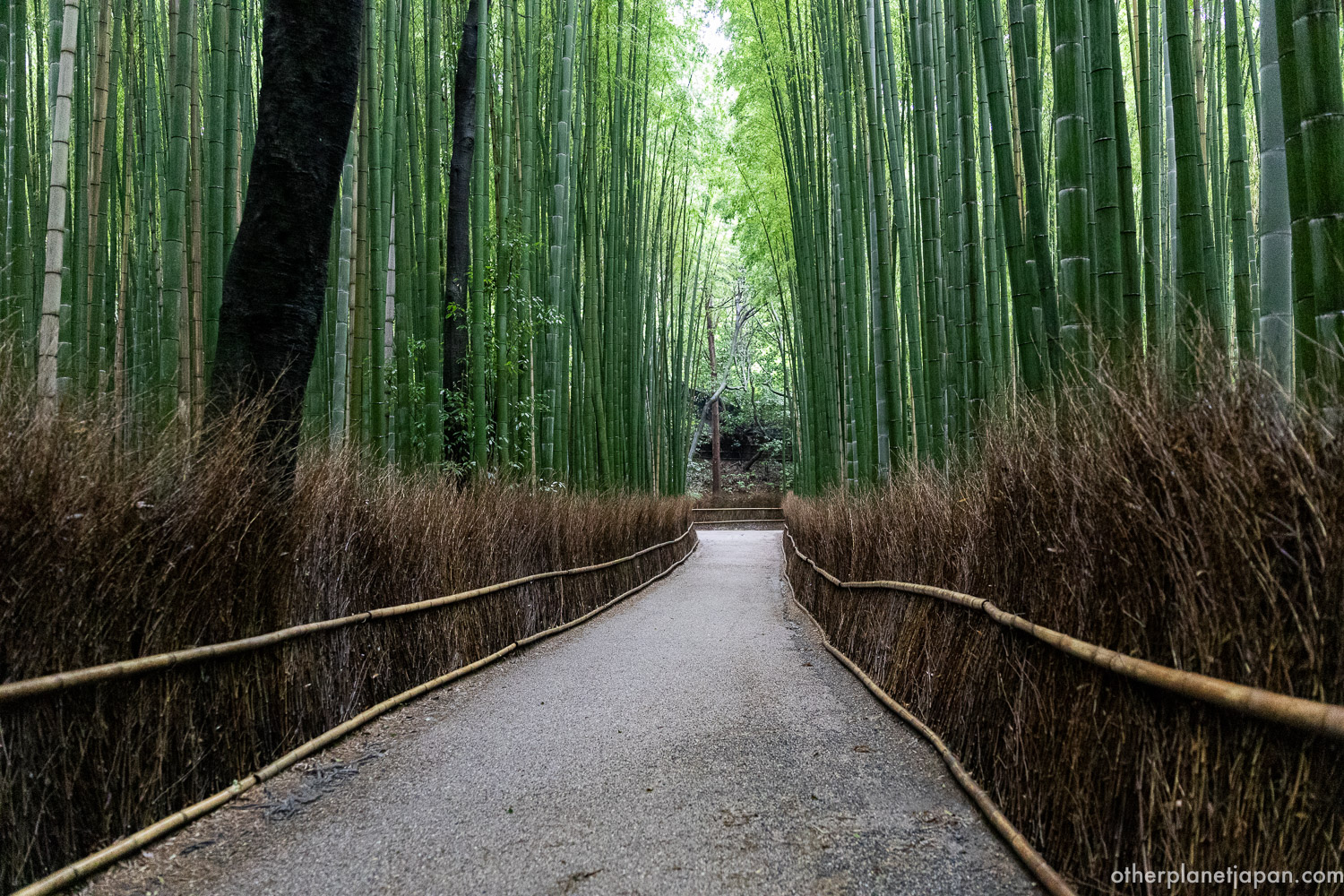
At 6:45 a.m., for the first time in all my visits, I arrived at an empty Bamboo Grove.
Almost empty. At the far end of the path, about fifty meters away, stood one man with a camera. We faced each other down the length of the grove, each standing squarely in the other’s frame. I braced myself. Would we start shouting at each other to move? Is that where this was heading?
Then the man stepped off the path and out of sight, and for a brief moment there was no one at all in the Arashiyama Bamboo Grove. I took my photographs. A little while later he reappeared and raised his camera again.
He had left the frame on purpose, so that the stranger at the other end of the path could have his shot.
I stepped aside in turn, and when we finally met in the middle, he turned out to be a traveler from the Philippines with three days in Kyoto, carrying the kind of camera you do not bring on a trip unless you intend to wake up early for it. He asked if I would take his portrait. As I did, the group I had noticed behind him came walking up: his family, about ten of them, traveling Japan together. They asked for a family photo under the bamboo.
Minutes earlier I had been bracing for a territorial dispute. Standing in the drizzle with a stranger’s camera in my hands, I was ashamed of myself.
I have thought about that morning many times since. The Arashiyama Bamboo Grove is never truly empty. The closest it ever comes is the moment two strangers decide, at the same time, to hand it to each other.
The People Who Keep It Beautiful
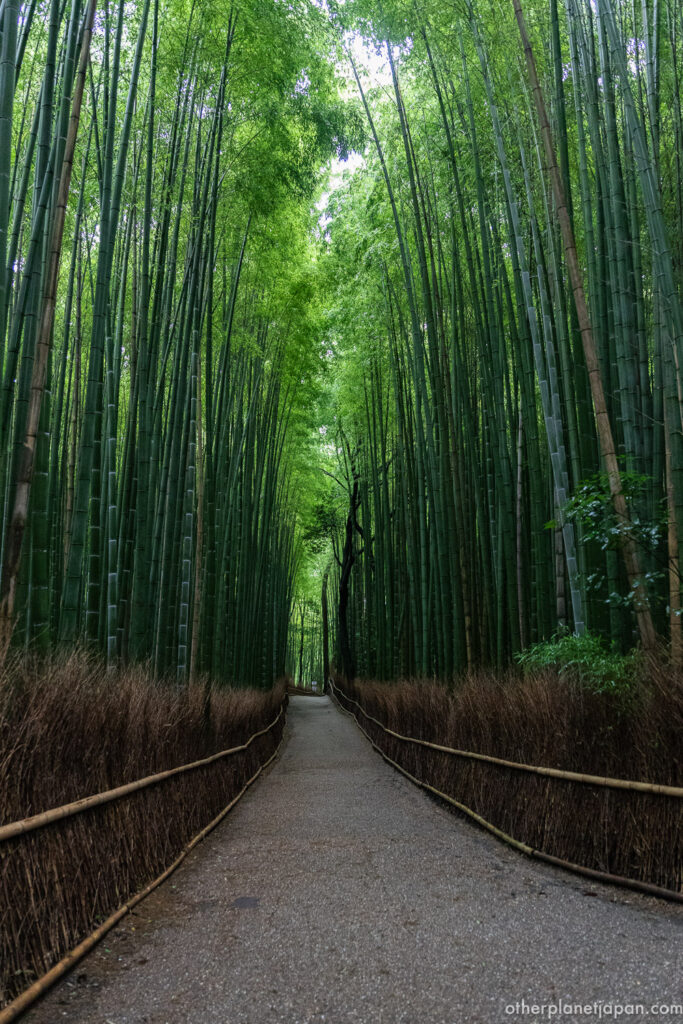
Another morning deserves telling. I had arrived early as usual and was waiting for the last visitors to leave the path. The next people to appear were not tourists. They were volunteers, carrying cleaning tools.
They live in the neighborhood, they told me, and they clean the grove at this hour regularly. That is why one of the most visited places in Japan looks immaculate no matter when you arrive. The reason my photographs of the empty path work at all is that the empty path is spotless, and it is spotless because of people who wake up even earlier than the photographers do. I had spent the morning wishing everyone would leave. Once again, I was ashamed of myself.
Why the Bamboo Here Grows So Tall
To a Japanese person, bamboo itself is nothing special. So why does this particular grove stop people from all over the world?
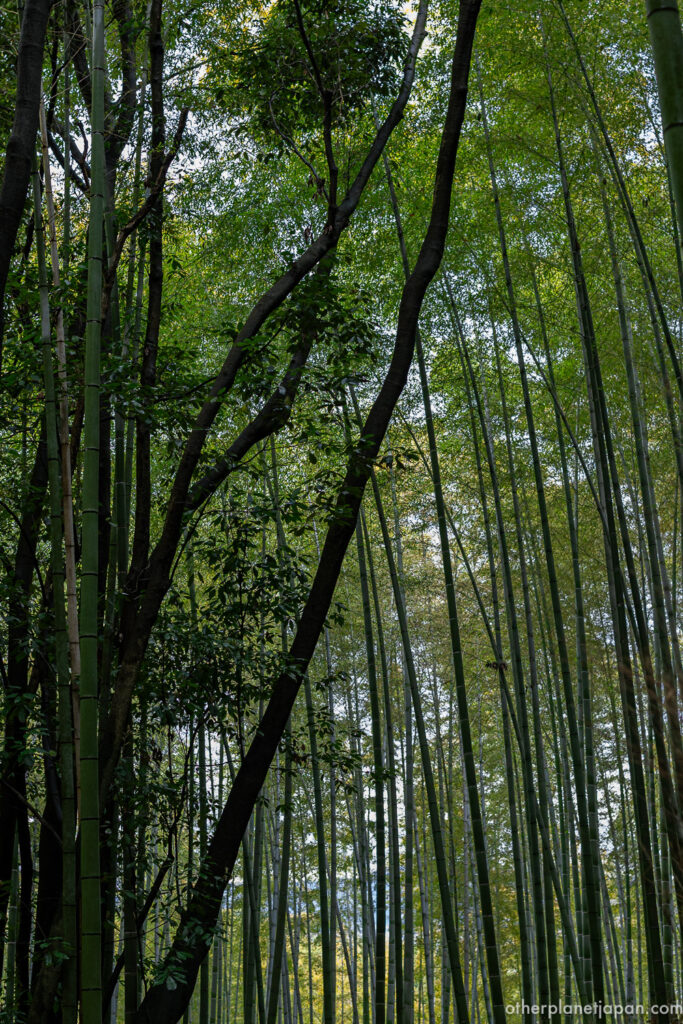
Start with the species. Most of the grove is moso bamboo, the tallest variety grown in Japan. A mature culm reaches 15 to 20 meters, sometimes more, with a trunk thicker than 10 centimeters. If you visit in early July, you will see ordinary bamboo around the city decorated with paper wishes for the Tanabata star festival. Set one of those next to the culms in Arashiyama and it would look like a sapling. I cannot give you an exact figure, but the Arashiyama bamboo stands easily twice as tall, and probably more.
But species alone does not make this forest. Bamboo is relentless. Left alone, a grove chokes itself into a thicket within a few years; I know, because my family’s bamboo in Shizuoka is exactly that. Watching the crowds in Arashiyama, I am occasionally tempted to tell my parents to tidy up their land and start charging admission. What separates their thicket from this path is constant human labor. In Arashiyama, old culms are cut, the stand is thinned, and the canopy is kept open so that light reaches down through the grove. Given room and light, moso bamboo does what bamboo does best, which is grow straight up. The result is the atmosphere everyone comes for: green columns of startling height, and thin lines of daylight moving across the path even at noon.
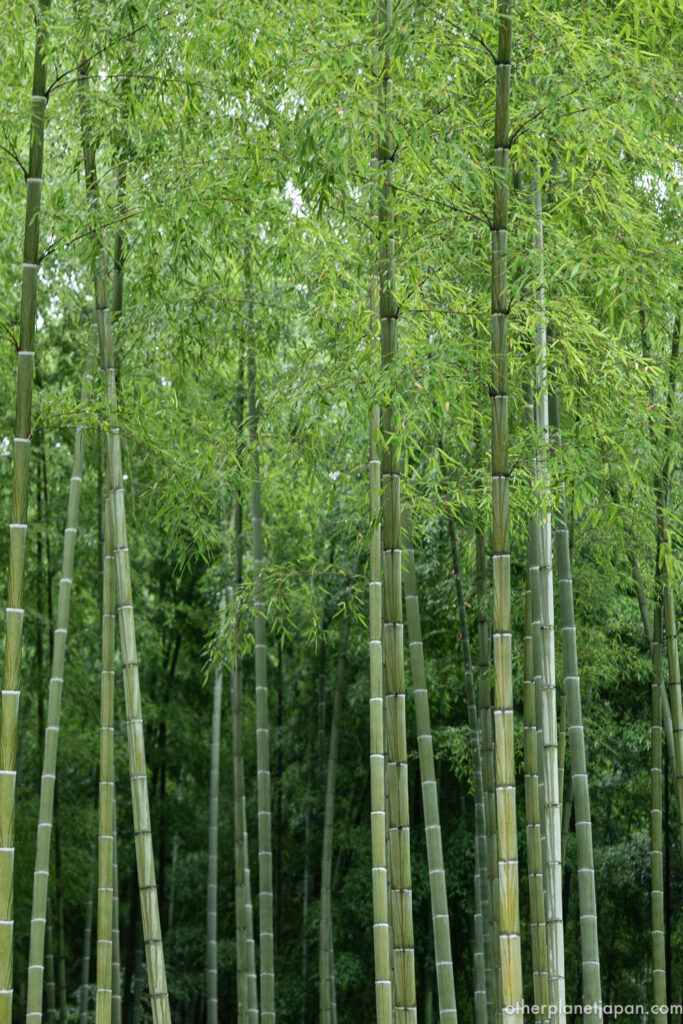
That straightness runs deep in the Japanese language. We say a frank, clean-natured person has a character like split bamboo, take o watta seikaku, because bamboo split lengthwise splits perfectly straight. And when something advances with unstoppable force, we call it hachiku no ikioi, the momentum of splitting bamboo: once the first crack opens at the top, the whole culm splits to the bottom in a single stroke. Walk the path with those two phrases in mind and the grove reads a little differently. You are looking at a plant my ancestors admired enough to turn into a compliment.
Four Seasons, Seen From Above the Grove
My English teacher, who is British, once told me that England has four seasons too, but not the way Japan does. Here, she said, the seasons announce themselves. I never asked what landscape she was picturing when she said it. It may well have been Arashiyama.
The bamboo itself hardly changes through the year. Everything around it transforms. Tenryu-ji, the Togetsukyo Bridge, and Arashiyama Park are celebrated for cherry blossoms in spring, fresh green in early summer, and blazing maples in autumn, and you will feel the season shift the moment you step out of the bamboo and into the park.
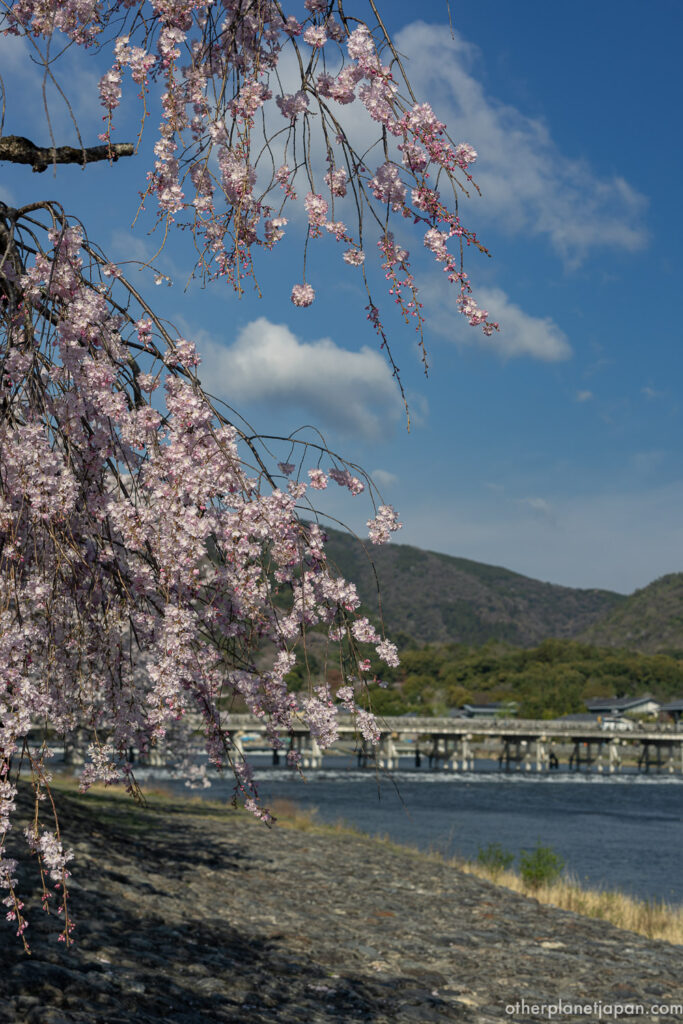
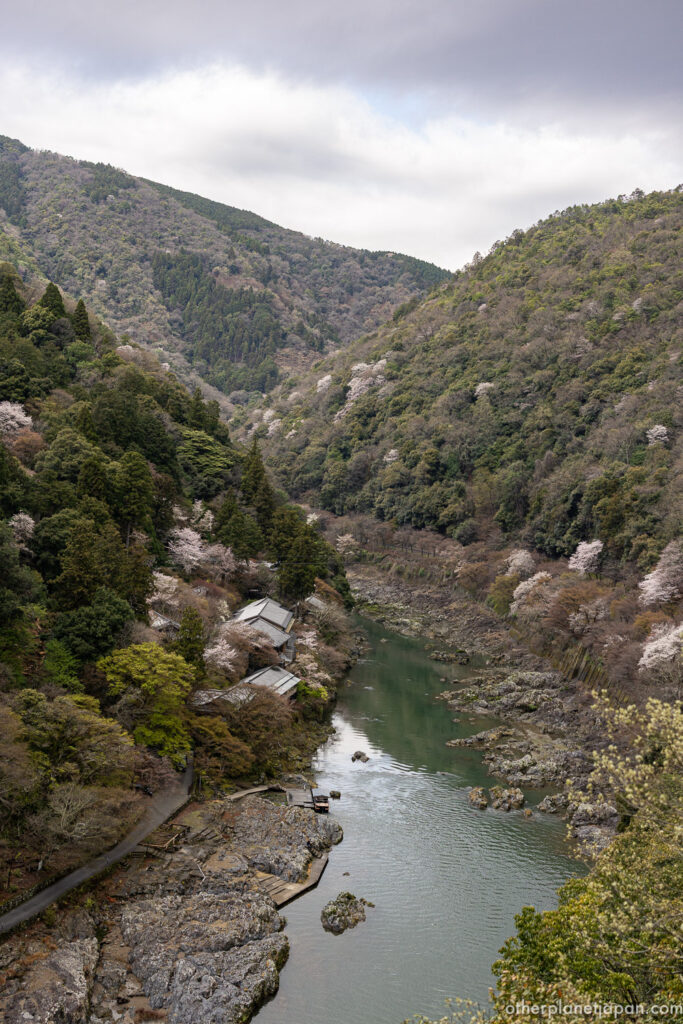
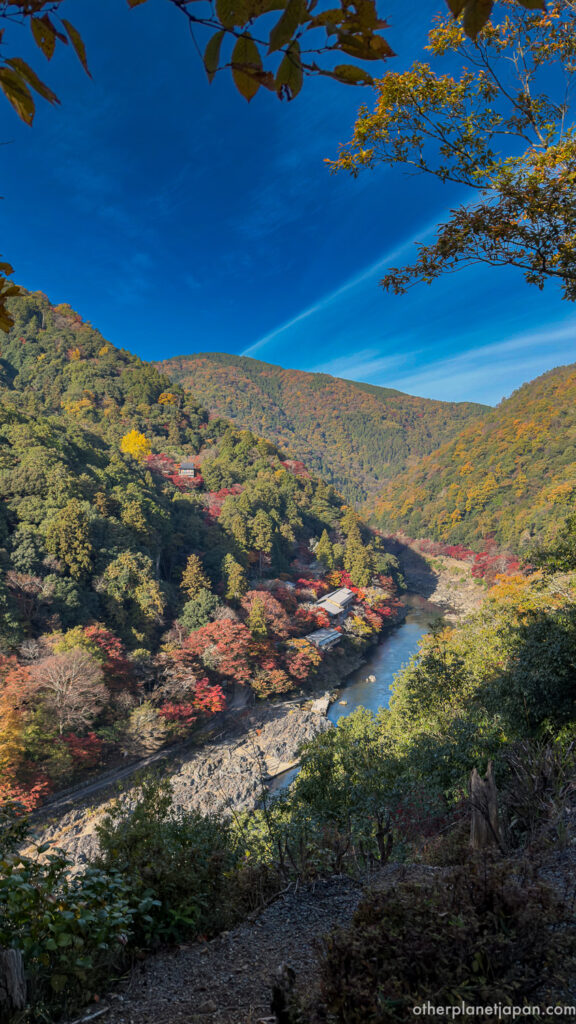
But the place where her words come back to me most clearly is the viewpoint above the grove, looking down into the Hozu River gorge. In spring the hillsides are dusted with wild cherry blossoms. In summer the valley is a single deep green. In November it becomes a wall of red and orange. The gorge itself never moves. The picture changes completely.
The Viewpoint Most Visitors Miss
So here is the single most useful thing in this article.
When you reach the end of the Bamboo Grove, do not turn back. Continue uphill into Arashiyama Park, where an observation deck overlooks the Hozu River gorge. The temple you can see clinging to the far bank, marked by five-colored Buddhist banners, is Senko-ji.
And this is the part almost no one knows: there are two observation decks. The first one, at the top of the climb, is often crowded. Keep walking for about one more minute and you will find a second deck farther along the ridge. It is usually nearly empty. If the first viewpoint is a wall of shoulders and phone screens, do not give up. The better view is sixty seconds away.
By 7:30, It Was Over
One more scene from that same morning. After my photographs I walked over to Nonomiya Shrine nearby, and when I returned to the main path it was 7:30. The grove was crowded. Forty-five minutes. That was the entire lifespan of my empty Bamboo Grove.
As I stood there, a couple asked if I would take their photo. I was, by this point, the unofficial photographer of the Arashiyama Bamboo Grove, a position that pays nothing but offers an excellent office. I took their picture, handed the phone back, and said, “Have a nice trip!”
“You too!” they said.
It took me a second. They thought I was a tourist. A Japanese man, in Japan, being wished a pleasant journey through his own country. I was too surprised to correct them, so I smiled and walked off, officially on vacation.
My only regret came later, on the train home. I should have handed them my phone and asked for a photo of myself. If I was going to be a tourist that morning, I should at least have gotten some pictures out of it.
Why the Grove Is Never Empty, Even at Dawn
A fair question: if I keep arriving at 6:30 and keep finding people, who are they?
The answer is in the geography of the place. The Bamboo Grove has no gates, no tickets, and no opening hours, so there is nothing to hold the morning crowd back. Photographers stay overnight in Arashiyama for precisely this shot. Guests at nearby ryokan take pre-breakfast walks. And because the grove appears on virtually every first-time Kyoto itinerary, even a tiny fraction of those visitors choosing to come early is enough to put two or three people on the path at any hour with light in the sky.
Nor does the crowd follow the seasons much. Unlike the maple temples, which swell in November and go quiet in February, the grove draws steady numbers year-round; bamboo looks the same in January as in June, and the tour itineraries know it. The one genuinely quiet window is early morning in winter, and it comes with a catch: at 6:30 in December the grove is still pitch dark. There are no streetlights on the path, and sunrise is close to 7:00. You would be standing in a black forest, waiting.
Which is why weather, not season, is the lever that actually works.
How to See the Bamboo Grove Empty
In my experience, the combination is a rainy forecast plus an early morning. The only time I have ever had the path to myself was a July morning at 6:45 with rain on the way. Wet weather thins the crowd far more reliably than any month on the calendar, and the grove itself loses nothing in the rain; if anything, the green goes deeper.
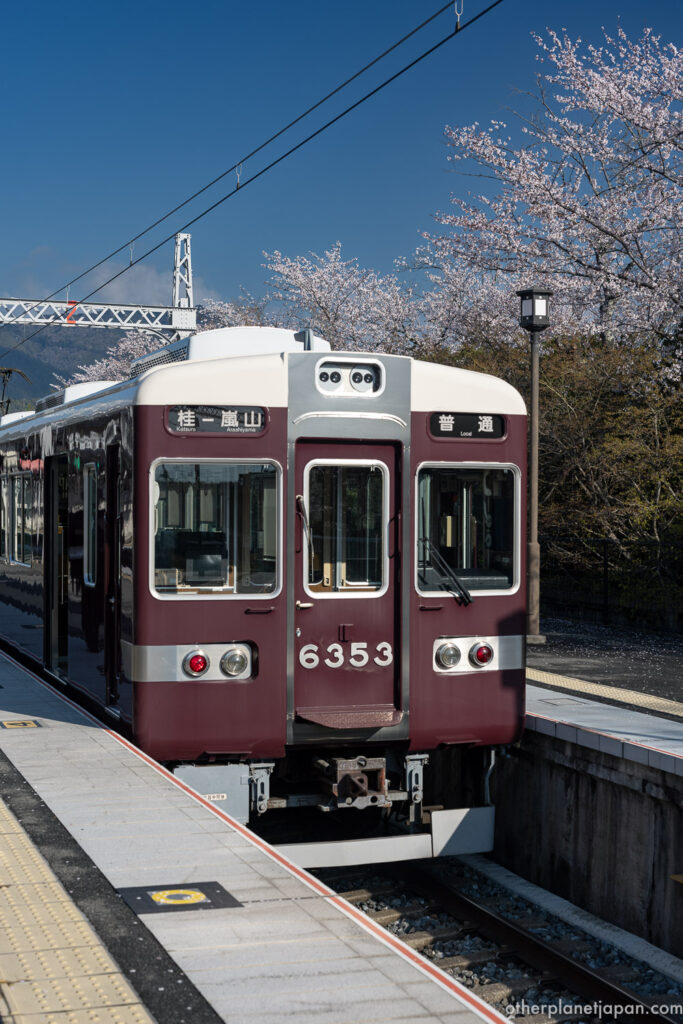
Practically speaking, arriving at that hour almost requires staying in or near Arashiyama the night before. The first trains from central Kyoto arrive too late, or cut it uncomfortably close.
As for nighttime: the path is open around the clock, but with no lighting at all there is nothing to see after dark, and Arashiyama as a whole closes early. Paid evening illumination events are the exception, held on occasion in autumn.
Practical Information
| Admission | Free. Paid evening illumination events are held on occasion; one such event, Arashiyama Tsukitoka, took place in autumn 2025. |
| Hours | Open 24 hours. No lighting after dark. |
| Time needed | 10 to 60 minutes. The main path takes about 10 minutes; exploring the surrounding bamboo areas takes up to an hour. |
| Strollers | Usable as far as the Bamboo Grove itself. The climb to the Hozu gorge observation decks involves stairs and steep slopes, and the route up from the Tenryu-ji side is particularly steep. |
| Restrooms | Inside Arashiyama Park. |
| Access | About 10 minutes on foot from Randen Arashiyama Station, about 15 minutes from JR Saga-Arashiyama Station, and about 20 minutes from Hankyu Arashiyama Station. |