Most visitors to Arashiyama never make it this far north. They turn left at the bamboo grove, loop past Tenryuji, cross the Togetsukyo Bridge, and call it a day. Their loss.
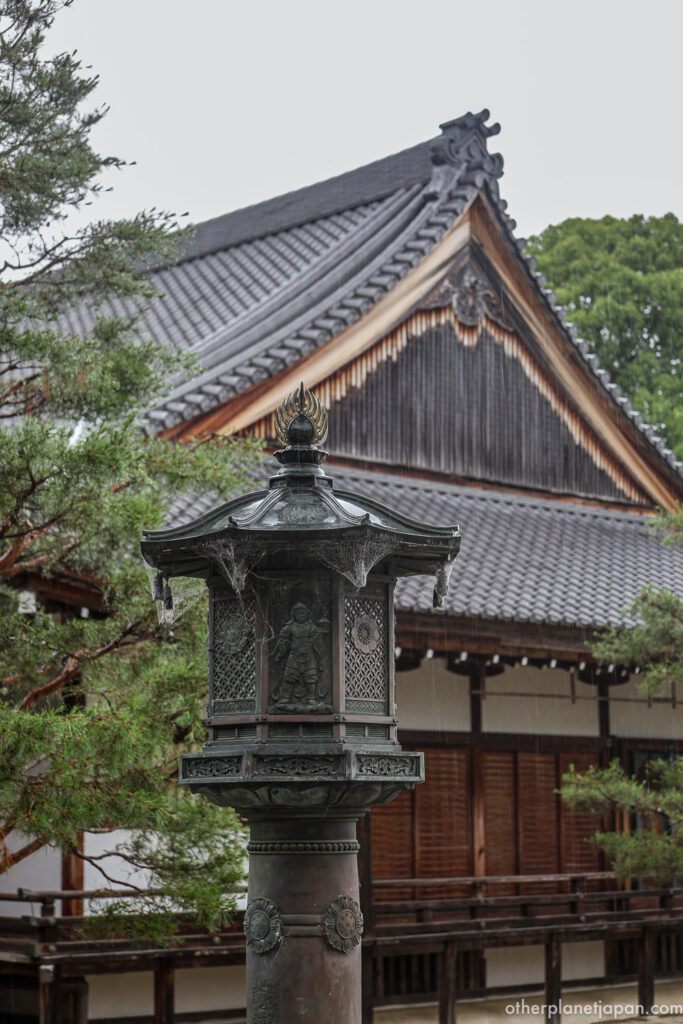
Daikakuji sits twenty minutes on foot from the crowds — far enough that the souvenir shops have thinned out and the only sound is rain on tile roofs. This is not a typical temple. It began life in the ninth century as a detached palace for Emperor Saga, and the bones of that origin still show: long wooden corridors connecting pavilion after pavilion, elevated walkways open to the breeze on both sides, gold-leaf paintings on sliding doors where courtiers once composed poetry by candlelight. The whole compound feels less like a place of worship and more like a place of governance that happens to house five fierce-looking statues of wisdom kings.
There are two distinct zones to explore — the interconnected temple halls (お堂エリア) and the sprawling Osawa Pond (大沢池エリア) — each ticketed separately, each worth your time. Add a session of sutra copying in a quiet hall with chair seating available, and you have half a day that feels nothing like the rest of Arashiyama.
A Brief History of Daikakuji
The story starts with a villa. In 814, Emperor Saga — a ruler as famous for his calligraphy and cultural patronage as for his politics — built a retreat in the Sagano hills northwest of the capital. He called it Saga-in, and when he retired from the throne, he made it his permanent home. His friend and religious advisor was none other than Kukai (Kobo Daishi), the founder of Shingon Buddhism, who persuaded the emperor to install five statues of the Wisdom Kings in the palace’s private chapel and to copy the Heart Sutra by hand during a devastating plague. That handwritten sutra still exists, sealed inside an octagonal hall on the grounds, and is shown to the public only once every sixty years.
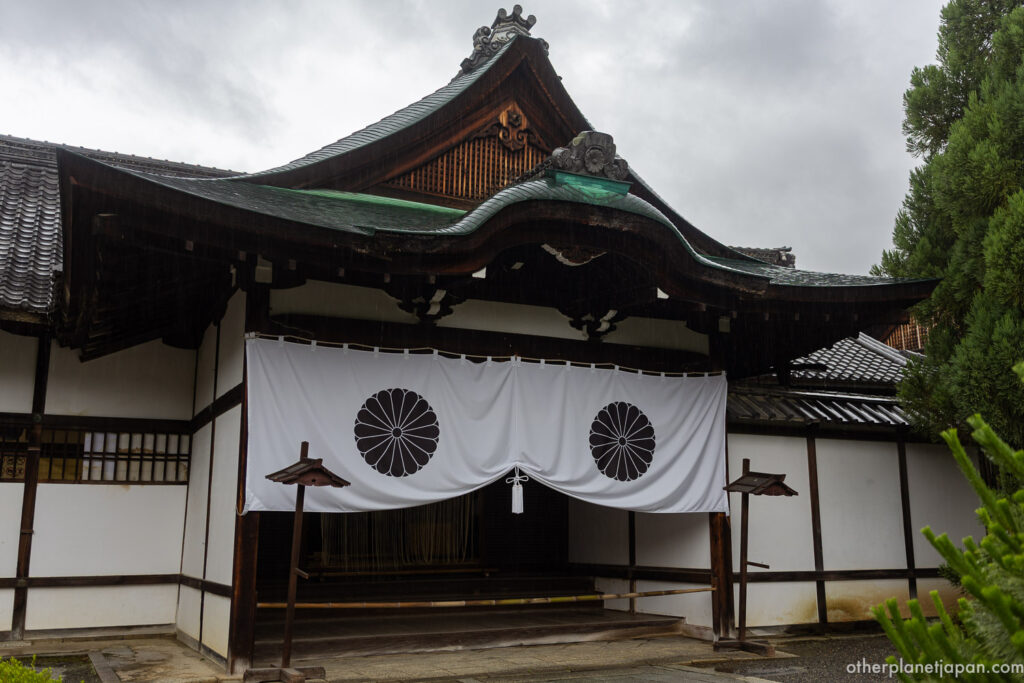
Thirty-four years after Emperor Saga’s death, his daughter Princess Masako converted the palace into a temple in 876 and named it Daikakuji. It became a monzeki temple — a category reserved for institutions whose head abbot is drawn from the imperial family. Members of that family continued to serve as abbot until the Meiji era, which is why Daikakuji earned the honorific title “Former Saga Imperial Palace” (旧嵯峨御所). The chrysanthemum crest of the imperial household still appears on the curtains hanging at the entrance today.
History kept finding this place. In the thirteenth and fourteenth centuries, retired emperors governed from here in what Japanese historians call “cloistered rule.” In 1336, it was at Daikakuji that a peace agreement was brokered between the Northern and Southern Courts, briefly ending decades of civil war. The temple burned during the Onin War of the fifteenth century, but was rebuilt with structures transplanted from the Kyoto Imperial Palace during the Edo period — which is why many of the rooms you walk through today still carry the unmistakable air of royal quarters rather than monastic cells.
Exploring the Temple Halls at Daikakuji
The hall area is where Daikakuji’s palace DNA is most visible. You move through the compound along elevated wooden corridors that connect building to building — shoes off, floorboards underfoot, gardens visible through lattice screens on both sides. The route is one-way and clearly signed, so getting lost is not really an option. Getting slow is.
Shinden (宸殿)
The first major building on the route, the Shinden was originally part of the Kyoto Imperial Palace and was gifted to Daikakuji by Emperor Go-Mizunoo in the seventeenth century. The rooms are lined with fusuma (sliding door) paintings by Kano Sanraku, a leading artist of the Momoyama period. The Peony Room is the one that stops people in their tracks — bold brushstrokes of red and white blossoms on gold leaf, designed to impress visiting dignitaries. Photography is not permitted inside, so you will have to trust the memory.
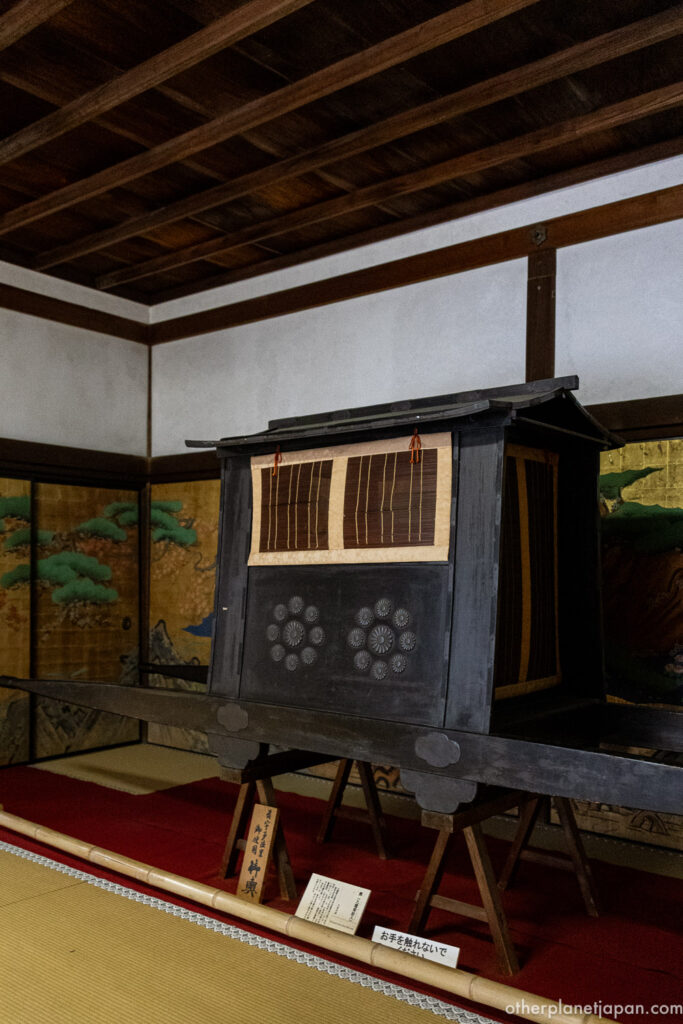
In one of the Shinden’s rooms, an imperial palanquin sits on permanent display — a lacquered sedan chair bearing the chrysanthemum crest, once used to carry members of the court between buildings. It sits there behind a bamboo barrier, golden screens glowing behind it, looking exactly like something that belongs in a museum but instead just lives in a temple most tourists never visit.
The Covered Corridors
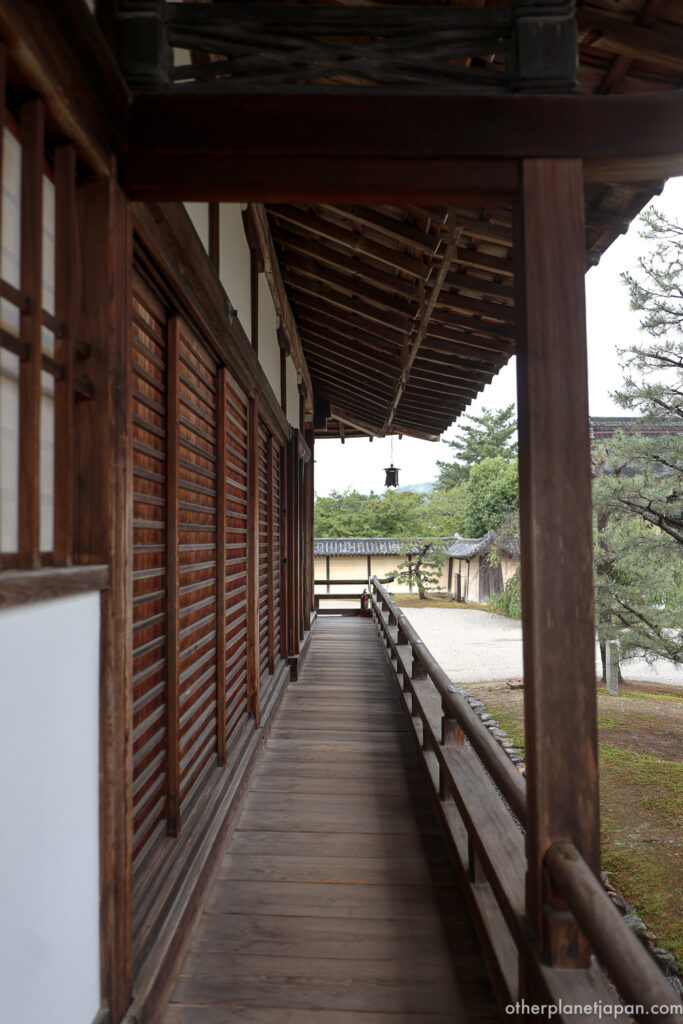
The corridors connecting the halls are as much a highlight as the buildings themselves. Open on both sides, roofed but unwalled, they frame the gardens like horizontal scroll paintings that change with every step. The longest stretch runs between the Shinden and the Godaido, and on a rainy day — which is when I visited — the wet wood grain has a luster that makes you want to photograph the floor.
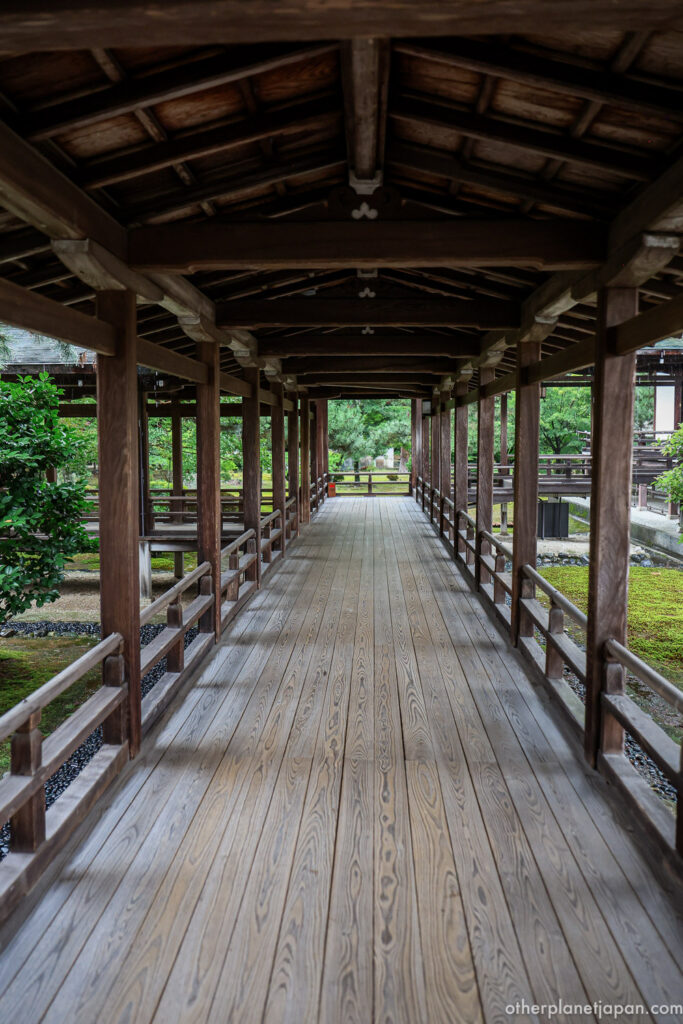
One section is known as the Murasame no Roka (村雨の廊下) — the “Village Rain Corridor.” The name comes from the sound the floorboards make underfoot, a faint creak said to resemble the patter of scattered rain. In practical terms, those creaking boards served as an early security system: anyone walking through would announce their presence whether they wanted to or not. The ceilings are deliberately low, making it difficult to swing a sword — a detail that says everything about the era in which this place was rebuilt.
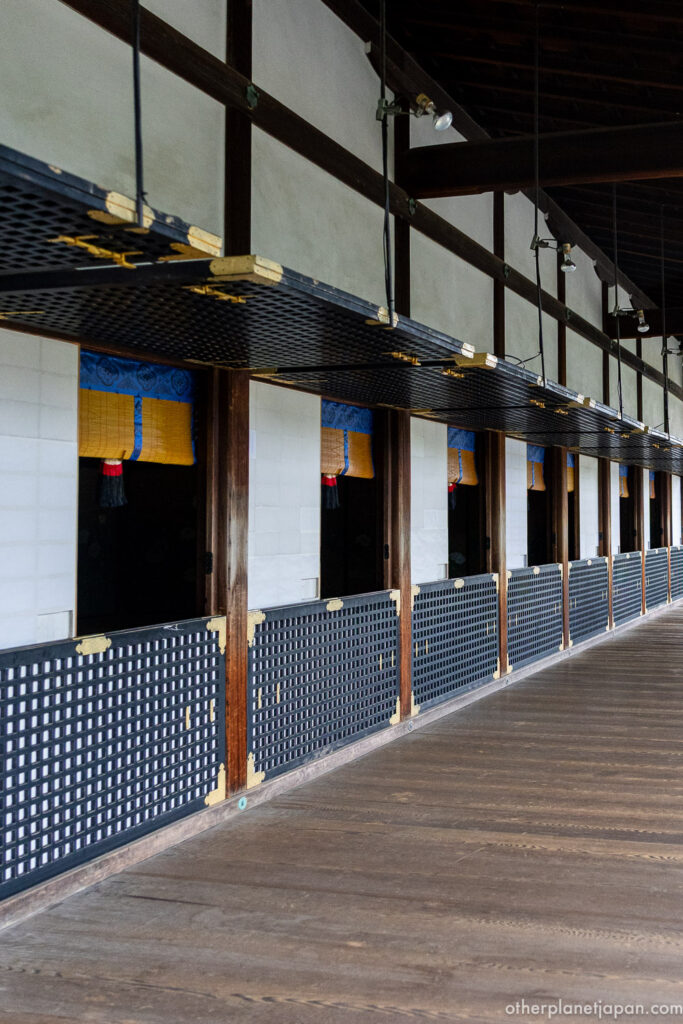
Godaido (五大堂) and the Viewing Platform
The Godaido is the main worship hall, dedicated to the Five Wisdom Kings — the fierce guardian deities of Shingon Buddhism. More immediately interesting to most visitors is the nure-en (observation deck) that extends from the east side of the hall out over Osawa Pond. This open-air wooden platform is where emperors once sat to watch the harvest moon rise over the water, and it remains one of the finest vantage points in the compound. In autumn, the temple hosts a Kangetsu no Yube (Moon Viewing Evening) that recreates this Heian-era tradition with costumed musicians and dragon-headed boats on the pond.
Shingyo Hoto (心経宝塔)
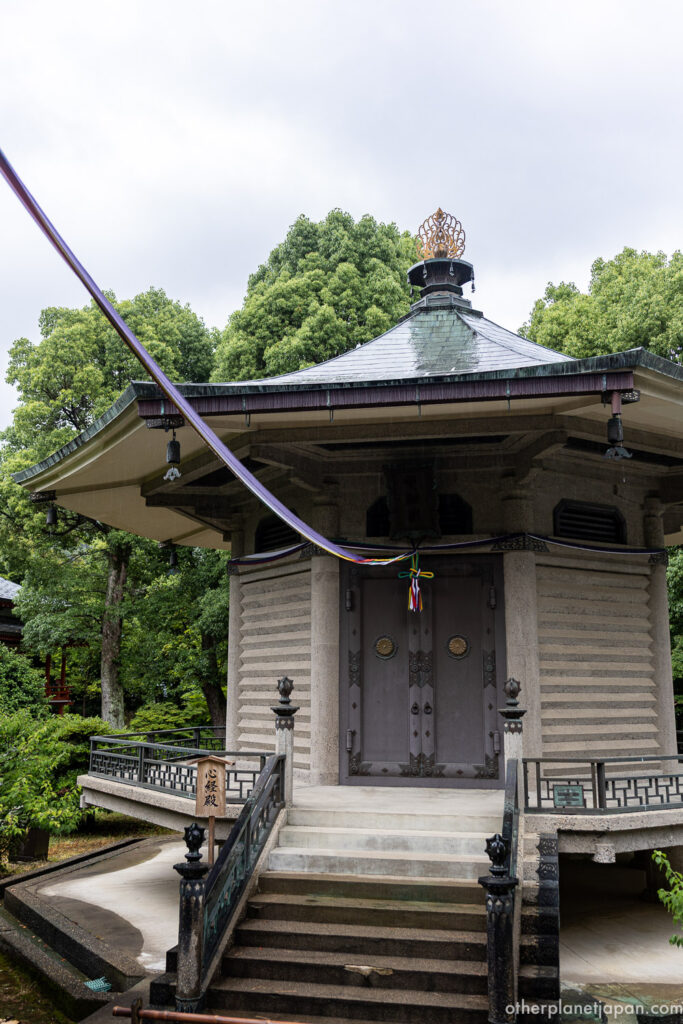
Past the Godaido, a path leads to the most architecturally distinctive structure on the grounds: an octagonal concrete pagoda modeled after the Yumedono (Hall of Dreams) at Horyuji in Nara. Built in 1925, it houses the Heart Sutra handwritten by Emperor Saga himself — the same manuscript that Kukai once urged the emperor to copy during a time of national crisis. The sutra is sealed and shown publicly only once every sixty years; the last opening was in 2018. A purple cord connects the pagoda to a post outside, symbolizing a spiritual link between the sealed sutra and the visitor who touches the cord.
Ikebana at Daikakuji: Birthplace of the Saga Goryu School
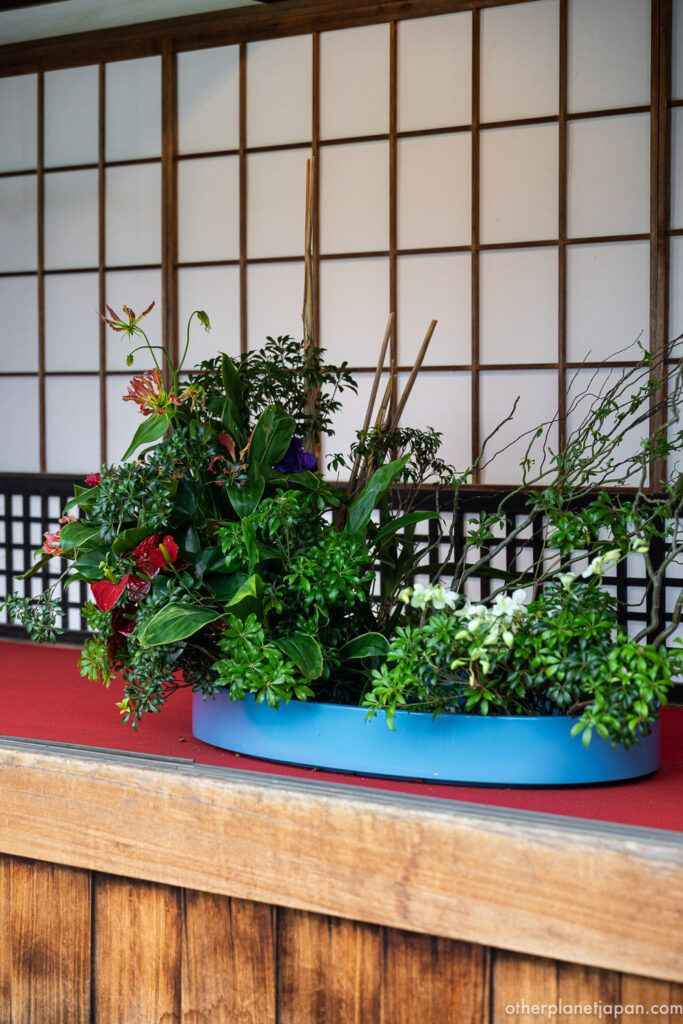
Daikakuji is the birthplace and headquarters of the Saga Goryu school of ikebana. The origin story is almost too elegant to be true: Emperor Saga is said to have arranged chrysanthemums from a small island in Osawa Pond and presented them to his court, and that single act is regarded as the founding gesture of this twelve-hundred-year-old tradition. Today, flower arrangements by Saga Goryu practitioners are displayed throughout the temple halls, and you will likely encounter at least one striking composition on your way through — placed with the kind of casual precision that makes you realize you have been looking at flowers wrong your entire life.
The Zen Rock Garden
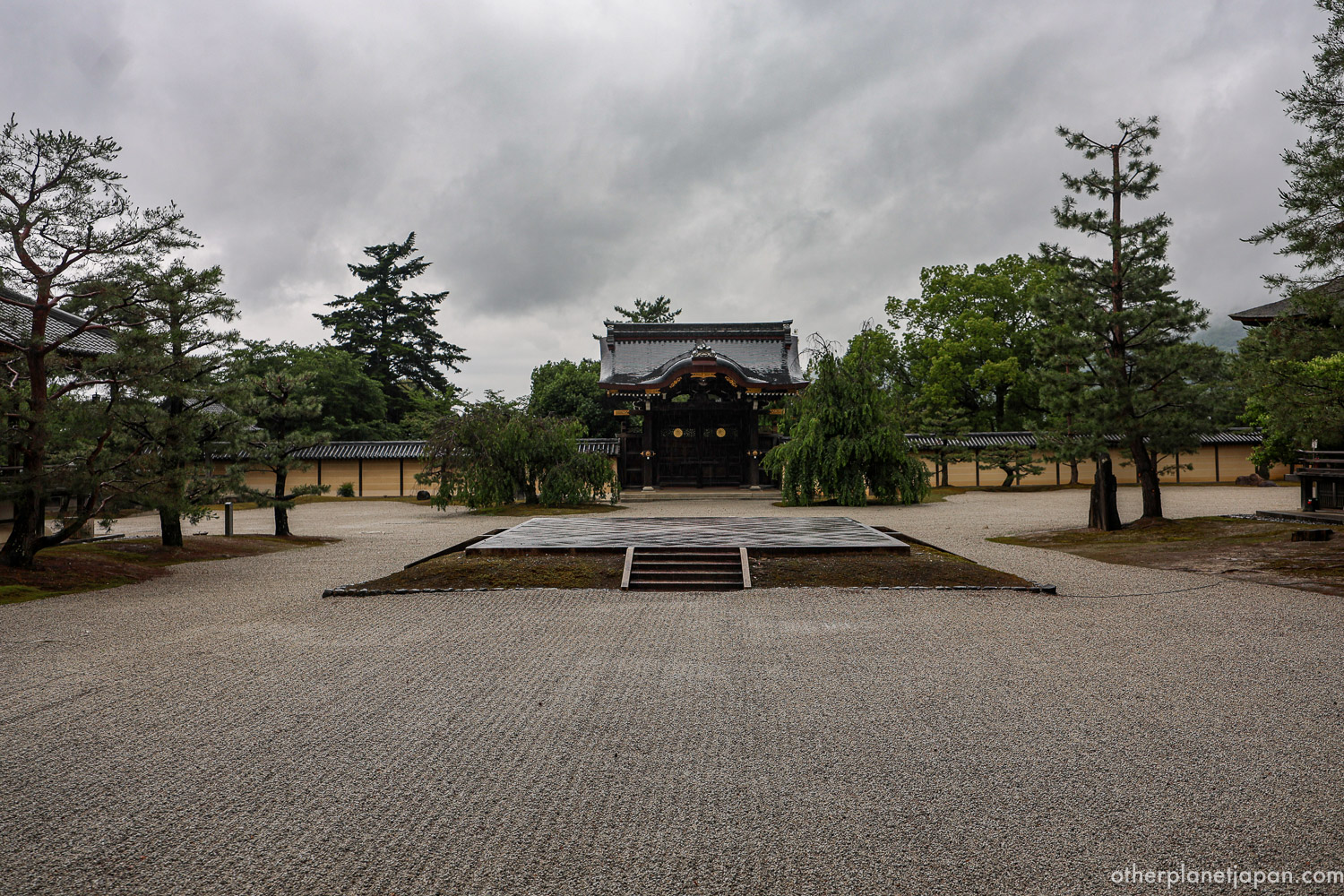
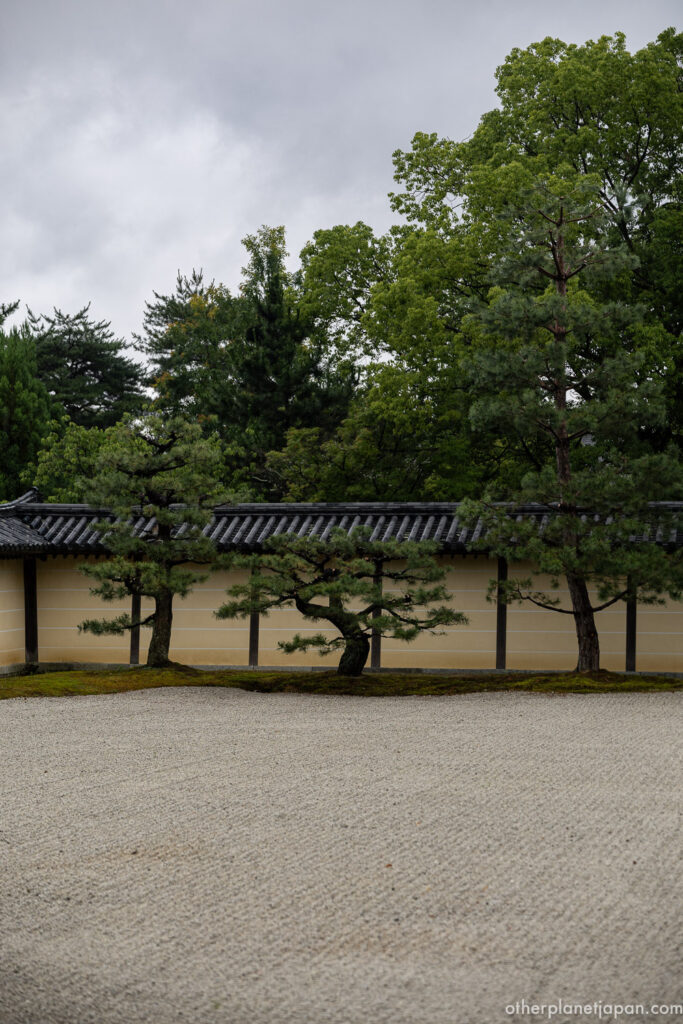
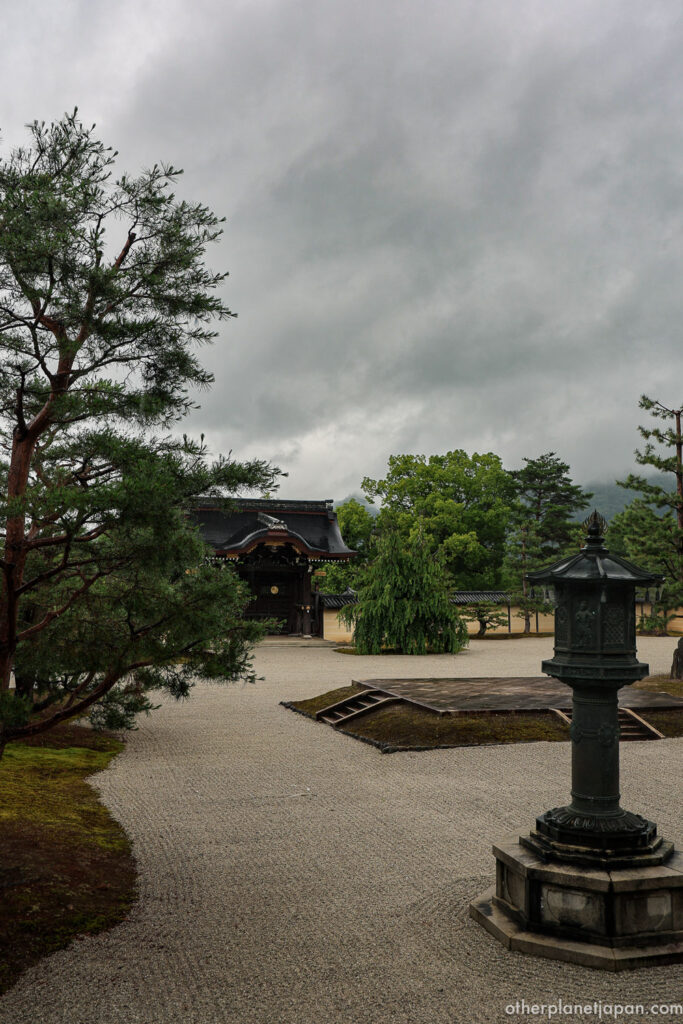
Between the main halls, a small dry landscape garden offers a moment of stillness. A stone lantern anchors one corner; raked gravel extends to the base of the surrounding walls. It is not the largest or most famous rock garden in Kyoto — that distinction belongs to Ryoanji — but its modesty is part of the point. Unlike the grand palace rooms with their gold-leaf screens, this garden asks for nothing except a pause.
Osawa Pond: Japan’s Oldest Artificial Garden Pond
The pond predates the temple. Emperor Saga created it during or shortly after his reign (809–842) by damming a stream that fed from the Nakoso waterfall. The design was inspired by Dongting Lake in China — one of the great cultural touchstones of Tang dynasty poetry — and the pond was built in the chisen-shuyu style, meaning it was designed to be viewed from a boat rather than from a fixed shore. At roughly one kilometer in circumference, it is considered the oldest surviving artificial garden pond from the Heian period.
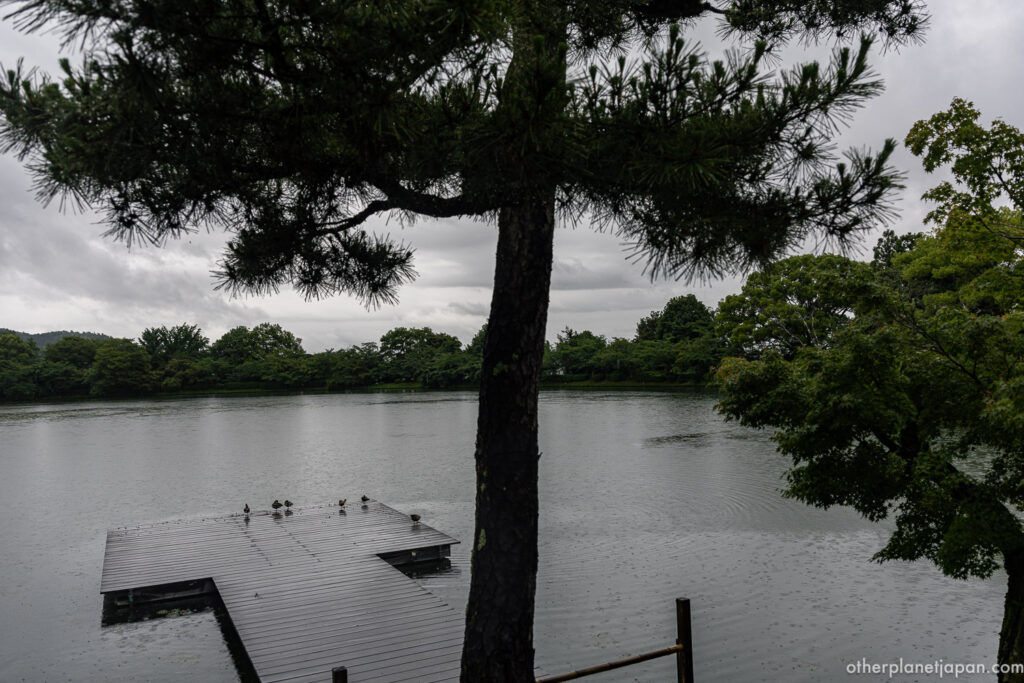
A walking path circles the entire shore. Two small islands — Tenjin-jima and the diminutive Kikuga-jima (Chrysanthemum Island) — break the water’s surface near the northern bank. Kikuga-jima is the island where Emperor Saga reportedly picked the chrysanthemums that launched the ikebana tradition. On the day I visited, the pond was silver under low clouds, and a handful of ducks had claimed the floating platform near the south shore as their personal real estate. No one was competing with them.
The pond area requires a separate ticket from the temple halls. It is quieter, greener, and more open than the hall compound — a different tempo entirely. In spring, the shore is lined with cherry blossoms; in autumn, a stretch called “Momiji Road” turns red. The Shingyo Hoto pagoda is also accessible from this side, along with a plum grove and the remains of the Nakoso waterfall — the same waterfall immortalized in a poem by Fujiwara no Kinto in the Hyakunin Isshu (百人一首): a verse about a waterfall whose sound has long since faded, though its name endures.
Sutra Copying (Shakyo) at Daikakuji
Daikakuji takes sutra copying seriously — it was Kukai himself who introduced the practice here, and Emperor Saga’s personal sutra is the temple’s most sacred treasure. Today, any visitor can participate. You sit at a low desk, pick up a brush, and trace the characters of the Heart Sutra over a lightly printed template. The fee starts at 500 yen, and chair seating is available for those who would prefer not to kneel on the floor — a detail worth knowing if your knees have opinions about seiza.
Reception for sutra copying runs from 9:00 to 15:30 (earlier than the general closing time), so plan accordingly if this is on your list. The session takes roughly thirty to sixty minutes depending on your pace and your relationship with a calligraphy brush. When you finish, you can submit your completed sutra to the temple. If you bring a goshuin-cho (temple stamp book), hand it in at the entrance before you begin — it will be ready with a freshly brushed seal when you leave.
Goshuin (Temple Seal Stamps) at Daikakuji
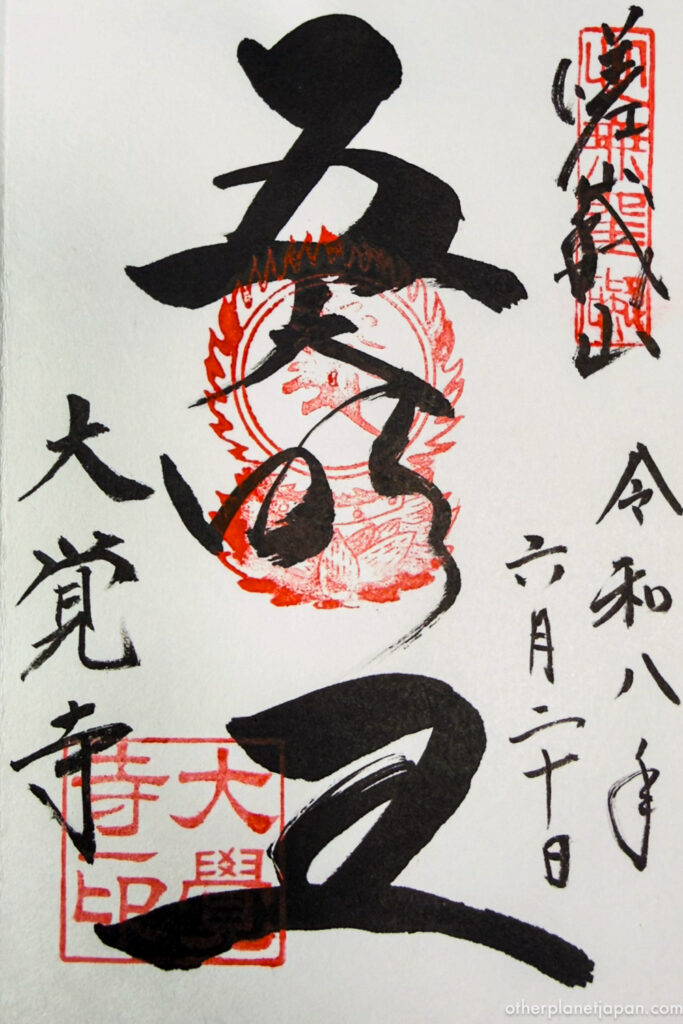
The standard goshuin at Daikakuji costs 500 yen and features bold calligraphy of the Five Wisdom Kings (五大明王). The temple also offers a rotating selection of seasonal and limited-edition designs — cut-paper (kirie) versions featuring cherry blossoms, autumn leaves, and the dragon-headed boats of the moon-viewing festival. If you are a collector, check the temple’s official website before your visit; seasonal editions tend to sell out.
Daikakuji Admission, Hours, and Tickets
Daikakuji is divided into two separately ticketed zones. You can visit one or both.
Temple Hall Area (お堂エリア)
Hours: 9:00–17:00 (last entry 16:30). Admission: 800 yen for adults, 400 yen for elementary through high school students. Sutra-copying reception closes at 15:30.
Osawa Pond Area (大沢池エリア)
Hours: 9:00–17:00 (last entry 16:30). Admission: 500 yen for adults.
Combined Ticket with Gioji Temple
A joint ticket covering Gioji Temple and Daikakuji’s hall area is available for 1,000 yen (adults only) — a saving of 300 yen compared to buying them separately. Note that this ticket does not include entry to the Osawa Pond area, which must be purchased separately on site.
How Long to Spend at Daikakuji
For the hall area alone, budget roughly sixty minutes. If you add the Osawa Pond circuit, allow ninety minutes to two hours total. Sutra copying adds another thirty to sixty minutes on top of that. A thorough visit covering both areas with sutra copying fills a comfortable half day — especially if you walk from the Arashiyama area rather than taking a bus.
How to Get to Daikakuji
Daikakuji is located in the Sagano district, north of the main Arashiyama sightseeing zone. It is walkable from all three railway stations in the area, or reachable by city bus from central Kyoto.
On Foot
From JR Saga-Arashiyama Station (Exit 2), the walk takes about 20 minutes (1.3 km). From Randen (Keifuku) Saga Station, it is roughly 25 minutes (1.6 km). From Hankyu Arashiyama Station, the walk is longer at about 40 minutes (2.6 km) — pleasant but better suited to those who enjoy the stroll through Sagano’s quieter residential streets.
If you are coming from Gioji Temple, the walk takes roughly twenty-five minutes through the back streets of Sagano — a quiet route that passes farmland and traditional houses. The two temples pair naturally for a half-day itinerary, and the combined ticket makes the pairing financially sensible as well.
By Bus
Three city bus routes connect major transit hubs directly to the “Daikakuji” stop in front of the temple gate.
From Hankyu Arashiyama Station: City Bus 28 to Daikakuji. Fare: 230 yen.
From JR Kyoto Station: City Bus 28 from the Karasuma Exit, bus stop C6, to Daikakuji. Fare: 230 yen.
From Shijo-Karasuma (Subway Shijo Station): City Bus 91 to Daikakuji. Fare: 230 yen.
Map