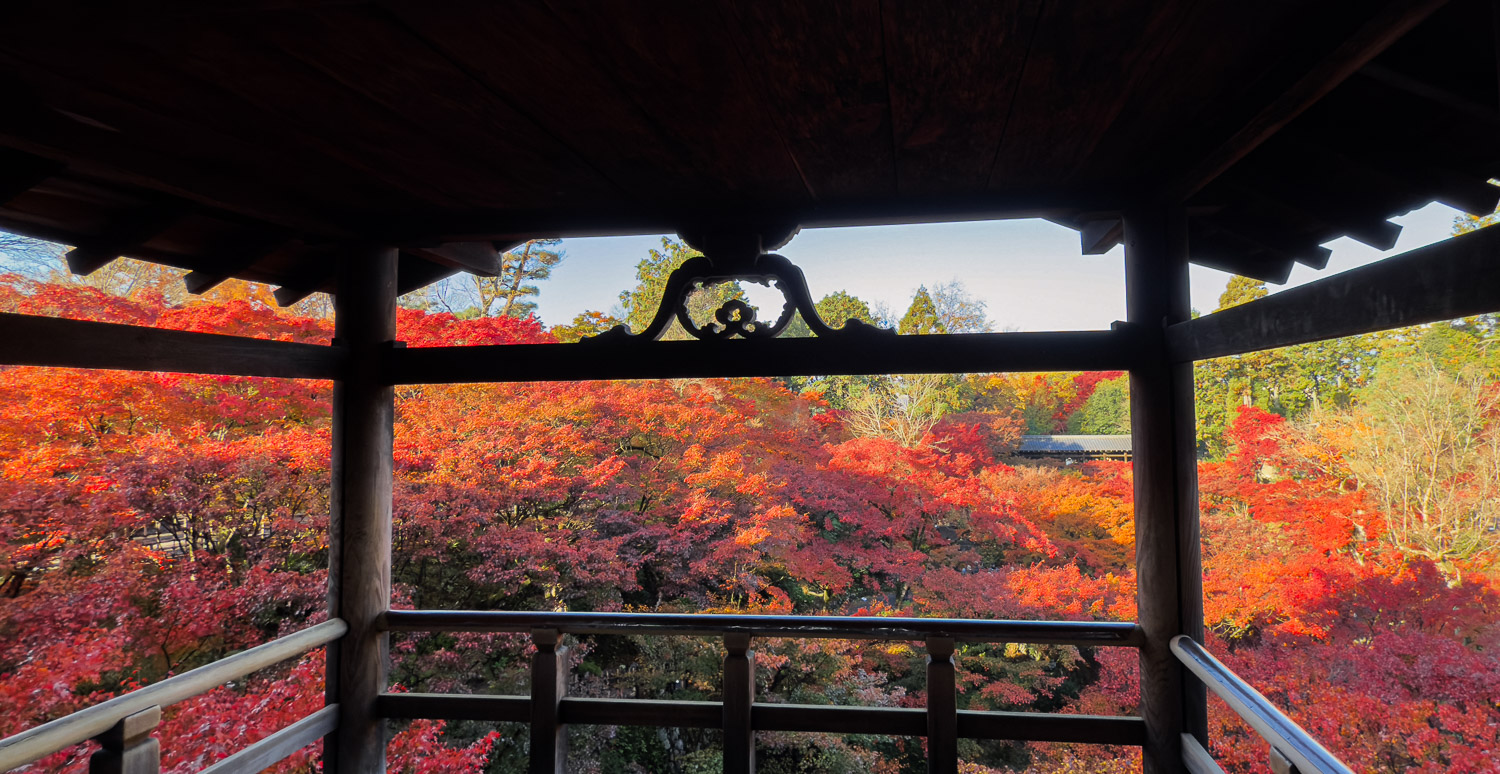
I went to Tofukuji as a schoolkid, on the class trip to Kyoto that nearly every Japanese teenager takes. The gardens, the halls, the routes we walked, all of it has dissolved. One memory survived, and it is not the one a Tofukuji Temple autumn visit is supposed to leave you with: this temple has the oldest surviving toilet in Japan.
The Toilet My Memory Kept
Years later, I checked. My memory was right.
Tofukuji’s tosu is the oldest and largest surviving toilet of any Zen monastery in Japan, built in the early Muromachi period and designated an Important Cultural Property. It also goes by the name Hyakusecchin, “the latrine of a hundred,” because rows of monks used it at the same time. Relieving yourself was part of the training. There were rules for how to walk in.
In Zen temples, the word tosu means the building that governs the east. The usual explanation is that these latrines stood on the east side of the compound. Tofukuji’s stands in the southwest.
So the single memory I carried home from Kyoto’s greatest autumn temple was a 600-year-old toilet whose name points the wrong way. I was impressed with my own recall. The feeling lasted about five minutes.
Because a few pages earlier in the same guidebook, there was a photograph of a covered wooden bridge crossing a ravine, and the ravine was on fire with red. Tsutenkyo Bridge. The single most famous autumn view in Kyoto, possibly in Japan.
I remembered none of it. Not a plank.
A Sea of Maples, Seen from Above
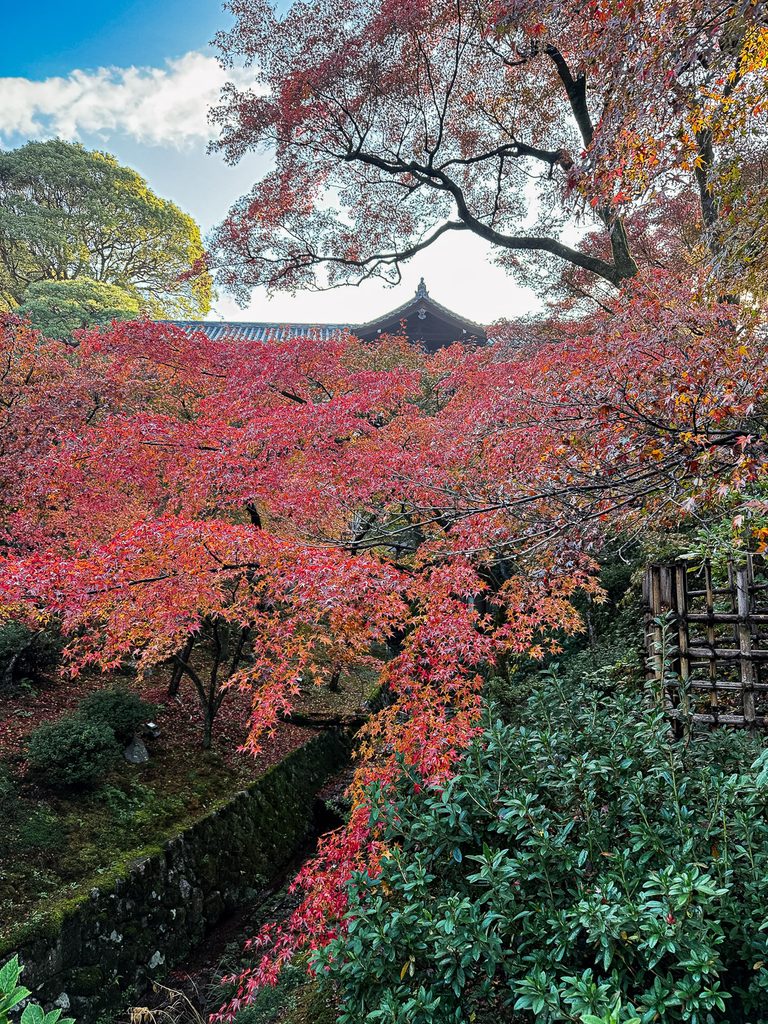
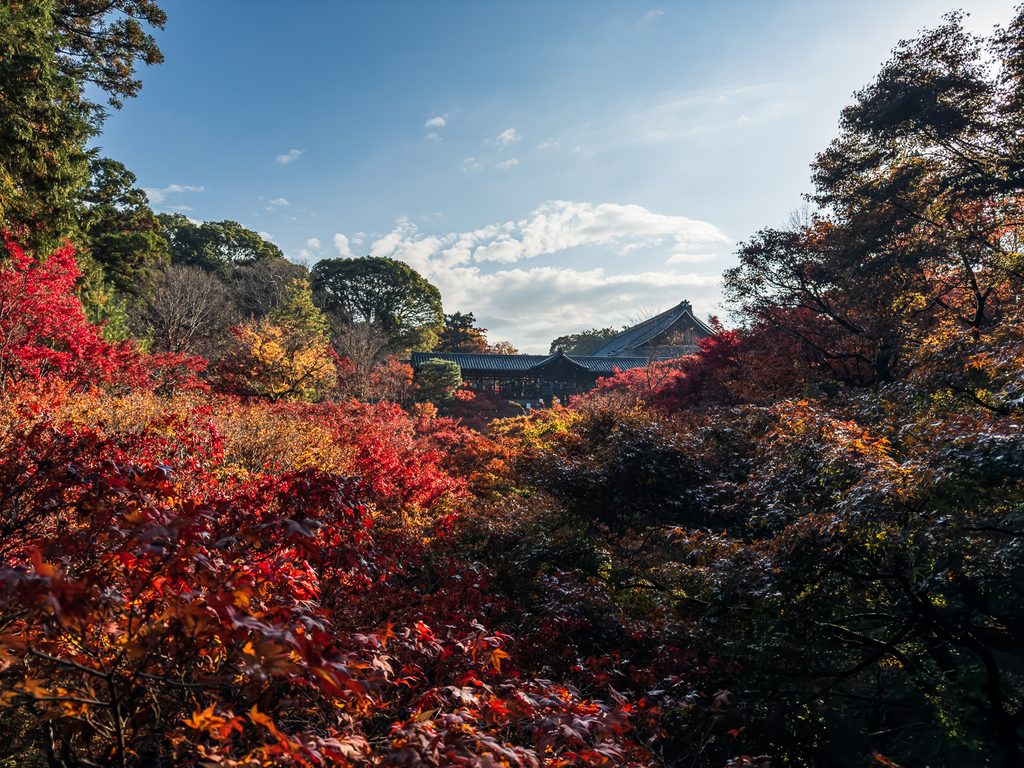
Gaunkyo Bridge is the first test. It sits on the approach, free to cross, and by the time I reached it, everyone ahead of me was already leaning over the rail. Below runs a ravine called Sengyokukan, and filling it, according to the autumn guides published in Kyoto every year, are some 2,000 maple trees. When they turn at once, the valley stops looking like a forest. Red shading into orange, a few late-green trees floating in it like islands. From above, it reads as liquid.
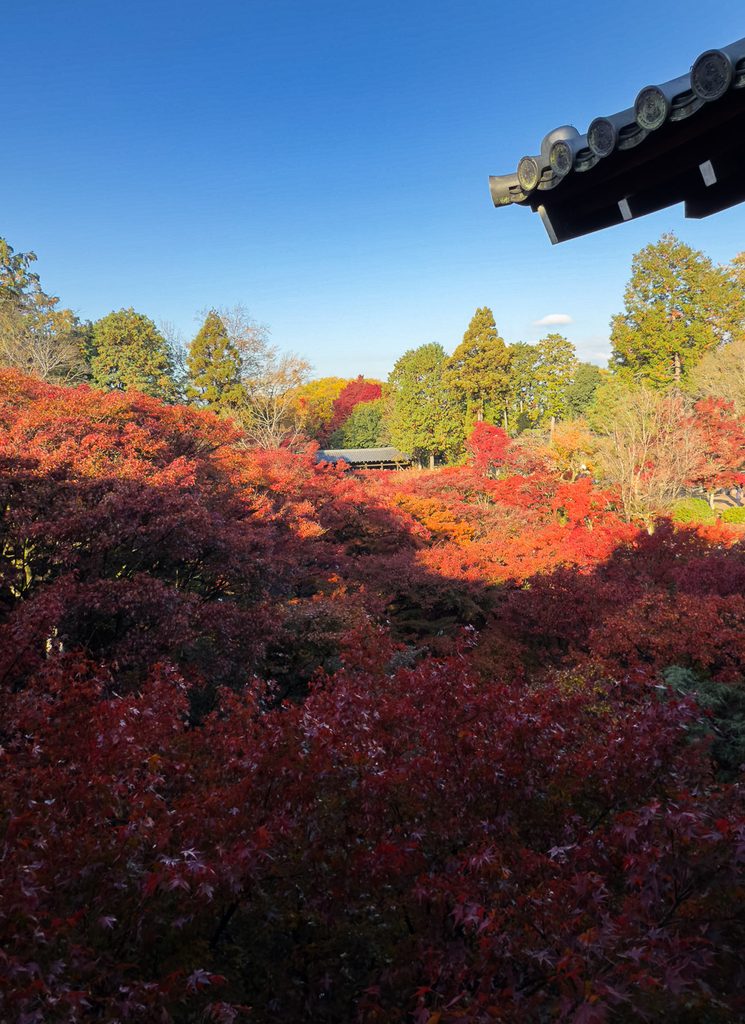
Kyoto has more celebrated ways to see autumn leaves. The mirrored maples of Rurikoin, for one. But nowhere else do you stand above the color, on a bridge that is itself part of the temple.
Come under a blue sky if you can. Red on its own is loud. Put blue above it and the whole valley settles.
I Went at Night Too. Here Is My Honest Verdict
The day visit was that good. So I wanted the night as well.
During the foliage season Tofukuji holds special evening viewings. I did not return the same day. I came back on another date, with a reservation, expecting 2,000 illuminated maples to do to the dark what they had done to the morning.
They did not.
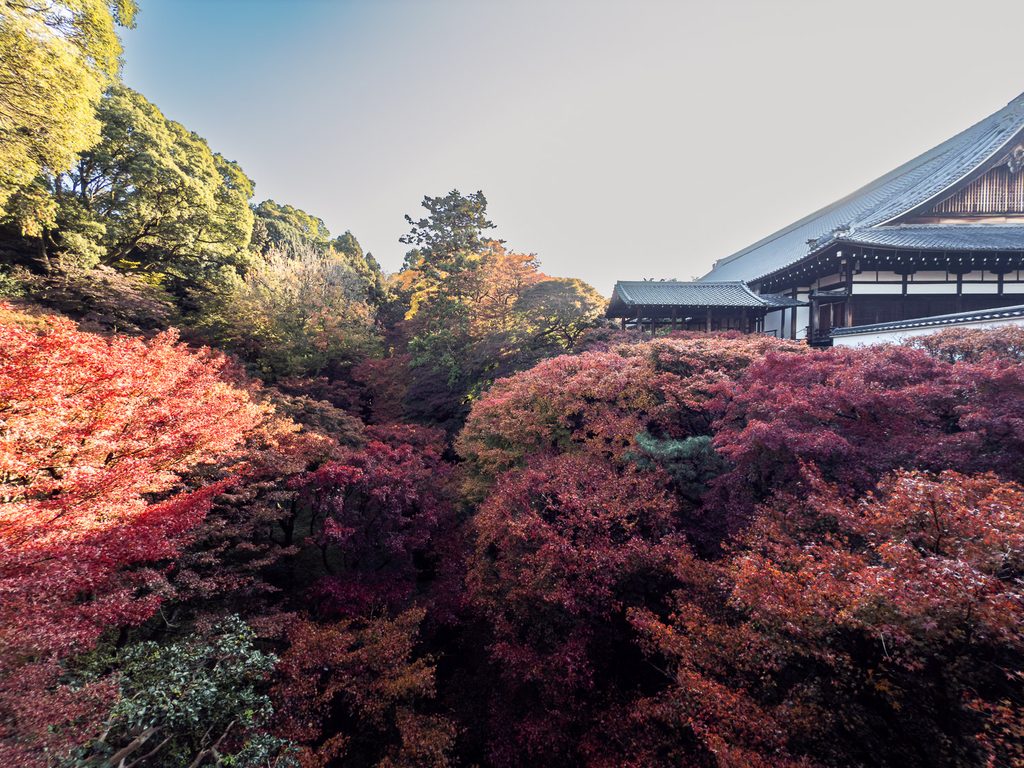
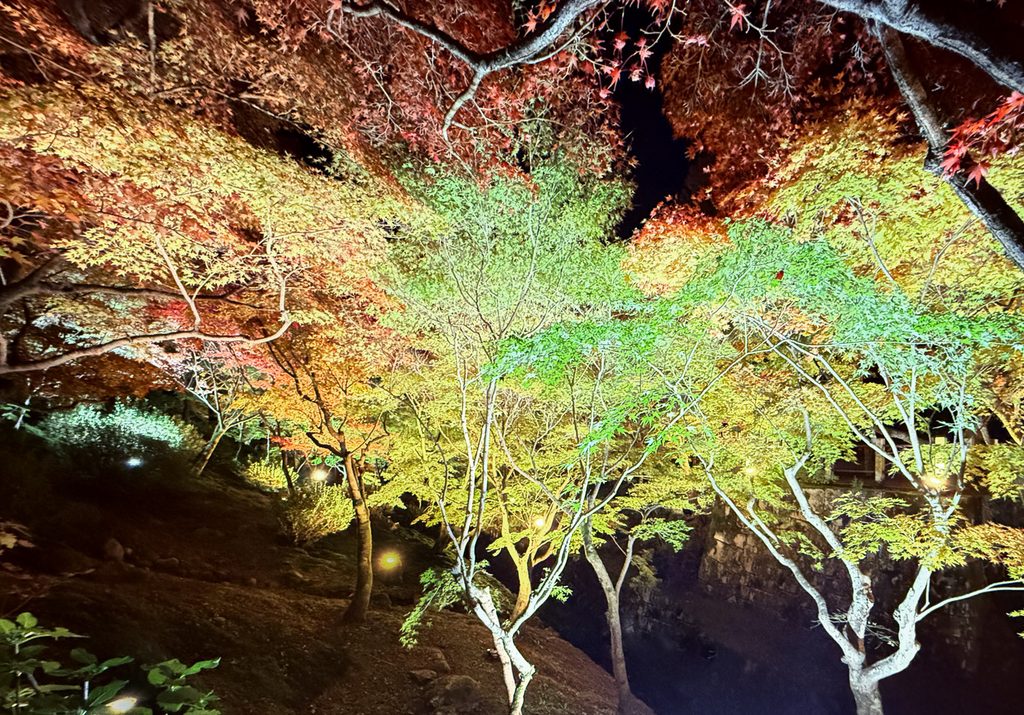
The problem is closeness. On the night route you walk right up to the lit trees, near enough to touch the glow. And up close, you can see that the leaves are not red. They are being made red. You see the seam where the light lands and where it stops. I will not call it fake. But the artificiality never quite leaves the picture.
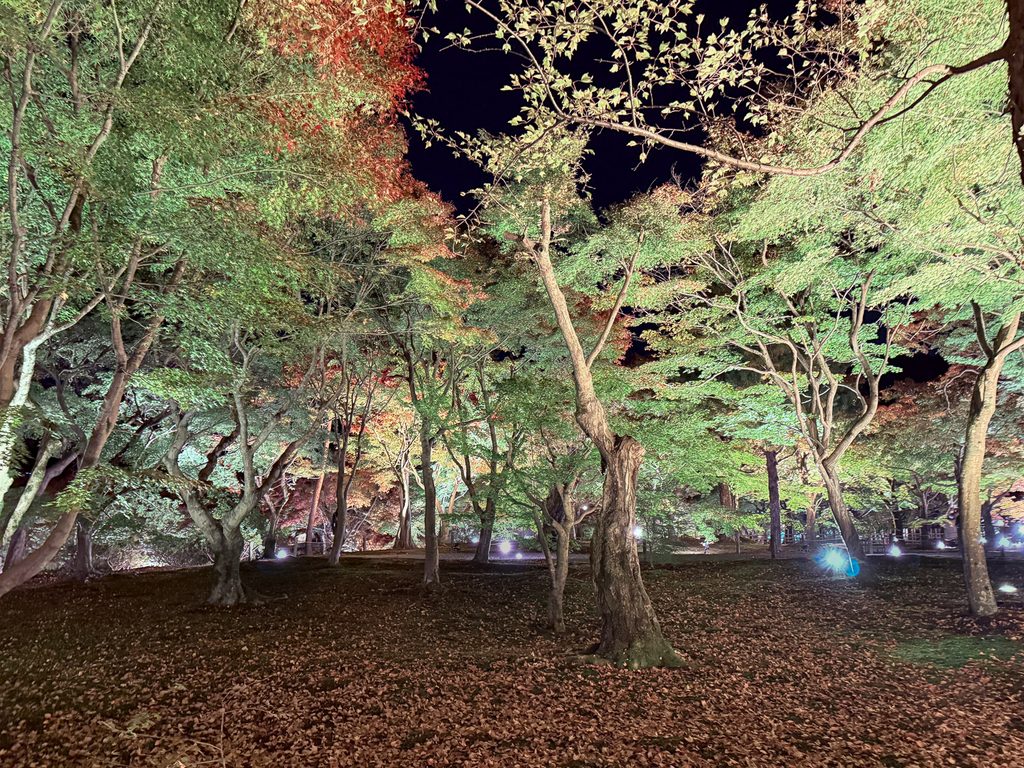
From a distance, taking in the whole valley at once, it might have been a different story. That distance is what the day gives you and the night could not. Daylight is the more natural beauty.
And yet the night was worth the ticket, for a reason that had nothing to do with leaves.
That evening, the main hall was open. Inside stood a statue of Shaka Nyorai, the historical Buddha, and overhead spread a dragon painted across the ceiling, wide enough to reach from one end of the hall to the other, looking down at everyone below. Photography is forbidden. So there is no picture of it in this article, and none in my archive either.
Writing this, I realized something. I have visited Tofukuji by day many times and I have never once entered the main hall. Whether my school trip went inside, I cannot say. That version of me was busy memorizing a toilet.
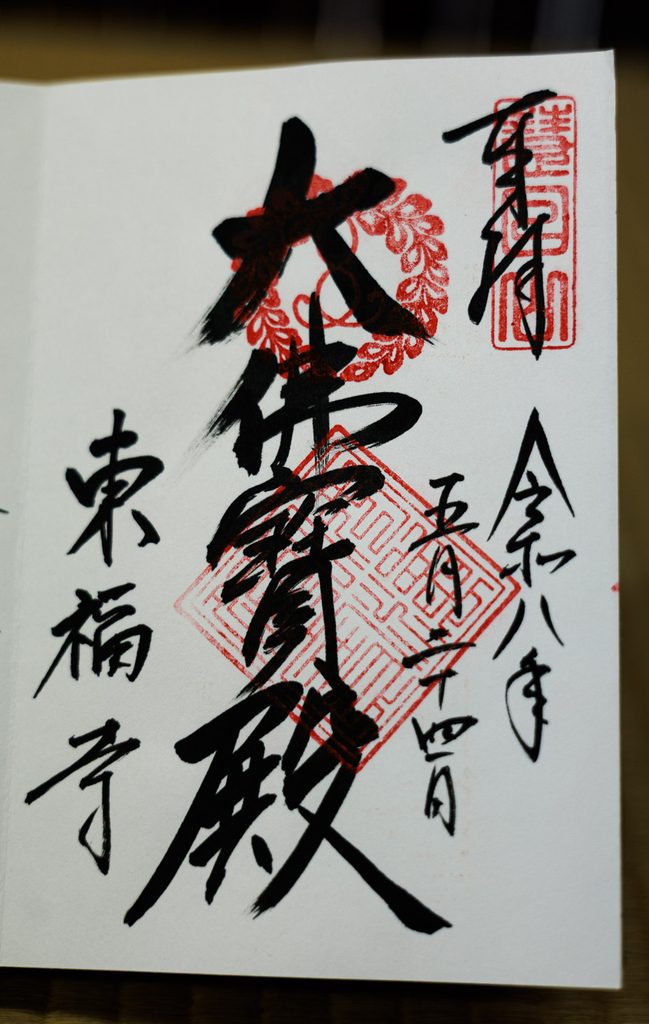
Which brings me to a piece of paper I collected on a different visit entirely, in May. At the hojo I received a goshuin, and the brush had written Daibutsu Hoden. The name of the main hall. On paper, and only on paper, exists the building my daytime self has never seen.
You Cannot Walk Backward
Everyone has the same idea.
Arrive at opening, march straight to Tsutenkyo ahead of the crowd, and photograph an empty bridge. In most of Japan, this works. Early rising is usually rewarded.
Not at Tofukuji in November.
For the foliage season only, the temple runs a fixed one-way route. You cannot double back. Guards stand at the turns to enforce it. And Tsutenkyo sits at the very end of the route, which means there is no marching ahead of anyone. The rest of the year, Tofukuji lets you wander wherever you like. For one month, it becomes a different animal.
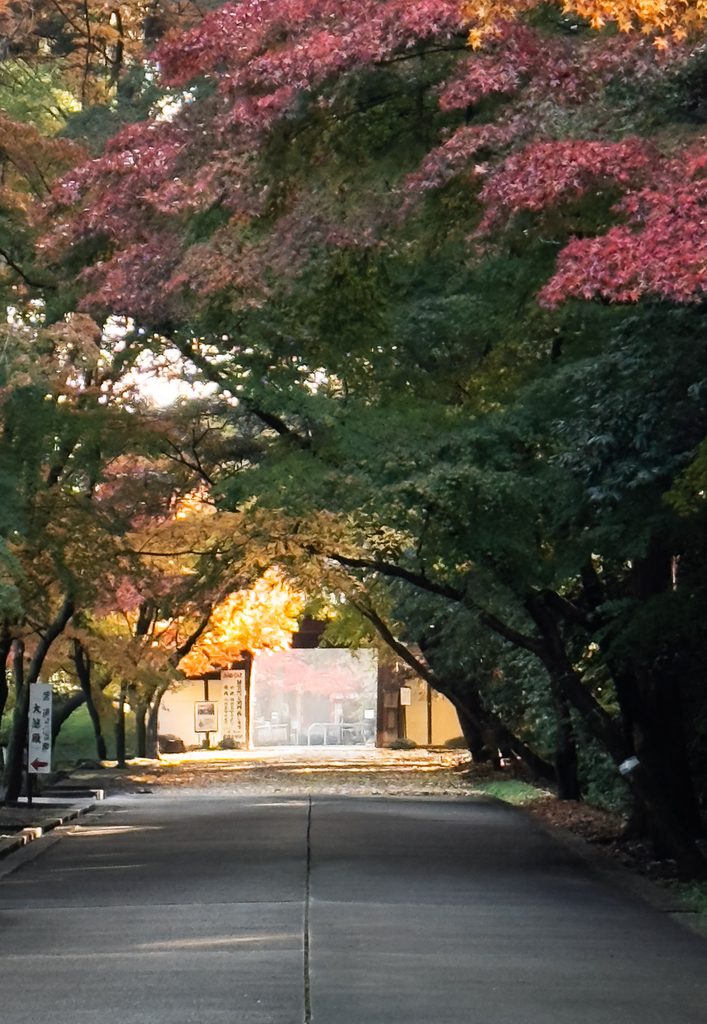
At the entrance I weighed my options anyway. Skip every other sight, save a few minutes, and arrive at the bridge where, exactly, ahead of the people already filing along the same fixed path in front of me? There was no version of this that worked. An empty Tsutenkyo, I concluded, does not exist in autumn.
“Let’s All Step Back for a Moment”
The bridge, of course, was full.
Partway across Tsutenkyo there is a viewing deck that juts out over the ravine. It is the most photographed spot in the temple. People lined the railing, took their turn at the front, stepped away for the next in line. The line never thinned. I went up once, took my frame, stepped back.
Then someone spoke. Why don’t we all clear the deck for a moment?
A Japanese man, middle of the crowd. No serious camera around his neck, nothing about him that said photographer. Just a visitor. And his suggestion traveled fast. Without any signal I could see, everyone on the deck moved to the sides.
The emptiness held for more than two minutes.
The railing stood empty. Wooden pillars, the balustrade, and beyond them 2,000 maples, and nothing else. The deck had gone quiet, or as quiet as November at Tofukuji gets. A few of us took our shot. I took mine. Nobody rushed anyone. Nobody broke early. No signal ended it, either. People simply finished, drifted back to where they had stood, and the line refilled as if nothing had happened.
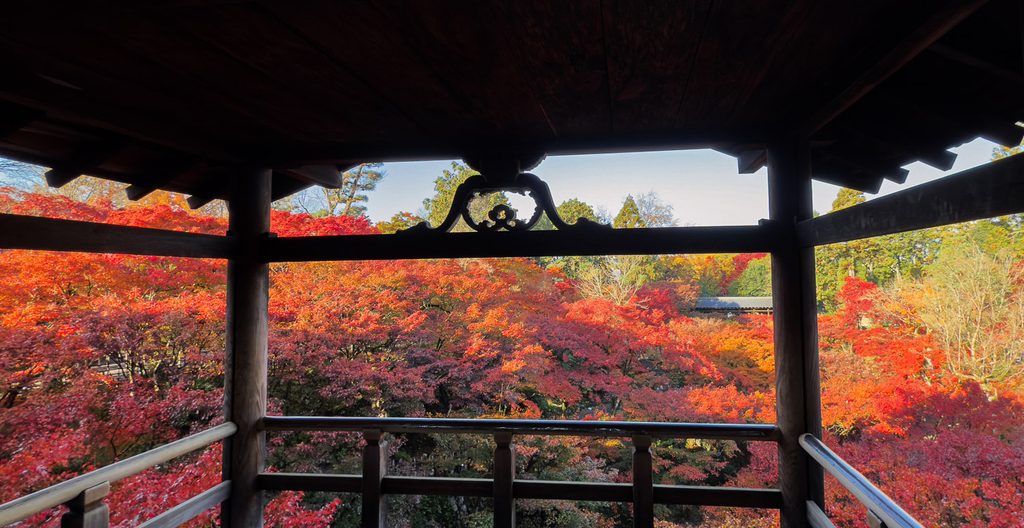
I have gone to a lot of places for photographs. I have risen early, stayed late, waited out crowds for a single clean frame. I have never, anywhere, had strangers clear a famous view for each other.
This photograph is not a product of my skill. The people on that deck took it, and let me press the button. My thirteen-year-old self walked out of Tofukuji having forgotten the entire bridge. This time, I don’t think I will.
The Temple Behind the Bridge: What Is Tofukuji?
After a morning like that, I wanted to know what kind of place produces it.
Tofukuji is one of the largest Zen temples in Kyoto and one of the city’s Five Great Zen Temples. It was founded in 1236 by the regent Kujo Michiie and took nineteen years to complete. The name splices together Todai-ji and Kofuku-ji, the two great temples of Nara, one character from each. Build in Kyoto something worthy of Nara: the ambition came first, and the name announced it.
It remains a working monastery of the Rinzai school. The grounds hold the Sanmon gate, a National Treasure; the oldest and largest surviving Zen meditation hall in Japan; and the tosu. The toilet building is normally closed, but you can look into it from its east face. That window is where I looked as a schoolkid.
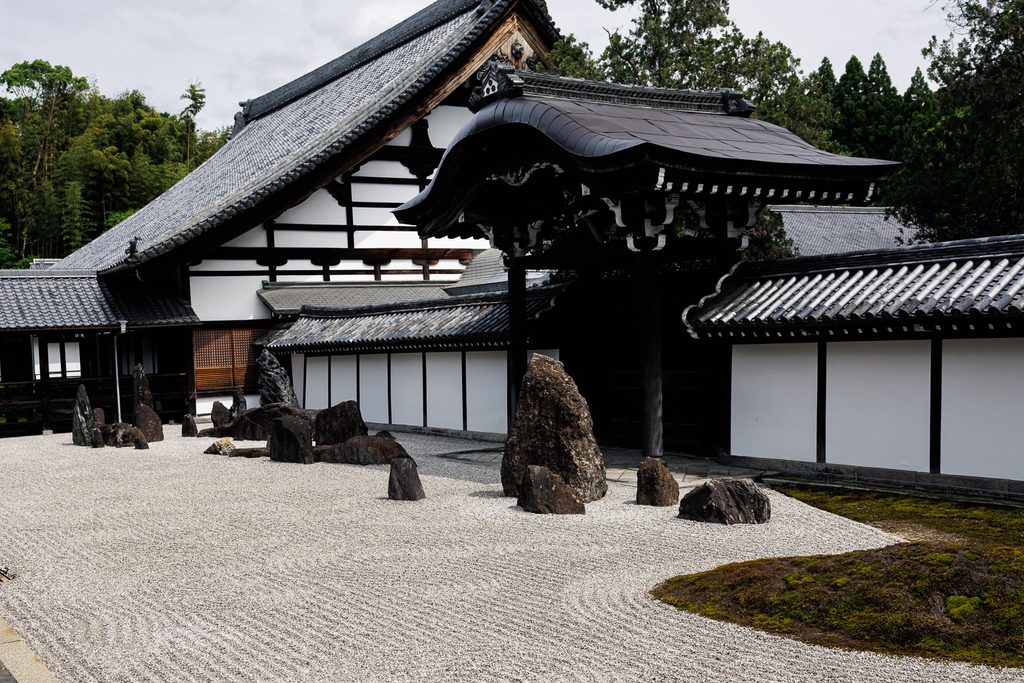
Around the hojo, the abbot’s quarters, lies the Hasso Garden, laid out in 1939 by Mirei Shigemori and famous for its checkerboard of moss. It is a separate visit and a separate article, so I will leave it there.
And there is a question about this temple I have never been able to answer. Tofukuji is not a World Heritage Site. The Historic Monuments of Ancient Kyoto, inscribed in 1994, comprise seventeen properties, and Tofukuji is not among them. It has a National Treasure gate, six-hundred-year-old halls, and an autumn the whole world flies in for. Why it was left out, I genuinely do not know.
When to Come, and Why the Sky Matters
Peak color runs from late November into early December, and the temple’s special autumn viewing period is your practical guide. In recent years it has run from around November 14 to December 6, but the dates change every year, so check the official Tofukuji website before you build an itinerary around it.
During this period only, Tsutenkyo opens at 8:30 a.m., half an hour before the hojo garden opens at 9:00. Thirty minutes is not a small head start at autumn Tofukuji.
Then the weather. Because this temple’s views look down into a ravine, the sky rarely appears in your photographs, yet its color governs everything you see. If your schedule has any give in it at all, spend it on a clear day.
One warning while you plan: there is no quiet hour at autumn Tofukuji. Not at opening, not at dusk, not midweek. The temple is simply that famous.
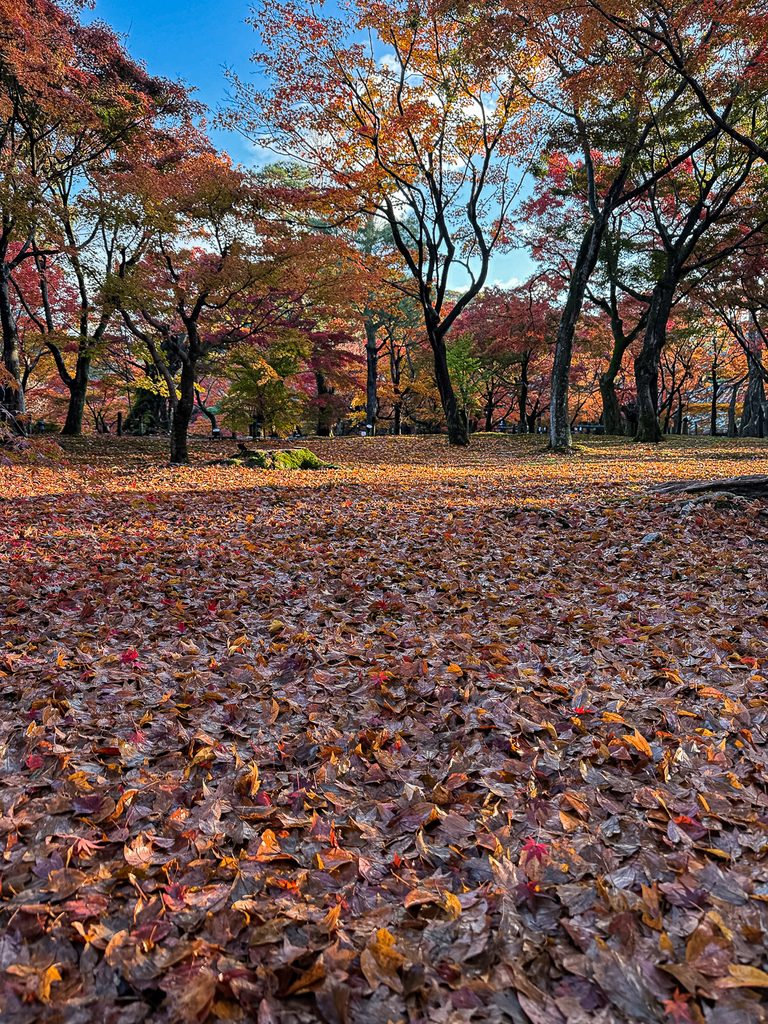
Into December, the leaves begin to fall, and the temple offers a second act. The ground turns into a carpet of shed red, drifting over the moss, and the crowds ease a little.
Which brings me to the only time-of-day advice I can honestly give. Come at opening and the fallen leaves may still be wet, and wet leaves hold their color in a way dry ones do not. Do not come early for the quiet, though. There was a line at the gate before opening, and another line before the evening viewing. Japanese guidebooks suggest nine to ten in the morning. Treat that as consolation rather than strategy.
The One-Way Route, Explained
Autumn Tofukuji is a one-way street: the route is fixed, guards enforce it, and re-entry is not allowed. Once you exit, your ticket will not bring you back in. Know these rules before you go, or you will miss things you meant to see.
First, Gaunkyo Bridge, on the way in and free to cross. It is the only place you can see Tsutenkyo from the side, with the valley beneath it. If photography is your priority, give this bridge more time than feels reasonable, because the route will not bring you back.
Next, through the Nikkamon gate into the grounds, past the Sanmon gate and the main hall. The tosu and the meditation hall stand in this area. No ticket needed so far.
Then the ticket gate for Tsutenkyo and the Kaisando hall. Inside, the bridge crosses the ravine, the viewing deck juts out partway along, and the Kaisando, resting place of the temple’s founding priest, waits at the far end. The bridge comes last, and nothing on this route lets you return to it. Whatever minutes you were holding in reserve, spend them on the deck.
The hojo garden has its own entrance and its own ticket, and during the autumn period no combination ticket exists, so seeing both means buying both. The goshuin is written inside the hojo.
Two rules for photographers. Tripods are prohibited on the grounds, and when crowding gets heavy, the temple may ask visitors not to photograph from Tsutenkyo and Gaunkyo at all. No such request was in force the day I visited. Treat it as a same-day call, decided by the crowds, not by the calendar.
Should You Visit at Night?
If the leaves are your reason, go by day.
Tofukuji has held special evening viewings in recent autumns, but whether they run, when, and at what price is announced year by year, so check the official site. I reserved my ticket in advance; others were buying theirs at the entrance. Daytime visits, by contrast, need no reservation at all, even at peak.
The reason to come at night is the architecture. On my evening, the main hall stood open, with the Shaka Nyorai inside and the ceiling dragon overhead, painted in 1934 by Insho Domoto. No photography is allowed. But be warned: the hall’s night opening is not guaranteed every year. If it is your reason for the ticket, confirm that year’s announcement first.
Fees and Hours
Autumn has its own fees and its own clock, and the bridge nearly doubles in price for the weeks it is worth seeing. I have paid it without complaint. The figures below are from recent years, and both dates and prices get revised annually, so check before you go.
| Regular season | Autumn viewing period | |
|---|---|---|
| Tsutenkyo Bridge & Kaisando | Adults 600 yen / Children 300 yen | Adults 1,000 yen / Children 500 yen |
| Hojo garden | Adults 600 yen / Children 300 yen | Same as regular season |
| Combination ticket | Adults 1,000 yen / Children 500 yen | Not offered |
During the autumn period, Tsutenkyo opens at 8:30 a.m. and the hojo at 9:00 a.m.; reception closes at 4:00 p.m. and gates close at 4:30 p.m. The rest of the year, hours run 9:00 a.m. to 4:00 p.m. (until 3:30 p.m. from December 7 through March).
The goshuin is available inside the hojo for 500 yen. One thing worth knowing: during the autumn viewing period, goshuin are not hand-brushed. If a hand-brushed one matters to you, as it did to me, come in another season. Mine, the one reading Daibutsu Hoden, is dated May.
Getting There
The nearest station is Tofukuji, served by both the JR Nara Line and the Keihan Main Line, about a ten-minute walk from the temple. From Kyoto Station it is a single three-minute hop on the JR Nara Line. Tobakaido Station on the Keihan line is also about ten minutes on foot.
By bus, routes 88 and 208 run from Kyoto Station in about fifteen minutes, and route 207 from Shijo Kawaramachi in about twenty; the Tofukuji stop is a four-minute walk from the gate.
Do not drive. The temple’s parking lots close for the entire foliage season, from late October to early December, and traffic restrictions apply in the surrounding streets.
One pairing worth building into your day: Fushimi Inari Taisha, the shrine of the ten thousand vermilion gates, is one station south of Tofukuji on both the JR and Keihan lines. Doing the two in a single morning is the standard move, and the geography makes it an easy one.