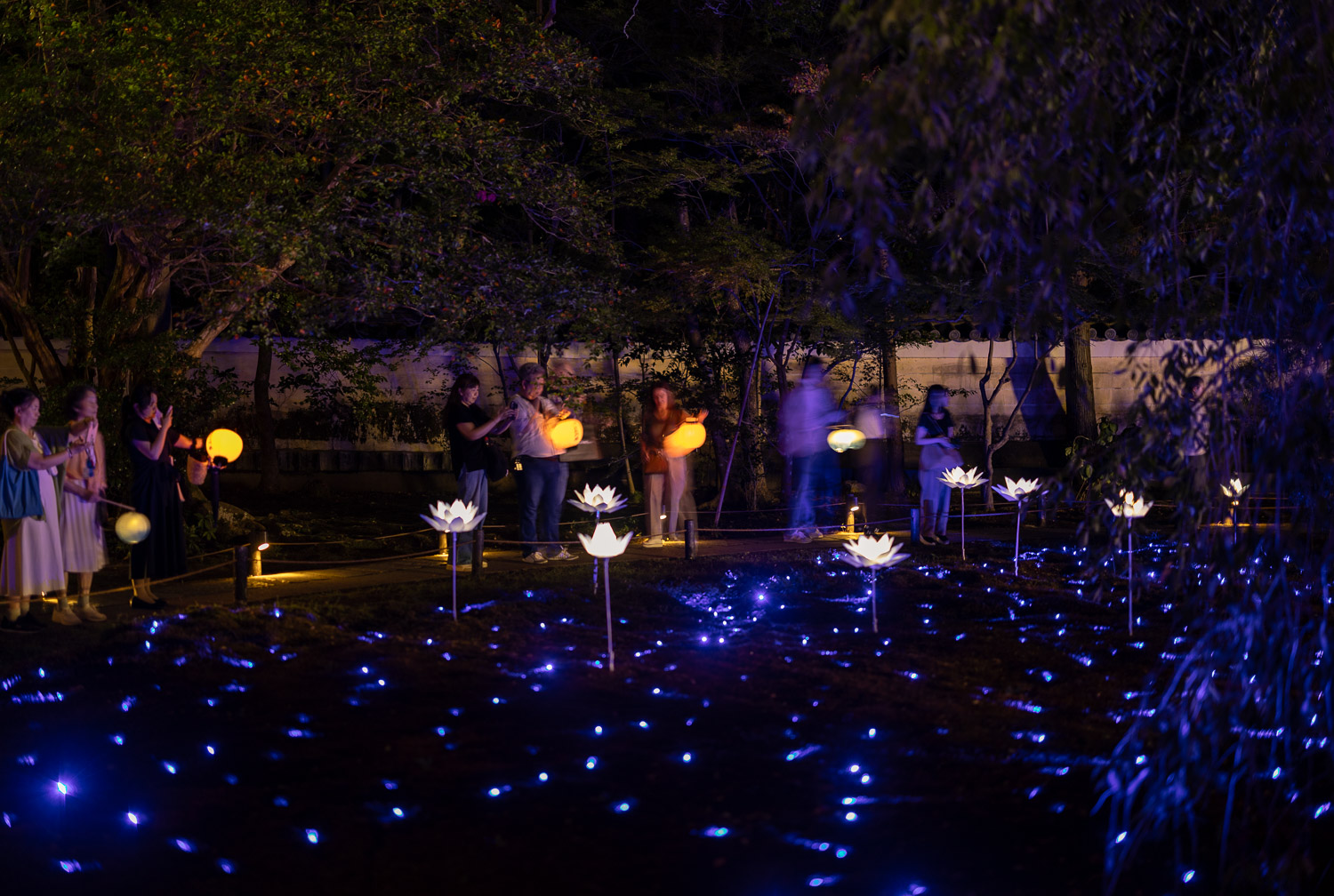
The color was wrong. I knew it the moment I stepped through the gate.
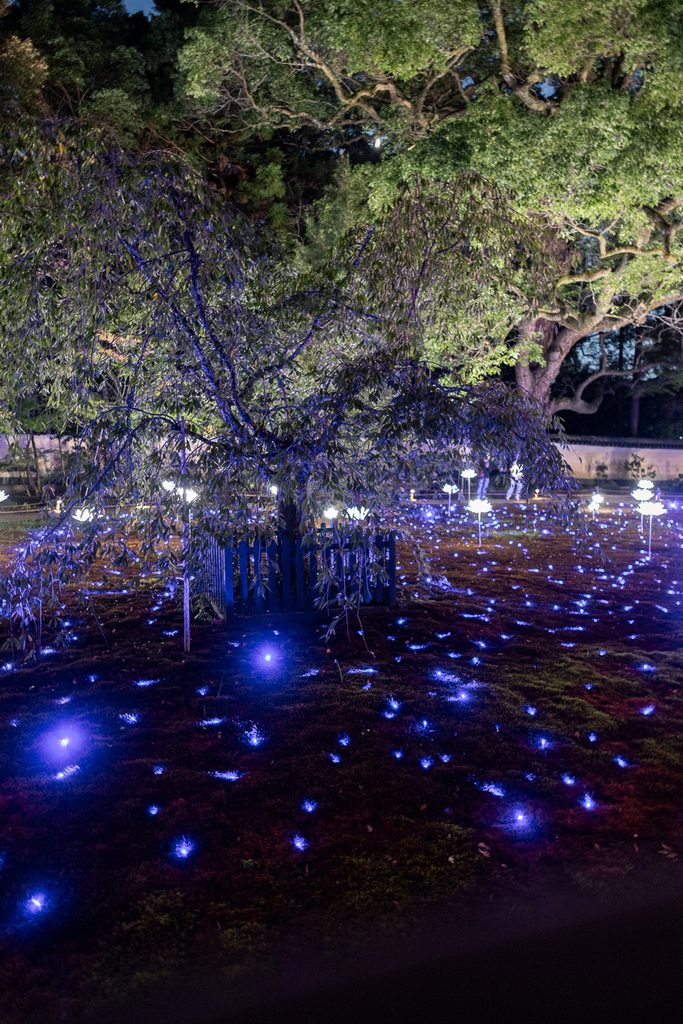
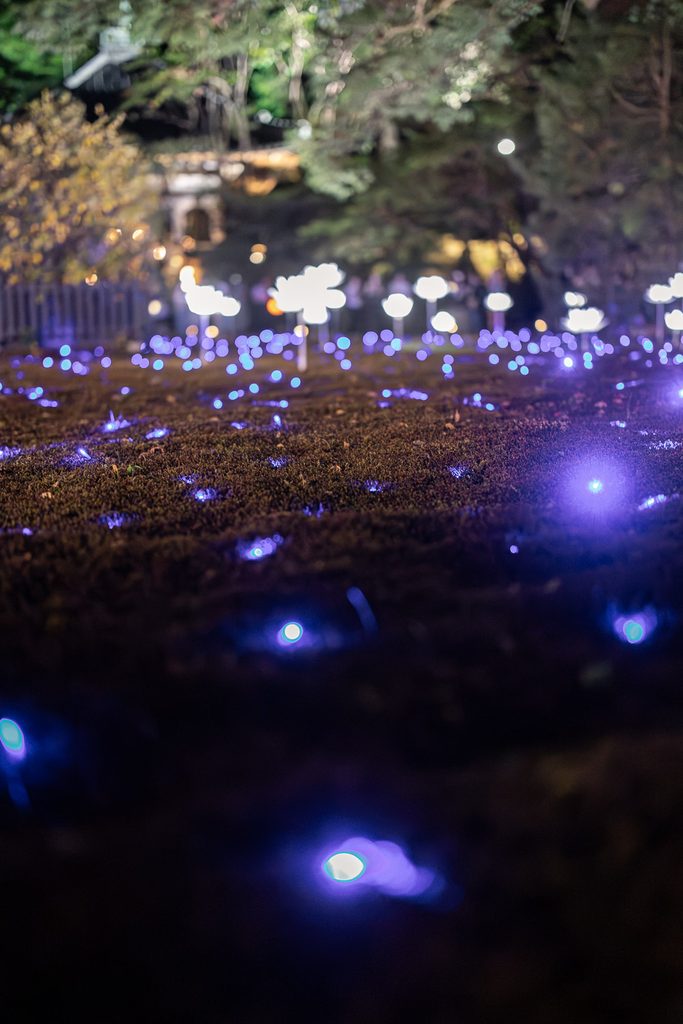
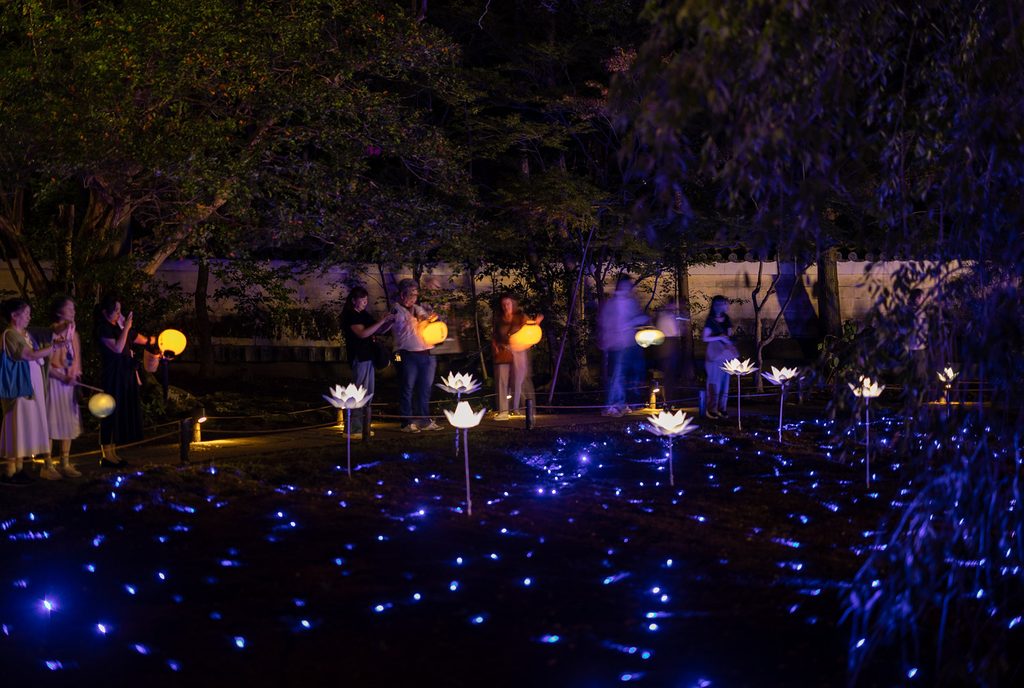
I have spent a fair number of nights at Kyoto temples, and the light is almost always orange. Candle orange. Lantern orange. Flame strained through wood and paper. But at the Shoren-in Temple night illumination, the garden glowed blue, hundreds of small blue lights scattered across the moss, and rising from between them, white lamps shaped like lotus flowers. Beautiful. Also unsettling, in a way I could not name yet.
Why blue? I carried the question around the temple and still had it when I walked out, thirty minutes later. That is the other thing worth saying about this place. It gives you a garden, a palace, a bamboo grove and a shrine, and it asks half an hour of your evening for the set.
I Arrived Late on Purpose
The gate opens at 7:00 p.m. In July, Kyoto is still bright at 7:00 p.m.
I knew this from experience, so I came late on purpose. Walk in while the sky still holds light and the lamps get washed out before they have a chance to do anything, which is a strange way to attend an illumination.
It was the right call, and because it was the right call, the blue hit harder. In a garden gone fully dark, the blue had nowhere to hide.
I am Japanese. I have been looking at temples my whole life. And what I was looking at, I did not recognize.
The Reason Was a Year Old
The night viewing came back in 2025, after a five-year pause.
I knew, and I missed it anyway. Those of us with day jobs cannot always drop everything for a first-time-in-five-years.
So I went last autumn instead, in daylight, and the maples were good enough that a question followed me home: what would all this look like after dark? When a summer session was announced this year, there was nothing left to decide.
The Breeze Never Comes
You take off your shoes, step up into the Shinden hall, and the garden is right there in front of you.
No wall stands between the corridor and the garden. The screens are pushed wide open, the moss begins just past the edge of the tatami, and you get that old Japanese vagueness about where inside ends and outside starts. “Open” does not quite cover it.
Temples also do not have air conditioning.
Which means the only relief on offer is whatever the night decides to send you. A building this open to its garden owes you a breeze, I reasoned, sitting down on the tatami to collect mine.
It never came.
This is the Kyoto summer. Heat pools at the bottom of the basin all day and the ground keeps handing it back long after sunset, so you can open every door in a building and the air will still refuse to move. Whatever you have heard about it cooling down at night does not apply here.
I had water. Water does nothing about the air on the far side of your skin. Dressing lighter was never an option either, because you do not turn up at a temple looking like you got lost on the way to the beach. So I sat in the heat and waited it out, which is what everyone else on that veranda was doing.
Then the garden changed color.
The blue dimmed and turned, slowly, to white. It held there a while, then eased back into blue. The garden was never only blue, and this was no flicker, nothing so quick. It was closer to breathing, the whole garden drawing in one color and letting out another, on a cycle long enough that you miss it if you only stop for a photograph.
Once I noticed, I could not leave.
The Building, at Least, Was Orange
Eventually I pulled my eyes off the garden and turned around.
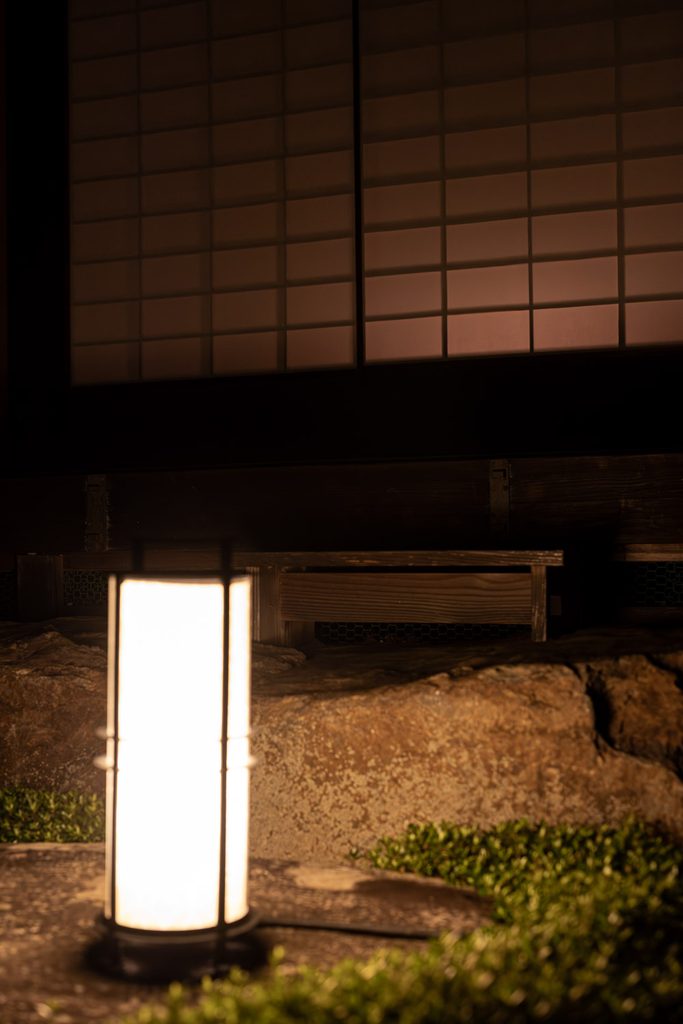
The inside of the building was orange. Tatami and wooden corridors held a warm light with a soft sheen, and my first thought was that it looked like the hallway of a very good ryokan. The lineage runs the other way, obviously. Ryokan learned from buildings like this one. But that is how a modern eye reads it, and I have a modern eye.
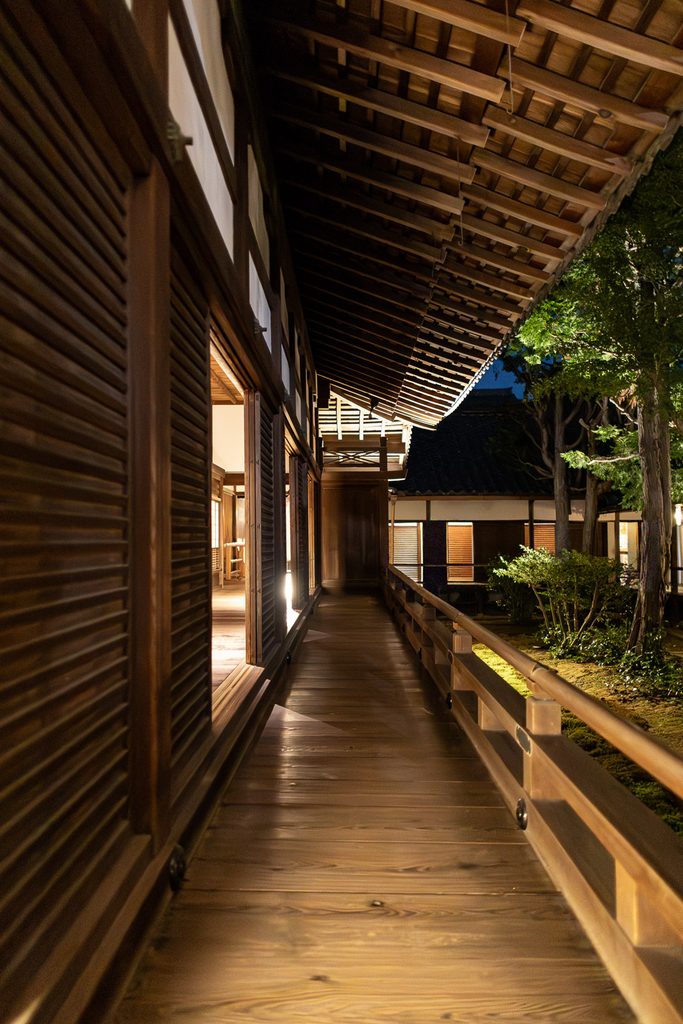
The garden is not the only thing worth your attention here.
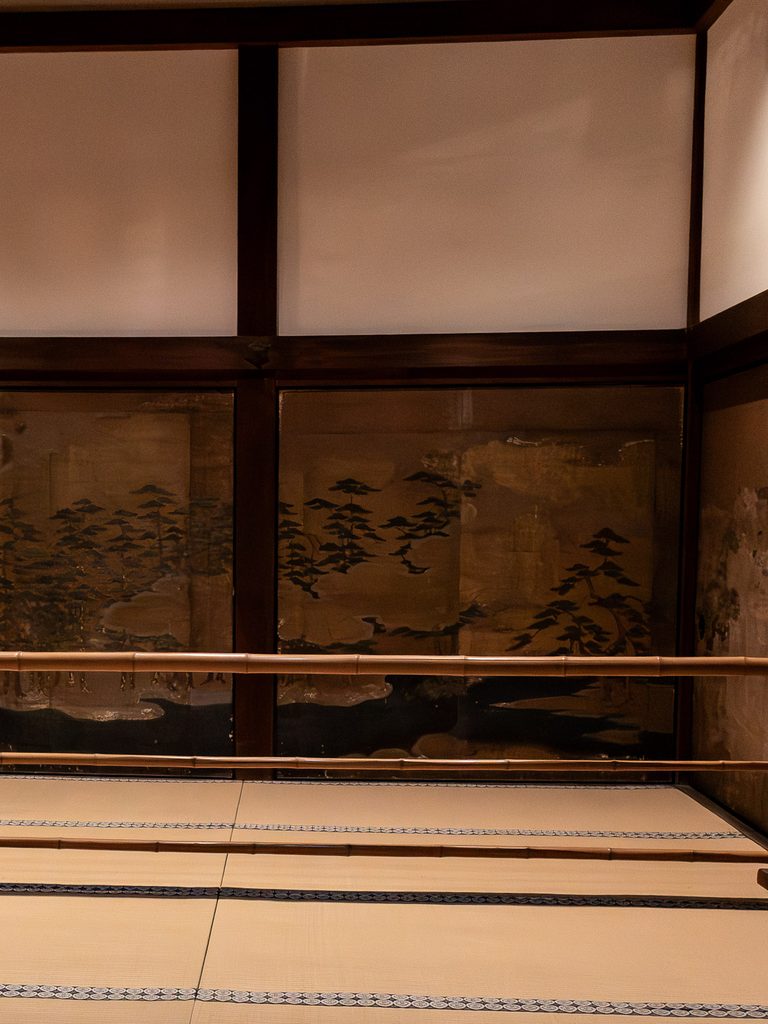
The large sliding doors, designated an Important Cultural Property, carry paintings of pine trees, deep green on a gold ground, each branch given its own weight when you get close enough to look. Night lighting is unkind to work like this, and details that survive daylight sink into shadow. What does surface out of the dark, though, has a presence the daytime version never manages.
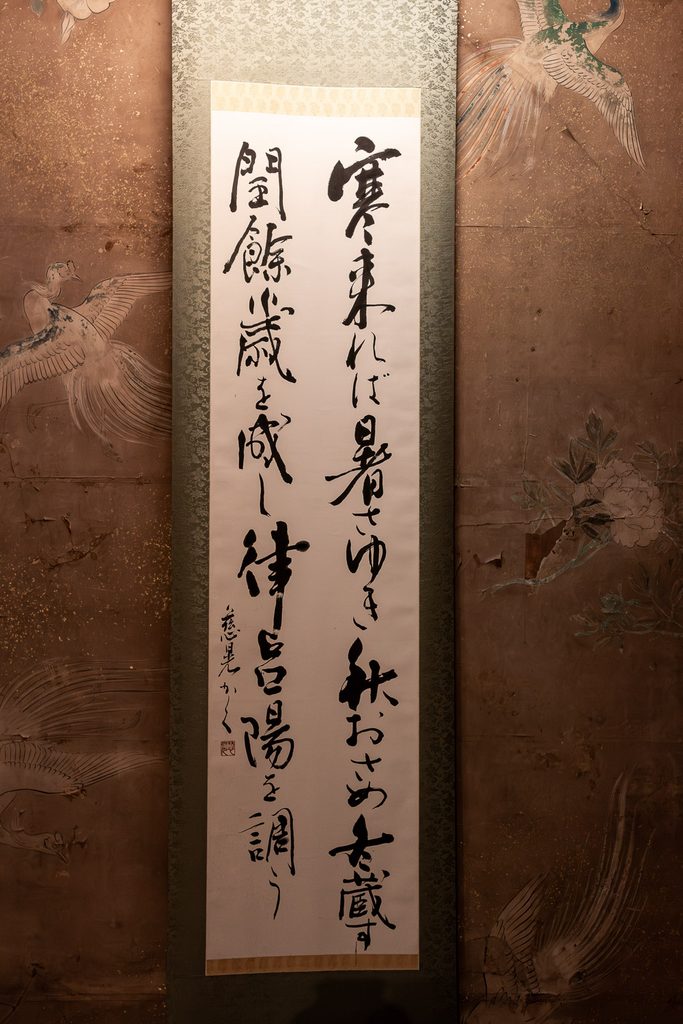
A hanging scroll waits in the alcove. Calligraphy, and there were characters in it I could not read. Let me be honest here: cursive calligraphy defeats plenty of Japanese people, this one included.
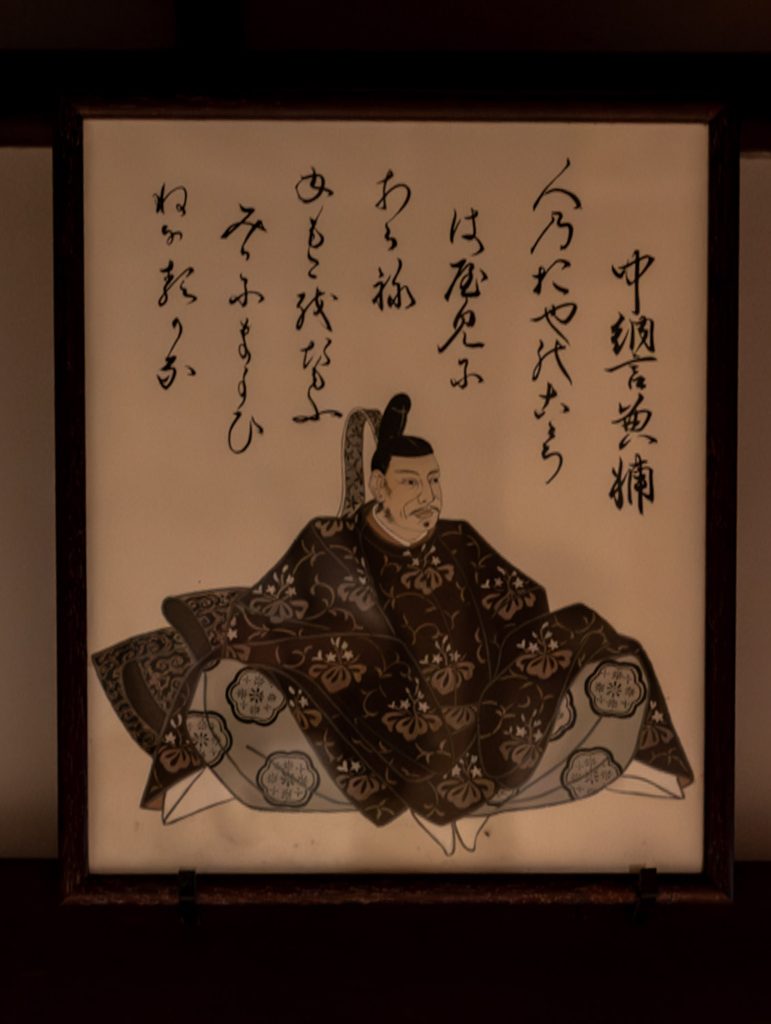
Then there are the portraits of the Thirty-Six Immortal Poets, Heian courtiers in formal dress, one to a panel, each with a poem written beside him. You do not need to parse the poems to get the message. A room that hangs these is telling you what kind of room it is.
Garden blue, building orange. I doubt that is an accident. The blue reads as strange because the orange is sitting right next to it, doing what temple light has always done.
They Hand You a Lantern. There Are Not Enough.
Down in the garden, they hand you a lantern.
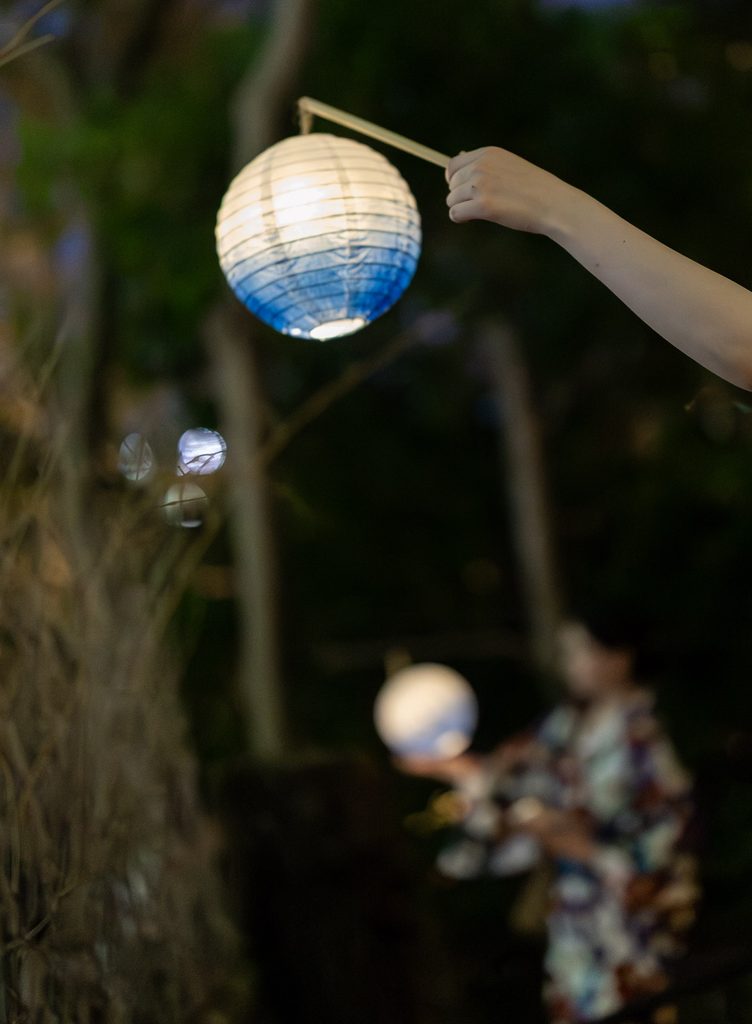
A white paper sphere with its lower half dyed indigo, hanging from a thin stick. You carry it while you walk.
Honestly, you do not need it. The paths are well kept and lit where it matters, so the lantern is not safety equipment. It is atmosphere equipment, and there is a practical catch that comes with it: there are not enough to go around.
You wait for someone ahead of you to return theirs. On a busy night that means ten minutes or more. When I reached the garden entrance a quiet line had already formed, nobody was complaining, and I stood there long enough to do the arithmetic. Ten minutes of my visit, for a prop.
I walked away without one. From outside the queue I could see what the people ahead of me could not: warm little globes drifting across a sea of blue light, moving through the garden at walking pace. That picture is only available if you are not holding one of them. I had been too impatient to wait, and I came out ahead on the deal.
No Set Route. You Still Walk.
There is no fixed course through this temple. You go where you like.
Which means you cover more ground than you expect. The grounds are not vast and this is not deep nature, but within one compound you get a pond, maple trees, a bamboo grove and a shrine, and the scenery keeps changing register on you.
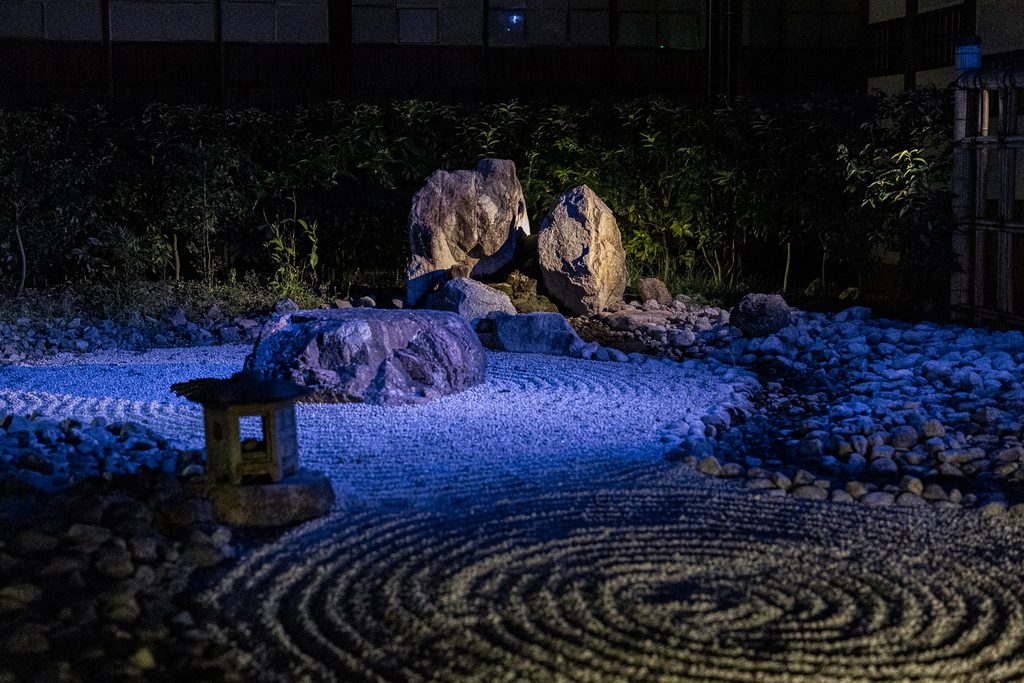
There is a dry landscape garden too. Raked gravel spirals around standing stones, all of it washed in blue. A karesansui in daylight is a garden you read through shadow, through the angle of the sun on sand, so flooding it with a single color turns the ridges into something else entirely. A garden built to suggest water finally looked like water.
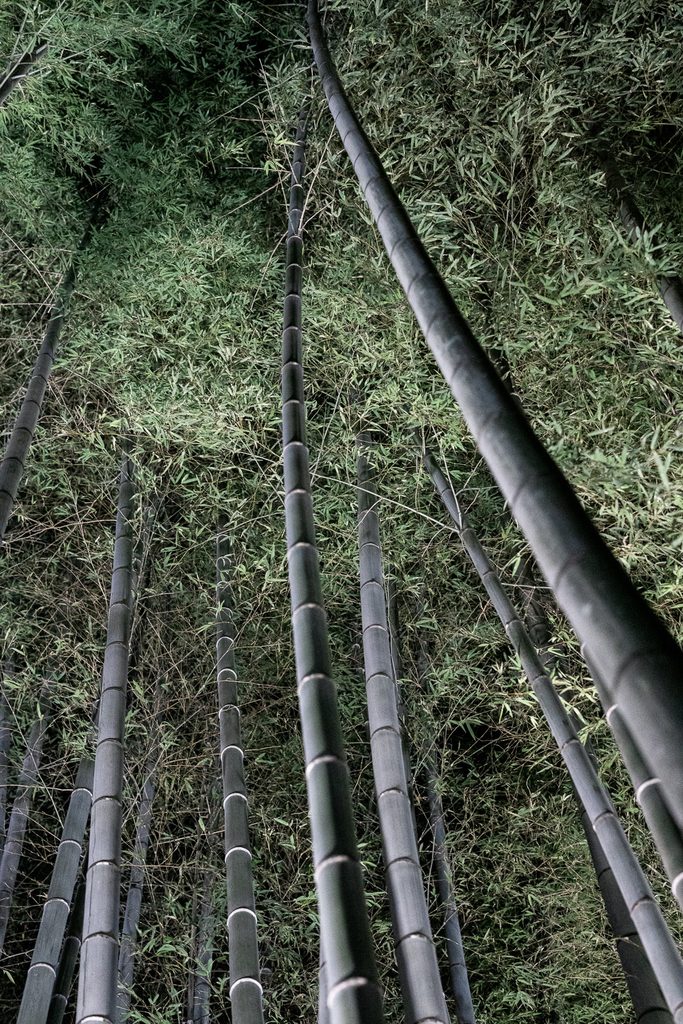
The bamboo grove is small, nothing like the famous one out in Arashiyama. But an empty bamboo grove, at night, in Kyoto, with no one photographing it but you? The list of places offering that arrangement is very short.
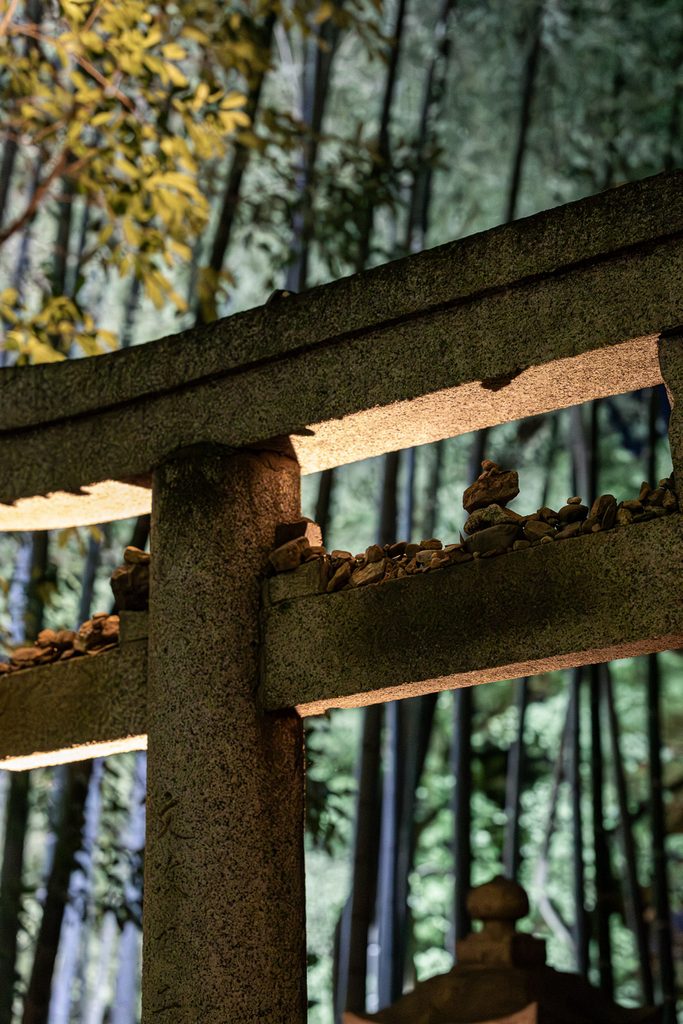
A stone torii gate stands near the shrine with dozens of pebbles resting along its upper beams. Visitors toss them up and hope they stay. A small wish, granted on landing. You will see this at shrines all over Japan, and the stones tend to accumulate wherever people naturally stop walking, which makes them a rough census of everyone who paused where you are pausing.
The path finishes by taking you along the far side of the garden. You look back across the moss at the Shinden hall you were sitting in half an hour ago, its screens still open, its interior still burning orange, the blue lights running all the way between you and it. Everything you have seen tonight is in one frame, and you are standing outside it.
It is a modest garden. But emperors looked at it, and retired emperors looked at it, and once you know that the question of size stops mattering somewhere along the path.
Here is the whole walk, more or less in the order you meet it.
It Was a Temple of Light All Along
Set the blue aside for a moment. There is an earlier question underneath it: why light at all?
The temple is explicit on this point. Shoren-in explains that its principal image, Shijoko Nyorai, is light itself, and that this Buddha’s fierce manifestation, Fudo Myoo, carries a halo of flames at his back. The temple has been bound up with light from the start, which is why it opens the garden after dark.
Once I knew that, the garden read differently. Those lights were not a show laid over a temple. They were the principal image, translated into moss.
So Why Blue? The Blue Fudo and a Flower That Does Not Grow Here
The light had its reason. The color still needed one.
The straightforward answer is the Blue Fudo. Formally titled Fudo Myoo with Two Attendants, it is a National Treasure and one of the three great Fudo paintings of Japan, counted alongside the Red and the Yellow, and Shoren-in is the temple that has kept it for centuries. A temple that guards a blue Fudo lights its garden blue.
The painting itself no longer lives down here in the city. It is enshrined at Shogunzuka Seiryuden, the temple’s hilltop annex above Higashiyama, which has its own viewing platform and its own maple trees and, I am told, one of the better views over Kyoto. I am going in the autumn. It seems only fair to visit the reason for the color.
The second answer takes longer, and it starts on a mountain.
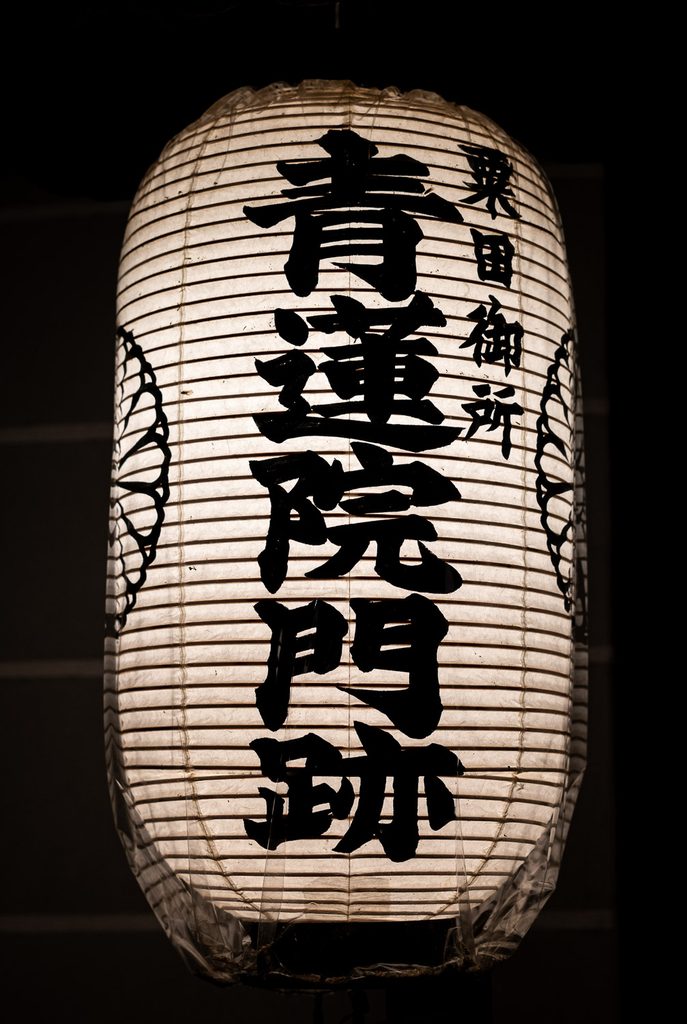
When Saicho founded Enryakuji on Mount Hiei, he built a number of lodgings for monks near the summit. One of them was called Shorenbo, the Hall of the Blue Lotus. It became the residence of the men who carried the Tendai lineage forward, Ennin among them, and it grew into one of the principal halls of the mountain’s eastern precinct. Centuries later, when the temple moved down into the city, it brought that name with it and became Shoren-in.
So the temple is named for a blue lotus. Which brought me back to the thing that had been bothering me all evening.
Blue lotuses do not bloom, or so I had always assumed. Say the word lotus to a Japanese person and the flower that appears is white, or pale pink, or deep pink. Blue is not on the list, and I could not work out why a hut on a mountain would name itself after a color the flower does not come in.
Then I looked into it, and found that the flower was not the problem.
The shorenge of Buddhist scripture, utpala in Sanskrit, is not the flower Japanese people picture when they hear the word lotus. It is generally identified with a blue water lily native to India, a different plant from the lotus altogether, and the old texts reach for it when they want to describe the beauty of the Buddha’s eyes. Deep blue, clear, unclouded.
The flower is real. It simply does not grow here.
And then I remembered what I had walked past on the way in without thinking about it once.
The white lamps standing up out of the blue moss are shaped like lotus flowers. Dozens of them, at the center of every photograph I took, including the one from the far side of the garden where I stood looking back at the whole thing. The temple had not simply picked a color it liked. It had planted its own name in the garden and switched it on. I spent thirty minutes photographing the answer while carrying the question around.
That, I think, was the real shape of my discomfort. The color looked wrong to Japanese eyes because Japanese eyes never see it, on a flower or anywhere else. But the blue was in this temple’s name long before I was born, carried down from a hut on a mountain, and it was never the thing that was out of place.
I had come to see something I did not know. I only worked that out on the walk home.
What Monzeki Means
The temple’s full name is Shoren-in Monzeki, and the second word is doing a lot of work.
A monzeki is a temple whose head priests came from the imperial family or the highest court nobility, and the status was not honorary. What it meant in practice was that somebody built you a palace.
The turn came in the late Heian period. Gyogen, a son of the regent Fujiwara no Morozane, was serving as the twelfth abbot of the mountain hall when Retired Emperor Toba became his devotee. Toba placed his seventh prince under Gyogen as a disciple, had a residence built in Kyoto on the model of an imperial palace, and renamed the whole thing Shoren-in. That is why the rooms feel the way they do before anyone explains anything to you.
It is counted today among the five Tendai monzeki temples of Kyoto.
On location, the temple was dealt a bad hand. Chion-in stands next door. Heian Shrine is a short walk away. Both are headline names, both go into the itinerary first, and Shoren-in gets whatever evening is left over.
On rank it concedes nothing, and it quietly benefits from the arrangement. Fewer people. In Kyoto, in summer, that is worth more than a headline.
Shoren-in Temple Night Illumination: Practical Information
When It Is Held
Spring and autumn are the regular seasons. Shoren-in has been running night viewings in those two windows for years, and autumn is the one most visitors build a trip around, since the maples in this garden are genuinely good and the crowds here stay far below what you will meet at the famous autumn temples.
Summer sessions happen, but they are not annual. The 2026 summer run detailed below is a specific occurrence, not a fixture, so confirm current dates on the official Shoren-in website before you plan an evening around any season.
Summer 2026 Dates, Hours, and Fees
| Dates | July 17 to August 23, 2026 (closed August 13 to 16) |
| Hours | 7:00 p.m. to 9:30 p.m. (last entry 9:00 p.m.) |
| Admission | Adults 1,500 yen / Elementary school children 1,000 yen |
| Venue | Main temple only (not held at Shogunzuka Seiryuden) |
When to Enter
Do not turn up at opening. Kyoto holds its light late in summer, and in autumn the sky is dark by around 5:30 p.m., so the useful rule is to arrive once the sky has genuinely gone, not once the gate has opened.
For the summer session, 7:30 to 8:00 p.m. is the window. That leaves you fully dark conditions and an hour or more before last entry.
How Long to Allow
Thirty minutes covers it, which is the single most useful thing I can tell you about planning an evening here. This is not a temple that demands half your night.
Allow an hour if you want to sit in the Shinden hall and watch the garden cycle through its colors properly, which I would recommend, since the cycle is slow and rushing it defeats the point.
There is no set route, so you can take the grounds in any order you like. The garden paths rise and fall, and the route ends by bringing you around to the far side, where you get the view back across the moss to the hall.
Photographing the Blue Garden
This is a harder place to photograph than it looks, and the reason is the color cycle.
- The garden shifts slowly between blue and white. Watch one full cycle before you shoot anything, then decide which phase you actually want. Most people fire off three frames and leave with whichever color happened to be running.
- The lotus lamps blow out easily. Meter for the lamps rather than the moss and let the darker areas go dark, because pulling shadow detail back up is easier than rescuing a white blob.
- Blue light does strange things to auto white balance. Shoot raw if you can, and expect to correct.
- The interior is warm orange and the garden is cold blue, often in the same frame. That contrast is the most interesting picture available here, and no automatic setting will handle it for you.
- A fast lens matters more than a long one. Nothing here needs reach.
- Leave the tripod at the hotel. No sign says so, because in Japan nobody thinks it needs saying: this is a wooden building, at night, with people walking through it in the dark. Set up three legs on a temple veranda and you will find out how quietly a Japanese person can disapprove of you. In practice the rule enforces itself. Stand in that garden for two minutes and the idea of unfolding a tripod there simply stops occurring to you.
What to Wear and Bring
- There is no air conditioning, and indoor temperatures match the outdoors.
- You remove your shoes to enter the buildings, so slip-ons save you time and dignity.
- Bring water. Places to buy it inside are limited.
- A folding fan or a small electric fan makes a real difference in the Shinden hall.
- Parts of the garden are dark and uneven, so wear shoes you can walk in.
About the Lanterns
Paper lanterns are lent out at the garden entrance, and the supply is limited. Expect ten minutes or more at busy times. The paths are entirely walkable without one, and the sight of other people’s lanterns crossing the blue garden is arguably the better souvenir, so I would skip the queue and keep the ten minutes.
Getting There
- Higashiyama Station on the Tozai subway line, about a five-minute walk.
- Jingu-michi bus stop (Kyoto City Bus), about a three-minute walk.
- Heian Shrine is within walking distance.