When I traveled to Lisbon, one bridge name would not leave my head.
Ponte 25 de Abril. The 25th of April Bridge, named for the date of the 1974 revolution. Nothing more. The city’s other great bridge is the Vasco da Gama. A date and a man.
I went to see the Sanzenin Temple autumn leaves because of that bridge. Not directly. But because of that bridge.
Japan does not name things this way. Maybe somewhere it does, but I don’t know of it. Our bridges borrow the river’s name. Our roads borrow the town’s. After I left Lisbon I looked up what the 25th of April actually was, because the name had been nagging at me for days. Vasco da Gama I did not need to look up. Even I knew that one. The 25th of April was a question I carried around for a week, and I have never been able to predict which names do that.
A Bridge Named After a Date, a Temple Named After a Number
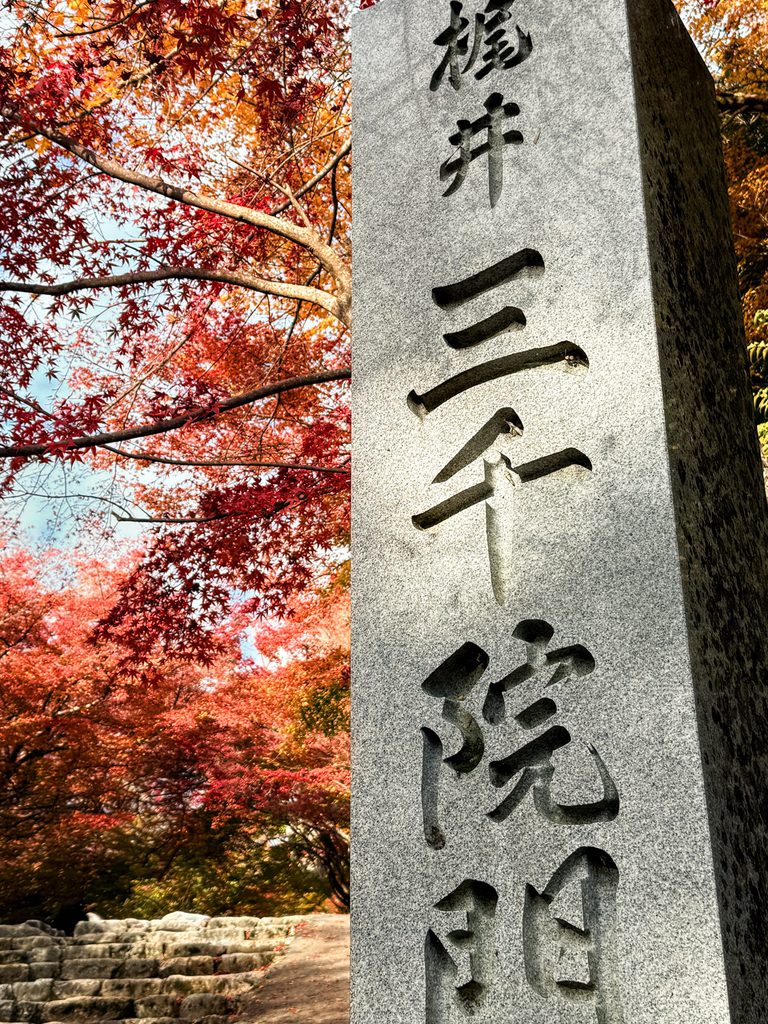
Sanzen means three thousand.
Literally the number. Monzeki is not a place but a rank: it marks a temple whose abbots were princes of the imperial family or sons of the highest court nobility. Sanzenin is one of five Tendai temples that hold it. Put the two words together and you have something rare in Japanese, a temple name that sounds like a title.
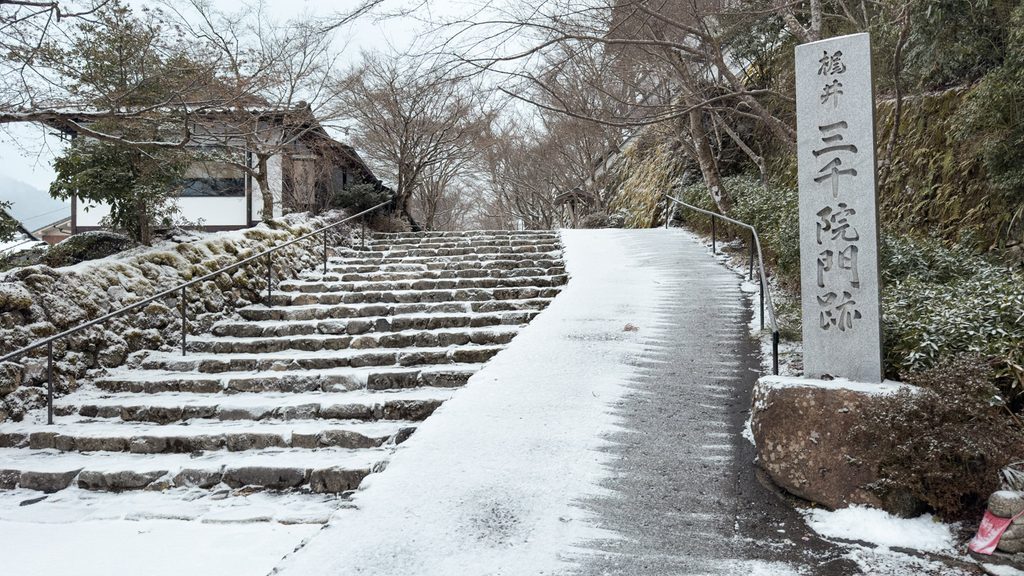
The stone marker at the foot of the approach has a second name carved above the first. Kajii. That is what this temple was called for most of its history, and the stone never let go of it. One temple, two names, on one piece of granite, with maples burning behind it. I took longer over that photograph than the stone strictly required.
The Sanzenin Temple Autumn I Kept Putting Off
Maples. Snow. Hydrangeas. Moss.
Ohara, and Sanzenin above all, is where I feel the four seasons most clearly in Kyoto. Every season has its own reason to go. Which is exactly why I didn’t. A place you can visit anytime is a place you can visit next year, and next year is a very patient word.
I had a second excuse ready. Ohara is far.
It is, in the sense that the bus from Kyoto Station takes about an hour. It isn’t, in any sense that matters. The Kamo River runs alongside the window, then the city thins out, then the mountains lean in close enough to touch. Both of my excuses were wrong, and I had been using them for years.
If you came here for the one thing everybody wants to know: mid-November. The rest of this is why I took so long to find that out for myself.
First in Line for the First Bus
I still can’t tell you why the excuses stopped working that morning.
Does Sanzenin possess some power that pulls a lazy man out of bed for the first bus of the day? It does not. What happened is that I read that Sanzenin at peak foliage is punishingly crowded, and fear is a better alarm clock than beauty.
So I reached Kyoto Station before anyone. I took the first spot at the bus stop. I had brought a folding stool, because I was prepared to wait a long time, and I wanted to wait it sitting down.
Nobody lined up behind me.
Minutes passed. Then more minutes. I began to suspect the route had been suspended for the day and I was the only person in Kyoto who hadn’t heard. Close to departure an ordinary line formed, at an ordinary length, and everyone in it got a seat.
The Man in the Back Row
First in line, I sat in the very last row.
I have no explanation for this. I have no explanation for most things I do before seven in the morning. Which meant that at the Ohara terminus, I was the last one off.
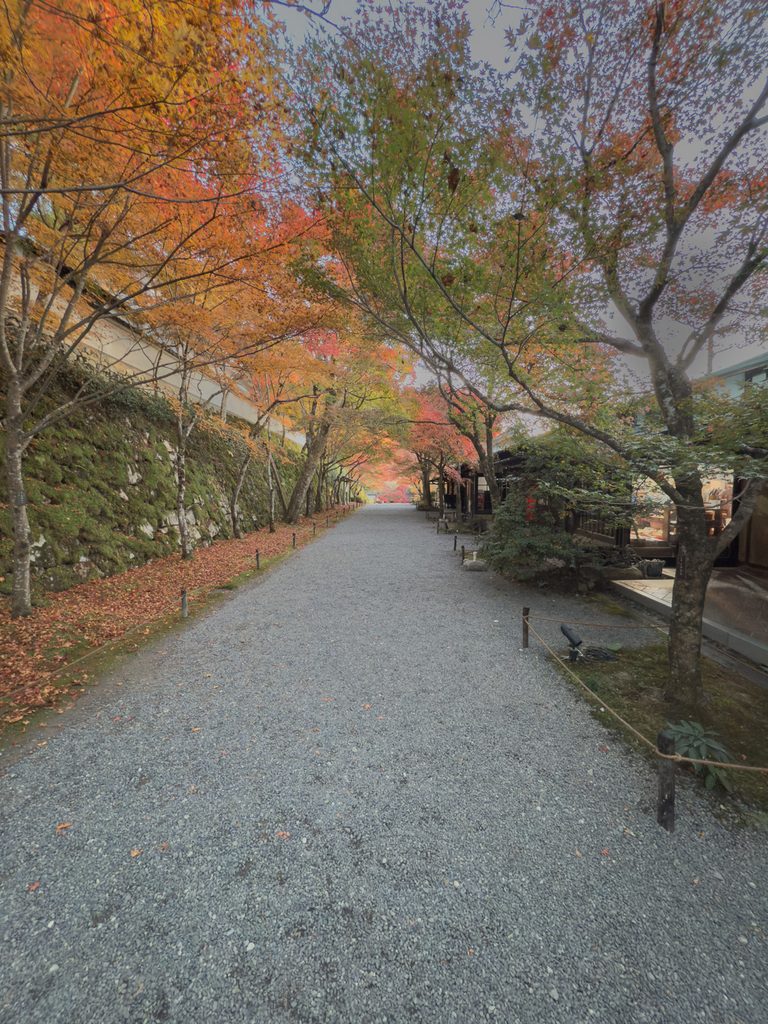
From the bus stop to the temple gate is a walk of about ten minutes, uphill, along a lane that in November is roofed with maples. I stopped. I photographed. I stopped again. By the time I reached the gate the grounds were already busy, and a line of visitors was waiting to be photographed with the stone marker.
Whatever advantage I had bought by standing first at a bus stop with a folding stool, I had spent it all before I stepped through the gate.
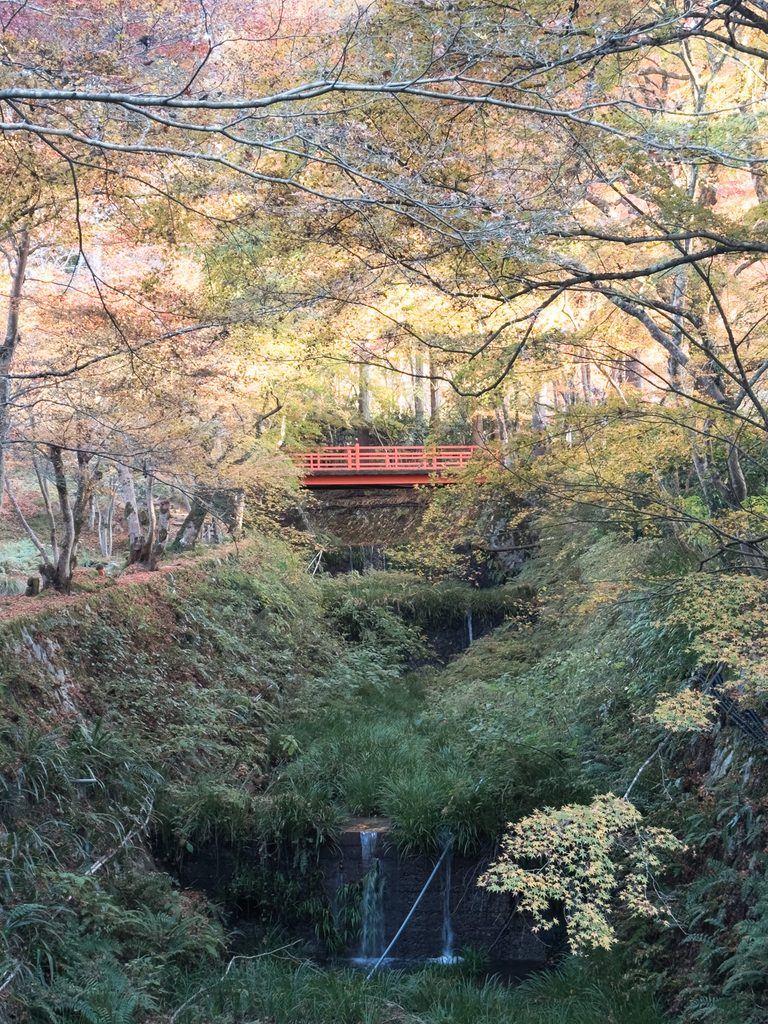
Incense, a Horned Saint, and a Cherry Tree Called Tears
You take your shoes off to enter.
The first thing inside is the incense, stronger than the household kind, or so it seemed to me. The second thing is the floor. The wooden corridor was cold underfoot in a way I had not braced for, and I couldn’t tell whether that was Ohara running a week ahead of the city or simply my having spent too long in shoes. When the corridor gave way to tatami, the difference was slight and enormous at once. A few degrees of warmth, and I noticed them the way you notice a stranger holding a door.
On the wall is a talisman: a gaunt, two-horned figure that, once seen, is never forgotten. This is Tsuno Daishi, the Horned Master, and his presence marks the temple as Tendai, the same lineage as Enryakuji on Mount Hiei. He is a protective image rather than a decorative one, pasted up at doorways to turn away sickness and misfortune, and he looks the part.
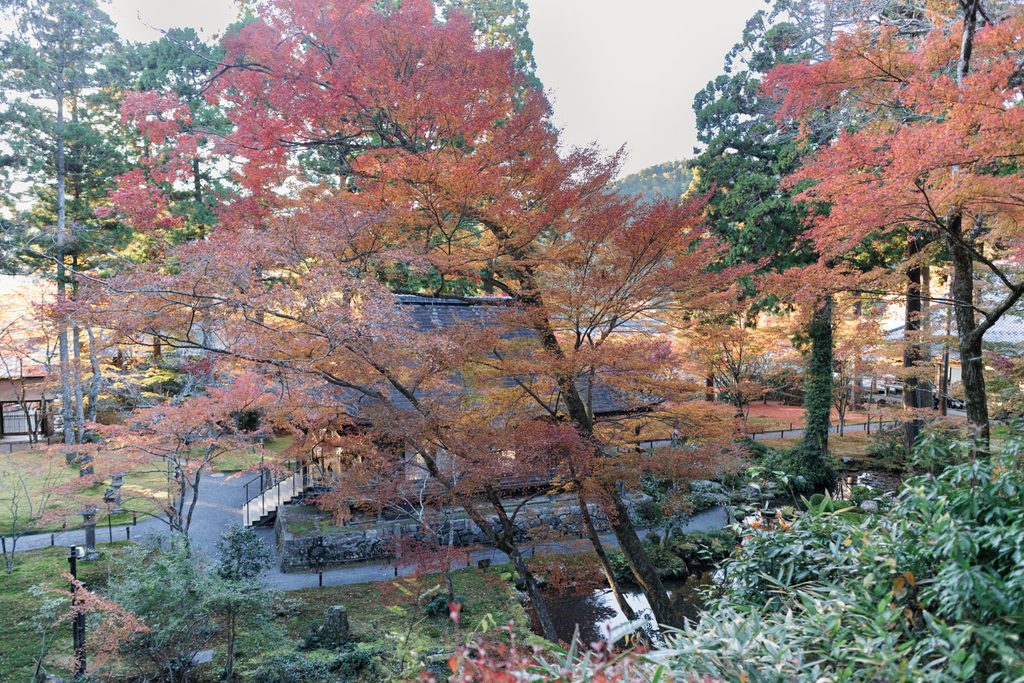
Sit on the veranda of the Kyakuden, the reception hall, and Shuhekien Garden opens in front of you. A pond garden meant to be looked at rather than walked through, said to have been reworked by the Edo-period tea master Kanamori Sowa. Clipped shrubs in the hundreds, a stone lantern, and above them the maples of the hillside doing something entirely different. Nobody misses this garden. You would have to try.
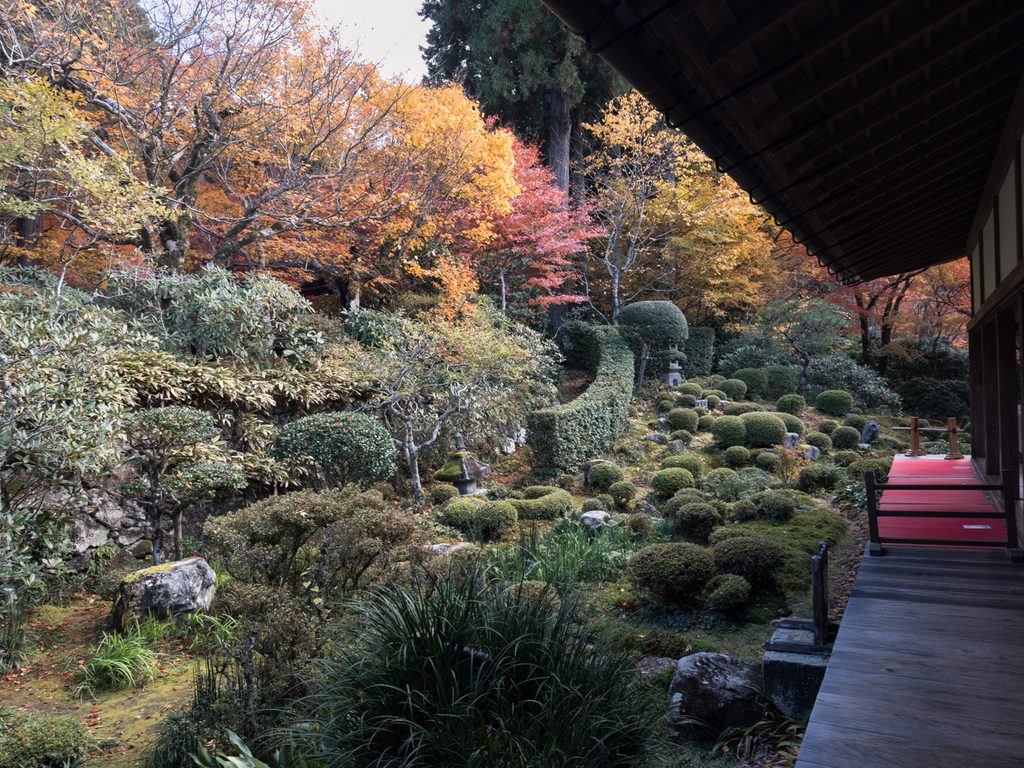
In one corner stands an old cherry tree with a name: the Cherry of Tears. The name comes from a poem by Ton’a, a monk-poet of the fourteenth century, and legend adds that the tree was planted by Saigyo, Japan’s most famous wandering poet.
Each time I see them, my sleeves are wet.
Cherry blossoms. Did someone plant here the seed of tears?
Ton’a, fourteenth century
I could not tell which tree it was. In November a cherry drops its leaves and becomes anonymous, one bare trunk among the others, and a tree named for tears looks like every tree that isn’t. In spring I’m confident I’d find it. In autumn I had to take the garden’s word for it.
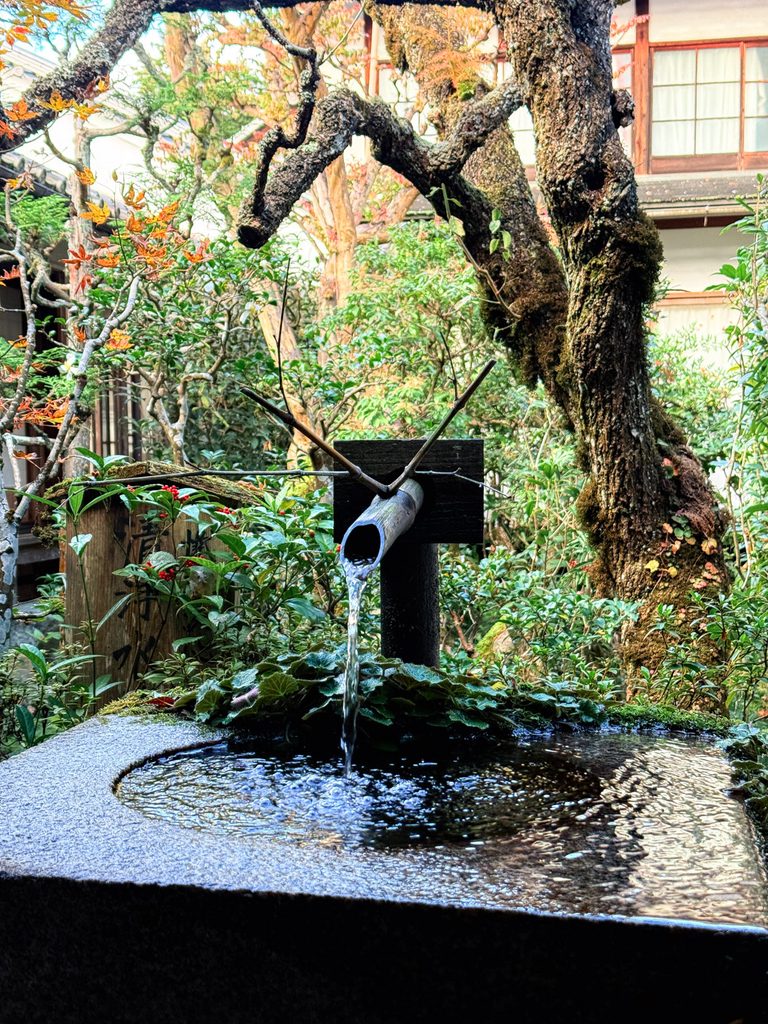
Moss Heaven, Demoted for the Day
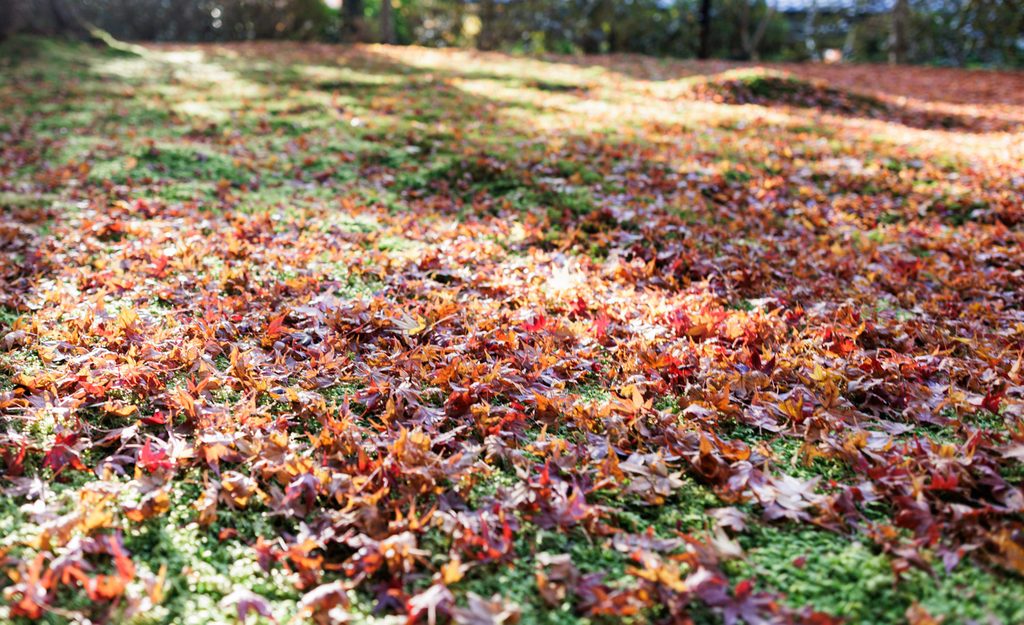
Moss grows where the moss decides.
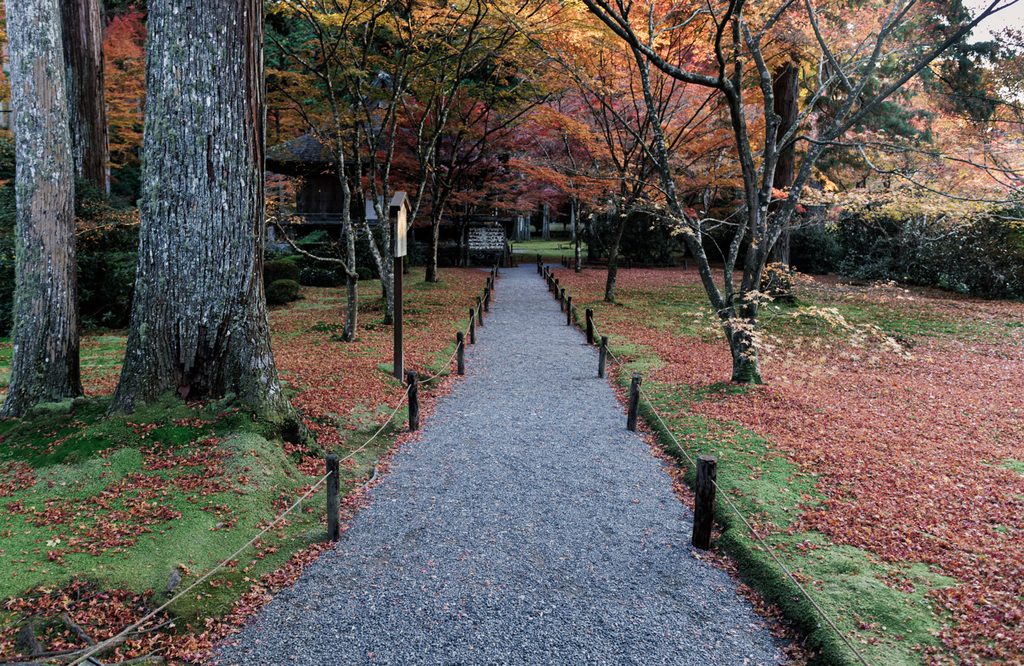
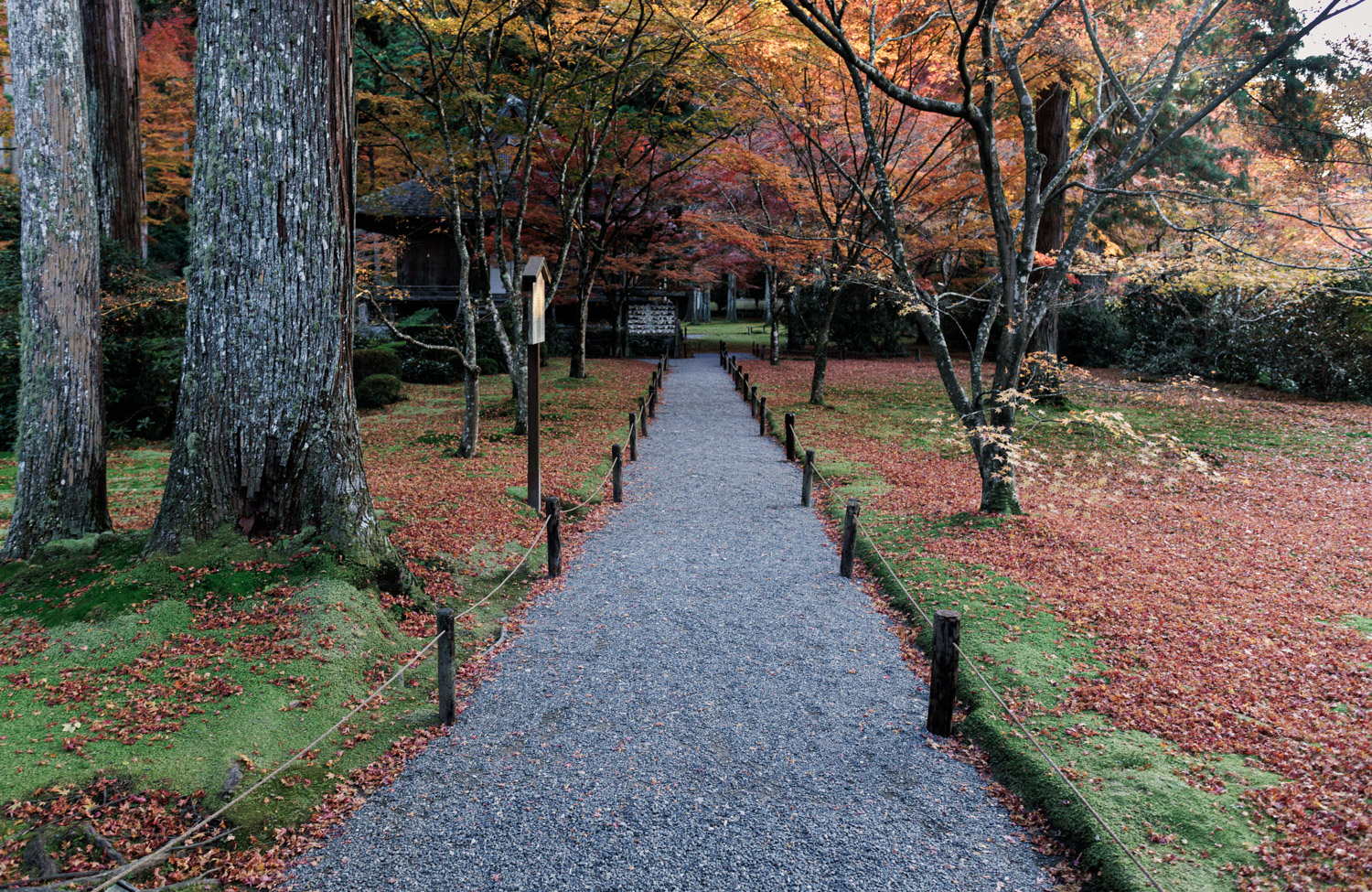
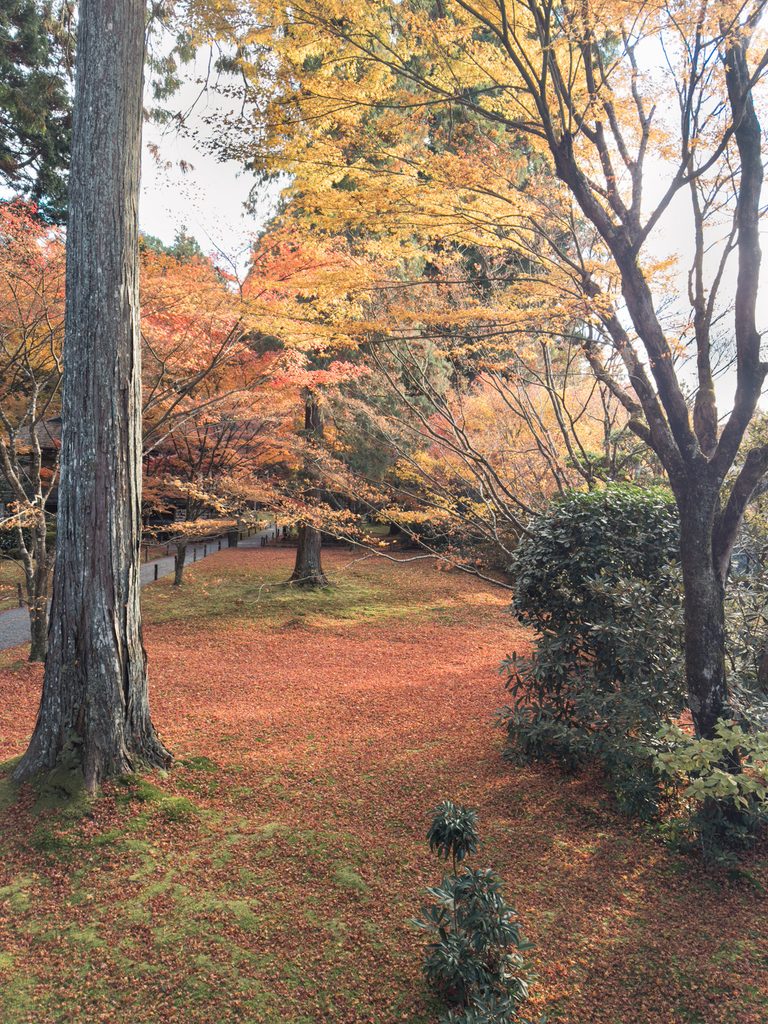
You can plant it wherever you like. It will take hold only where it chooses. That is not the gardener’s will; it is the moss’s. I heard this on a Japanese television program about gardens, and whether a priest said it or a gardener said it, I no longer remember. I remember the sentence, and Sanzenin is the place that brings it back. The moss wraps the roots of the cedars, climbs the slope, rounds off the heads of stones, stops dead at the edge of the gravel path and does not cross it. None of it looks planned.
And on this day, all of it was under red.
The Japanese word is shiki-momiji, literally spread maple leaves: the carpet the trees lay down over the moss in the second half of November. So the moss Sanzenin is famous for spends late autumn hidden beneath the maples Sanzenin is also famous for. I had come at the one time of year when the main attraction is buried, and I could not bring myself to mind.
Where the Crowd Ran Out
From the Shinden hall you step out into Yuseien.
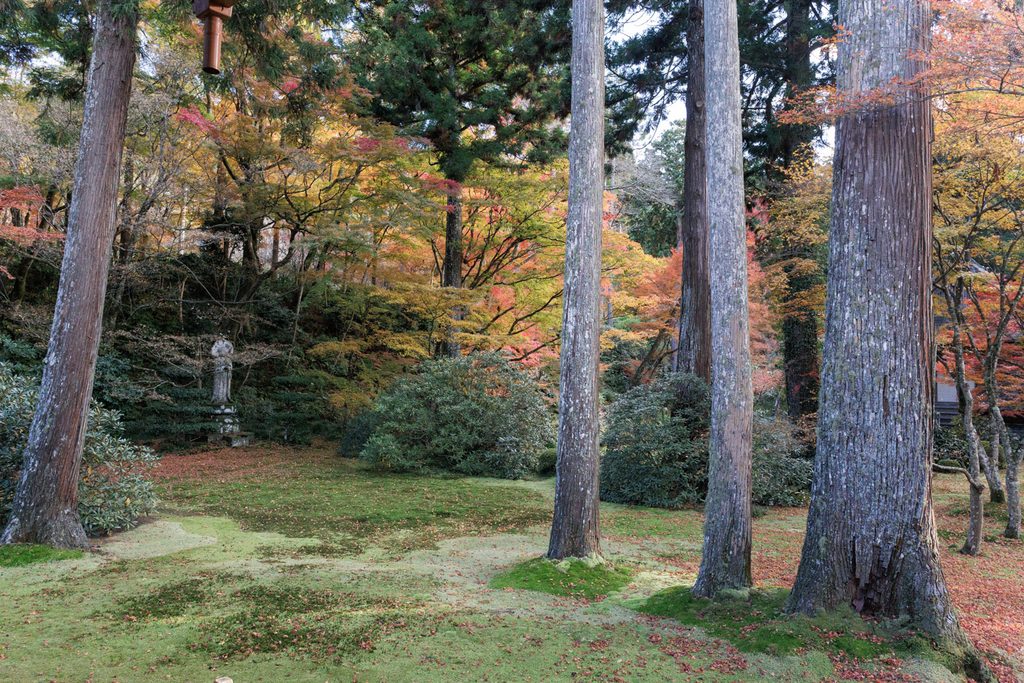
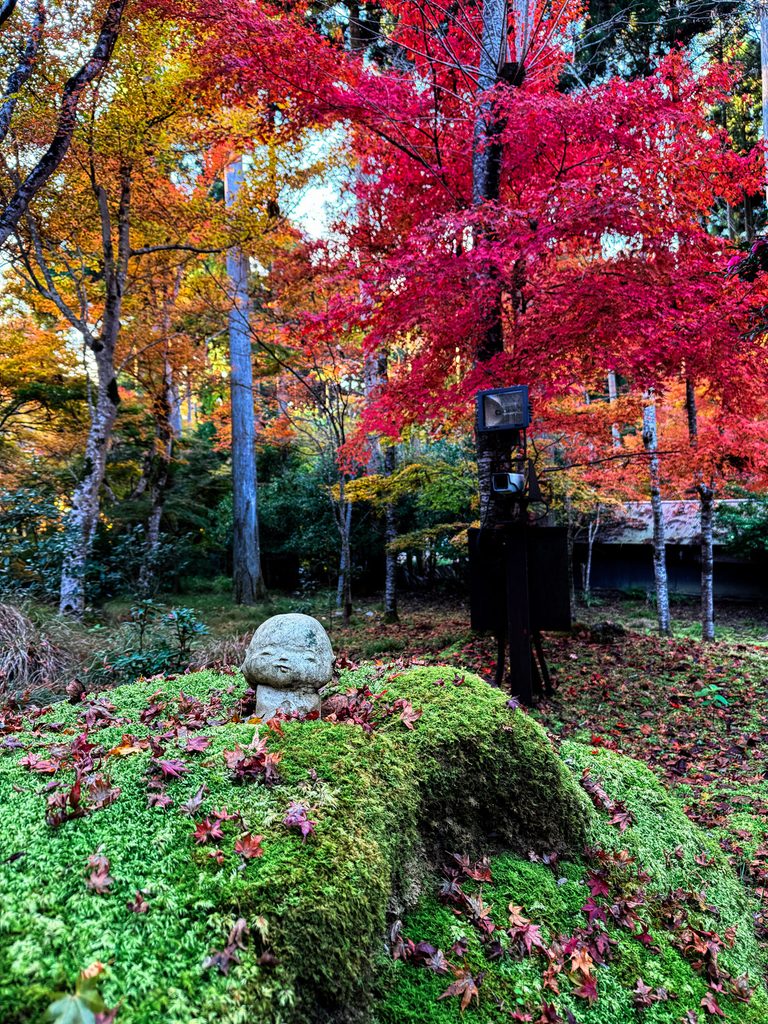
This is the garden most people carry home in their heads: the roof of the Ojo Gokurakuin hall showing between cedar trunks, a slope of cedar moss, and the small stone Warabe Jizo, child-faced guardians, half sunk in the green with red leaves settling on their heads.
Then, for no reason I could see, the flow of people thinned and stopped.
The gravel path in front of me was empty. Nobody ahead, nobody behind, and for a moment the only sounds were water somewhere below the slope and my own shoes on the gravel. I stopped walking, because the noise I was making seemed too big for the garden. A leaf came down at the speed leaves come down, which is slower than you remember. I could hear the cedars working in the wind above the garden, a sound like a door easing shut in another part of a house. I took the photograph everyone wants and nobody expects to get in November. Then I stood there and didn’t take another one.
It lasted perhaps a minute. Then a family came around the corner and the garden went back to being a place with people in it.
I had lost my head start before the gate, so I have no advice to offer about how I earned this. I earned nothing. Sanzenin is simply large enough to swallow a full morning bus and still leave a path empty, if you happen to be standing on it.
Tea with Gold Floating in It
Past the Konjiki Fudo hall there is a rest house, and I sat down in it.
A woman brought me a cup of shiso tea. Red perilla, the herb this valley grows and pickles and is known for, served hot. Floating on the surface were flakes of gold leaf, turning slowly. I have been given a lot of complimentary tea in Japanese temples. None of it has ever had gold in it.
The tea is blessed for good health at the Konjiki Fudo hall, she explained, and it is also for sale, and she was extremely clear about the second part. “You can only buy it here,” she said. I did not mind at all. I had wanted somebody to talk to since the bus stop.
Then she told me what I had spent the morning working out for myself. “Here you feel the seasons change almost every day,” she said. “Much more clearly than in the center of the city.” She said it the way people say things they have said many times and still mean. Then she said it again. There was nobody else in the rest house, so the conversation never once threatened to end, and I sat holding a cup of gold-flecked tea, nodding, watching the leaves come down outside and quietly calculating how long politeness required me to stay.
I bought a box for my mother, who would like it. Then I stood outside with the box under my arm and understood, with total clarity, that my mother was never going to see this tea.
The Year the Temple Apologized to Its Hydrangeas
The following June I opened the temple’s website, planning to come back for hydrangea season.
There was an apology posted. An insect infestation, it said, and that year the hydrangeas had barely bloomed at all. The temple was sorry. I read it twice, mostly out of admiration.
Even a temple cannot order its flowers around. Neither, it turns out, can I. The moss decides where it grows, the hydrangeas decide whether they bloom, and I had been handed one more reason to come back to a place I had spent years not coming to.
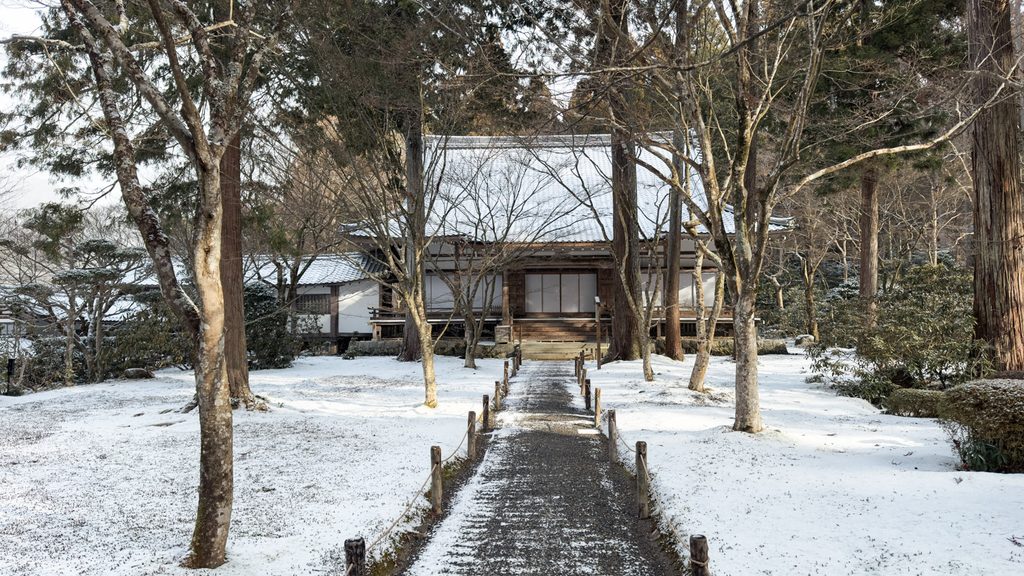
I already had the snow.
Why a Temple Is Called Three Thousand
I didn’t look it up until I was on the bus home.
The same thing I did with the bridge in Lisbon. Stand in front of a name, feel the pull of it, take the photograph, and then wait until the place is behind you before finding out what it means. I don’t know whether that is laziness or a preference for keeping a name unexplained as long as possible. Either way, here is what I found.
Three thousand comes from a Tendai Buddhist phrase, ichinen sanzen: a single moment of thought contains three thousand worlds. It is the kind of idea that sounds like poetry and is actually a system, the way a mandala is. But the temple did not carry that name for most of its life. It was Saicho, the founder of Japanese Tendai, who built the first hermitage here in the ninth century while establishing Enryakuji on Mount Hiei. For the next thousand years the place moved, and grew, and was known as Kajii Monzeki, with princes of the imperial line serving as its abbots.
Then the country changed. At the Meiji Restoration the last prince-abbot left the priesthood, and in 1871 the temple’s property here in Ohara became its main seat under a new name. That name was taken from a plaque in the hand of Emperor Reigen, which had hung in the private chapel of the old Kajii residence. A neighboring temple called Gokurakuin was absorbed into the grounds at the same time. That hall still stands in the moss garden, and the Amida triad inside it is a National Treasure.
So the name is younger than the bridge over the Tagus by a hundred years and change, and the temple under it is older than almost anything in Lisbon. I like knowing that. It has not made me a better traveler.
One more thing worth knowing about this valley: Ohara has been called Gyozan for over a thousand years, and it is the birthplace of shomyo, the chanted Buddhist music of the Tendai school. If the place sounds unusually quiet to you, that is not entirely an accident of geography.
The main buildings today are the Kyakuden with Shuhekien Garden, the Shinden, built in 1926 as a copy of the Shishinden at the Imperial Palace, and Ojo Gokurakuin standing in Yuseien. Japanese autumn-foliage guides put the number of maples on the grounds at around 300.
Getting to Sanzenin Temple from Kyoto Station
The name, the moss and the emperor’s handwriting all stop at the gate. What follows is the part I would have wanted before I went, and the part that would have saved me a folding stool.
There are two ways in, and in autumn one is clearly better.
- Direct bus: Kyoto Bus Route 17 bound for Ohara, from stop C3 in front of Kyoto Station’s central gate. About an hour, 630 yen. Ohara is the last stop.
- Subway plus bus, my recommendation in autumn: take the Karasuma subway line north to its terminus, Kokusaikaikan Station, then the Kyoto Bus from stop 3 outside the station. 23 minutes and 400 yen for the bus portion.
- From the Ohara bus stop it is a walk of about ten minutes, uphill, to the temple gate.
Japanese guidebooks recommend the subway route during foliage season and I agree. It is shorter, cheaper, and the bus is emptier. Ohara is the end of the line either way, so shifting your departure out of the morning rush is the more effective move.
Getting back, which matters more than you think
Buses run roughly three times an hour, split between the Kyoto Station and Kokusaikaikan services. Note the difference in their last departures.
- Last bus to Kyoto Station: 17:27. Earlier than most visitors expect.
- Last bus to Kokusaikaikan Station: 21:01, with the subway onward from there.
In practice this means that if you linger over an early dinner in Ohara, the direct route home has already gone. Plan on the subway route for the return regardless of how you came. There are toilets at the Ohara bus stop, which is worth knowing before an hour on a bus.