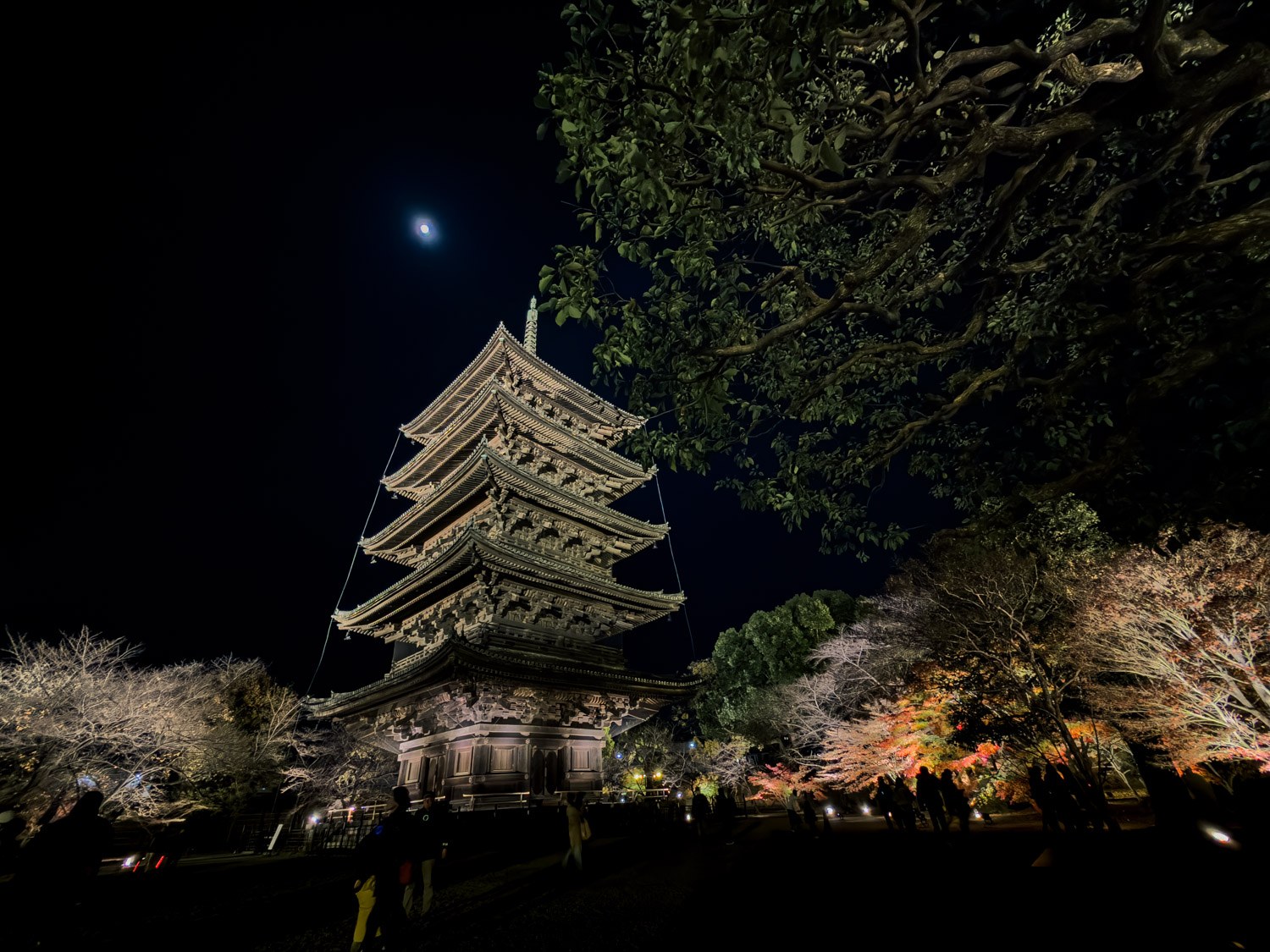
Shortly after the westbound Shinkansen leaves Kyoto Station, a dark pagoda rises off to the left. Blink and it is gone. That is the five-story pagoda of Toji Temple, and for a long time it was the only part of Toji I knew.
A Pagoda I Kept Passing
It was always on the way to somewhere else.
I saw it from the train window, and I saw it rising above the rooftops near a friend’s house in Kyoto. I kept telling myself I would go, and I kept not going. Toji is within walking distance of Kyoto Station, and that was the problem. The places you can always visit are the ones you never do.
When the pandemic ended, the first place I went was the Toji Temple autumn illumination. I still can’t explain why. I knew almost nothing about the temple’s history or what was inside that pagoda. All I had was a half-remembered fact: a five-story pagoda only looks like a five-story building, and nobody climbs to the upper floors.
My First Autumn Night: The Line That Disappeared
I arrived a little after 6:30 p.m.
The line was astonishing. It ran along the temple wall all the way to the Todaimon Gate, then doubled back on itself. For a moment, I thought about going home. I had told myself I was ready to wait in line in Kyoto. My resolve, it turned out, was shorter than the line.
Then the temple swallowed it whole. Once through the gate, the people who had been packed along the wall scattered across grounds far too big to feel crowded. Some went no farther than the rest area by the entrance and settled in to warm up. The temperature had dropped fast that evening, and I suspect a few of them had dressed for the afternoon. The rest of us crunched across the gravel, and the sound carried in the cold air. Everyone drifted toward the pagoda at the far end.
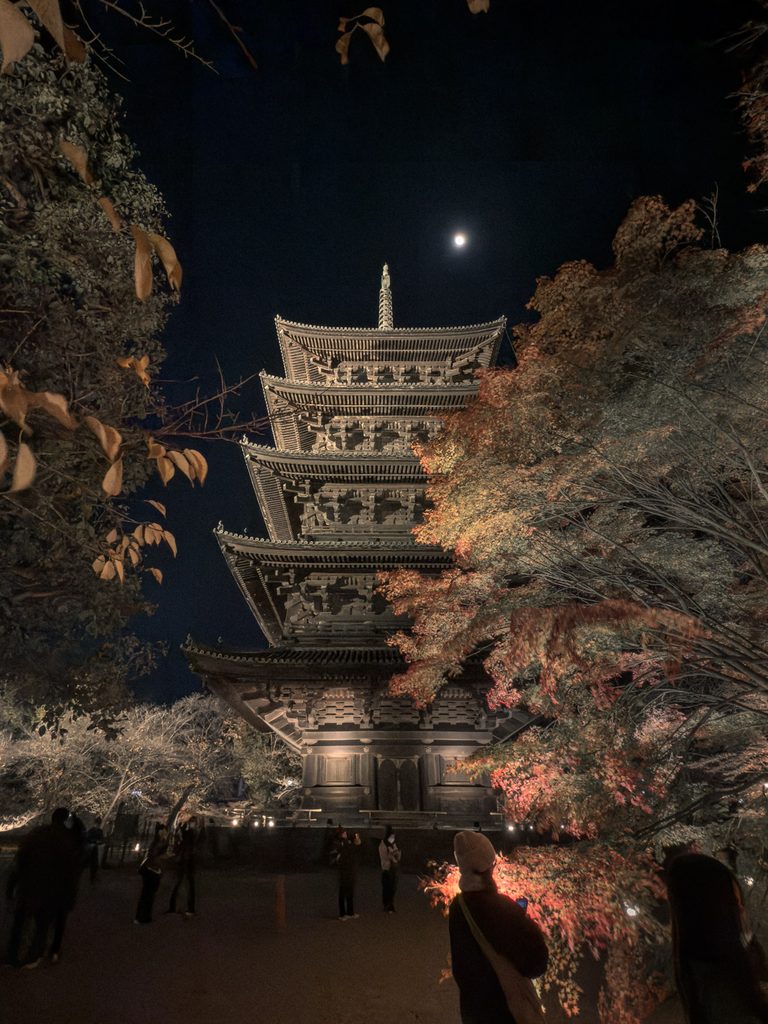
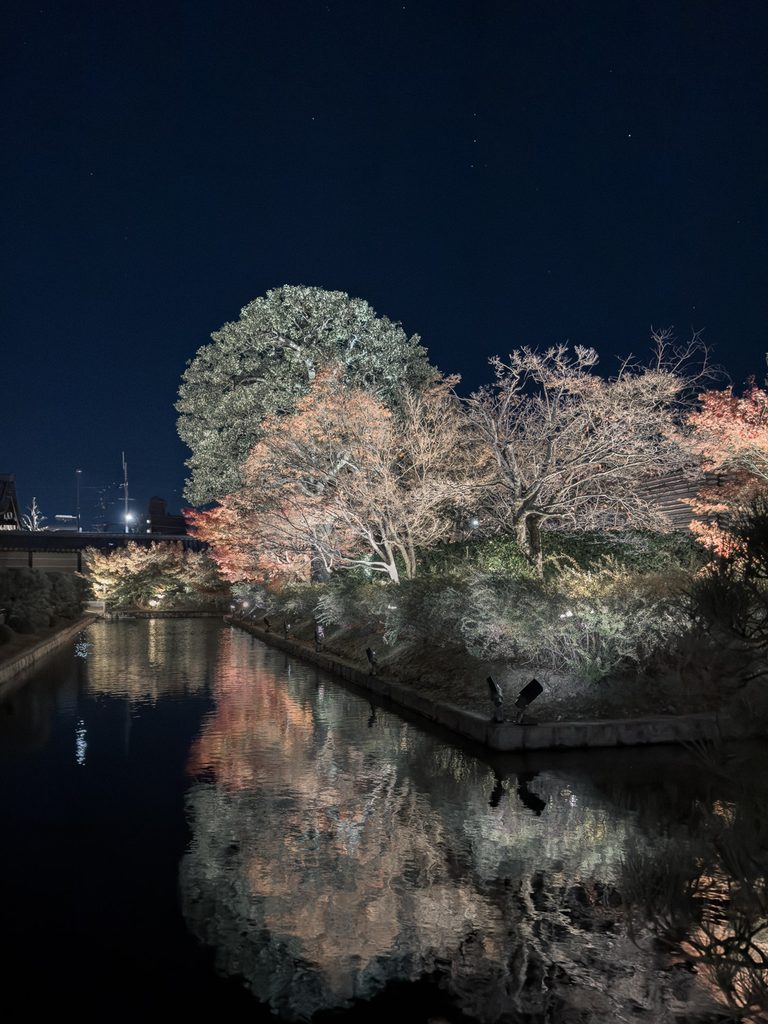
The maples were lit from below. On Hyotan Pond, the leaves and the pagoda hung upside down in the water, and when the wind dropped, a second Toji appeared beneath the first.
I couldn’t go inside the pagoda. Its interior opens only for limited periods, which I learned later. What I saw that night was scenery, and very good scenery, but nothing more. What is actually inside that pagoda is a story for another night.
A Name Japan Uses Every Day
In 823, Emperor Saga gave Toji to the monk Kukai, known after his death as Kobo Daishi, and it became the main seat of Shingon esoteric Buddhism.
In Japan, most people grow up hearing his name in proverbs. Kobo mo fude no ayamari: even Kobo slips with his brush, which is to say even the best of us make mistakes. Kobo fude o erabazu: Kobo doesn’t choose his brush, because a true master can work with any tool.
So what did he actually teach? I can quote his proverbs, and I have read about esoteric Buddhism many times. I still cannot tell you what he taught.
My Second Autumn: Facing the Buddhas
Between those two autumns, I came back once for the cherry blossoms.
That spring night I went inside the Kondo (Main Hall) and the Kodo (Lecture Hall), yet it was my second autumn when I actually faced the Buddhas. The first time, I saw only maples and a pagoda. In spring, the cherry blossoms had my full attention. It took a third visit before I really looked at what was inside the halls.
Twenty-one statues stand together in the Lecture Hall, arranged as what is called a three-dimensional mandala. In esoteric Buddhism, a mandala is a map of the teachings, usually painted, and it comes as a pair. The Womb Realm shows the truth of the world as it is, held the way a womb holds a child. The Diamond Realm shows the wisdom that sees that truth, as hard and clear as a diamond. Kukai conceived of a mandala made not of paint but of statues. It is called the katsuma mandala.
The figure that stayed with me was Fudo Myo-o. He sits at the center of the Five Great Wisdom Kings, the first such group introduced to Japan.
Fudo wears a wrathful face, an unusual look for a Buddhist deity, and he is one of esoteric Buddhism’s best-known figures. I had heard that he is the one who drags stubborn people back onto the right path by force. I am an obedient sort of person. I assumed we would have nothing to say to each other.
At Toji, he became the Buddha I feel closest to. He was glaring, and somehow I felt at ease in front of him anyway. It made me curious, too, that a figure this angry has drawn such devotion in Japan for centuries.
Fudo is sometimes shown with a blue body, and I wanted to check. The hall was too dark to tell. The flames behind him looked red. The Main Hall and the Lecture Hall are both dim inside, day or night, and the statues never quite come into focus. Standing in what felt like a museum of Buddhas, I still did not understand esoteric Buddhism.
A Cold Wind
As I stood before the statues, a cold wind moved through the hall.
For a moment, I could faintly feel the faith that generations of my ancestors had carried and handed down.
Walking back out across those vast grounds, the ride home to Osaka suddenly felt very long. I had a fairly thick pamphlet in my hand. I decided to read it properly first, and then come back.
If Toji has only ever been a pagoda outside your train window too, here is how to step off and go.
What Is Toji Temple?
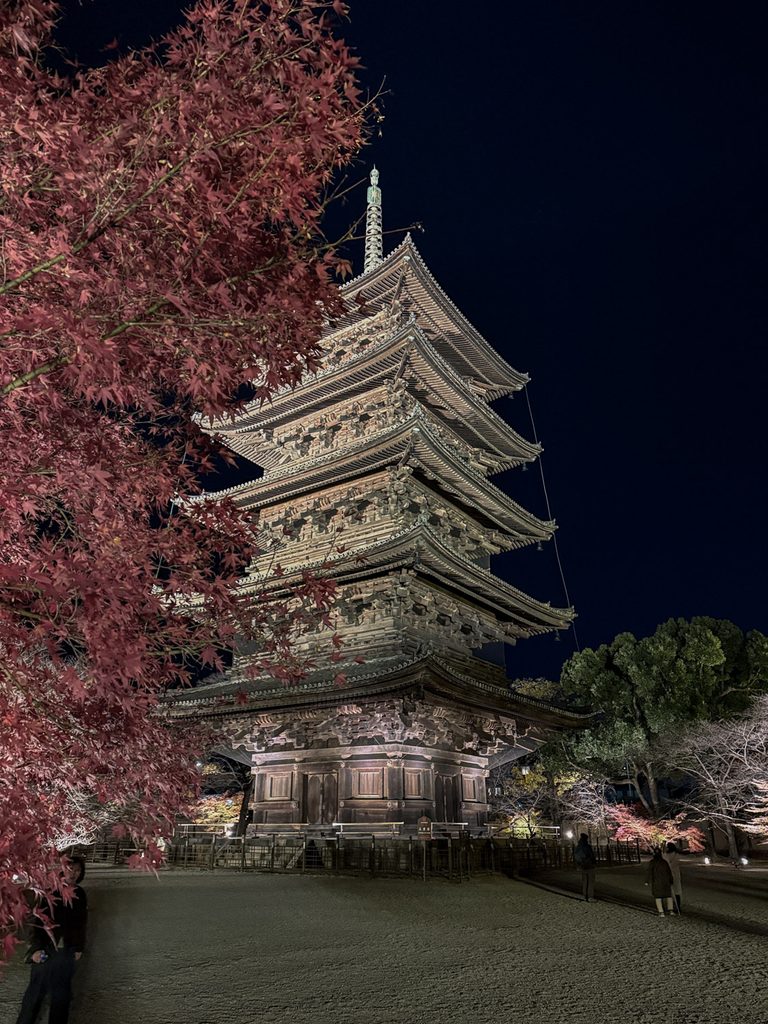
Officially named Kyo-o-gokoku-ji, Toji (also written To-ji) is the head temple of Shingon Buddhism and part of the UNESCO World Heritage Site “Historic Monuments of Ancient Kyoto.” It was founded as a state temple when the Heian capital was laid out, and in 823 it was entrusted to Kukai. Its five-story pagoda stands nearly 55 meters (about 180 feet) tall, the tallest wooden pagoda in Japan. Fires, including ones sparked by lightning, destroyed it four times, and each time monks rallied to rebuild. The pagoda you see today, completed in 1644, is the fifth.
Each autumn, about 200 maple trees on the grounds are illuminated, and the Main Hall and Lecture Hall open for special night viewing. For the temple’s own overview, see the Toji Temple official English site.
Toji Temple Autumn Illumination 2026: Dates, Hours and Tickets
The night viewing runs for about six weeks in 2026, from the end of October to mid-December.
| Dates | October 31 (Sat) to December 13 (Sun), 2026 |
| Hours | 6:00 p.m. to 9:30 p.m. (last entry 9:00 p.m.) |
| Closed | Open daily during the period |
| Night admission | 1,000 yen for adults and high school students, 500 yen for junior high students and younger (no group discounts or combination tickets) |
| Tickets | Sold at a desk set up in front of the Keigamon (East Gate) |
| Included | Illuminated grounds, Main Hall (Kondo) and Lecture Hall (Kodo) |
| Day and night | Separate admissions; the grounds are cleared between daytime and night viewing |
| Photography | Not allowed inside the Main Hall and Lecture Hall |
To see inside the pagoda, you need a daytime ticket. Its first floor opens to the public by day from October 31 to December 13, 2026, and admission covering the pagoda’s first floor, the Main Hall and the Lecture Hall is 1,200 yen for adults, 700 yen for high school students, and 500 yen for junior high students and younger.
Crowds and How Much Time to Allow
On my first visit, arriving just after 6:30 p.m., the line stretched to the Todaimon Gate and doubled back. Inside, however, the grounds absorbed everyone, and I never felt crowded. If you only want the illuminated maples and pagoda, a short visit works. If you want time with the Buddhist statues in the Main Hall and Lecture Hall, allow at least 60 minutes. Toji’s own estimate for a regular daytime visit is 30 minutes to an hour.
Late-autumn evenings can turn cold quickly, so dress for the night, not the afternoon. If you need to warm up, there is a rest area near the entrance.
If you are planning more than one night viewing this autumn, my guide to the Kiyomizu-dera night illumination covers another.
Getting There, and Pairing Toji with Tofukuji
Toji is a 15-minute walk (about 1.1 kilometers) from the Hachijo Exit of Kyoto Station, or a 10-minute walk (about 0.6 kilometers) from Toji Station on the Kintetsu Kyoto Line.