Most travelers in Kyoto have never heard of Konkai-komyoji. Locals know it by its older nickname, Kurodani-san — “Mr. Black Valley” — and for a head temple of the Pure Land sect with a gate as commanding as any in the city, it remains remarkably quiet. On a weekday morning, you may find yourself standing alone at the foot of the Sanmon, with only the wind moving through the maples.
This is also, by an accident of history, the place where the Shinsengumi was born and where the Aizu domain made its last stand against the tide of modern Japan. The cemetery on the hill behind the temple holds the graves of samurai who never returned home. Few foreign visitors realize it. This guide is for the ones who want to.
A Brief History of Konkai-komyoji
Honen’s hermitage on the hill
The story of Konkai-komyoji begins in 1175, when the Buddhist reformer Honen Shonin descended from Mount Hiei and built a thatched hut on this quiet hillside east of the imperial capital. From that small hermitage grew one of the head temples of Japanese Pure Land Buddhism (Jodo-shu) — a school whose central practice, the recitation of Namu Amida Butsu, would eventually reshape the spiritual life of ordinary Japanese people.
The local name Kurodani — “Black Valley” — long predates the formal temple name and remains in daily use among Kyoto residents today.
Kyoto in chaos and the new Protector’s office
To understand why this peaceful hillside became a samurai garrison, you have to picture Kyoto in the early 1860s. The late Tokugawa shogunate was losing control. Assassinations and robberies had become daily occurrences in the streets of the old capital, and the existing police forces could no longer keep order.
In 1862, the shogunate created a new office to restore the peace: the Kyoto Shugoshoku, or Kyoto Protector. On the first day of the eighth intercalary month of that year, the lord of the Aizu domain, Matsudaira Katamori, was summoned to Edo Castle and appointed to the position by the fourteenth shogun, Tokugawa Iemochi. He was awarded a stipend of fifty thousand koku and thirty thousand ryo in gold.
Aizu had refused the post several times. Katamori’s senior retainers begged him to refuse again. The chief retainer Saigo Tanomo warned that accepting the position would be “like carrying firewood on your back to put out a fire.” But Katamori felt bound by the house code left by the domain’s founder, Hoshina Masayuki — younger half-brother of the third shogun — and accepted. His retainers are said to have wept openly, embracing each other and vowing that Kyoto would become their place of death.
The arrival of the Aizu samurai
On the twenty-fourth day of the twelfth month of 1862, around nine in the morning, Matsudaira Katamori reached Sanjo Bridge in central Kyoto at the head of one thousand Aizu samurai. The Kyoto deputy and the Kyoto magistrate’s office came out to receive him. The column of armored regulars stretched for more than a mile along the road to Kurodani, and townspeople lined both sides of the route to welcome them.
Why Kurodani became the headquarters
Konkai-komyoji was chosen as the Aizu domain’s headquarters for three reasons that read, in hindsight, like the brief for a military base.
It was secretly built as a fortress. When Tokugawa Ieyasu was consolidating his rule over Kyoto, he quietly converted both Kurodani and Chion-in temples into castle-like structures, in case troops ever needed to be stationed in the imperial city. The temple has only a small gate to the south, while the western side is guarded by a high Korean-style gate (korai-mon) more commonly seen on castles than on temples.
It commanded the western approaches. Set on a low hill, Kurodani is a natural stronghold. From its western edge, defenders could see all the way to Oyamazaki and the Yodo River — the natural choke points between Kyoto and Osaka. A teahouse within the temple precincts, the Yodomi-no-chaseki at Sai-o-in (an Important Cultural Property), takes its name from the fact that sailing ships on the Yodo River were once visible from inside it. An old map of Kurodani labels one viewpoint Naniwa-jo yoshoku — “the distant gaze toward Osaka Castle.” The imperial palace was only about two kilometers away, and the eastern terminus of the Tokaido at Awataguchi only about 1.5 kilometers downhill — five minutes on horseback, fifteen on foot.
It could quarter an army. The grounds cover roughly forty thousand tsubo, large enough to billet one thousand soldiers. Unlike a Sengoku-era field encampment, a permanent headquarters needed real buildings. Kurodani had fifty-two sub-temples (tatchu), and surviving documents record that the main abbot’s quarters and twenty-five sub-temples were turned over to the Aizu samurai as barracks.
The birthplace of the Shinsengumi
The connection between Konkai-komyoji and the Shinsengumi began with a separate shogunate scheme. In early 1863, the shogunate had assembled a band of ronin — masterless samurai — to provide security for the shogun’s planned visit to Kyoto. More than 240 men gathered at Denzu-in temple in Edo on the eighth day of the second month, then marched up the Nakasendo highway to Kyoto, arriving in Mibu (then a village on the western edge of the city) on the twenty-third.
The group fractured almost immediately. After news of the Namamugi Incident reached them, their leader Kiyokawa Hachiro and over two hundred men chose to return to Edo. Kondo Isami, Hijikata Toshizo, and the Mito ronin Serizawa Kamo refused to leave. They petitioned to remain in Kyoto, and on the twelfth day of the third month they were placed under the formal supervision of the Kyoto Protector — Matsudaira Katamori, here at Kurodani. Kiyokawa and the others left for Edo the next day.
On the sixteenth, Kondo and Serizawa were granted an audience with Katamori inside the temple. Five months later, on the day of the Coup of the Eighth Month (the night the “Seven Nobles” fled Kyoto), they received a new name from the Imperial Court Liaison: Shinsengumi, the “Newly Selected Corps,” with formal authority to police the streets of Kyoto. Reports and orders moved daily between their barracks in Mibu and the Aizu headquarters at Kurodani.
Loss and survival
A fire in 1934 destroyed the Mieido (the founder’s hall) and the great abbot’s hall. They have since been rebuilt. Most of the other buildings on the grounds — the Sanmon, the bell tower, the sub-temples — stand as they have for centuries.
The Aizu domain martyrs’ cemetery
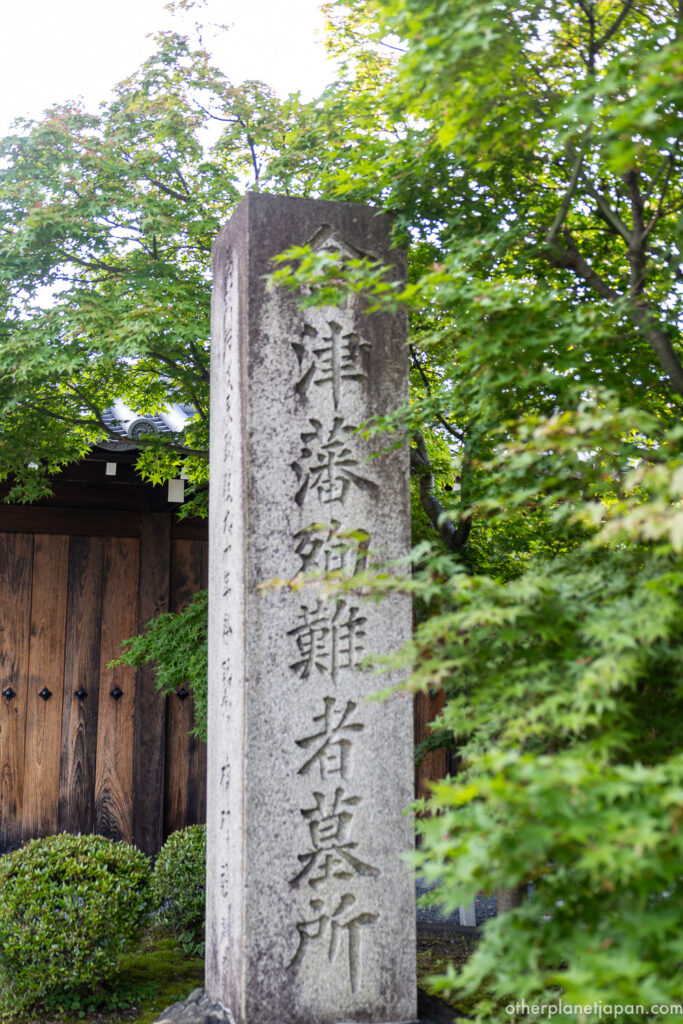
On the northeastern edge of the upper cemetery, on a plot of about three hundred tsubo, stands the Aizu Domain Martyrs’ Cemetery. A memorial stele erected in March 1907 honors 237 souls who died between 1862 and 1867, along with 115 men killed at the Battle of Toba-Fushimi. The graves are not only for samurai. Servants without surnames are buried here, as are women. Twenty-two of the dead from the Hamaguri Gate Rebellion (the Kinmon Incident) are interred on a raised platform in three separate groupings. Because the Aizu Matsudaira family followed Shinto, about seventy percent of those buried here are enshrined as kami rather than as Buddhist souls.
The grave of Aizu Kotetsu
Just west of the Aizu cemetery, in front of the kitchen quarters of Sai-un-in sub-temple, lies the grave of Aizu Kotetsu — a Kyoto kyokaku, or chivalrous outlaw, whose real name was Kosaka Senkichi. During Matsudaira Katamori’s tenure as Kyoto Protector, Kotetsu ran a labor-recruitment business as his public trade and worked as a Shinsengumi informant in private.
After Aizu was branded a “rebel army” at the Battle of Toba-Fushimi and the bodies of its soldiers were left scattered on the roadside, Kotetsu mobilized more than two hundred of his followers, defied threats of reprisal, gathered the dead, and had them cremated and prayed for at a nearby temple. For the rest of his life he repaid Katamori’s favor by guarding the Aizu cemetery here at Kurodani together with the priests of Sai-un-in, sweeping and tending the graves. A memorial service for the Aizu dead is still held at Sai-un-in on the second Sunday of June each year, attended by the fourteenth-generation head of the Aizu Matsudaira family, Matsudaira Morihisa, and organized by the Kyoto Aizu Society.
What to See at Konkai-komyoji
The Sanmon gate
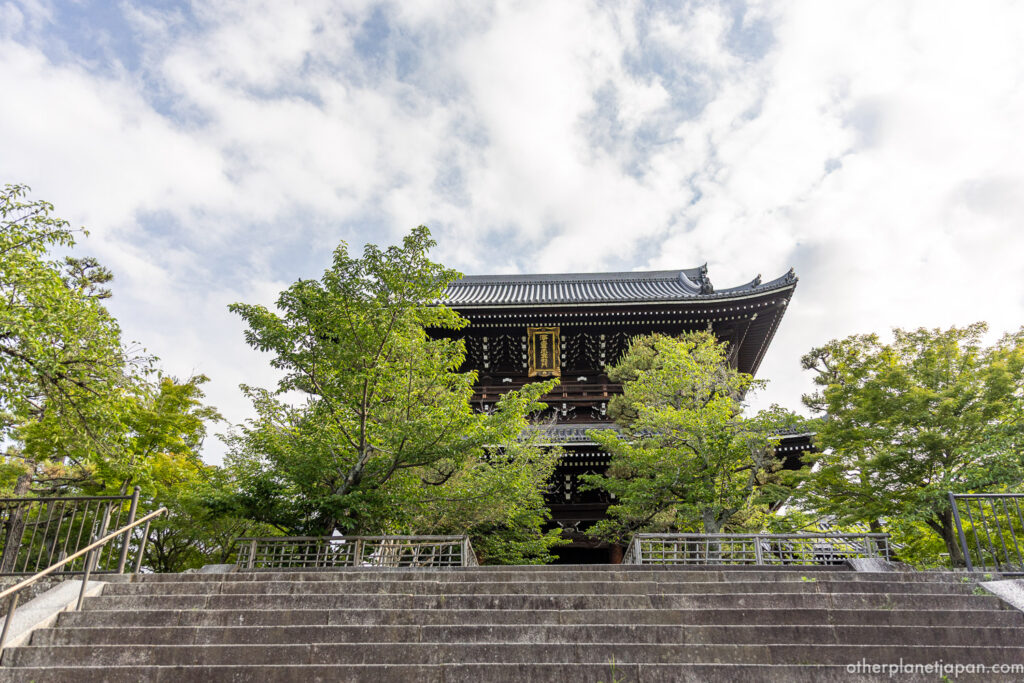
The first thing most visitors notice is the Sanmon, the two-story main gate, standing dark and massive at the top of a long stone approach. It was once part of the temple’s castle-like defenses, the western side guarded by a Korean-style gate. Today it is best appreciated from the bottom of the stone steps, where the curve of the eaves and the depth of the bracketing show their full weight.
The bell tower
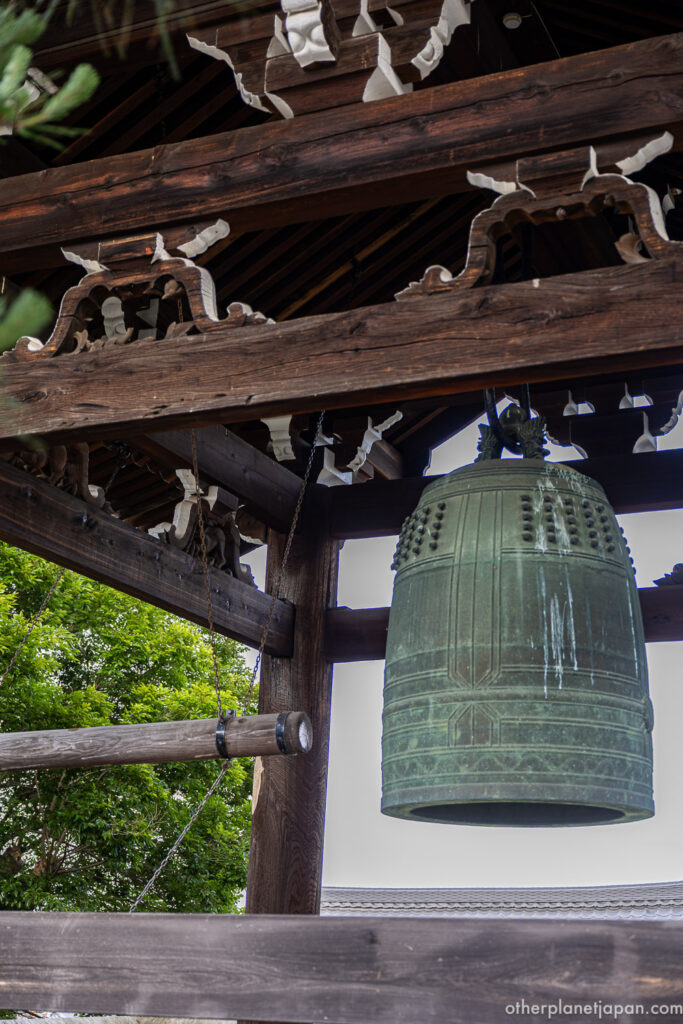
To one side of the main precinct, a green-patinated bronze bell hangs from a heavy timber frame inside an open belfry. The carved wooden brackets and the dark grain of the beams reward a closer look — this is one of the quieter corners of the temple grounds, often passed over by visitors hurrying toward the cemetery.
The Mieido and bronze lantern
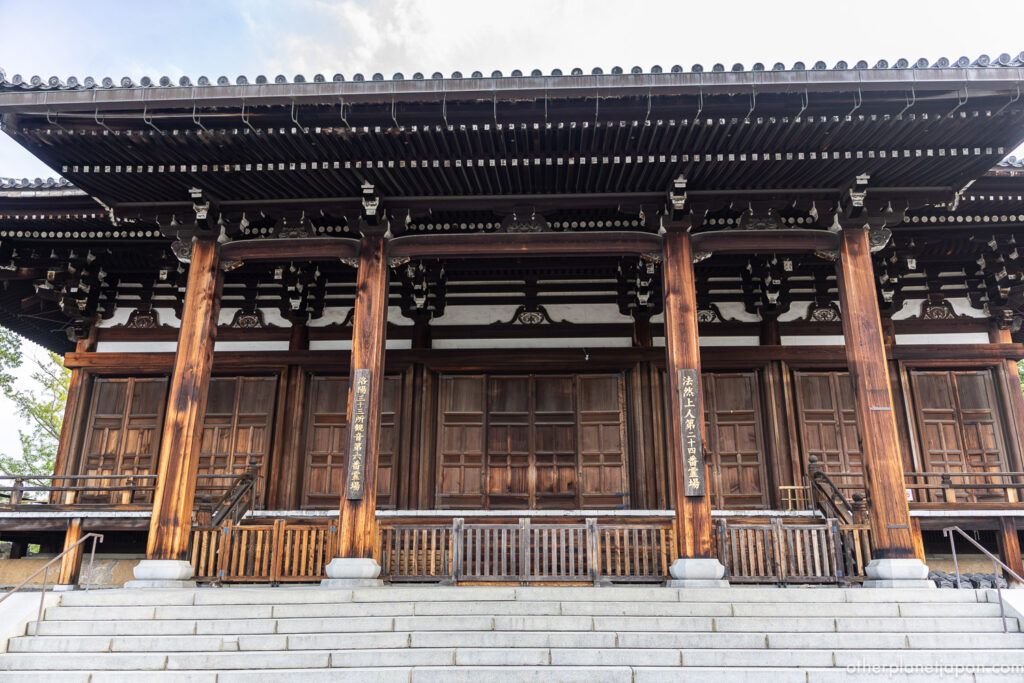
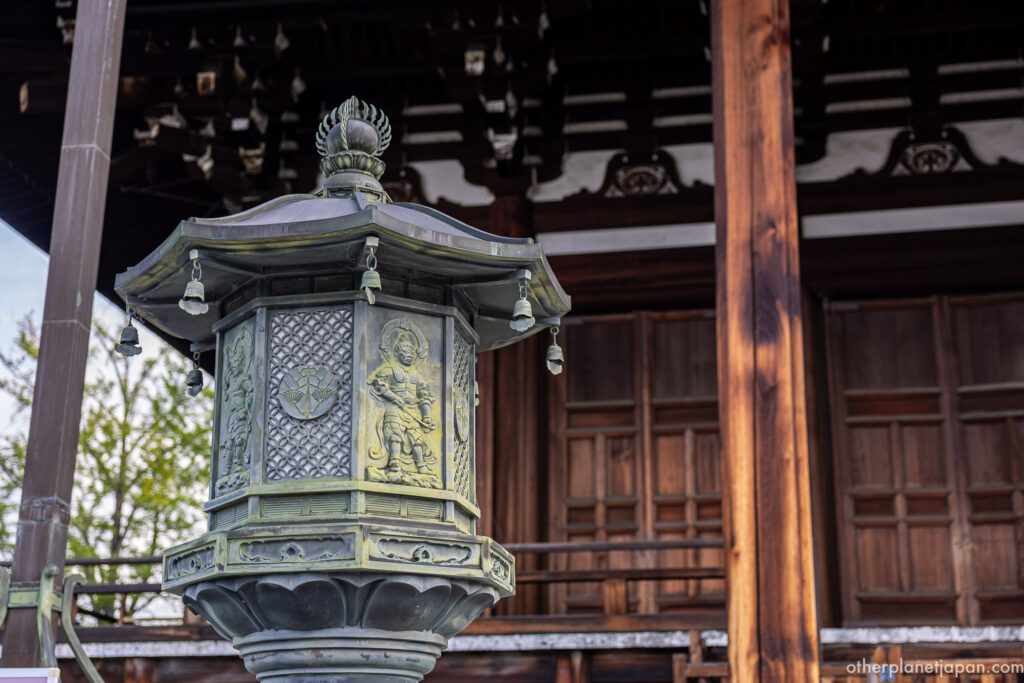
The current Mieido — the hall dedicated to Honen Shonin — is a postwar reconstruction of the building lost in the 1934 fire. The wide wooden façade, the dark cypress columns, and the vertical pilgrimage plaques marking the temple’s place on the Honen 25 Sacred Sites circuit and the Rakuyo 33 Kannon circuit give a clear sense of the temple’s role in popular Buddhism. In front of the hall stands an ornate hexagonal bronze lantern, its panels cast with guardian figures and its eaves hung with small bells.
The raked gravel garden
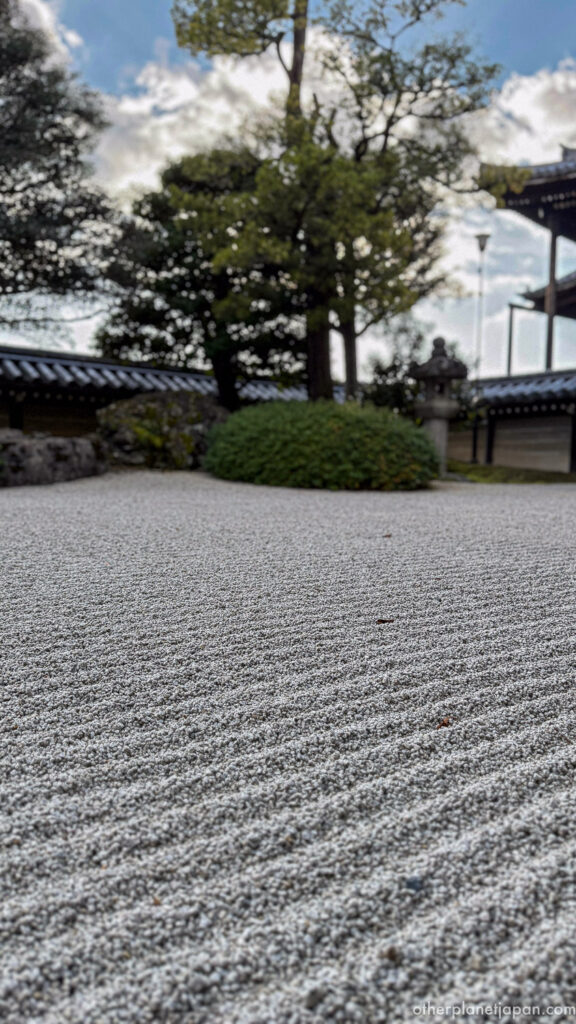
Tucked behind one of the temple walls, a small dry landscape garden of raked white gravel sits in front of a single rounded shrub and a stone lantern. It is not the most famous garden in Kyoto, but its low scale and quiet position make it a useful pause between the Mieido and the upper grounds.
The pond garden in autumn
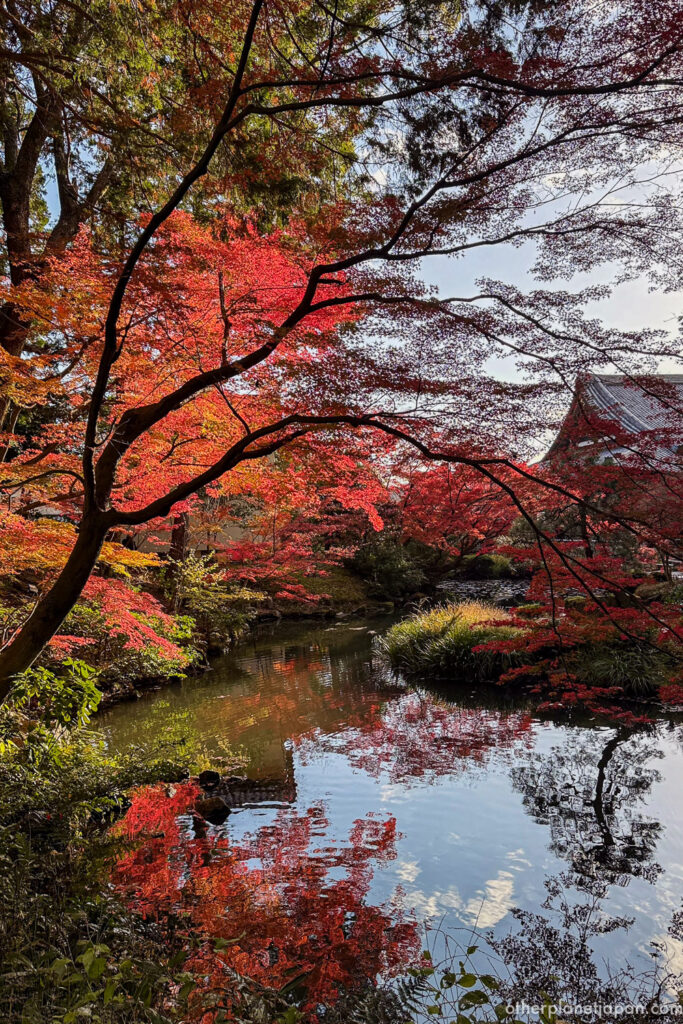
Further along the precincts, a small pond catches reflections of the surrounding maples. In late November, the water turns red with the inverted image of the leaves above it. The garden is small enough to feel intimate even on the busier autumn weekends.
The hilltop cemetery and the view over Kyoto
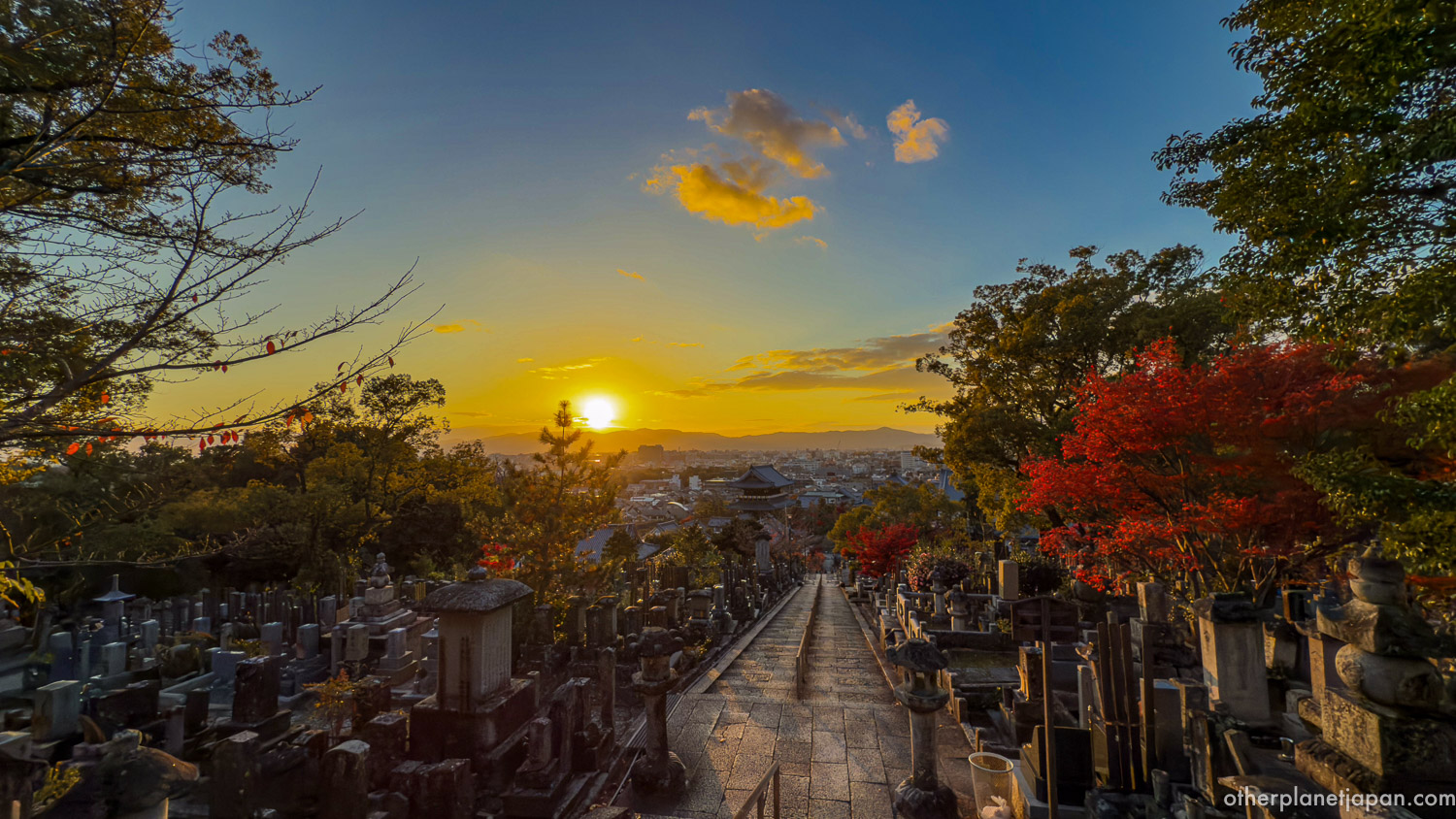
Behind the main precincts, a long flight of stone steps climbs through ranks of haka — family graves — to the top of the hill. From here, on a clear day, you can see straight across central Kyoto to the western mountains. In the late afternoon in autumn, with the sun dropping behind the city and red maples bracketing the path, it is one of the more atmospheric viewpoints in the city, and one of the least visited.
When to Visit Konkai-komyoji
Autumn and the evening illumination
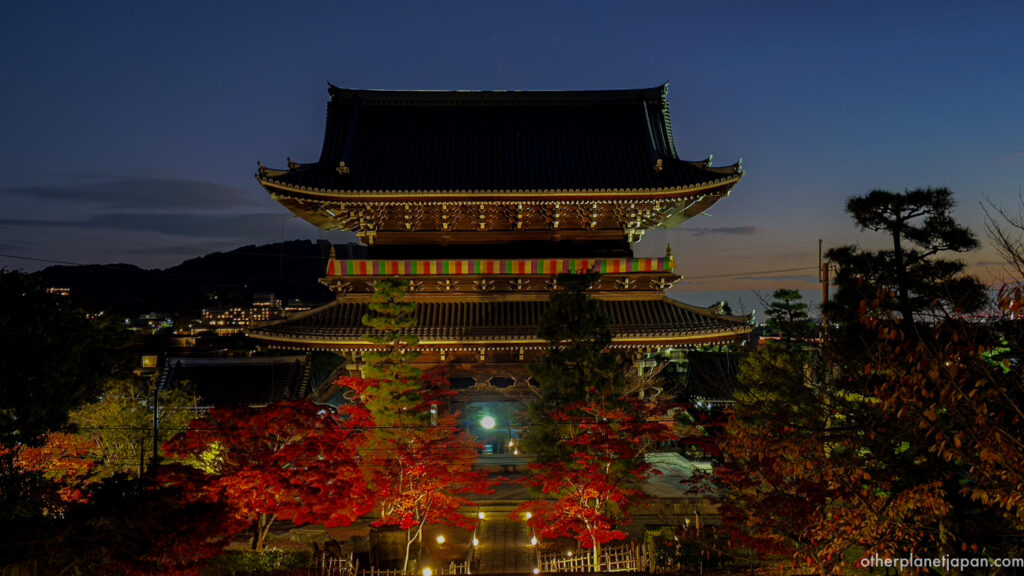
Konkai-komyoji’s most photographed season is late November, when the maples along the approach and around the pond turn deep red. During the peak of the season, the temple holds an evening illumination: the Sanmon and the surrounding maples are lit from below, and the contrast against the dark sky is striking. Crowds remain manageable compared with the major Higashiyama temples.
Early summer greenery
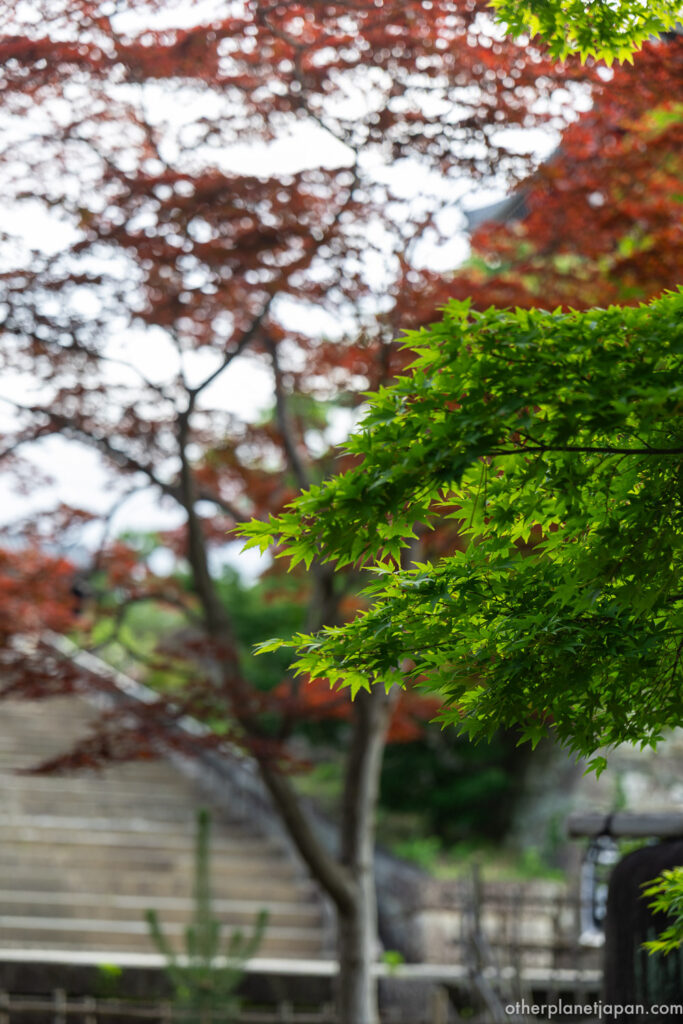
In late May and early June, the maples here put out a fresh, almost translucent green that some Kyoto regulars prefer to the autumn red. The grounds are nearly empty in this season — you can spend an hour on the approach without meeting another foreign visitor.
How to Visit Konkai-komyoji
Getting there
Konkai-komyoji is in the Okazaki area of Kyoto’s Sakyo-ku ward, on the eastern side of the city. The easiest way to reach it is by city bus.
| Bus stop | Routes | Walking time |
|---|---|---|
| Okazaki-michi (岡崎道) | City Bus 32, 203, 204 | About 10 minutes |
| Higashi-Tenno-cho (東天王町) | City Bus 5 | About 15 minutes |
From either stop, signs in Japanese point toward the temple. The final approach is uphill along a stone-paved road.
Hours and admission
| Area | Hours | Admission |
|---|---|---|
| Temple halls (御堂) | 9:00 AM – 4:00 PM | Free |
| Temple grounds | Open 24 hours | Free |
| Main abbot’s hall, garden, Sanmon | Limited seasonal openings only | Paid (check current schedule) |
The temple grounds, including the upper cemetery and the Sanmon approach, are accessible at any hour and free to enter. Specific halls, the garden, and the upper level of the Sanmon are only open to the public during limited seasonal periods, typically in spring and autumn, with an admission fee charged at those times.
Current renovations
At the time of writing, the temple’s three-story pagoda (Bunshu-to) and the stone staircase leading up to it are under restoration and not open for close-up viewing. Visitors should check the temple’s official notices before planning a visit specifically for the pagoda.
Tips for visiting
- Allow at least 60–90 minutes to walk the grounds at a relaxed pace; add another half hour if you plan to visit the upper cemetery.
- The approach from the lower entrance involves a long flight of stone steps. There is a more level approach from the west, near the Korean-style gate, that is easier for travelers with limited mobility.
- The cemetery is an active religious site. Quiet movement and respectful photography are expected.
- The temple shop carries simple amulets and pilgrimage stamps (goshuin) for those collecting them along the Honen 25 or Rakuyo 33 Kannon circuits.
Nearby Temples and Shrines
Konkai-komyoji sits in a quiet pocket of eastern Kyoto that is well worth a half-day on foot. Several other notable sites are within walking distance:
- Shinnyodo (Shinsho-gokurakuji) — a Tendai temple immediately north of Konkai-komyoji, famous for its three-story pagoda and autumn maples.
- Okazaki Shrine — a small Shinto shrine with rabbit motifs, associated with fertility and easy childbirth.
A natural walking route runs from Heian Shrine north along the Philosopher’s Path approaches, taking in Konkai-komyoji, Shinnyodo, and Okazaki Shrine along the way.
Map
Frequently Asked Questions
Is Konkai-komyoji really the birthplace of the Shinsengumi?
Yes, in a meaningful sense. Kondo Isami, Hijikata Toshizo, and the other founding members of what became the Shinsengumi were formally placed under the authority of the Kyoto Protector — based at Konkai-komyoji — in the third month of 1863, and they received their famous name later that year while operating under that authority. The temple is widely recognized in Japan as the Shinsengumi’s birthplace.
How much time should I plan for a visit?
Sixty to ninety minutes is enough to walk the main grounds at a relaxed pace. Add another thirty to forty-five minutes if you plan to climb to the upper cemetery and the panoramic viewpoint above it.
Is the Aizu domain cemetery open to the public?
Yes. The Aizu Domain Martyrs’ Cemetery is accessible at any hour as part of the temple grounds. As it is an active religious site, visitors are asked to keep voices low and to photograph respectfully.
Does Konkai-komyoji charge an entrance fee?
The temple grounds and most halls are free to enter. The main abbot’s hall, the garden, and the upper level of the Sanmon are only open to the public during limited seasonal periods, and an admission fee is charged at those times.
Is Konkai-komyoji wheelchair accessible?
The main approach involves a long flight of stone steps. A more level approach is possible from the western side of the temple near the Korean-style gate, but the upper cemetery requires further climbing.