I regretted it almost immediately.
Two Western travelers were standing at the bottom of the stairs, squinting at the sign. As I walked past them, they turned around and left. I should have said something. Go up. Trust me. Instead, I did what I always do when faced with a stranger and a language gap — nothing at all. I just stood there.
Of all moments, there was no orderly Japanese queue. If there had been one, I could have joined it, stood beside them, found some reason to speak. I have never missed the Japanese habit of forming lines this much.
This was my second visit to Yusai-tei. The first was in late November, when the maples were at their peak. The second was the following May, in the new green of early summer.
What surprised me the first time was that the famous round-window room had a time limit. A time limit. For looking at windows. I have never encountered that anywhere else in Kyoto, before or since.
I came back in May braced for the same rules. There was no time limit this time. The room was mine — at least until the next visitor walked in.
The Round Window Room
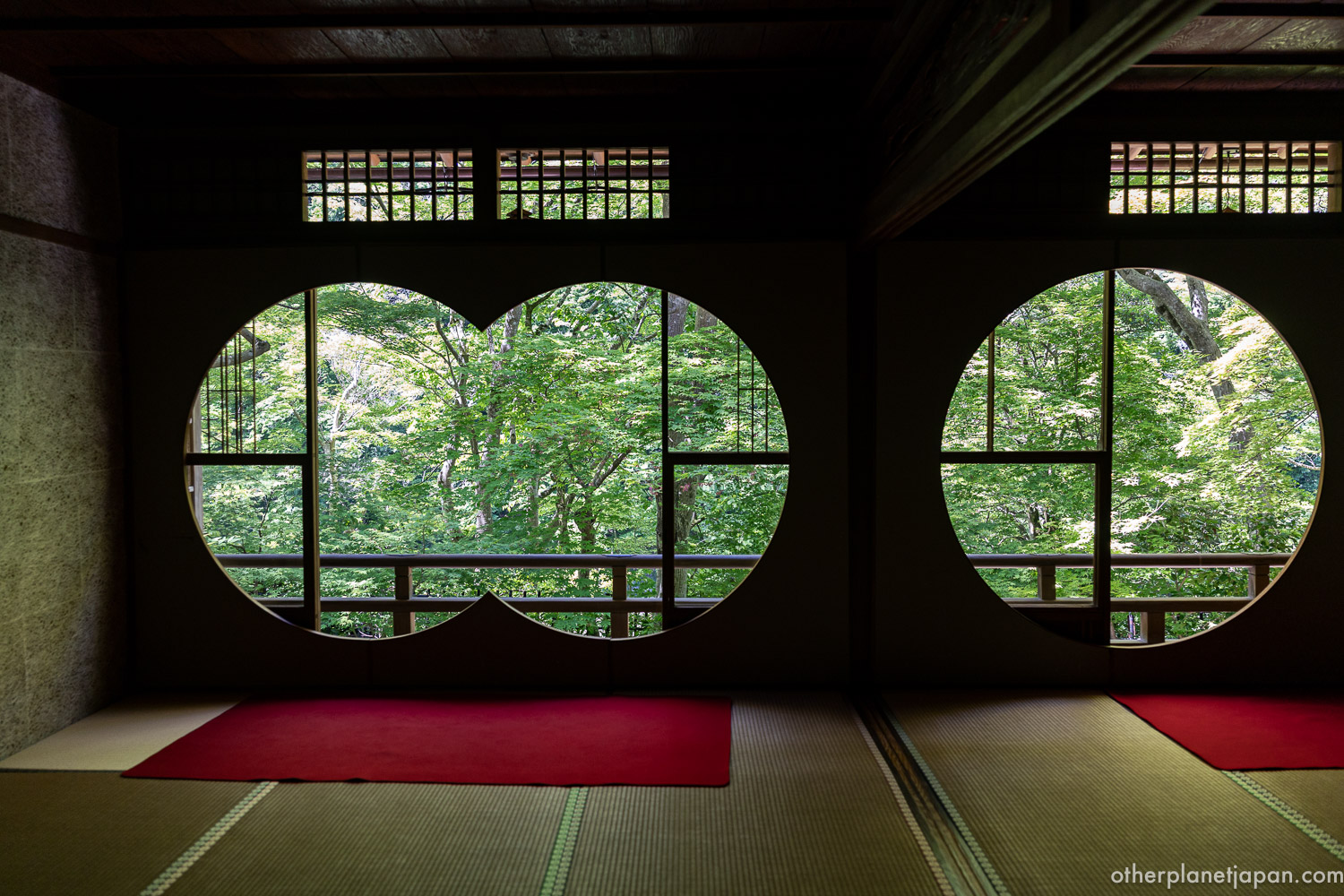
The room is darker than you expect. That darkness is the point.
Three large circular windows are cut into the wall. Each frames a slice of hillside forest. Below each window, the polished floor catches the reflection — so every circle exists twice, once above and once below the dark wooden seam. You are not looking at a garden. You are looking at a mirror that happens to contain a garden.
In autumn, it looks like this.
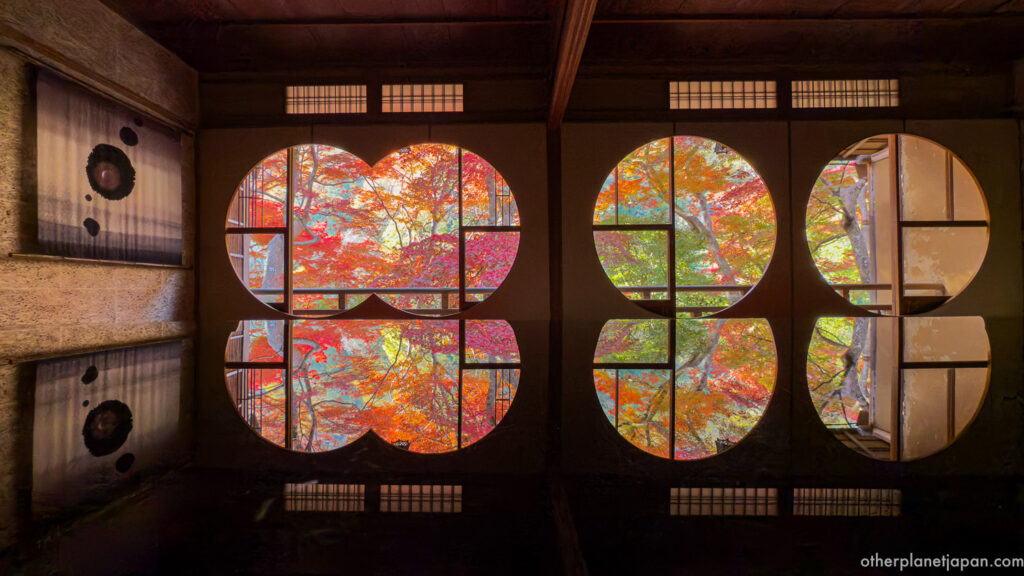
November — the round windows in autumn
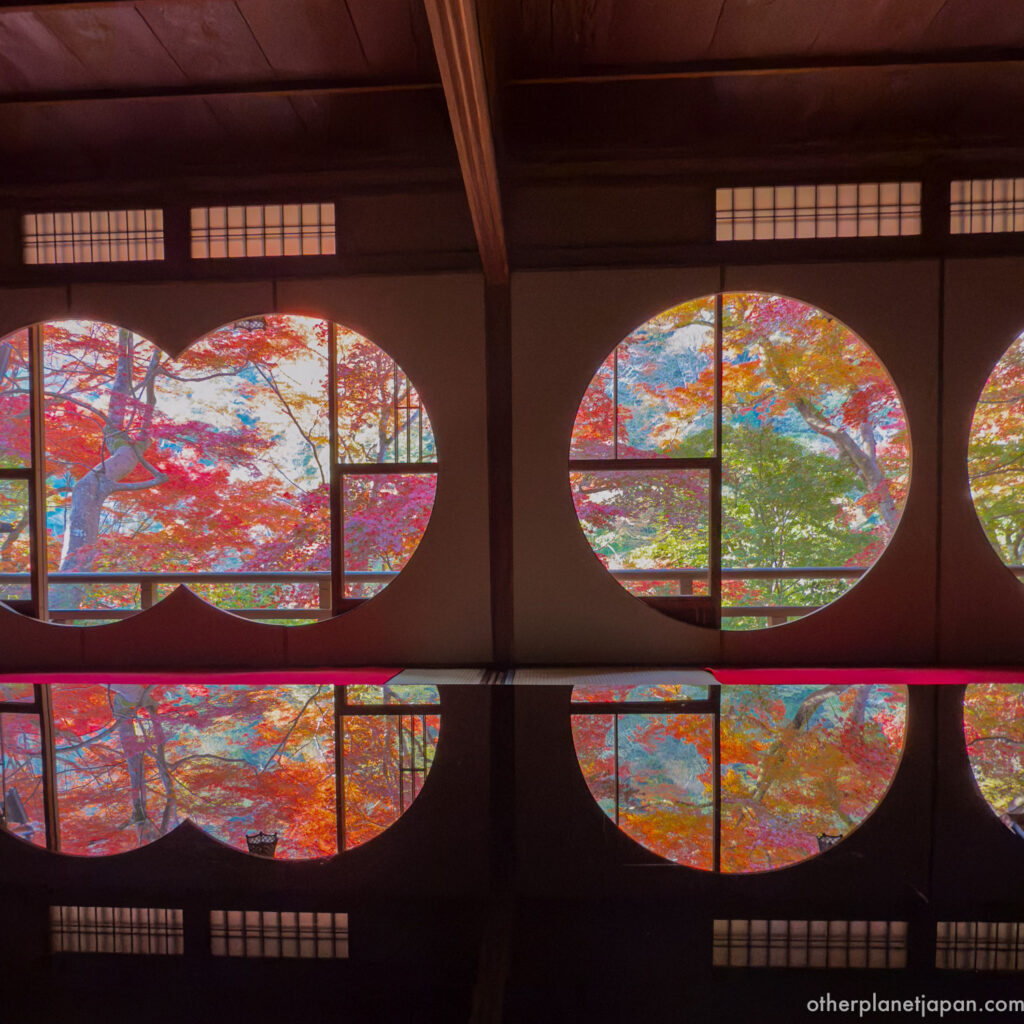
November — fire above, fire below
Above and below, the colors are nearly competitive. It is beautiful. No argument there. It also comes with crowds and a stopwatch.
In the new green of May, the room is quieter — and to my eye, more beautiful. This is probably a minority opinion among Japanese people. The leaves haven’t decided anything yet. I sat with that green longer than I’d planned to, and I would have sat longer still if the next visitor hadn’t walked in.
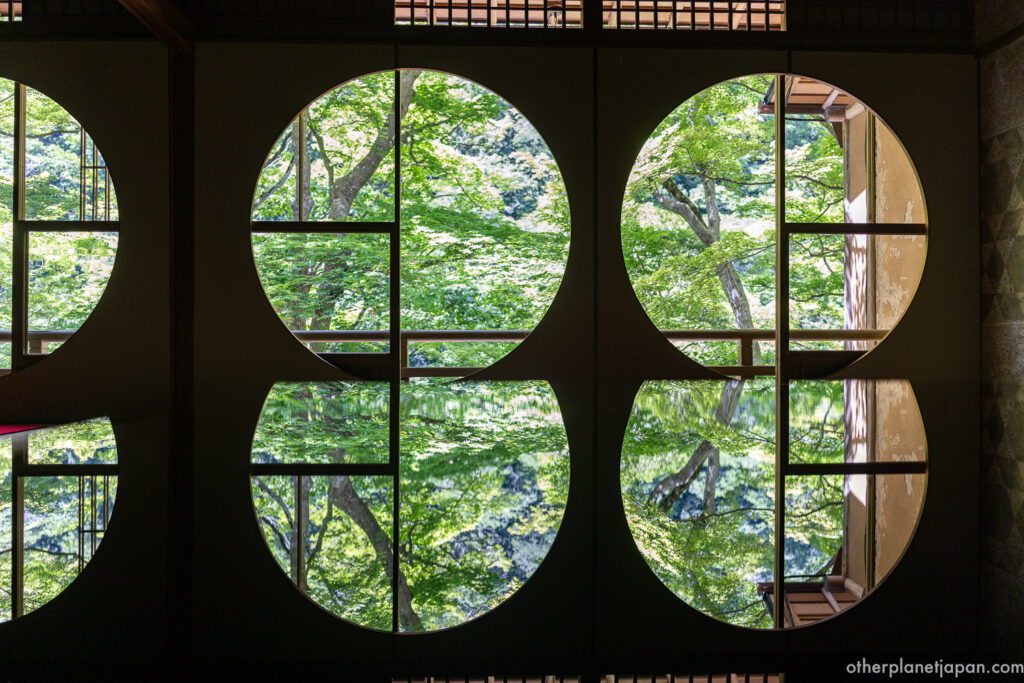
May — the round windows in new green

May — looking through glass at the hillside
The Water Mirror
Outside, there is a shallow basin of dye-infused water.
Beside it, a dropper and brush are laid out neatly, available for visitors to use. Next to those, a small sign warns that the dye does not come out of clothing. Here are the tools. Please enjoy. Also, do not touch your clothes. It sounds contradictory until you think about it for a second longer. It is not contradictory — it is honest. You may use these. You are responsible for what happens next.
If you visit with a companion, this is the section to enjoy together. One person manipulates the water with the brush or dropper while the other shoots the reflection. Doing it alone is possible but significantly less fun.
In November, the water catches fire.
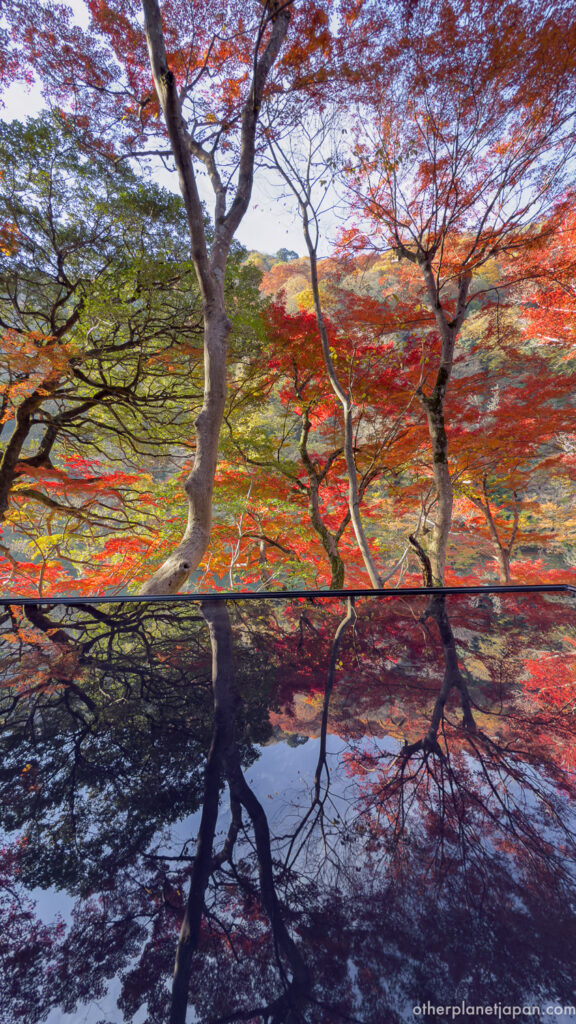
November — the water mirror
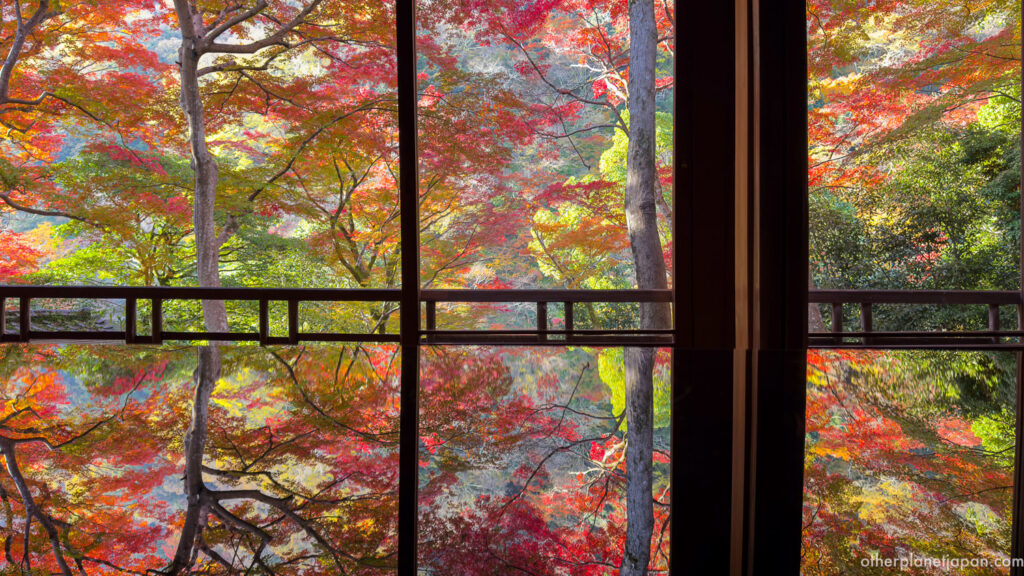
November — the round window meets the water mirror
In May, it turns into a green so deep it looks lacquered.
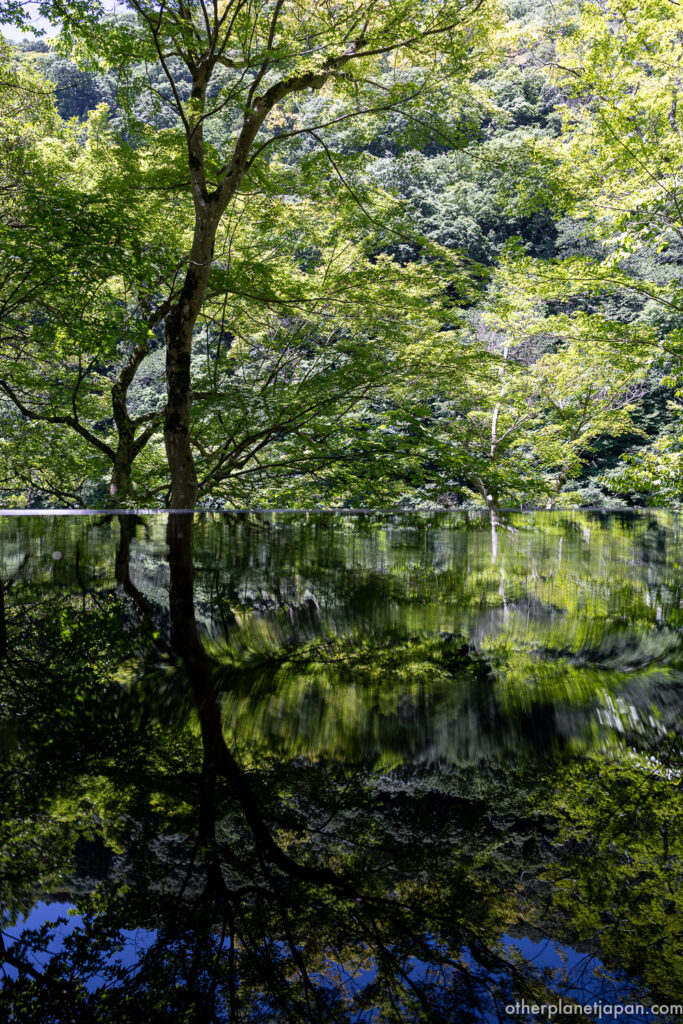
May — the water mirror, vertical
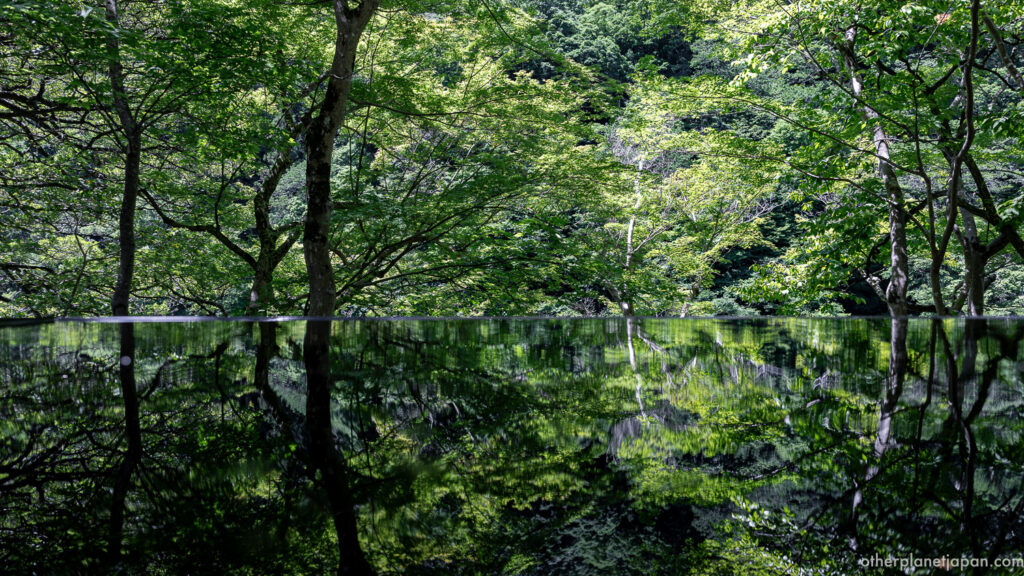
May — the water mirror, horizontal
Hold a camera at water level and Arashiyama doubles itself. The real trees and the reflected trees stitch together along a single horizontal seam, so cleanly that the photograph looks less like a photograph and more like a painting.
The voices of passengers on the Hozu River sightseeing boats carry up through the trees. You can’t see the boats from here — only the laughter reaches you, cheerful and anonymous. The sound doesn’t break the quiet. It deepens it.
The Glass Vessels
Along the veranda, a row of glass bowls catches the season.
The flowers inside are changed seasonally — a detail a staff member mentioned to me quietly, the way people mention things they are proud of without making a show of it. In early summer, the arrangements echo what is blooming outside. The round glass distorts the garden behind it, compressing the entire hillside into something you could hold in both hands.
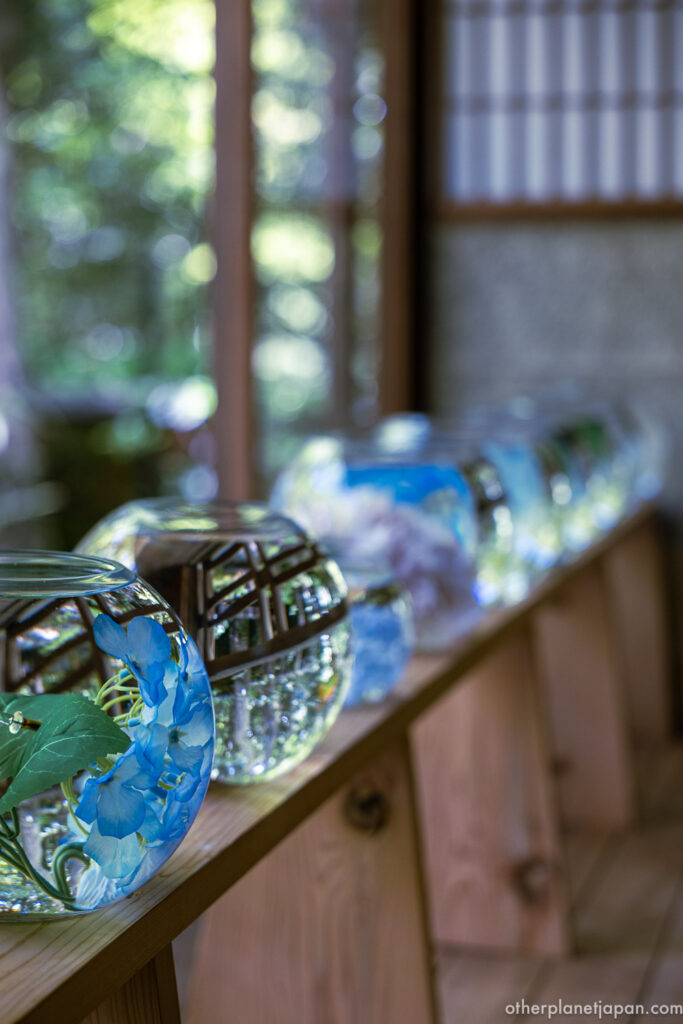
Blue summer flowers along the veranda
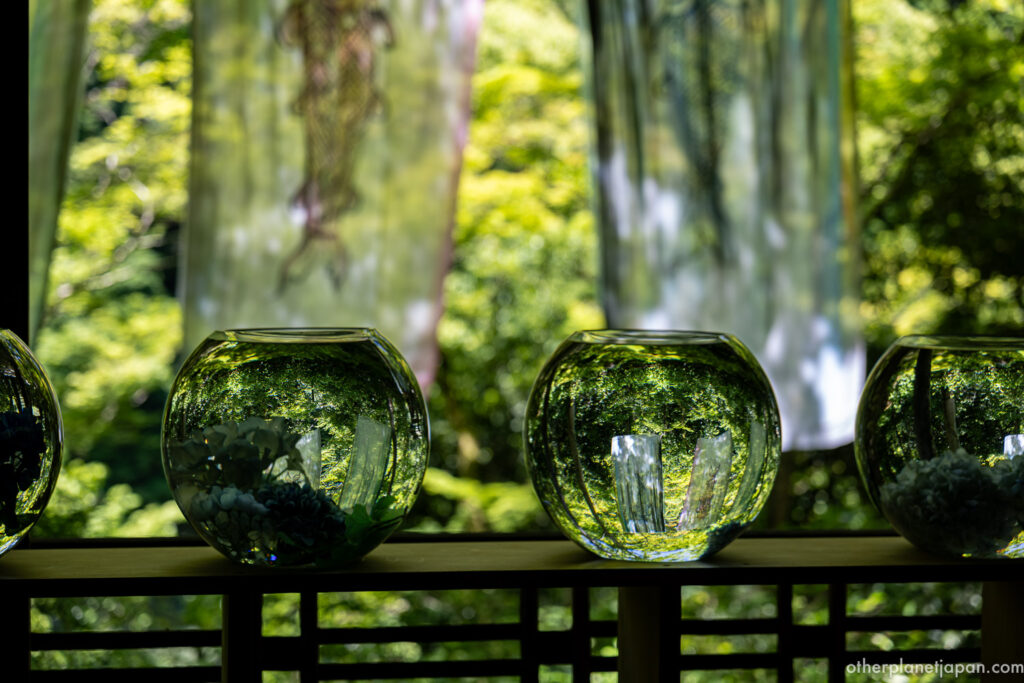
The hillside, compressed inside a glass bowl
Kōrozen — The Emperor’s Dye
In one of the rooms, a video plays on loop. Most visitors watch for a minute and move on. I watched it twice.
The video explains kōrozen — a dyeing technique created in Japan more than 1,200 years ago, a color reserved exclusively for the Emperor’s ceremonial robes. It shifts with the light. In sunlight, the color deepens. Indoors, it withdraws. Because the dye belonged to the Emperor alone, the technique was never widely taught. The knowledge was nearly lost.
The dyer Okuda Yusai discovered traces of the method in old documents preserved at Kōryū-ji temple and spent years reconstructing what had been deliberately kept secret. What hangs in these rooms is the result — fabric that shifts color as you move, as the light shifts without your noticing.
Near the entrance, a spring cashmere piece is displayed for visitors to touch. The staff encourages it. This is not a museum where you keep your hands to yourself.
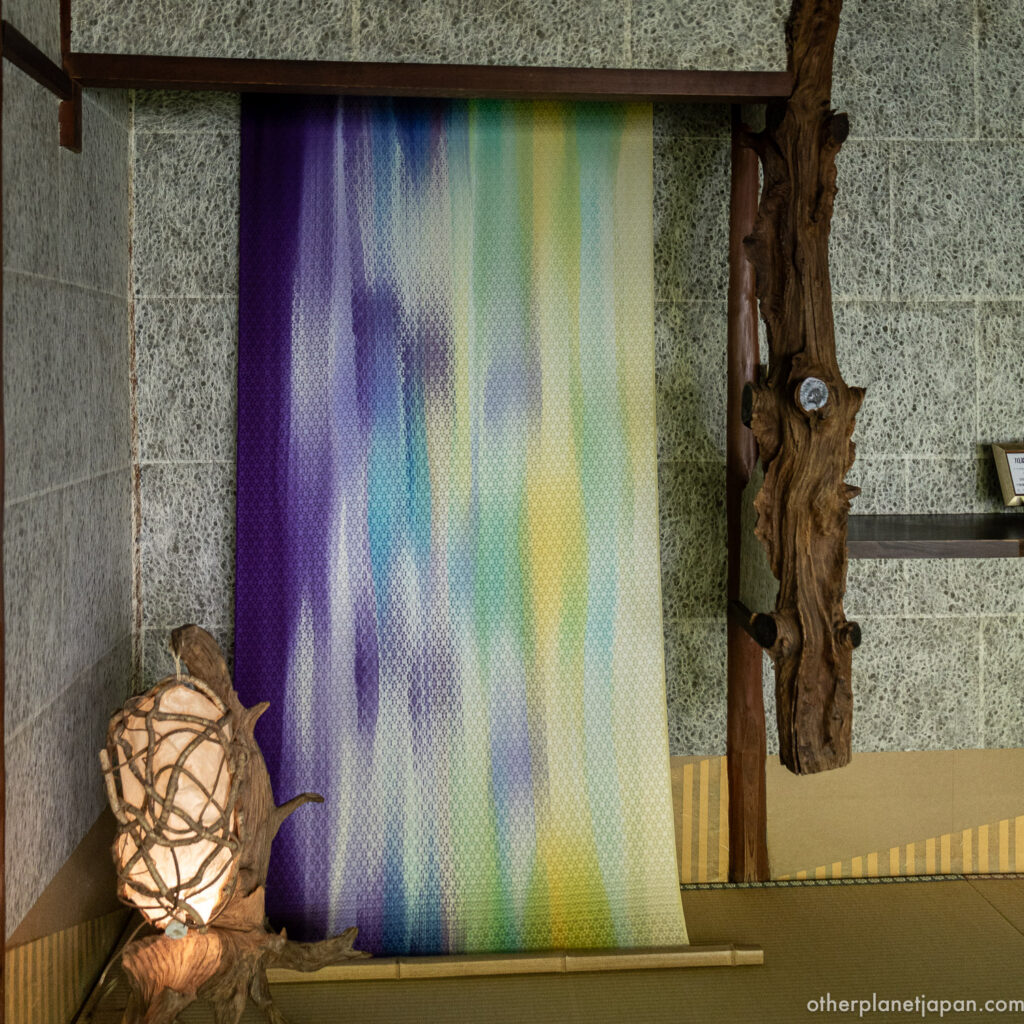
A dyed silk panel in the tokonoma alcove
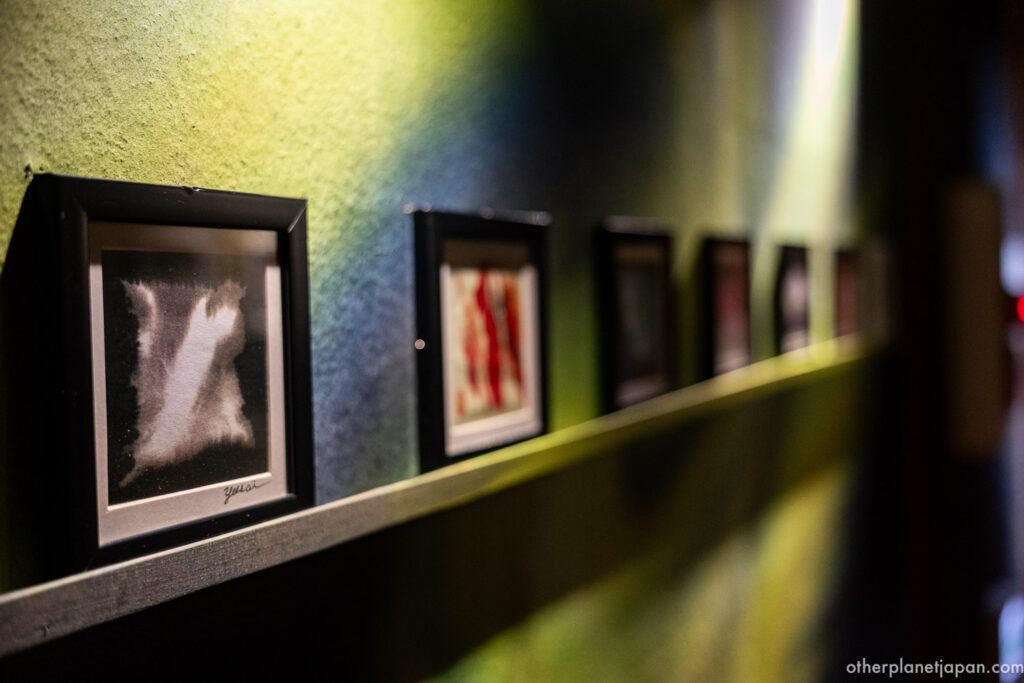
Small framed works along the corridor
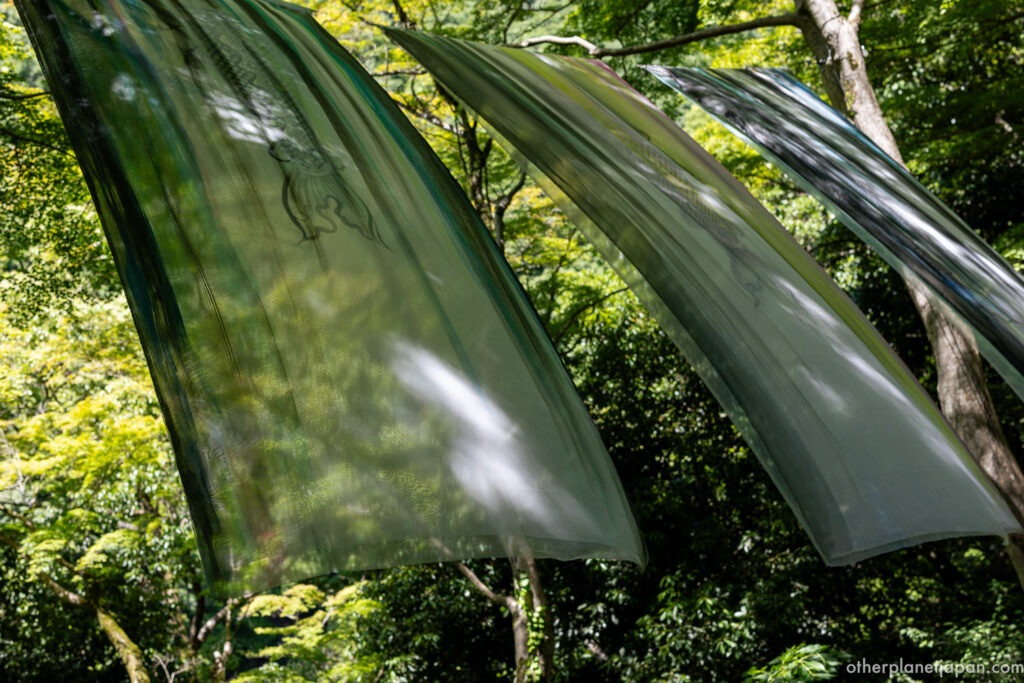
Dyed silk drifting in the outdoor air
Photography at Yusai-tei
Yusai-tei is one of the most photographable interiors in Kyoto, and the staff makes it easy. Photography is permitted throughout the property.
The Round Window Room
You are allowed to set your camera directly on the low table in front of the windows. This matters more than it sounds. The room is dark, the windows are bright, and a stable surface lets you slow your shutter without lifting a finger. Because visitors are controlled in number, no one will walk into your frame. You can take your time with the exposure. The dynamic range is wide but manageable — meter for the highlights in the foliage and let the interior fall dark. The shadow is the composition.
The Water Mirror
Crouch low. The closer your lens gets to the water, the more seamless the reflection becomes. If you have a companion, have them use the brush or dropper to disturb the surface in small, controlled spots — it adds visual texture to an otherwise glassy plane. Solo visitors can still get the shot, but it takes more patience.
What You Cannot Bring
Tripods are not permitted. Plan around that. Bring a fast lens or accept that the table is your tripod.
Practical Information
Admission
Regular season: 2,000 yen. Autumn foliage season: 3,000 yen.
Time Required
Most visitors spend 30 to 60 minutes on site. Photographers should plan for the full hour.
Reservations
Walk-ins are accepted, but the site enforces a capacity limit, so reservation holders take priority during busy periods. Web reservations are released in 30-minute slots; if you have a specific time in mind — especially in autumn — book early. Autumn reservations are not impossibly difficult to secure if you plan ahead.
Crowds
Because of the capacity limit, the interior never feels packed. In autumn, the round-window room operates as a one-way route with a time limit; in other seasons, you can linger.
Best Time of Day
According to a staff member, the lunch hour (around midday) is the quietest. Don’t plan around sunset — Yusai-tei sits directly beneath the hillside, and the light fades early. Mornings are beautiful, but morning hours are not open to general admission.
Weather
Yusai-tei is largely an indoor experience and works well in rain. A wet day actually intensifies the moss and the reflections.
Accessibility
The site has stairs and is not wheelchair accessible. Children under 13 are not admitted.
Climate
The building has natural air circulation, and air conditioning was installed a few years ago. It stays comfortable even in midsummer.
Access
A short walk from Togetsukyō Bridge. Easy to combine with Tenryū-ji or a walk through Sagano.
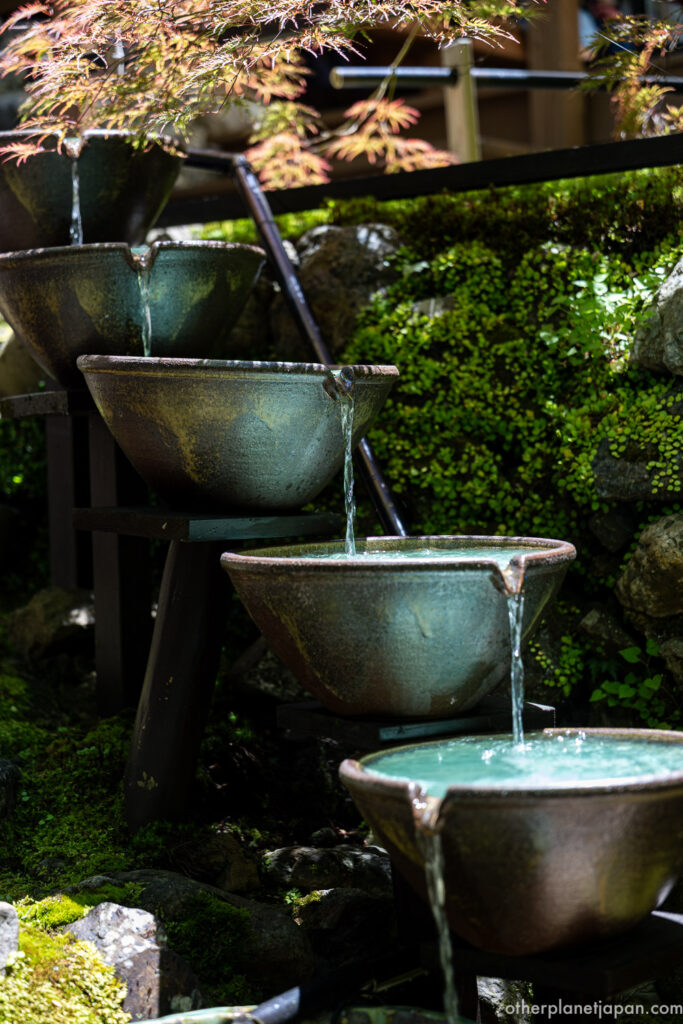
A water basin in the garden
Official Website
For the latest hours, seasonal closures, and online reservations, visit the official Yusai-tei website.
Why I Come Back
On the walk back down to the river, I thought about those two travelers.
Maybe they looked it up later. Maybe they saw a photo of the round windows and booked something for the next morning. Maybe they hit the autumn crowds and walked away saying it wasn’t worth it. I will never know.
What I do know is this: Yusai-tei is the kind of place that makes me want to stop strangers on staircases and tell them, with a conviction that probably sounds strange coming from someone they don’t know: this one is worth it.
Frequently Asked Questions
Is Yusai-tei worth visiting?
Yes — particularly if you appreciate quiet interiors, traditional Japanese architecture, and photography. The round-window room and the water mirror are unlike anything else in Kyoto.
Do I need a reservation?
No — walk-ins are accepted. However, the site has a capacity limit and gives priority to reservation holders during busy periods. A reservation is recommended during the autumn foliage season (mid- to late November). Reservations are released in 30-minute slots, so book early if you have a preferred time.
How much is admission?
2,000 yen during the regular season, 3,000 yen during the autumn foliage season.
When is the best time of year to visit?
Autumn foliage (mid- to late November) is the most famous season, but it comes with crowds and a time limit in the round-window room. For a quieter, less restricted experience, the new green of late May through June is, in my opinion, more beautiful.
How long should I plan to spend at Yusai-tei?
Most visitors spend 30 to 60 minutes. Photographers should plan for the full hour.
Can I take photos? Are tripods allowed?
Photography is permitted throughout. Tripods are not allowed, but in the round-window room you can place your camera directly on the low table — a useful workaround for the dark interior.
Is Yusai-tei suitable for children or wheelchair users?
Children under 13 are not admitted. The site has stairs and is not wheelchair accessible.