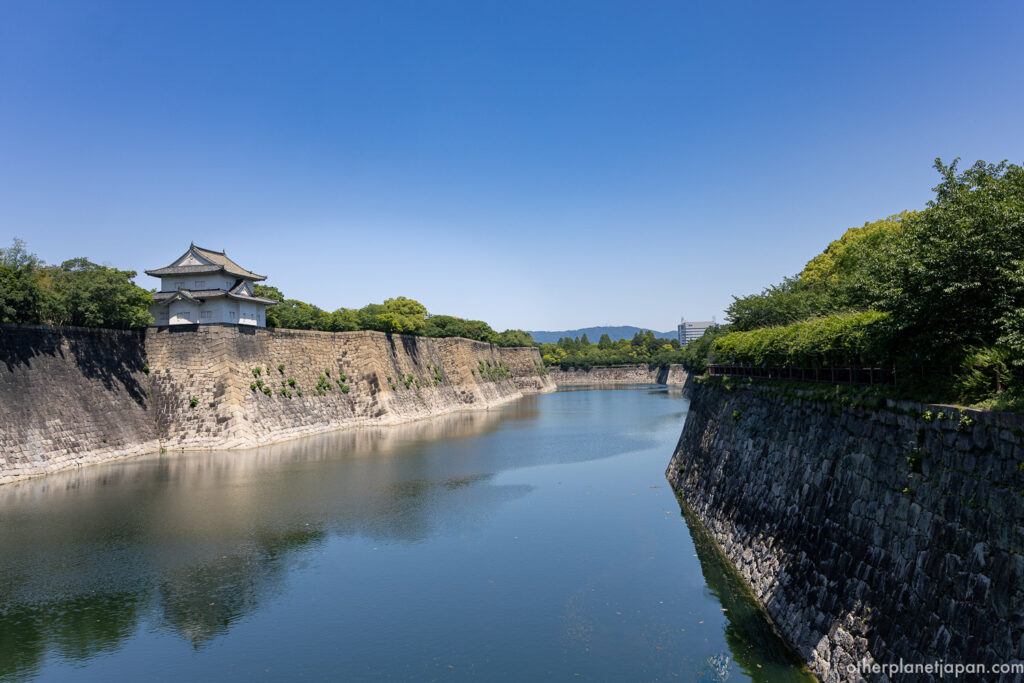
There’s a bench at the southwestern edge of Osaka Castle Park, overlooking the inner moat, that I consider my seat. It doesn’t matter whether the cherry blossoms are out. From here, you can’t even see the tower. What you can see is the moat — and that’s the point.
Every time I sit here, I find myself thinking the same thing: how desperate must those 16th-century commanders have felt, standing on the opposite bank, staring at all that water between them and everything they wanted? It’s not a useful thought. I think it every single time.
Behind me, a small electric car ferries tourists cheerfully through the grounds. If a samurai warlord were to materialize beside me right now, I’m not sure what would confuse him more — the tourists, or the car.
And yet: a 16th-century castle complex, burned down, rebuilt, burned again, rebuilt again, standing in the dead center of a city of 2.7 million people. When you stop to think about it, that’s a genuinely strange thing. Nobody in Osaka thinks it’s strange.
Osaka Castle is a landmark, yes. But it is also something else entirely. This place has layers. Toyotomi Hideyoshi’s ambition. A century-long religious war on the ground beneath your feet. A postwar symbol rebuilt by public donation. A park where salarymen jog past school children on field trips. And beneath all of it, excavations that are still turning up secrets.
One visit shows you one layer. This guide is here for the rest.
What Is Osaka Castle, Really?
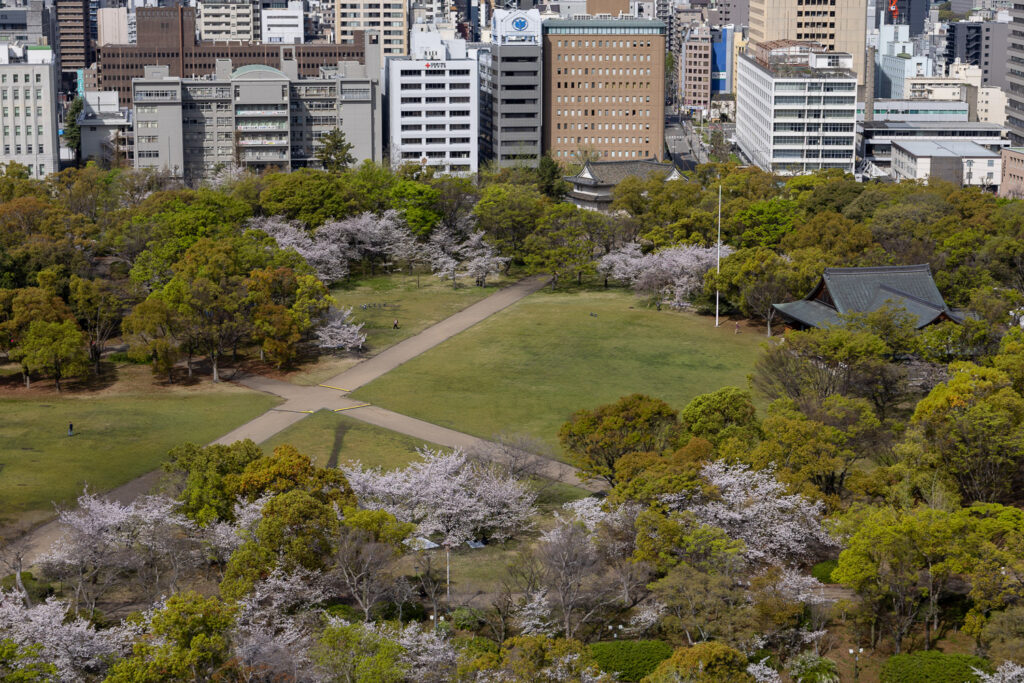
Osaka Castle is not a castle. It is a castle precinct — 106 hectares of parkland centered on the main tower. Think of it as roughly one-third the size of New York’s Central Park, dropped into the heart of a major city.
The precinct divides into four distinct areas, each with its own character:
| Area | Key Sights | In a Word |
|---|---|---|
| Main Tower & Inner Moat | Castle tower, Tamon Turret, Sakuramon Gate | History beneath a 1931 facade |
| Nishinomaru Garden | 600 cherry trees, mysterious stone walls | Sakura and secrets |
| Plum Grove & City Forest | Plum orchard, maple grove | The Osaka locals keep to themselves |
| Otemae Area | Toyotomi-era stone walls (underground), Osaka Museum of History | The real castle, buried |
Five Centuries in Five Minutes
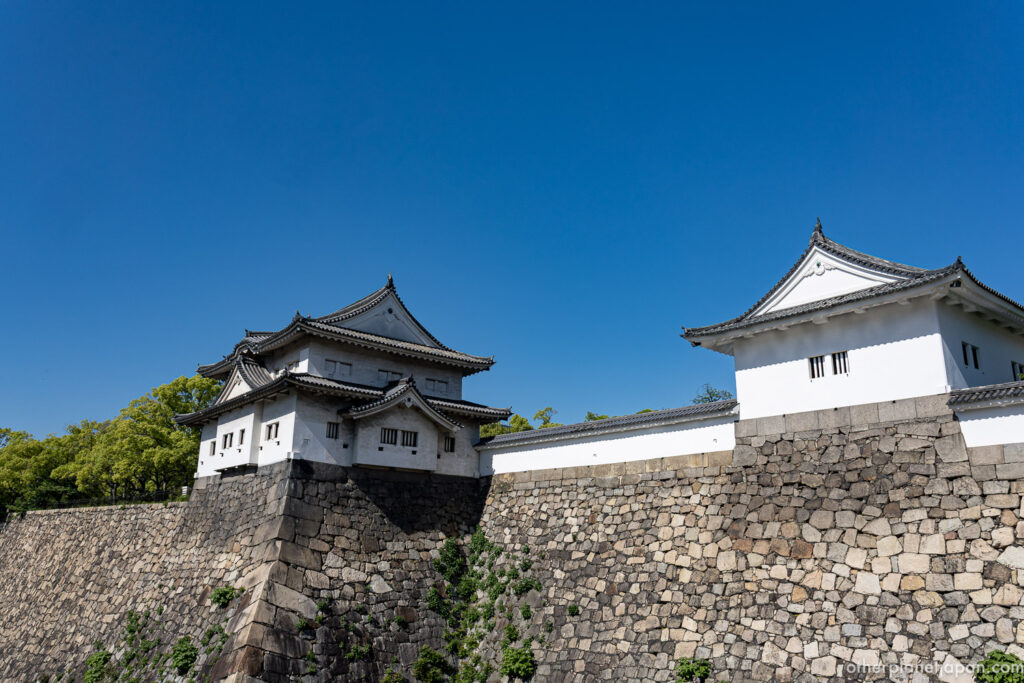
Osaka Castle’s history, told honestly, comes down to this: burned down three times, rebuilt three times.
The first castle was built by Toyotomi Hideyoshi in 1583. But before Hideyoshi arrived, this ground belonged to the Ishiyama Honganji — a fortress-temple that held off the most powerful warlords in Japan for nearly a century. The longest religious war of the Sengoku period was fought on the exact ground where tourists now take selfies. → The Hundred-Year War Beneath Osaka Castle
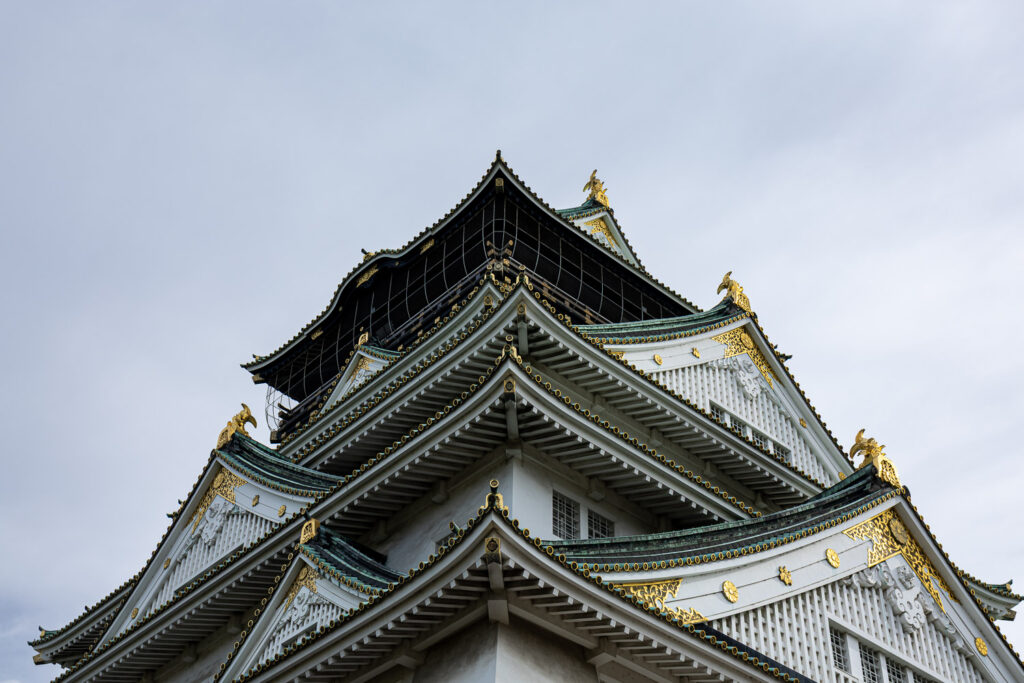
Toyotomi’s castle fell in the Siege of Osaka in 1615. The Tokugawa shogunate rebuilt it. That second castle was struck by lightning and lost. The tower you see today was built in 1931, funded by public donations from Osaka citizens. It is reinforced concrete. It is not a medieval reconstruction — it is a Showa-era civic monument.
The original Toyotomi-era stone walls, however, are still there. Just underground. → Osaka Castle’s Hidden Secrets: The Buried Stone Walls
Osaka Castle Through the Seasons
Osaka has countless flaws. A shortage of green space is one of them. Osaka Castle Park is the city’s most convincing counterargument.
The park looks genuinely different in every month of the year. That is not a figure of speech. In that sense, it reminds me of Kyoto — a place that rewards the return visitor far more than the one-time tourist.
Spring (Late March – Mid-April)
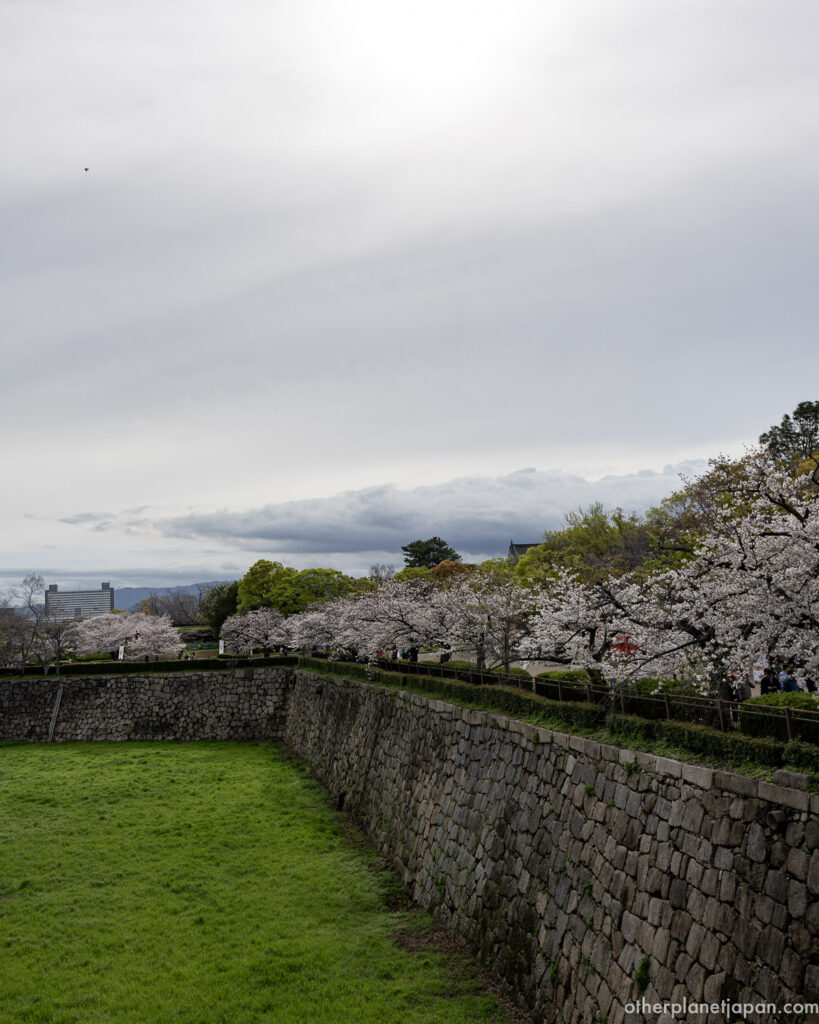
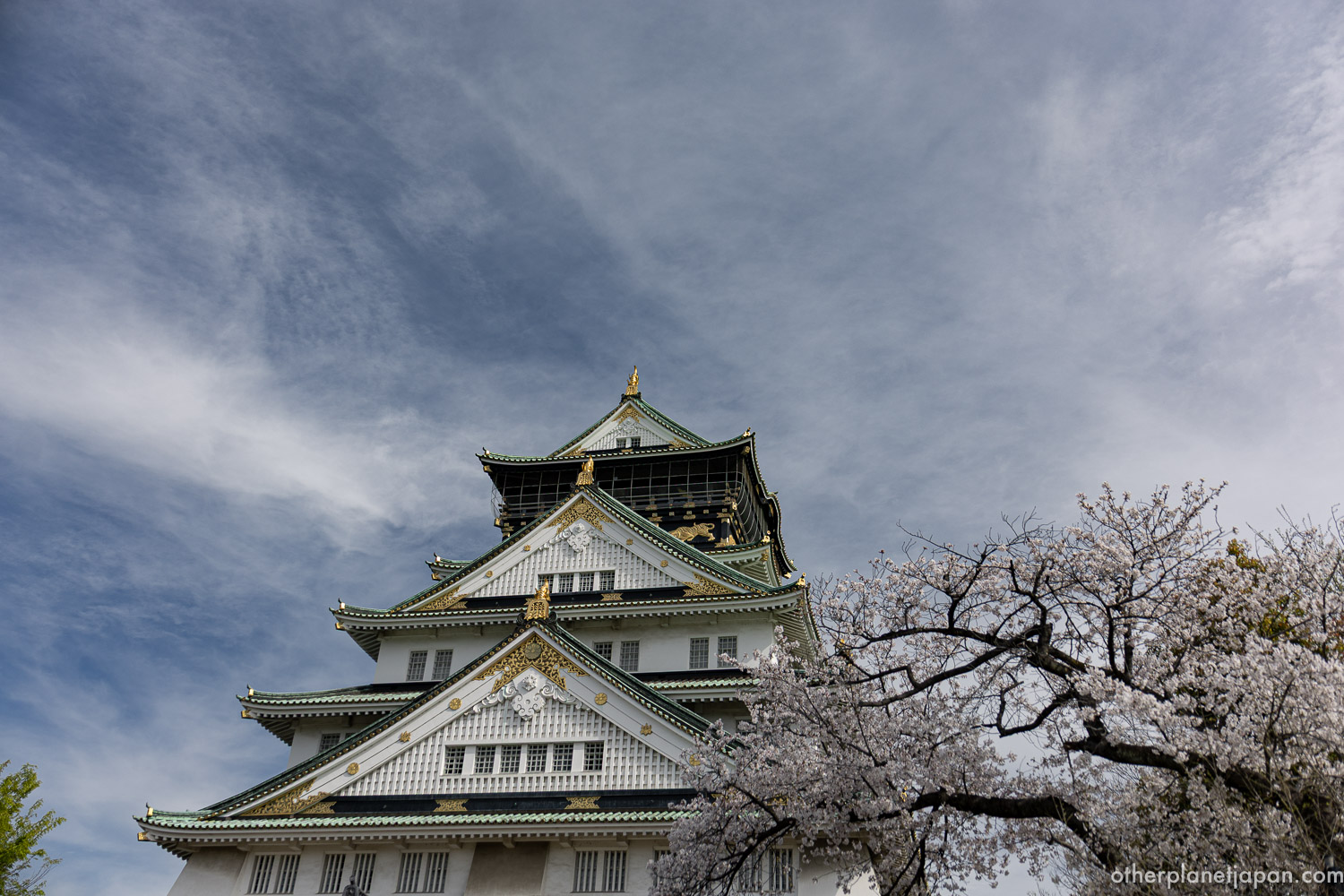
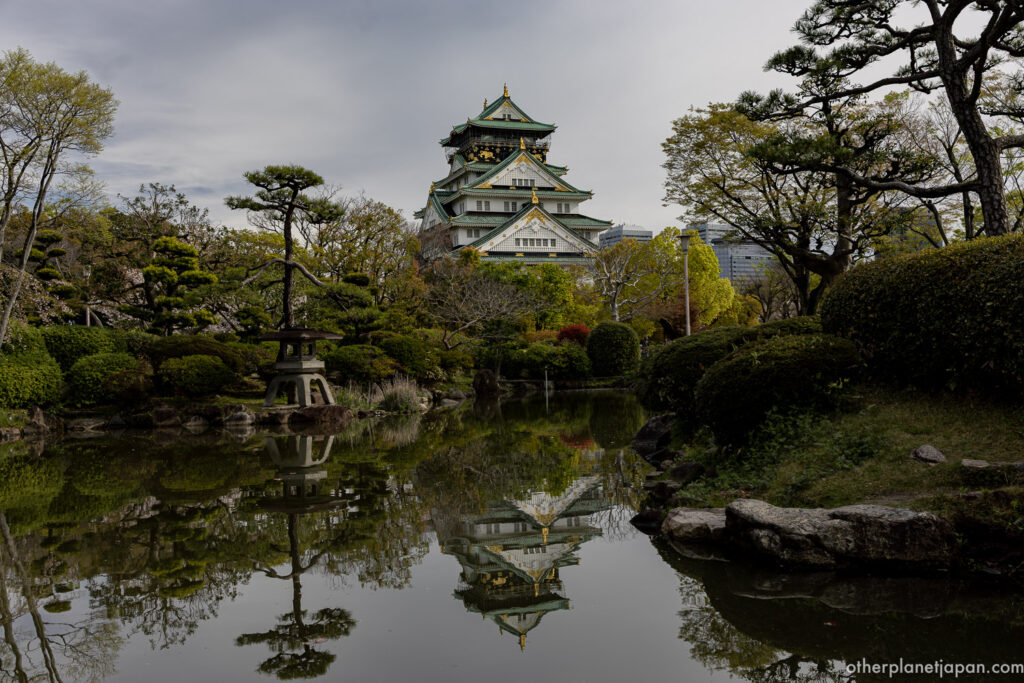
Nishinomaru Garden’s 600 cherry trees frame the tower, the sky, and the blossoms in a single composition — a shot that is rarer in Japan than it sounds. The evening illumination begins in the final week of March. → Nishinomaru Garden: Cherry Blossoms and Hidden Turrets
Early Summer (June)
Hydrangeas are Osaka Castle’s overlooked season. While everyone else is focused on the tower, the hydrangea paths stay quiet. → Hydrangea Guide (coming June 2026)
Summer (June – August)
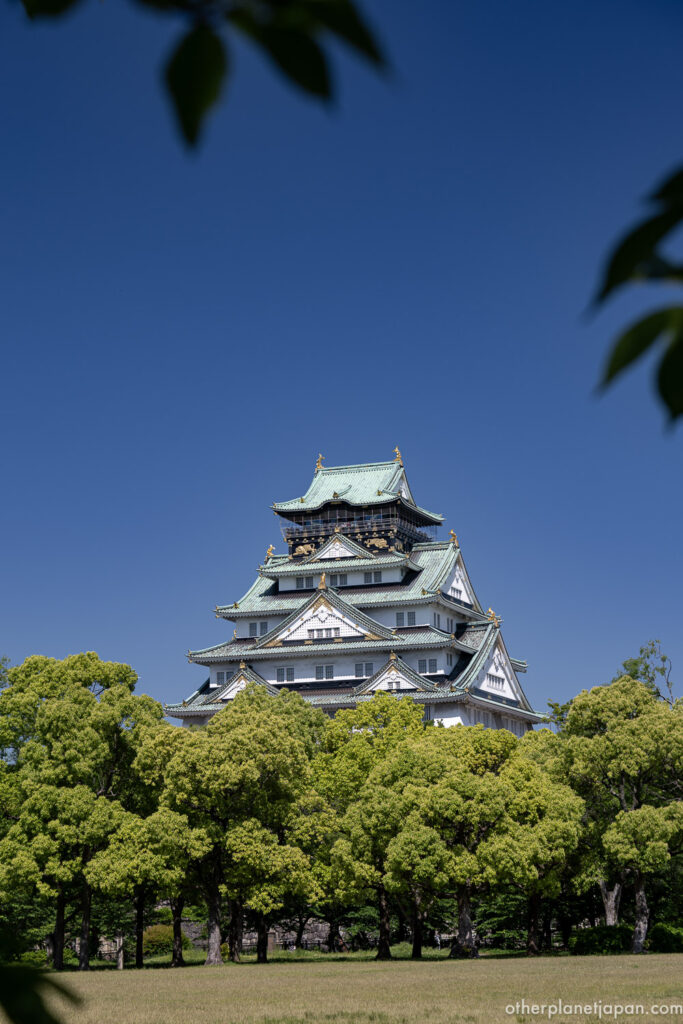
Early summer is the season of the green castle — dense foliage against old stone, which is likely the image you’ve already seen in photographs. By high summer, the heat shows no mercy. Come before 7 a.m., or come in the evening. The park is also one of the better jogging routes in central Osaka, for whatever that’s worth.
Autumn (November)
The maple groves inside the park are among the most underrated fall foliage spots in the city. Because visitors concentrate on the tower, the autumn color spots stay surprisingly uncrowded.
Late Winter (February – Early March)
The early-blooming plum grove may be the most local experience in the entire park. Plum season draws a fraction of the sakura crowds. That, frankly, is the appeal.
Before You Go: The Essentials
Admission
| Attraction | Fee |
|---|---|
| Castle Park (entire grounds) | Free |
| Main Tower | ¥1,200 (adults) |
| Nishinomaru Garden | ¥300 (¥350 during cherry blossom season) |
Getting There
| Line | Station / Exit |
|---|---|
| Tanimachi Line | Tanimachi 4-chome Station (Exit 1-B) / Temmabashi Station (Exit 3) |
| Chuo Line | Tanimachi 4-chome Station (Exit 9) / Morinomiya Station (Exit 1, Exit 3-B) |
| Nagahori Tsurumi-ryokuchi Line | Morinomiya Station (Exit 3-B) / Osaka Business Park Station (Exit 1) |
| Osaka Loop Line (JR) | Morinomiya Station / Osakajokoen Station |
| JR Tozai Line | Osakajokitazume Station |
| Keihan Electric Railway | Temmabashi Station |
How Long to Allow
Main tower only: approx. 90 minutes
Full park walk: half a day
With seasonal events: a full day
Explore Every Layer of Osaka Castle
Published Guides
The Osaka Castle Tower: What’s Actually Inside — The exhibits are more interesting than the observation deck. Here’s what most visitors walk straight past.
The Hundred-Year War Beneath Osaka Castle — A century of religious warfare, and the history still buried beneath the park.
Nishinomaru Garden and the Mysterious Turrets — The best cherry blossom photography position in Osaka, and the stone walls that nobody can fully explain.
Osaka Castle’s Hidden Secrets: The Toyotomi Stone Walls — Who built them? Why are they buried? The castle’s greatest unsolved mystery.
Coming Soon
Hydrangea Guide (June 2026)
Frequently Asked Questions
Is Osaka Castle worth visiting?
Yes — but how you visit matters more than whether you visit. The castle grounds are free and reward a slow walk in any season. If you’re short on time, you can skip the tower interior — it’s a 1931 reinforced-concrete building, not a medieval original — and spend your hour on the moat path instead. With half a day, the seasonal gardens more than justify the trip. With a full day, you’ll begin to see the layers.
How long should I spend at Osaka Castle?
Budget 90 minutes for the tower alone. A half-day covers the park properly. For seasonal visits — cherry blossoms, plum, hydrangea — plan a full day.
Is the Osaka Castle tower the original?
No. The current tower was built in 1931 using reinforced concrete, funded by public donations from Osaka citizens. The original Toyotomi-era castle was destroyed in 1615; the Tokugawa reconstruction that followed was later struck by lightning. The building you see today is a Showa-era civic monument, not a medieval structure. → Full story
What is the best time of year to visit Osaka Castle?
Cherry blossoms (late March to mid-April), autumn foliage (November), and plum blossoms (February) are the three peak seasons. Each has a dedicated guide above.
Can I visit Osaka Castle for free?
The castle park itself is entirely free. The main tower costs ¥1,200 for adults. Nishinomaru Garden charges ¥300 (¥350 during cherry blossom season). If budget is a factor, the moat path alone is worth the visit.