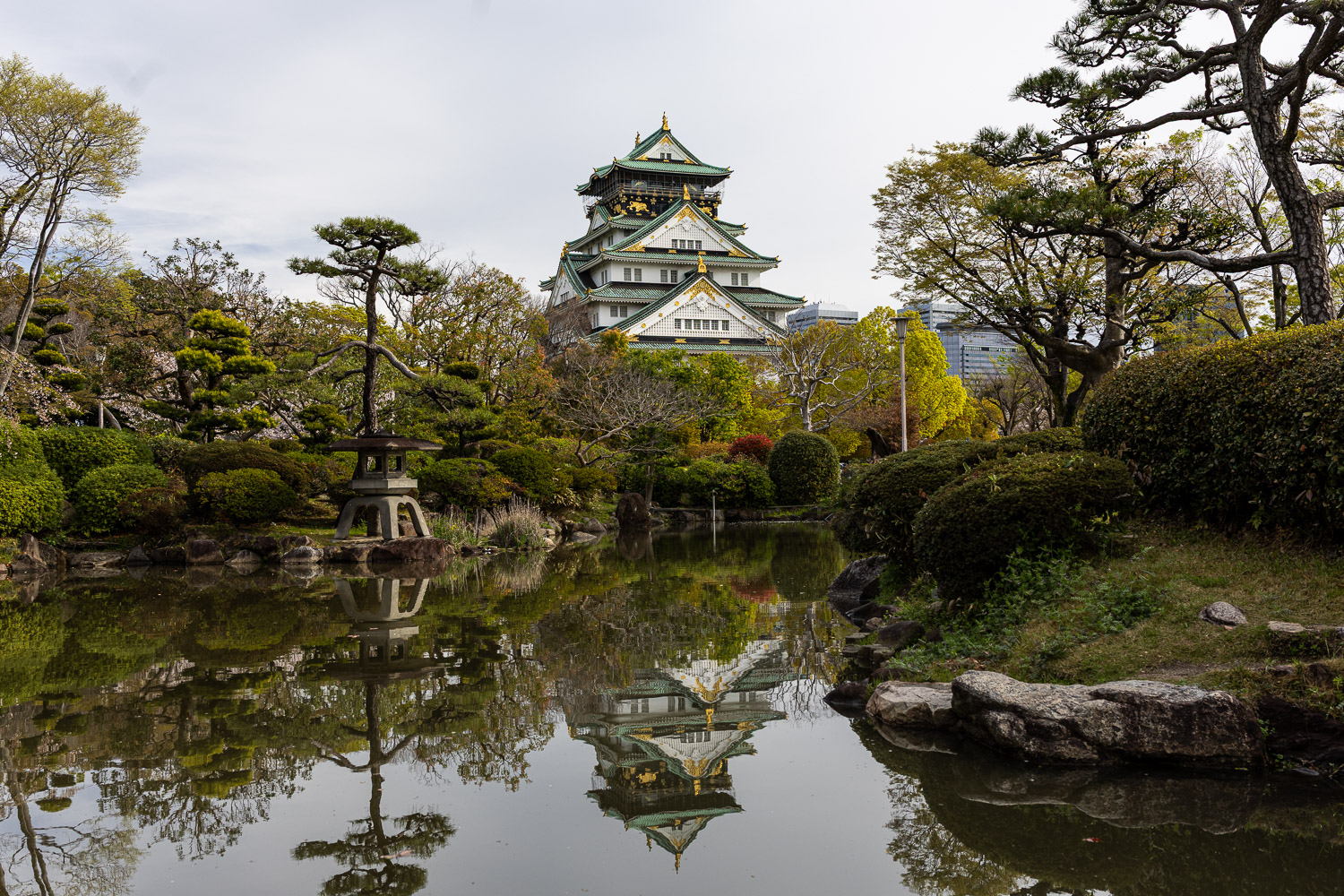
The Man Who Knew
“No way.”
I said it quietly, to no one.
A Western man stood alone at the gate, holding up his phone—not toward the castle, not toward the skyline, but at a wooden pillar. A pillar that no one ever photographs. A pillar whose secret I thought only I knew.
He was shooting it with the careful attention of someone who understood exactly what he was looking at.
How did he find out? I never learned the answer. But standing there, watching him frame that shot, I felt what I always feel inside Osaka Castle: the unsettling suspicion that this place is hiding something just out of view.
It is. Several things, actually.
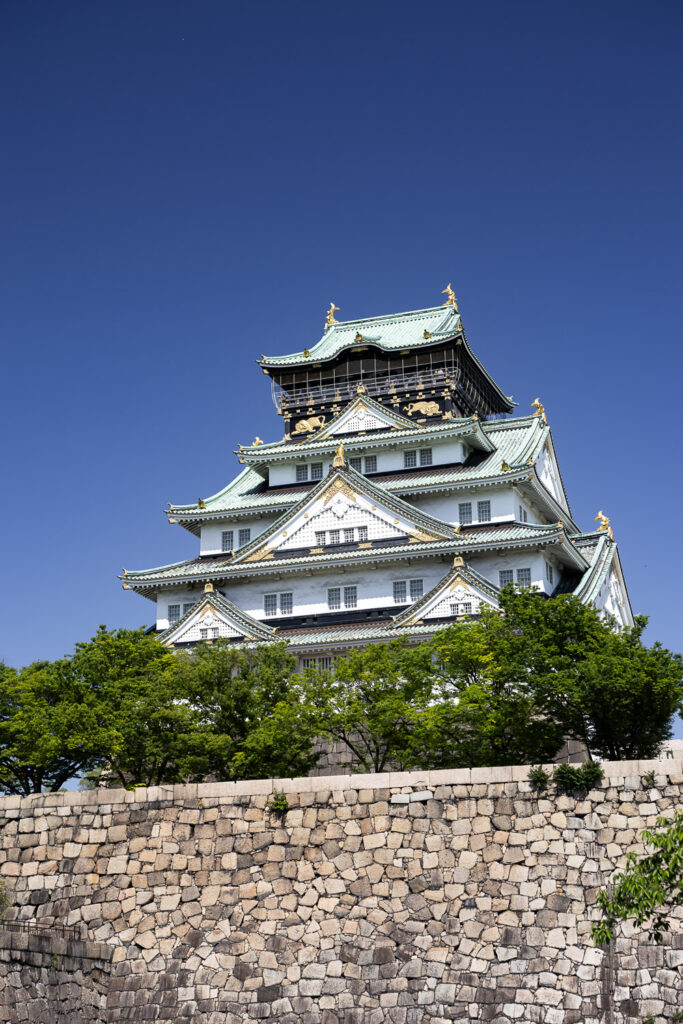
Osaka Castle keep rising above stone walls under a deep blue sky
Osaka Castle’s First Secret: The Joint That Shouldn’t Exist
Stop before you pass through the Otemon Gate.
Look at the pillars.
At first glance, they’re unremarkable. Solid. Weathered. Old. But look more carefully and you’ll notice something: a seam, running across the wood. A joint connecting two pieces of timber—except you can’t tell how. No visible fastener. No obvious mechanism. From the outside, the connection appears seamless, almost impossible.
For centuries, it was called the phantom joint. Carpenters examined it. Scholars debated it. No one could explain how it held together, or why it held so well.
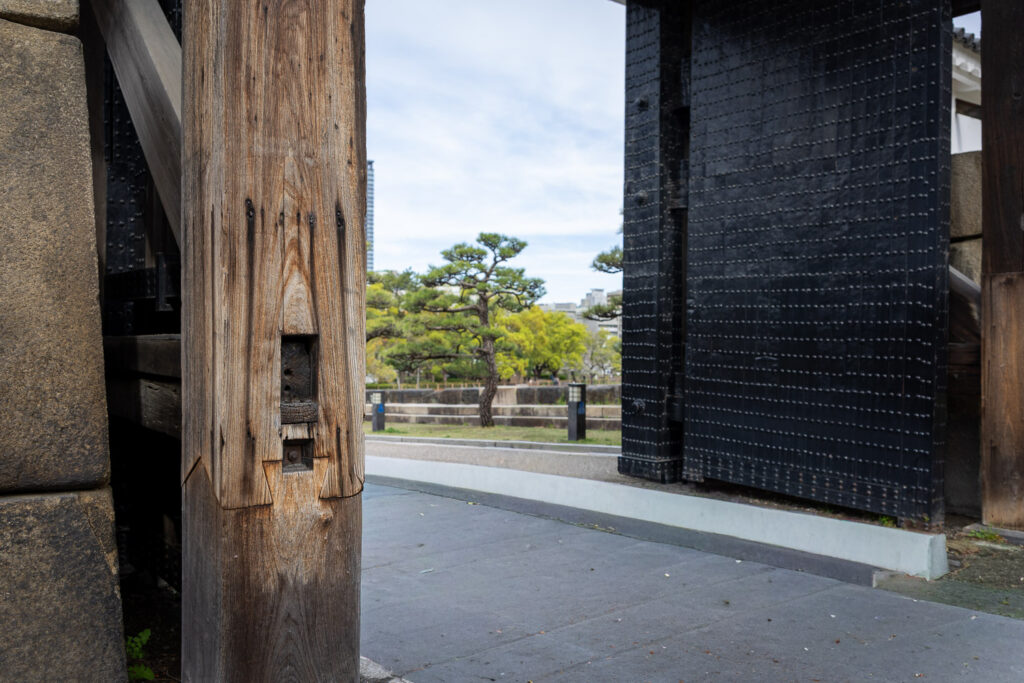
Ancient wooden pillar at Otemon Gate showing the mysterious basara-tsugi joint, Osaka Castle
The answer came in 1983, when X-ray imaging finally revealed the interior: an interlocking system of convex and angular forms, fitted together in three dimensions with a complexity that defied the tools of its era. The joint achieves something rare in any craft—structural strength, seismic flexibility, and visual elegance, simultaneously.
Four hundred years before earthquake engineering became a discipline, someone here had already solved the problem.
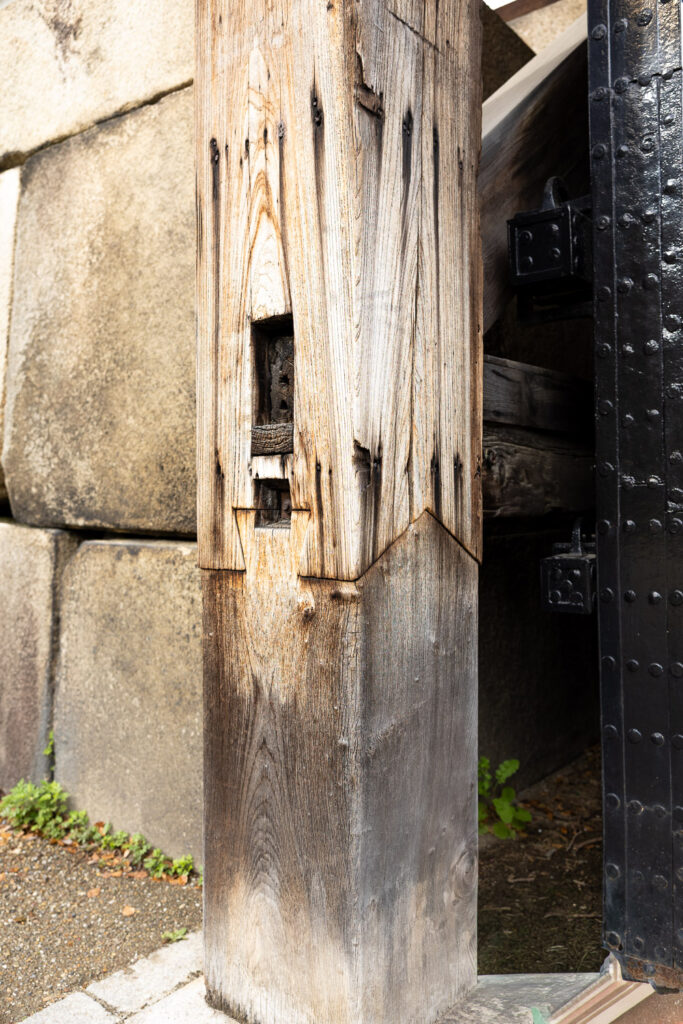
Close-up of the basara-tsugi wood joinery on the pillar at Otemon Gate, Osaka Castle
Today, a small community of Japanese carpenters has become obsessed with recreating it. They document the process on social media, sharing techniques that nearly vanished. Their videos travel quietly across the world. Two hundred years from now, historians may look back at those posts the way we look back at the printing press—a moment when ancient knowledge found a new transmission.
The man photographing the pillar understood this. I’m still not sure how.
→ Planning your visit? Start with
Osaka Castle: The Complete Insider’s Guide.
The Stone That Crossed the Sea
Look up from the pillar. Turn around.
Directly across from the Otemon Gate stands the Otemon Mitsukeshi-ishi, the fourth-largest stone ever brought to Osaka Castle. It was quarried on Shodoshima—a small island in the Seto Inland Sea—and transported here by sea during the castle’s construction.
I always pause at this stone. Not because of its size, though the scale is genuinely difficult to process. But because of what it represents: the sheer organizational force required to move an object this massive across open water, without machinery, without engines, without any of the tools we consider essential.
Osaka Castle is full of moments like this. Moments when the math simply doesn’t add up, and you’re left standing there, recalculating what humans were capable of.
The Unmarked Sign That Named a City
Between the Otemon Gate and the Sakuramon Gate, there is a small marker beside the path.
No English signage. Easy to miss. Most visitors walk past it.
This is the presumed site of Ishiyama Hongan-ji—a fortress temple of the Jodo Shinshu school of Buddhism, which grew from a modest retreat built here by the monk Rennyo in 1496. Over the following decades it expanded into one of the most powerful religious complexes in Japan, a city unto itself.
The area was known at the time as Osaka—written with the character for “small.” Someone, at some point, decided that wasn’t right. The character was changed to “large.” Osaka became Osaka.
The city’s name may have been decided here, beside a marker with no English translation.
Stand in front of it for a moment. It deserves that much.
Find the Octopus
Pass through the Sakuramon Gate and stop.
The stone directly in front of you is the Takoshi—the Octopus Stone—the largest single stone within the castle grounds, with a surface area of sixty square meters. It has no rival.
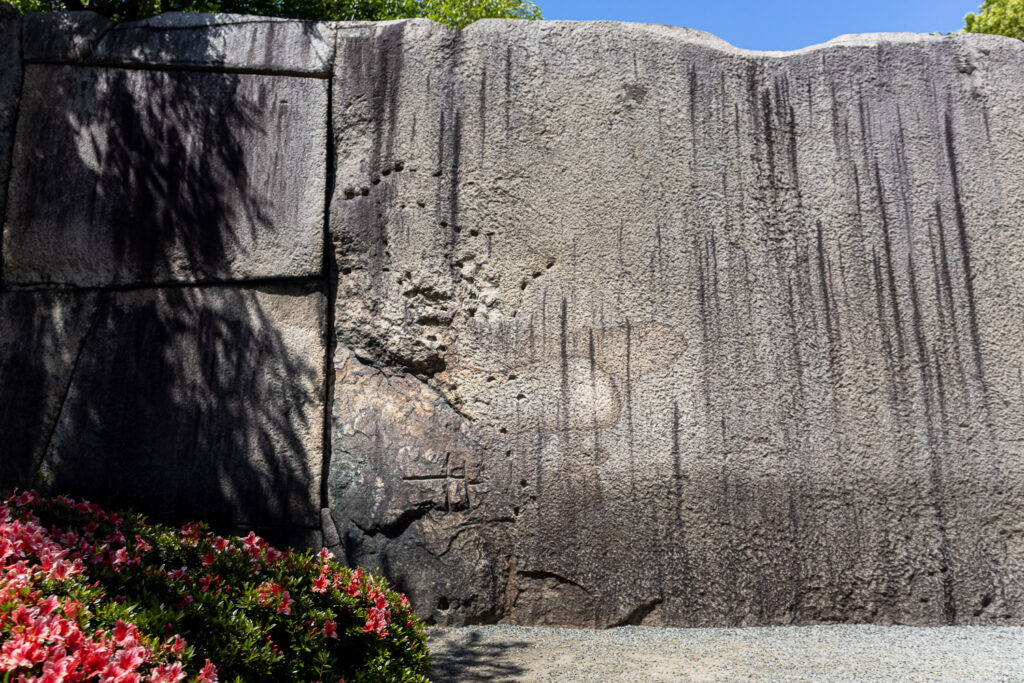
The Takoshi Octopus Stone, the largest megalith within Osaka Castle grounds, with azalea flowers in the foreground
Look at the lower left.
Somewhere in the surface of that stone, if the light is right and you’re patient, the shape of an octopus appears in the natural pattern of the rock. This is how the stone got its name. Finding it feels like solving something small but satisfying—the kind of discovery that makes you feel, briefly, like you’re in on a secret.
You are.
Three More Secrets Near the Keep
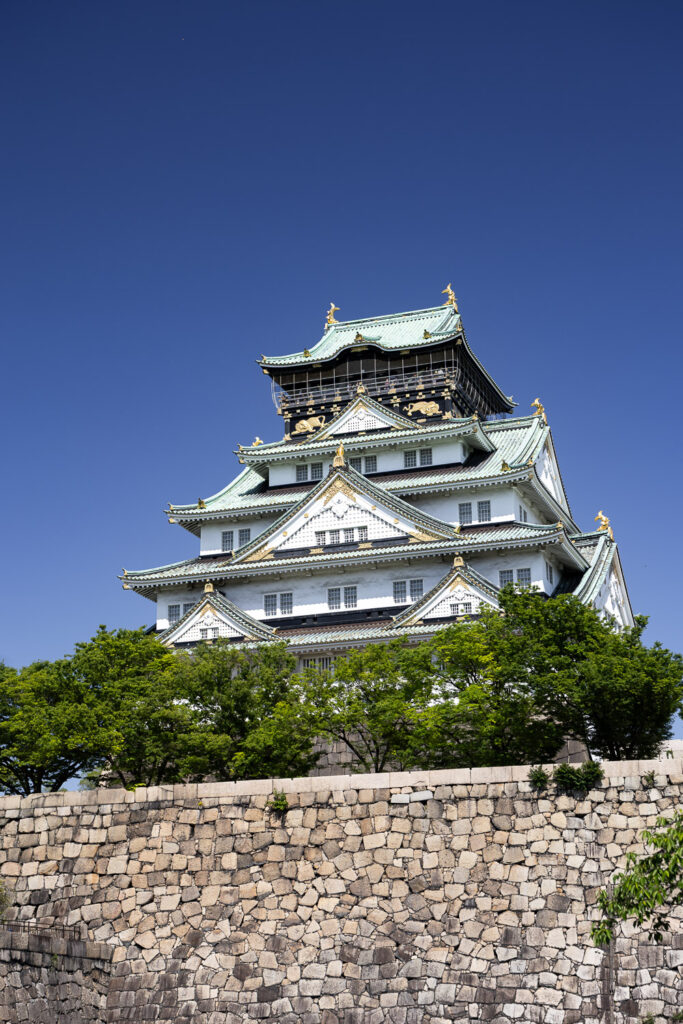
Why Is the Roof Green?
The first time I saw Osaka Castle’s roof, something felt off. Japanese castle roofs aren’t green. Not traditionally. Not like this.
The color comes from copper oxidation. What looks like tarnish is, in fact, a stable protective layer—a patina that seals the surface and extends the life of the metal significantly. The green isn’t decay. It’s armor.
Nature finished what the architects started.
The Well With No Gold
Near the keep, there is a well that was called Ougon-sui—Golden Water—throughout the Edo period.
The legend: Toyotomi Hideyoshi sank large quantities of gold into the well to purify the water. The water was said to be exceptionally clear, and the story stuck for centuries.
In 1959, researchers lowered equipment to the bottom of the well to investigate. No gold was found.
What they did find: the water is still there. Still visible from above, even now. Look down into it—carefully. And please don’t throw coins. The well has been through enough.
The Cannon That Isn’t
In front of the keep, there is what appears to be a cannon.
It isn’t.
It’s a signal gun—a goho, used to announce noon to the surrounding town during the Edo period. At midday, it fired. Not at anyone. Just into the air. A daily reminder that time was passing, that the castle still stood, that the city below was still running on schedule.
Someone decided a cannon was the right instrument for timekeeping. I find that very Osaka.
The Mystery I Never Solved
Walking back through the Otemon Gate, I thought again about the man with the phone.
Did he find the octopus? Did he look down into the well? Did he stop, even for a moment, at the unmarked sign that may have given this city its name?
I don’t know. He was gone by the time I circled back.
Osaka Castle keeps its secrets carefully. Even the people who know them.
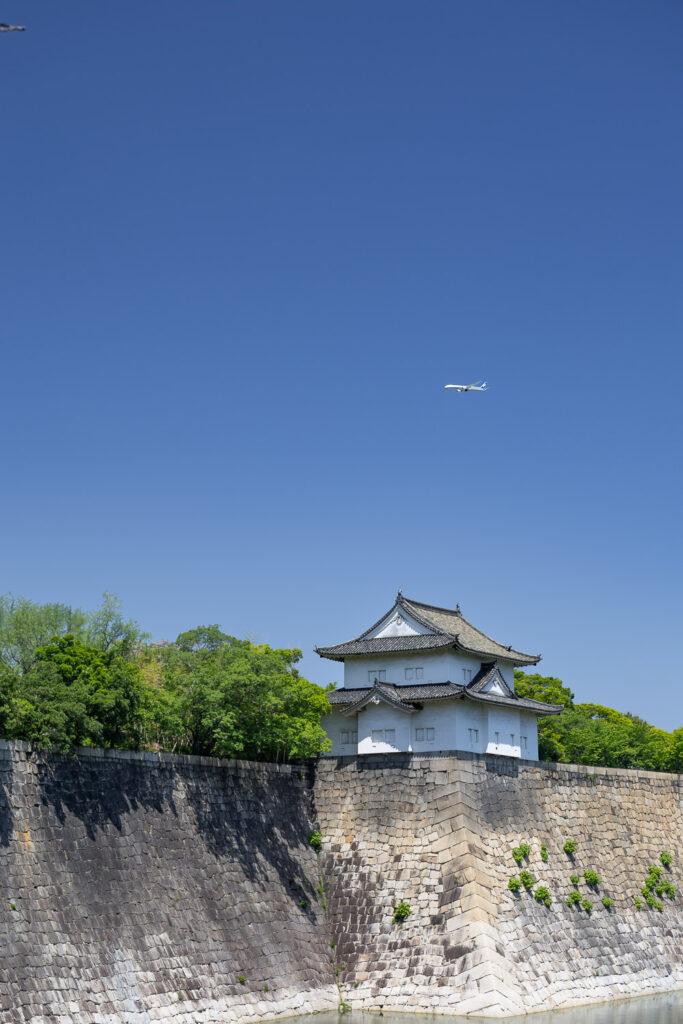
A traditional yagura turret at Osaka Castle with a modern airplane crossing the blue sky above
Want to go inside the keep? Everything you need to know about tickets, hours, and what to expect on the upper floors: Osaka Castle: A Complete Visitor’s Guide