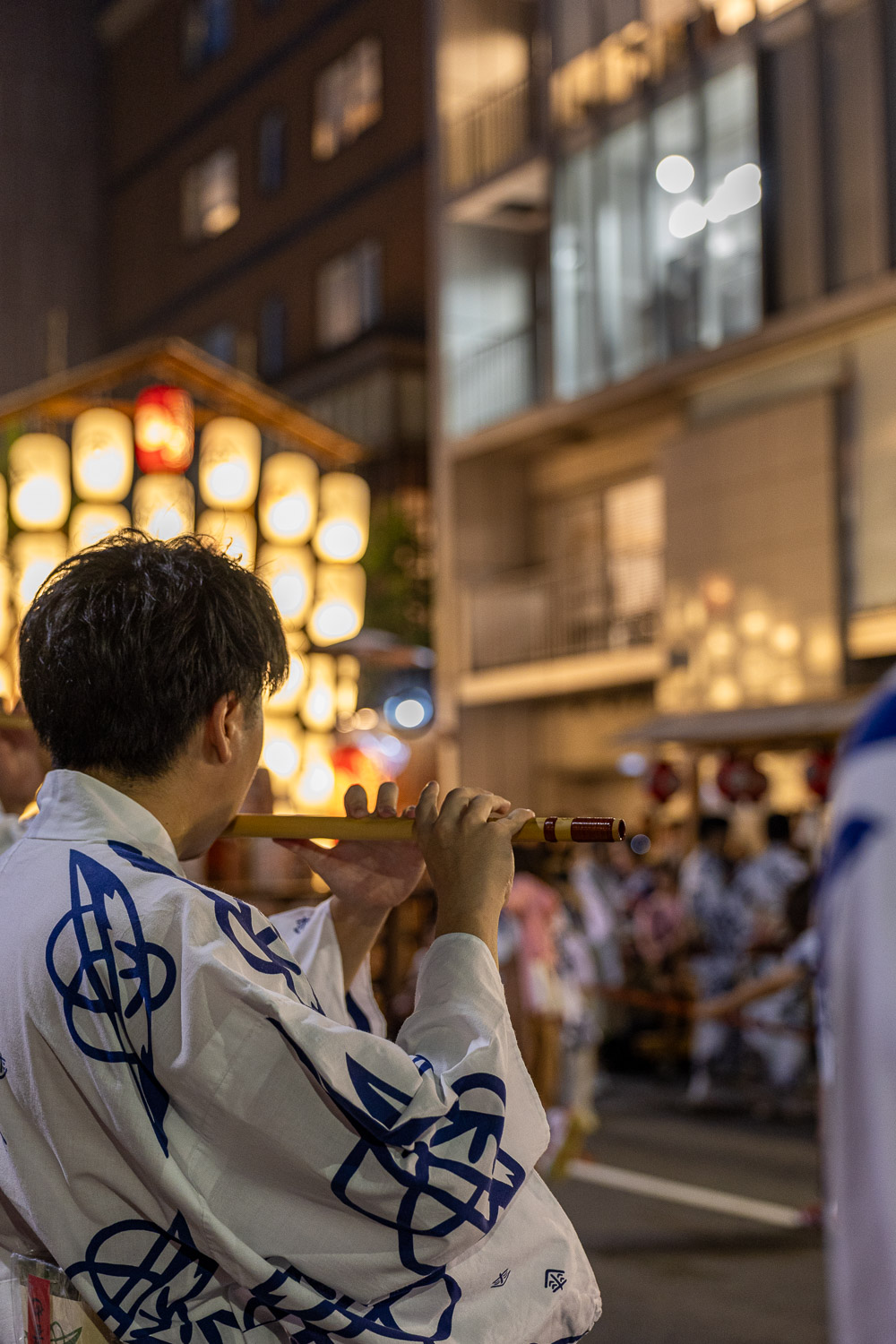
Every guidebook says the highlight of Gion Matsuri is the grand float procession on July 17. The guidebooks are not wrong. But ask people who actually live in Kyoto, and many of us will tell you something different: the real pleasure comes on the evenings before the parade, at Gion Matsuri Yoiyama.
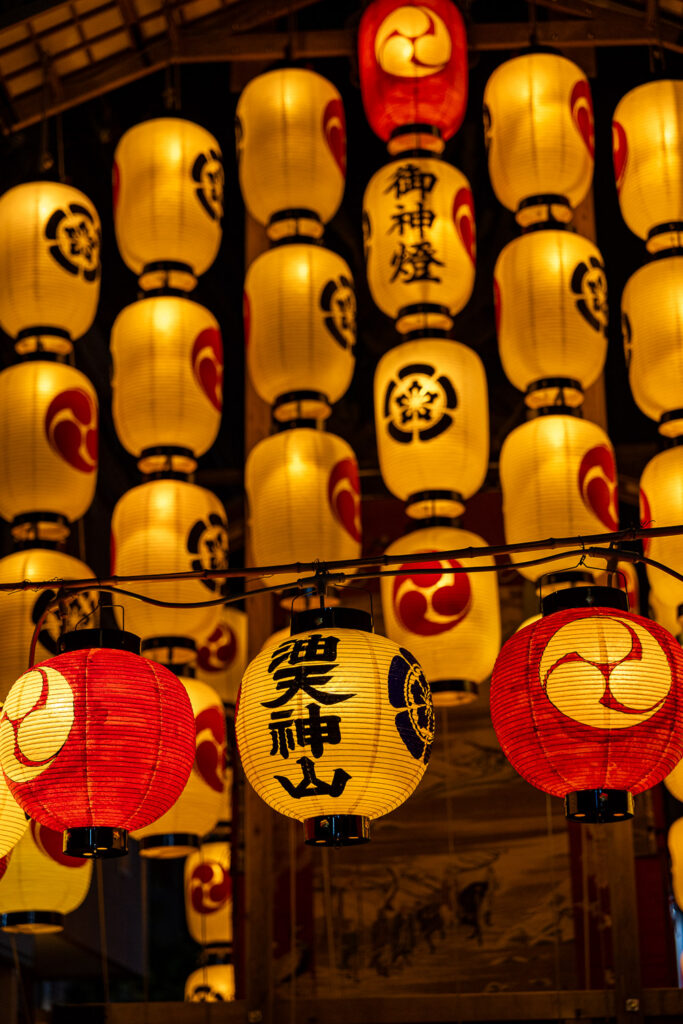
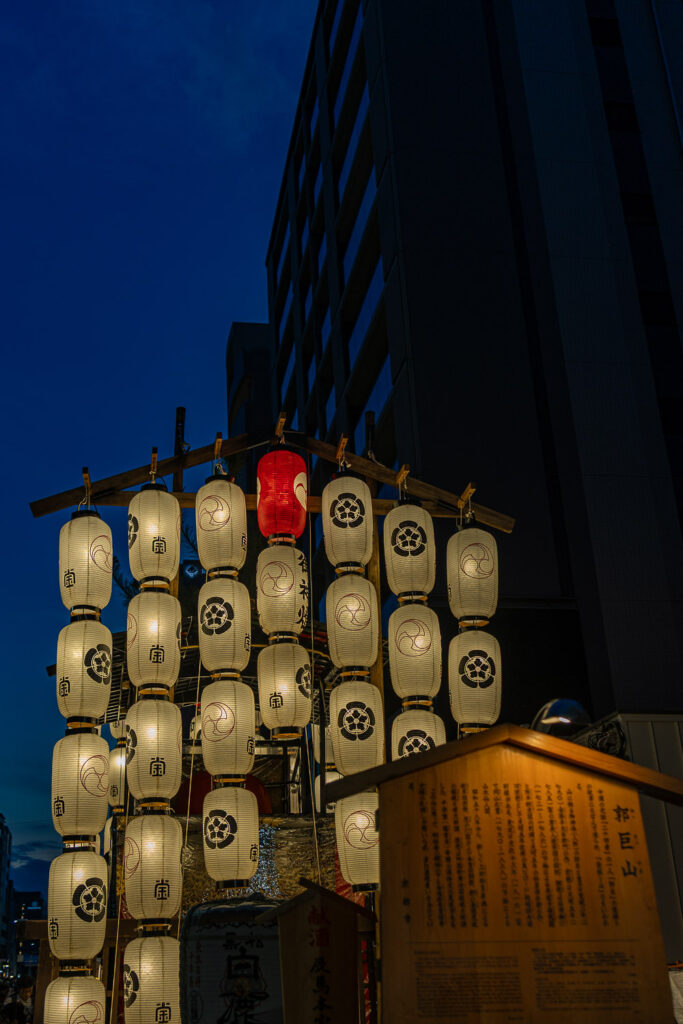
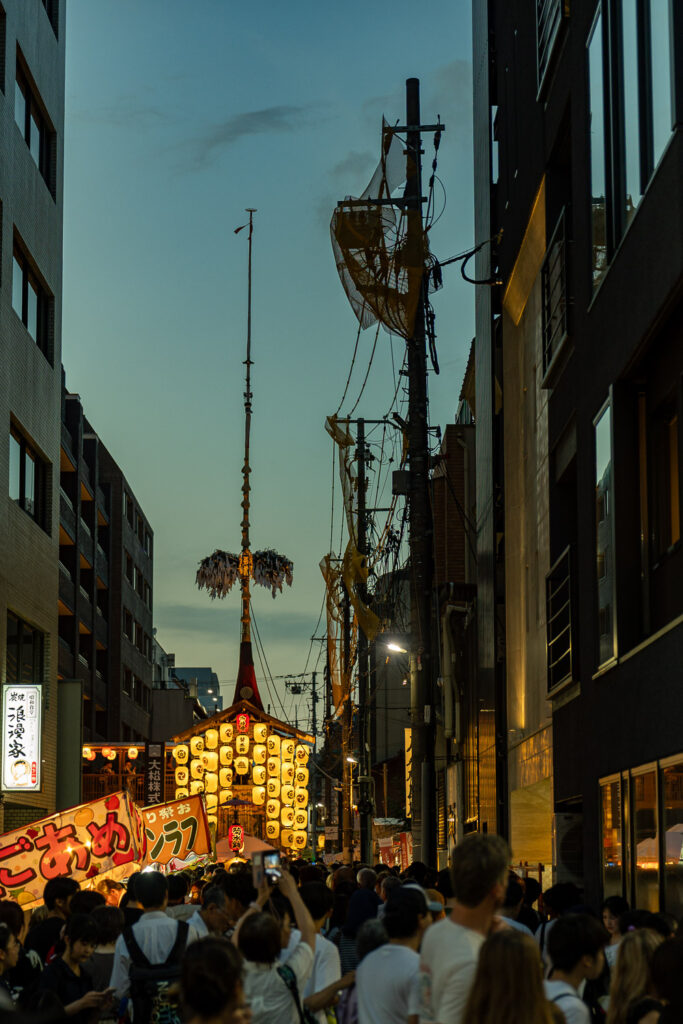
On the three nights leading up to the procession, the festival floats stand parked on the streets where they were built, dressed in rows of glowing paper lanterns. Festival music drifts out of the side streets. Shijo Street, normally four lanes of traffic, closes to cars and fills with people in yukata. The floats don’t move. They simply stand there, lit up, waiting.
I go every year. And every year, I make the same mistake. I’ll get to that.
Naginata Hoko: The Rolex of Festival Floats
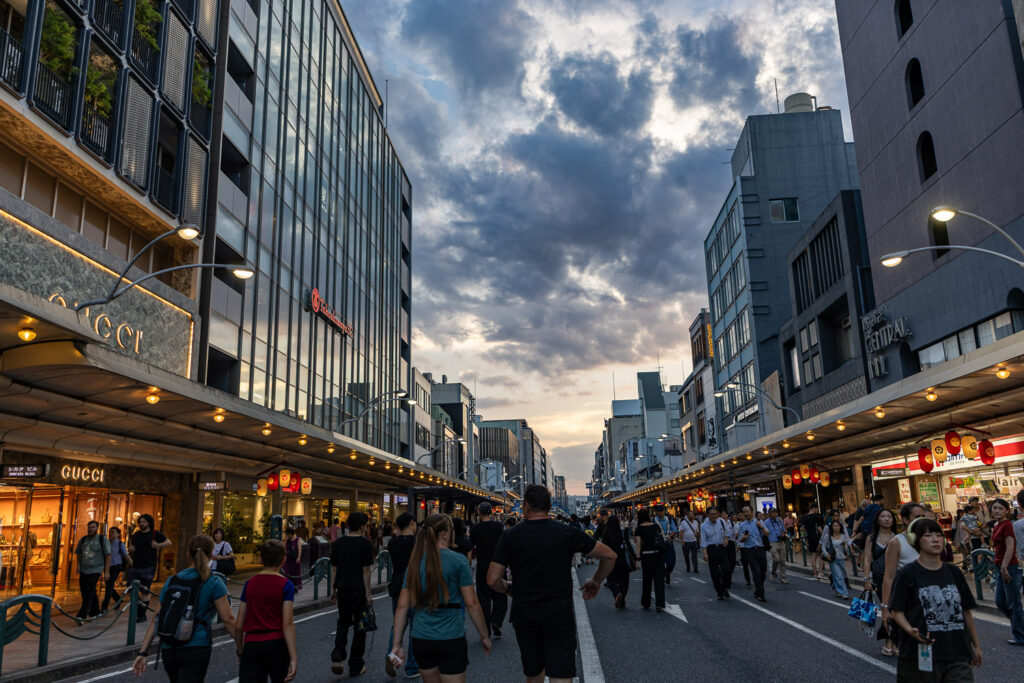
Start at the corner of Shijo-Karasuma. Walking from Kawaramachi toward Karasuma, the first float you meet is Naginata Hoko, and it is the one to see.
There are more than thirty floats in the Gion Festival, and they have a hierarchy, the way watches do. If the floats were watches, Naginata Hoko would be the Rolex. The crowd around it stands three deep. The line for its charms starts in the morning. Even visitors who cannot name a single other float know this one. It is also the only float guaranteed to lead the procession every year; on parade morning, a sacred child called the chigo rides aboard and cuts the rope that opens the festival.
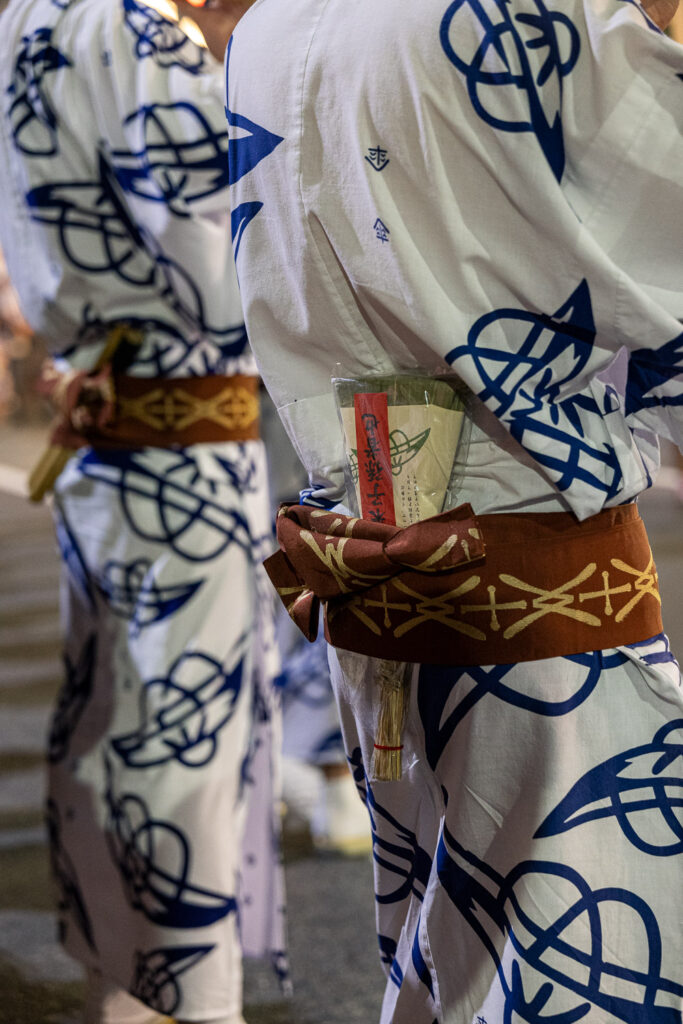
The morning news confirmed its status. People had been lining up since early morning to buy Naginata Hoko’s chimaki, the woven bamboo-leaf charms sold at each float. A chimaki is not food; it is a protective amulet that Kyoto households hang above their doors for the year. And for this one, people queue like it’s a product launch. That is what brand power looks like in a 1,100-year-old festival.
A Sunset You Can Only See Two Nights a Year
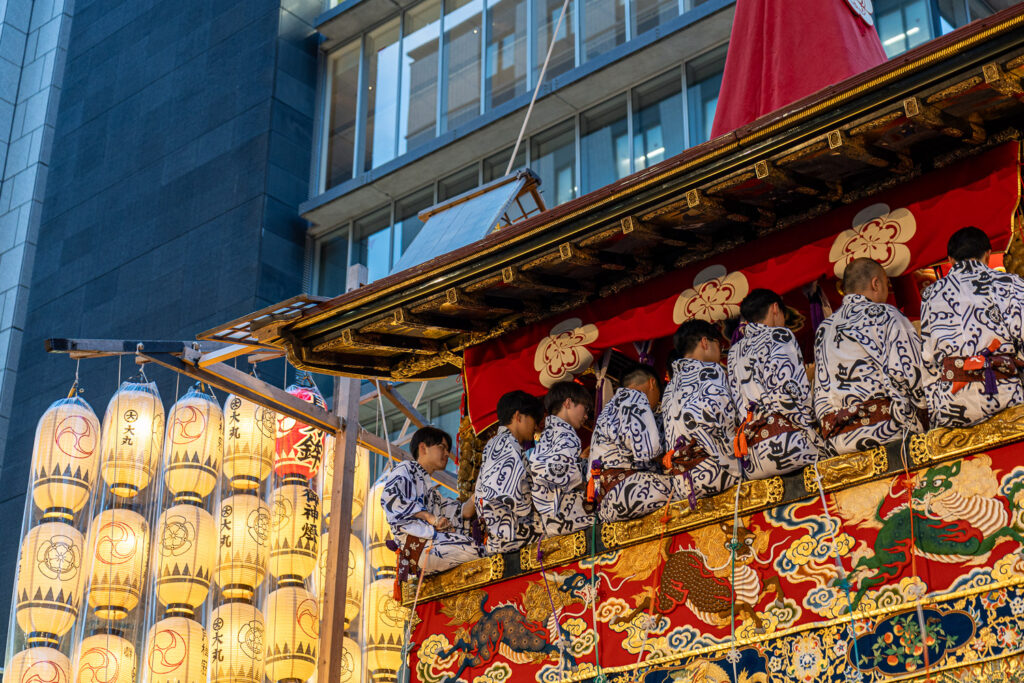
Head west along the pedestrian zone. Somewhere past Fuya-cho, you’ll see it: the silhouettes of Kanko Hoko and Tsuki Hoko rising out of the crowd, and far beyond them, the sun going down at the end of Shijo Street.
This view exists for only a few evenings each July. You are standing in the middle of a street that is closed to cars for just two nights a year, watching the sky burn out behind two wooden towers that were designed centuries before the buildings around them. When the weather cooperates, it is one of the finest moments the festival offers.
The weather did not cooperate. Clouds rolled in, the sunset was canceled, and I stood there thinking I should have come the night before, too. The street closes to cars on only two nights each July. I had spent the first of them at home, sitting in front of the air conditioner. Learn from me.
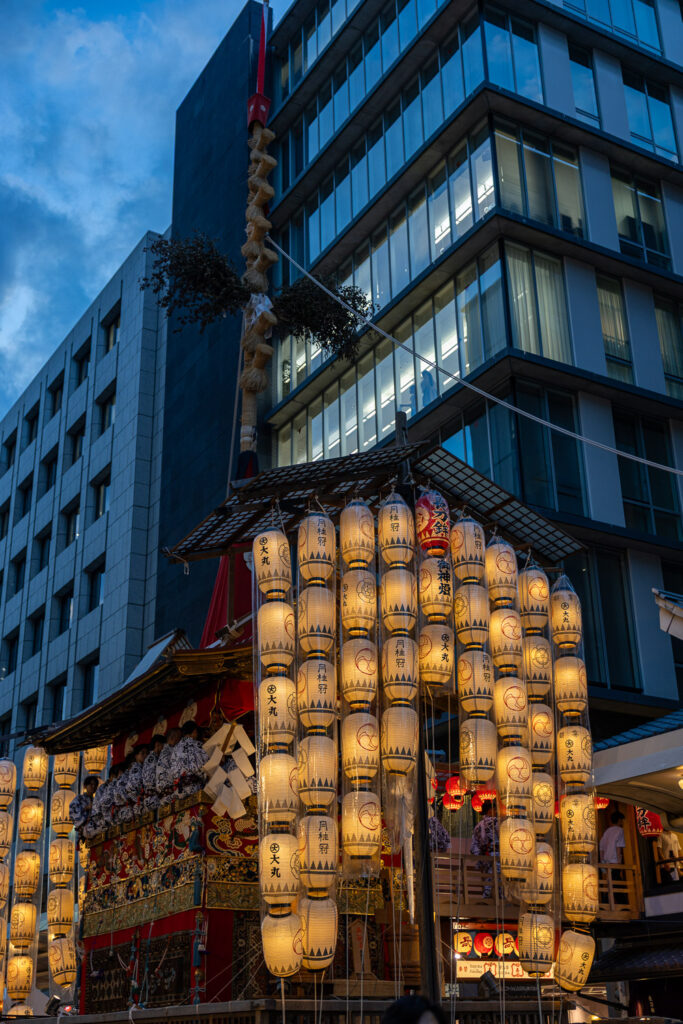
Shaved Ice, Surrendered
Did I mention the heat? Kyoto in July is famous for it, and the sun going down changes surprisingly little. The air stays thick and the humidity stays personal. What I wanted was kakigori, shaved ice, the festival’s classic answer to a night like this. What I found was the line for it. I took one look and gave up. A convenience-store ice cream and a bottle of water did the job instead, and finding a konbini near Shijo takes about thirty seconds in any direction.
Here is the other thing about central Kyoto: there is almost nowhere to sit. No benches, no plazas, no chairs. But on this one night, people settle onto curbs and storefront steps with their festival food, and for one night, nobody minds. Use it.
Learning to Tell the Floats Apart
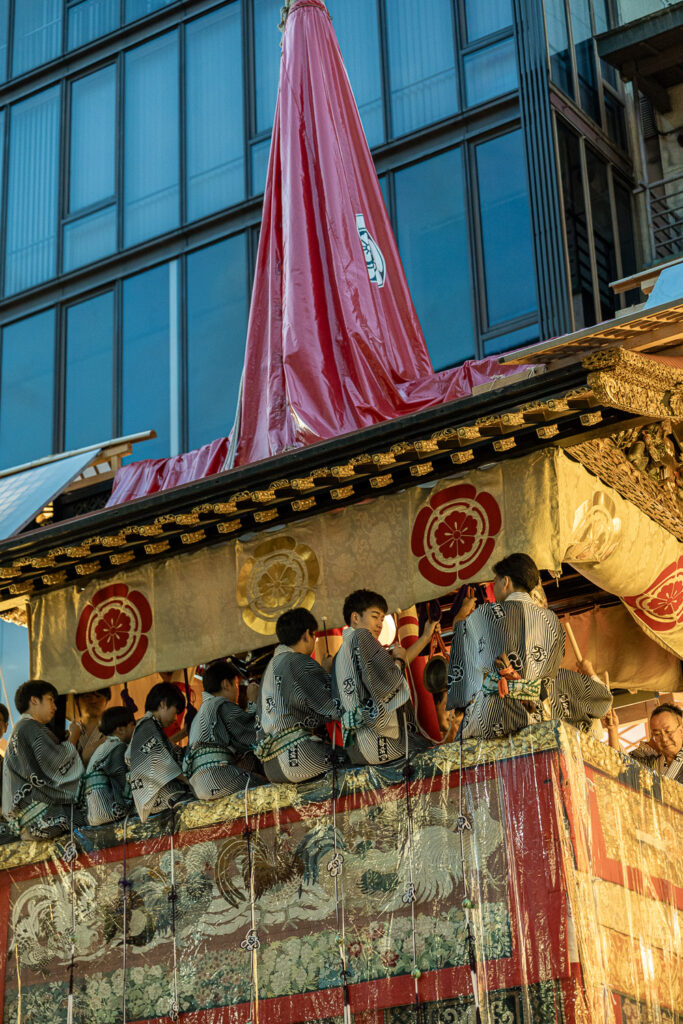
At first, they all look the same. Lanterns, wood, music. When I started coming to Yoiyama, that was honestly my level of appreciation: the lanterns are pretty.
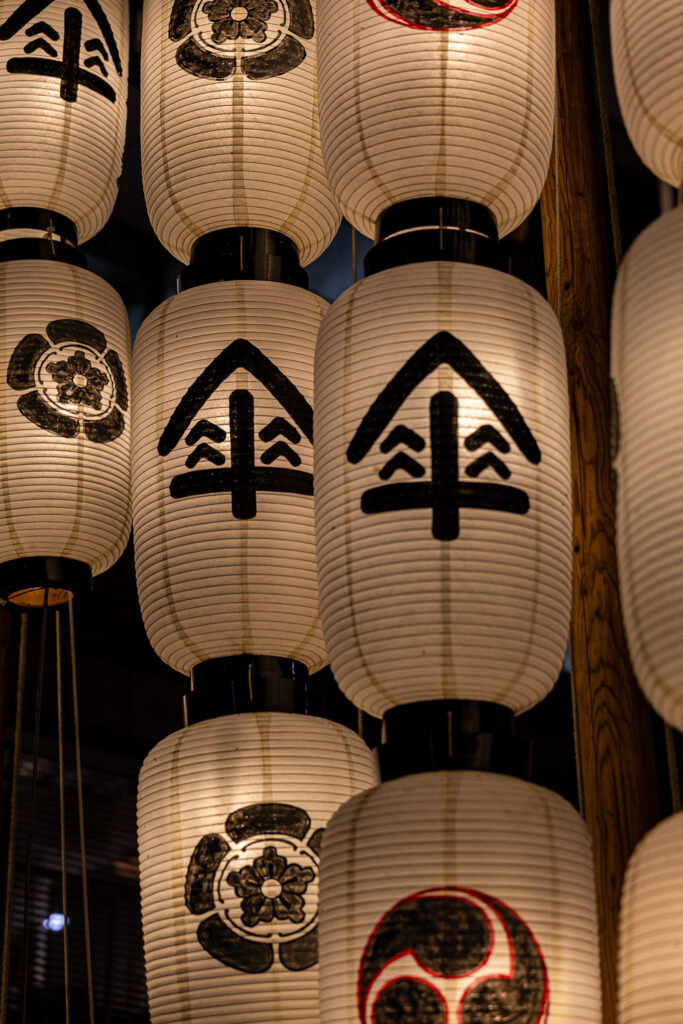
The big-name floats cluster around Shijo and Karasuma the way luxury boutiques cluster on a single block. But stop and look closely and the differences open up. The tapestries hanging on their sides come from different centuries and different continents; a few floats display European weavings older than the United States. The metalwork is different. The lantern crests are different. Calling them all “floats” starts to feel as lazy as calling a Cartier and a Casio both “watches.”
It took me years of living in Japan to start seeing these distinctions, so if everything looks identical on your first Yoiyama, you are in good company.
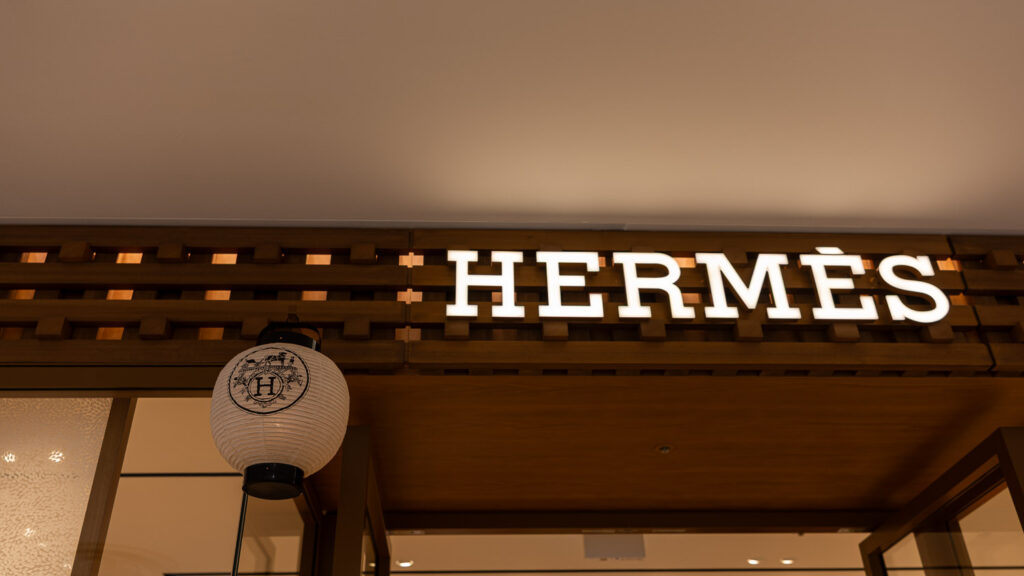
Even the luxury brands play along. Outside the Hermes boutique on Shijo, a white paper lantern hangs from the eaves, printed with the house’s carriage emblem. A Paris maison, bowing in washi paper to a festival nearly a millennium its senior.
Chasing the Music Down One-Way Streets
Then you hear it. From somewhere in the grid of side streets comes Gion-bayashi, the festival music: a hypnotic loop of gongs, flutes, and drums that Japanese people describe with the onomatopoeia “kon-chiki-chin.”
You will want to walk toward that sound. Here is the catch: on the most crowded streets, foot traffic runs one-way. The music pulls you right while the crowd control points you left, and the sound you wanted drifts further away with every step. You surrender and go where the crowd goes.
Somewhere west of Shijo-Karasuma, I remembered my annual failure. Every year I mean to plan a route in advance. Every year I don’t, and end up drifting wherever the one-way streets decide to take me. I’ve put a route strategy in the practical section below, so at least my negligence can be useful to someone.
The Most Reliable Way to See the Musicians Up Close
I have a favorite float. It is one of the smaller ones, and I won’t name it, for reasons that will become clear.
For years I have wanted to watch its musicians perform at close range. The problem is geography. The float stands on a street so narrow that waiting there for the performance is prohibited; the crowd would choke the block. The musicians play only a few times each evening. If you happen to pass at the right moment, you win. I never have. And judging by how fast that little street fills the instant the music seems about to start, everyone else has the same idea.
At home that night, I looked at the float association’s website and found something unexpected: a recruitment notice. They were looking for new musicians.
So there it is. Rather than fighting for a front-row spot, the surest way to see the performance up close is to be in it. Some situations in life offer only two options, spectator or participant, and that narrow street is one of them. If you spot me next July in a yukata, holding a flute and looking terrified, consider it the follow-up to this article.
Toro Yama: The Float With a Praying Mantis on Top
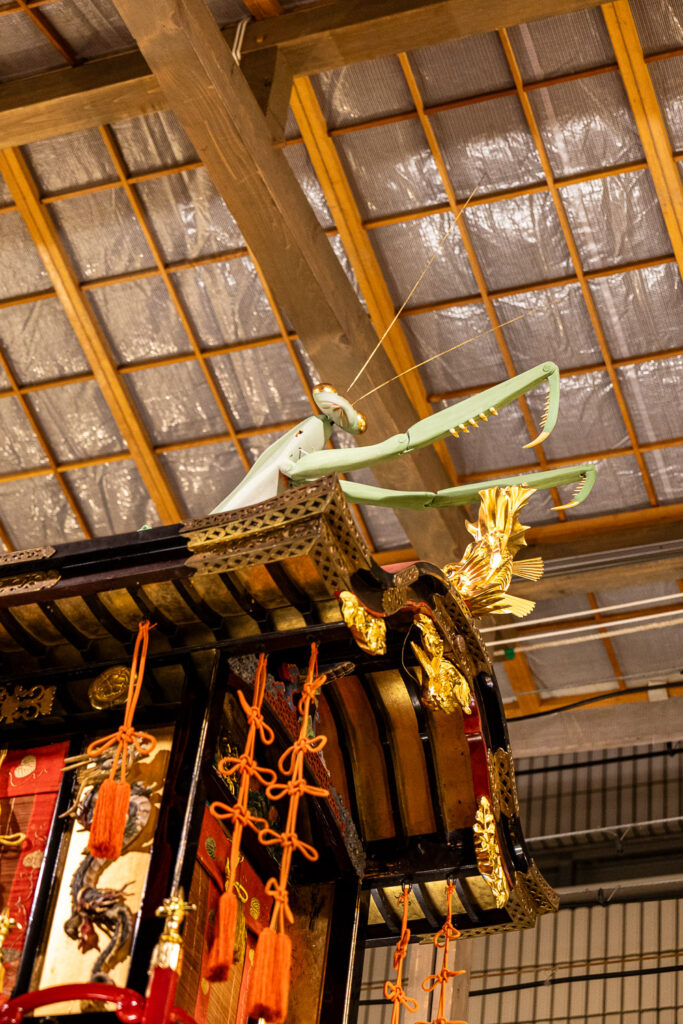
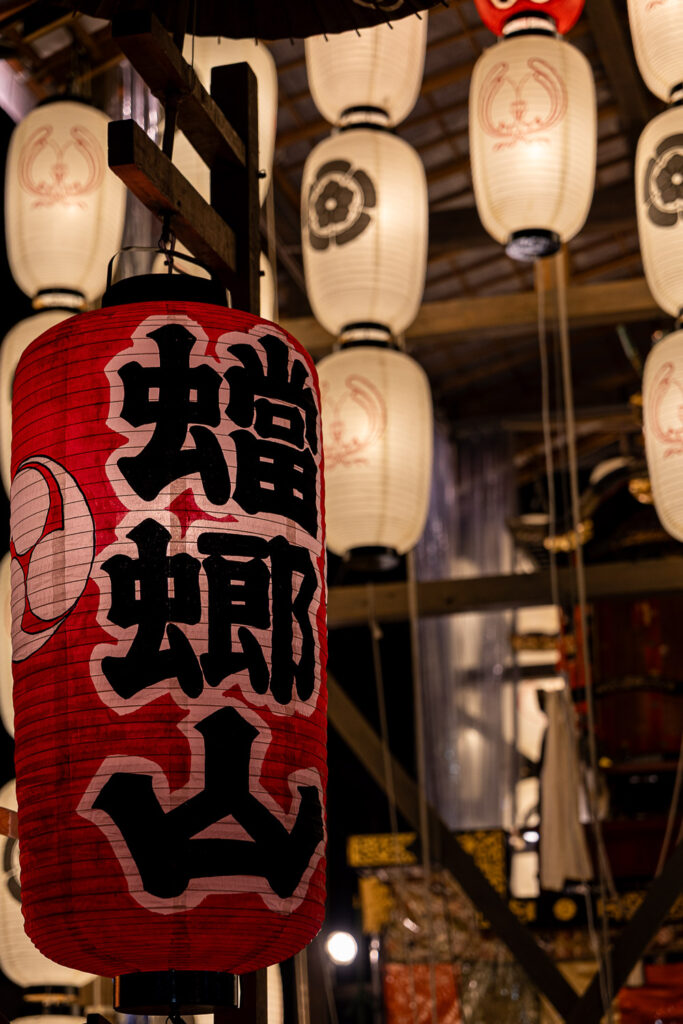
Remember the luxury watch analogy? Toro Yama breaks it. No watchmaker I know of puts a giant praying mantis on the case. Yet there it sits on the float’s roof: a pale-green mantis with gilded fittings, forelegs raised, ready to swing at something far larger than itself.
Why a mantis? I look at this float every year, and every year I have completely forgotten. So every year, I read the wooden plaque in front of it. According to the plaque, a 14th-century court noble named Shijo Takasuke lived in this neighborhood and fought so fearlessly against impossible odds that people compared him to the proverbial mantis raising its axe against a cart. In 1376, a Chinese-born resident of the same neighborhood honored him by mounting a large mantis figure on the Shijo family’s ox carriage and parading it through the streets. The float has carried one ever since.
I read it, I nod, I understand, and by next July it will be gone again. Call it a system: festival history, absorbed at the rate of one plaque per year.
A Flute in the Dark: Walking Alongside Kikusui Hoko
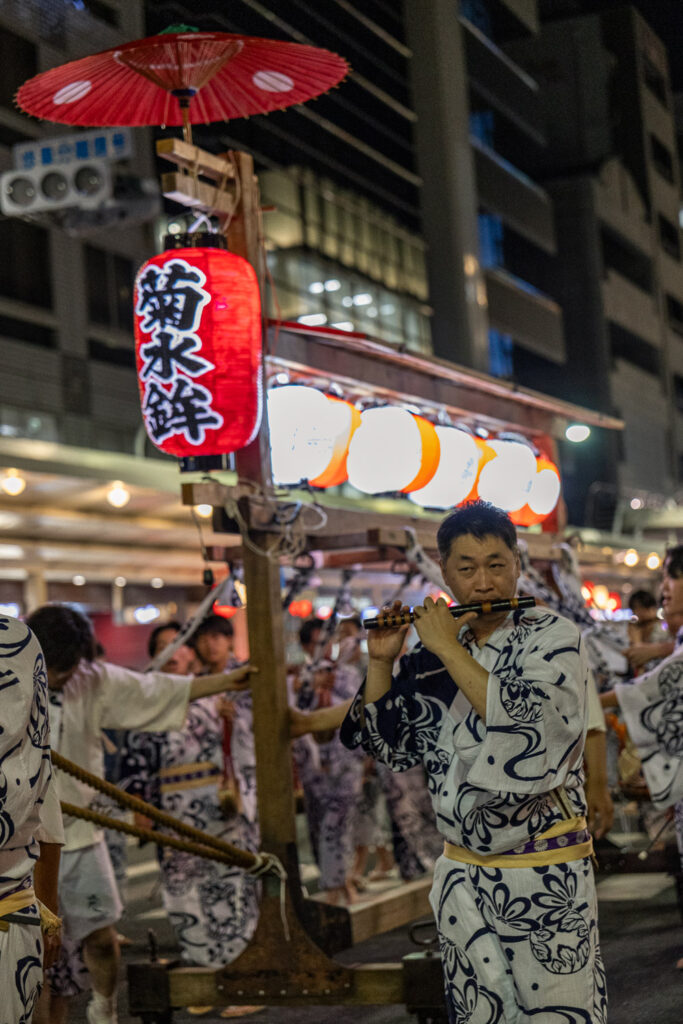
The night gave me one more scene. On the walk back toward Kawaramachi, I found myself moving alongside a procession of red lanterns marked “Kikusui”: the musicians of Kikusui Hoko, out in the streets.
Gion Matsuri is, on the whole, an elegant festival. The floats are sometimes called moving museums, and the mood matches: refined, composed, a little reserved. This group was different. There was heat in it. A flute carried over the crowd noise, and as the procession moved, it picked up tourists, phones raised, the way a river picks up leaves, until the group had swollen to several times its size.
Yoiyama does this. The best moments are on no schedule and no map; they simply happen in front of you, once, and then dissolve. Which is exactly why you should not pack this evening too tightly with plans.
The night ends the way it began, in a slow river of lanterns and yukata drifting toward the stations. To walk these unpredictable evenings well, though, a little planning goes a long way. Here is what you actually need to know.
Gion Matsuri Yoiyama: Practical Information
Dates
The Yoiyama evenings of the first parade (Saki Matsuri) run every year on July 14, 15, and 16. The float procession itself takes place on the morning of July 17. The three evenings are called Yoi-yoi-yoiyama (July 14), Yoi-yoiyama (July 15), and Yoiyama (July 16). Official schedules are posted in English by Yasaka Shrine, the shrine behind the entire festival.
Pedestrian Zone Hours
Shijo Street and part of Karasuma Street typically close to traffic on the evenings of July 15 and 16 only, from around 6:00 p.m. to around 11:00 p.m. On July 14 the floats are lit but the streets stay open to cars. One-way walking rules are enforced on crowded blocks, so where you can go is not always where you want to go.
Food Stalls
Street food stalls set up on July 15 and 16, generally from around 4:00 p.m. to around 11:00 p.m., though hours vary by stall. Expect classic Japanese festival food and long, happy lines.
Heat, Water, and Restrooms
Kyoto in mid-July is seriously hot and humid, and the heat barely eases after sunset. Carry water; the convenience stores along Shijo restock all evening and double as air-conditioned refuge. Restrooms are easier to find than you might fear: most convenience stores let you use theirs, and there are also public toilets, department stores such as Daimaru and Takashimaya, and the commercial buildings attached to the stations. Go before you commit to the thickest part of the crowd, and remember there is nowhere to sit except the ground.
Buying a Chimaki
Each float sells its own chimaki charm at its neighborhood stand, and each float’s charm carries a different blessing. Popular floats, Naginata Hoko above all, can sell out. If you want a specific one, go in the morning.
Getting There
The festival area centers on Shijo-Karasuma. The closest stations are Karasuma and Kyoto-Kawaramachi on the Hankyu Line, and Shijo Station on the Karasuma subway line. Roads around the area are restricted during Yoiyama, so trains are the only sensible option. https://www.google.com/maps/embed?pb=!1m18!1m12!1m3!1d3268.1191313970667!2d135.75509915983952!3d35.00372284562682!2m3!1f0!2f0!3f0!3m2!1i1024!2i768!4f13.1!3m3!1m2!1s0x6001089a3a451a29%3A0xa057eeb4b5ef0f85!2z54OP5Li46aeF!5e0!3m2!1sen!2sjp!4v1784720943959!5m2!1sen!2sjp
How to Walk It
Crowds peak between 8:00 and 9:00 p.m. If you want time with the floats rather than with the backs of strangers’ heads, start around 6:00 p.m. Decide which floats you want to see before you go, and check their positions on the festival map, because the one-way rules make backtracking difficult. A route that works well: start with the great hoko on Shijo Street (Naginata Hoko, Kanko Hoko, Tsuki Hoko), then head north into Muromachi and Shinmachi Streets, where the smaller yama stand in quieter, more intimate lanes.
If you are building a full Gion Matsuri itinerary, the festival has quieter chapters most visitors never see. I wrote about one of them here: Gion Matsuri’s other night: the Omukae Chochin procession and Mikoshi Arai.
Frequently Asked Questions
What is a chimaki?
A chimaki is a protective charm made of woven bamboo leaves, not food. Kyoto households hang one above the entrance for a year to ward off misfortune, then exchange it for a new one at the next Gion Festival. Each float sells its own version with a different blessing.
What time are the food stalls open at Yoiyama?
Generally from around 4:00 p.m. to around 11:00 p.m. on July 15 and 16, though exact hours vary by stall.
Should I see Yoiyama or the float procession?
If you want to eat, drink, and soak in the festival atmosphere, choose Yoiyama; it is an evening where you move from float to float on foot. At the procession on July 17, the floats come to you, so you can pick a spot and wait. See both if you can: Yoiyama shows you the floats at rest, the procession shows them in motion.
What happens if it rains?
Stalls stay open in light rain but may shorten hours or close in a downpour, and Kyoto in July is capable of sudden torrential bursts. The floats themselves are wrapped in clear plastic covers to protect their centuries-old tapestries. Lanterns glowing through rain-streaked plastic is not the photo you came for, but it is its own kind of Yoiyama scene.