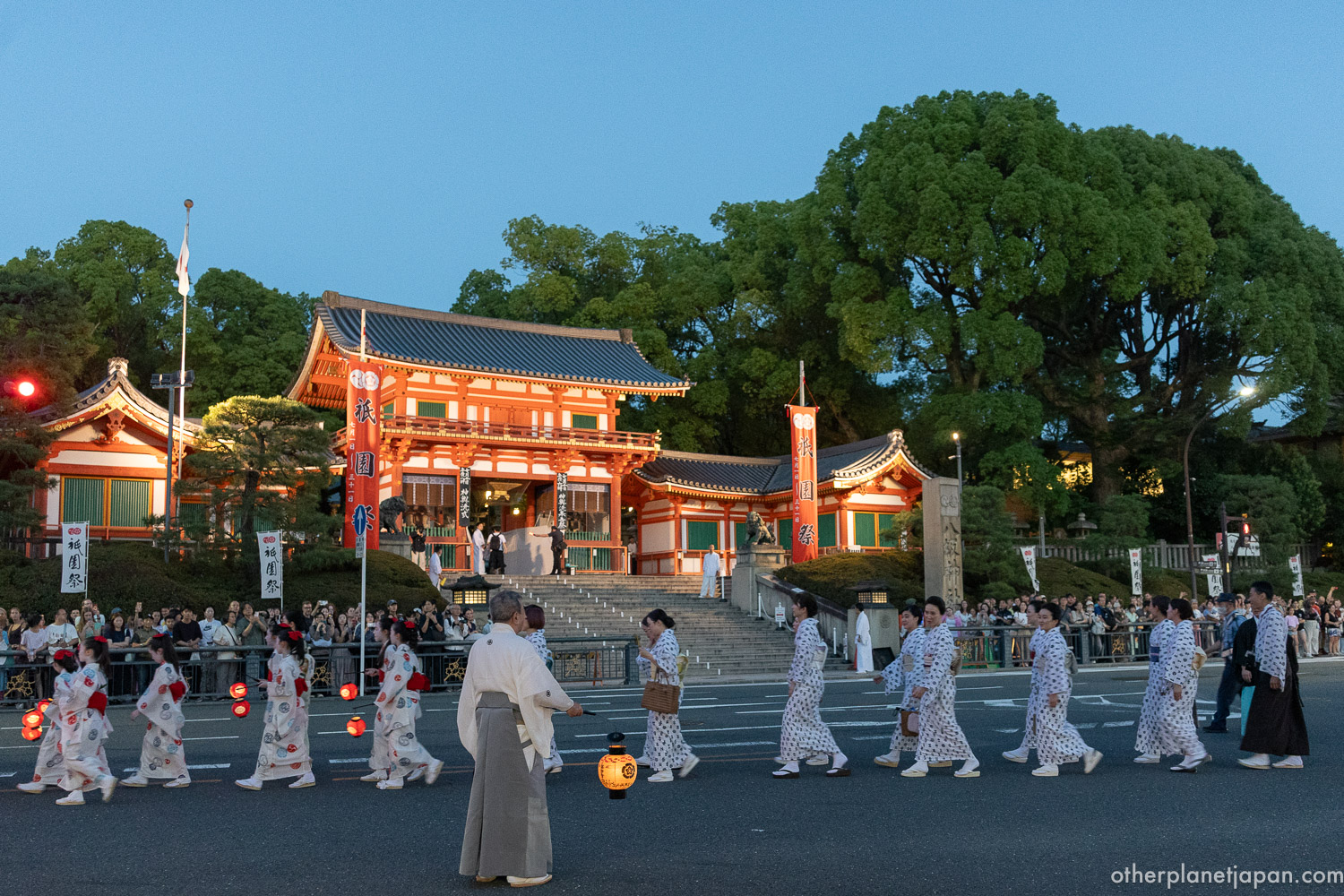
The moment I climbed the stairs out of Gion-Shijo Station, a wind hit my face like the exhaust of a hair dryer. This particular kind of wind, I had always believed, existed in exactly two places: in front of an actual hair dryer, or beside a heating vent in the dead of winter. In Kyoto in July, it blows outdoors, with no off switch.
The Omukae Chochin procession was about to walk through this air all the way to Kyoto City Hall and back. I hadn’t seen a single participant yet, and I already felt sorry for all of them.
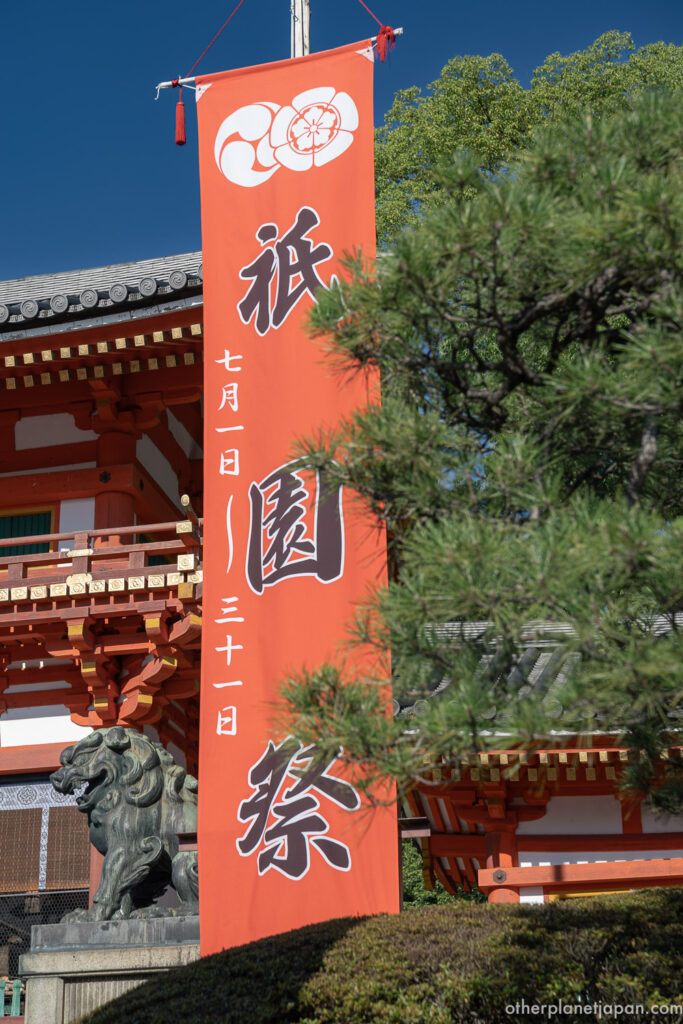
Ask most travelers about Gion Matsuri, Kyoto’s month-long Gion Festival, and they’ll describe the Yamaboko Junko, the grand parade of towering floats on July 17. But the festival actually runs the full month, July 1 through 31. [INTERNAL LINK: full Gion Matsuri month-by-month guide / July-in-Kyoto sub-pillar, once published] And here is the part almost nobody tells you: those magnificent floats are not vehicles for the gods. The gods ride the mikoshi, the portable shrines. The floats parade to purify the streets the mikoshi will pass through: a spectacular opening act for the main event.
July 10 is the day the mikoshi stir for the first time all year. In the late afternoon, children walk the streets in the Omukae Chochin lantern procession. After dark, fire and sacred water take over in the Mikoshi Arai purification. One day, two entirely different faces. What follows is that whole arc, from the blinding afternoon into the fire.
What Is Omukae Chochin? A Welcome Written in Lanterns
Omukae Chochin translates, more or less, as “welcoming lanterns.” That evening, one of Yasaka Shrine’s mikoshi will travel to Shijo Ohashi Bridge for its ritual purification — and this procession goes out to welcome it with lanterns held high. The afternoon parade and the night ritual aren’t separate events. They are two chapters of the same story.
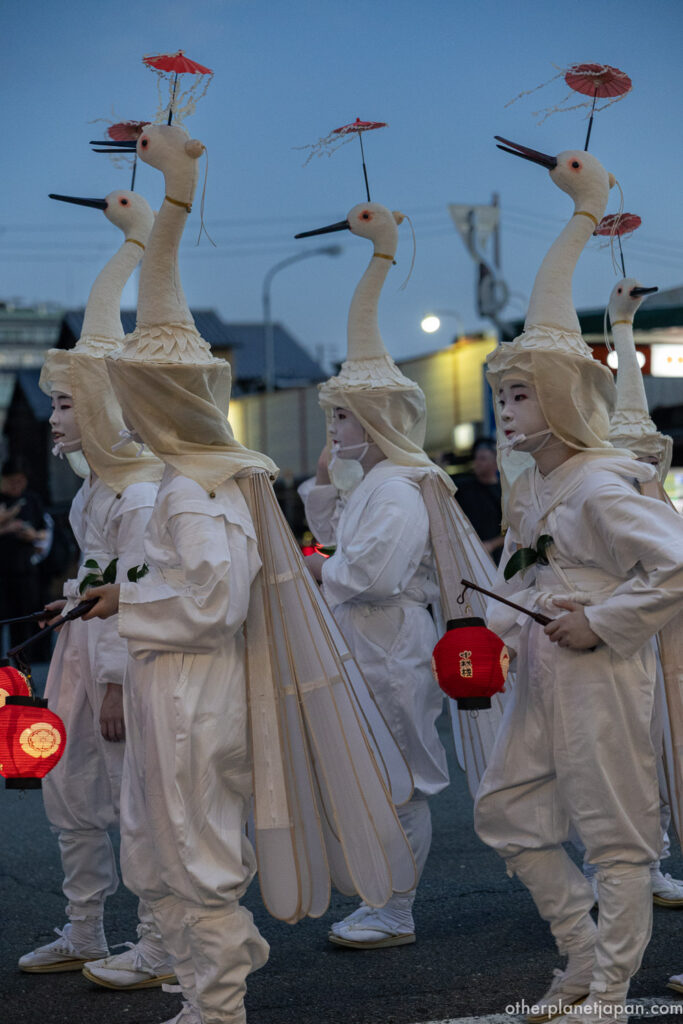
The procession carries some of Kyoto’s oldest performing arts along with it, none more improbable than the Sagi Odori, the heron dance: children draped in white feathers, an art that seems too delicate to have survived centuries of summers, and yet here it is.
According to a festival official who spoke at City Hall that evening, Omukae Chochin died out at one point and was revived roughly seventy years ago. Kyoto is full of traditions like this: interrupted, then stubbornly resumed.
![Golden mikoshi portable shrines of Yasaka Shrine resting in their storehouse before Gion Matsuri]](https://otherplanetjapan.com/wp-content/uploads/2026/07/gion-matsuri-golden-mikoshi-portable-shrines-kyoto-683x1024.jpg)
4:30 PM, Yasaka Shrine — Shade Before Spectacle
For a 4:30 start, the area around Yasaka Shrine was strangely calm. Near me stood a group of Western travelers wearing the unmistakable expression of people wondering if they’d gotten the date wrong. I understood completely. Gion Matsuri’s reputation is wall-to-wall crowds, and this was nothing of the sort.
The evidence, however, was already assembling: the procession stood in formation on the street beside the shrine.
What amused me was the logic of the spectators’ positioning. At this hour, nobody was competing for the best view of the procession. They were competing for shade. In midsummer Kyoto, the second row under an awning beats the front row in full sun, every time. I managed to claim a spot that put exactly half of my body in shadow. It reminded me of the sol y sombra seating at a bullring I once visited in Spain: sun tickets cheap, shade tickets expensive. Here, both came at the same price. Free.
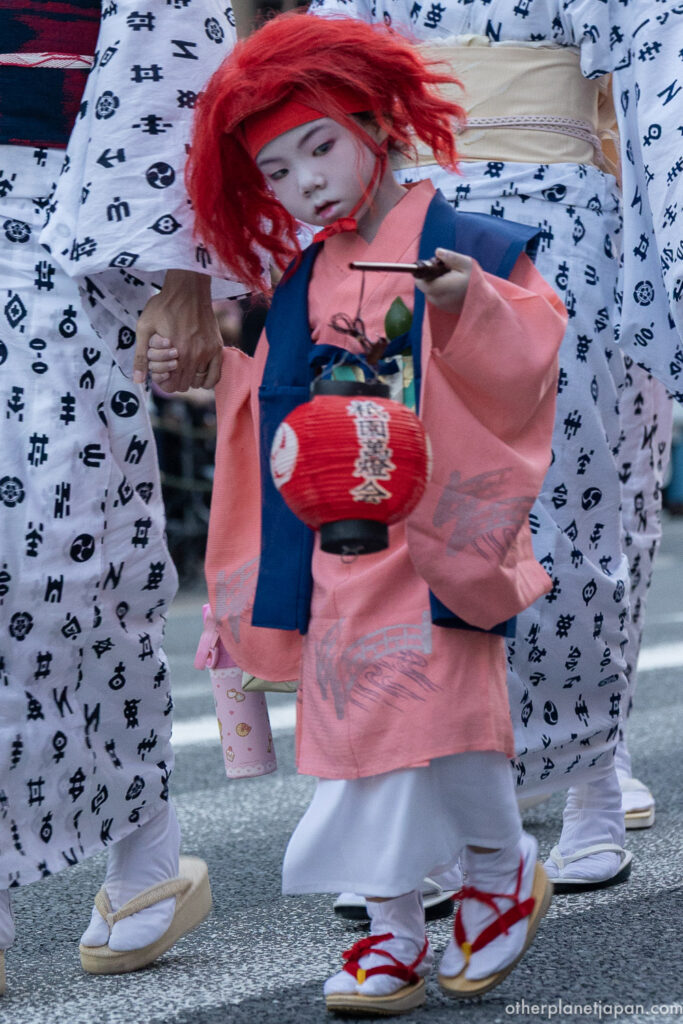
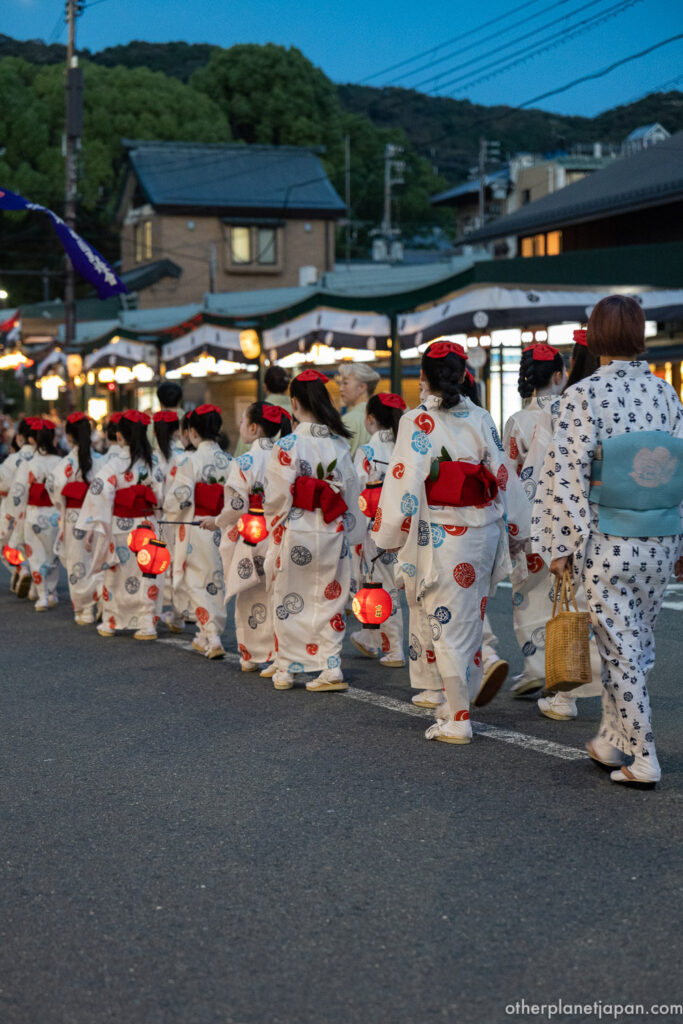
The procession began to move. A child in a flame-red shaguma wig walked past, one hand gripping a lantern, the other an adult’s hand. Farther back rode a boy in courtly dress, an umaosa chigo, waving from horseback with the gravity of a small dignitary.
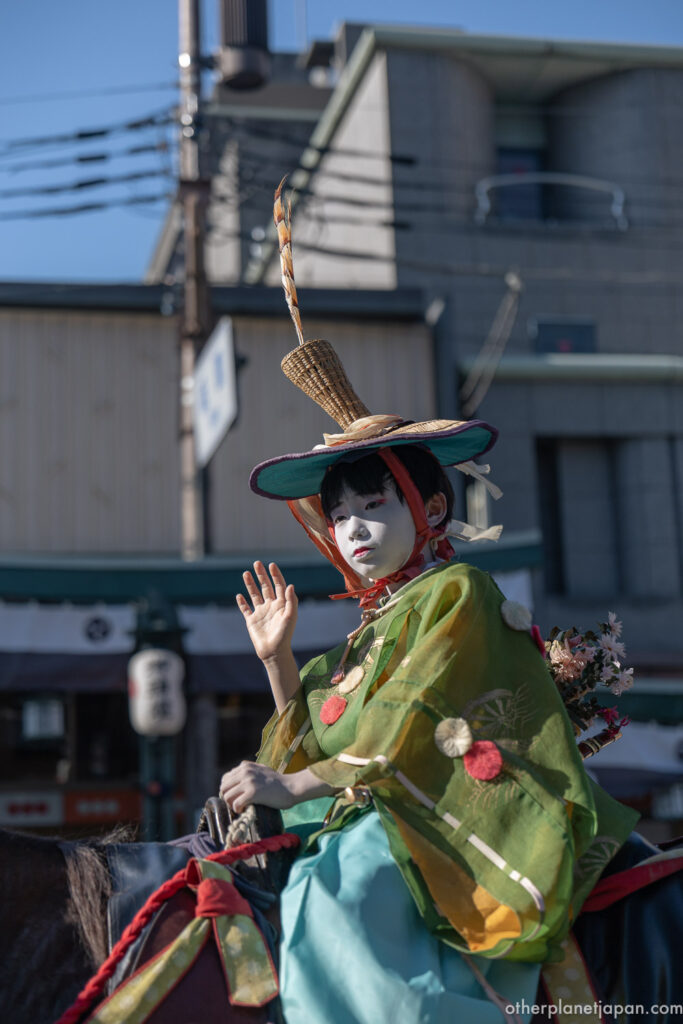
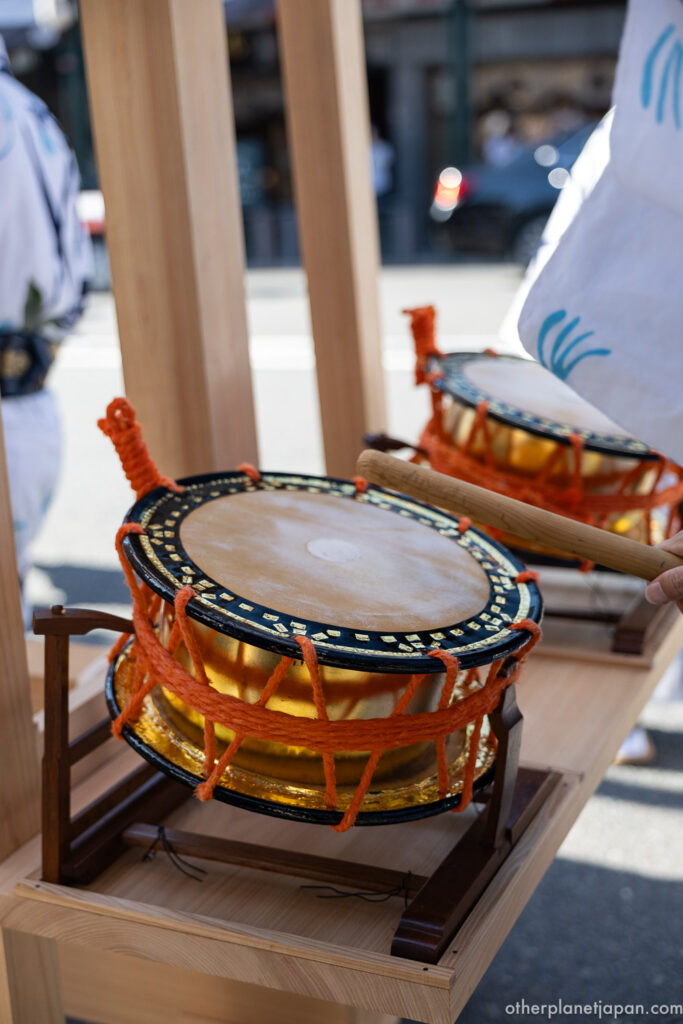
Only later did the obvious occur to me. The procession leaves Yasaka Shrine, walks to City Hall, and returns after 7:00 PM — well into the cooler hours. I could have simply arrived in the evening. I had learned to factor shade into my plans at the bullring in Seville, and I applied precisely none of that education here.
I tried photographing the departing procession and couldn’t even review the shots — the afternoon glare made my camera’s monitor unreadable. I decided to wait for dusk. I should have decided that from the beginning.
5:40 PM, Kyoto City Hall — Dances in a Borrowed Shadow
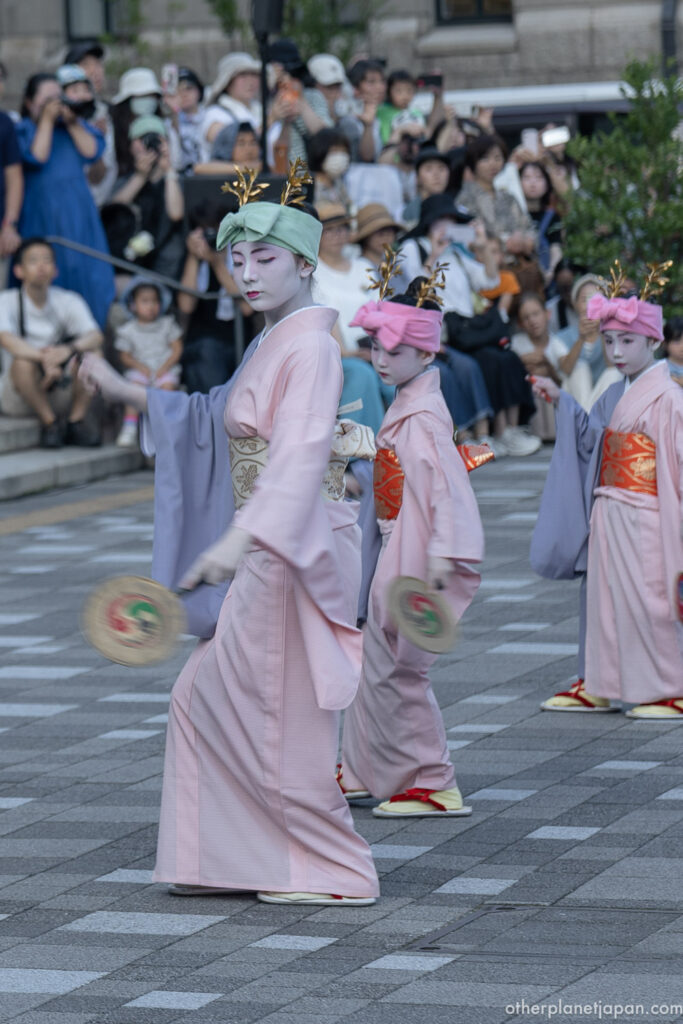
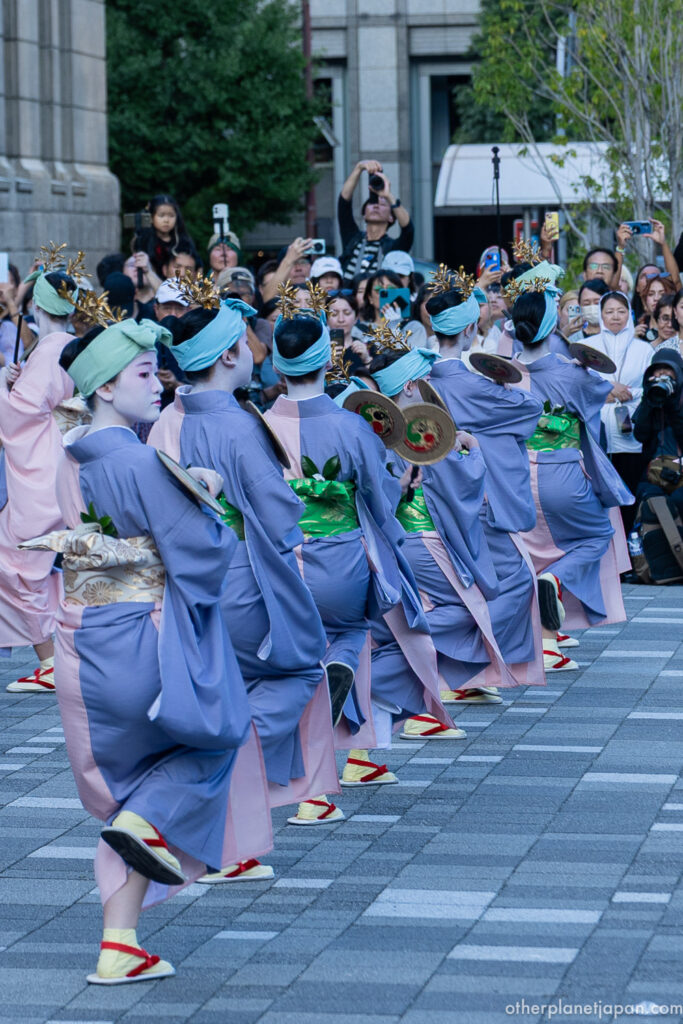
The procession reached Kyoto City Hall at 5:40, and the building’s great stone mass cast the plaza into shadow. For the first time in over an hour, I stood out of direct sunlight. The city hall dates to 1927, and on this afternoon its finest architectural feature was, without question, its shade.
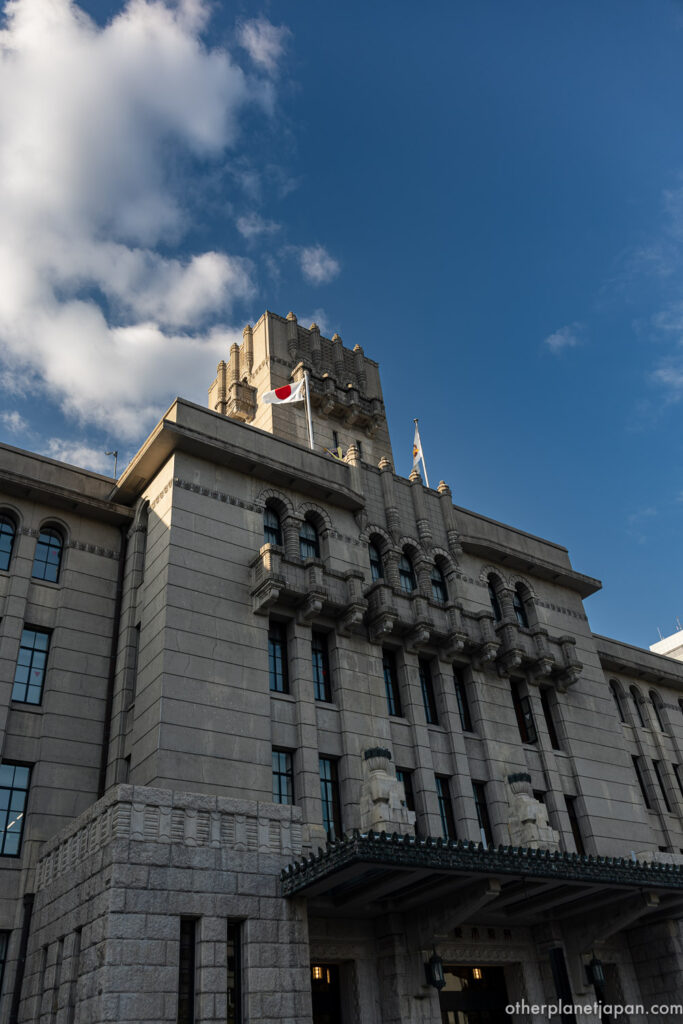
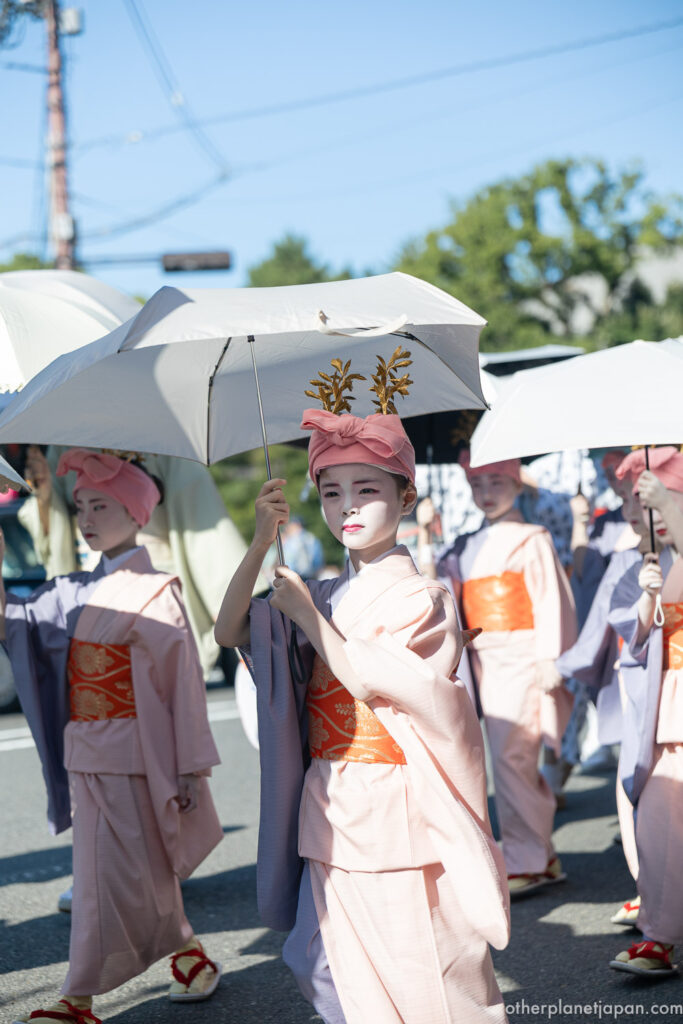
In the plaza, the children performed their dances as an offering. The white wings of the Sagi Odori opened slowly in the early-evening light. The Komachi Odori dancers turned in formation, their green brocade obi catching what sun remained. Traditional dance performed against a 1927 Western facade. Kyoto rarely bothers to keep its centuries apart.
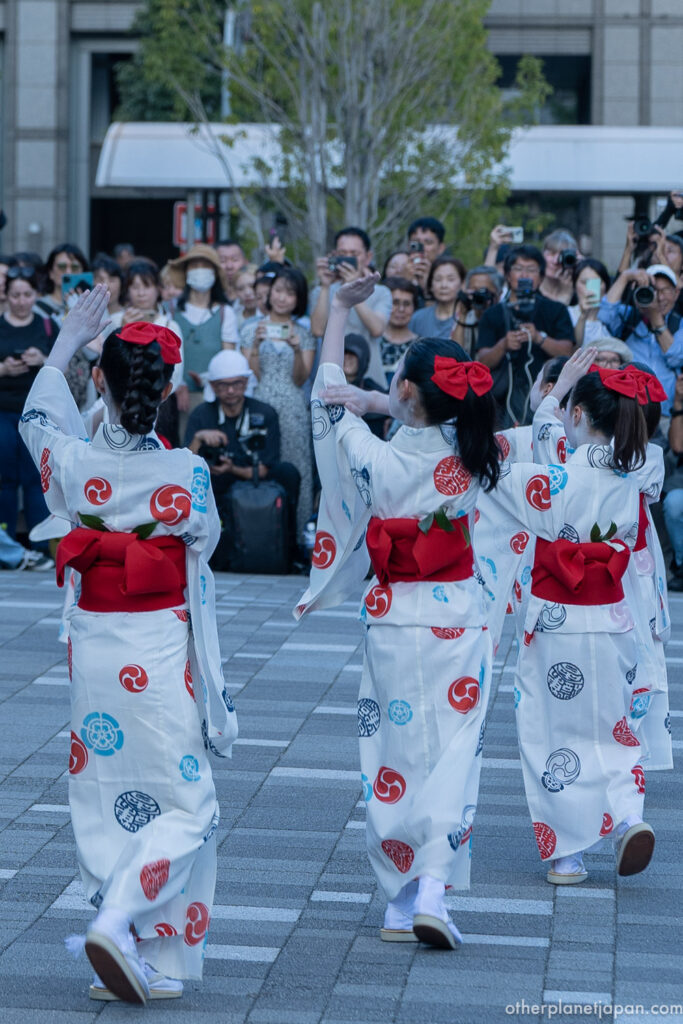
6:30 PM — When the Lanterns Earn Their Name
[ROUTE MAP: Original vertical route map. Yasaka Shrine (1) 4:30 PM departure → Kyoto City Hall (2) 5:40 PM arrival and dances → south on Teramachi-dori (3) 6:30 PM → Shijo-dori (4) 6:55 PM → return to Yasaka Shrine (5) after 7:00 PM]
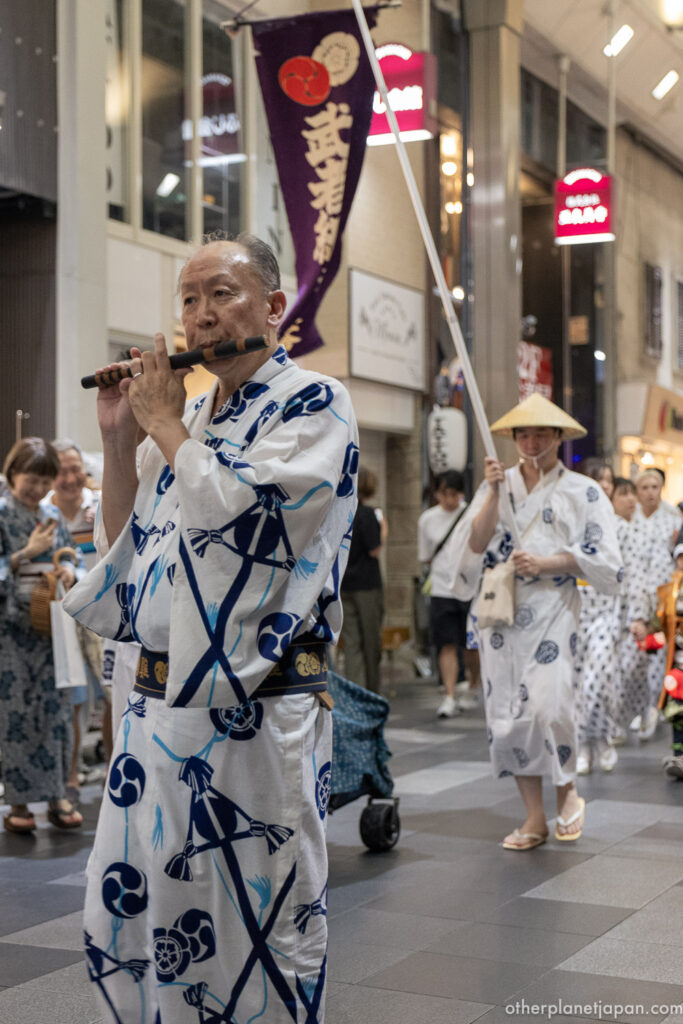
The procession left City Hall at 6:30 and turned south down Teramachi-dori, reaching Shijo-dori at 6:55. The sun finally dropped, and the lanterns came alight. This is the hour when Omukae Chochin becomes worthy of the “chochin” in its name — and when waiting through the heat pays off.
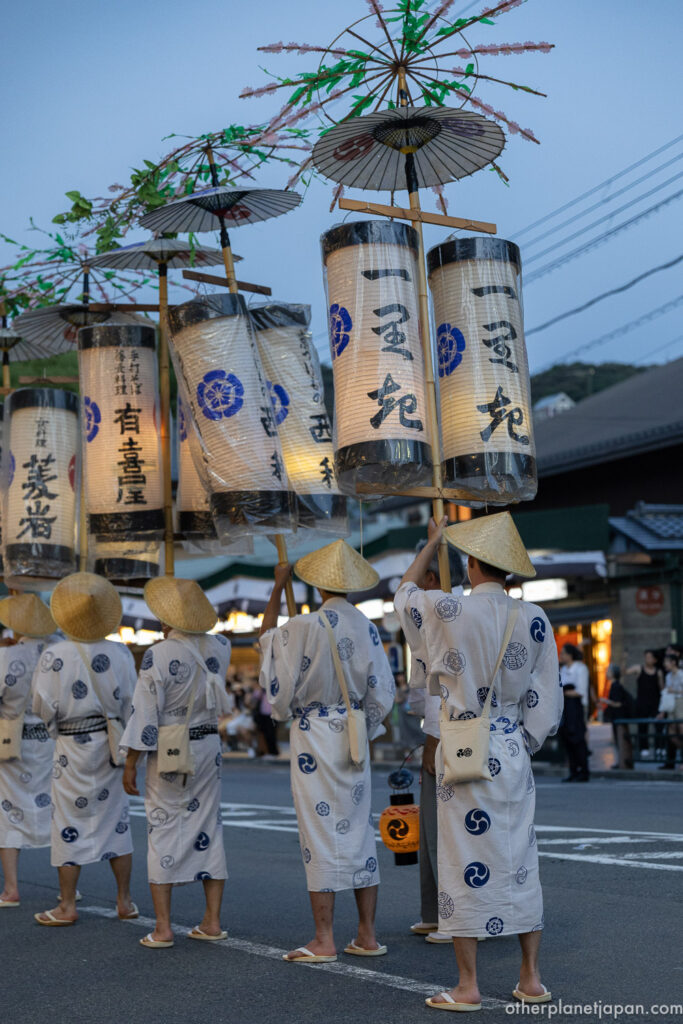
7:16 PM — Where the Lanterns Meet the Fire
The scene of the day arrived near Hanamikoji on Shijo-dori. The torch procession of the Mikoshi Arai, heading one way, crossed paths with the Omukae Chochin procession heading home. The gentle face of the festival and its fierce one, passing each other on the same street.
The children of the lantern procession craned their necks at the torch bearers, meeting, in a sense, the very thing they had spent all afternoon welcoming.
Night — Mikoshi Arai: Fire Clears the Way
From here the festival changes register entirely. The afternoon belonged to children and lanterns. The night belongs to fire, sacred water, and men’s shoulders.
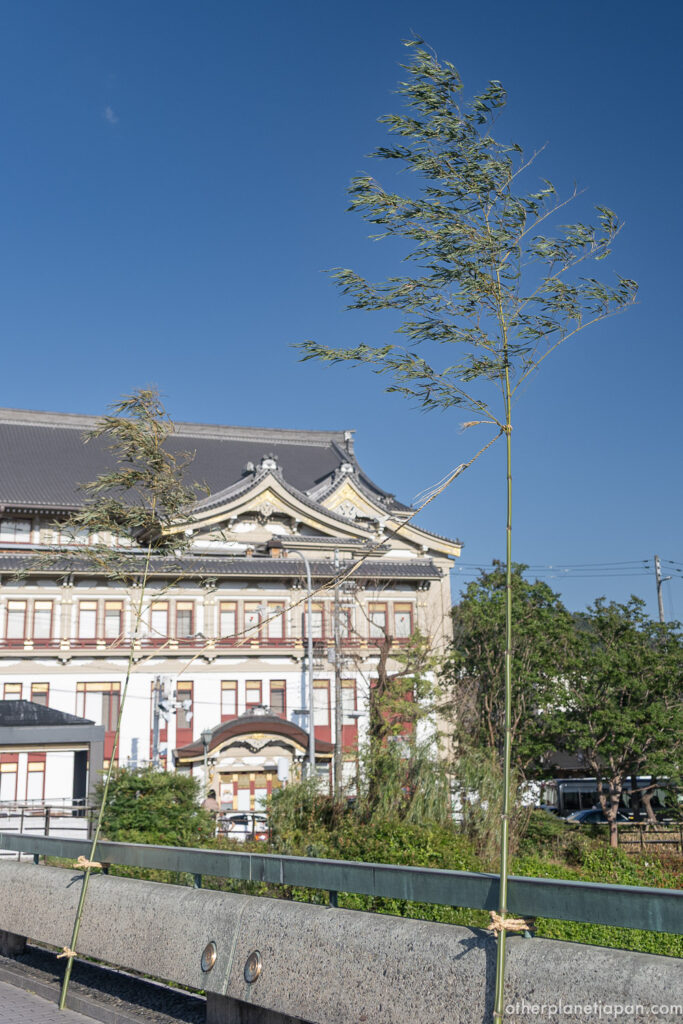
The preparations, in fact, had started that morning. At Shijo Ohashi Bridge, imitake, sacred bamboo marking a ritual boundary, had been raised, and water drawn up from the Kamo River. That water, blessed in a morning rite most tourists never see, is what purifies the mikoshi after dark.
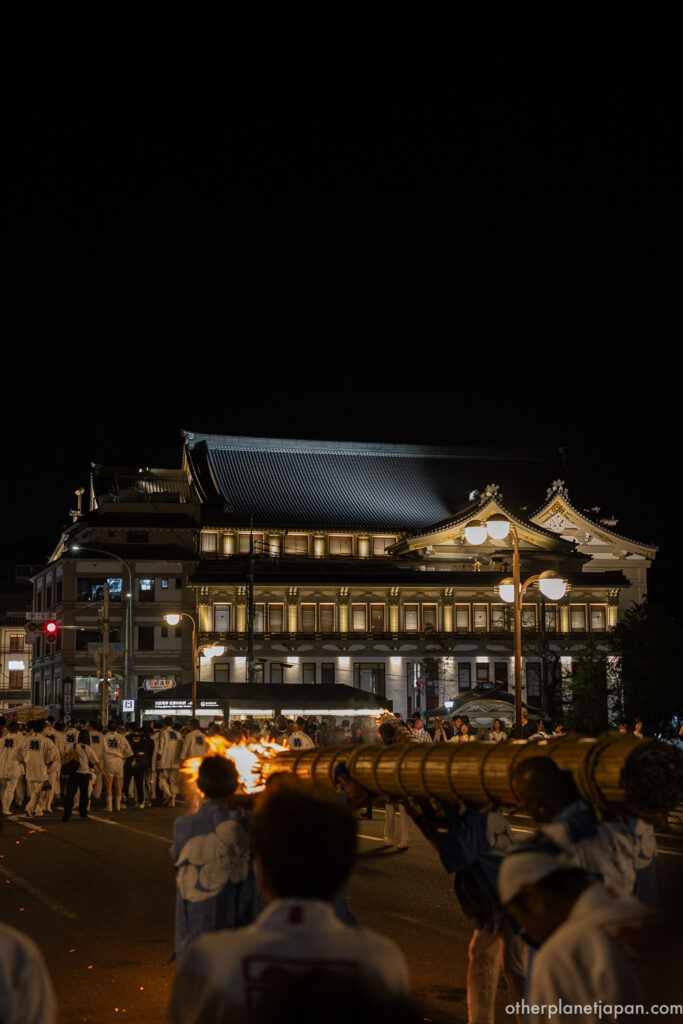
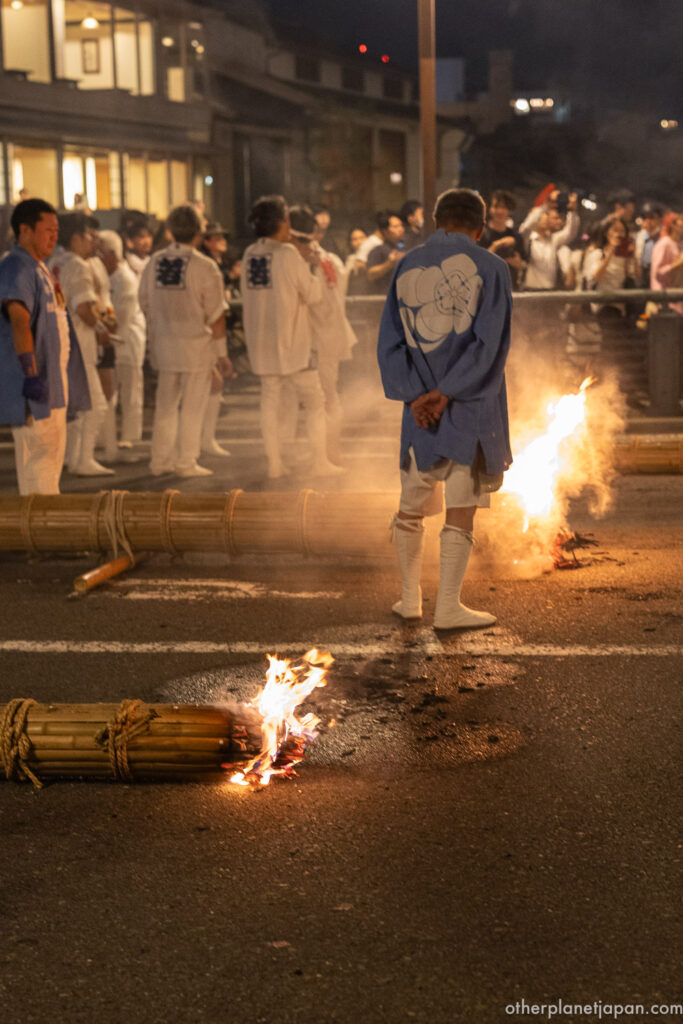
As night fell, a great taimatsu torch moved along Shijo-dori, its flames clearing the route the mikoshi would take. You register the taimatsu as heat before you see it: a pressure that crosses the width of the street, smoke settling low over the asphalt, embers scattering where it has passed. Fire moving in front of the Minamiza kabuki theater — this was the image of the night.
At 7:56 PM, the mikoshi came down the stone steps of Yasaka Shrine. The official notices say “around 8:00 PM,” but on the night I attended, it ran early. Arrive at the posted time and you may find the descent already over.
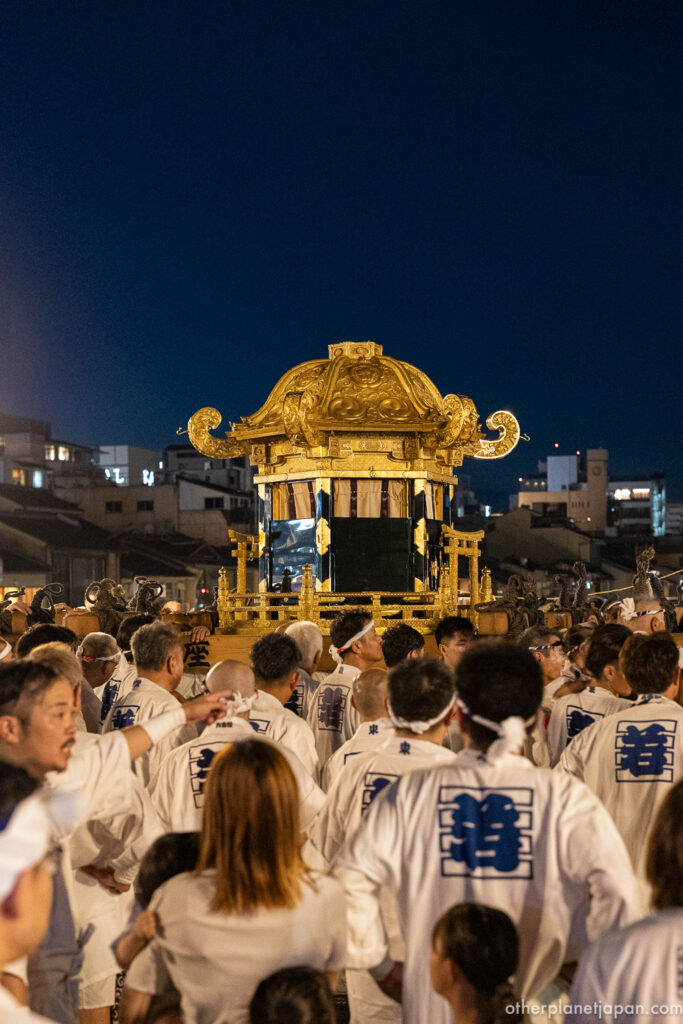
I followed the mikoshi from Yasaka Shrine toward the bridge, carried along by the rhythmic chant you hear at festivals all over Kyoto. After the composed grace of the Omukae Chochin a few hours earlier, the sheer roughness of it felt like a different festival altogether.
The mikoshi reached Shijo Ohashi before 8:10. And here is something worth knowing in advance: the closest view of the mikoshi anywhere on the route is from the bridge itself — far closer than watching the steps from across the crowd. There is one condition. You cannot stop. Security keeps everyone moving, so you watch at close range, in passing, trading the freedom to stand still for a view you can nearly touch.
“Is This a Festival?”
On Shijo-dori, a traveler from the Netherlands turned to me with a question.
“Is this a festival?”
I hesitated. A few years ago, a Shinto priest at Yasaka Shrine made national news for pushing back against the festival’s drift toward commercialism, insisting that Gion Matsuri is, at its core, a sacred rite, a shinji.
“It’s a festival,” I said. “But strictly speaking, it’s a religious ritual.”
A safe answer. On the walk home, though, it struck me that it was also the accurate one — maybe the most accurate description of the entire day. The sacred bamboo raised on the bridge before the tourists woke. The torch fire clearing the street. The water lifted from the Kamo River. Behind the parasols and the lanterns, a rite had been unfolding since morning.
Though for all I know, the Dutchman just thought I was being pretentious.
The dedication dances began at 9:00 PM in the grounds of Yasaka Shrine. July 10 at Gion Matsuri runs late.
Practical Information
Timeline (observed on the ground, July 10)
| Time | What happens | Where |
|---|---|---|
| Morning | Imitake bamboo raised; water drawn from the Kamo River | Shijo Ohashi Bridge |
| 4:30 PM | Omukae Chochin procession departs | Yasaka Shrine |
| 5:40 PM | Arrival; dedication dances | Kyoto City Hall plaza |
| 6:30 PM | Departure south along Teramachi-dori | Teramachi-dori |
| 6:55 PM | Procession reaches Shijo-dori | Shijo-dori |
| After 7:00 PM | Procession returns | Yasaka Shrine |
| ~7:16 PM | Torch procession crosses the lantern procession | Shijo-dori near Hanamikoji |
| 7:56 PM | Mikoshi descends the shrine steps (officially “around 8:00 PM”) | Yasaka Shrine |
| Before 8:10 PM | Mikoshi arrives; Mikoshi Arai purification | Shijo Ohashi Bridge |
| 9:00 PM | Dedication dances | Yasaka Shrine |
Times reflect one observed evening and can shift slightly year to year. Gion Festival official website for the current year, and treat even that as approximate, as the 7:56 descent proved.
Viewing Notes
- For the afternoon procession, prioritize shade over sightlines. July in Kyoto does not negotiate.
- For photography, the best window is after 6:30 PM along Teramachi and Shijo, once the lanterns are lit.
- The mikoshi’s descent down the shrine steps can run ahead of schedule. Be at Yasaka Shrine by 7:30 PM.
- The closest view of the mikoshi is from Shijo Ohashi Bridge — but stopping on the bridge is not permitted. Plan on watching while walking. For a stationary view, choose the torch procession or the shrine steps instead.
- If you’d rather skip the heat entirely, arrive around 7:00 PM: the returning lantern procession, the torches, and the mikoshi can all be seen in the cooler hours.
Surviving the Heat
- Carry water before you claim your spot; convenience stores along the route double as air-conditioned refuges.
- A parasol or hat and a cooling towel are not optional in July.
- If you feel unwell, step into any air-conditioned shop without hesitation.
Getting There
- Gion-Shijo Station (Keihan Line)
- Kyoto-Kawaramachi Station (Hankyu Line)
- Both are a short walk from Shijo Ohashi Bridge and Yasaka Shrine.