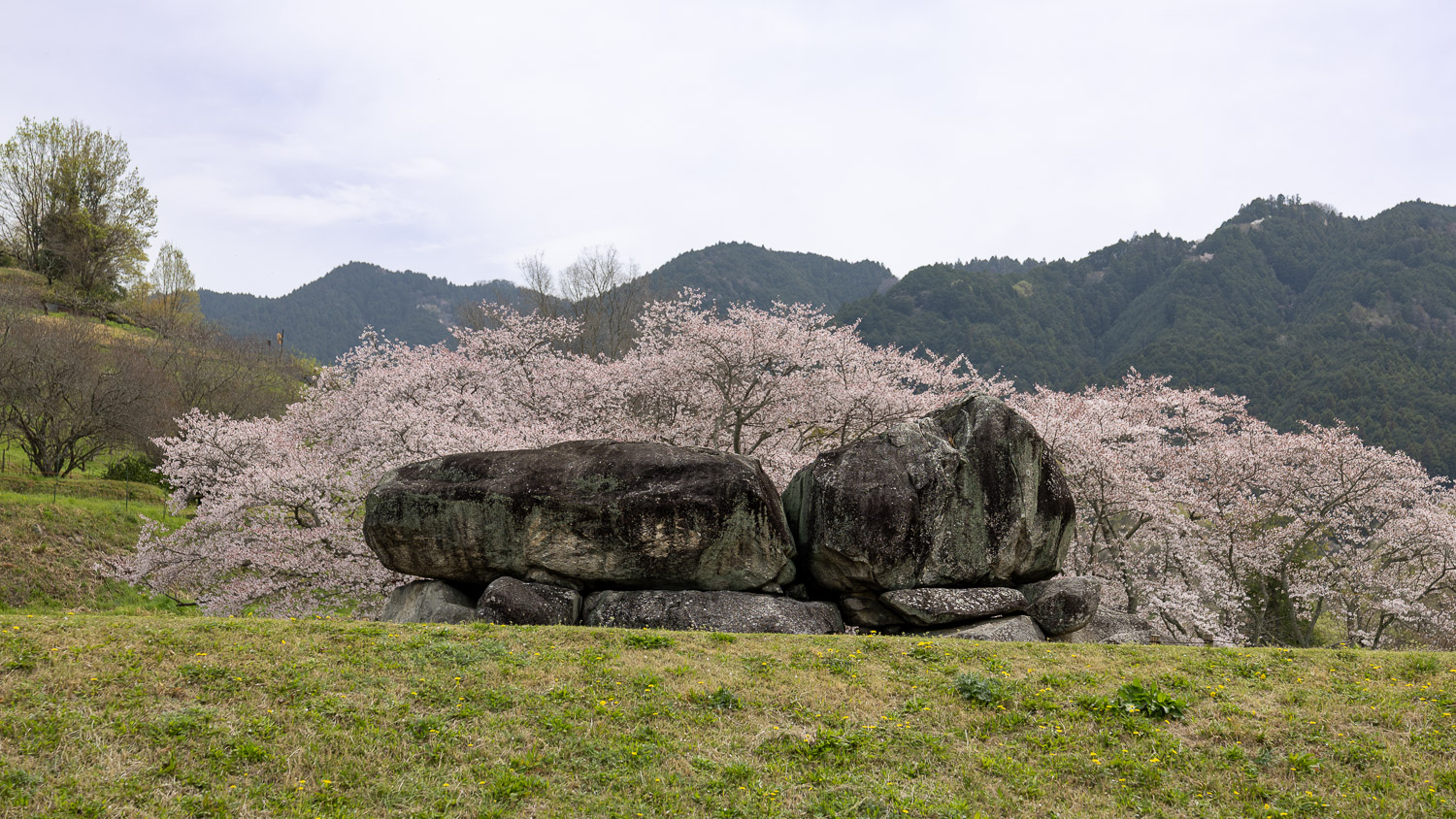
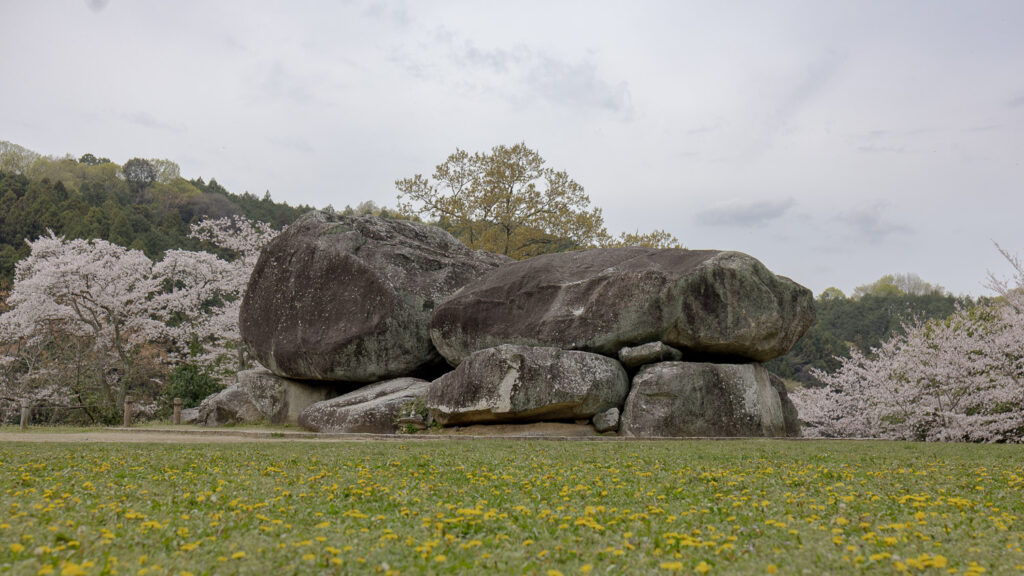
Ishibutai Kofun is Japan’s largest megalithic burial chamber — a 2,300-ton stone tomb in the ancient village of Asuka, believed to belong to a 7th-century statesman nobody liked. Today it sits exposed to open sky, framed by cherry blossoms and dandelions, at the heart of a region nominated for UNESCO World Heritage status.
The Bus Was Packed. In the Middle of Nowhere.
The bus from Kashiharajingumae Station was standing room only. Not what I expected from rural Nara.
Nobody here was commuting. Every single person on that bus was a traveler — cameras around their necks, paper maps folded in quarters, the slightly glazed look of people who had already walked too much and were fully prepared to walk more. I assumed we were all heading to the same place. Of course we were.
Then, one by one, people started getting off. A couple here. A family there. By the time we were down to three groups, I was quietly reconsidering my route choices. A moment ago, the crowd had been the problem. Now its absence felt like a verdict.
I pressed my face to the window — and opened it. All the way. Without asking anyone.
A rush of warm air swept through the cabin. The air conditioning had been running fine, but nobody complained. Then again, this was a bus full of Japanese passengers. Even if I had let in a wall of freezing wind, they would have sat there in polite, suffering silence and said nothing.
Rolling past outside: cherry trees in bloom, hills softened by deep green, and low, rounded mounds rising gently from the farmland — burial tombs, dozens of them, dotting the landscape as casually as roadside shrines. If I had gotten on the wrong bus, I thought, I could probably live with that.
After twenty-odd minutes, the bus stopped at Ishibutai.
Cherry Blossoms, Dandelions, and Stone
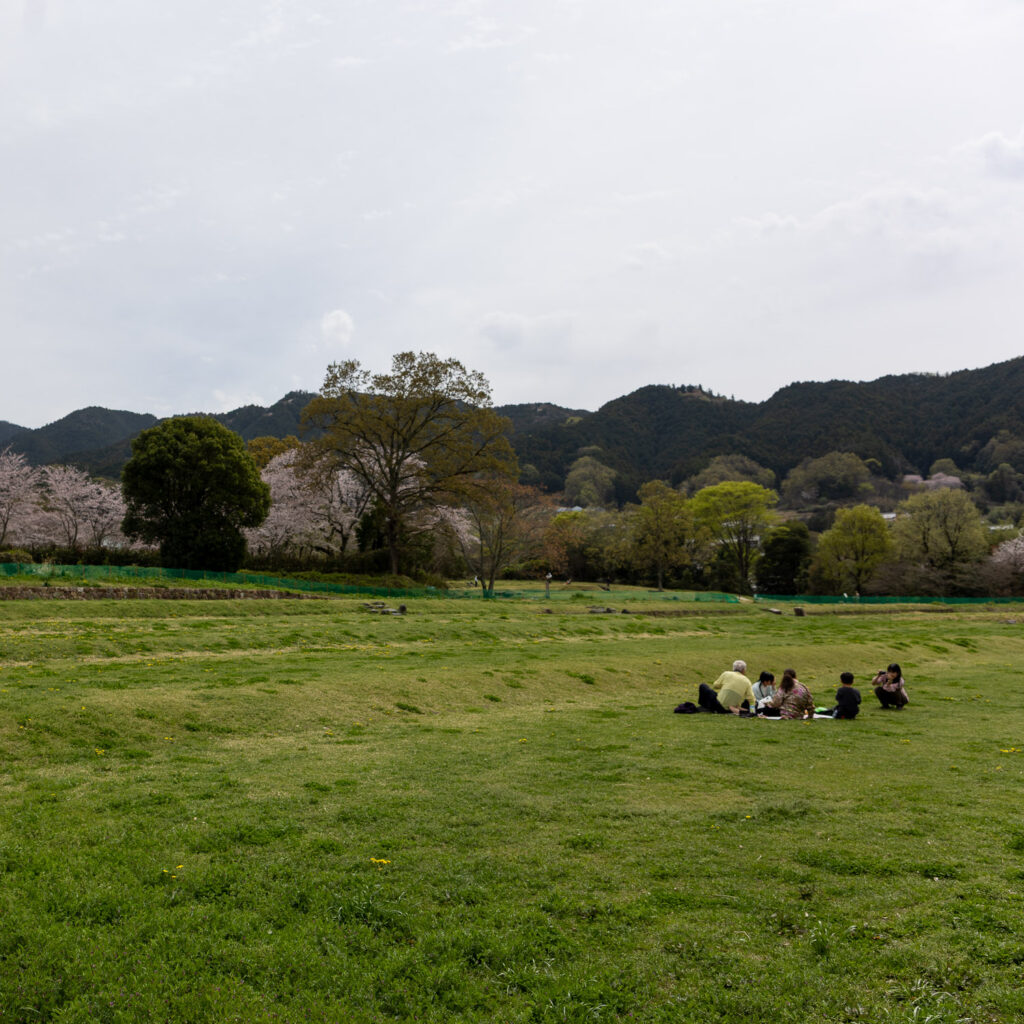
Standing in front of the tomb for the first time, what caught my eye wasn’t the stone. It was the color.
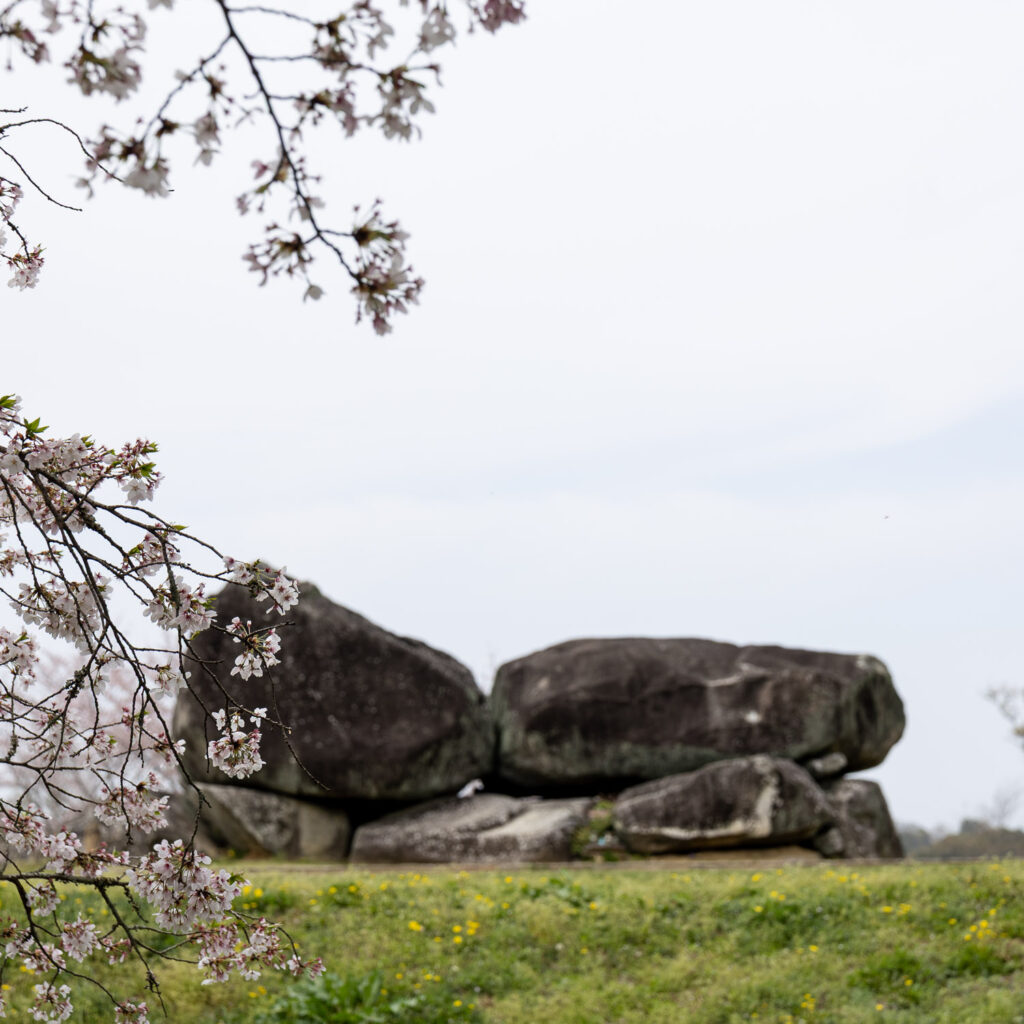
Pink from the cherry blossoms. Yellow from the dandelions scattered across the grass. And between them, the grey of granite that hasn’t moved a single millimeter in fourteen hundred years.
Elsewhere, you’d walk past rock like this without a second glance. Just rough stone, weathered and unremarkable. But here, flanked by sakura and wildflowers, the same stone radiates something harder to name. Maybe it was the season. Maybe it was the contrast. Either way, standing there, I found myself less interested in history and more interested in time — when did those cherry trees take root here? When did the first dandelion seed float in and settle? The stone was here first. Everything else arrived later.
I spent a while trying to capture all three in a single frame. Sakura, dandelions, ancient stone — the composition felt significant to me. Then I noticed that nobody else was photographing the dandelions. Not one person. They were all pointed at the cherry blossoms and the megalith, completely ignoring the carpet of yellow and green at their feet.
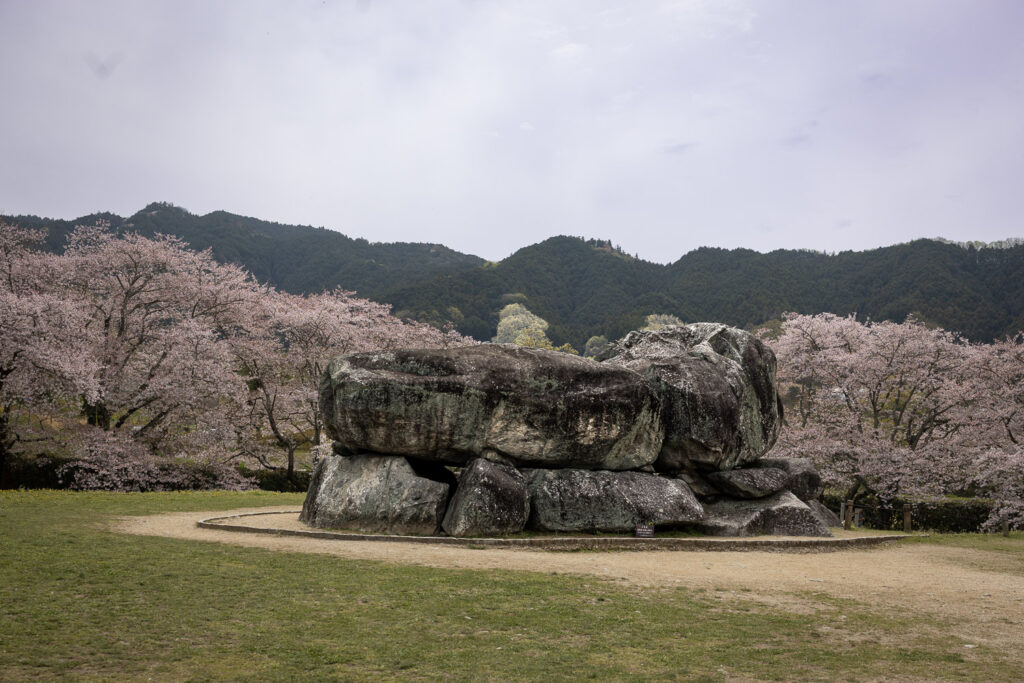
Are dandelions just weeds to them? Probably. In Japan, they are. Which meant I was the photographer crouching in the grass, wrestling with the angle, shooting weeds. A fair description, honestly. But those weeds were the only living things in that frame that had chosen to be there.
Japan Has Its Own Stonehenge
Stonehenge is on my list. Has been for years. I can’t entirely explain the pull — something about massive stones arranged by people who left no instructions, no explanation, no apology for the mystery. That particular silence speaks to me.
Japan has a version of that silence. It just doesn’t get enough credit for it.
The Nara and Osaka regions are full of kofun — ancient burial mounds built for the ruling class, dating from roughly the 3rd to 7th century AD. Most are still covered in earth, green and rounded, blending quietly into the landscape. You pass them without realizing. Ishibutai Kofun is different.
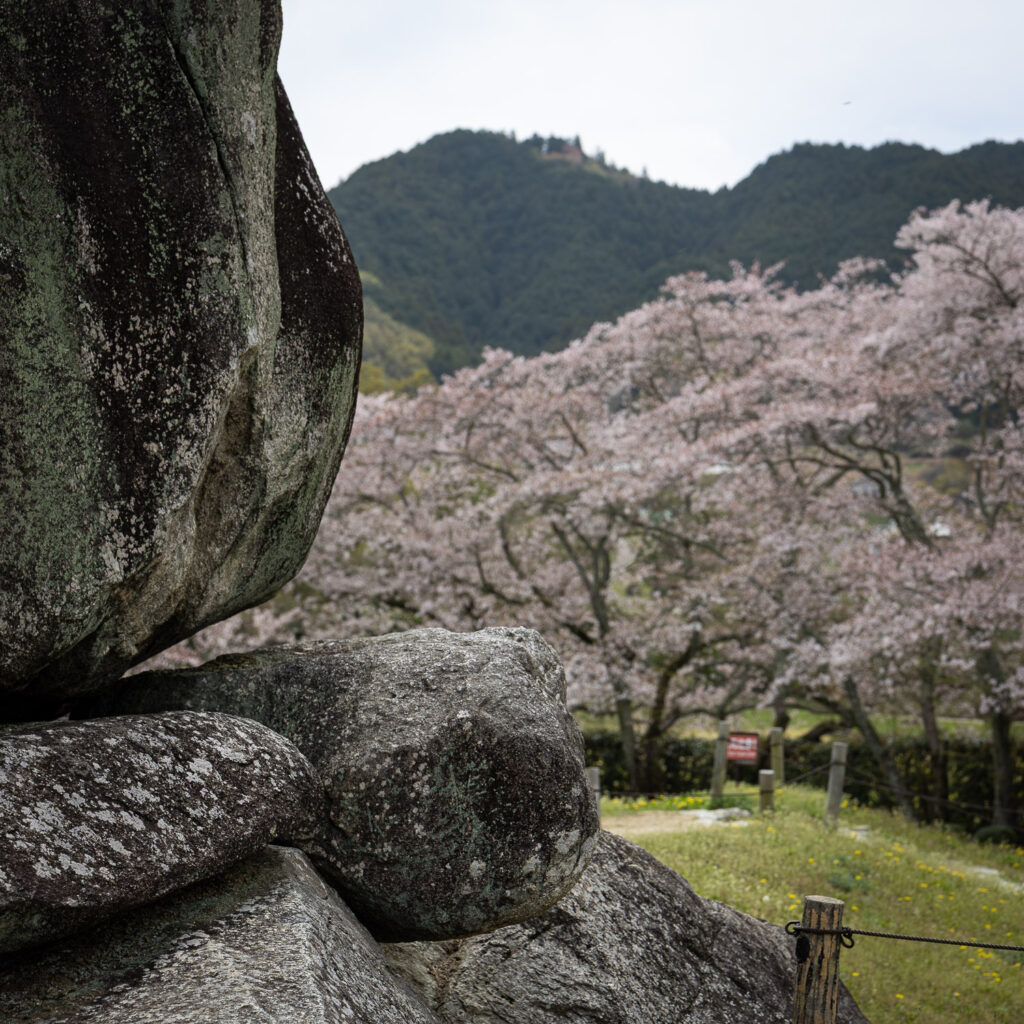
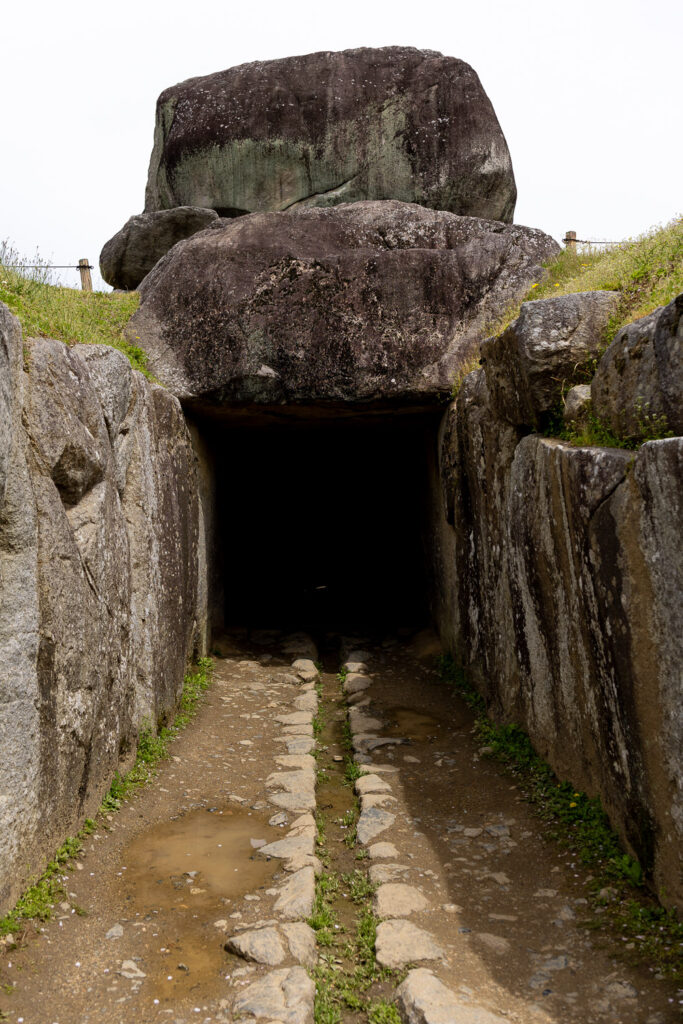
At some point after its construction, the earthen mound covering the burial chamber was lost — stripped away, most likely, by human hands during the ransacking of the tomb. What remained was the stone chamber itself: thirty-odd granite slabs, exposed to open sky, raw and unapologetic. The total weight of the stones is approximately 2,300 tons. The largest single stone weighs 77 tons. This is the largest stone burial chamber in Japan.
The Tomb of a Man Nobody Liked — And How They Built It
The leading theory is that Ishibutai Kofun was built for Soga no Umako — one of the most powerful political figures of the Asuka period. Umako effectively controlled the imperial court and played a central role in promoting Buddhism as a political and cultural force in Japan.
He was also, by most accounts, deeply unpopular.
The logic historians use goes like this: the tomb was ransacked. Thoroughly. The original stone coffin is gone — what you see today is a replica. And the reasoning follows that a grave this completely destroyed must belong to someone who was hated even in death. Therefore: Soga no Umako. It’s a bold conclusion for an academic argument, but I find it entirely persuasive — it sounds exactly like something humans would do.
So how did they move a 77-ton stone without machinery?
There is an illustrated diagram at the site, in Japanese. Reading through it, the method goes like this: first, a pit was excavated and the side stones set upright, with earth packed tightly around each slab to hold it vertical. The ground level was then raised gradually, the accumulated soil serving as a ramp up which the massive ceiling stones were dragged and lowered into position from above. Once the roof was in place, the soil inside was scooped out. The chamber hollowed itself from within. The granite was quarried roughly three kilometers upstream along the Fuyuno River, from the foothills of Mount Tonomine. Extraordinary logistics. Understood method.
What remains unknown is not how it was built, but on whose orders — and why on this particular scale.
Standing in front of this tomb, the Taika Reform goes strangely soft in the memory. Every Japanese person who sat through a history class knows the year — 645 — and the name. Both are drilled in early and stay forever. What they actually mean tends to drift.
Taika — 大化 — was Japan’s very first imperial era name. The system of designating eras had just been adopted from China, and this was its inaugural use. Japan has been counting ever since. The current era, Reiwa, is the 248th. From that first name to the present, an unbroken chain of named time — stretching back to this place, this coup, this particular rupture in history.
Soga no Umako’s grandson, Soga no Iruka, was assassinated in 645 — and the political upheaval that followed gave the Taika era its name. The Soga clan’s grip on power ended there. And then history moved fast. A few kilometers north of this same landscape, Emperor Jito established Japan’s first full-scale Chinese-style capital in 694 — the Fujiwara-kyo, with the Fujiwara Palace at its center. The ancient village of Asuka had become the birthplace of a nation.
Why UNESCO Is Paying Attention
Curious about why this region was nominated for World Heritage status, I looked into the case being made. The nomination — “The Palace Sites of Asuka-Fujiwara and Their Related Properties” — includes Ishibutai Kofun alongside the Fujiwara Palace ruins a short distance away.
The argument is straightforward: this is where Japan became Japan.
In the 7th century, through diplomatic and cultural exchange with Tang Dynasty China and the Korean kingdoms, Japan adopted the ritsuryo legal code, Chinese-style urban planning, and a centralized imperial government — a fundamental transformation. The Fujiwara Palace ruins are the physical evidence: Japan’s first full-scale capital, built in 694, now a vast open field where only stone foundations remain. Recent excavations suggest the original scale exceeded even the later capitals of Nara and Kyoto.
On the way back, standing at the edge of that empty field with the three sacred mountains of Yamato lined up on the horizon, the case for UNESCO designation felt self-evident. You don’t need a building to feel the weight of what happened here.
Visiting before the designation comes through means seeing it without the crowds that will inevitably follow.
Go Inside. Don’t Think About the 77 Tons.
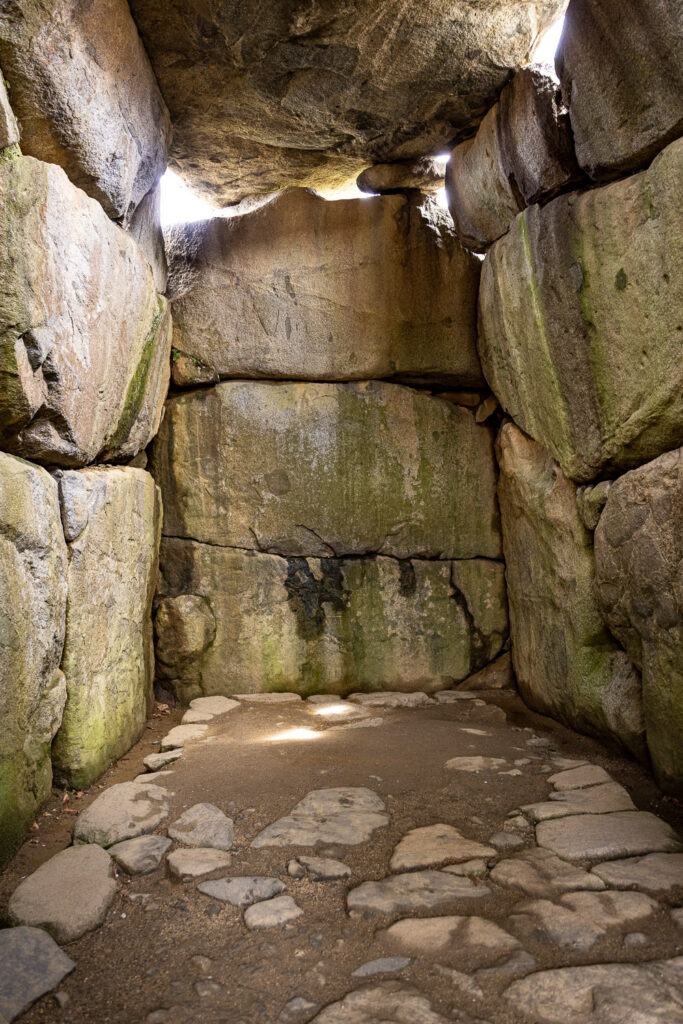
Admission to Ishibutai Kofun is ¥500. With that, the burial chamber is open to everyone — don’t miss it. Hours are 9:00 AM to 5:00 PM, year-round, with last entry at 4:45 PM.
One piece of advice before you step in: do not think about the 77-ton stone directly above your head. Just don’t go there.
Inside, the air drops a few degrees. Light filters through the gaps between the stones — not warm, not dappled, but precise and still, the way light behaves when it has had to work to get somewhere. Japanese has a word for sunlight through leaves: komorebi. There is no equivalent for light through stone. That gap in the language felt right.
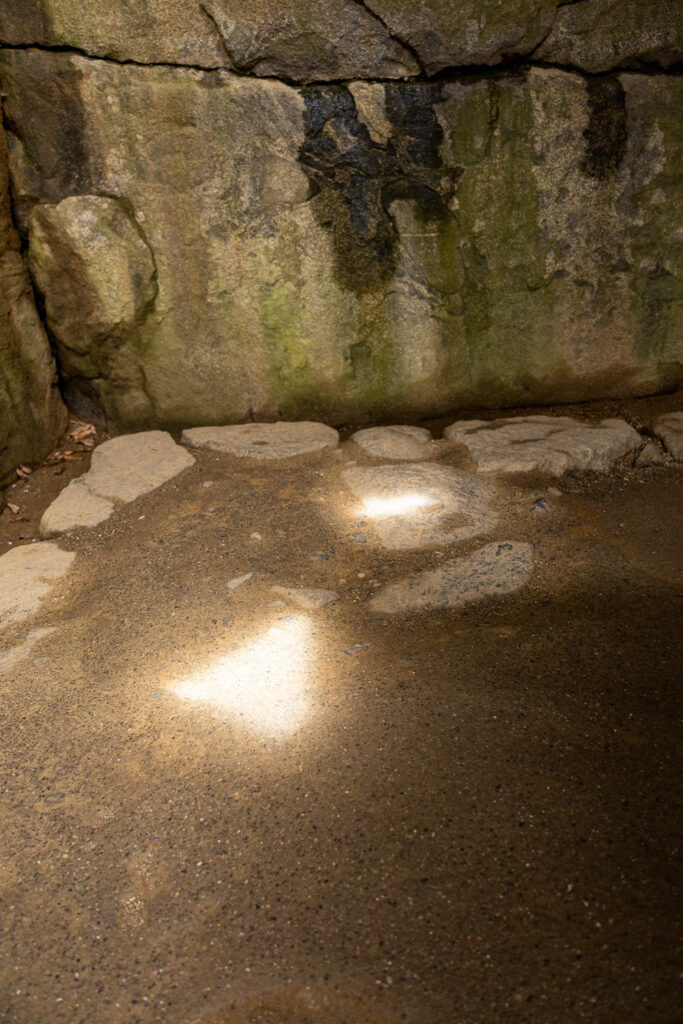
The stone coffin — the replica — faces north. In modern Japan, sleeping with your head pointing north is considered bad luck, too close to the way the dead are laid out. The expression is kitamakura — the north pillow — and it carries the kind of quiet dread that doesn’t need explaining to anyone who grew up here. And yet, fourteen hundred years ago, the builders deliberately oriented the coffin exactly that way. The taboo, it turns out, may be a memory. The direction was once a form of respect.
I hadn’t planned to think about the archaeology of superstition inside an ancient tomb. Ishibutai has a way of taking you somewhere you didn’t plan to go.
How to Get There
Nara city is dense — temples and shrines stacked close enough to walk between them in a day. Asuka is the opposite. Burial mounds, stone monuments, and ancient ruins are scattered across open farmland, with stretches of quiet road in between. There is no reason to rush, and no way to fully experience it on foot. A rental bicycle is not just convenient here — it is the right speed for this landscape.
Bicycles are available near Asuka Station or Kashiharajingumae Station for ¥1,200 per day. One-way returns are accepted at the Ishibutai and Kameishi branch offices for a ¥200 drop-off fee. The rental company operates an English-language website. Note that there are no dedicated cycling lanes in the area — share the road with care.
By bus, take the Nara Kotsu Asuka Loop Bus — known as the Kame Bus, or “turtle bus” — from the east exit of Kintetsu Kashiharajingumae Station. The ride takes around 20 to 25 minutes. Buses run once an hour on weekdays, and twice an hour on weekends and holidays. Check the timetable before you go.
For groups or those short on time, a taxi from Kashiharajingumae Station east exit takes about 15 minutes and costs around ¥3,000.
The surrounding area is part of the Asuka Historical National Government Park, with restaurants and souvenir shops nearby.
Quick Reference
| Admission | ¥500 (burial chamber included) |
| Hours | 9:00 AM – 5:00 PM (last entry 4:45 PM) |
| Closed | Never — open year-round |
| Best season | Spring (cherry blossoms) / Early summer (fresh green) |
| Time needed | 45 minutes on site; half-day to explore the wider Asuka area |
Frequently Asked Questions
What does “Ishibutai” mean?
Ishibutai (石舞台) translates as “stone stage.” The name comes from the flat upper surface of the exposed burial chamber, which resembles a performance stage. One theory holds that the original name was Ishifutoya — meaning “a house of great stones” — which gradually shifted in pronunciation to Ishibutai over the centuries. Local legend adds that foxes danced on the stones by moonlight. The atmosphere at dusk makes this easy to believe.
Who is buried at Ishibutai Kofun?
The tomb has never been officially identified. The leading theory, first proposed by historian Kida Teikichi in 1912 and widely accepted among Japanese scholars today, is that it belongs to Soga no Umako (551–626), a powerful Asuka-period statesman who controlled the imperial court. The main evidence is the degree to which the tomb was ransacked — historically interpreted as a sign that the occupant was deeply unpopular even after death.
How was Ishibutai Kofun built?
The construction method has been reconstructed by archaeologists and illustrated at the site. Builders first set the side stones upright in a pit, packing earth tightly around each slab to keep it vertical. They then raised the earth level gradually, using it as a ramp to position the massive ceiling stones from above. Once the roof was in place, the soil inside was removed — the chamber was essentially hollowed out from within. The granite came from the upper Fuyuno River valley, roughly three kilometers away. It was a sophisticated engineering process, achieved without modern machinery.
Can you go inside the burial chamber?
Yes. Admission to Ishibutai Kofun is ¥500, and the burial chamber is included — open to all visitors. The interior is cool and dimly lit by light filtering through the gaps between the stones. Don’t miss it.
How long should I plan to spend at Ishibutai Kofun?
The site itself takes about 30 to 45 minutes to explore thoroughly. If you’re visiting the broader Asuka area — which includes Kameishi (the turtle stone), Takamatsuzuka Kofun, and the Asuka-dera temple — plan for a half-day minimum.
What is the connection between Ishibutai Kofun and the Fujiwara Palace ruins?
Both are component sites in the same UNESCO World Heritage nomination: “The Palace Sites of Asuka-Fujiwara and Their Related Properties.” Ishibutai represents the era of Soga clan dominance in the 7th century; the Fujiwara Palace ruins represent what came immediately after — Japan’s first full-scale centralized capital, established in 694. Together they form a continuous historical narrative about the birth of the Japanese state.
Is the Fujiwara Palace ruins worth visiting on the same trip?
Absolutely. The ruins are located slightly north of the Asuka area, near Kashiharajingumae Station — easy to combine with an Asuka day trip. There are no standing structures, but the scale of the site and its backdrop of the Yamato Sanzan — three sacred peaks — are striking. Spring brings fields of rapeseed flowers; autumn brings cosmos. The contrast of open sky, ancient foundation stones, and seasonal flowers is unexpectedly moving.
What is the Taika Reform, and why does it matter here?
The Taika Reform of 645 AD was Japan’s first major political restructuring — effectively the country’s first coup d’état, in which the powerful Soga clan was overthrown and a centralized imperial government was established. “Taika” (大化) was also Japan’s very first imperial era name, adopted from the Chinese system of designating time. The current era, Reiwa, is the 248th. Standing at Ishibutai, which is believed to be the tomb of Soga no Umako — grandfather of the assassinated Soga no Iruka — places you at the origin point of that entire chain.
Is Ishibutai Kofun accessible from Kyoto or Osaka?
Yes. From central Osaka, take the Kintetsu Line to Kashiharajingumae Station, then bus or taxi. Total travel time is roughly 60 to 90 minutes. It makes a comfortable day trip, and pairing it with nearby Yoshino or Nara city is straightforward.
Is there English signage at the site?
Some. The main explanatory panels have English translations, though the construction diagram is in Japanese only — which is part of what makes reading it yourself a worthwhile exercise. The site is compact enough to navigate independently.
More from OtherPlanetJapan — Asuka & Nara
▶ Tsubosaka-dera: The Cherry Blossom Buddha and the Temple That Cares for the Blind