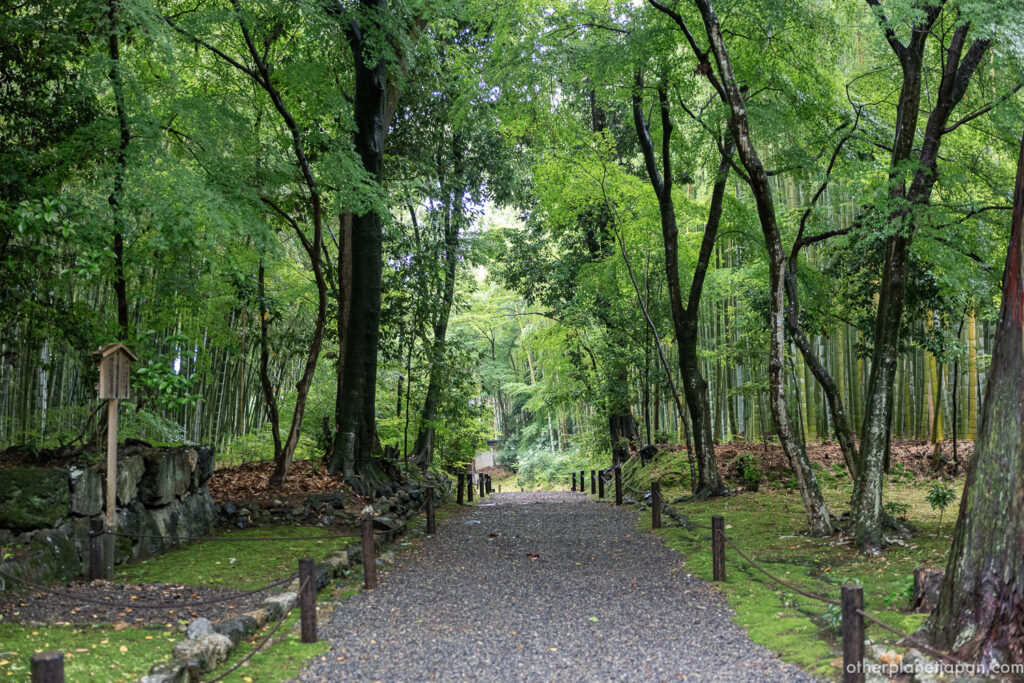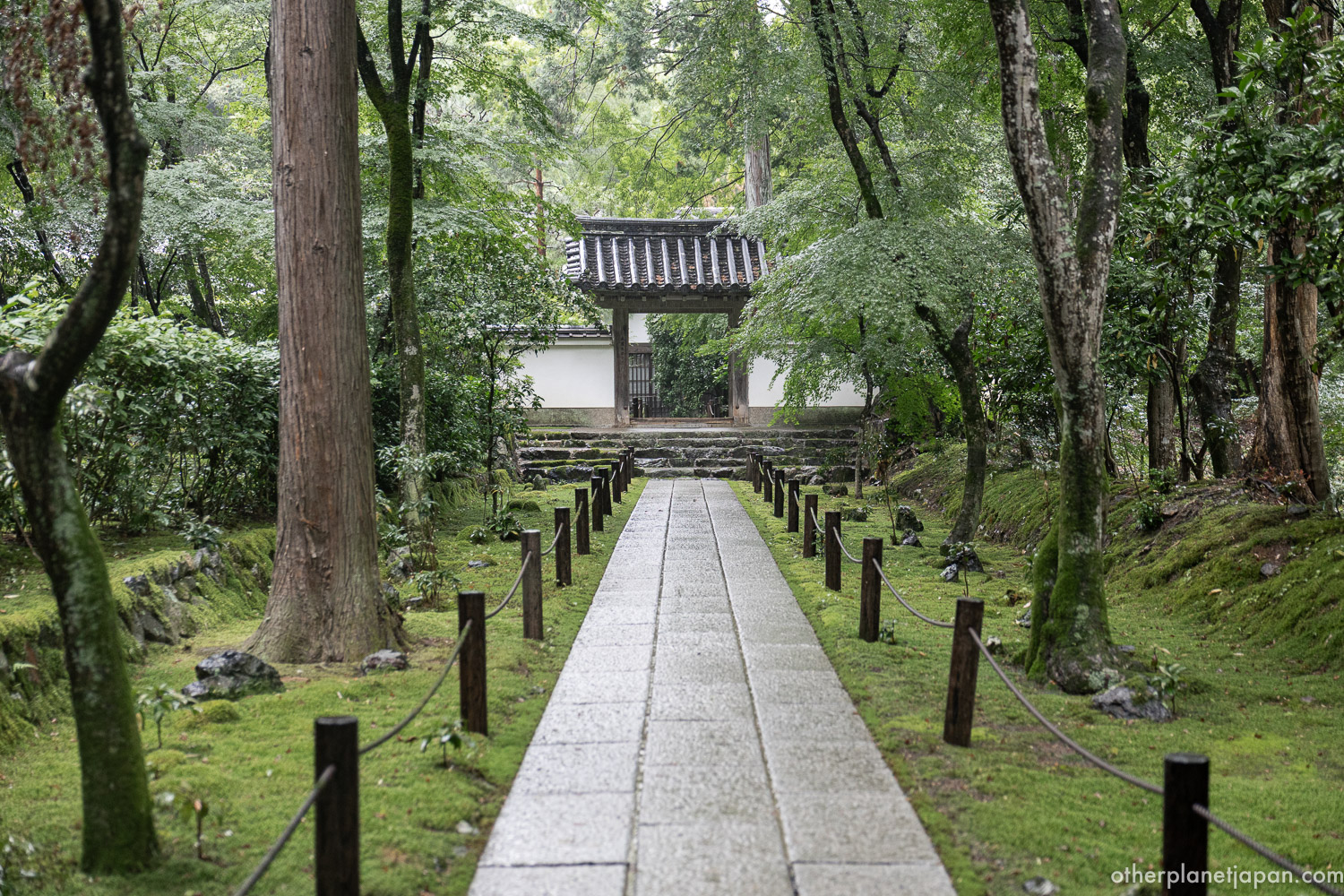
The moment you step through the outer gate at Jizō-in, something shifts. Not metaphorically — though that too. The street noise actually stops. Replaced by the rustle of bamboo and, if you’re lucky, nothing else at all.
I visited on a drizzly June morning, which turned out to be the right call. Wet moss has a saturation that no camera quite captures. The gravel path glistened between its rope-post borders, and the white plaster wall at the far end floated in the green like a lantern. I counted fifteen other visitors that day. Felt like a crowd.
That’s Jizō-in. Locals call it 竹寺 (Takeno-dera) — the Temple of Bamboo — and the name is accurate: the grove wraps around every wall, filters every angle of light, muffles every stray sound from the outside world. Arashiyama gets the famous bamboo path. Jizō-in gets the quiet version, plus a moss garden that could make Saihō-ji jealous.
At a Glance
| Official name | 衣笠山地蔵院 (Kinugasayama Jizō-in) |
| Nickname | 竹寺 (Takeno-dera) |
| Sect | Rinzai Zen (independent) |
| Founded | 1367 |
| Hours | 9:00–16:00 (last entry 15:40) |
| Admission | ¥1,000 (adults) |
| Goshuin | ¥500, pre-written only |
| Nearest stop | “Kokedera” bus stop (3-min walk) |
A Temple Built by a Shogun’s Right-Hand Man
Jizō-in was founded in 1367 by Hosokawa Yoriyuki, the kanryō (shogunate regent) who served under the third Ashikaga shogun, Yoshimitsu. The site itself was originally the mountain villa of the Heian-era poet Fujiwara Ienaga — a man who apparently had excellent taste in real estate.
Hosokawa recruited the Zen master Sokyō Zenji — a student of the renowned Musō Kokushi — to establish the temple, and dedicated it to Jizō Bosatsu (地蔵菩薩), the guardian deity of children and travelers. The principal image is a wooden statue said to have been carved by the great founding priest Dengyō Daishi himself. You won’t see it up close — the main hall is not open to visitors — but it’s in there, quietly doing its job.
Two names make this temple historically significant beyond its beauty. The first is the Hosokawa family: Yoriyuki’s descendants remained deeply connected to Jizō-in across the centuries, and the current family patriarch — former Prime Minister Hosokawa Morihiro — donated a rotating series of fusuma paintings and calligraphy to the temple’s main hall. You may see one of the three works when you visit.
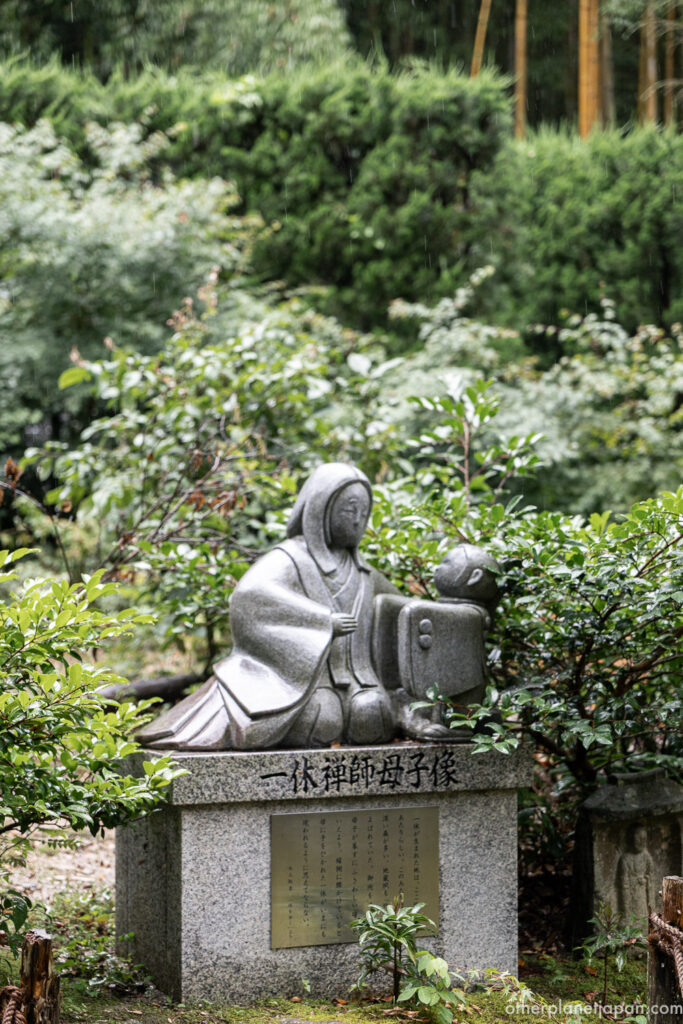
The second name is Ikkyu Zenji (一休禅師). Yes, that Ikkyu — the irreverent Zen master and poet who became a beloved cultural icon. He was born here in 1394 and spent his first six years within these grounds before being ordained. Widely believed to be the son of Emperor Go-Komatsu, his mother — Lady Iyo — was forced to leave the imperial court by those who resented her pregnancy, and gave birth in a house near Jizō-in before raising him within the temple. That a child who grew up surrounded by bamboo and moss became one of Japan’s most freethinking monks feels, somehow, correct.
The temple was largely destroyed in the Ōnin War (1467–1477) and rebuilt with support from both the imperial court and the Hosokawa family. The current hōjō (main hall) and its garden date from 1686.
What to See at Jizō-in
The Bamboo Approach
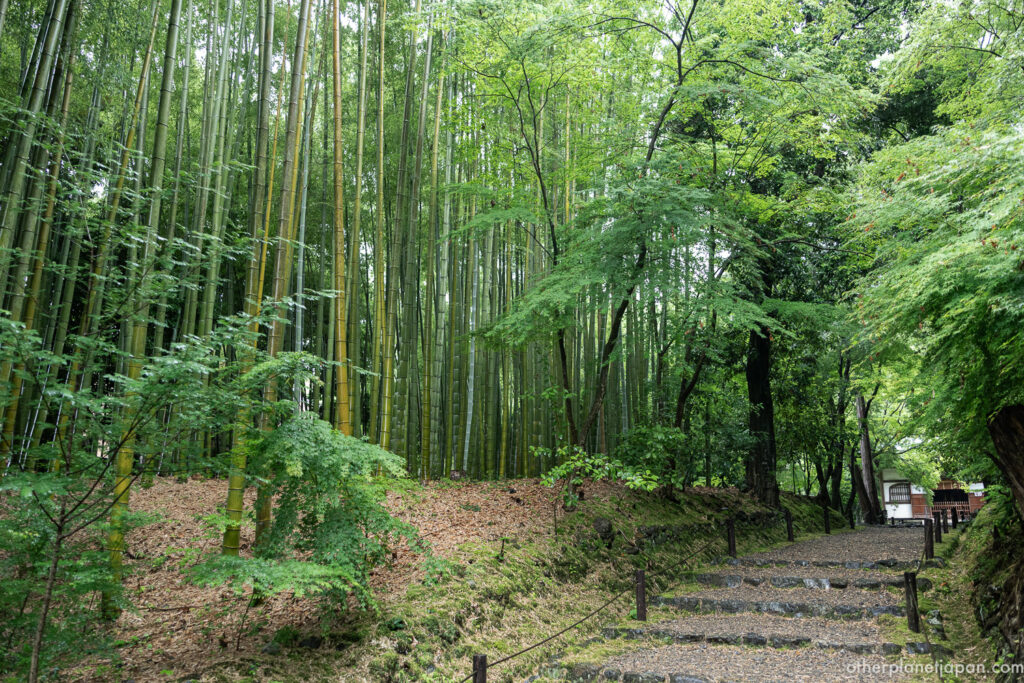
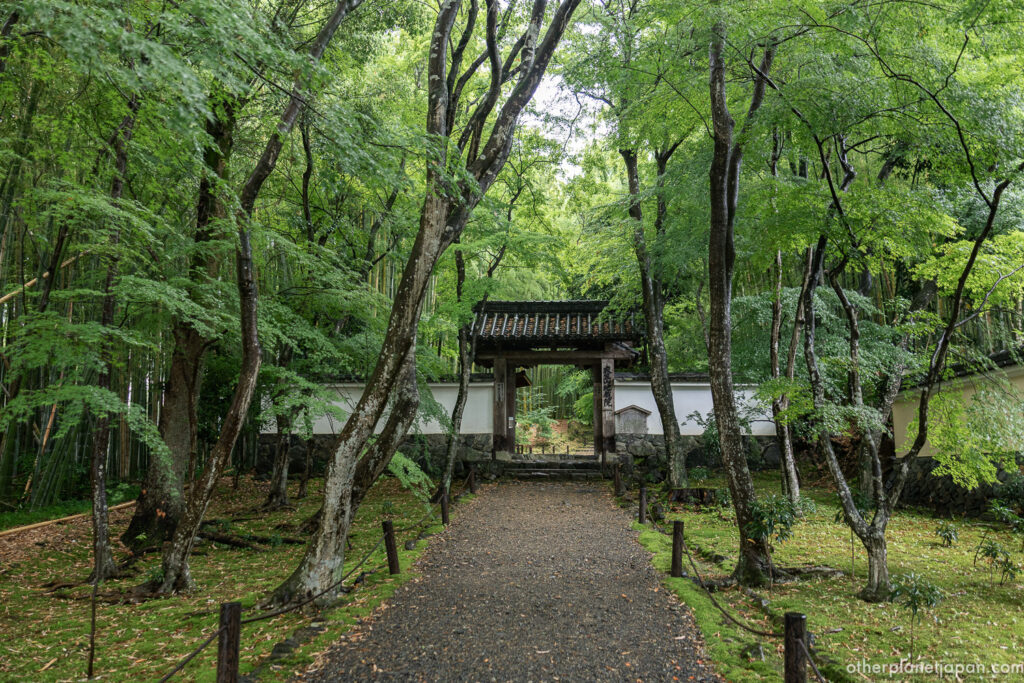
The current outer gate dates from the Azuchi-Momoyama period, roughly 400 years ago. The temple grounds are a place of worship, and the signage asks visitors to bear that in mind — no eating or drinking while walking the paths. The atmosphere makes the reminder feel unnecessary.
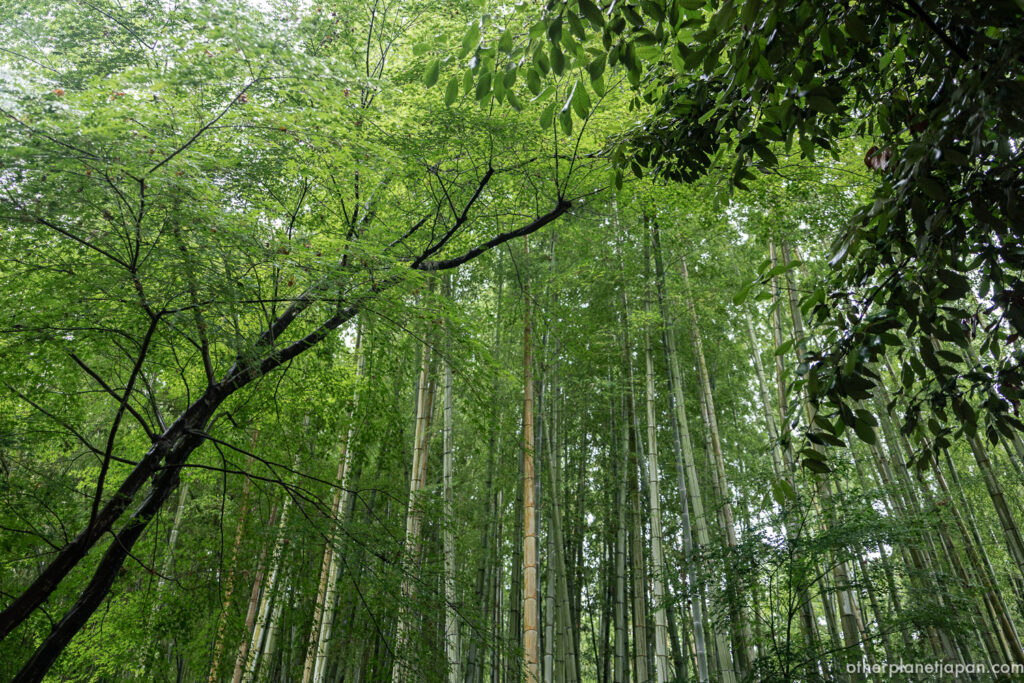
From the gate, the approach to the inner sanctuary runs between dense stands of mōsō-chiku (孟宗竹) — the thick-stalked bamboo species that defines the Japanese aesthetic of the form: yellow-green, ringed at intervals, tall enough to block direct sun. Unlike the famous Arashiyama Bamboo Grove a few kilometers north — which functions more like a corridor through a photograph — the bamboo here has depth. It recedes into the hillside on both sides, and you can feel it rather than just see it.
Look up. The bamboo and maple canopy overhead forms a composition that doesn’t exist anywhere else on the grounds. Worth a minute, and worth a photograph.
The Moss Garden
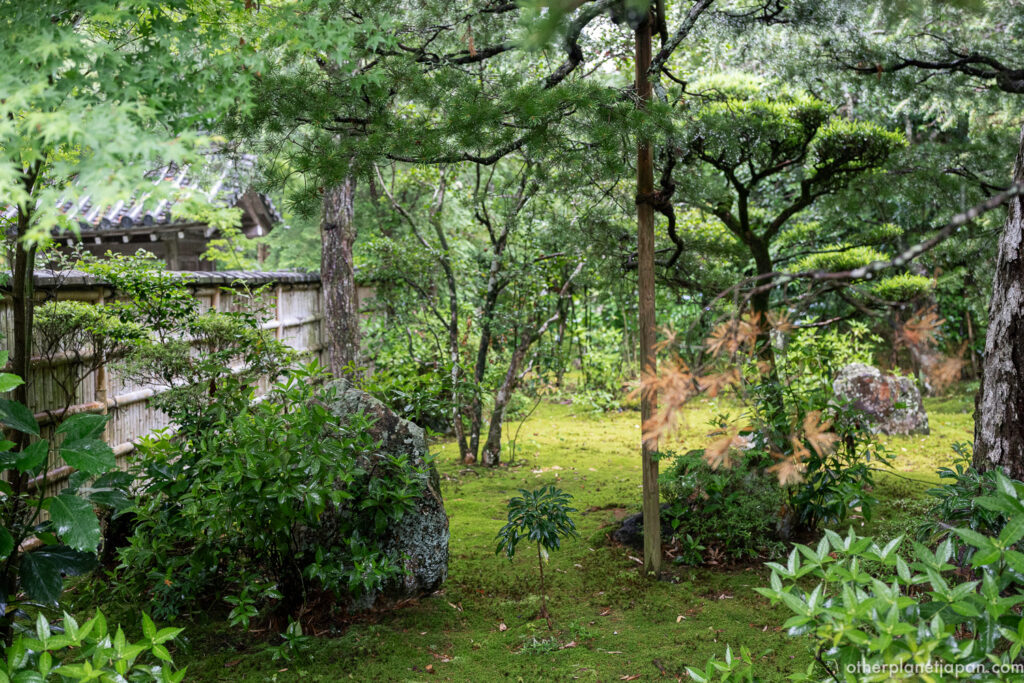
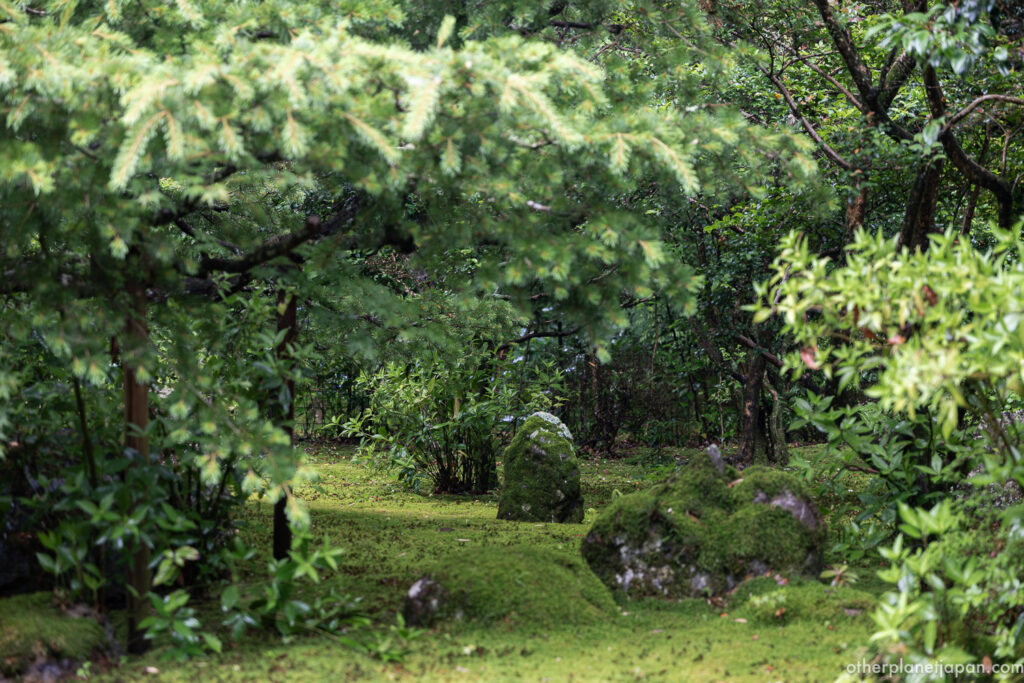
Saihō-ji — the famous Moss Temple — sits a four-minute walk from Jizō-in, and requires advance reservation, a handwritten application, and a mandatory sutra-copying ceremony before admission. Jizō-in requires a ticket. That’s the whole process.
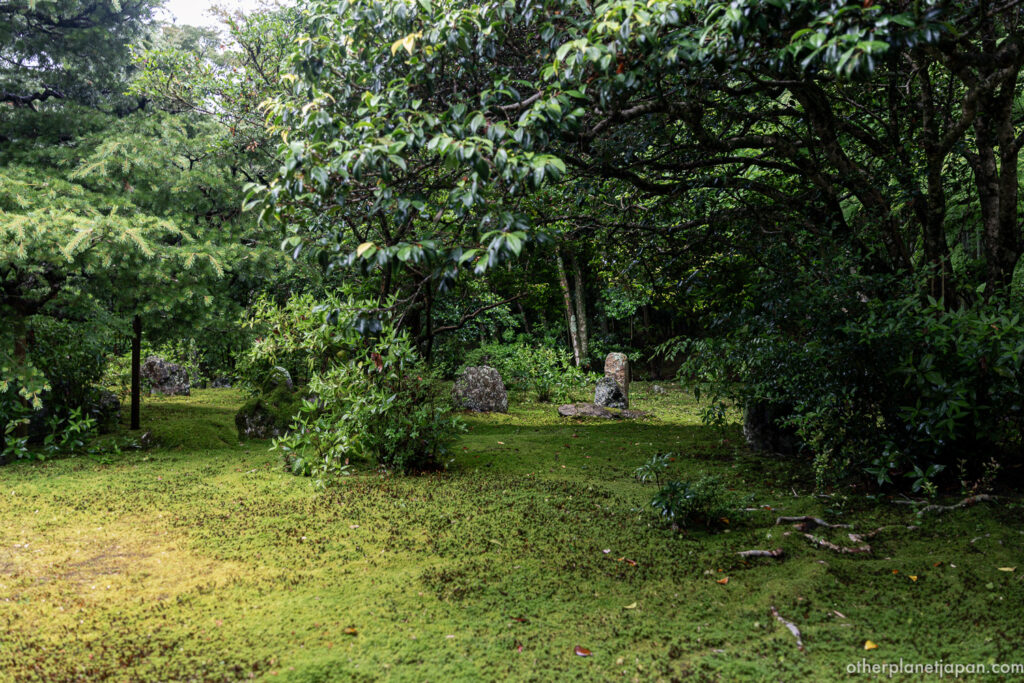
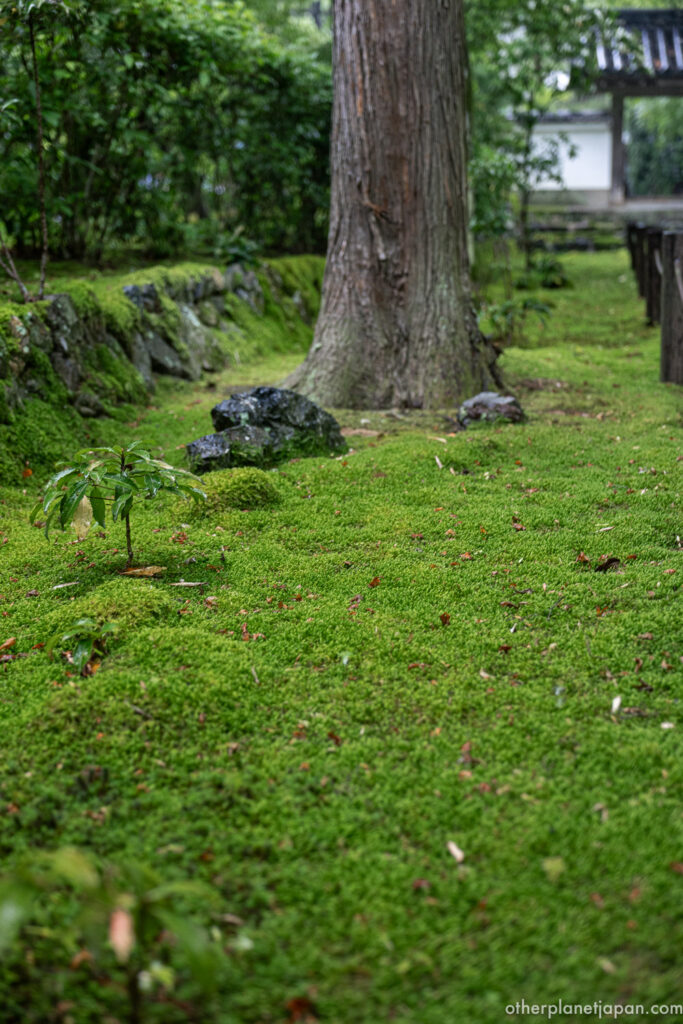
The moss here is a different species and a different character from Saihō-ji’s. Where the Moss Temple layers dozens of varieties in depth, Jizō-in’s garden is more unified — a single sweeping carpet of deep green that turns almost luminescent after rain. Stones emerge from it at irregular intervals. Maples and pines cast partial shade. The overall effect is less manicured than Saihō-ji, more like a garden that has been slowly becoming itself for centuries.
Visitors walk the gravel perimeter paths but do not enter the moss. This is a sensible rule. The moss is not an amenity; it’s the point.
The Hōjō (Main Hall)
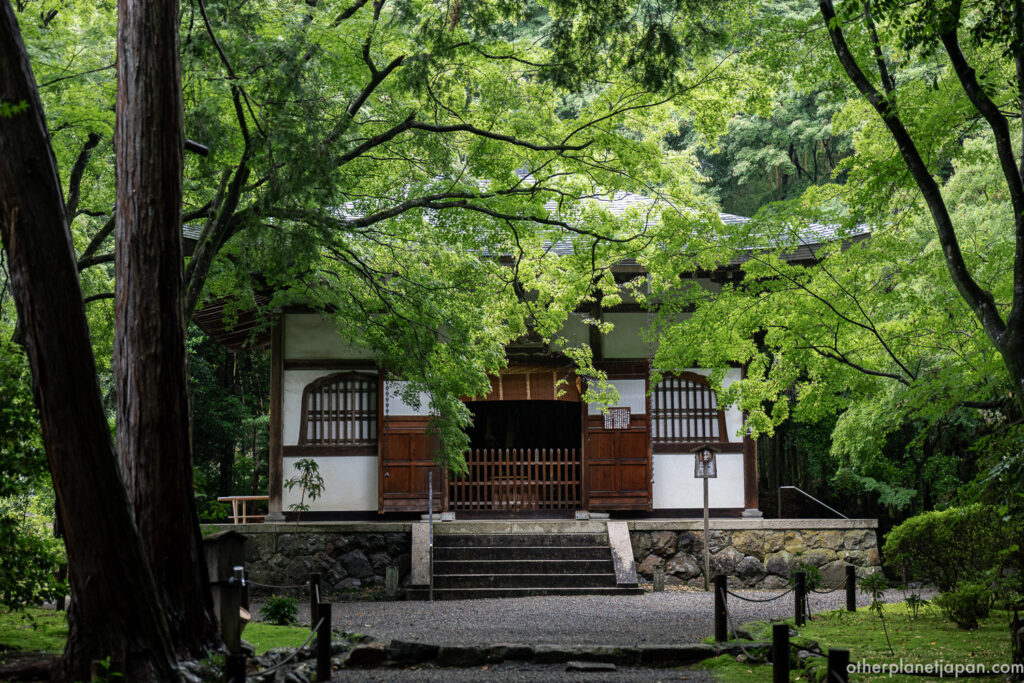
The hōjō dates from 1686 and is designated as a Kyoto City Registered Cultural Property. Visitors remove their shoes at the entrance. Please do not soil or damage the buildings or garden — they are registered cultural assets of Kyoto City.
Inside, the rotating exhibition features fusuma paintings and calligraphy donated by former Prime Minister Hosokawa Morihiro. Three works cycle through the display; whichever is shown when you visit is worth pausing at. The connection between this family and this temple has run uninterrupted for more than six and a half centuries.
Jūroku Rakan no Niwa (Garden of the Sixteen Arhats)
Directly in front of the hōjō is the karesansui garden known as 十六羅漢の庭 (Jūroku Rakan no Niwa) — the Garden of the Sixteen Arhats — designated as a Kyoto City Registered Scenic Site. Sixteen stones represent the principal disciples of the Buddha, arranged across a bed of raked gravel. In March, several varieties of camellia bloom among them.
This is a seated-viewing garden (zaikan shiki): visitors observe from the veranda rather than walking through. The restraint of the design is its strength. Sit down, look across, and take your time.
The Inome-mado (Heart-Shaped Window)
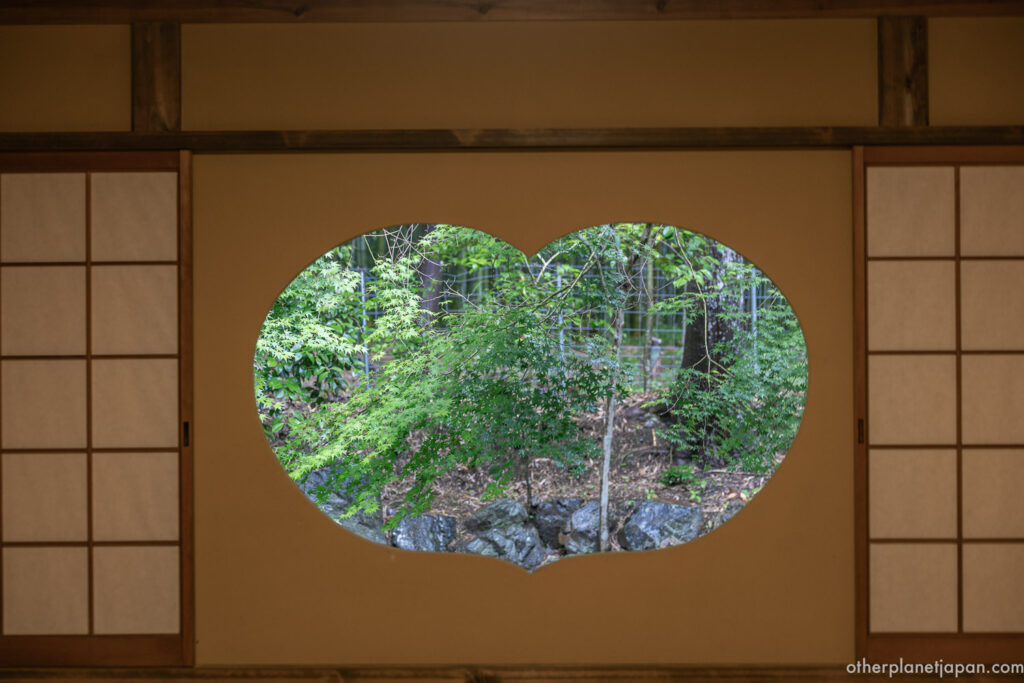
The tea room adjacent to the hōjō cannot be entered, but there is one reason to stand in front of it: the 猪目窓 (inome-mado), a window cut in the shape of a boar’s eye — the traditional architectural motif from which the heart-like silhouette comes. The temple notes that this window is believed to ward off evil (open to visitors for a limited period).
Through it, the bamboo grove resolves into a single framed composition: green on green, branches layered against stalks. The view was designed in the Edo period, centuries before anyone thought to call things photogenic. It holds up.
Inari Shrine and Sarasvati
The grounds contain two smaller shrines. The Inari Shrine (稲荷社) is dedicated to Uka no Mitama, the deity of happiness and good harvest. The Sarasvati (弁才天) is the goddess of art, learning, and wisdom, said to draw out one’s talents. A Zen temple that also honors Shinto deities is not unusual in Japan — the two traditions have coexisted here for centuries, and visitors come to venerate both.
The Graves of Sokyō and Hosokawa Yoriyuki
At the far end of the grounds lie the graves of the founding Zen priest Sokyō and the temple’s patron Hosokawa Yoriyuki — both marked only by simple natural stones. The grave on the right, known as the Hosokawa Stone, once had an arakashi oak growing beside it, its trunk wrapping around the stone as if embracing it. The tree was knocked down by a typhoon and only the stump remains. Even in absence, it’s a striking image.
Goshuin (Temple Stamp)
Jizō-in offers a goshuin for ¥500. It is available as a pre-written slip (kakioki) only — a priest does not write it on the spot. The design is clean and understated, centered on the character for Jizō.
Practical Information
Admission
Overseas visitors: ¥1,000 (adults) / ¥500 (children, ages 6–18)
Japan residents (any nationality): ¥500 (adults) / ¥300 (children)
Special periods (GW / Nov 21–Dec 7): ¥1,000 flat
Visitors presenting a disability certificate receive a 20% discount; up to two caregivers receive the same.
Hours & Closing Days
The hōjō and gardens are open 9:00–16:00 (last entry 15:40; hōjō closes 15:50).
Jizō-in observes a more complex schedule than most Kyoto temples:
- Open daily: April 29–June 20 and October 11–December 7
- All other periods: Tuesday, Wednesday, Friday, Saturday, Sunday only (closed Monday and Thursday)
- Closed: August 1, 14, and 15
- Temporary closures may occur due to ceremonies, weather, or repairs
Check the official attendance calendar before visiting. It is updated in real time and is the only reliable source for current opening status.
How to Get There
By bus (recommended):
Kyoto Bus stops directly at the Kokedera (苔寺) stop. Three departure points connect to this stop:
- From Kyoto Station: Kyoto Bus Route 73, alight at Kokedera
- From Shijo-Kawaramachi / Sanjo Keihan: Kyoto Bus Route 63, alight at Kokedera
- From Arashiyama: Both Route 63 and Route 73 stop at Arashiyama — board either and ride to Kokedera
From the Kokedera stop, Jizō-in is a 3-minute walk. Flat fare: ¥230 (adults) / ¥120 (children), all routes.
By train + walk:
From Hankyu Kamikatsura Station (阪急上桂駅), approximately 12 minutes on foot.
By car:
Five parking spaces available (standard vehicles only, no tour buses). One hour free. The approach road is too narrow for two-way traffic; public transit is strongly encouraged.
Address: 23 Yamada Kitanochō, Nishikyō-ku, Kyoto 615-8285
Combining with Other Sites
Jizō-in pairs naturally with a visit to Saihō-ji (the Moss Temple), a four-minute walk away. For those spending a half-day in the area, Suzumushi-dera and Kōkedera are also within easy reach. Visitors coming from the city center can combine the trip with Arashiyama, which is served by the same bus routes.
Official Website
For the latest information on opening status and temple events, visit the official Jizō-in website
Frequently Asked Questions
Can I visit Saihō-ji and Jizō-in on the same day?
Yes — they are a four-minute walk apart, and Jizō-in requires no reservation, so it fits naturally into a Saihō-ji itinerary. Saihō-ji admission is typically scheduled for morning slots, which makes Saihō-ji in the morning, Jizō-in in the afternoon the most practical order. Think of Jizō-in as the walk home that happens to contain a moss garden and a bamboo forest.
What is the best season to visit Jizō-in?
Late April through June, when the moss is at peak saturation and the maples are fully leafed, is the strongest season. Autumn (mid-October through early December) is equally good for the combination of red maple and bamboo. Rain is not a reason to stay away — wet moss reaches a depth of green that dry conditions simply cannot produce.
Can I walk in the garden or on the moss?
The hōjō interior and veranda are accessible with shoes removed. The karesansui garden and moss garden are for viewing only — entry is not permitted. The tea room is not open to the public.
Is Jizō-in worth visiting if I’ve already seen Saihō-ji?
The two experiences don’t overlap as much as they appear to. Saihō-ji is ceremonial and immersive; Jizō-in is casual and atmospheric. The bamboo forest, the inome-mado, the Hosokawa fusuma paintings, and the graves of Sokyō and Hosokawa Yoriyuki are all things you won’t find at the Moss Temple. They complement each other rather than repeat.
Is the temple accessible by wheelchair?
There are steps along the main approach and at the hōjō entrance. The grounds are not fully wheelchair accessible. Contact the temple directly at 075-381-3417 for current details.