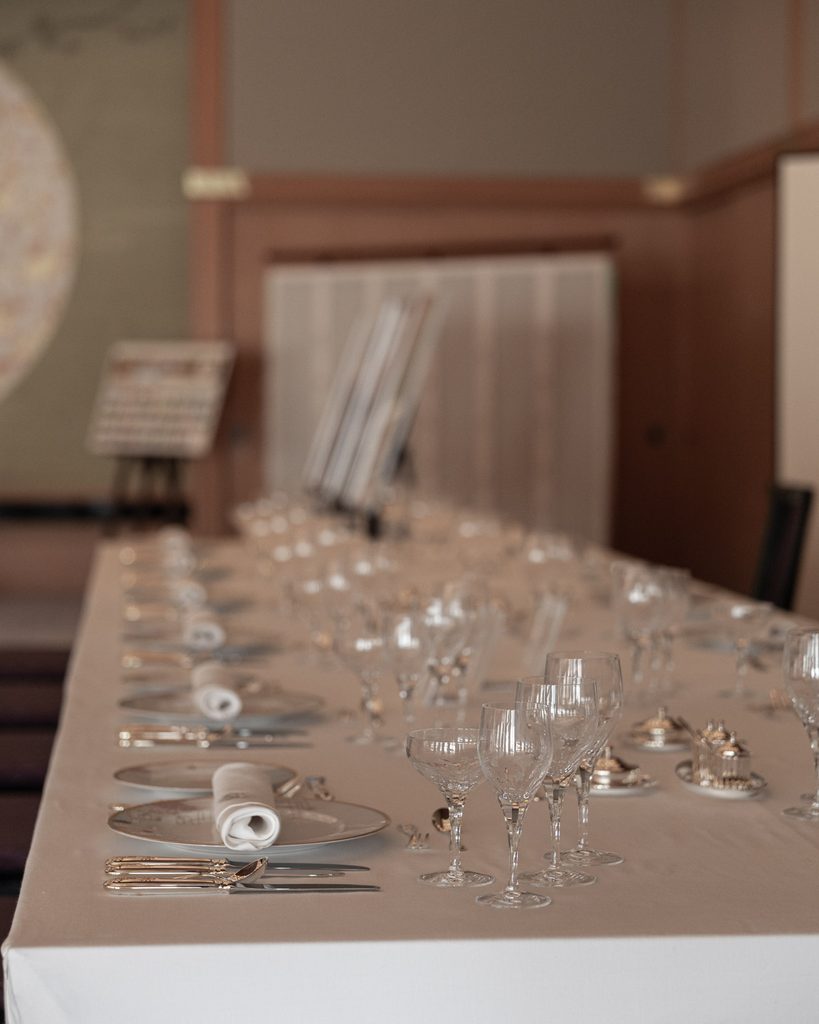
Four glasses at every place. Napkins rolled on the plates. Silverware laid out so evenly it looked measured, and it probably was.
It was a table set for a state dinner, and I was not on the guest list. Presidents, prime ministers, and royalty sit here. I had a 2,000-yen ticket.
The Kyoto State Guest House, known in Japanese as Kyoto Geihinkan, is where the Japanese government hosts visiting heads of state. When no official guest is expected, it opens to the public on guided tours. You can walk through the rooms. You can’t stay for dinner. On a late-September morning, I joined a Japanese-language tour to see what the guests see.
Planning a visit? Jump to How to Visit the Kyoto State Guest House for tickets, tour times, and what to bring.
Not Yet a State Guest
I did consider the other way in.
How does a person get invited here as a state guest? I gave it some honest thought. The short answer is that it hasn’t happened. Not yet.
So I gave up and applied on the official website, like any other visitor.
Check-in isn’t at the guest house itself. It’s at the Seiwain Rest House, a short walk away inside Kyoto Gyoen, the vast park in central Kyoto that also surrounds the Kyoto Imperial Palace. I showed my reservation number and paid at a machine, which took my credit card without complaint. If you’re used to Kyoto temples, where you count out coins at a wooden window while a monk waits, it feels almost suspiciously efficient. Then again, this isn’t a temple. It belongs to the Cabinet Office.
A Cooking Show With No Dinner
Because every visit is a guided tour, arriving early means waiting in a lounge, where a video about omotenashi, the Japanese idea of wholehearted hospitality, plays on a screen. A chef who cooks Japanese cuisine for state guests is interviewed, and then the camera moves into the kitchen. Dish after dish is plated. Everyone in the room watched in silence, and none of us was about to eat any of it. I have never been shown so much food and fed so little.
Other artisans follow. In the tea segment, a tea master from one of the Senke schools, the tea lineages descended from Sen no Rikyu, talks about serving tea to visiting dignitaries. The style used here is ryurei, in which tea is prepared and served with everyone seated at tables instead of kneeling on tatami.
Foreign guests, the tea master explained, don’t need a lecture on the fine points of the tea ceremony, so the conversation turns to spring in Kyoto instead. The water is boiled over a charcoal fire built from scratch, and one state guest, delighted, compared it to floor heating.
Flower arrangers appear, too, and every artisan returns to the same idea: twelve centuries of Kyoto tradition, combined with a new sensibility, went into this house.
Kiri-no-Ma, Where I Didn’t Hit My Head
Getting into the building means going under it first, down to a basement checkpoint that looks a lot like airport security. Bags go through a scanner, you step through a metal detector, and your shoes come off in exchange for slippers. No photos are allowed here. It never feels intimidating, though. The staff are courteous, and the whole process is calmer than any airport I know. For a moment I wondered whether visiting presidents come in this way, too. Probably not.
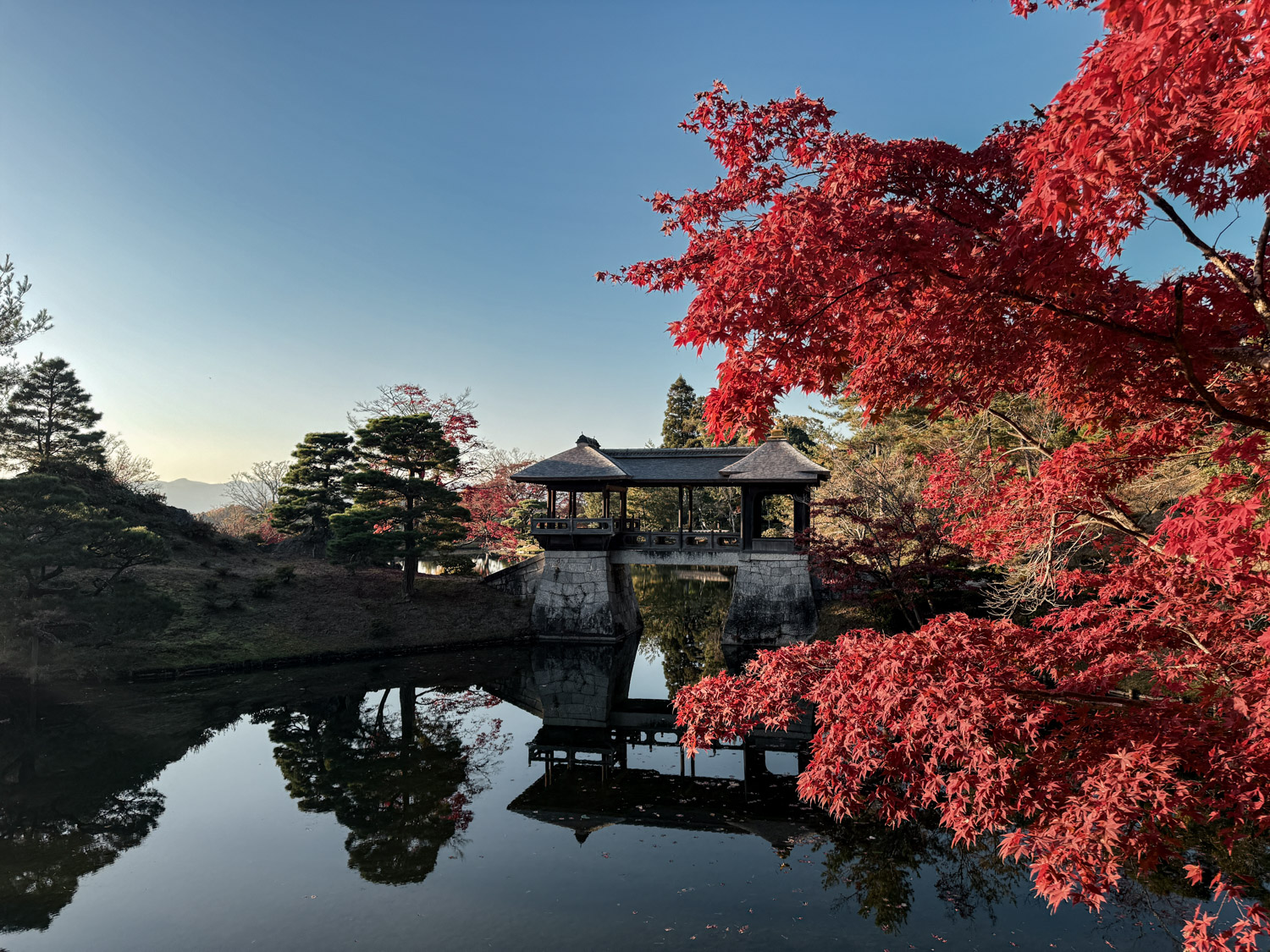
Back upstairs, we crossed a covered bridge over the pond and kept walking. The garden would have to wait. There would be time for photos later, and there was.
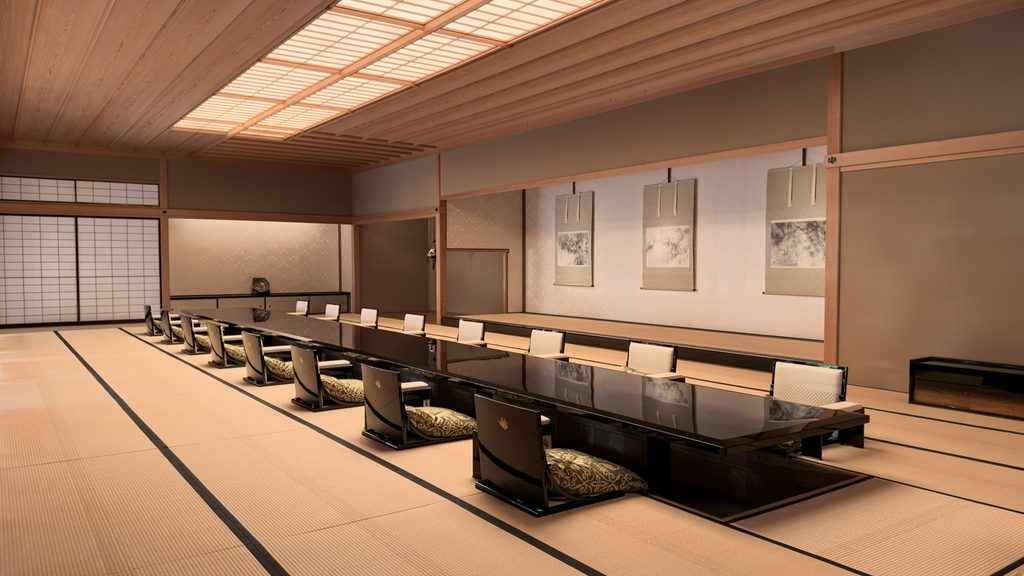
Kiri-no-Ma is, put simply, the banquet hall. It’s the room for formal Japanese dinners, and its long black lacquered table is polished enough to hold the ceiling and the hanging scrolls in its surface. The dishes from the video presumably end up here.
What struck me first was the height of the room. I’m a little over 180 centimeters, close to six feet, and at my family’s house in Shizuoka I still clip my head on the door lintels now and then. Japanese houses and my forehead have a long, unresolved disagreement. Kiri-no-Ma was built on a generous scale, with foreign guests in mind. I don’t know its actual dimensions. I only know I had never felt that much air above me in a Japanese room, and I liked it immediately.
The guide pointed up at the ceiling. Hidden along it are lights meant for geiko and maiko when they dance for guests. I would have walked right under them without noticing.
The tatami underfoot hide a detail of their own. They’re woven in nakatsugi-omote, a traditional technique that uses only the best part of each rush and joins the stalks at the center of the mat, and the borders are hemp dyed with natural indigo. To the eye, it’s simply a beautiful tatami mat. Nobody would guess there’s a seam running down the middle. Once the guide explained it, I suddenly noticed the smell of the rush, as if it had only now arrived. It had probably been there all along. Much of this building works that way. You don’t see it until someone tells you.
A Room We Weren’t Supposed to See
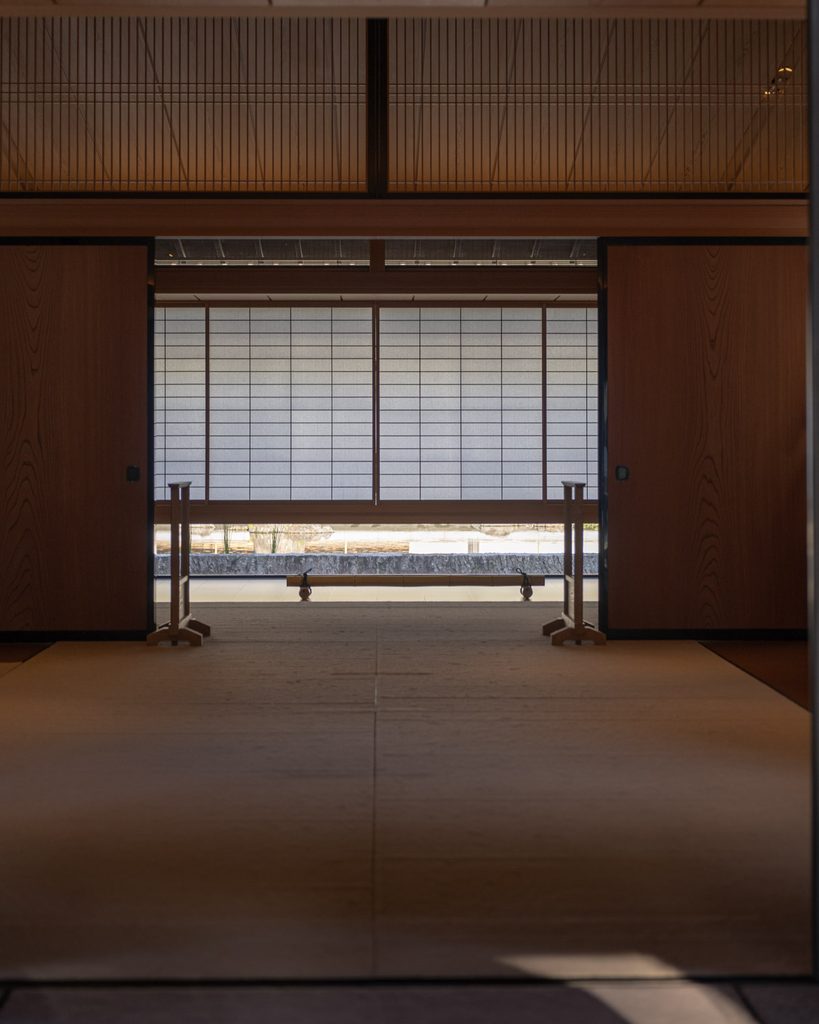
The next room wasn’t on our scheduled route.
Yubae-no-Ma, a conference room named for two tapestries on its walls, one of moonlight over Mount Hiei and one of evening light over Mount Atago, was closed to visitors that day, and nobody told us why. In its place, we were shown Suimei-no-Ma, a room normally not open to the public at all. I didn’t feel shortchanged. Few visitors ever get to stand in it.
On display was a photograph of a U.S. president with a Japanese prime minister. I looked out toward the pond and wondered what the two of them had talked about in here.
Plans change here because this is still a working government building, not a museum. The guests’ schedule comes first. Ours comes second.
Not everything about the visit came second, though. It was a hot day, and I had left my drink in a locker at the Seiwain Rest House along with my bag, since you can’t bring drinks inside. The first water server appeared at the security checkpoint. The second came about halfway through the tour, just as I was starting to flag. The timing was so good that, for a moment, I felt like a state guest.
It Used to Be a Baseball Field
There was almost no time to talk to the guide, so I saved my one question for the walk to Juraku-no-Ma. What stood here before the guest house was built? The answer caught me off guard. According to the guide, it was a baseball field.
Somewhere beneath all this lacquer and silk, someone once chased down a ground ball.
The guest house itself grew out of an anniversary. Around 1990, as Kyoto looked ahead to the 1,200th anniversary of its founding as the capital Heian-kyo in 1994, momentum built for a Japanese-style guest house in the city. The cabinet approved the plan in 1994, and the house opened in April 2005. Those are the same twelve centuries the artisans kept mentioning in the video.
Juraku-no-Ma and Fuji-no-Ma
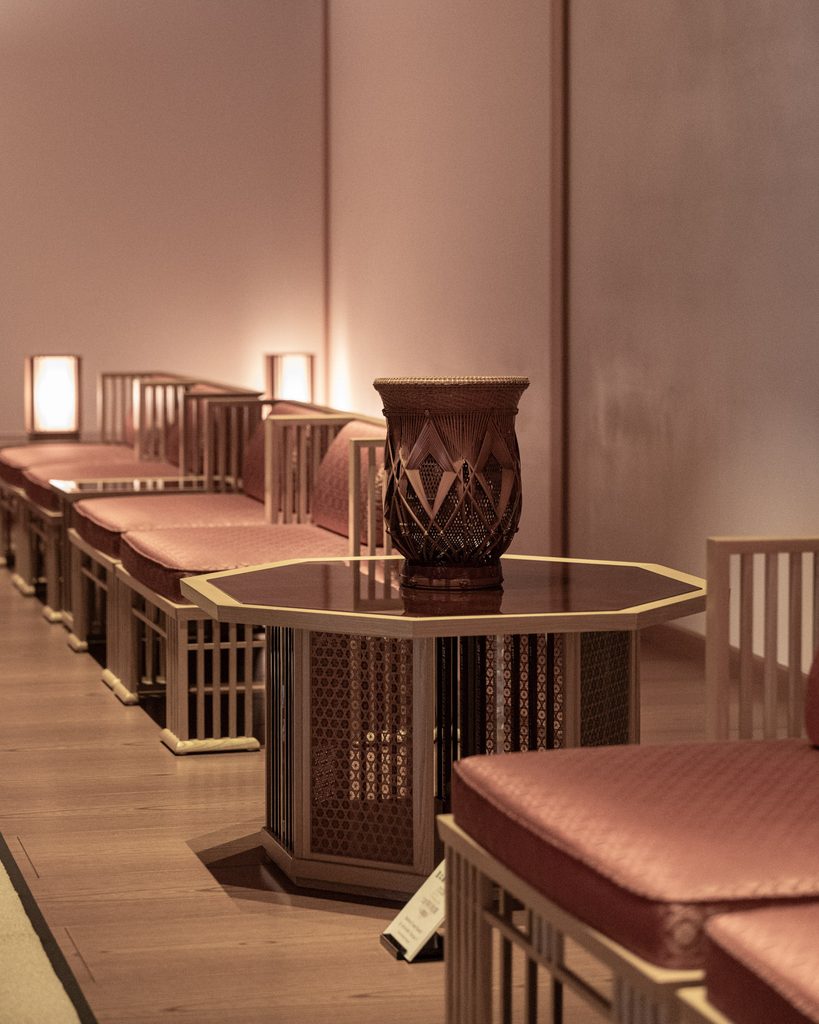
Juraku-no-Ma is less a room than a place to wait.
It serves as an anteroom, where guests pause before going farther in, and even so, nothing in it is an afterthought: a woven bamboo flower basket on an octagonal lacquered table, low lamps, chairs cushioned in a soft cherry-blossom pink.
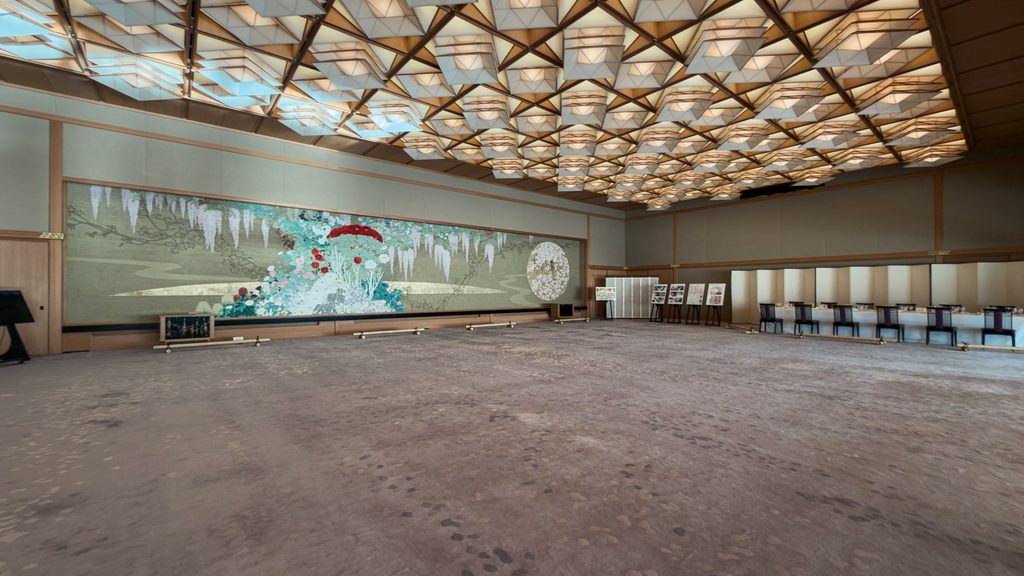
Fuji-no-Ma was the last room on the tour, and I’ll admit I never quite warmed to it. After so many small, quiet details, a hall this big felt like a change of key. It’s the largest room in the guest house, used for welcome ceremonies and Western-style state banquets, and I can think of few hotel ballrooms that could match its size. Even here, though, most of the craft was the kind you’d miss until someone pointed it out. One long wall is covered by Reika, a tapestry of 39 kinds of flowers. It was woven in tsuzure-ori, Kyoto’s traditional tapestry weave, from a design by the nihonga painter Shikami Kiyomichi. From across the room, it looks like a painting. Up close, it’s thread.
Fuji means wisteria, and in the Japanese language of flowers, wisteria stands for welcome. The carpet carries the theme, with wisteria petals scattered across it as if blown in by the wind. Overhead, panels of Mino washi paper set in wooden lattice can be raised and lowered into 15 different patterns. The table I described at the start was set in this room.
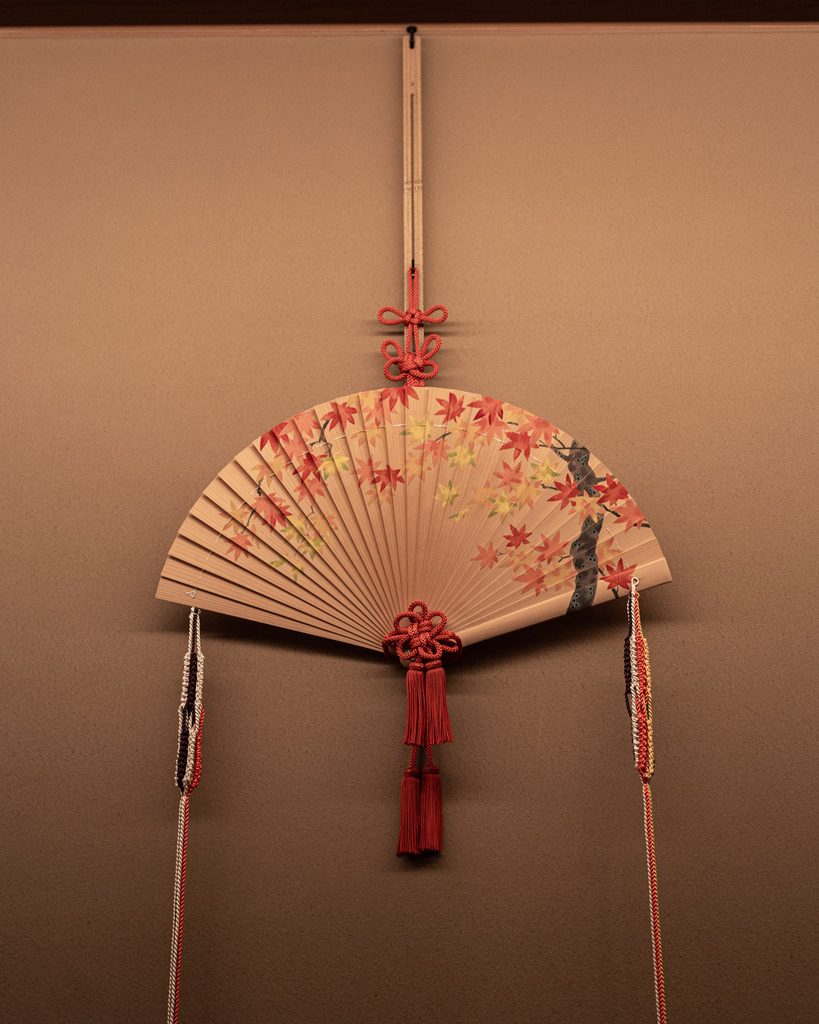
In the corridor that connects Fuji-no-Ma and Kiri-no-Ma hung a folding fan painted with maple leaves. It was late September, and outside, the trees were still green.
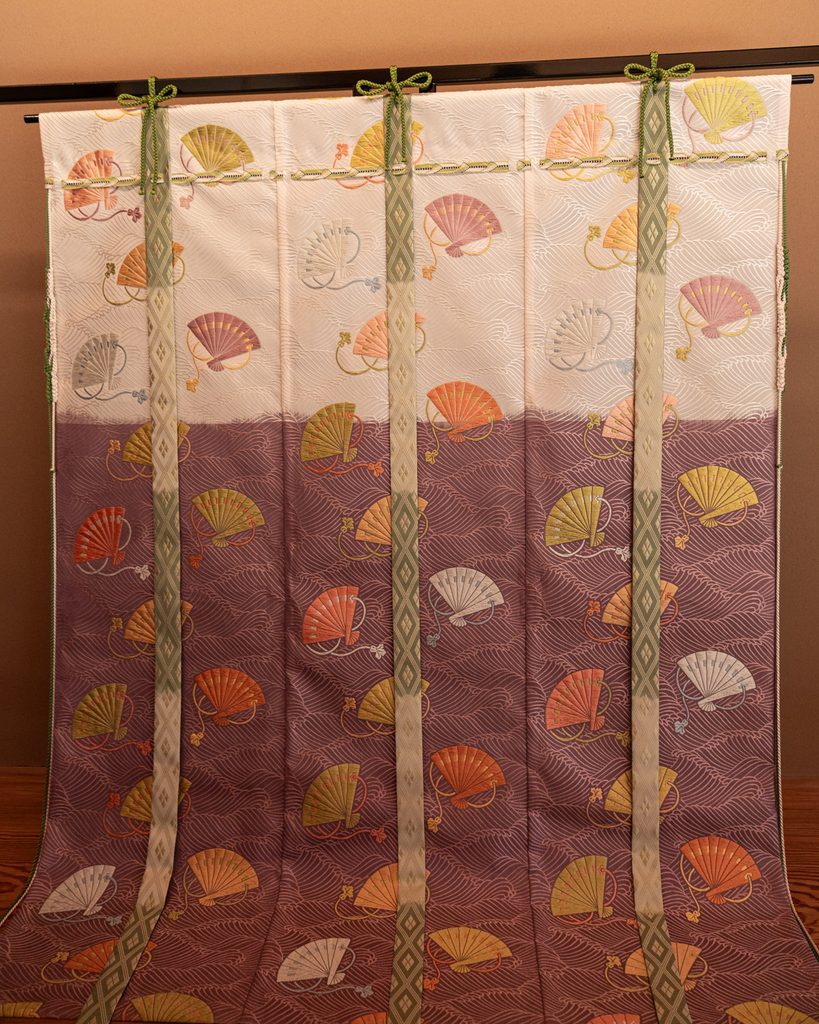
Farther along the same corridor stood a kicho, a silk standing curtain of the kind once used to divide rooms in aristocratic homes, its white and purple panels scattered with painted fans.
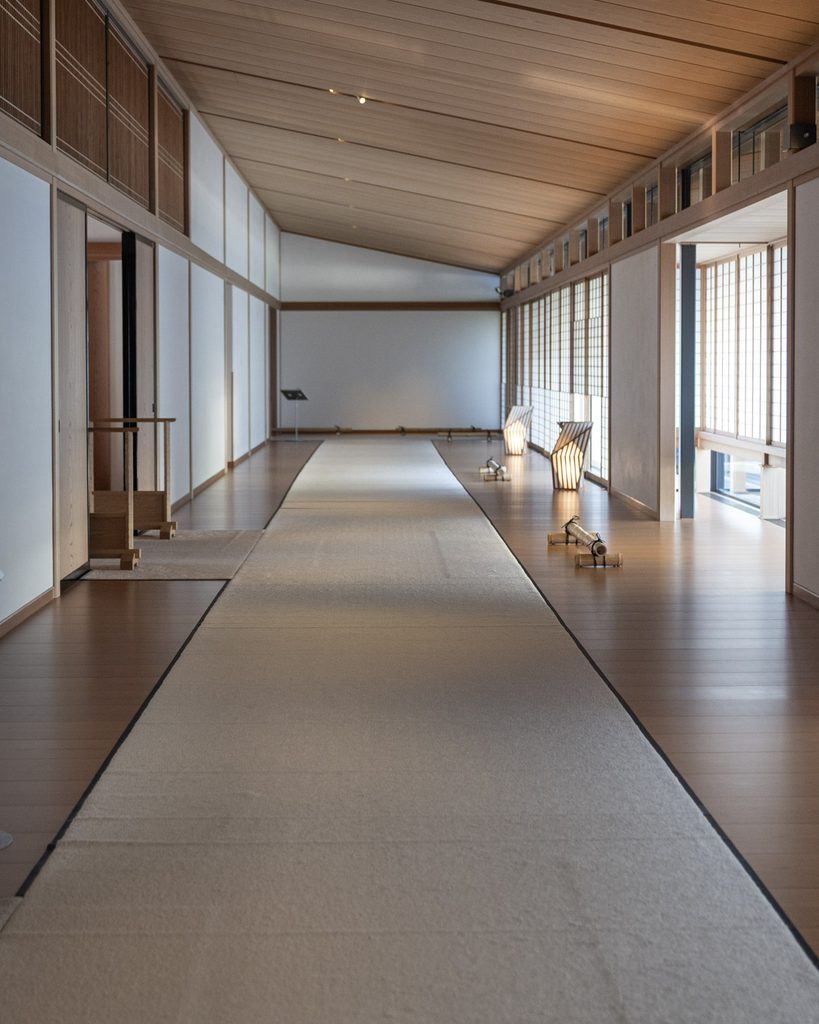
Light came through the shoji in soft panels and lay across the polished floorboards, and the low paper lanterns along the walls were already lit.
A Garden That Belongs to the House
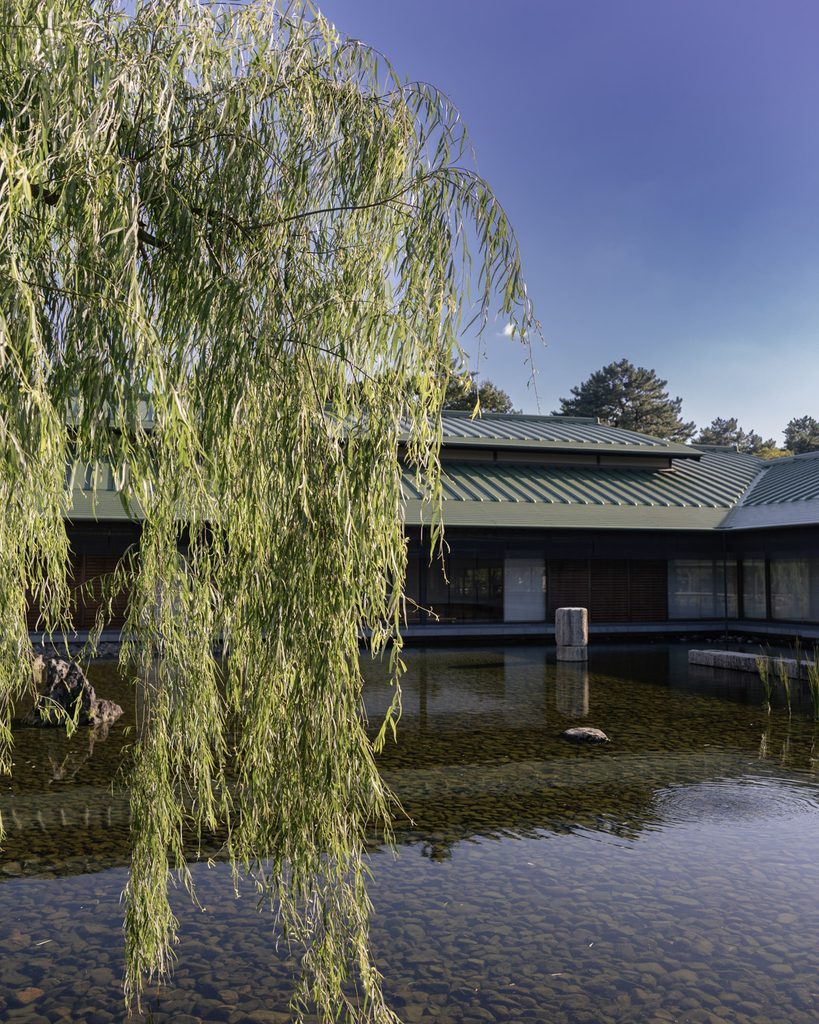
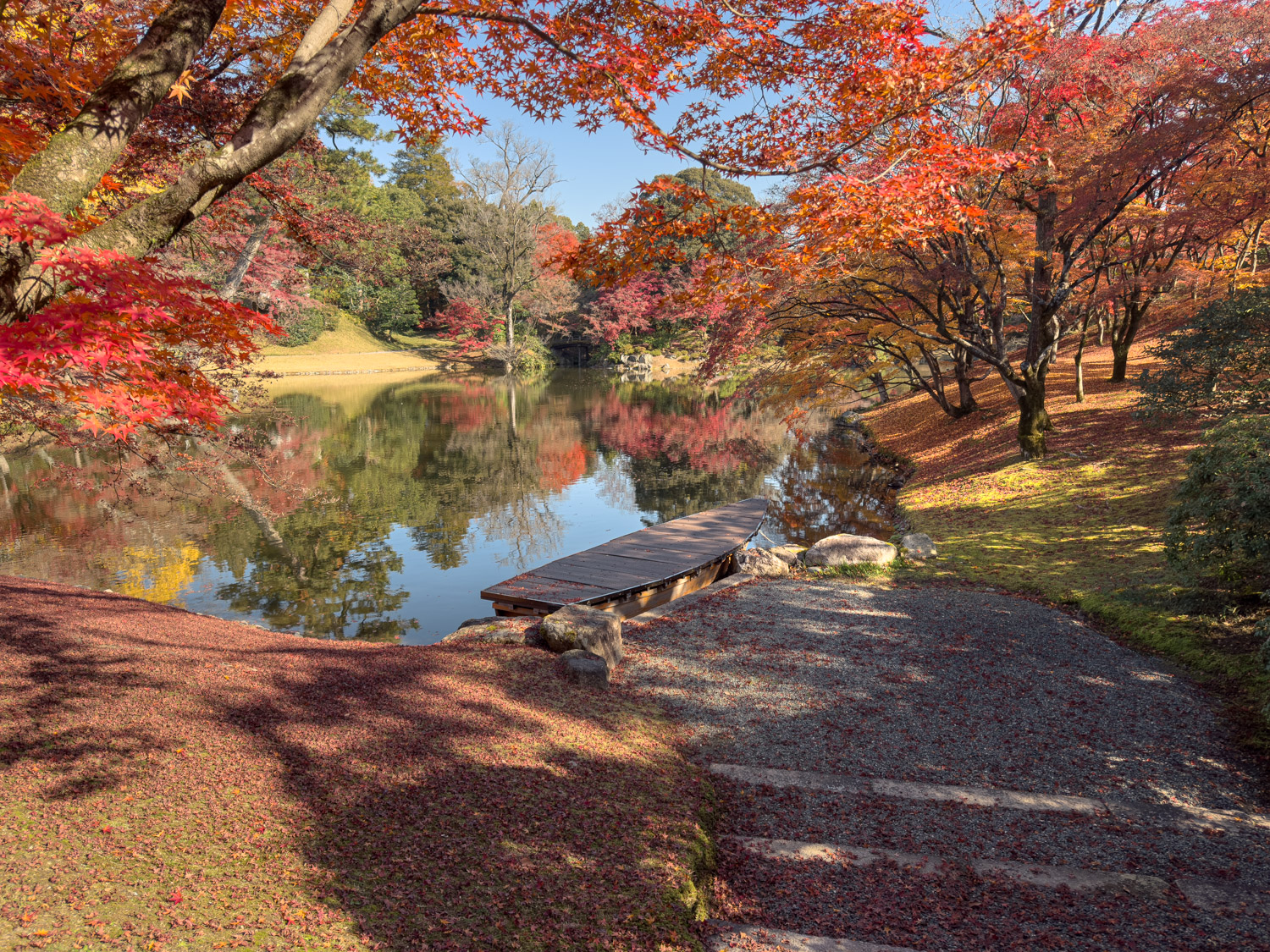
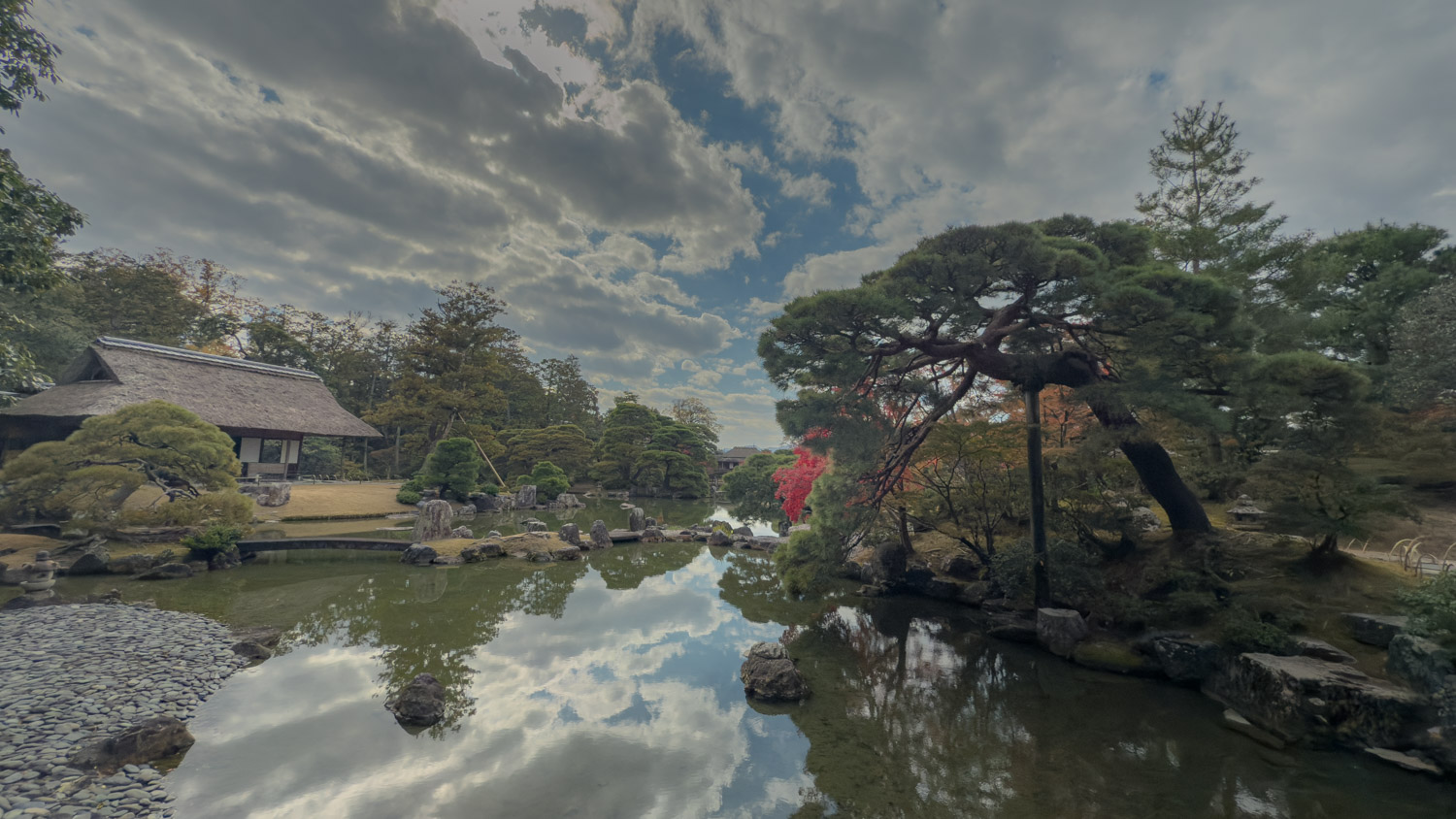
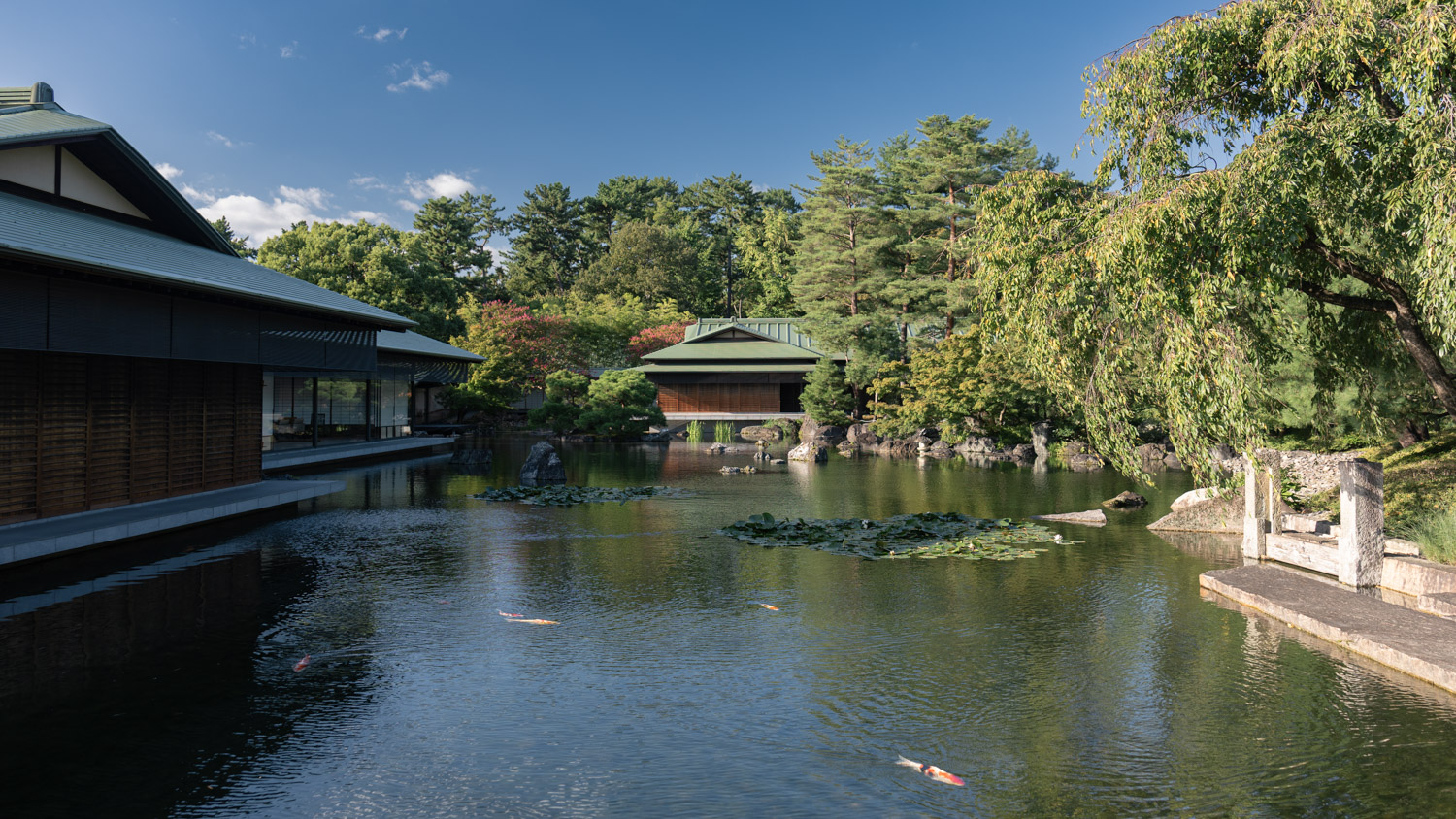
Every room looks toward the pond, because the design follows teioku-ichinyo, the old idea that a house and its garden should be one, and the trees of Kyoto Gyoen rise beyond the walls as borrowed scenery. When the guide finally gave us time to photograph it, a willow hung low over the water, and the pond was clear enough that I could count the stones on the bottom.
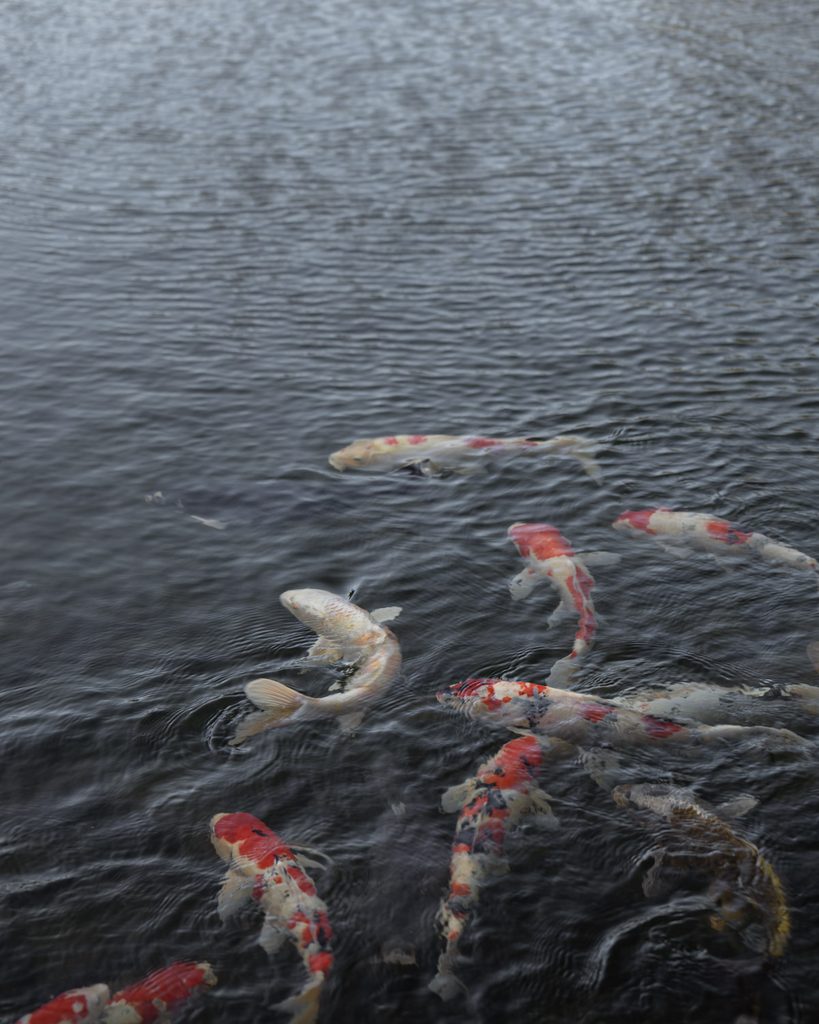
Koi crowd the northern part of the pond, and visiting dignitaries often feed them. I never got the dinner, but I did get to watch the same koi from roughly the same spot as a head of state.
As for the invitation, the answer hasn’t changed. Not yet.
How to Visit the Kyoto State Guest House
The guest house is open to the public year-round, except when it’s being used for official visits. Every visit is a guided tour, and the details below come from the official website and my own visit on September 22, 2026. Rules and schedules change, so check the official Kyoto State Guest House website before you go.
Kyoto State Guest House Tickets and Reservations
Book ahead if you can. Advance reservations are taken first come, first served through the official reservation form, until noon the day before your visit. Keep the confirmation email, since you’ll show it at check-in. Only one reservation per email address is accepted for each day.
Without a reservation, you can try for a same-day entry slip. If a tour still has room, slips are handed out first come, first served at the Seiwain Rest House from 9:30 a.m. When it’s busy, visitors with reservations go in first.
Public openings can be canceled at short notice when an official guest arrives. Check the public opening schedule shortly before your visit.
Fees, Hours, and Tour Times
| Admission | Adults ¥2,000; university students ¥1,500; junior high and high school students ¥700 (student ID required) |
| Payment | Cash; Visa, Mastercard, American Express, JCB, Diners Club; transit IC cards such as Suica, ICOCA, and PASMO. No PiTaPa or QR code payments, and cash and cashless can’t be combined |
| Hours | 9:30 a.m. to 5:00 p.m. (last admission 3:30 p.m.) |
| Closed | Wednesdays, and days when official guests are received |
| Tour length | About 90 minutes, including check-in and the briefing |
| English tour | Scheduled days only, once a day at 11:45 a.m., up to 20 people |
| Japanese tour | Nine times a day, from 9:30 a.m. to 3:30 p.m., up to 40 people |
| Age | 13 and older (children 12 and under, including infants, are not admitted) |
English Tour or Japanese Tour?
I took the Japanese tour. If you don’t speak Japanese, the English tour is worth planning around, but it runs only once on scheduled days and has just 20 places, so book as soon as your dates are set. If the English tour is full, the Japanese tour is still a good option: tablet audio guides are available in English, French, Spanish, German, Chinese, and Korean.
Read Up on the Crafts Before You Go
The guide’s explanations were precise, but they assume you already know a little about Japanese crafts, and neither the website nor the pamphlet goes much deeper. Even as a Japanese visitor, I missed some of it. Spend ten minutes beforehand on the official page about traditional skills and techniques at the Kyoto State Guest House. It covers each craft with photos, and it will give you names for much of what you’re about to see.
What to Bring, and What to Leave in the Locker
- You can carry one small bag into the building, no larger than 25 × 25 × 10 cm (about 10 × 10 × 4 inches). Backpacks aren’t allowed in any size.
- Everything else goes in a locker. I left my bag and drink in one at the Seiwain Rest House. The official site also lists coin lockers in the guest house basement that take a 100-yen coin, which you get back. There’s no change machine, so bring coins.
- Drinks, including plastic bottles, can’t be taken inside. On my visit, water was offered at the security checkpoint and again about halfway through the tour.
- Pens and note-taking aren’t allowed in the building, and neither is eating.
- You’ll change into slippers indoors, so wear shoes that slip off easily and are comfortable on gravel, since the paths through Kyoto Gyoen are unpaved.
A Souvenir Card, Not a Goshuin
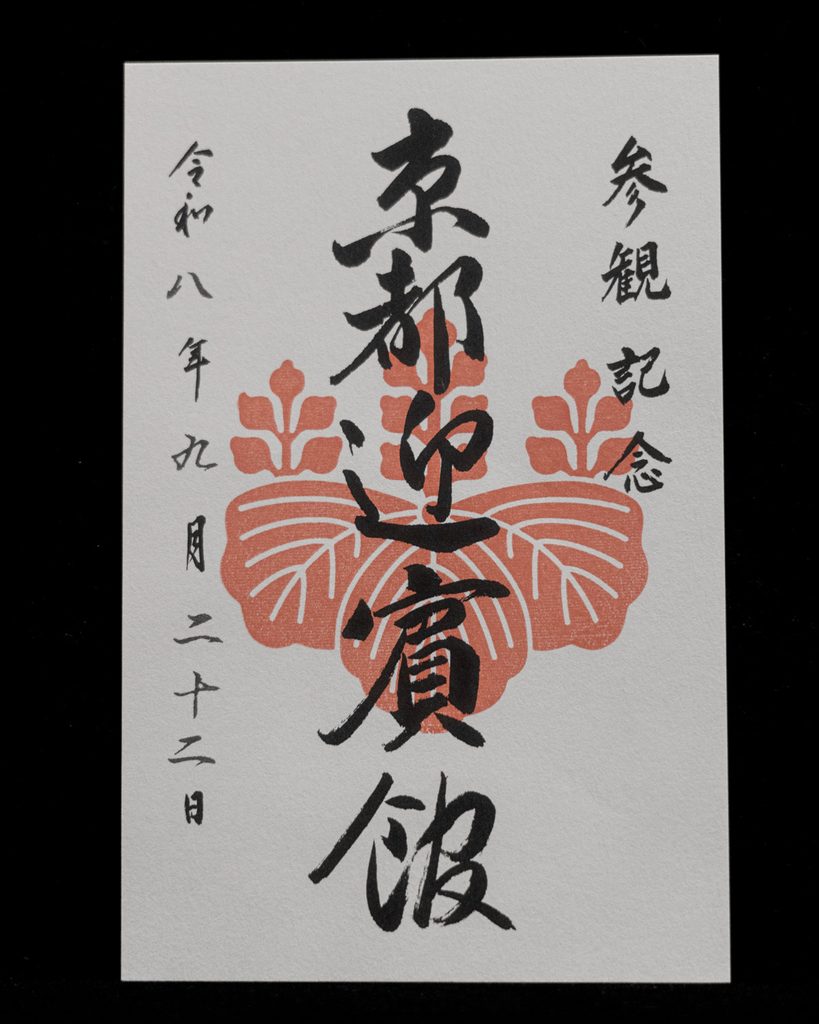
The shop at the Seiwain Rest House sells a commemorative visit card for 300 yen, and the staff will add the date for you. It isn’t a goshuin, the calligraphy stamp collected at temples and shrines, since this is neither. With brushed characters over the vermilion paulownia crest used by the Japanese government, though, it looks at home in a goshuin book.
Getting There
Check-in is at the Seiwain Rest House in Kyoto Gyoen, not at the guest house entrance. The address is 23 Kyoto Gyoen, Kamigyo-ku, Kyoto.
- City bus: Get off at Furitsu Idai Byoin-mae and walk about 7 minutes. From Kyoto Station, take bus 4, 7, or 205 from stop A2. From Hankyu Kyoto-kawaramachi Station, take bus 3, 4, 7, 37, 59, or 205.
- Subway: Imadegawa Station on the Karasuma Line, about 15 minutes on foot from Exit 3.
- Keihan Railway: Demachiyanagi Station, about 20 minutes on foot from Exit 3.
- Taxi: Ask for the Seiwain Gate of Kyoto Gyoen (Kyoto Gyoen Seiwain Gomon-mae), then walk about 5 minutes.