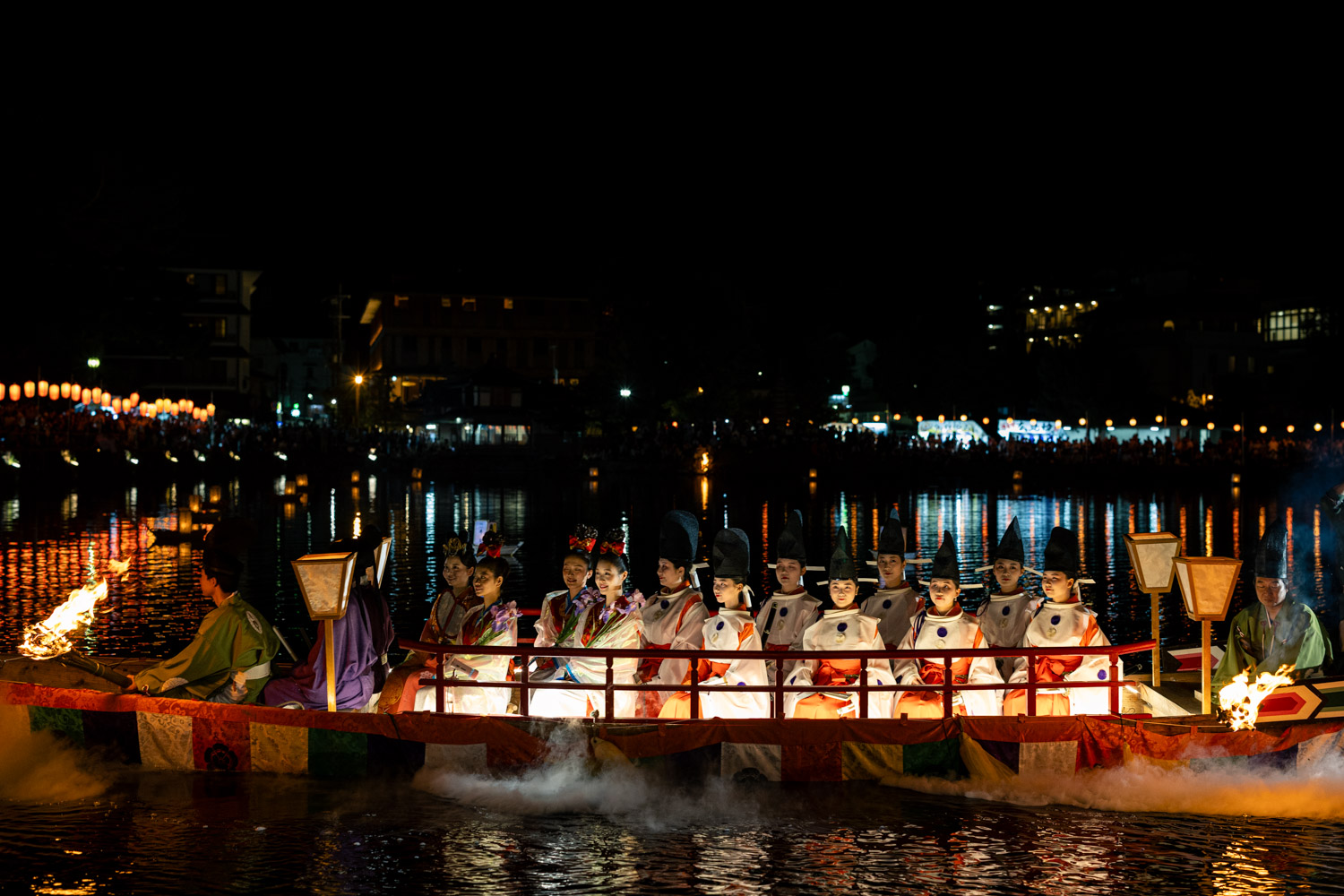
The pond was the color of sumi ink.
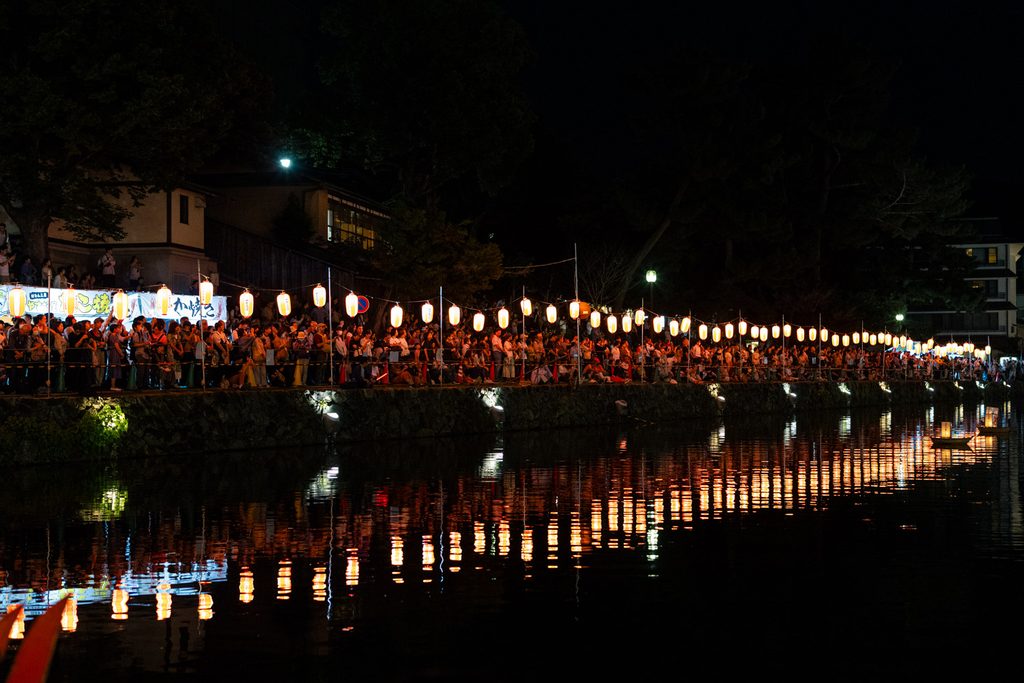
The lanterns lining its banks laid their light across the surface in long, trembling lines. Somewhere above the clouds, the harvest moon kept appearing and disappearing. It hadn’t quite decided whether to attend.
This was the Uneme Festival, or Uneme Matsuri, held on the night of the harvest moon at Sarusawa Pond in Nara. There are many ways to go moon viewing in Japan, and a tsukimi festival is usually a quiet affair of rice dumplings and pampas grass on a veranda. This one involves a procession, a shrine that turned its back on this water, and a dragon-headed boat carrying flowers across it in the dark.
Sarusawa Pond is usually famous for a reflection. For generations, the five-story pagoda of Kofukuji has hung upside down in this water, on postcards and in countless photos. You can’t see it now. The pagoda is under a long restoration, and the pond has been missing its star for a while.
For one night, someone else takes the stage.
Why I Chose the Uneme Festival Over Kyoto’s Moon-Viewing Nights
I had options.
On the night of the harvest moon, the Kyoto area alone offers more moon-viewing than one person can reasonably attend. Matsuo Taisha holds its moon-viewing festival. Daikakuji hosts its famous evening on Osawa Pond. And Katsura Imperial Villa, home to a pavilion whose name means “moon waves,” holds a moon-viewing gathering, the Kangetsu-kai, by lottery.
This year, 3,911 applications came in, representing 6,751 people (Imperial Household Agency, in Japanese). The drawing was held under the watch of the Imperial Guard, which feels like serious security for a moon. Thirty-nine applications won. Mine was not one of them.
I later learned that the same clouds had drifted over Katsura that night. According to the agency’s event report (in Japanese), the first four groups of guests never saw the moon at all. It finally showed up partway through the fifth, to cheers. Win a one-in-a-hundred lottery, and you still end up negotiating with the weather.
So I went to Nara, to the festival I couldn’t picture. Of all the options, it was the one I knew least about.
I’ll confess something else. I didn’t know what an uneme was. A Japanese insider, heading to a Japanese festival, with no idea what it was named after. Strong start.
The Procession from JR Nara Station
The procession left JR Nara Station at 5 p.m., passed Kintetsu Nara Station, and wound through a shopping arcade toward Uneme Shrine at the edge of Sarusawa Pond. The costumes looked as though they had come straight out of eighth-century Nara, when this city was the capital of Japan.
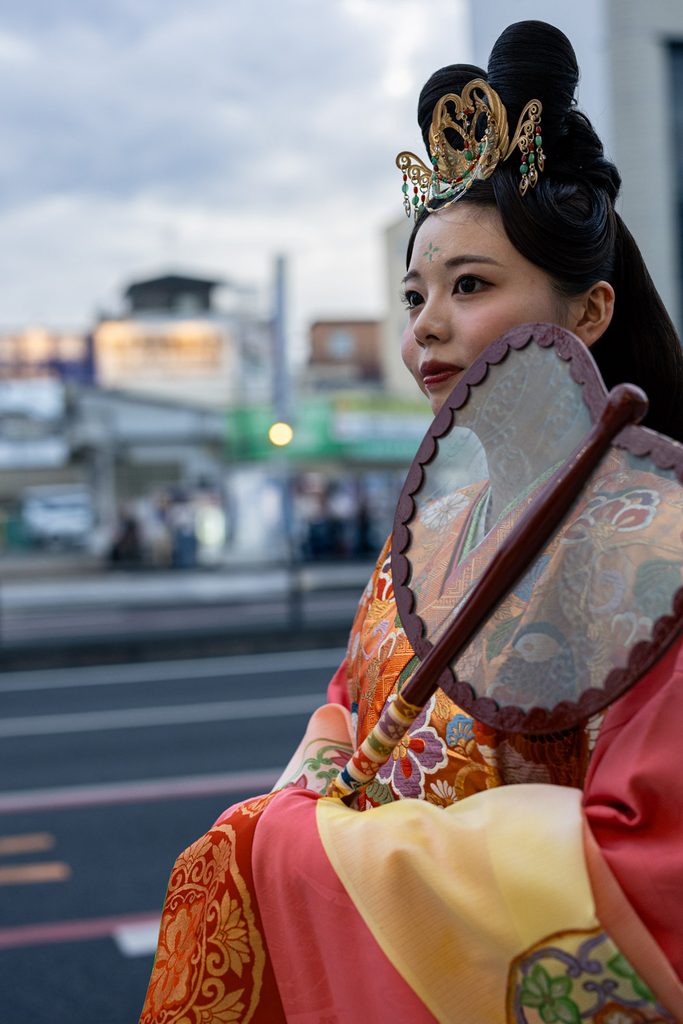
One woman wore her hair piled high and pinned with gold, a translucent fan held before her chest. Behind her were a crosswalk and a steady stream of cars. None of it pulled her back into the present.
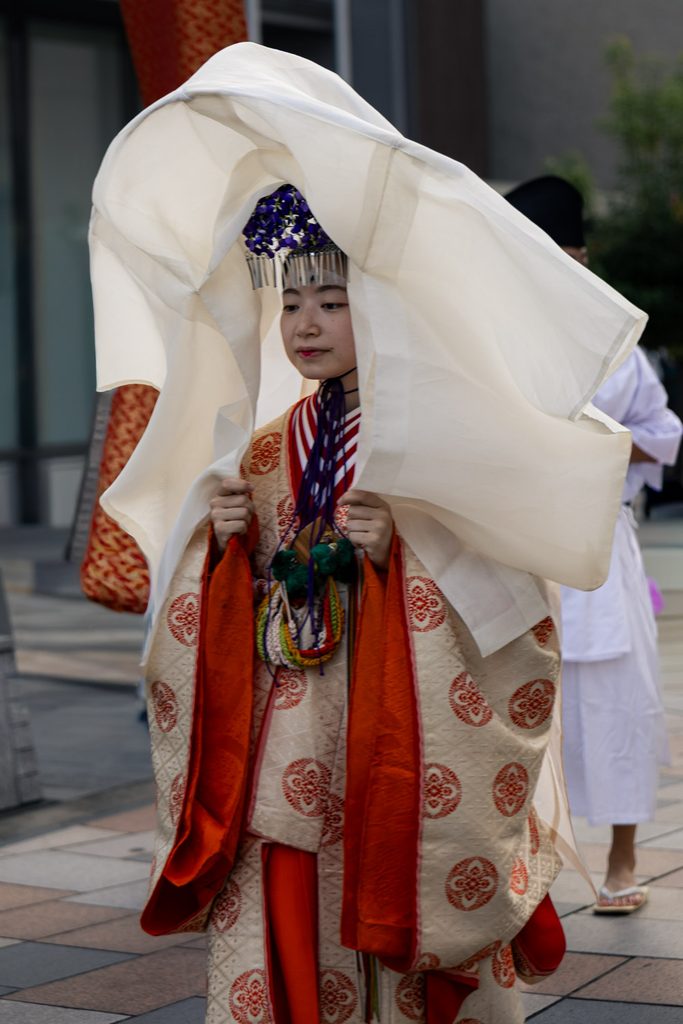
Another walked beneath a sheer white veil draped over her head. Each time the wind filled the fabric, her face appeared, then vanished again.
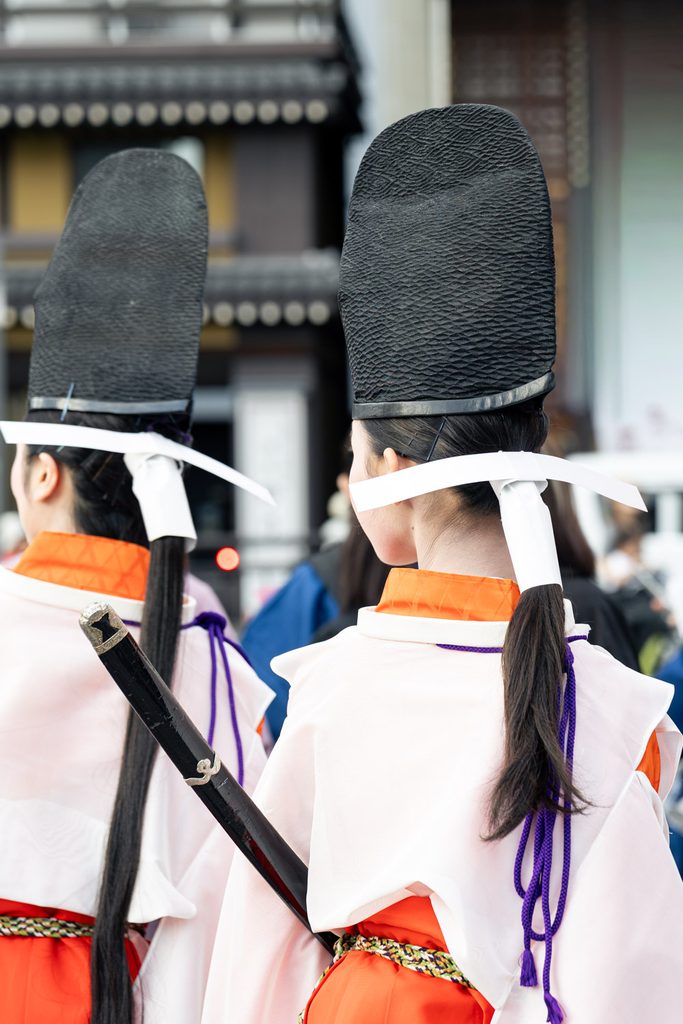
There were women in tall black hats, their long hair tied back, swords carried at their sides. By around 6 p.m., the procession had reached Uneme Shrine.
Waiting for a Ritual You Can’t See
There was a long gap before the ceremony began, and I spent part of it talking with one of the festival staff. The ritual, I was told, has been handed down since the Nara period. Only in recent years has it become widely known.
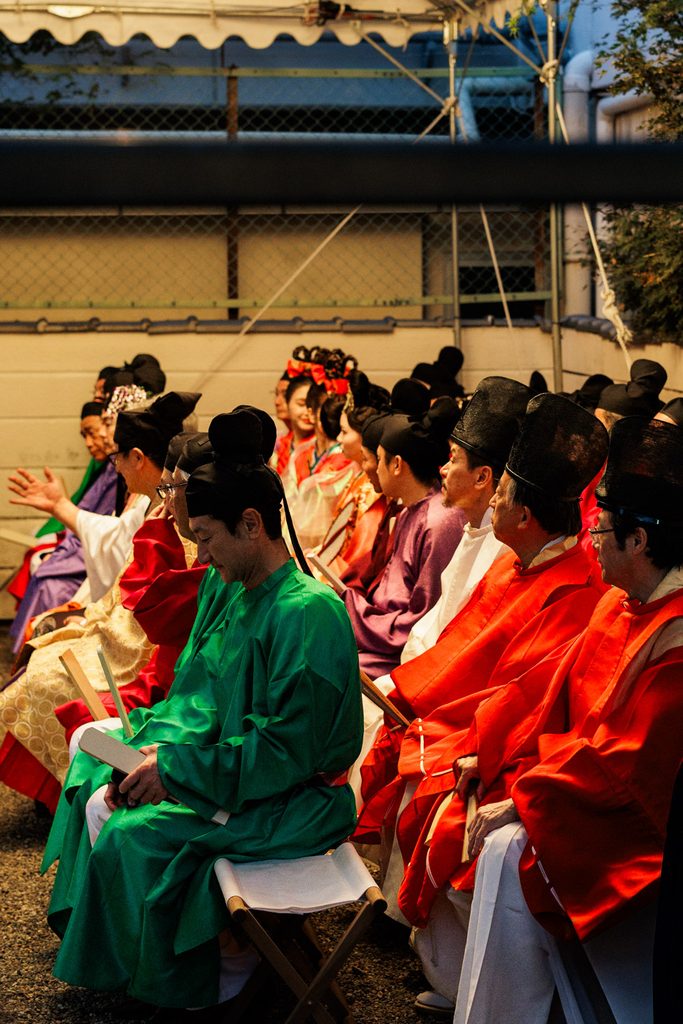
Uneme Shrine is small. Very small. When the ritual began, its sound reached us through speakers, and nothing else did. None of us standing outside could see what was happening. We listened in the dusk and filled in the rest ourselves.
The ritual ended at 6:26 p.m. A shinobue offering followed, and the thin notes of the bamboo flute drifted out across the pond.
Who Was the Uneme? The Legend of Sarusawa Pond
After the flute, the speakers around the pond began to tell a story, in Japanese and at a pace my notebook could not match. This was the part I had come knowing nothing about.
An uneme was a court attendant, a woman who served the emperor and empress in their daily lives. The Yamato Monogatari, a collection of poem-tales from the mid-tenth century, tells of one who threw herself into Sarusawa Pond after the emperor’s affection for her faded. A shrine was later built to console her spirit. But she could not bear to look at the water where she had drowned, the story goes, and in a single night she turned the shrine around.
Uneme Shrine still stands with its back to the pond. It may be the most dramatic cold shoulder in Japanese history. Today it is a subsidiary shrine of Kasuga Taisha, Nara’s great shrine a short walk away.
The Other Ending: Haruhime of Koriyama
The voice kept going.
The second legend came from Koriyama, in Fukushima Prefecture, far to the north. About 1,300 years ago, the village of Asaka, now part of Koriyama, suffered year after year of cold weather and failed harvests. When an imperial inspector, Prince Katsuragi, arrived from the capital at Nara, the villagers begged to be excused from their tribute to the court. He refused.
At the banquet that night, the prince noticed the village headman’s daughter, Haruhime. She served him with care and offered him a poem about a spring at the foot of Mount Asaka.
Mount Asaka’s shadow
shows in the mountain spring.
Shallow as it looks,
the heart I hold for you
runs deeper than that.
The prince was delighted. He excused the village from tribute for three years, on one condition: Haruhime would go to the capital as an uneme. She was already engaged to a young man named Jiro. They parted all the same.
Somewhere around here, my pen lost its race with the speaker. I caught the shape of the story and not much more, and I wished I had done my homework before coming.
In the capital, Haruhime won the emperor’s favor. But on the night of the harvest moon, aching for Jiro, she hung her robe on a willow at the edge of Sarusawa Pond so that it looked as though she had drowned, then slipped away toward home. By the time she reached Asaka, Jiro was dead. On a snowy night she followed him into the same mountain spring. The next spring, small pale-purple flowers covered the ground around the water, and people said the two had bloomed there together. The flower is called the hanakatsumi, a small wild iris.
In Nara’s version, the uneme dies in this pond. In Koriyama’s, she only pretends to, and walks home. Both stories use this water and this harvest moon, and they cannot both be true.
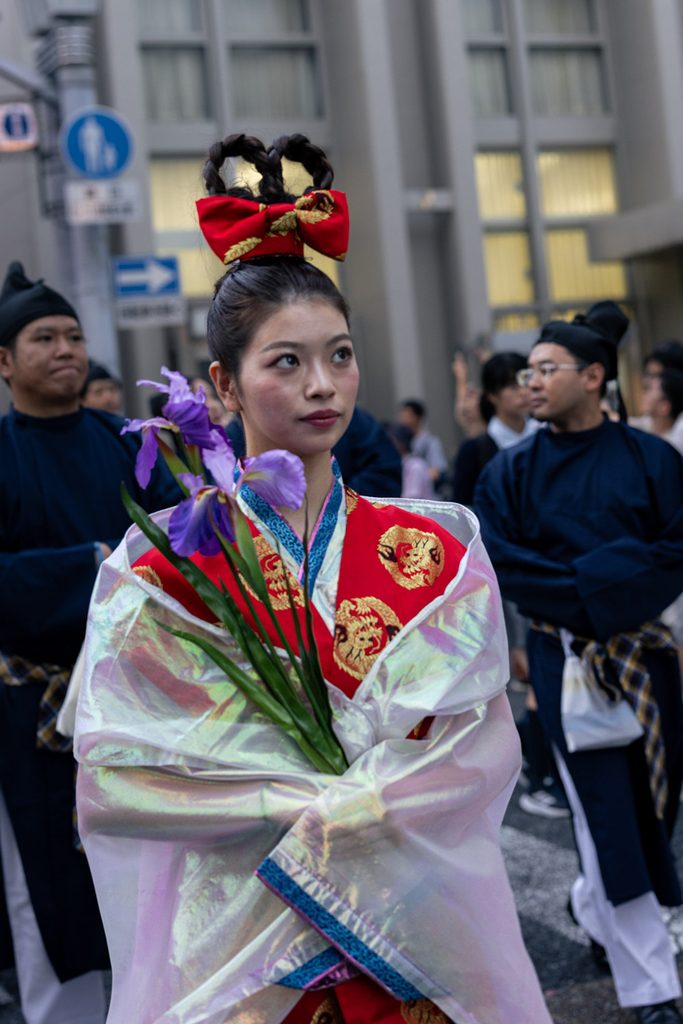
The final announcement caught me off guard. Because both cities keep an uneme legend, Nara and Koriyama became sister cities in 1971, and they remain close today. I had never expected a sister-city agreement to move me. This one did.
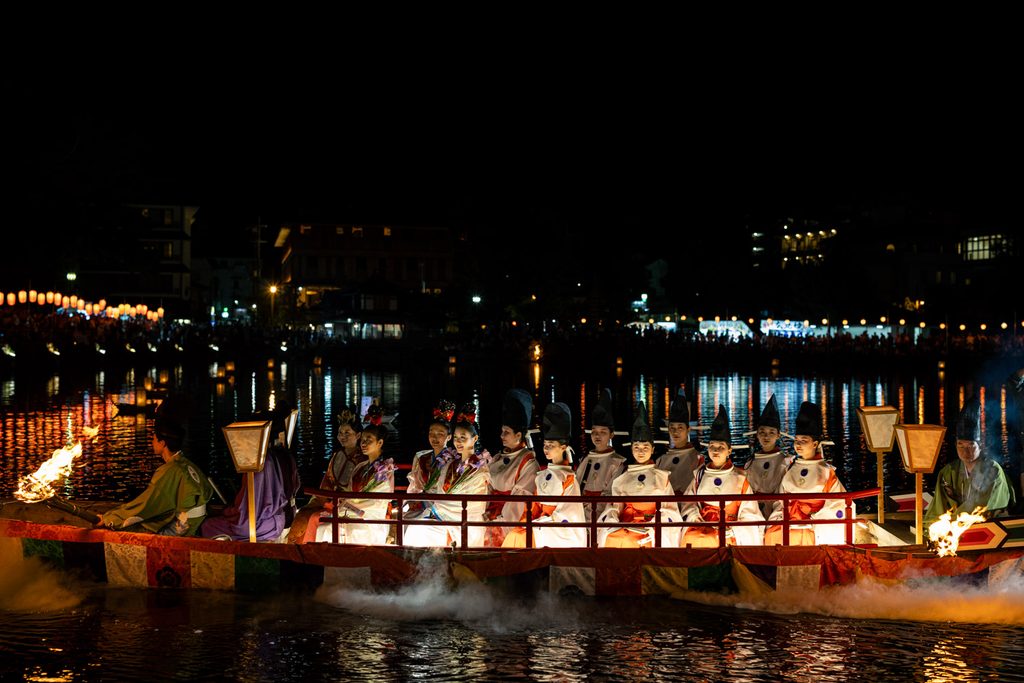
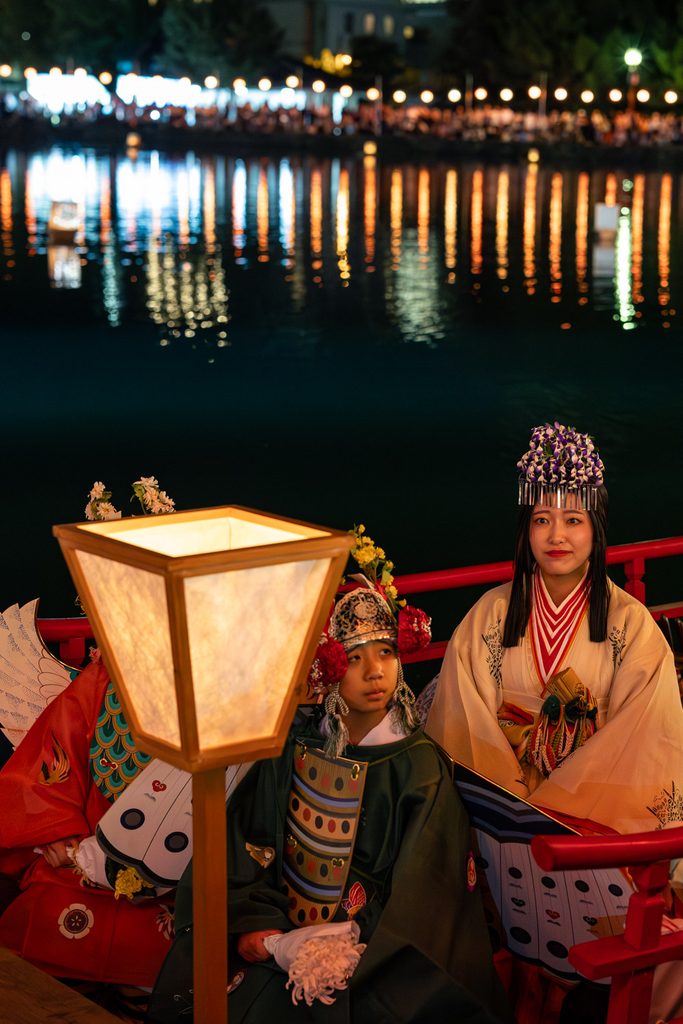
Women from Koriyama still take part in this festival. The purple flowers they carried stand for the hanakatsumi. Look again at the photo at the top of this page. They are on the boat.
Koriyama holds its own Koriyama Uneme Matsuri every year in early August (in 2026, August 6 to 8). Crowds of residents in yukata fill the city’s main street for the uneme odori nagashi, a flowing street dance.
The Poem That Became a Beginning
I learned about the poem only afterward. It appears in the Man’yoshu, Japan’s oldest surviving poetry anthology, credited to a former uneme who soothed an angry Prince Katsuragi at a banquet in the north. The preface to the Kokinshu, compiled in the early tenth century, pairs it with one other poem and calls the two the “father and mother” of Japanese poetry, the first poems anyone learning to write was taught. A wooden tablet bearing both, thrown away in the mid-740s, was dug up at the site of Shigaraki Palace in Shiga. A few lines offered at a provincial banquet ended up where Japanese poetry begins.
A Shrine That Rarely Opens
On any other night, the doors of Uneme Shrine are shut. I was told it opens only for this festival and at New Year’s, though I couldn’t find an official statement saying so. This time the counter was lit, and staff in white robes were offering Uneme amulets and golden dragon amulets, along with omikuji, the paper fortunes you draw at shrines.
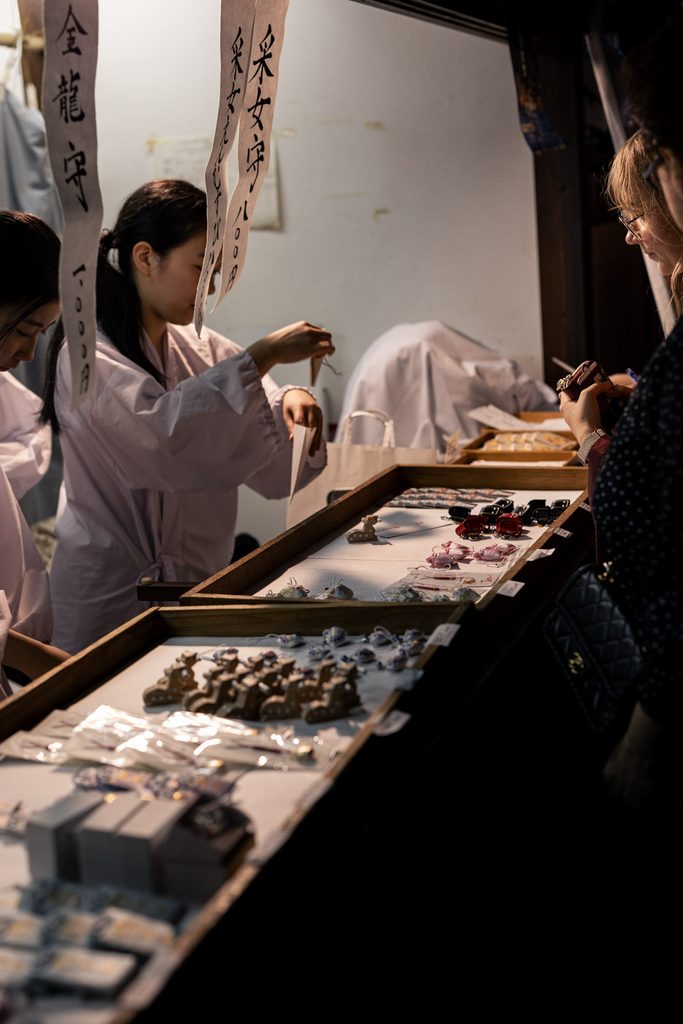
The one that caught my eye was the thread fortune. You make a wish and try to pass a red thread through the eye of a needle. If it goes through, the wish will come true.
Dragon Boats Under a Hiding Moon
At about 7:10, the boats came.
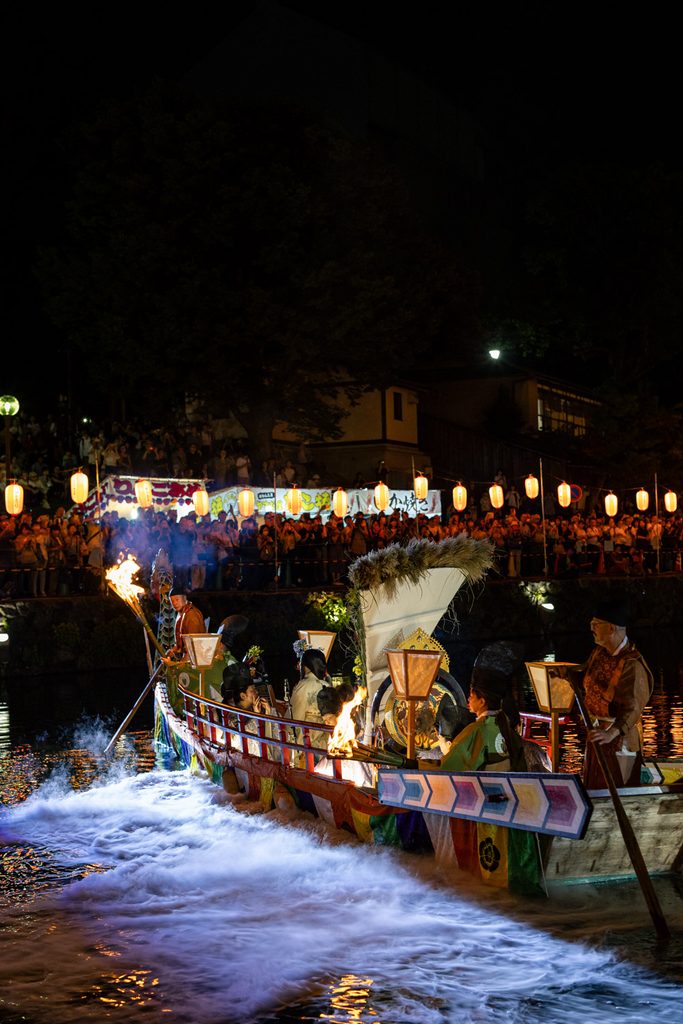
A boat with a dragon’s head at its prow slid out onto the pond, torches flaring, water churning white along its hull. Lanterns lined the banks, and people packed every foot of the bank. The air was still thick with humidity. Now and then the clouds thinned and the moon showed itself.
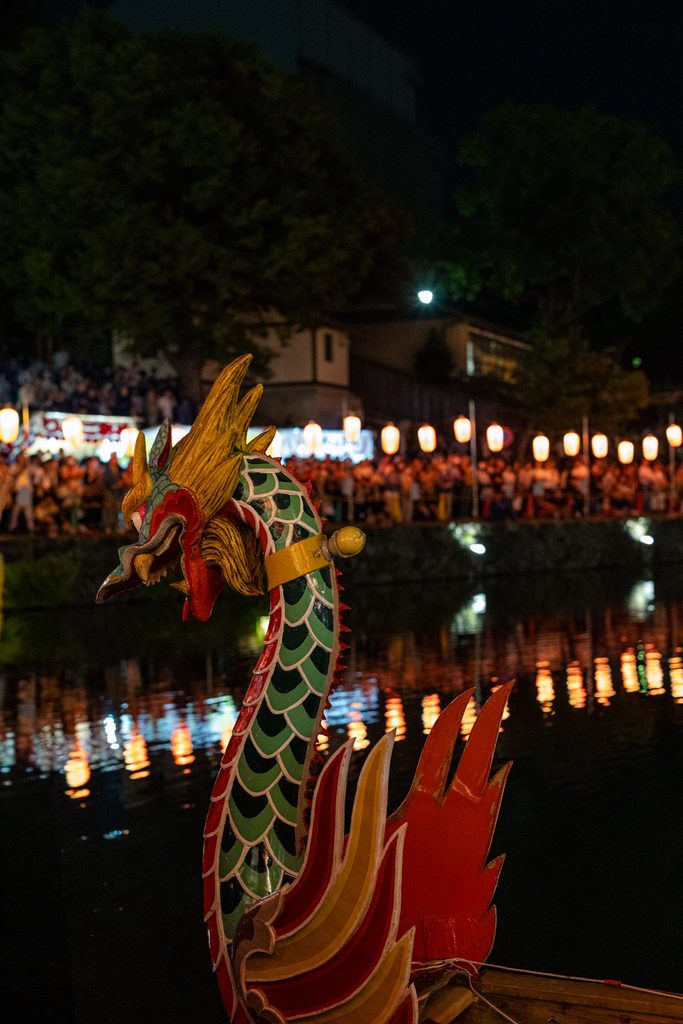
The boats circled the pond twice. An hour earlier, I hadn’t known any of this. Now I was watching it with both stories in my head. The women with purple flowers were aboard. Somewhere in this water, one uneme ended her life. Somewhere on this bank, another hung her robe on a willow and walked away.
After the second lap, a single boat left the others and made for the center of the pond, carrying the hana-ogi, a great fan decked with autumn grasses. At 7:39 p.m., the fan was sunk into the water. That was the end. The moon was still coming and going. It never did make up its mind.
The Walk Home: Yomogi Mochi at Nakatanidou
Nakatanidou was still open.
The shop sits a one-minute walk from the pond and is famous for its high-speed mochi pounding, and for the crowds that gather to watch it. I had never seen it open this late, and I had never seen it this empty. Walking past was not an option. The mochi was no longer warm from the pounding. But it was soft, and it smelled of yomogi, Japanese mugwort, exactly the way it always does. It tasted like the night folding itself back into an ordinary Friday.
Uneme Festival Guide: Dates, Times, and Where to Watch
If the stories have pulled you in, the practical side is simple: the festival is free, and almost everything happens within a few minutes’ walk of Sarusawa Pond.
| Date | Always the night of the harvest moon, the 15th day of the eighth lunar month, so the date moves every year. 2026: September 25. 2027: September 15. |
| Venue | Uneme Shrine and Sarusawa Pond, Nara Park |
| Procession | Leaves JR Nara Station at 5:00 p.m., reaches Uneme Shrine around 6:00 p.m. |
| Ritual | About 6:00 to 6:26 p.m. (audio only; not visible from outside) |
| Flute offering and legends | After the ritual, over speakers around Sarusawa Pond (Japanese only) |
| Dragon boats | From around 7:10 p.m. The boats circle the pond twice. |
| Finale | One boat carries the flower fan to the center of the pond, where it is sunk (7:39 p.m. in 2026) |
| Admission | Free (no paid seating) |
| Access | 5-minute walk from Kintetsu Nara Station |
Where to Watch the Dragon Boats
Get there early. The boats set out around 7:10 p.m., and if you arrive then, the edge of Sarusawa Pond will already be full. Aim to be at the pond by 6:30 p.m. The ritual can’t be seen from outside the shrine, so plan your evening around the procession and the boats.
If You Don’t Speak Japanese
The narration at the festival, including both legends, is in Japanese only, and it moves quickly. Read the stories above before you go, and you’ll be able to follow the evening without a translator.
Getting to Sarusawa Pond
Sarusawa Pond is a five-minute walk from Kintetsu Nara Station. If you want to see the procession set off, head to JR Nara Station, farther west, before 5 p.m.