This was my first zazen. Properly, I mean.
Like many Japanese people, I had done some version of it before. You sit cross-legged on the tatami, close your eyes, and try to look serene until your knees file a complaint. What I had never done was try zazen in Kyoto, inside a working Zen temple, under a monk’s instruction, and take it seriously.
This October, on two consecutive weekends, I sat at Daitoku-ji, the sprawling Zen temple complex in the north of the city. The first time was a warm Saturday morning at Daiji-in, a subtemple closed to general sightseeing. The second was a cold evening at Daisen-in, a few minutes’ walk away.
Three Generations, One Temple Gate
Why Daitoku-ji? The honest answer isn’t particularly compelling.
My father visited Daitoku-ji. Then my older brother came on a school trip. Then I came on mine. But Daitoku-ji is not a single temple. It is a walled compound of some twenty subtemples, and none of us could tell you which one we had actually stood in. I certainly couldn’t.
So I had followed my father and my brother here without remembering where “here” was. Later, when a monk told me that imitating the pose gets you nowhere, the line hit a little close to home.
I found a notice about public zazen sessions while researching Daitoku-ji for this site. I didn’t hesitate.
Daiji-in: The Opposite of Concentration
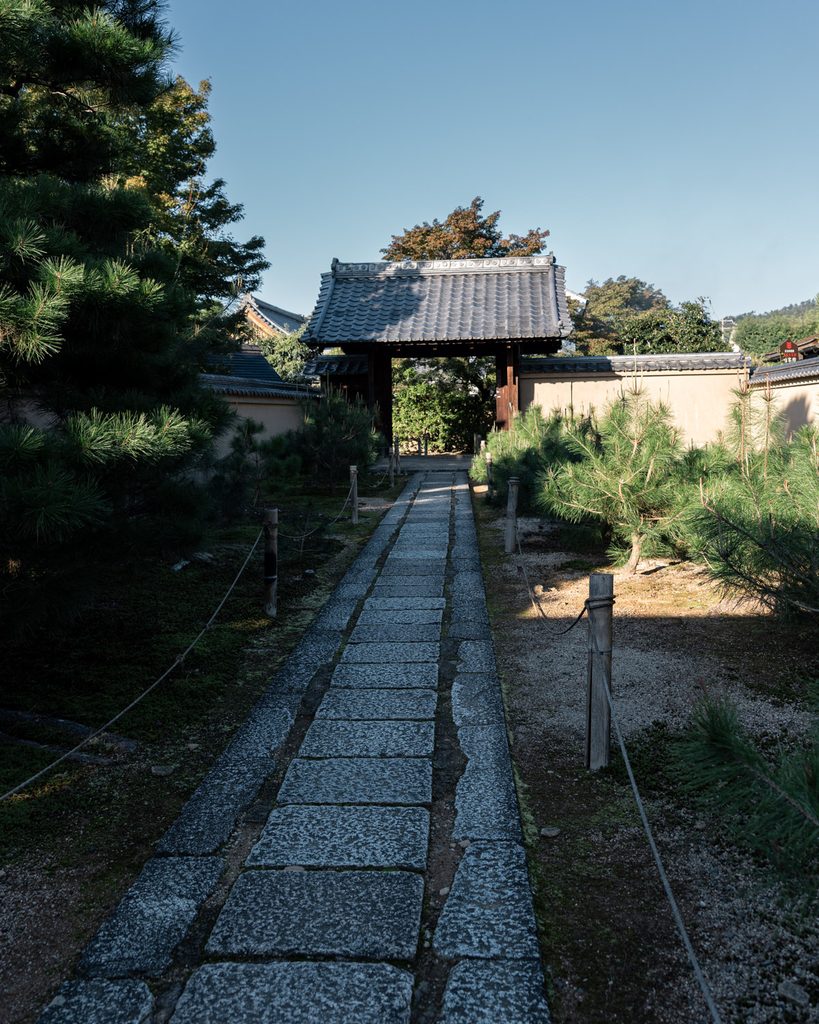
Daiji-in does not open its gates for general sightseeing. The only way in is to sit. I had signed up for the 8 a.m. Japanese-language session, and the monk’s explanation was thorough. He did not begin with posture. He began with the self.
What matters, he said, is you. The trouble is, we rarely know our own minds. Body and mind are one thing. When the mind settles, the breath comes more easily, so the breath is where the work begins. Modern people, he observed, bend the mind to suit their convenience. Zen moves the other way, back toward what is natural, back to where we started.
Then came the part that stuck. Zazen, he said, uses the yin muscles. Yin and yang are the old Chinese pair of opposites, the receptive and the active, and in his telling the stress of work lives on the yang side of the body. Zazen is not concentration. It is closer to its opposite: thinking of nothing at all. And copying the pose, he warned, gets you nowhere.
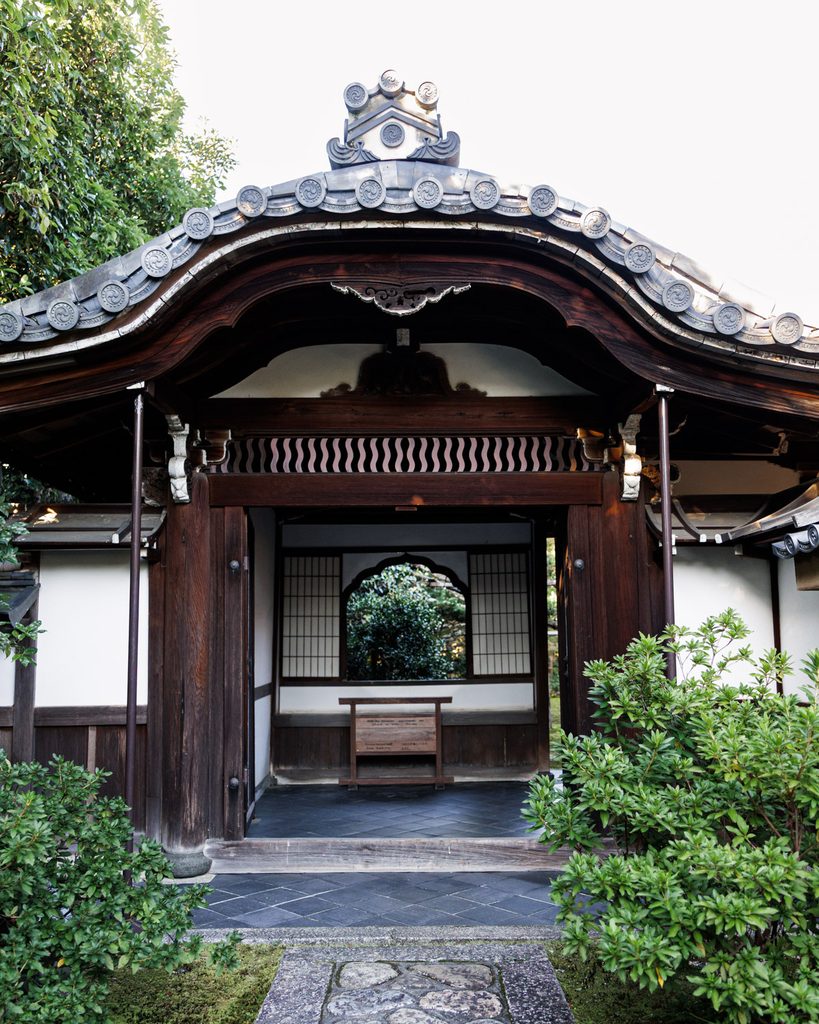
Even the classic lotus position, he said, came from India and Nepal and was never designed with Japanese bodies in mind. That explained my second surprise. I was allowed to sit on a pillow-like cushion set on top of my zabuton, the flat floor cushion. Zen, apparently, does not require suffering in the knees.
He walked us through how to release the body, slowly and carefully. I felt the tension ease almost at once.
Every year from December 1 to December 8, he told us, the monks sit for a full week. December 8 is the day the Buddha is said to have attained enlightenment.
What I Heard When I Stopped Listening
The first thing I noticed was sound.
Birdsong. Leaves moving in the wind. Sounds that had always been there, apparently, waiting for me to shut up. Somewhere nearby, someone seemed to be burning leaves, and the smoke drifted over the wall.
It was warm for October, and the sky held not a single cloud. Whether Bodhidharma, the Indian monk said to have founded Zen, ever called an empty sky Zen, I do not know. Sitting there, it felt that way.
A Few Questions for the Monk
When the session ended, the monk came over to talk. He had noticed me scribbling notes the whole time. I explained that I forget things easily, and that I had promised a report to my English teacher, a Buddhist with a long interest in Zen.
It was a short conversation, but I asked what I could. What is that week in December actually like? Do the monks eat? Do they really sit for twenty-four hours? They eat, he said. And during that week, they sleep for about two hours a night.
As I left, he told me to come again. I was glad he did.
Daisen-in: The Temple I Had Forgotten
Daisen-in came next. This, it turned out, was the subtemple from my school trip.
I had forgotten everything. The dry landscape garden, even the name of the subtemple. What brought it back was a saying posted in the temple, signed by Ozeki Sōen, its longtime head priest and a monk known across Japan for his larger-than-life sermons and his books. The moment I saw the name, the memory returned in one piece. One of his books, I realized, was sitting on a shelf at home.
Daisen-in holds evening zazen on weekends, so I came back the following week.
I can only compare it to Daiji-in, but the introduction here lasted about three minutes. A Western monk gave the instructions in English. There were seven Japanese participants and twice as many visitors from abroad. Usually, I was told, Japanese participants outnumber foreigners two to one. Foreign participants were asked to sit where an English instruction sheet had been laid out.
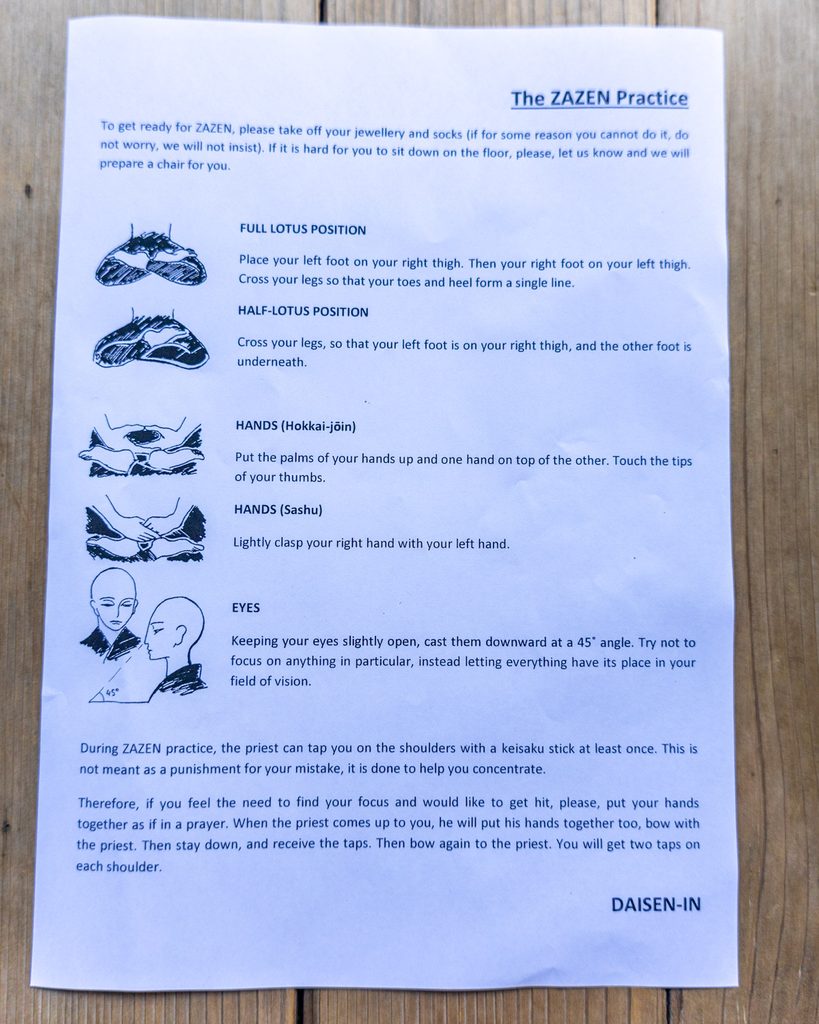
If emptying the mind proved too hard, we were told, count the breaths.
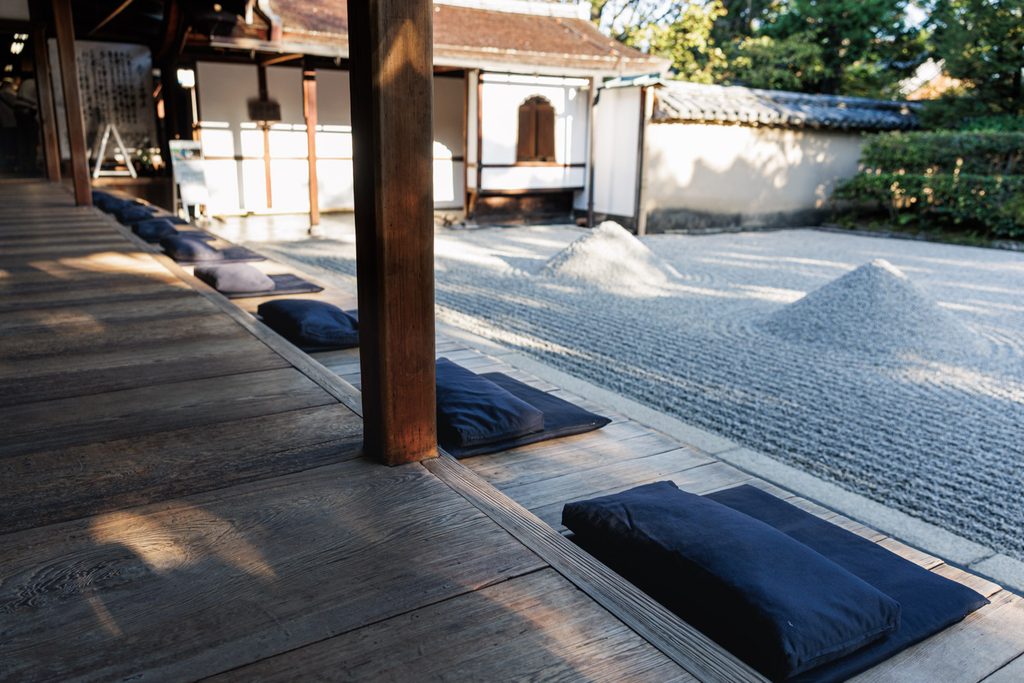
Again the birds came, seven or eight kinds I had never heard before, enough that I briefly wondered what zazen would sound like in a tropical rainforest. Then a cold wind moved through the trees, nothing like the warm air of the week before. Then the temple bell rang out the end of the day. Every sound seemed to arrive with its edges sharpened, and so, unfortunately, did the slow numbness creeping into my legs.
Counting Breaths, Waiting for the Keisaku
After a short break, the second session began. This time I asked for the keisaku.
It was nothing like manga and TV dramas had taught me. I had assumed the flat wooden stick was for people who failed to meditate properly. In fact, you ask for it. You press your palms together as the priest approaches. He bows; you bow. You lower your head and receive two taps on each shoulder, then you bow to each other again. The English sheet says it plainly: this is not a punishment. Which means, in theory, you could doze off entirely and no one would touch you.
To be perfectly honest, it didn’t hurt at all. I felt almost cheated.
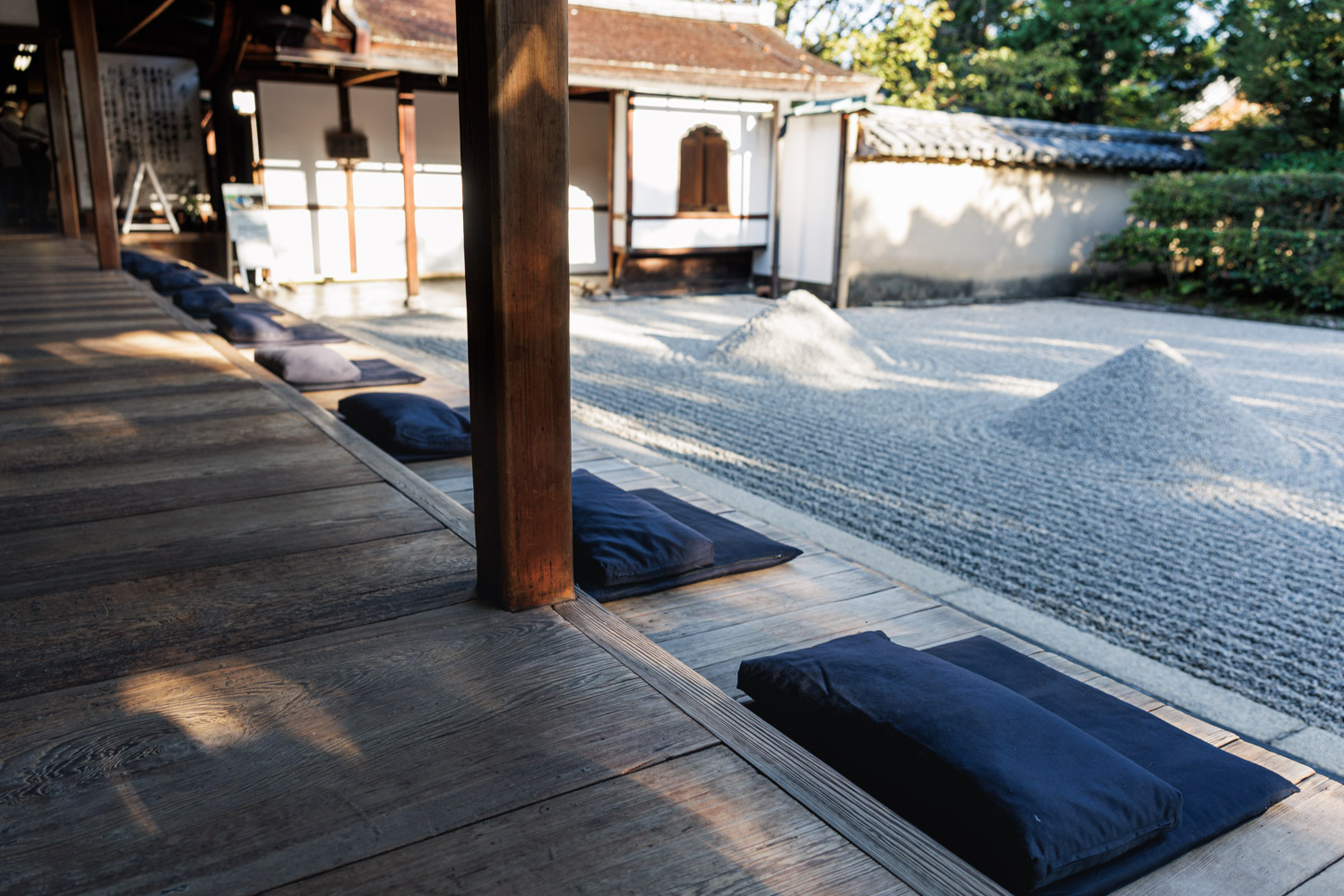
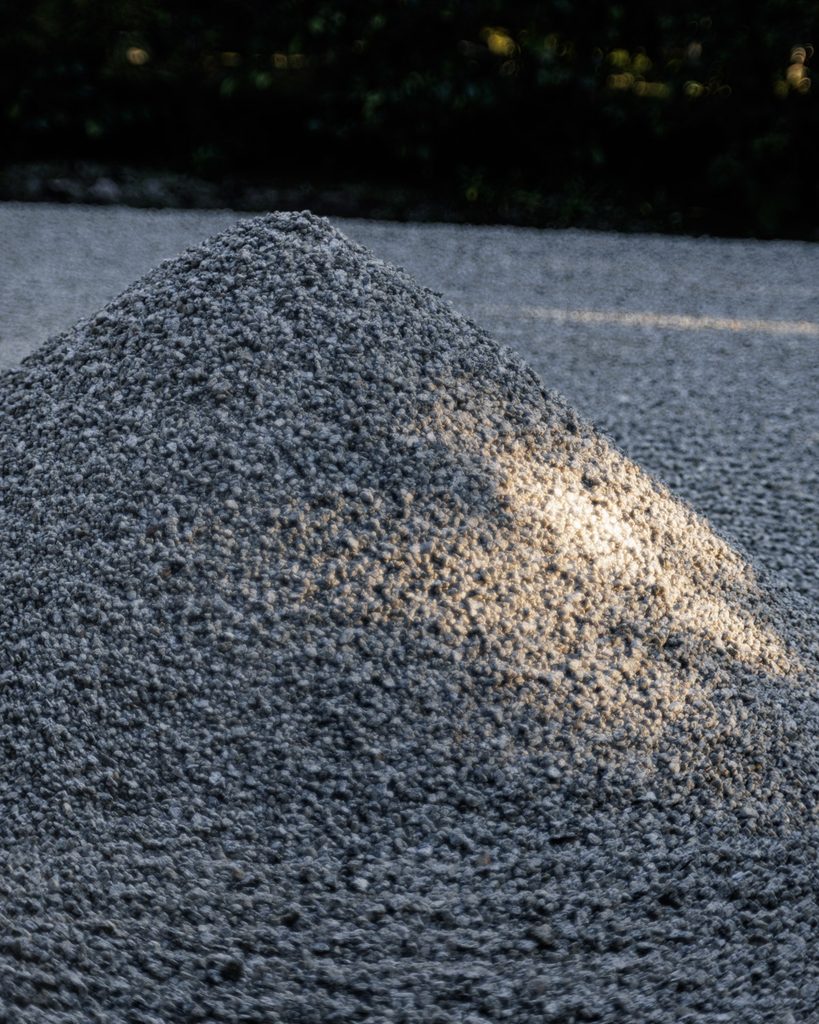
With my eyes half open, I could see the dry garden spread out at the edge of the veranda. Birds, wind, a bell at dusk, raked gravel going gray in the fading light.
I was still taking it in when the monk struck the bell, and the session was over. In the end, I never managed to think of nothing.
Matcha, and the Way Back
After the final bell, we were served matcha.
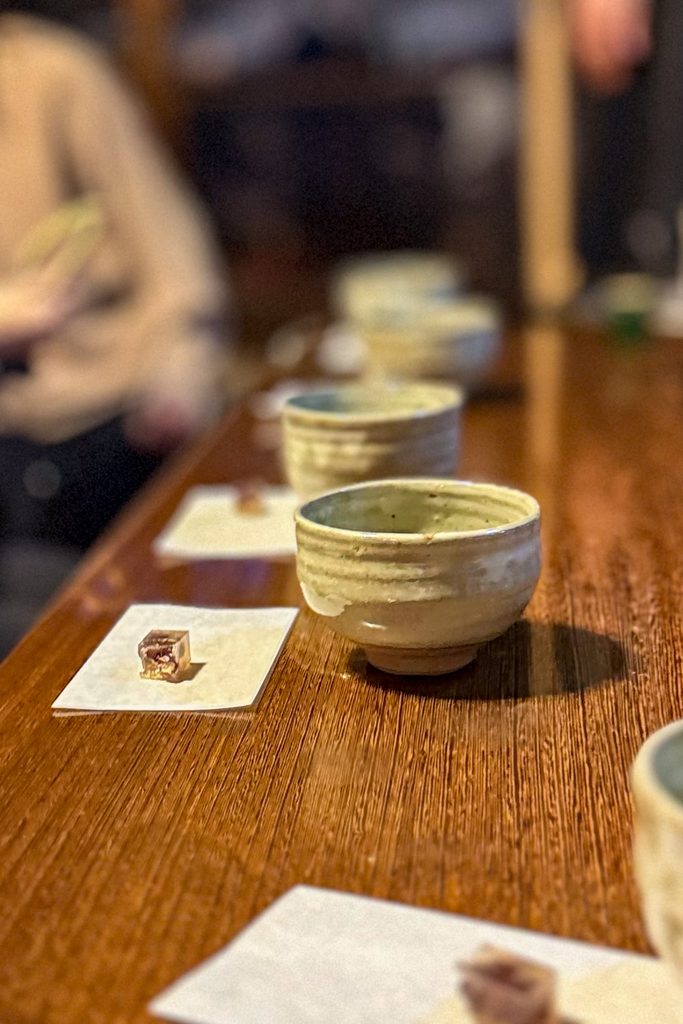
The bowls came out in a long row along the polished wooden counter, each beside a small square of white paper holding a single translucent sweet. Some people stood up almost as soon as they had finished. Others looked ready to stay all evening. I wanted to talk with the monk, but this was not the one-on-one conversation of the week before, so I rose and took my leave.
The sweet was intensely sweet, and the matcha was bitter in return, as if to balance the account. I may well have tasted the same pairing on my school trip, in this same temple, without remembering a thing. My mind, I noticed, had already wandered off to trivial things again.
How to Try Zazen in Kyoto at Daitoku-ji
Both temples take first-timers. For most travelers, Daisen-in is the easier place to start: English instructions, a fixed weekend schedule, and matcha at the end. Daiji-in suits those who can book ahead and want a long, careful explanation of zen meditation in a temple closed to general sightseeing.
Daisen-in: Weekend Evening Zazen with English Instruction
| When | Saturdays, Sundays, and the 24th of each month, 4:30–5:45 p.m. |
| What | About 60 minutes of zazen, then roughly 10 minutes of matcha and a sweet |
| Cost | ¥1,500, plus ¥500 temple admission |
| Language | Japanese, with English instructions for overseas visitors |
| Booking | Advance booking recommended; same-day spots are sometimes available |
My session ran as two sittings of about thirty minutes each, with a short break in between. The keisaku was offered only in the second. You can check availability and book through Daisen-in’s regular zazen page (in Japanese).
If the evening session doesn’t fit your schedule, Daisen-in is open for regular visits from 9 a.m. to 4:30 p.m. every day of the year. Admission is ¥500, and matcha is another ¥500. Hours change on some days, so check the calendar on Daisen-in’s visitor information page before you go.
Daiji-in: Morning Zazen and a Private Zen and Tea Session
Daiji-in is closed to general visitors, so a session is the only way through the gate. It offers two formats.
| Morning zazen (Japanese) | Zen and Tea (English, private) | |
|---|---|---|
| When | Limited dates, from 8:00 a.m. | By reservation |
| What | Two sittings with a guided self-care stretch in between, ending around 8:55 a.m.; shojin ryori (Buddhist vegetarian) meal at 9:00 a.m. if reserved | About two hours: gentle bodywork, 20 minutes of zazen on chairs, and tea in the temple’s tea room |
| Cost | See the booking page | Suggested donation of about $200 per person |
| Group size | Shared session | One group at a time, up to 8 people |
| Booking | Daiji-in’s Japanese website | Daiji-in’s English website |
The morning schedule above is the one I followed on my visit. For the English session, the monk notes on the booking page that his English is limited and that he uses a translation app.
Before You Sit
Wear loose, comfortable clothes. At Daisen-in, you will be asked to take off jewelry and socks, though the English sheet says they won’t insist if you can’t. If sitting on the floor is hard for you, tell the staff and they will bring a chair. The sheet also suggests keeping your eyes half open and cast down at about 45 degrees, without focusing on anything in particular.
Getting to Daitoku-ji
Take a city bus to the Daitokuji-mae stop. From Kyoto Station, buses 206, 205, and the 101 express all stop there. From Kitaoji Station on the Karasuma subway line, take bus 1, 101, 204, or 205. Daisen-in is about an eight-minute walk from the stop, and Daiji-in is about five minutes.