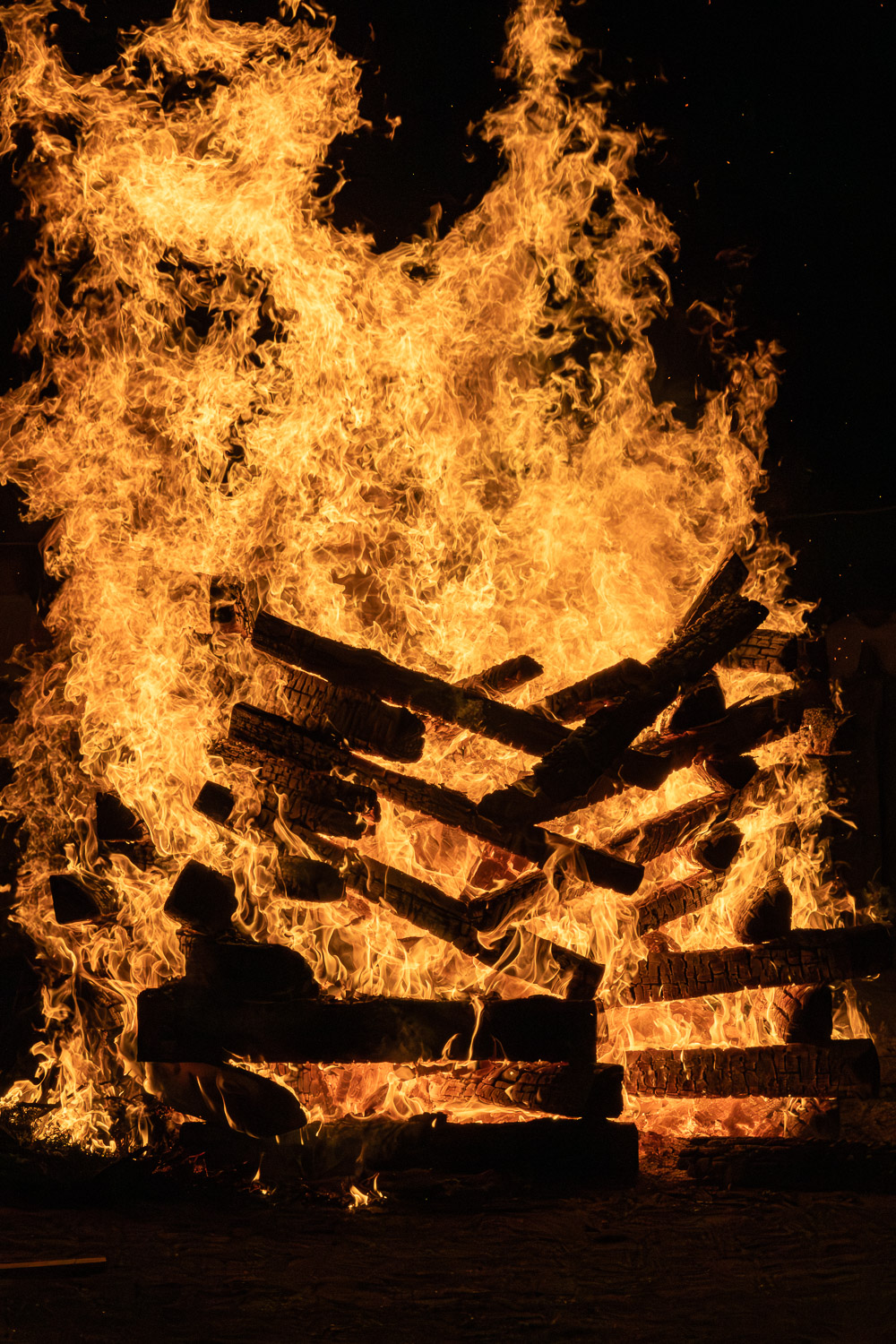
Empty your mind, and even fire feels cool.
Every Japanese child hears that proverb at some point, and I was still repeating it to myself on the way up the mountain to the Tanukidani Fudoin Fire Walking Festival, where I had voluntarily signed up to walk barefoot across a bed of burning charcoal. Almost none of us can explain what the proverb actually means. In my case the source was definitely a comic book. A warrior empties his mind, steps into the flames, and does not flinch.
Could I pull off something that transcendent? No. Obviously not.
One thing before the story, because it is the detail most English-language sources still get wrong. The date changed in 2025. This festival now falls on the fourth Saturday of July, not July 28. I attended on July 25, 2026.
Why I Paid Extra, for Once
I don’t buy travel agency packages. Ever. But I wanted to see a goma fire ritual up close, so I paid the surcharge for a reserved-seat plan through a Japanese agency.
My reasoning was sound. Walking over the fire would surely be optional. I would watch a small child cross first, confirm that nobody burst into flames, and then follow with whatever dignity remained.
That plan had a flaw.
Two Hundred and Fifty Steps in a Kyoto July
The walk up felt much longer than the map suggested. The slope was steep, and the heat that day defied all reason, even by the standards of a Kyoto July.
There are 250 steps to the main hall. Everyone knows the number, which means you always know exactly how much you have left, and I am not sure that helps. In late July heat you should assume the number is 2,500 and plan accordingly.
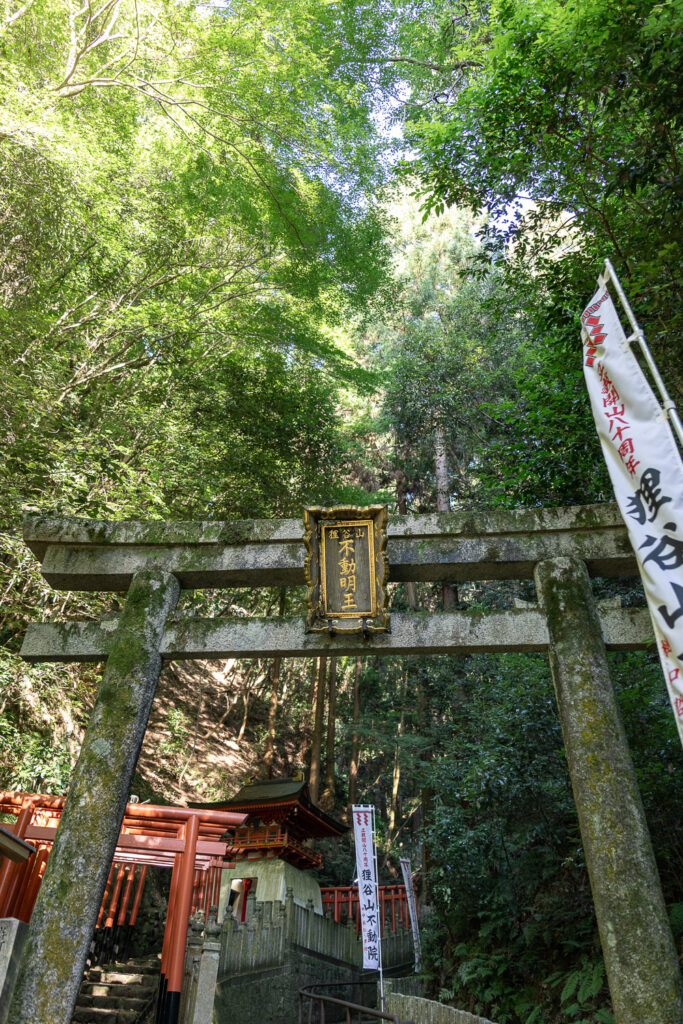
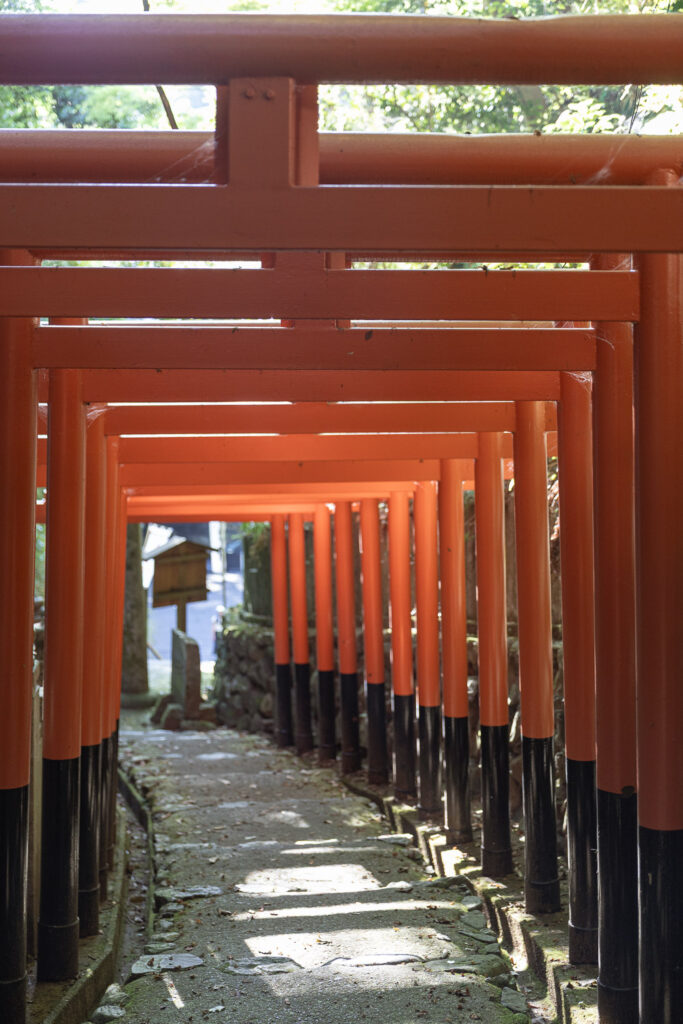
Past the stone gate, rows of vermilion torii stack one behind another, and a narrow stone path disappears into the tunnel they form. If you know the thousand gates of Fushimi Inari, picture the mountain-temple version. Minus the crowds. Plus the occasional spider web.
Beyond the gates stands a small hall where spring water seeps out of the bare rock. It enshrines Benzaiten, the goddess associated with water. The first thing I saw at this temple was water coming out of stone.
The Waiting Room
The festival starts at 7 p.m. I arrived at five, and several people were already waiting.
The agency’s attendant, drenched in sweat, greeted me, and I felt a pang of guilt for being the last of her group to arrive. Not late. Just last. In that heat the distinction felt unkind anyway.
The waiting room was full. Twenty-odd people, no seat for me, and air conditioning that had clearly given up on the assignment. I had paid a premium for this. At that moment my single greatest wish in life was a shower and a cold room.
Writing a Wish, Almost the Wrong One
Then came the goma-gi, the slender wooden sticks on which you write a prayer before the monks feed them to the sacred fire. I came dangerously close to writing “a shower and a cold room.” Somehow I resisted.
We received a set of keepsakes: a tenugui hand towel, a goshuin temple stamp issued only on festival day, a towel, and a paper talisman. Then we moved to the main hall.
A Main Hall Built Inside a Cave
The main hall stops you mid-step. It juts out from the mountainside on a lattice of massive wooden pillars, the same kakezukuri construction that supports the famous stage at Kiyomizu-dera, and five-colored banners hung from the eaves in the late afternoon light.
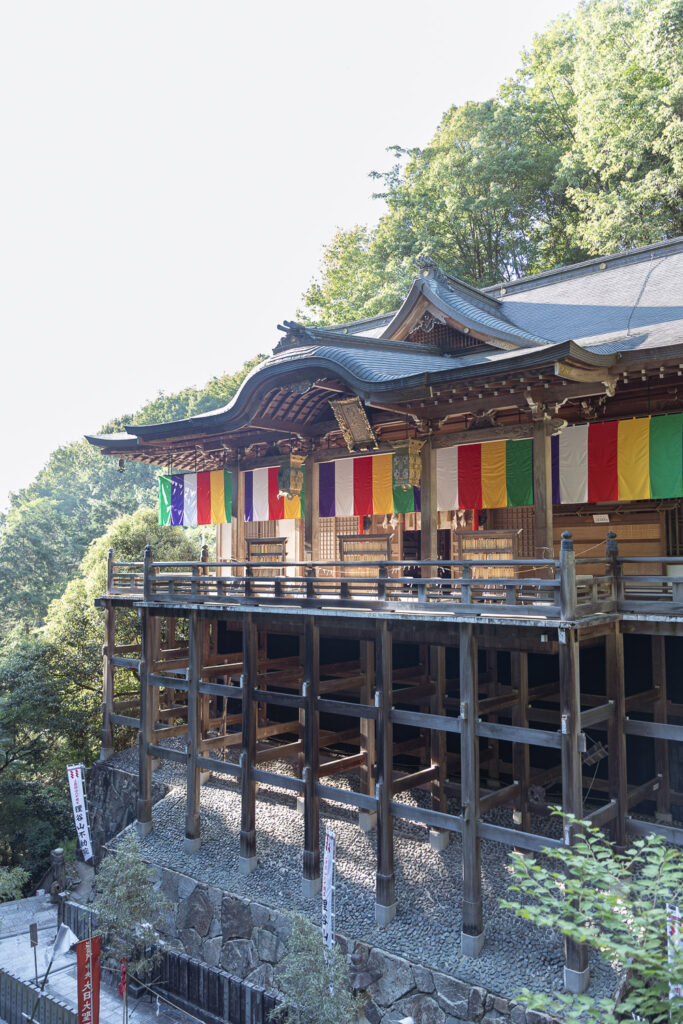
Inside, the surprise doubles. The hall sits within a cave. Around the statue of Fudo Myo-o, the fierce Buddhist deity of unmovable wisdom, the raw rock face is plainly visible, and a monk explained that the structure is essentially iron sheeting fixed to the cave itself.
Shugendo, Japan’s ascetic mountain religion, does not carve a mountain away to build a hall. It slots the hall into the mountain and worships the two as one body. We were led close enough to pray directly before the statue, rock walls pressing in on either side.
The Story Nobody Told: Miyamoto Musashi
The monk’s talk stayed with me, though not for what it included.
We got documented history and nothing else. The temple was founded in 1718 by a monk named Hoko, then thirty-one years old. During World War II, families climbed this mountain to pray for sons sent to the front, and that groundswell of folk devotion paid for the temple’s restoration. In 1944 it was formally established under its current name, and rebuilt.
One name never came up. Miyamoto Musashi.
Open Kyoto’s official tourism site and this temple’s introduction leads with the waterfall where Japan’s most legendary swordsman is said to have trained his spirit before his duel with the Yoshioka school. It is the temple’s most famous story by a wide margin, and the monk never mentioned it. There was time. The history lesson was unhurried. The facts were simply chosen over the legend, and I still don’t know why.
Down to the Plaza
The ash of a goma fire is believed to carry blessings, and walking through it is how you receive them.
When the indoor ceremony ended and we stepped outside, daylight still lingered over the ridge. Down in the plaza below the main hall, the general public had gathered. A thousand people, easily. Announcements played over the grounds in Japanese and English.
The Arrow That Went to the Wrong Person
The ceremony opened with archery. A young yamabushi drew a full-length bow and loosed arrows toward the four directions to purify the grounds. The arrows are bladeless, and the announcement explained that anyone who catches one may keep it as a good-luck charm.
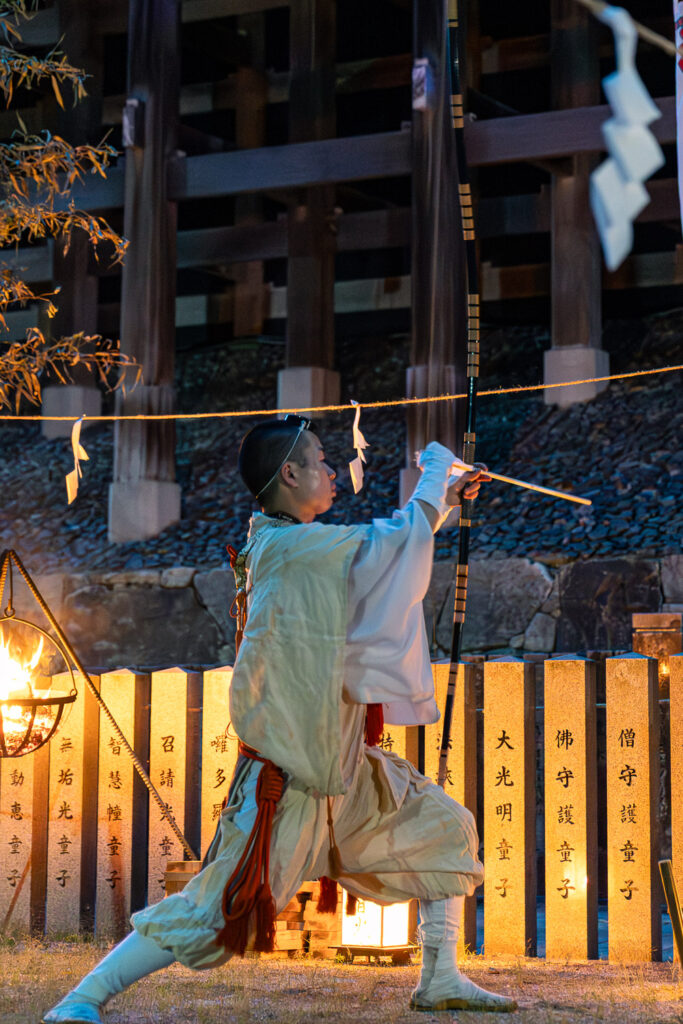
I wanted one badly. But I was pinned to the reserved seat I had paid extra for, and the arrows fell far out of reach. Next year, I told myself.
My seat faced the unlit pyre directly. A yamabushi warned me it would get hot there, which was exactly what I had paid for. The woman beside me kept drifting into my camera frame, and I said nothing.
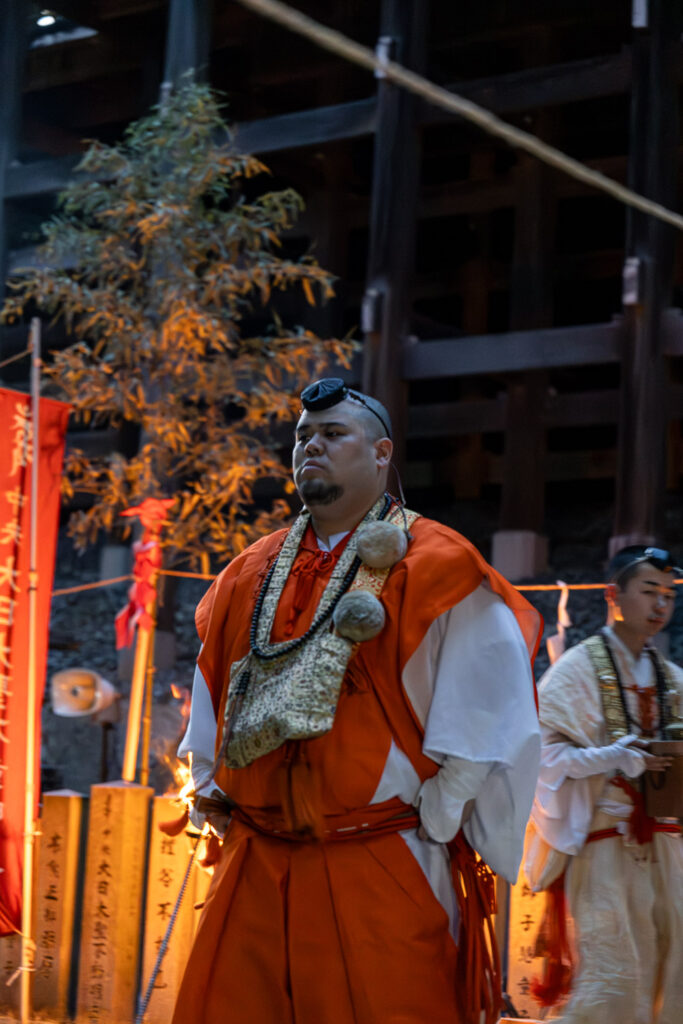
A while later, a yamabushi walked over carrying one of the sacred arrows and presented it to her. She turned it over in her hands with polite confusion, clearly unaware of what it was or where it had come from.
The Fire
Then it was lit.
For a moment the small flame seemed to hide deep inside the stacked cedar. Then it took everything at once, and the darkness around the plaza simply ended. Orange light poured across the mountainside, the banners, the trees, the faces of a thousand people.
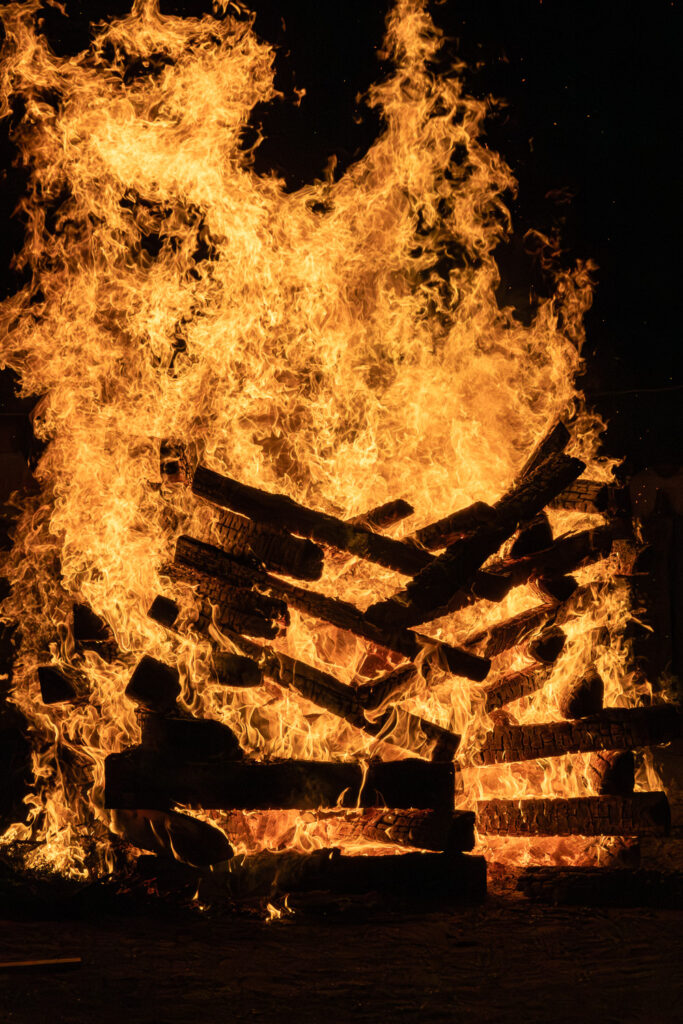
The wood cracked and popped. Smoke drifted into my eyes and, to my surprise, did not sting.
I could not identify most of the chanting, and I grew up in this country. Sutras I had never heard, one after another, none of them familiar. Then a few syllables surfaced that I did know, the mantra of Fudo Myo-o, and disappeared again into the rest of it.
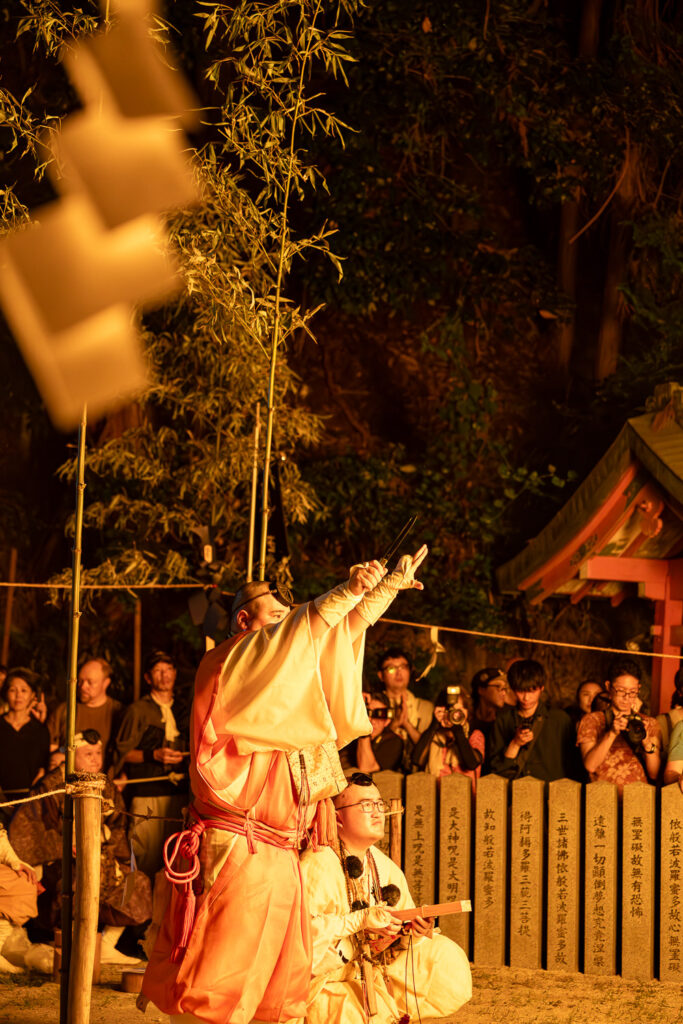
The chanting began to accelerate. The yamabushi fed prayer sticks into the blaze faster, and the flames climbed until I had to tilt my head back to find the top of them. This had to be the peak of it.
Around me, people near the fire started backing away. I stayed. My seat was three meters from the pyre, closer than the yamabushi themselves, who sat at a sensible five. If Fudo Myo-o was anywhere that night, he was in there, and I had paid for this seat specifically.
Then I looked at my phone. A temperature warning filled the screen.
I retreated on the advice of an iPhone.
Raking It Flat
The prayer sticks ran out and the chanting fell away.
What followed was quiet, methodical work. The monks pulled the burning structure apart, knocked down the flames, and raked the embers into a long, flat bed of charcoal. This was the path we would walk. Ten minutes earlier I had half-felt the presence of a deity in that fire, and I regretted, sincerely, not being a more devout man.
The Yamabushi Go First
The monks crossed first, and flames still burned along both edges of the path. They walked through the smoke in their white tabi, palms pressed together, eyes forward. Not fast, not slow.
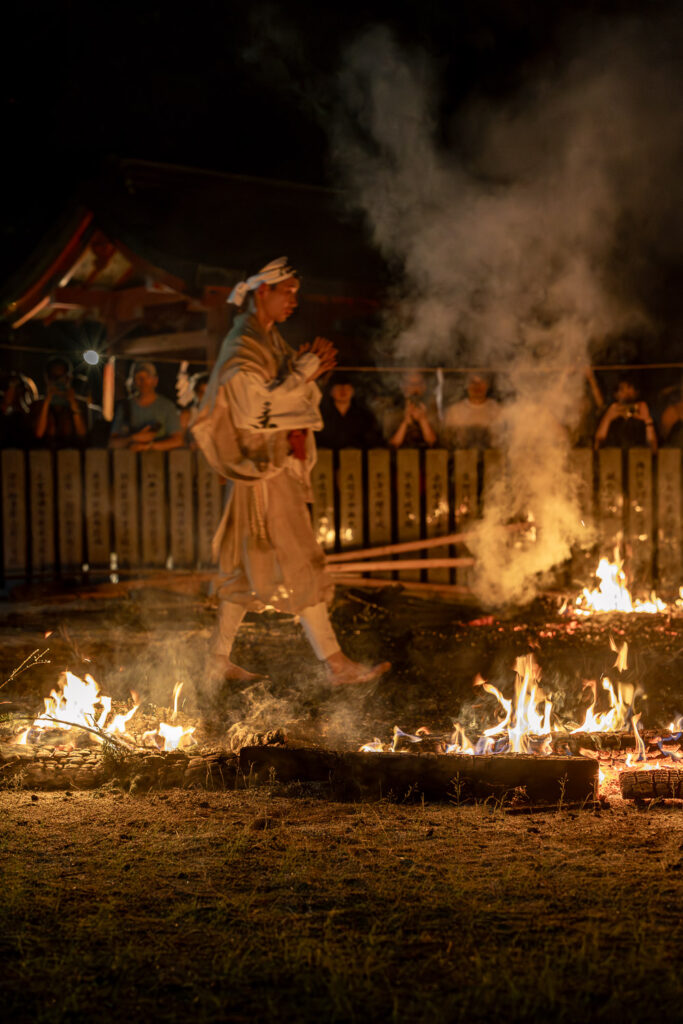
How many years on a mountain does it take to walk like that?
Barefoot, With No Warning
Someone told me to take off my shoes. A yamabushi, a staff member, I honestly cannot remember which.
My entire strategy, you will recall, depended on watching children cross first. But no suitable child appeared, because out of a thousand people I was going third or fourth. The agency plan I had paid extra for came with a reserved seat, ceremony access, and one feature nobody had advertised: priority fire walking. The people who pay go early.
A thick bed of salt had been laid at the entrance to the path, for purification. I stepped onto it.
On a day when everything had been hot, the climb, the waiting room, the seat three meters from an inferno, the salt was the one cold thing. I have never touched that much salt in my life. I can still feel it.
A monk was saying something to me. I have no idea what. There was no option left that did not involve walking, so I walked.
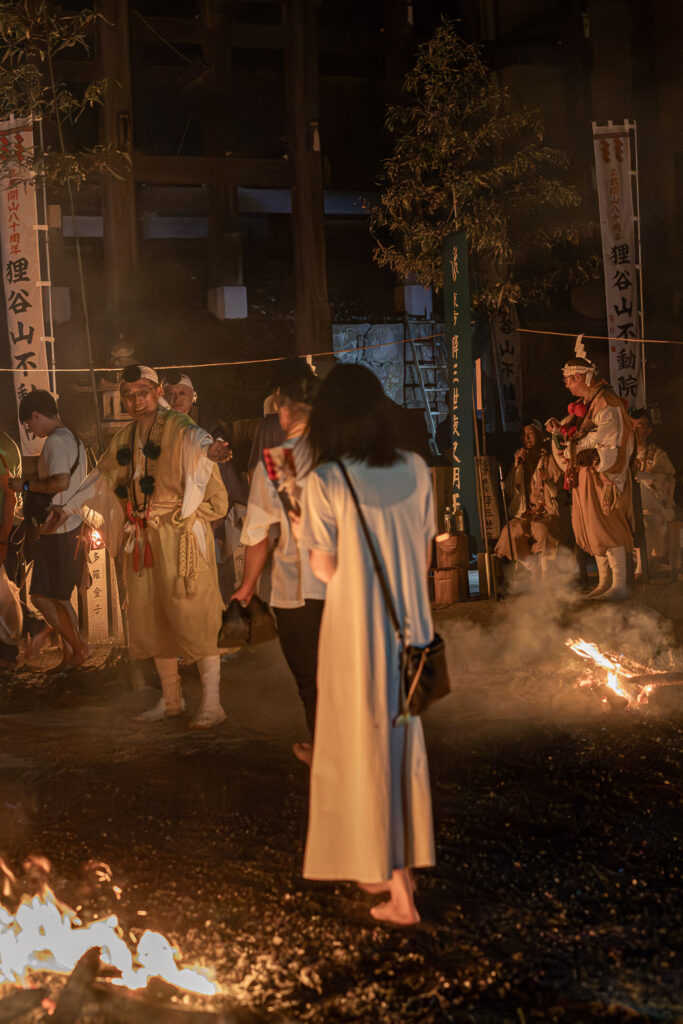
The Walk Across the Coals
It was not hot.
But I felt the heat. The monks had extinguished the flames while raking the embers flat, and what remained was charcoal still holding its warmth, unmistakable through the soles of my feet and nowhere near burning. The bed was maybe ten meters, and the yamabushi waiting at the far end grew closer with every step, and then I was standing in front of him.
It was over almost before it began.
Watching from the Other Side
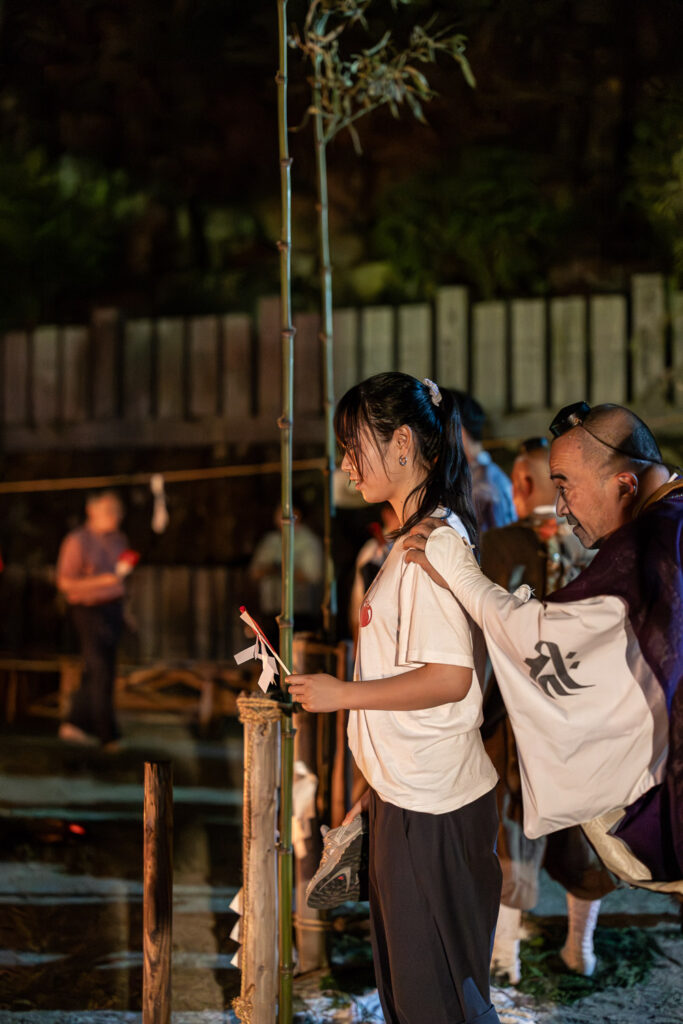
I received a blessing before crossing and another after. Nobody wiped their feet, so neither did I; the salt and ash fall away on their own as you walk.
Then I stood on the far side and watched the thousand people behind me take their turns. There were travelers from the West among them, stepping onto the salt with the same face I must have made a few minutes earlier.
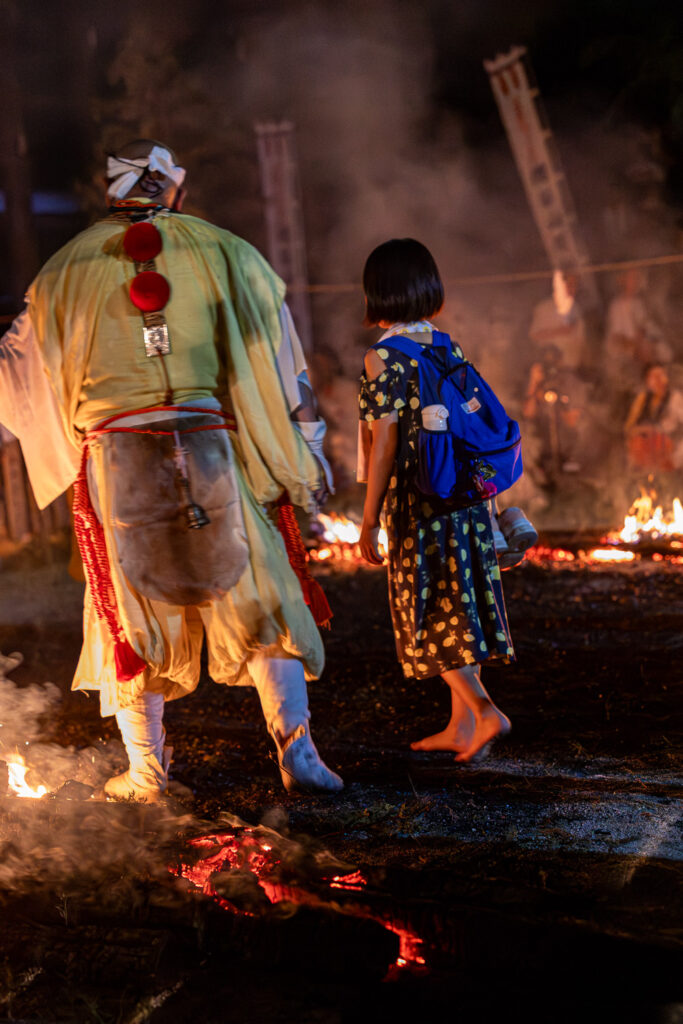
And there were children. The very children I had planned to hide behind, crossing the coals without a flicker of hesitation, long after I had already gone.
The Other Kind of Light
On the way down, I noticed the lanterns.
They had not been lit when I climbed these steps in the late afternoon. Of course they hadn’t. Now each one glowed from the inside, a square of paper light every few steps, the face of Fudo Myo-o printed across them in red, following the staircase down into the trees.
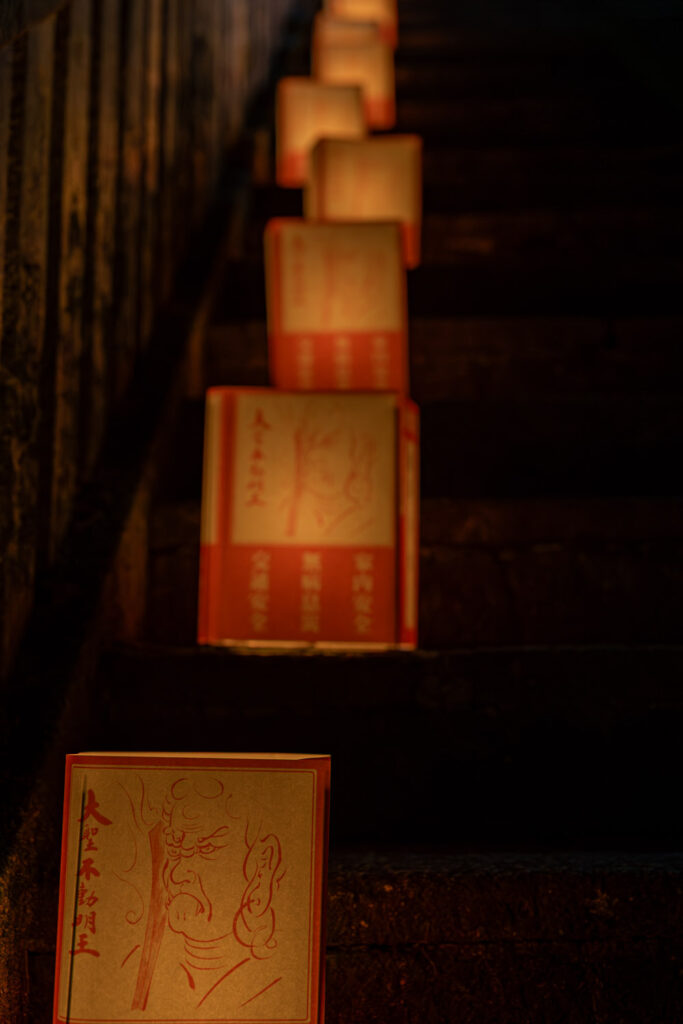
An hour earlier I had been sitting three meters from a fire that lit an entire mountainside. This was the same deity, in the same red ink, giving off a completely different kind of light. Small. Gentle. I walked down through it.
That is the night. What follows is everything I wish someone had told me before I started climbing.
Visiting the Tanukidani Fudoin Fire Walking Festival: Practical Information
Tanukidani Fudoin is a Shugendo mountain temple above Ichijoji, in the hills of northeastern Kyoto. Once a year its yamabushi build a towering goma fire, pray over it for hours, rake the embers flat, and walk across them barefoot. Then anyone may follow. That is the whole event, and it is far less exclusive than it sounds.
Fire Walking Festival Dates and Schedule
The date changed in 2025 and most English-language sources have not caught up. The festival is now held on the fourth Saturday of July every year. Confirm the current year’s date on the official Tanukidani Fudoin website before booking anything around it.
| Date | Fourth Saturday of July, annually |
| Festival start | 7:00 p.m. |
| Regular temple hours | 10:00 a.m. – 3:00 p.m. (admission ¥500) |
| Festival-day closure | Gates close at 3:00 p.m. No entry between 3:00 and 5:00 p.m. |
| Evening entry | From 5:00 p.m., paid at the Komyoden hall midway up the steps |
| Evening admission | ¥1,000, including a limited-edition tenugui |
| Fire-walking talisman | ¥500 |
| Attendance | Around 1,000 people |
| Ends | Around 9:00 p.m. |
Read the closure window carefully, because it catches people out. If you arrive early hoping to wait somewhere cool inside the temple, you cannot. Between 3 and 5 p.m. the grounds are sealed. Nor is there much waiting for you on the other side of 5 p.m.: the rooms are full, the air conditioning is theoretical, and the mountain holds the day’s heat well into the evening. Arrive at five, not before, and accept that the next two hours are part of the ritual.
Is the Fire Walking Actually Hot?
You feel real heat through your soles, and it is nowhere near burning. The yamabushi extinguish the flames as they rake the fire bed flat, so what you cross is warm charcoal rather than live fire. The path runs about ten meters and takes seconds.
Three things nobody tells you. You cannot choose your turn, and an earlier turn means fewer people to watch before you commit. Before the charcoal there is a thick bed of salt, laid down for purification, and on a night when everything else is hot it is shockingly cold underfoot; it is the sensation I remember most clearly from the entire evening. And you do not need to wipe your feet afterward, because the salt and ash fall away on their own.
The 250 Steps: Know This Before You Go
Everyone quotes the same number, 250, and the number is accurate. It is also the reason you always know exactly how much suffering remains, which some people find motivating and I do not. In the heat of late July, budget for it to feel like 2,500.
I am telling you this so that you bring water and leave yourself an extra half hour, not so that you stay home. Go. Just don’t arrive at the base of the steps with ten minutes to spare and a bottle you already finished.
One caveat that is not about stamina. A taxi can take you only as far as the base of the approach, and there is no route to the main hall that avoids the steps. If knees, heart, or a stroller are part of your planning, this is unfortunately not your event.
What to Bring
Late July in Kyoto is among the most punishing heat Japan offers. You will climb a slope and 250 steps, then spend hours near a large fire, and the temperature does not drop much after dark.
- Water, more than seems reasonable, and a second bottle for the walk down
- A spare shirt. It will not go to waste
- Shoes you can slip off and carry, because that is what you will be doing
- A hand towel or fan. You receive a tenugui at the gate, and it earns its keep
- Cash. Admission and the talisman are paid on site
Photography and a Warning About Your Phone
Seats near the fire get hot enough to shut down a smartphone. Mine threw a temperature warning at the climax of the ceremony and stopped working. If photography matters to you, bring a dedicated camera, keep spare batteries, and expect to shoot in near-darkness before the fire is lit and in violent contrast afterward.
About Paid Agency Plans
I joined through a Japanese travel agency’s paid plan, which included entry at 5 p.m., a reserved seat close to the ceremony, and a place near the front of the fire-walking order. Whether a comparable plan will be offered in future years is not confirmed, so treat this as a description of what existed in 2026 rather than a promise.
Consider the trade-off honestly. A front-row seat is extraordinary, and going third out of a thousand means walking the coals before you have watched a single other person survive them.
Getting There and Getting Back
Transit details are current as of July 2026. Schedules are revised annually, so verify before you travel.
Getting there
- Eizan Railway to Ichijoji Station, then about ten minutes uphill to the approach
- Kyoto City Bus 5 to Ichijoji-Sagarimatsu-cho, then the same ten-minute walk
- Taxi as far as the base of the steps, and no farther
Getting back
- Eizan Railway, the reliable option. Last train from Ichijoji to Demachiyanagi at 11:34 p.m.
- City Bus 5, roughly three an hour, last bus 10:41 p.m.
- Taxi. Do not count on hailing one near the temple after dark; walk down to Shirakawa-dori first
One reassurance about the walk down. A dark mountain temple at 10 p.m. sounds ominous, but the crowd disperses gradually rather than all at once, the route to the station runs through a quiet residential neighborhood, and there are people around the whole way. I never once felt uneasy. You will also descend the 250 steps by lantern light, which is a considerably better experience than climbing them in the sun.
Location
Frequently Asked Questions
These are the questions I was asked most often after I got home, usually by people who assumed I had lost my mind.
Can tourists join the fire walking at Tanukidani Fudoin?
Yes. After the yamabushi monks cross the fire bed, general visitors may follow with the monks guiding them. Pay the evening admission of ¥1,000 on arrival; the talisman you carry across costs an additional ¥500. Announcements are made in English as well as Japanese, and travelers from abroad were among the participants the night I attended.
Is the fire walking dangerous or painful?
You feel warmth through your soles, but the monks extinguish the flames before participants cross, so the temperature is nowhere near burning. Children walk it with a monk holding their hand. The path is about ten meters long and takes only seconds.
Do I need a reservation?
No. Arrive from 5 p.m., pay the evening admission at the Komyoden hall on the steps, and you can take part in everything, including the fire walking. Paid agency plans with reserved seating have existed, but their availability in future years is not confirmed.
What is a goma fire ritual?
Goma is a fire ceremony of esoteric Buddhism in which wooden prayer sticks are burned as offerings. This festival features two forms: an indoor goma service inside the cave main hall, and the outdoor saito goma, the great open-air fire whose embers become the fire-walking path.
Is Tanukidani Fudoin connected to Miyamoto Musashi?
The grounds include a waterfall where the swordsman Miyamoto Musashi is said to have trained before his duel with the Yoshioka school, and it is the temple’s best-known legend. On the night I attended, the monk’s historical talk never mentioned it and stayed entirely with documented history.