The Gion Matsuri float procession begins at nine in the morning on July 17. I was on Shijo Street by eight, feeling clever.
I had done my calculations. The procession departs from Shijo-Karasuma, so Shijo-Karasuma would be mobbed. I got off at Shijo-Kawaramachi instead, well before nine, and found a spot without effort. So easily, in fact, that I got greedy and started walking west toward Shijo-Karasuma anyway, toward the heart of the whole event. Halfway there, I stopped. The floats were coming to me. Walking toward something that is already on its way to you is not strategy. It is exercise.
Along both sides of the street, the sunny stretches were filling with Japanese spectators dressed for a war against the sun: long sleeves, wide hats, parasols, cooling towels around their necks.
The Family That Would Not Leave the Shade
Near me, a Western family stayed under the shopping arcade, deep in the shade.
Their equipment: water, sunglasses, one handheld fan. No parasol. I worried about them, in that meddlesome way you worry about travelers who seem underprepared. They were never going to get a front-row spot at this rate.
Except the floats did not come.
I was waiting near Shinkyogoku, and they simply did not come. Five minutes became ten. Ten became twenty. The family in the shade did not move. They chatted. They drank their water. They looked comfortable.
Slowly, a suspicion formed. Did they know the floats would take this long? Had I mistaken the smartest people on the street for the least prepared?
The only thing running out that morning was me.
I should confess something here, because I had no business assessing anyone’s preparation.
At last year’s reserved seat, the organizers came down the row handing out frozen pouches of Aquarius, the sports drink. I assumed it was an apology. Those seats are not cheap, and a small gift softens the arithmetic. Whatever the intention, the thing was a revelation: ice you can drink as it melts, and something cold to hold against the back of your neck until it does. Ever since, a frozen pouch has gone into my bag whenever I leave the house in a Japanese summer.
On the one morning of the year when it mattered most, I left it in the freezer.
So while I was quietly grading the family in the shade, I was standing in full sun with no parasol, no ice, and nothing but a plan. Had I spotted another traveler holding a frozen pouch, I would have dropped every judgment I had and asked them how they do it.
Any supermarket sells them. Buy two.
The parasol is not really a custom anywhere else in the world, but Kyoto summers being what they are now, I would put it on the essential list for this particular morning. If you do not own one, there is exactly one alternative, and that family had already mastered it.
Reserved Seats, and Why I Now Watch for Free
Last year I paid for a front-row reserved seat. Then it rained on me. Properly.
Reserved seating has one clear flaw. You cannot move. Rain arrives, you stay. Something interesting happens fifty meters away, you stay. You watch each float pass from one fixed angle, in order, like frames of a film someone else has already edited.
Sitting there in the rain, I learned something about myself. I need to roam.
The price for that lesson was paid this July: hours of standing in the sun, for free, exactly where I chose to stand.
Hoko, Yama, and the Thirty-Four Floats of Kyoto
While you are waiting, it helps to know what you are waiting for.
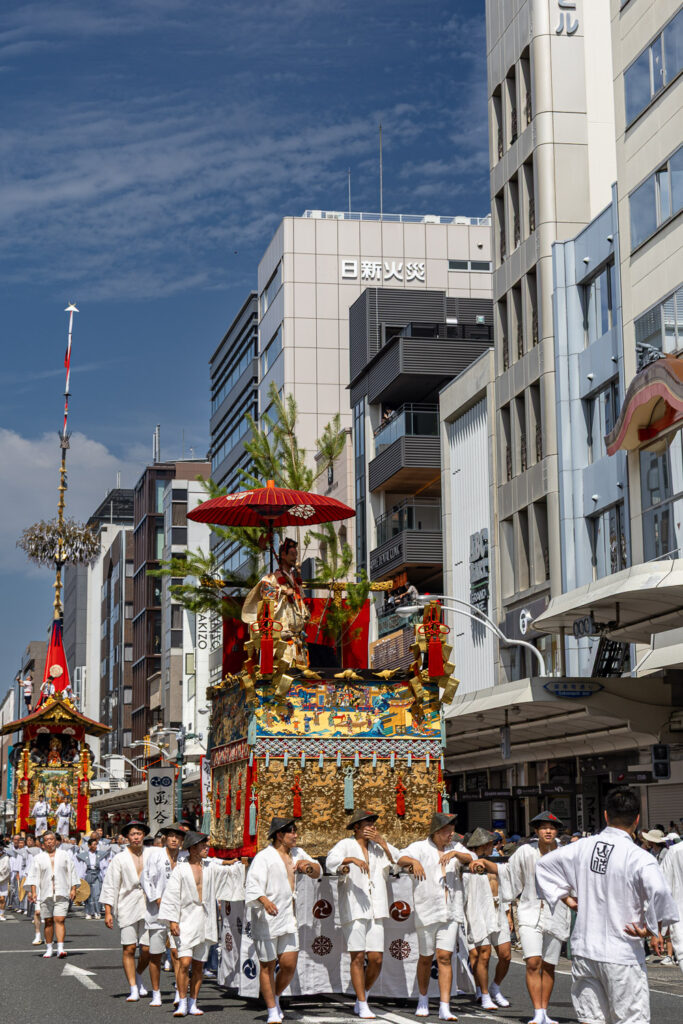
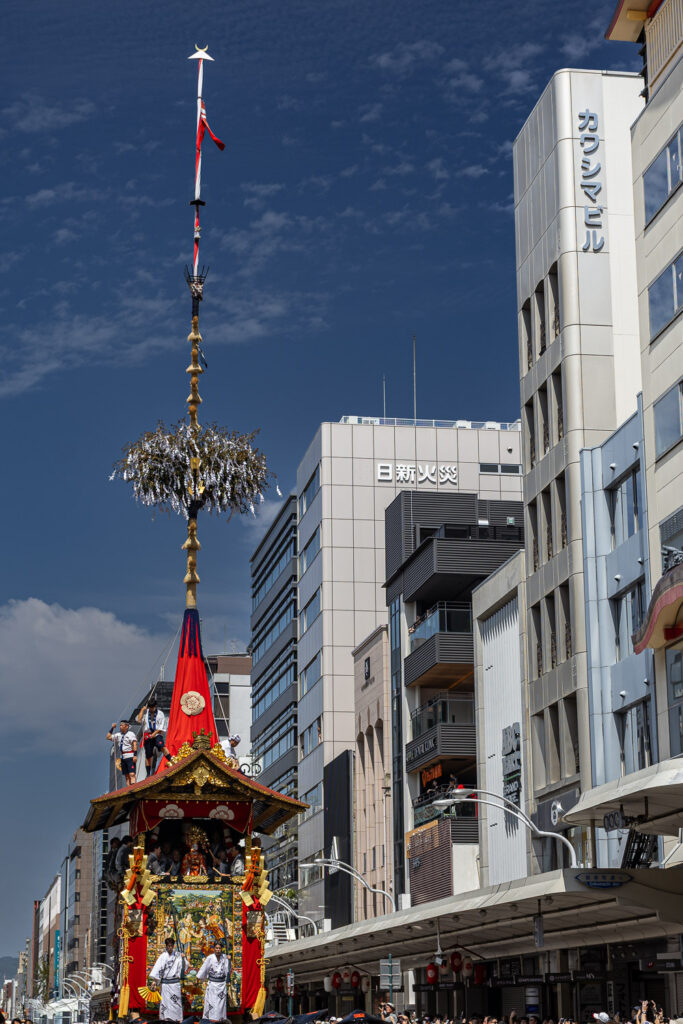
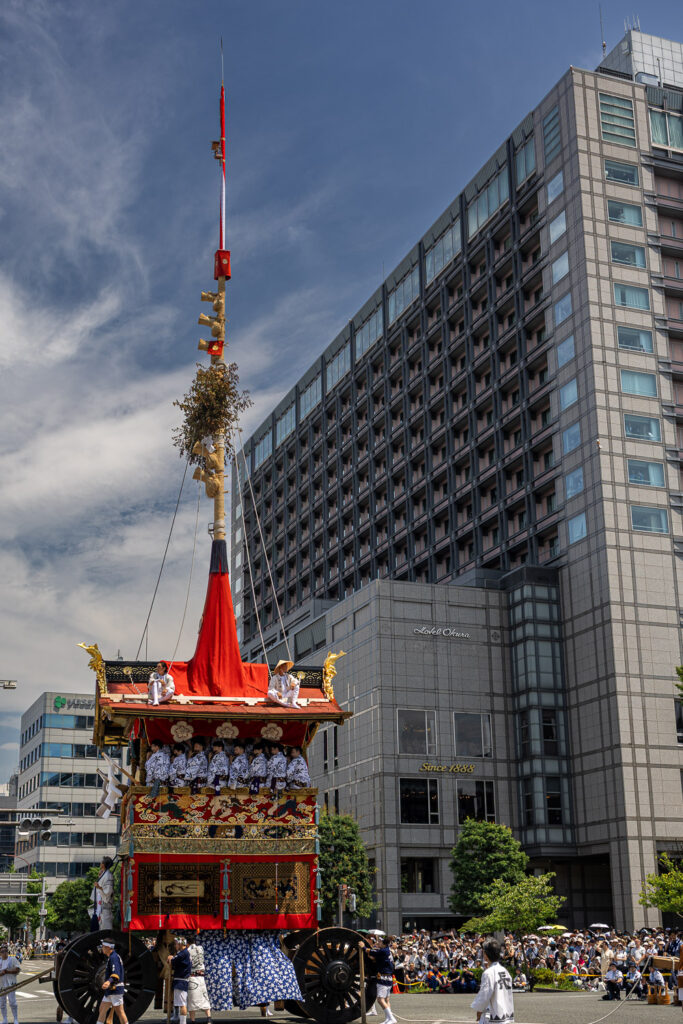
Thirty-four floats take part in the Gion Festival across two processions: twenty-three on July 17, eleven more on July 24. They divide into two types. The hoko are the giants, several tons each, rolling on solid wooden wheels beneath poles that rise higher than the buildings on either side. The yama are smaller, and many of them are carried on shoulder poles rather than pulled.
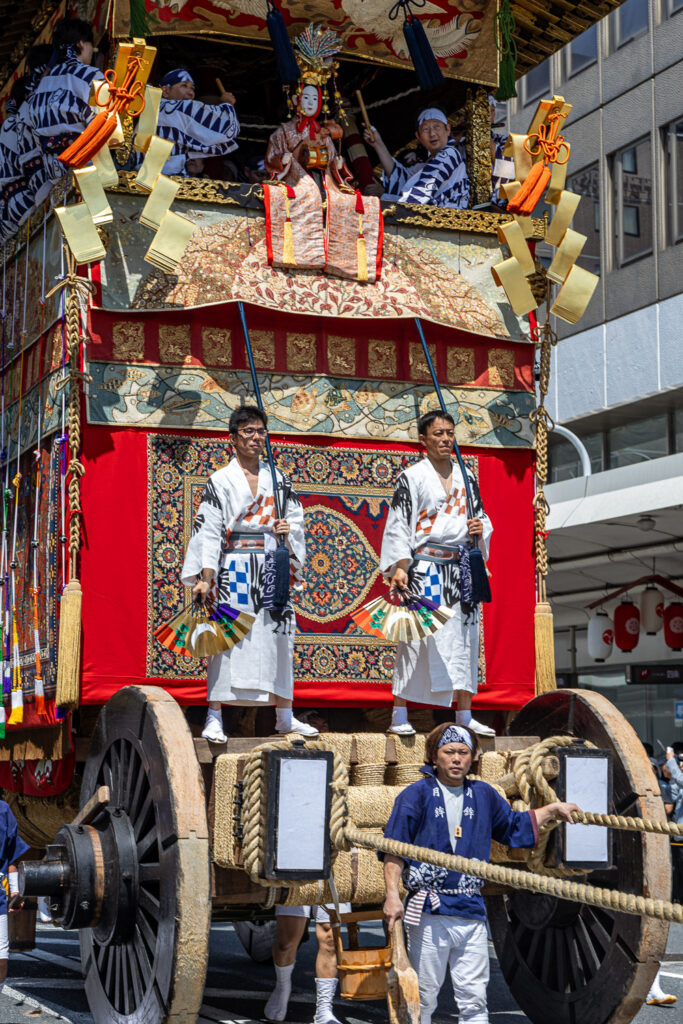
On the front platform of Tsuki Hoko, two men stood facing forward, folding fans in hand, performing slow gestures in time with the float’s movement. That is all they do. Set beneath all that height, the gesture carries a gravity it has no right to.
The wheels stand as tall as a person. Solid wood, no iron rim, no rubber.
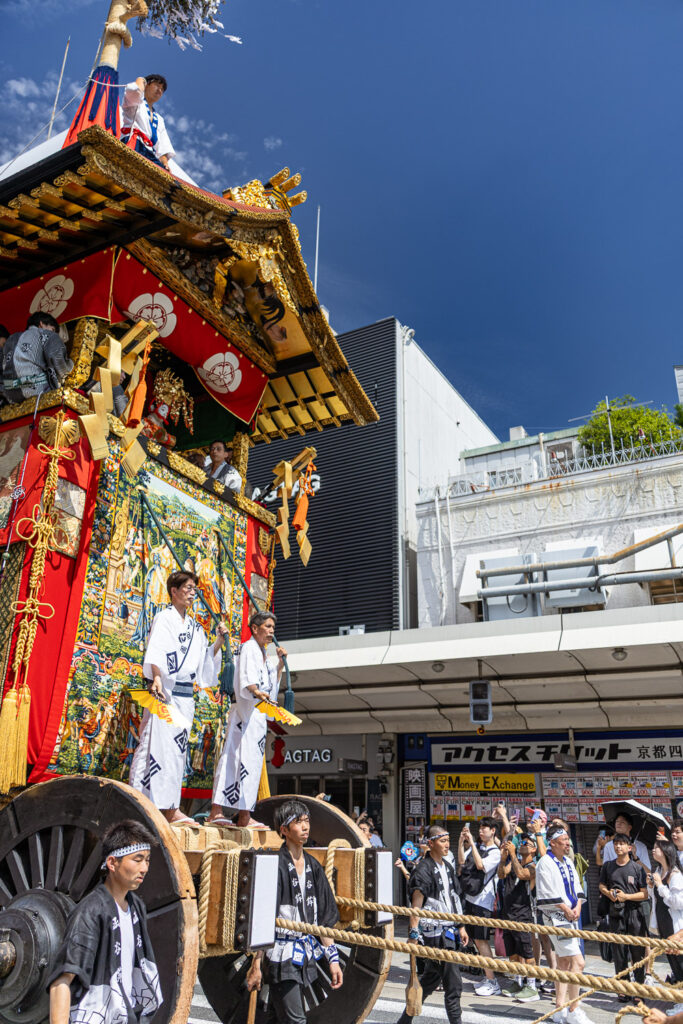
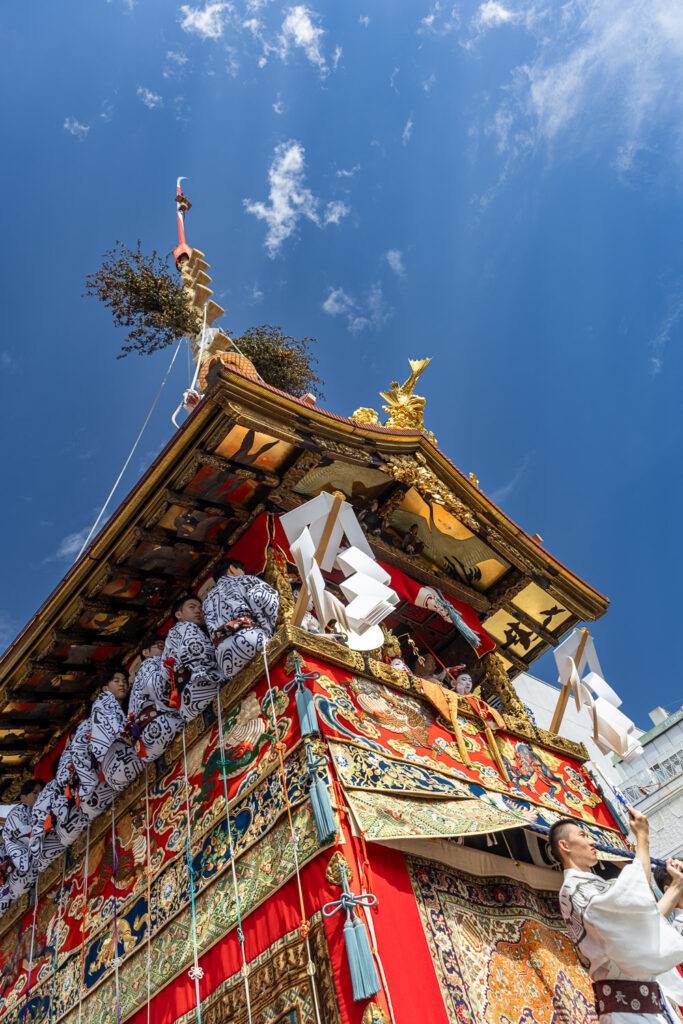
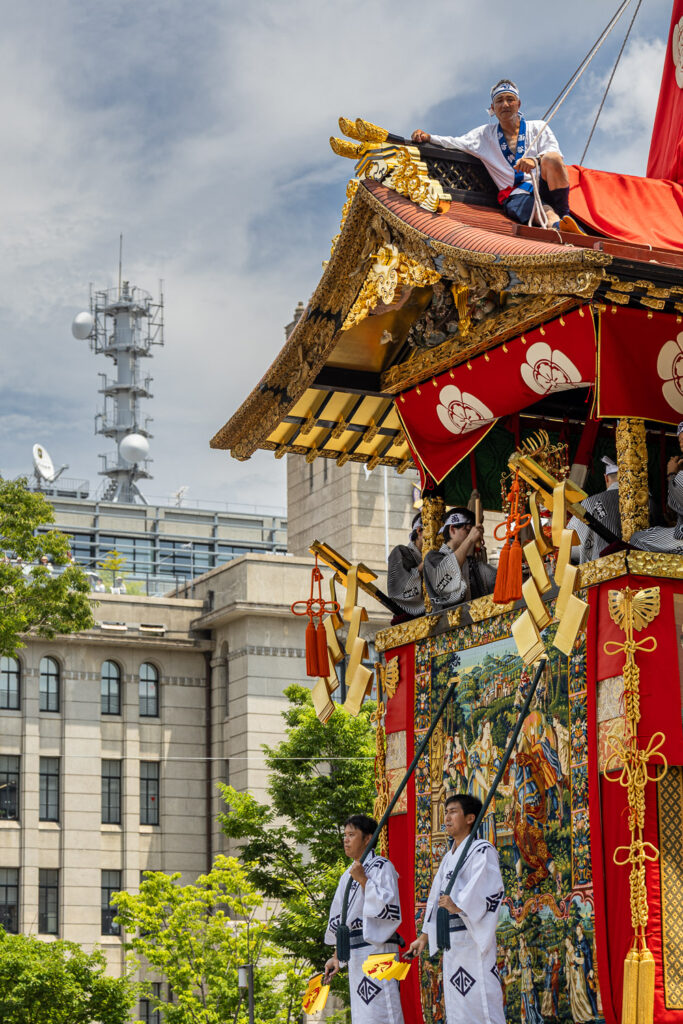
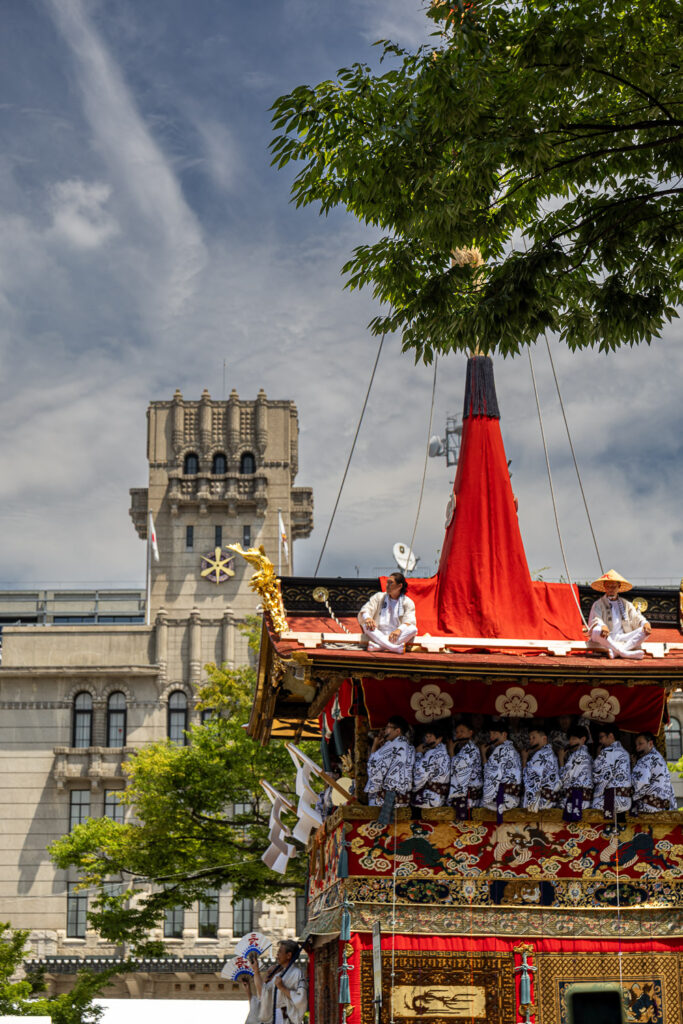
Men ride on the roof, holding the ropes that steady the central pole, eyes forward. Below them the musicians sit in a row along the float’s edge, playing flute, bells, and drums without pause.
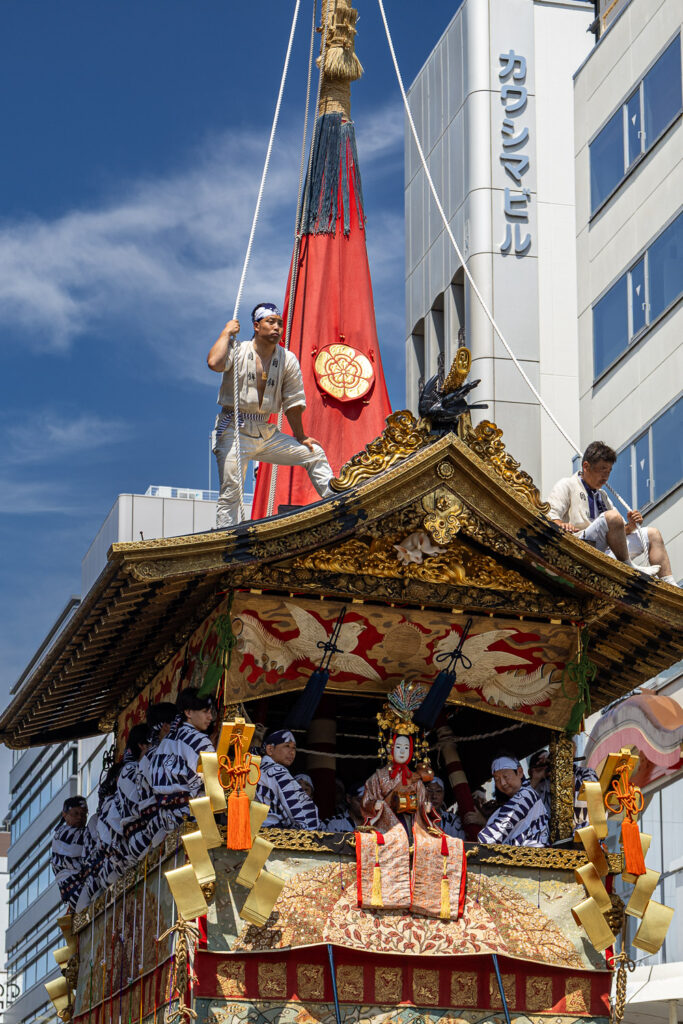
Here is the part that reframes everything you are looking at. None of these structures is permanent. There is not a single nail in them. Each float is lashed together every summer with rope, in a technique the neighborhoods have kept alive for centuries, then taken apart again after the procession. What is rolling past you was assembled a few days ago and will not exist next month. They rebuild it, from nothing, every year.
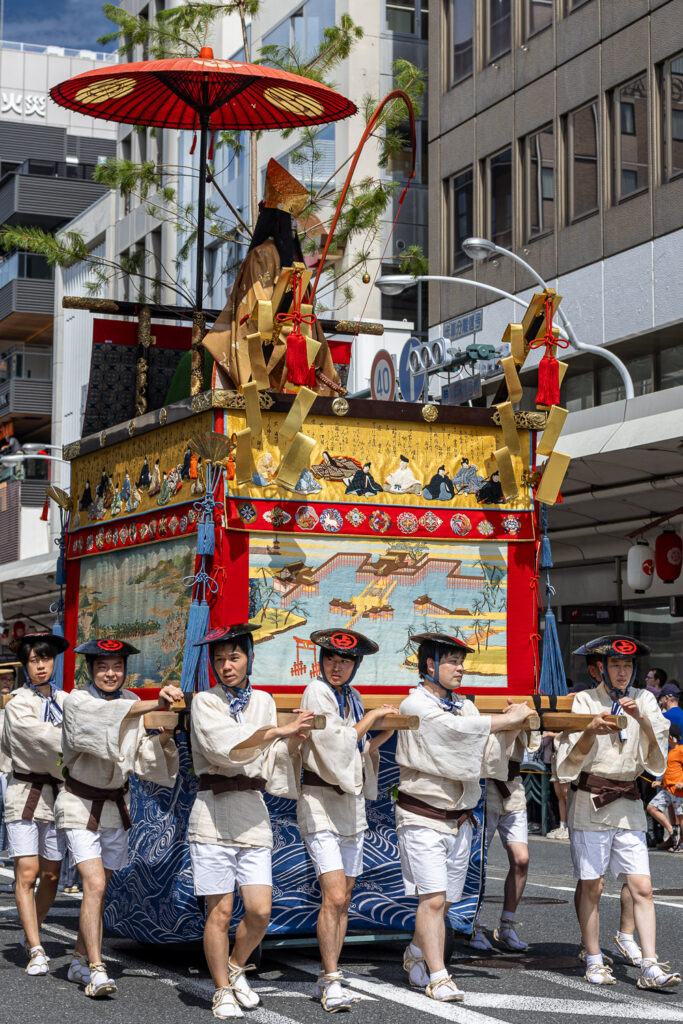
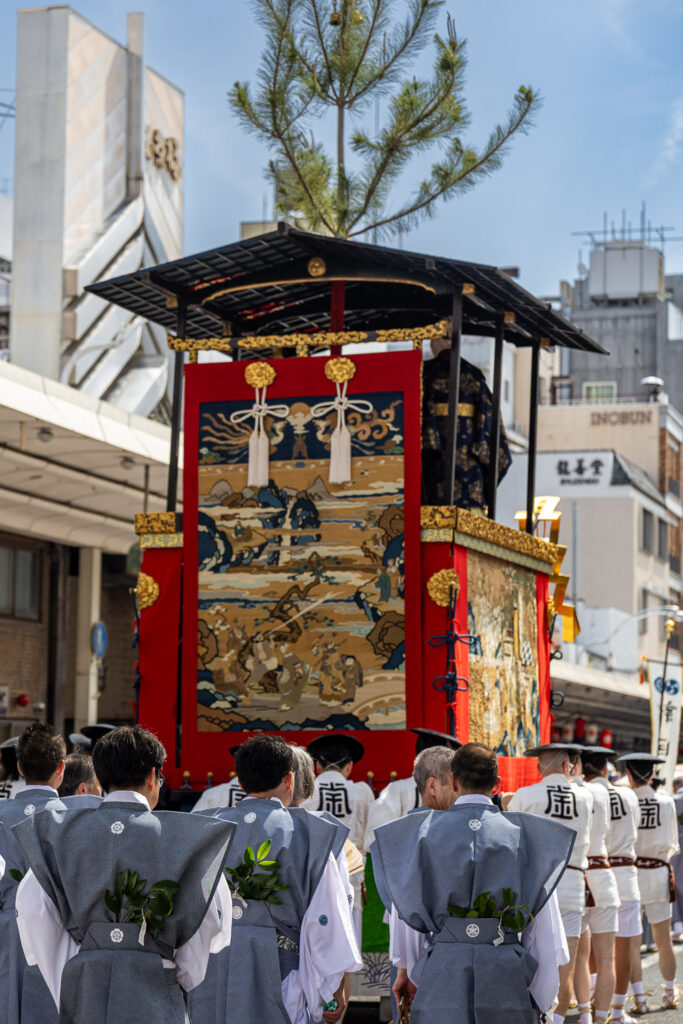
Some of the smaller floats perform along the route. Ayagasaboko is known for it. I have still never seen it. They always seem to perform directly in front of the paid seats, which are, by definition, where I am not.
Close Up, the Red Cloth Turns Into Something Else
By this point the back of my shirt had given up, and I had stopped pretending otherwise. Then a float came close, and I forgot about it.
From across the street, the fabric on a float registers as one thing. Red.
Then a float passes within a few meters of you, and the red stops being red.
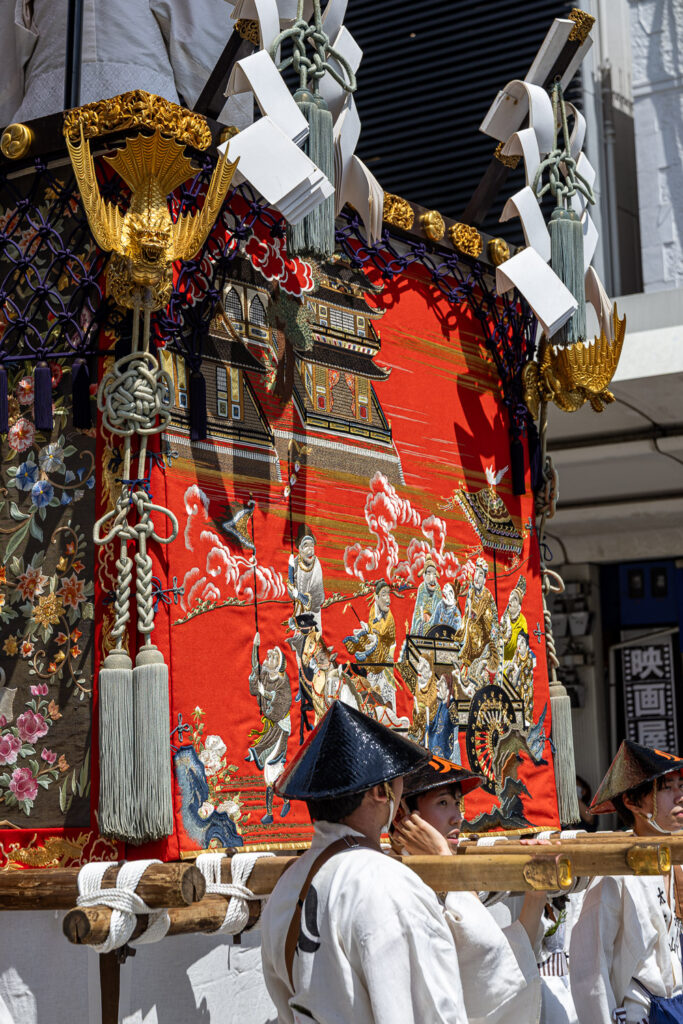
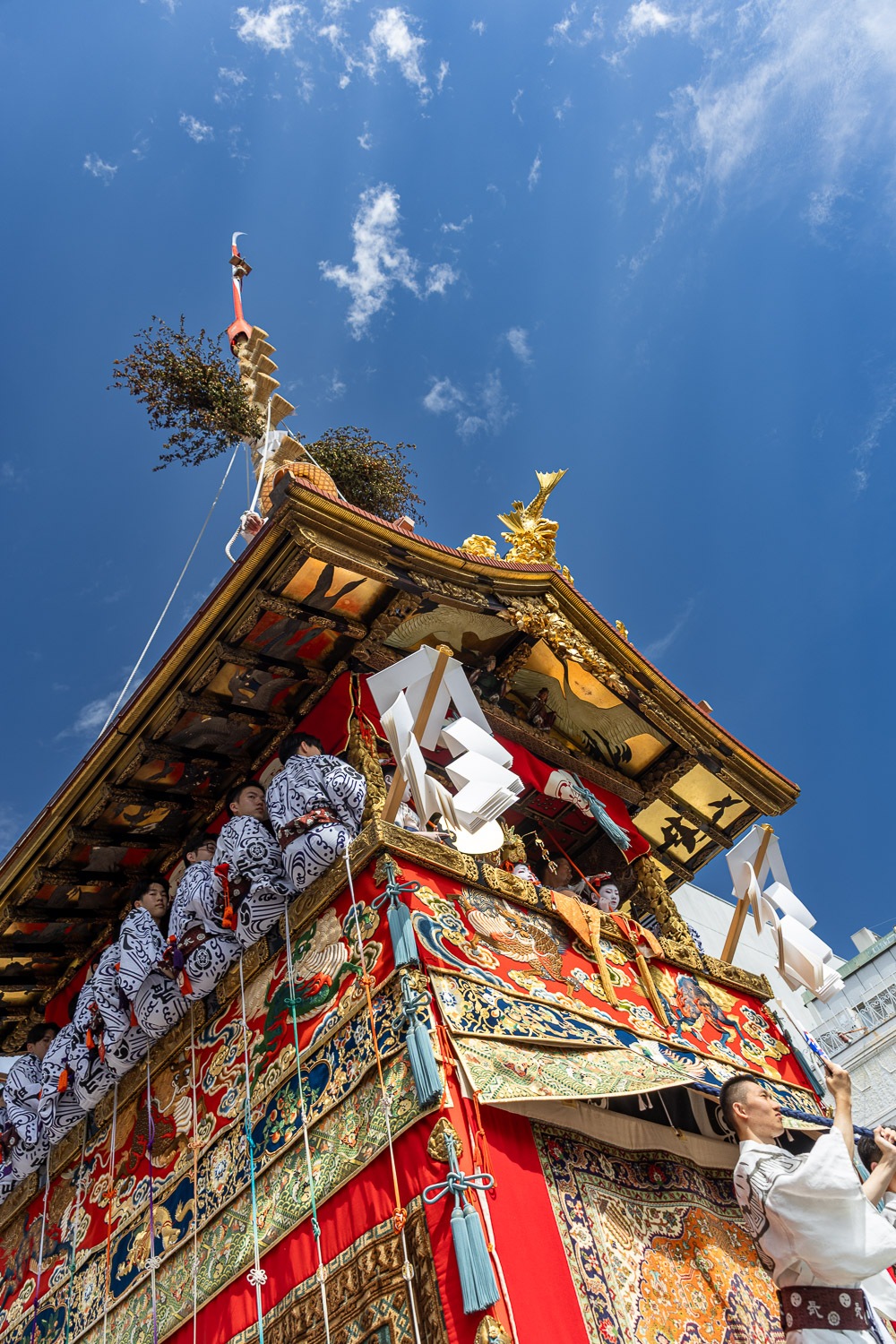
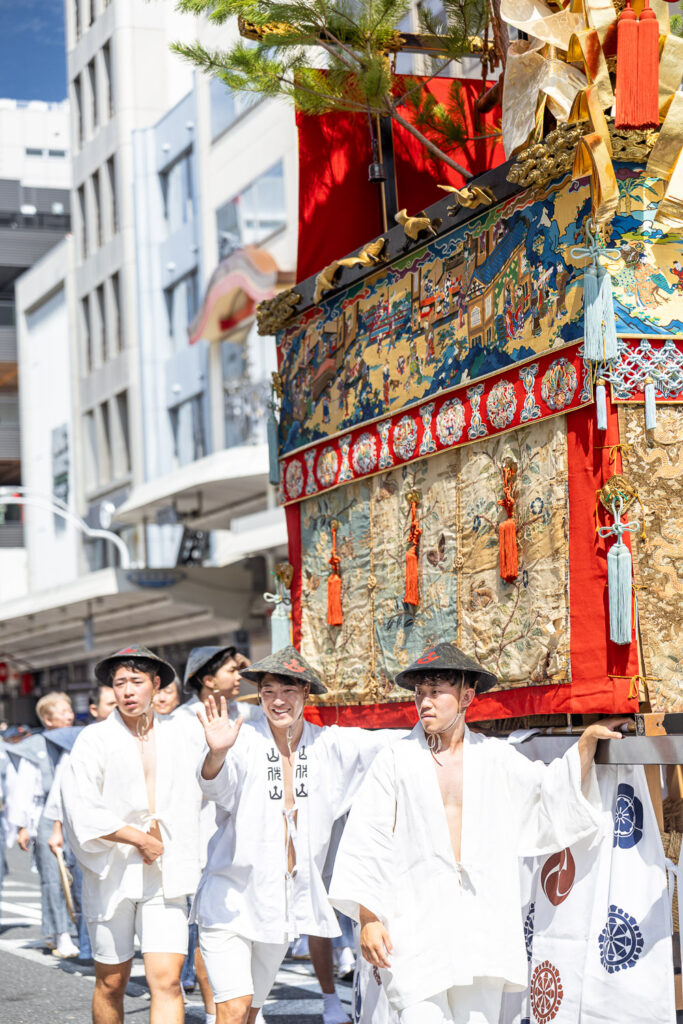
Gold thread. A palace with tiered eaves and latticed windows. Figures in Chinese court dress, a horse, a carriage, clouds worked in white and coral. Flowers in blue and rose on the panel beside it. Tassels the color of sea glass hanging over all of it.
This one belongs to Taishiyama, a small carried float dedicated to Prince Shotoku, the seventh-century statesman who did more than anyone to establish Buddhism in Japan.
Then look at what it is wearing. The scene across the front panel is not Japanese at all. It is Epang Palace, the pleasure complex raised by Qin Shi Huang, the first emperor of China, and lost when his dynasty fell. Chinese poets spent the next thousand years using it as shorthand for magnificence that outruns its own foundations. It is embroidered onto scarlet rasha, a woolen broadcloth that reached Japan through European traders. The hanging at the rear was made from a Qing dynasty court robe, a woman’s. The side panels are Indian embroidery, the entire ground filled in with gold thread. Even the metal fittings along the railing and the hooks that carry the corner tassels are considered pieces worth stopping for.
Count the passports on that single float. A Japanese prince, a Chinese emperor’s vanished palace, a Qing court robe, Indian goldwork, European wool. All of it carried on men’s shoulders down a street lined with convenience stores.
One more thing, easy to miss. Every other yama in the procession carries a pine at its center. Taishiyama carries a cedar, and hanging from it, sealed in a small shrine cabinet, is an image of Nyoirin Kannon. Thirty-four floats in this festival, and one of them brings a different tree.
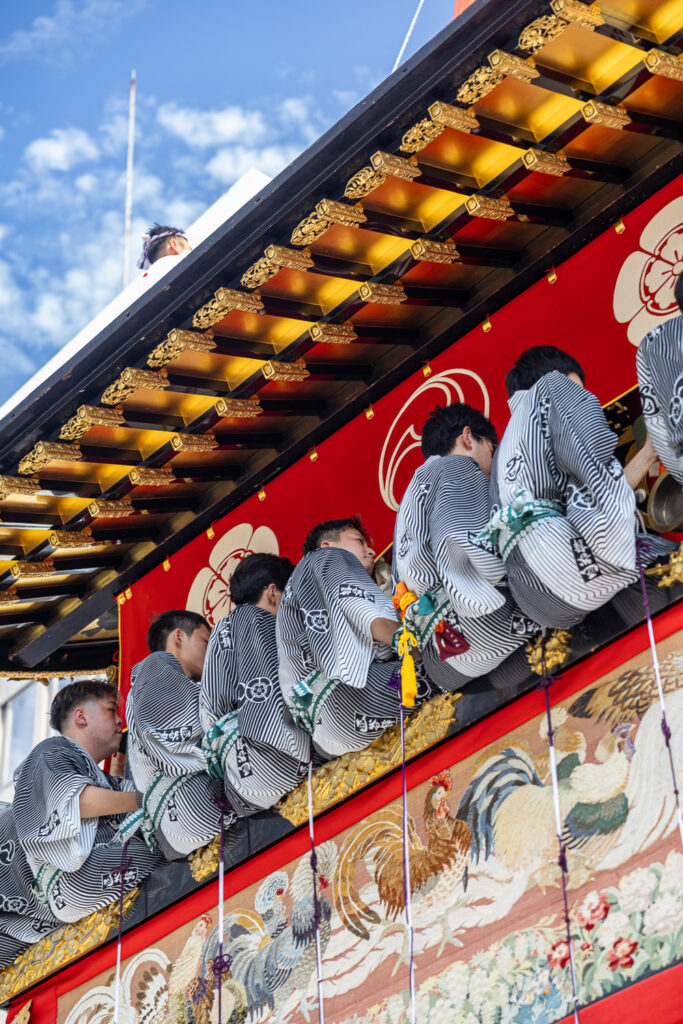
There is no glass between any of this and you. No rope line, no climate control, no one explaining it. Just a July sky and four hundred years of textile, moving past at walking pace.
This is the thing nobody mentions about watching from the roadside. It is free. It is hot. You wait a long time for it. And then a museum walks past your face at arm’s length. Subtract the heat, subtract the waiting, and I would still call it a fair trade.
And yet.
Even at this pace, on floats slow enough to chase on foot, I could not read them. A float takes about a minute to pass. You look up, you register gold and red and something happening among the figures, and then the panel is gone and the next float is arriving. Not once did I follow a single scene from beginning to end.
I saw them properly that night, at home, on a screen. Going through the photographs, I was genuinely stunned. There were faces in that panel I had stood directly beneath and never noticed. The camera had been paying attention. I had been standing in the heat, waiting.
So take the photographs, even when you feel like a tourist for taking them, and look at them again that evening. That is when the second half of this festival happens.
A Speed You Can Chase
The floats keep coming. Everyone knows that. And still, watching one recede down the street, I felt the urge to chase it.
I resisted. I waited for the next one. Then I waited some more.
Somewhere in that waiting, the truth of the event settles in. The floats are slow. Slower than a person strolling. Slower than you believe a parade is permitted to be.
Maybe I had not noticed last year because I was pinned to a seat in the rain. This year, standing, it was impossible to ignore.
Then I reconsidered. This slowness is not a flaw in the Yamaboko Junko. This slowness is the Yamaboko Junko.
So I gave in and followed the floats toward Kyoto City Hall. Chasing them is easy. That is how slow they are, slow enough to be caught by anyone on foot.
Naginata Hoko, and the Rope I Did Not See Cut
I caught up with Naginata Hoko, the float at the head of the procession.
It leads every year, and it does so by exemption. The order of the other floats is settled by lot at a ceremony on Shijo Street, where each neighborhood presents its box to the mayor and the lot is verified in public. Naginata Hoko draws no lot. Its place has never been in question.
It is also the only float in the procession that still carries a living child.
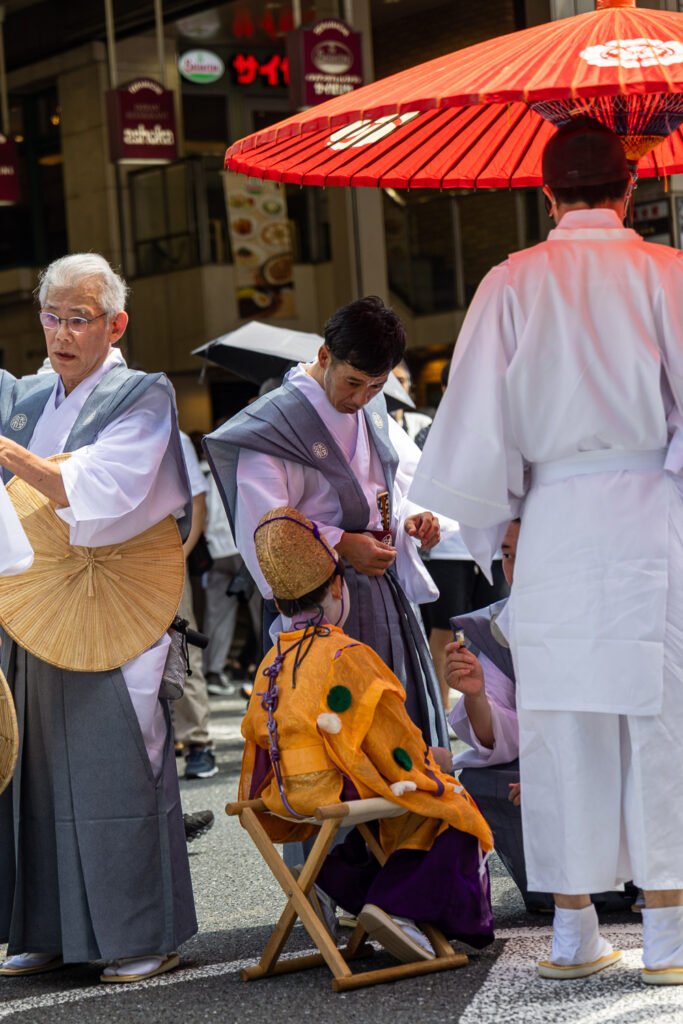
The chigo is a boy chosen from the neighborhood, dressed in gold and purple brocade, treated as a sacred vessel for the duration of the festival. Shortly after the procession sets off, at the corner of Shijo and Fuyacho, he stands at the front of the float and cuts a rope of twisted rice straw with a sword. That cut opens the boundary between the ordinary street and sacred ground, and the entire procession follows him through it.
By the time I caught up with the float, the rope had been cut an hour earlier and half a kilometer behind me. I saw the boy afterward, off the float, sitting on a folding stool under a red parasol while three adults in gray attended to him. He looked like a boy who had been awake since before dawn.
If you want to see the rope cut, you need to be near Shijo-Fuyacho early, and you need to accept that you will see very little else. I did not plan for it. Next year I might.
Tsuji-Mawashi: Turning Ten Tons Without a Steering Wheel
What I did see was the tsuji-mawashi.
This is the ninety-degree turn a float makes at an intersection, a tsuji in old Kyoto usage, and it is the single greatest spectacle of the procession.
Here is why. The floats have no steering. No pivoting axle, no mechanism of any kind for changing direction. Ten tons of wood and textile, and nobody ever installed a way to turn it.
So this is the solution. Green bamboo slats are laid across the pavement. Water is splashed over them. The wheels are hauled onto the slick bamboo, and teams of men pull on ropes until the whole float slides sideways, a few degrees at a time.
One pull is never enough. This magnificently unmaneuverable object takes the corner in stages. Lay the bamboo again, splash the water again, pull again.
The crowd roars. A real roar.
Honestly? The spectacle is quieter than the roar suggests. Nothing explodes. Nothing lurches. Ten tons cross wet bamboo, slowly, and arrive facing a different direction.
Walking away from it, a thought kept circling back. Perhaps this is exactly what Kyoto is.
No attempt to overwhelm you. No machinery brought in to solve a problem that bamboo and water already solve. The same maneuver, at the same unhurried pace, every July since long before anyone thought to time it. A thousand-year-old festival is not built to impress you in ten seconds. It is built to still be here.
Where to Watch the Gion Matsuri Procession: Practical Information
Everything below is what I wish I had known before eight in the morning.
Dates and Times
Saki Matsuri (first procession): July 17 every year. Departs Shijo-Karasuma at 9:00 a.m. Twenty-three floats.
Ato Matsuri (second procession): July 24 every year. Departs Karasuma-Oike at 9:30 a.m. Eleven floats.
The dates are fixed regardless of the day of the week. In 2027, July 17 falls on a Saturday, which will make an already crowded morning heavier still. Schedules for the wider festival are published by Yasaka Shrine, the shrine at the heart of Gion Matsuri.
For a first visit, choose July 17. Scale is the point. If you would rather have room to breathe, July 24 is the calmer half of the same festival.
The Route, and the Three Corners That Matter
The July 17 procession departs Shijo-Karasuma and moves east along Shijo Street. It turns north at Shijo-Kawaramachi, west at Kawaramachi-Oike, and south at Shinmachi-Oike before the floats return to their neighborhoods. The tsuji-mawashi happens at those three corners.
The July 24 procession runs the route in reverse from Karasuma-Oike, with turns at Kawaramachi-Oike and Shijo-Kawaramachi.
Choosing Your Spot
| Location | What you get |
|---|---|
| Shijo-Karasuma (start) | All floats assembled. The most crowded point on the route |
| Shijo-Fuyacho | The rope-cutting by the chigo, early. Little else |
| Shijo-Kawaramachi | The first tsuji-mawashi. Crowded and eventful |
| Kawaramachi-Oike | Paid seating, a wide boulevard, and hotels on the corner |
| Shinmachi-Oike | July 17 only. The giants squeezing into a narrow street |
| Midpoints on Shijo Street | Lighter crowds, floats passing close, no turns |
Do not fixate on the starting point. The floats come to you, and moving against them costs energy you will want by eleven.
What Time Should You Arrive?
Not as early as you think.
If you want a place on Shijo Street, arriving at nine is enough. The route is long, which means the roadside is long, and the crowd spreads itself thin across several kilometers. I have never had to fight for a position there.
The exceptions are the corners. If you want the tsuji-mawashi from the front row, or the rope-cutting at Shijo-Fuyacho, treat those as separate operations and arrive well before the lead float does.
Photographing the Floats
Shijo Street is where you get closest. The floats pass within a few meters, close enough that a phone or a standard lens will do everything you need. You do not need a telephoto.
What you do need is the discipline to keep shooting while the float is beside you, rather than watching it and telling yourself you will remember. You will not. The panels go by in about a minute, and the details only become visible later, on a screen, when you have time to look at them properly.
Is It Free to Watch?
Yes. Watching from the roadside costs nothing, and that is how most Kyoto residents do it. The paid grandstands are an option, not a requirement.
Paid Seating
Reserved seats are set up mainly along Oike Street. You get a guaranteed seat and a guaranteed view, which matters if standing for three hours in July concerns you. You also get my one complaint: you see a single stretch of the route and nothing else. Sections, prices, and sale dates change from year to year, so check the official announcement before booking.
Where to Stay for the Procession
This is the one piece of advice I would give anyone visiting Kyoto specifically for the Yamaboko Junko. Stay on the route.
The procession passes directly in front of hotels at Shijo-Karasuma and again at Kawaramachi-Oike, where the second tsuji-mawashi takes place. Staying at one of them means you can step outside at 8:45, watch until the heat wins, walk back into air conditioning, and come out again for the next float. Everyone else spends the morning defending a patch of pavement.
July 17 is one of the highest-demand nights of the Kyoto year. Rooms on the route go early, often six months to a year ahead.
Surviving the Heat
Mid-July Kyoto routinely reaches 35°C (95°F) with high humidity.
- A parasol changes the morning entirely. A folding one is fine.
- A frozen pouch of sports drink from any supermarket. It is ice for your neck first and a drink second, and it is the single most useful thing I have ever been handed at this festival. Do not leave it in the freezer, as I did.
- Carry two bottles of water from the start. Every store nearby will have a line.
- Hat, sunscreen, something salty.
- Check where the shade will be before you commit to a spot. Shade moves as the morning goes on, and the family in the arcade will still be there when you give up.
- Scout somewhere to sit before you need it.
Restrooms and Access
Convenience stores along Shijo and Kawaramachi, the Daimaru and Takashimaya department stores, and the commercial buildings attached to the stations all have usable restrooms. Traffic control restricts street crossings in places once the procession begins, so go before you settle in.
Nearest stations: Karasuma (Hankyu) or Shijo (subway) for Shijo-Karasuma; Kyoto-Kawaramachi (Hankyu) for Shijo-Kawaramachi; Kyoto Shiyakusho-mae (subway) for Kawaramachi-Oike. https://www.google.com/maps/embed?pb=!1m18!1m12!1m3!1d3268.143151038116!2d135.75660517623592!3d35.00312152281374!2m3!1f0!2f0!3f0!3m2!1i1024!2i768!4f13.1!3m3!1m2!1s0x6001089a3a451a29%3A0xa057eeb4b5ef0f85!2z54OP5Li46aeF!5e0!3m2!1sen!2sjp!4v1786726380686!5m2!1sen!2sjp
How Long It Takes
Naginata Hoko leaves Shijo-Karasuma at 9:00 a.m. and completes the final turn at Shinmachi at around 11:30 a.m. The last float finishes near 2:00 p.m.
You do not need all five hours. Two to three hours is the honest recommendation: one tsuji-mawashi and a handful of floats passing close enough to see the embroidery gives you the entire anatomy of the event.
Yamaboko Junko or Yoiyama?
Yoiyama, on the evenings beforehand, is the festival where you move. The floats stand parked across the neighborhood, lit from within, and you walk among them with street food in hand.
The Yamaboko Junko is the festival where the floats move and you wait. Same festival, opposite verbs.
And the floats are only half of Gion Matsuri. The portable shrines that carry the deities keep their own calendar through July, beginning with the mikoshi purification on the night of July 10, which almost no visitor sees.
Frequently Asked Questions
What is so special about the Gion Matsuri float procession?
Ask ten people and you will get the tapestries, the height, the crowds. My answer is the arithmetic underneath it.
A prayer begun in the year 869 to drive out plague, running without a permanent break ever since. Thirty-four structures that contain no nails, tied together with rope each summer and dismantled again weeks later. Textiles from Europe, Persia, and China, some of them four hundred years old, carried outdoors through a working city. Ten tons turned by hand at a street corner because no one has ever needed to invent a better way. All of it organized not by the city government but by the neighborhoods themselves, which is why UNESCO lists it as intangible cultural heritage.
And all of it moving slower than you walk. That is not a shortcoming of the festival. It is the reason there is still a festival.
Is it free to watch from the street?
Completely free. Reserved seats exist for those who want a guaranteed view, but the sidewalks are open to everyone and cost nothing.
Which is better, July 17 or July 24?
July 17 has twenty-three floats and the full weight of the event. July 24 has eleven and far more breathing room. First-timers should take the seventeenth.
Do I need a reserved seat?
Only if standing for hours in the heat is a real concern. The trade-off is mobility. I have tried both and I now watch from the street.
What time should I arrive?
Nine o’clock is enough for a place on Shijo Street; the route is long and the crowd spreads out. For a front-row view of a tsuji-mawashi, arrive considerably earlier.
Where can I see the tsuji-mawashi?
Three corners on July 17: Shijo-Kawaramachi, Kawaramachi-Oike, and Shinmachi-Oike. Two on July 24: Kawaramachi-Oike and Shijo-Kawaramachi. Work backward from the lead float’s arrival time.
How many hours does it take?
The lead float departs at 9:00 a.m. and finishes its last turn near 11:30 a.m.; the final float is done around 2:00 p.m. Most visitors get everything they came for in two to three hours.
Can I get close enough to see the tapestries?
From the roadside, yes. Floats pass within a few meters, though only for about a minute each, and a phone camera is enough. If you want unhurried time with the textiles, go to Yoiyama on the evenings before, when the floats stand still and you can walk right up to them.
What happens if it rains?
The procession goes ahead. The floats are covered in clear plastic sheeting. I can confirm from a reserved seat and a bad forecast that nobody calls it off.
Yoiyama or the procession, if I can only choose one?
Yoiyama for the night atmosphere, the food, and the chance to stand still in front of a float. The procession for the engineering, the chigo, and the tsuji-mawashi.