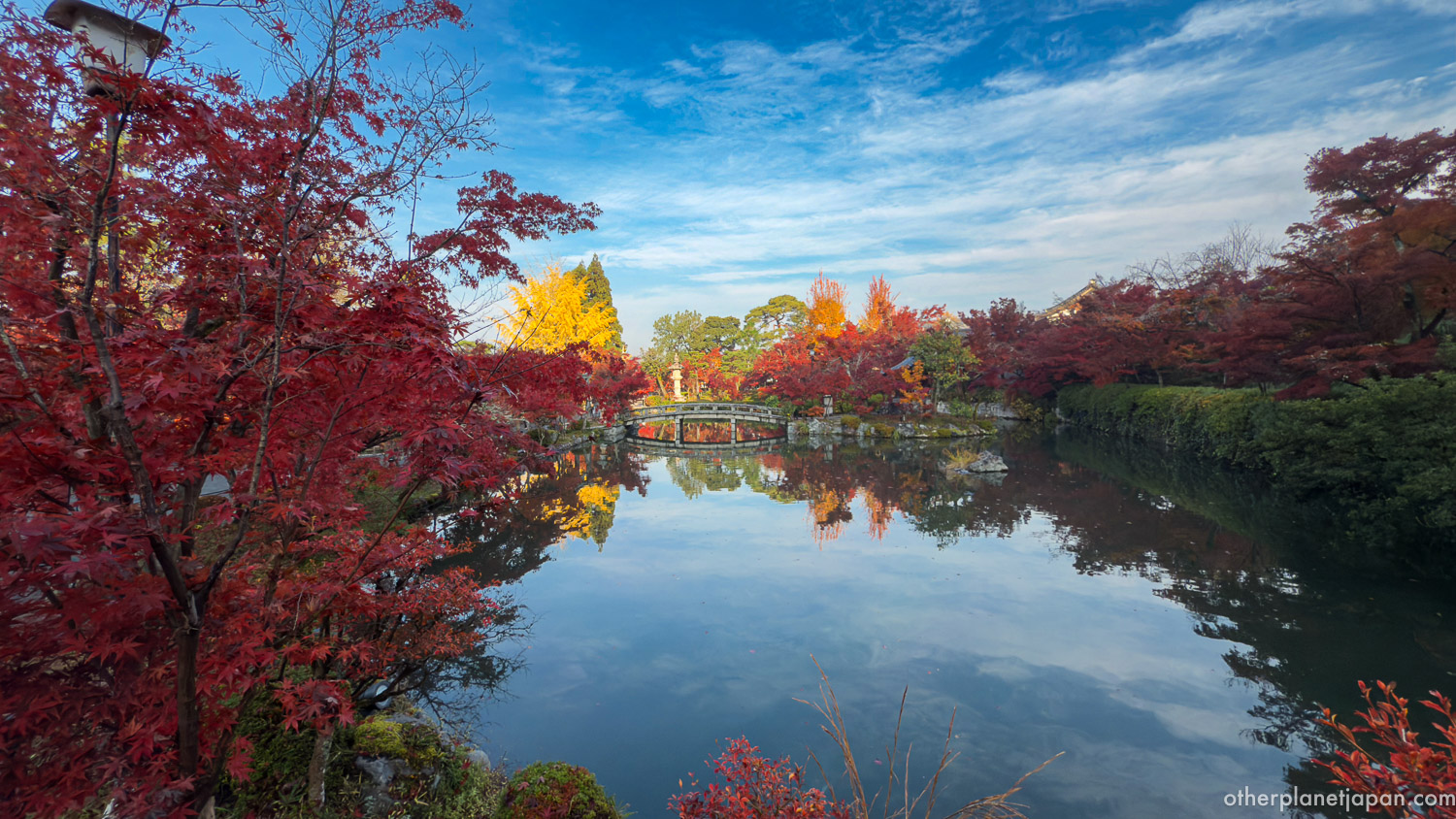
For ten months of the year, Eikando plays a supporting role.
Then November comes, and the billing changes. Local TV in the Kansai region tracks how far its maples have turned on the morning news. TV Osaka’s evening news has even gone live for the light-up, right down to the moment the lamps came on. Very few temples in Kyoto get the weather-report treatment.
An Eikando Temple autumn visit is never a quiet one, and I have said as much in print. In my honest guide to Eikando Temple, I swore off this place in autumn. November 27, 2025, is the day that made me write that. I am writing about the day anyway, because some things at Eikando only show themselves from inside a crowd.
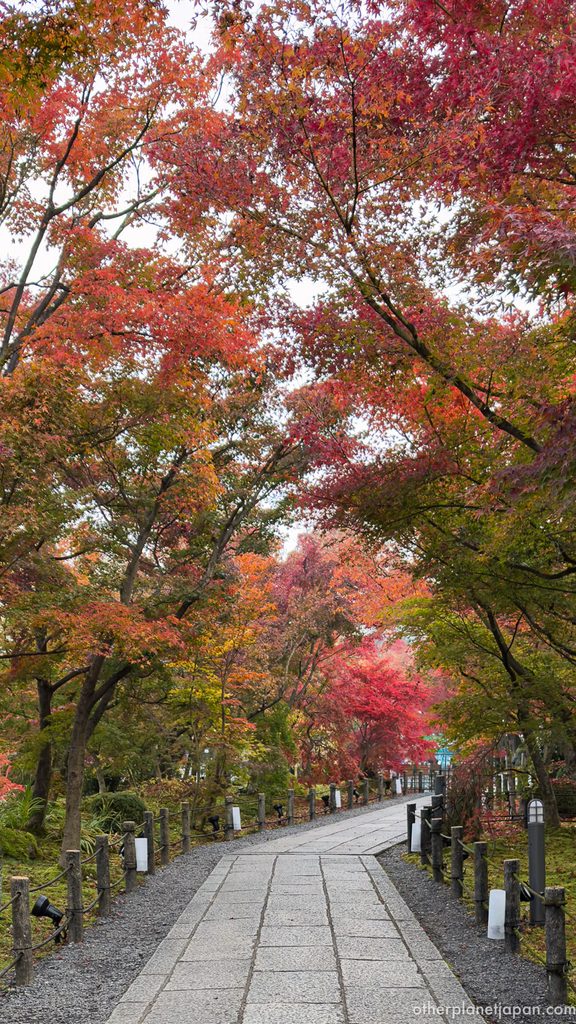
The maples explain the attention. There are about 3,000 of them in and around the grounds, against roughly 2,000 at Tofukuji, another of Kyoto’s great autumn temples. Eikando also lacks the sprawling grounds of Kiyomizudera or Tenryuji, so all those trees and everyone who comes to see them end up sharing a tight space.
Shoes in Hand, One Way Only
I arrived at 9:00, the minute the gates opened.
The line was already long. It was crowded, though not the elbow-to-elbow crush I had braced for. At the main entrance, you take off your shoes and someone hands you a plastic bag. The shoes go in the bag, and the bag stays in your hand for the rest of the indoor route, which on this day ran in one direction only.
Shoes in one hand, phone in the other, I shuffled along behind whoever was in front of me. Getting from the entrance to the Amida Hall means crossing corridor after corridor. Eikando’s halls are strung together into one long indoor path, and on a peak day that path moves at the speed of an airport security line. There were a dozen places where I wanted to stop. People kept coming from behind, so most of the views came and went at walking pace.
Floors Too Clean to Walk On
The cold comes up through the floor.
Every time I visit, I tell myself to bring thick socks next time. Every time, I forget. This time, I forgot. The covered walkways between the halls are half open to the air, and they seem to run about two months ahead of the calendar. The garden said late November. My feet said January.
What stopped me was the wood. The floorboards have a startling gloss, and they are so clean that I hesitated before stepping onto them, thin socks and all. These walkways take wind and rain all year. Someone sweeps them before the first visitors arrive, and I remembered hearing that in Buddhism, cleaning is a form of practice. My apartment is fully indoors. It has a roof, four walls, and far fewer excuses, and the corridor still wins. I resolved to clean the moment I got home. That resolution went the same way as the socks.
Four of the Seven Wonders
Eikando keeps a list of seven wonders, rumors that spread around the middle of the Edo period (1603–1867). Four of them sit right along the one-way route.
The first comes early. In the Kohojo, the old abbot’s quarters, a room called the Peacock Room has a carved and painted transom over its entrance. There are five sparrows on the left side and only four on the right. Legend credits the painting to Kano Tan’yu and claims one of his sparrows looked so alive that it flew off.
The second one you are unlikely to meet in autumn. From late April to early June, visitors report a frog whose call sounds like a mokugyo, the hollow wooden drum monks strike while chanting. Plenty of people have heard it, yet nobody has ever seen it. I came in late November and managed neither.
The third is the Garyuro, or Reclining Dragon Corridor, a covered wooden stairway that climbs the hillside toward the founder’s hall in long, bending flights. It was built about 400 years ago with traditional joinery, and to the people who named it, it looked like a dragon stretched along the slope. In autumn it is closed. You can walk right up to the entrance and not one step farther. The dragon’s back is right in front of you, and you cannot climb it.
The fourth makes the walk to that closed entrance worthwhile. From there, you can see a maple growing out of the steep rock face, an unlikely place for any tree to take hold. Fujiwara no Sekio, who once owned this land, wrote about it in a poem later collected in the Kokinshu, Japan’s first imperial poetry anthology.
Deep in the mountains,
the maple on the rock wall
will scatter its leaves
without ever having seen
the light of the shining sun.
The poet imagined this maple dropping its leaves where no one would see them. More than a thousand years later, it has a steady audience every November.
Stranger Than the Seven Wonders
Then comes the Amida Hall.
You can tell at once that this is the heart of the temple. It is the main hall, and it feels like one: the age of the building, a mandala on the wall (a reproduction, but a convincing one), the smell and faint give of the tatami underfoot, and light kept low enough that your eyes need a moment to adjust. The low light only deepens the sense that this is the room that matters most.
At the center is Eikando’s principal image, the Mikaeri Amida, or “Amida Looking Back.” Most Amida statues face straight ahead. This one turns to look over its left shoulder. According to temple legend, the monk Eikan was walking in prayer when Amida stepped down in front of him, turned, and said, “Eikan, you are slow.” I wrote more about the statue, including the best angle for seeing its face, in my Eikando Temple guide.
Maybe I am alone in this, but a Buddha turning around to check on the people behind him strikes me as stranger than all seven wonders put together.
In a hall where everyone was being moved forward, the only one looking back was the Buddha. He was waiting for anyone who had fallen behind. None of us could stand still long enough to be waited for.
From the Amida Hall, you put your shoes back on and step down into the garden, where you are free to wander in any direction.
Another Way Up
The Garyuro was closed, but an outdoor path leads up to the Tahoto, the pagoda on the hill.
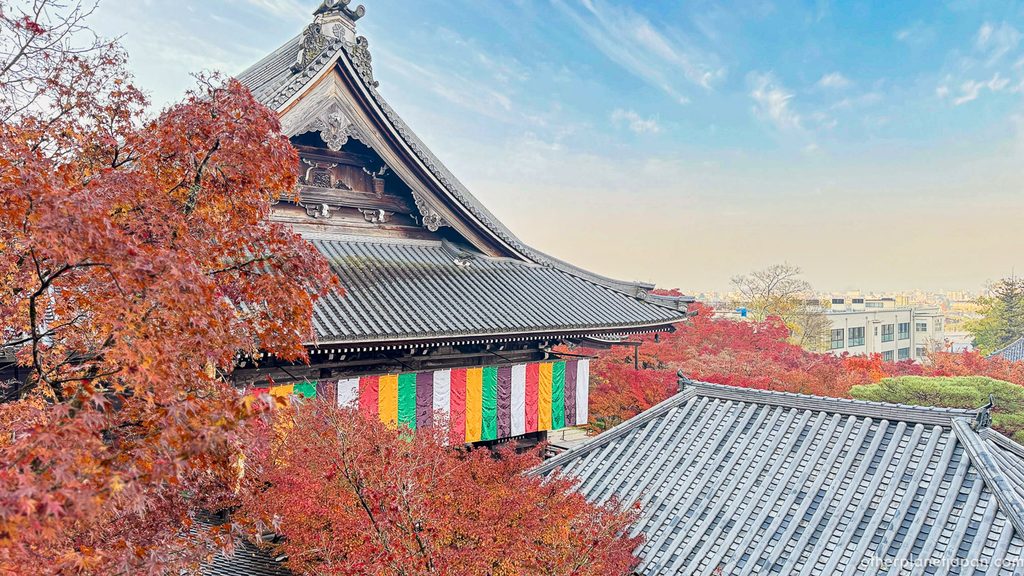
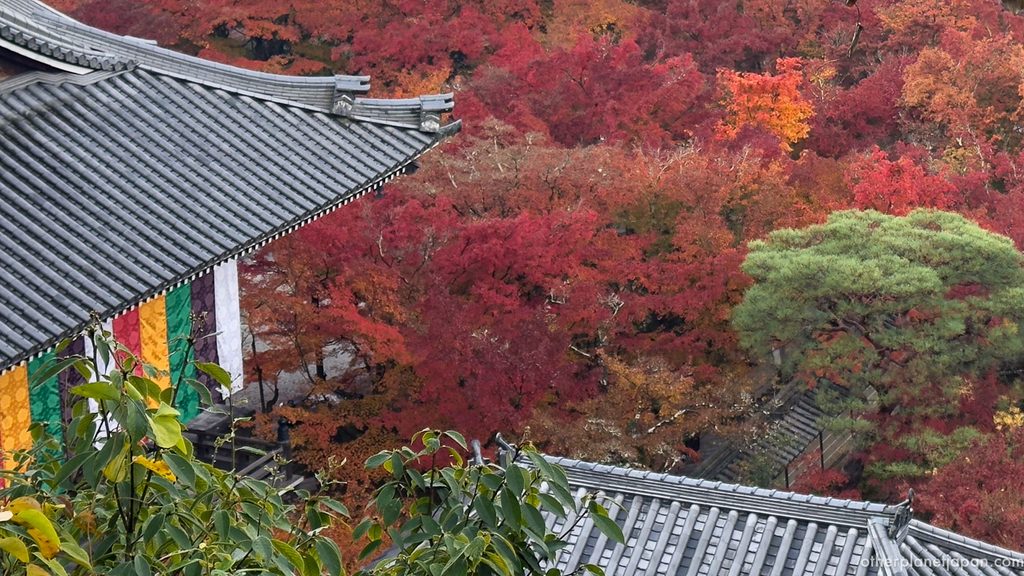
From up there, the roofs I had just walked beneath were below me. The Mieido hall’s five-color curtains hung in stripes of yellow, green, purple, white, and red. Past the gray tiles, the city stretched to the horizon, and the slope below was packed with maples in every shade from crimson to orange. Nobody seemed in a hurry to leave. The faces around me hardly changed the whole time I stood there. Judging by how slowly they did, I was not the only one who could have kept looking at those maples and that city for a long time.
I never made it onto the dragon’s back. I got higher anyway.
Hojo Pond and the Gokurakubashi Bridge
Back down at the bottom of the grounds, I reached the pond.
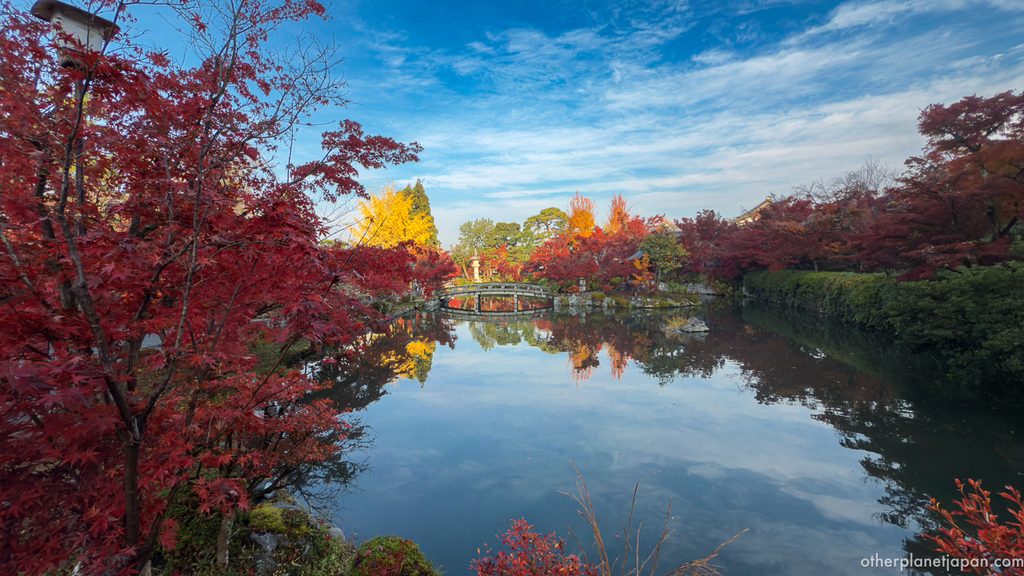
Hojo Pond held the sky and the maples at once, with the stone Gokurakubashi bridge arching across the middle. The crowd was still there, but around the water people slowed to their own pace. The small Benten shrine on the pond was closed to visitors that day.
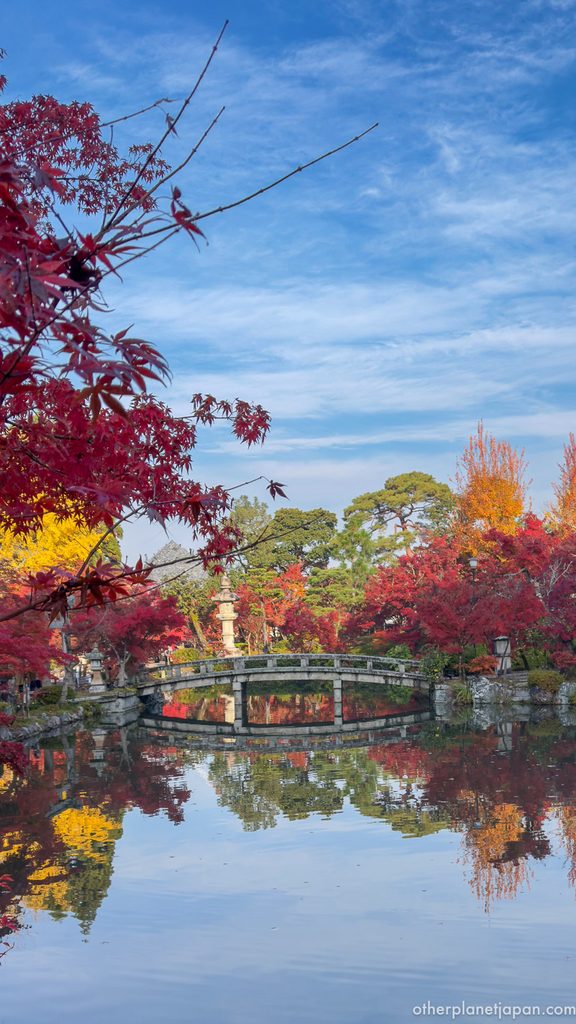
By late November the leaves were already coming down. Red maple and yellow ginkgo lay mixed together on the paths, so the color was underfoot as much as overhead.
I filmed a short clip of the pond, the curtains, and the fallen leaves that morning.
What Is Eikando (Zenrin-ji)?
The formal name is Zenrin-ji, head temple of the Seizan Zenrin-ji branch of Jodo-shu (Pure Land) Buddhism, founded according to temple tradition in 863 by the priest Shinsho. “Eikando” honors Eikan (1033–1111), the seventh head priest. The characters of his name are pronounced Yokan when they refer to the monk himself, but Eikan in the temple’s nickname. The main hall enshrines the Mikaeri Amida.
The other three of the seven wonders are worth knowing before you go:
- The Fire-Warding Amida (Hiyoke no Amida): An Amida statue in the Zuishiden hall that, by tradition, came through the fires of the Onin War (1467–1477), when most of the temple burned.
- The Plum of Compassion (Hidenbai): Eikan cared for the sick on the temple grounds and gave them the fruit of his plum trees. One tree from that orchard is remembered by this name, and it appears on a wooden plaque in the Shakado hall.
- The Three-Needle Pine (Sanko no Matsu): Japan’s native pines grow their needles in pairs. This one grows them in threes. Tradition holds that it was raised from the roots of a pine on Mount Koya, and its three needles stand for wisdom, compassion, and sincerity.
Kyoto Autumn Leaves at Eikando: When to Go
Peak color shifts from year to year. On November 27, 2025, the maples still held their red, but the leaves were already falling. If you want fuller trees than I saw, aim a little earlier, and check a current Kyoto fall foliage report before you lock in a date.
Is there a less crowded time?
Not really. Japanese guidebooks put it plainly: in autumn, Eikando has no truly quiet time. Arriving at opening does not guarantee much, either. When I got there at 9:00 a.m., a long line had already formed. If your schedule allows, a weekday is the best you can do.
The 2026 Autumn Treasure Exhibition
Each autumn, the temple displays works from its collection alongside the regular route.
- Dates: November 11 (Wed) to December 6 (Sun), 2026
- Reception: 9:00 a.m. to 4:00 p.m. (gates close at 5:00 p.m.)
- Highlights announced by the temple: portraits of Shoku, founder of the Seizan branch, and of Shandao (Zendo in Japanese), the Chinese master of Pure Land Buddhism, plus three Important Cultural Properties: the Taima Mandala Engi, a pair of scrolls depicting the Ten Realms, and a painting of twenty-five bodhisattvas descending to welcome the faithful.
Daytime admission during the exhibition is higher than at other times of year. See the fee table below.
Eikando Autumn Light-Up (Illumination) 2026
- Dates: November 20 (Fri) to December 6 (Sun), 2026
- Reception: 5:30 p.m. to 8:30 p.m. (gates close at 9:00 p.m.)
- Admission: 1,000 yen (junior high school students and older)
At night, only the main hall is open. Because the main hall is the Amida Hall, you can still see the Mikaeri Amida, but the Mieido, the Shakado, and the rest of the indoor route stay closed.
The daytime exhibition and the light-up are ticketed separately, and the temple clears visitors between the two, so you cannot stay on from one into the other. Daytime gates close at 5:00 p.m., and evening reception opens at 5:30 p.m.
One evening when I arrived around 5:00 p.m., people were already lined up. It is easy to assume 5:30 p.m. still counts as daylight, but in late November the sun sets in Kyoto before 5:00 p.m., so it should be dark by the time reception opens. I do not have night photos of my own. For a sense of the illumination, see the temple’s official autumn exhibition and light-up page.
Goshuin in Peak Season
Leave your goshuincho, the book for collecting temple stamps, at the counter near the entrance, take a numbered ticket, and pick the book up on your way out. Eikando’s own goshuincho costs 2,500 yen, and the goshuin is 500 yen on top of that. I covered both in more detail in my Eikando Temple guide.
Tips for Visiting Eikando in Autumn
- The temple provides bags for your shoes, so there is no need to bring one.
- In autumn, the Garyuro corridor is closed at its entrance, but the outdoor path to the Tahoto pagoda is open, though it can close in bad weather.
- Wear thick socks. The corridor floors are cold by late November.
- Photography is not allowed inside the halls, though the garden is fine. Tripods are prohibited everywhere on the grounds, and the temple asks visitors not to use selfie sticks when it is crowded.
- Eating, drinking, smoking, and pets are not allowed on the grounds.
Eikando Opening Hours and Entrance Fee (2026)
| Ticket | Regular season | Autumn exhibition (Nov 11–Dec 6) | Light-up (Nov 20–Dec 6) |
|---|---|---|---|
| Adults | 1,000 yen | 1,500 yen | 1,000 yen |
| University and vocational students | 800 yen | 1,000 yen | 1,000 yen |
| Junior high and high school students | 600 yen | 800 yen | 1,000 yen |
| Reception | 9:00 a.m.–4:00 p.m. (gates close 5:00 p.m.) | 9:00 a.m.–4:00 p.m. (gates close 5:00 p.m.) | 5:30 p.m.–8:30 p.m. (gates close 9:00 p.m.) |
In the regular season, elementary school students pay 200 yen. The autumn exhibition and the light-up require separate tickets. For the latest details, check the Eikando official website.
How to Get to Eikando
- City Bus 5: From JR Kyoto Station, Keihan Sanjo Station, or Hankyu Kyoto-Kawaramachi Station to Nanzenji-Eikando-michi, then a 3-minute walk.
- City Bus 204 or 93: From Keihan Jingu-Marutamachi Station to Higashi-Tenno-cho, then an 8-minute walk.
- Subway: Tozai Line to Keage Station, then a 15-minute walk.
City Bus 5 gets especially crowded in autumn and often gets stuck in traffic, so the subway is the more reliable choice. The temple asks visitors not to come by car.
Address: 48 Eikando-cho, Sakyo-ku, Kyoto