The gust came out of nowhere. One second I was holding a freshly written slip of paper in the courtyard of Yasui Konpiragu, and the next it was skidding across the gravel with me bent double behind it, one arm out, like a man chasing a runaway dollar bill. I caught it a few steps later. When I straightened up, a woman standing by the stone was smiling at me.
“The wind just cut one of your ties,” she said. “Lucky you.”
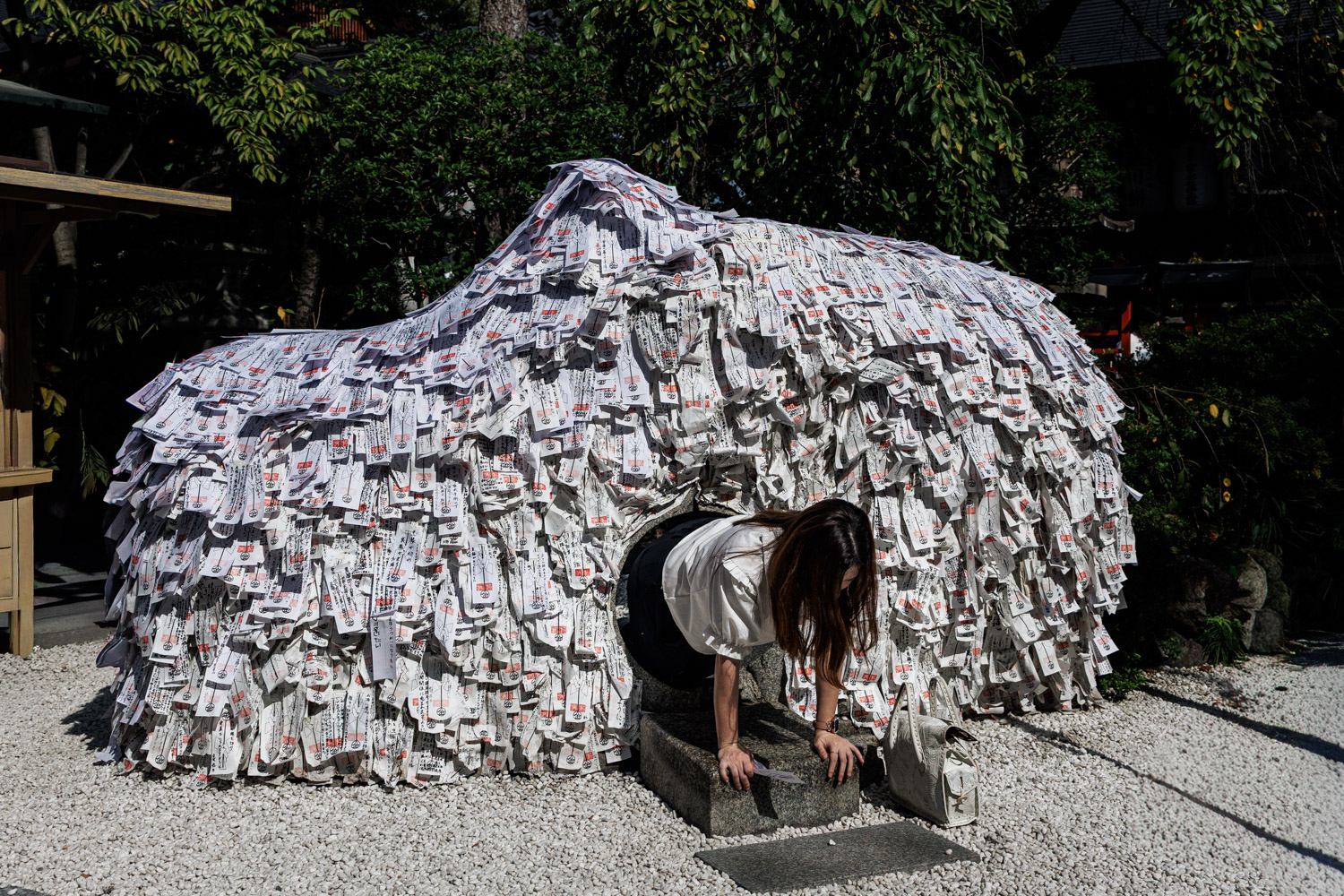
She meant it kindly. Here, that counts as good news. Yasui Konpiragu is Kyoto’s best-known enkiri shrine, a place people visit to end things: a relationship gone bad, an illness, a drinking habit, a gambling habit, anything that won’t leave on its own. You write down what you want gone, crawl through a hole in a stone, and paste your wish on the way out.
Before Nine, and Already a Crowd
I thought I was early. The shrine office opens at 9:00, and I arrived a few minutes before, picturing a quiet courtyard and a stone to myself. Instead the courtyard was already busy. Office hours only apply to charms and goshuin seals. The stone itself never closes, and neither does the supply of paper slips, so anyone with an urgent grievance can come at 3 a.m. Judging by the morning crowd, plenty of grievances are urgent.
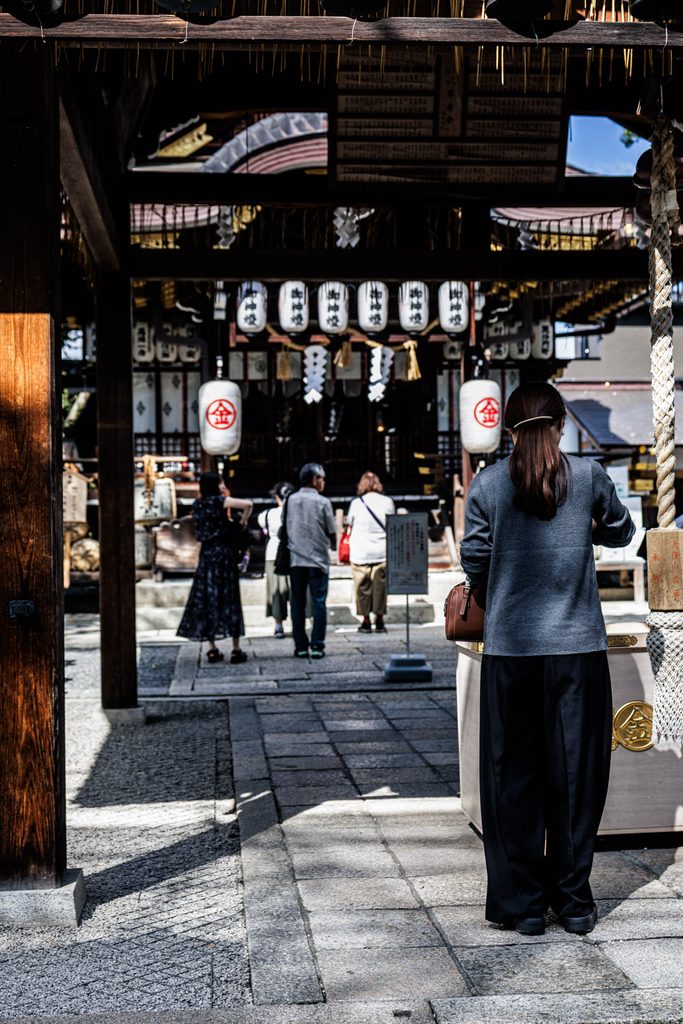
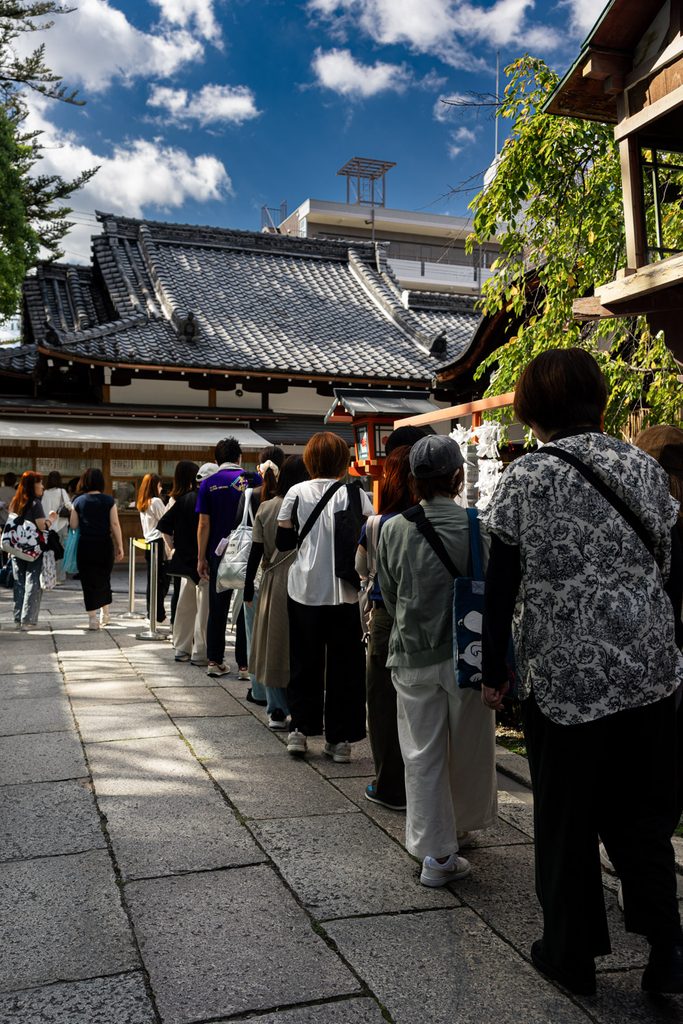
So I took a walk around the neighborhood. When I came back around 9:30, the line for the stone had grown long.
It was a long holiday weekend in September, and Gion is about as easy to reach as anywhere in Kyoto. I told myself that explained it. Then I looked at the line again, at all those people giving up a morning off to crawl through a rock and end something, and the transit theory fell apart. Only one explanation fit. A lot of people in this city want out of something.
A Stone Buried in Paper
You don’t really see the stone. You see paper. The monument is shaped like an ema, the wooden wish plaques that hang at nearly every shrine in Japan, except this one is carved from rock, roughly 1.5 meters tall and 3 meters wide (about 5 by 10 feet), with a round hole through the middle. The shrine’s English sign calls it “the relationship breaking and making stone,” which is accurate if not exactly lyrical. In Japanese it is the enkiri enmusubi ishi, the stone for cutting ties and binding them.
Almost none of it is visible. Thousands of white slips have been pasted one over another until the stone looks shaggy, each printed with red seals and the shrine’s crest, the character for gold inside a circle. Every one carries somebody’s handwriting. Some of it is careful. Some of it runs straight off the edge of the paper, as if the writer ran out of room before running out of reasons.
I read a few before I caught myself. I’m relieved to report that none of them asked to be rid of me. I checked.
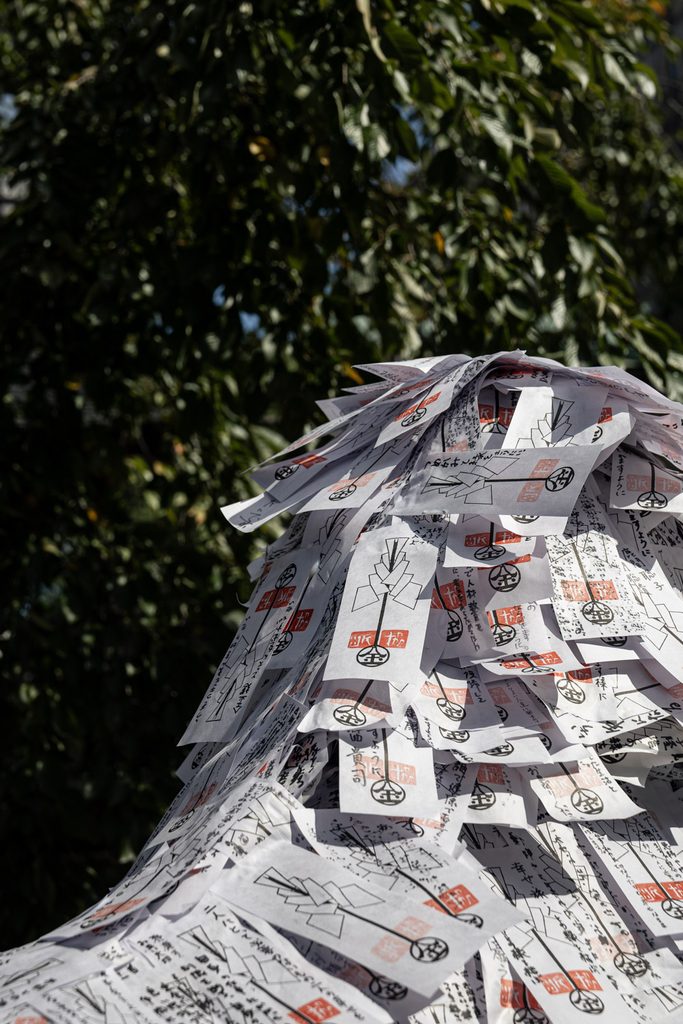
I didn’t crawl through. The line was long, so I did what plenty of others were doing: skipped the hole and went straight to pasting. It isn’t the full ritual. It is, from what I saw that morning, common practice.
A Wish for 100 Yen
The slips are called katashiro. A katashiro is a paper stand-in for yourself, something that carries your wish in your place. They’re stacked on a stand to the left of the stone, and you drop 100 yen or more into the offering box before taking one. The paper has a faint grain to it, slightly rough under the pen.
One hundred yen for a wish. By Kyoto standards, that’s practically a giveaway.
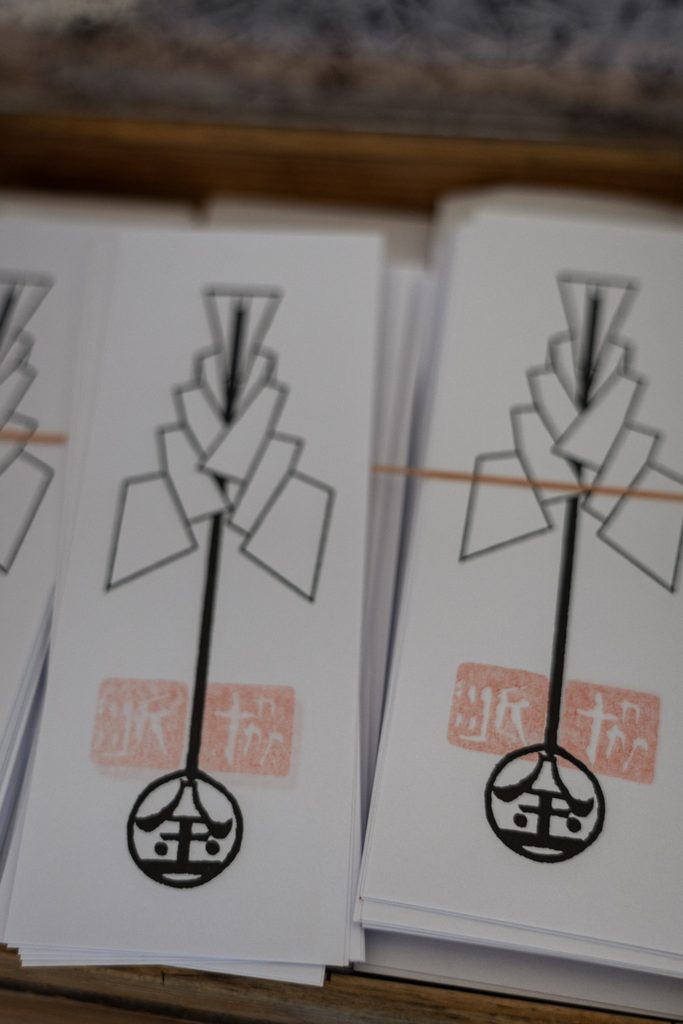
The woman who laughed at me had finished hers before I did. I could see it in her hand. Most slips carry a line or two. Hers was dense from top to bottom, the characters packed so tightly there was hardly any white left. Her daughter leaned over to look and said, loud enough for me to hear, “You wrote all that?”
Her mother only smiled. For a request that thorough, I thought, a few hundred yen more might have been fair. I kept that to myself.
Then I found a gap on the stone and pressed my own slip into it, the one the wind had tried to carry off. Whatever tie the gust had cut, I had just pasted it back. I stayed longer than I needed to, watching her look for a place to put hers, and I couldn’t help hoping that a good many of the things on that crowded piece of paper would come true.
Why Yasui Konpiragu Cuts Ties
The answer begins with an exiled emperor. Emperor Sutoku, who reigned from 1123 to 1141, loved the wisteria at a small temple on this spot. In 1146 he restored its halls and gave it to his beloved consort, Awa no Naishi, as her home. Ten years later he was defeated in the Hogen Rebellion and sent into exile in Sanuki, today’s Kagawa Prefecture on the island of Shikoku. He never returned. Awa no Naishi kept a portrait he had drawn of himself and enshrined it in the temple’s Kannon hall.
The shrine gives two reasons this became a place for cutting ties. In Sanuki, it says, Sutoku shut himself away at Kotohira-gu and renounced every desire, and so the shrine became known for prayers of tachimono, giving something up. The second reason is the separation itself. Parted from Awa no Naishi by war against his will, Sutoku is said to cut the bad ties that stand in the way of happy bonds, so that no one else has to live through what he did. The shrine is clear that this covers far more than romance. Illness, alcohol, tobacco, and gambling are all on the list.
From Wisteria Temple to Shrine
The site is older than Sutoku. The shrine dates the first hall here to the seventh century, when purple wisteria gave the place its early name, Fuji-dera, the Wisteria Temple. After Sutoku’s death, he was said to have appeared at the temple, and a new temple later built on the order of a retired emperor, Komyoin Kanshoji, is what the shrine regards as its origin. The Onin War of the 15th century left it in ruins. In 1695 another temple, Rengeko-in, moved here and enshrined three guardian deities: Sutoku, Omononushi brought from Kotohira-gu in Sanuki, and the warrior Minamoto no Yorimasa. Kyoto started calling it the Konpira of Yasui. After the Meiji Restoration the temple was abolished, and the site became Yasui Shrine, then Yasui Konpiragu.
The Other Konpira
Say “Konpira” to many Japanese people and they’ll think of Kagawa. That’s where Kotohira-gu stands, the great shrine of sailors and seafarers. Yasui Konpiragu shares its deity, Omononushi, long worshipped as a god who opens the way, and it offers prayers for safety at sea as well as safety on the road. It describes itself as the only Konpira shrine within Kyoto city, and it draws anglers and marine-sports enthusiasts alongside everyone at the stone.
How to Go Through the Stone
Start at the main hall, not the stone.
| Step | What to do |
|---|---|
| 1 | Pray at the main hall (honden). |
| 2 | Take a katashiro from the stand to the left of the stone, leaving 100 yen or more in the offering box. Write the tie you want to cut and the tie you want to form. |
| 3 | Holding your katashiro, crawl through the hole while focusing on your wish. Front to back cuts a bad tie. Back to front forms a good one. |
| 4 | Paste your katashiro onto the stone. |
Because the direction matters, people doing the full ritual usually go through once, then come back around the other way. That return trip is why the shrine also works as a Kyoto love shrine: crawl back to front and the stone binds instead of cuts. Keep a few 100-yen coins handy. The stone and the katashiro are available 24 hours a day, and not everyone crawls; many visitors simply write a slip and paste it.
Goshuin, Ema, and Charms
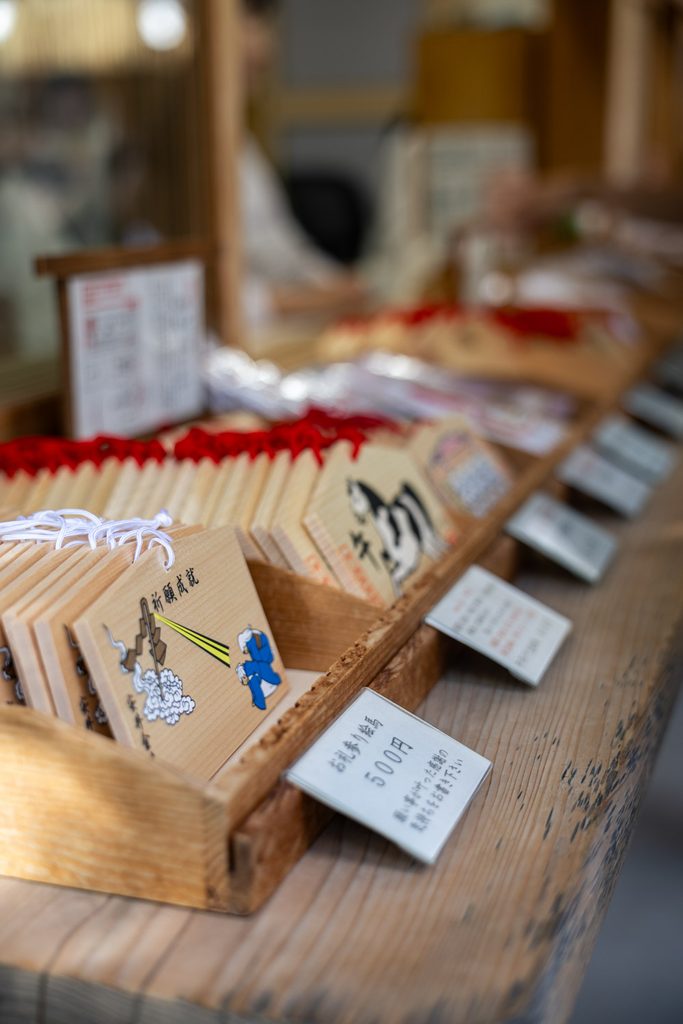
The shrine office sits beside the stone. It’s open from 9:00 to 17:30 and sells omamori charms and ema plaques, and it’s where you receive the goshuin, the hand-brushed shrine seal collected in a special book.
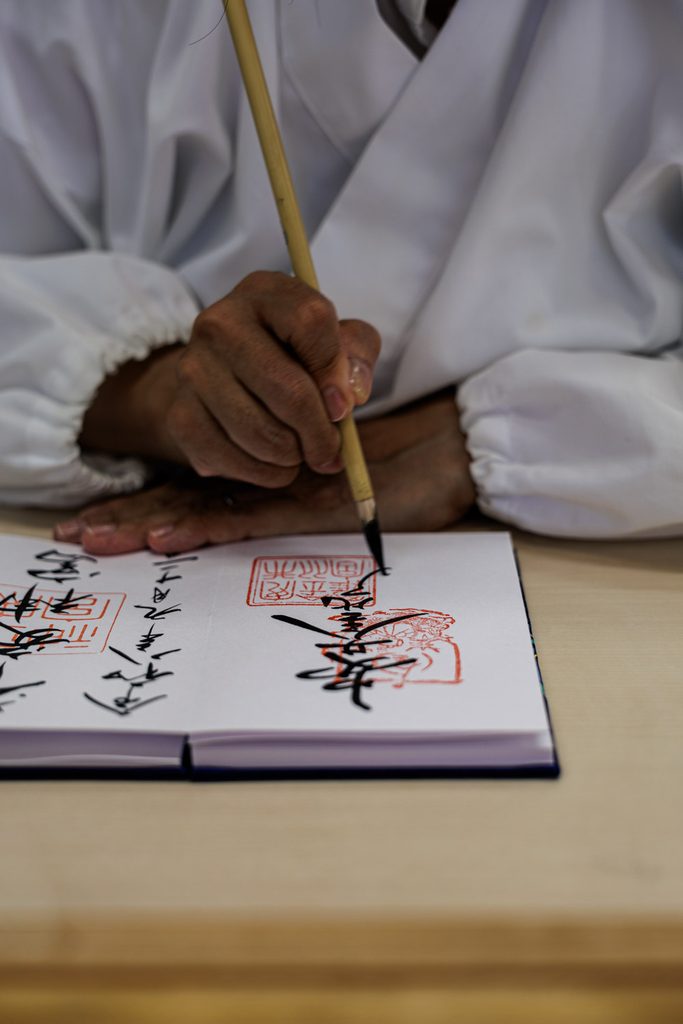
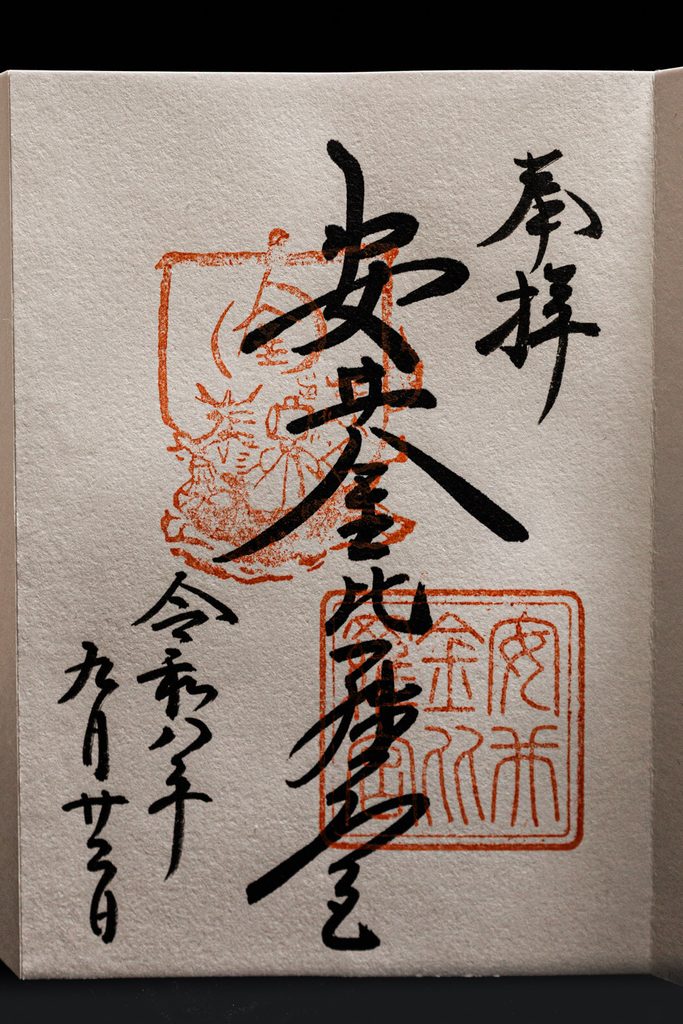
The goshuin costs 300 yen and is written directly into your book, not handed over as a pre-printed sheet. Mine carries the date of my visit, brushed in at the counter while I waited.
Among the ema is an orei-mairi ema for 500 yen, a thank-you plaque for people who come back after a wish has come true.
When to Go
On a holiday, 9:00 is already late. The courtyard was busy before the office opened, and the line for the stone was long by 9:30. Because the stone is open around the clock, an evening visit is a solid choice. Just remember that the shrine office closes at 17:30, so come before then if you want a goshuin or an ema.
Kushi Matsuri, the Comb Festival
Once a year, the shrine gives thanks for old combs. Kushi Matsuri is held on the fourth Monday of September. People bring combs and hairpins they’ve used, and at 13:00 a ceremony is held in front of the Kushizuka, the comb mound built on the north side of the grounds in September 1961, where the combs are laid to rest. A dance called Kurokami, “Black Hair,” is then offered in the worship hall.
Around 14:00 the hairstyles and costumes are explained, and then a procession sets out through the streets of Gion. It traces Japanese hair from the Kofun period to the modern maiko, and every style is dressed in the wearer’s own hair, with no wigs. The styles are recreated each year by the Kyoto Biyo Bunka Club. If it rains, the procession is canceled.
I’ve seen it twice. In 2024, with the summer heat still hanging on, the procession walked a long route all the way to Gion Shirakawa. In 2025 it went to the Kanji Museum in Gion and performed there. The route changes from year to year, and the shrine announces very little in advance, which is a shame. This festival deserves more attention than it gets.
Getting There and Practical Information
The nearest bus stop is three minutes away. The shrine sits in Higashiyama, a short walk south of Gion’s busiest streets.
| Address | 70 Shimobentencho, Higashiyama-ku, Kyoto 605-0823 |
| Hours | Grounds open 24 hours; the stone and katashiro are available at all times |
| Shrine office | 9:00–17:30 (charms, ema, goshuin) |
| Admission | Free |
| Katashiro | 100 yen or more |
| Goshuin | 300 yen, written directly into your book |
| By bus | Kyoto City Bus 206 from Kyoto Station (bound for Kitaoji Bus Terminal) to Higashiyama Yasui, then a 3-minute walk |
| By train | Keihan Gion-Shijo Station, 10 minutes on foot; Hankyu Kyoto-Kawaramachi Station, 15 minutes on foot |
| Nearby | Kenninji, about 5 minutes on foot; Yasaka Shrine and Kodaiji, about 10 minutes; Kiyomizu-dera, about 20 minutes |