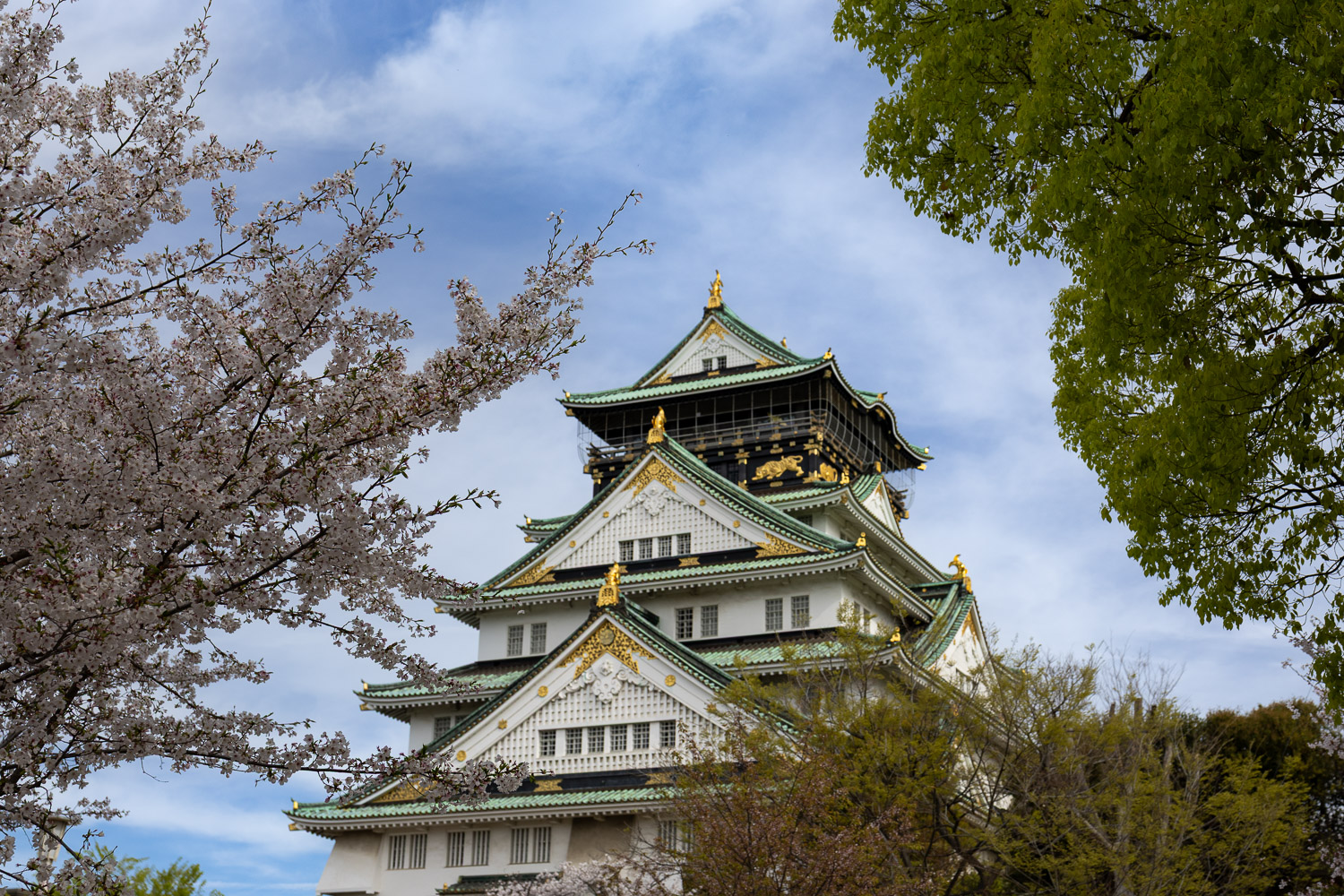
Clear skies. Cherry blossoms at full bloom. A Sunday.
I am not optimistic enough to expect Osaka Castle to be quiet under these conditions. But at 9:00 a.m., the moment the gates open, I walk straight toward the keep without breaking stride.
The strategy is simple. If I make it onto the first elevator, I’ll have a few stolen minutes at the top before the next wave arrives — the castle’s observation deck, briefly, almost to myself.
Those waiting at the gate had not been quiet. The crowd buzzed with the particular energy of a Sunday morning in spring — children, selfie sticks, the cheerful chaos of people with nowhere urgent to be. But the moment the elevator doors closed, something shifted. The attendant began her safety instructions, and without any announcement or agreement, everyone listened. There is a version of Japan that only appears in small, unremarkable moments like this one.
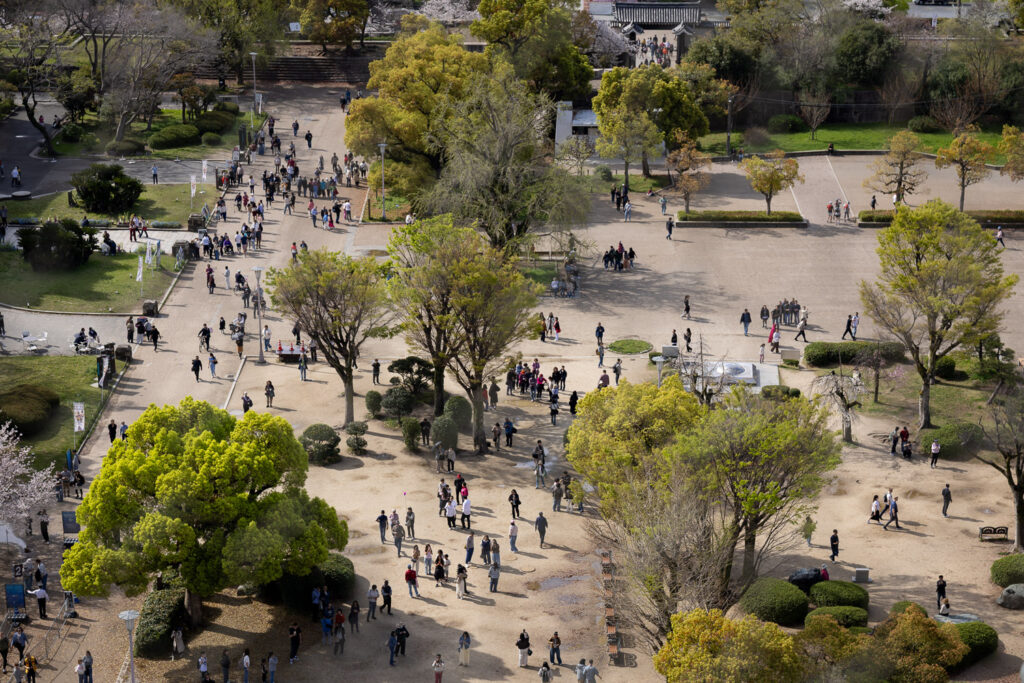
The wind hits me the moment I step outside onto the top floor. And with it, something unexpected: the faint green scent of new leaves, carried up from the park below. At street level, Osaka offers no such thing. That particular freshness belongs entirely to this height.
Osaka has many flaws — and among them is a shortage of green space. But from this height, that particular grievance dissolves. What doesn’t disappear is the skyline pressing in from every direction: glass towers, cranes, the low hum of a city that has always preferred commerce to ceremony.
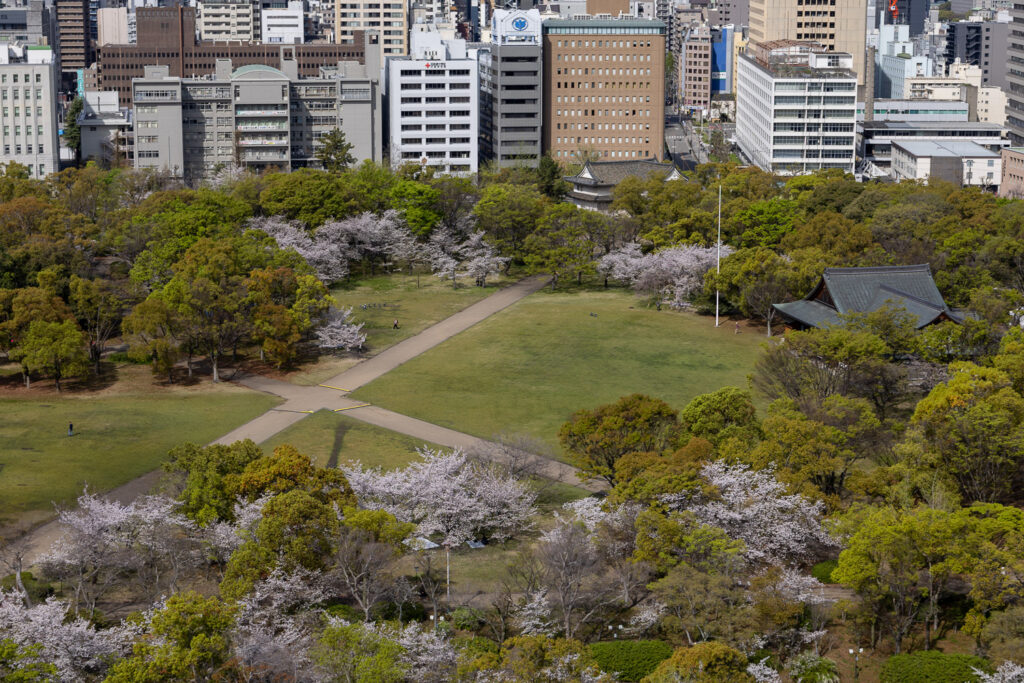
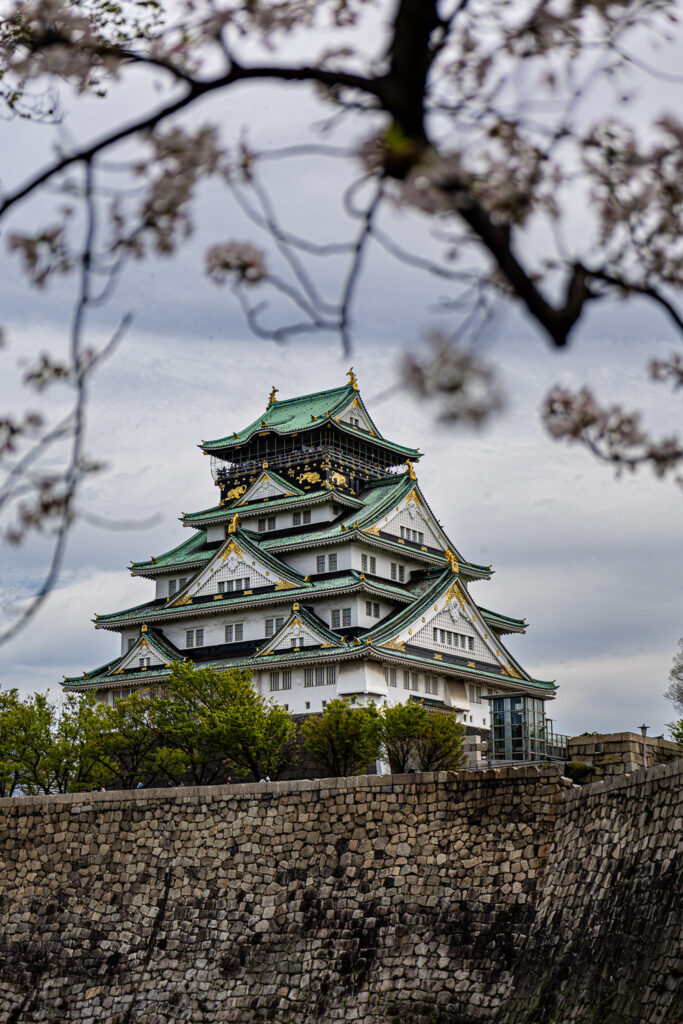
I turn toward Nishinomaru Garden. Cherry blossoms, thick and white, cover the grounds below. Samurai residences once stood on that land. I’m deep in that thought when the first hanami groups appear, rolling out blue tarps, cracking open cans. They are here for the sakura. Or rather, for the excuse the sakura provides.
The alcohol, not the history, is the main attraction. Fair enough. I keep my imagination to myself — it’s quieter that way.
Most visitors arrive at Osaka Castle believing one thing: that Toyotomi Hideyoshi built it. Technically, the castle standing before you was rebuilt by the Tokugawa shogunate — and that contradiction explains modern Osaka better than most history books.
Who Built Osaka Castle? (The Answer Will Surprise You)
“Who built Osaka Castle?”
“Toyotomi Hideyoshi.”
For most of living memory in Japan, this was the correct answer. Schoolchildren knew it. Quiz shows banked on it. To say otherwise was social suicide.
But it isn’t quite true.
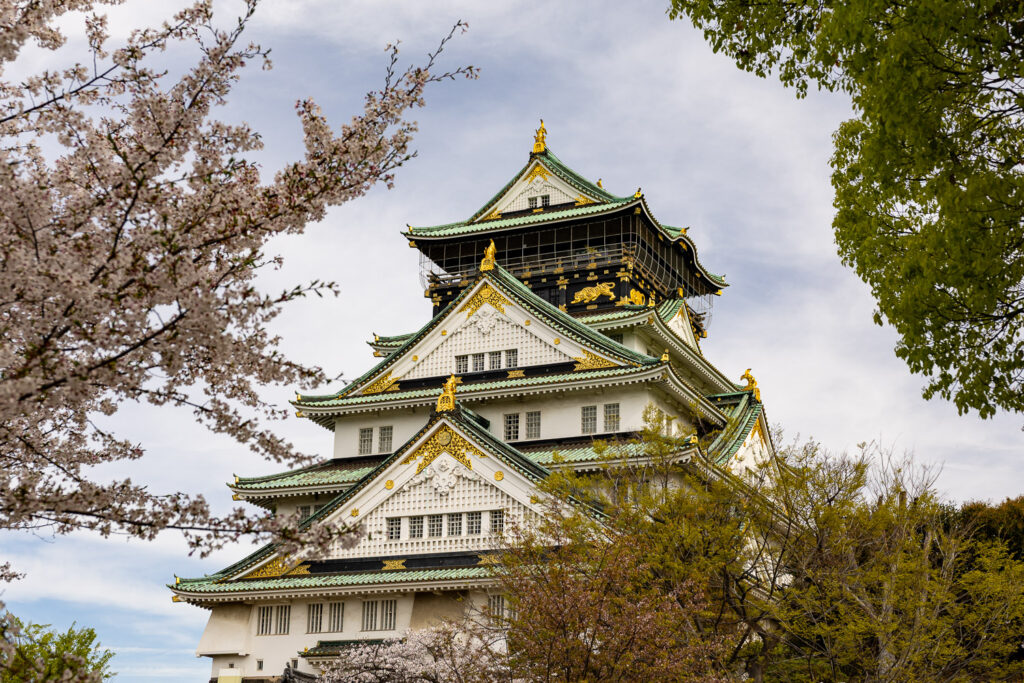
Toyotomi Hideyoshi began construction in 1583 — that part is accurate. What followed is less flattering to the legend. His castle fell in 1615, during the Siege of Osaka, consumed by fire and defeat. The Tokugawa shogunate rebuilt it in the 1620s — larger, more imposing, and entirely their own. That version burned down in 1665, struck by lightning. The white tower you see today was completed in 1931, funded by public donation, and built from reinforced concrete.
The castle standing before you shares not a single stone with Toyotomi Hideyoshi.
A generation ago, answering “Tokugawa Ieyasu built Osaka Castle” — the correct answer — was social catastrophe for adult and child alike.
And yet: it was the right answer.
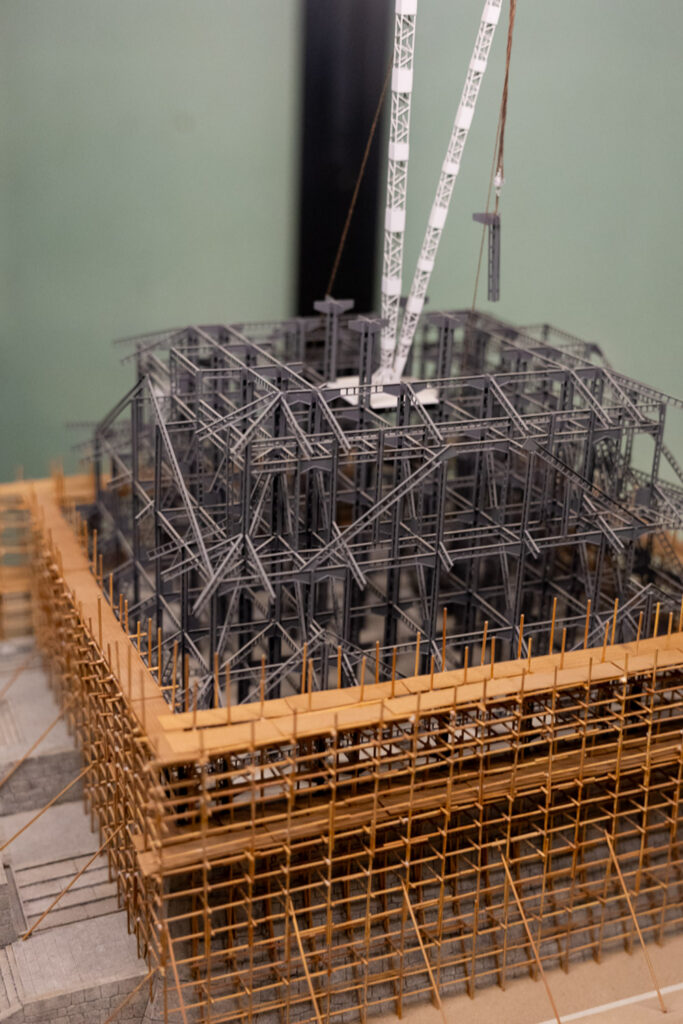
Inside the keep, the museum does not dwell on this irony. It does, however, display an architectural cross-section model showing the concrete interior in full, unblinking detail. As a Japanese person, I find this mildly mortifying. I suggest you don’t walk past it without looking.
Inside Osaka Castle Keep — A Museum Built Around One Man
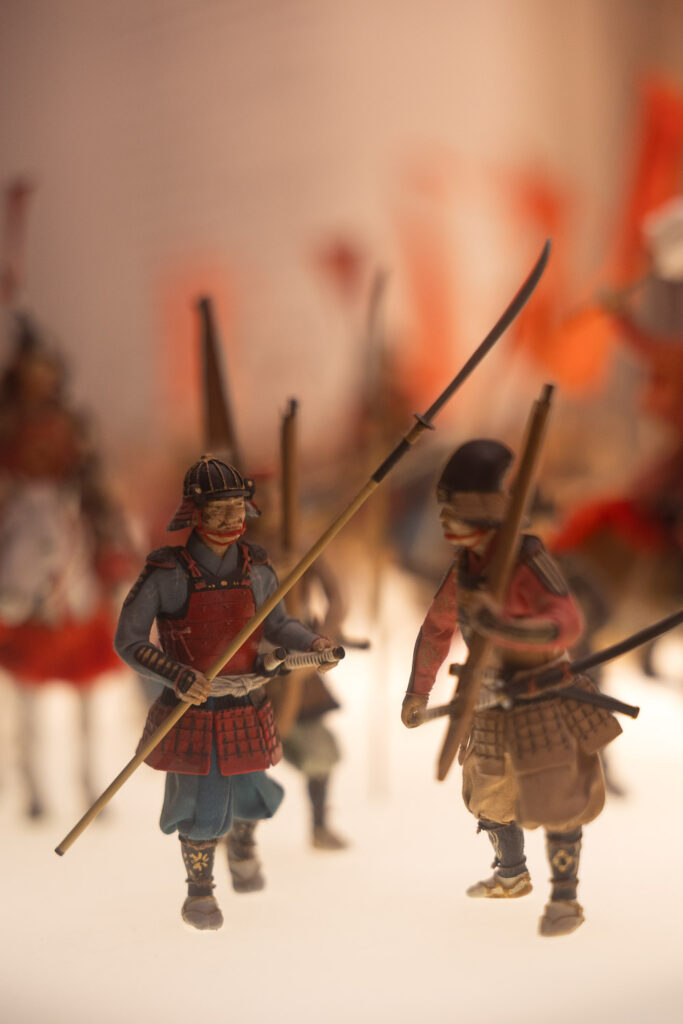
The interior of the keep is, in essence, a monument to Toyotomi Hideyoshi’s life — arranged across eight floors, with one dedicated entirely to nineteen episodes from his biography.
The episodes begin where the legend begins: a young man of no status, carrying sandals for his lord. They move through the story most Japanese people know by memory — the reconstruction of Kiyosu Castle completed in three days, the military campaigns, the slow, improbable ascent to absolute power. Even for those who learned this in school, seeing the arc laid out in sequence does something unexpected. The sheer range of one human life becomes difficult to dismiss.
I found myself slowing down at panels I thought I already knew. The three-day castle, for instance — I had carried that story since middle school. What I had not known was that the castle in question was Kiyosu. Had I known this at thirteen, I would have raised my hand in history class and corrected the teacher in front of everyone. I was that kind of student.
This is, of course, precisely the point. The exhibits do not ask whether the Tokugawa built the castle. They ask: who was the man this place belongs to, spiritually if not architecturally?
For Osaka, the answer has never been in doubt. Hideyoshi is Taiko-san — a figure of local pride in a city that has always favored the self-made over the inherited. A castle built by his political enemies, consecrated in his name: there is something very Osaka about that.
The View From the Top — What the Observation Deck Actually Shows You
The observation deck on the eighth floor is the reason most visitors make the climb.
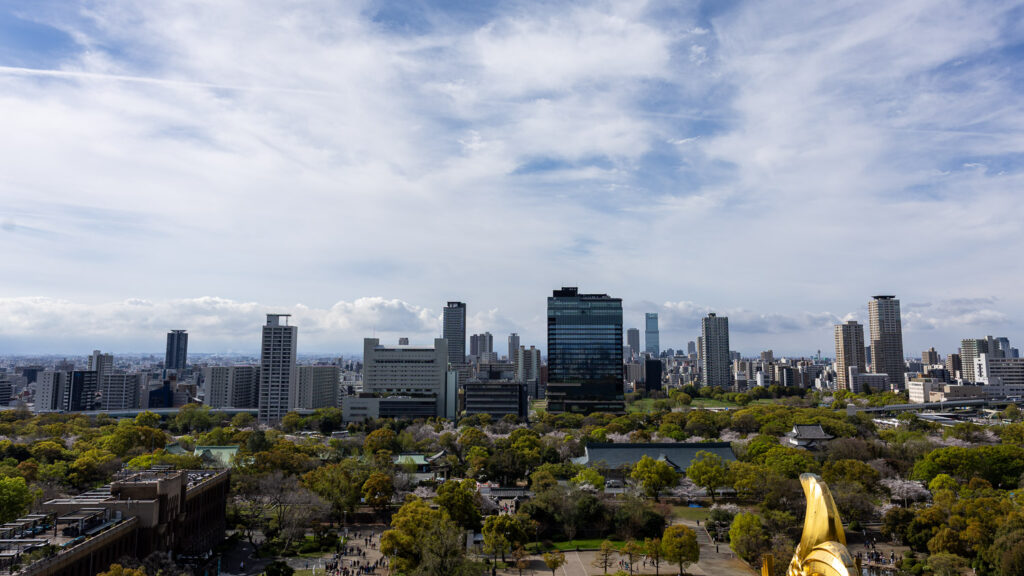
The view is honest rather than romantic. Osaka does not pretend to be Kyoto. High-rise buildings crowd the horizon in every direction, close enough that the castle’s historical isolation feels almost implausible. What saves the scene is the moat far below, still wide and intact, and the blossoms in Nishinomaru Garden catching the light at an angle unavailable from the ground.
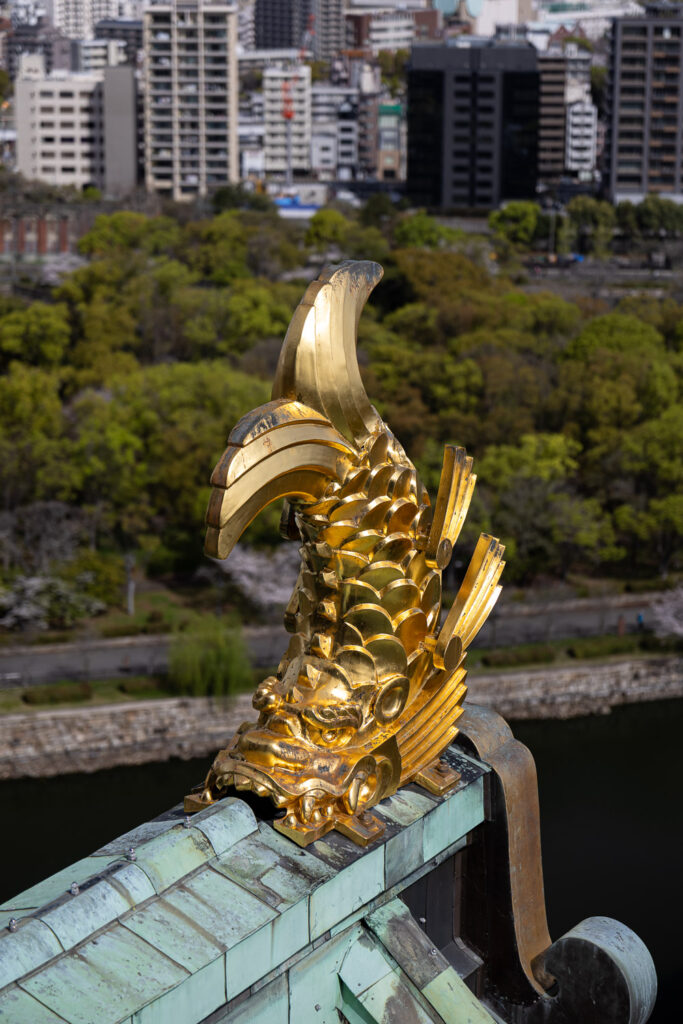
Along the interior walls of the observation deck, four large information panels identify the landmarks visible from each direction — with a specificity that rewards patience. Foreign visitors cycle between the panels and their camera screens, pausing to photograph the golden shachi — the mythical dolphin-tigers mounted on the roof — before returning to their phones. I know what they are missing: that the ridge in the distance is Ikoma, that the tower breaking the southern skyline is Abeno Harukas, the second-tallest building in Japan. I consider mentioning this. I don’t.
Beyond the Keep — What First-Time Visitors Miss
The castle grounds reward those who wander after the main climb.
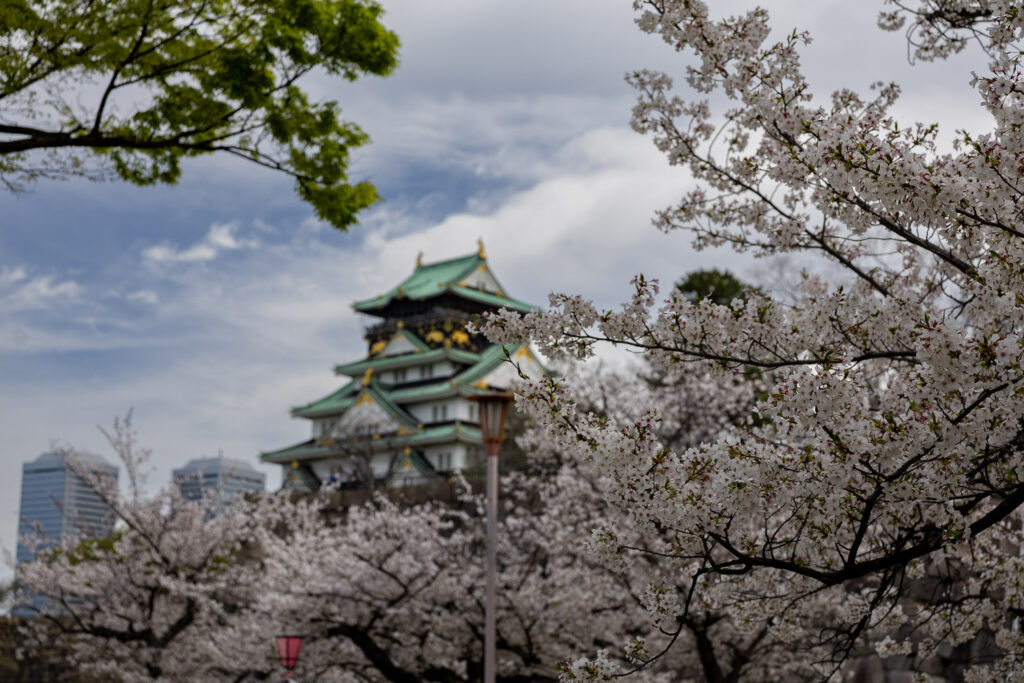
Nishinomaru Garden holds approximately 600 cherry trees, at their best in late March to early April. Samurai residences once occupied this space. Separate admission applies: ¥300. In spring, arrive early if you want the blossoms without the tarps.
In autumn, the park transforms entirely. The maples turn deep red while the ginkgo trees go yellow — the two colors running side by side along the castle walls in a contrast that feels almost deliberate. Osaka Castle Park is less famous for its autumn foliage than it deserves to be.
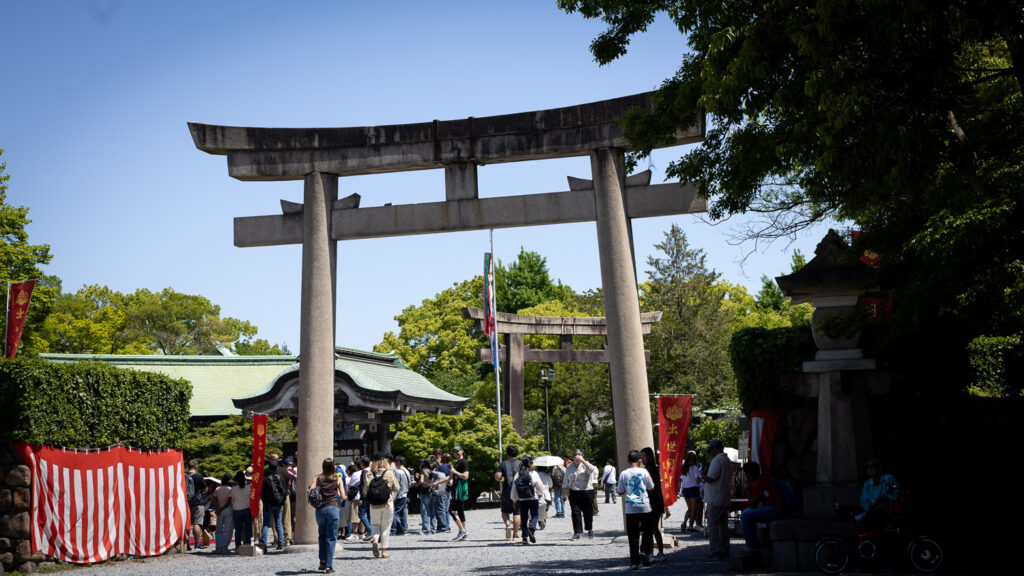
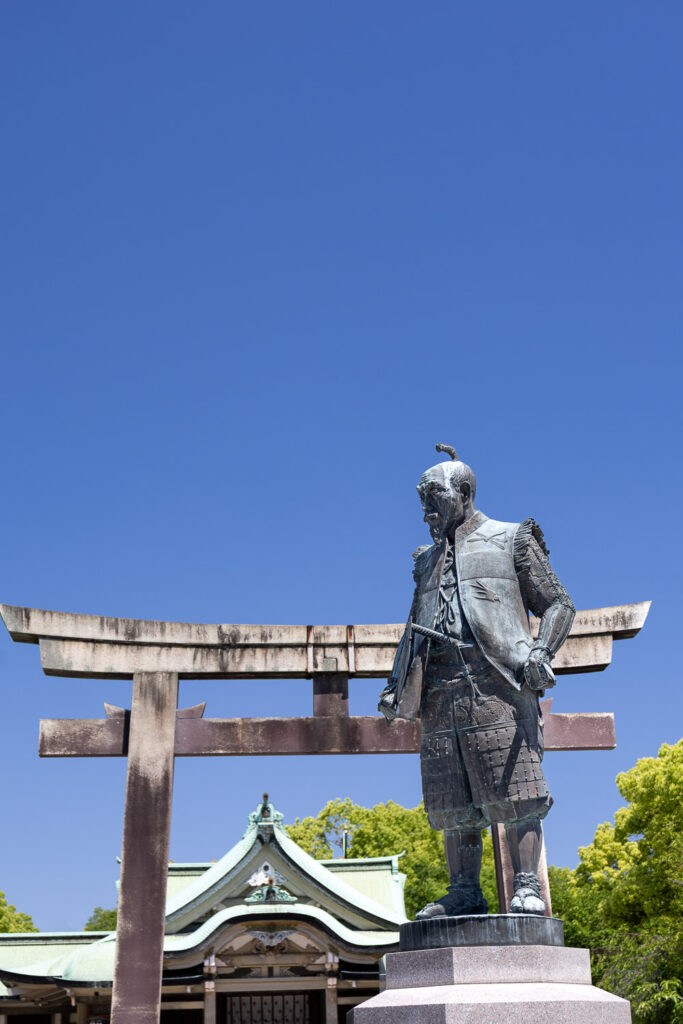
Toyokuni Shrine carries a history that most visitors walk past without knowing. It was Emperor Meiji who ordered the enshrining of Toyotomi Hideyoshi here — and the shrine itself has moved. It once stood in Nakanoshima, on the site of what is now Osaka City Hall. When the city outgrew that building and needed the land, the shrine was relocated to its current position within the castle grounds. One imagines the decision was unanimous: Hideyoshi belongs here, beside his castle, rather than next to a municipal office.
Today the shrine sits quietly among food stalls and kitchen cars — the kind of contrast that Osaka produces without apparent effort. If you’ve spent time in the keep learning Hideyoshi’s story, you may find yourself wanting to stop and bow. I did.
Plan Your Visit to Osaka Castle
Admission
The keep is priced accessibly for what it offers — a full museum, observation deck, and audio guide included in a single ticket.
Adults: ¥1,200
High school and university students: ¥600 (student ID required; international students should present an ISIC card)
Junior high school students and under: Free (proof of age required — student ID, health insurance card, or passport for visitors under 15 from outside Japan)
Nishinomaru Garden: ¥300 (separate admission)
Entrance tickets can be purchased by credit card. Note that the museum shops on the first and eighth floors are cash only.
One important note: Nishinomaru Garden and the keep have separate entrances and do not connect to each other. Entering one does not give you access to the other. Make sure you are in the correct line before purchasing your ticket — a surprisingly easy mistake to make.
Hours
The keep runs standard daytime hours, with occasional seasonal extensions worth checking before you go.
Keep: 9:00–17:00 (last entry 16:30)
Nishinomaru Garden: 9:00–17:00
Hours may vary seasonally. Confirm on the official website before visiting.
Getting There
Osaka Castle is well-served by multiple lines — pick whichever suits your starting point.
Osaka Metro Tanimachi Line / Chuo Line: Tanimachi 4-chome Station, 10-min walk
JR Osaka Loop Line: Osakajokoen Station, 15-min walk
Osaka Metro: Morinomiya Station, 10-min walk
Avoiding the Crowds
Timing is everything here, and the math is simple.
Arriving at opening time (9:00 a.m.) is the single most effective strategy, particularly on weekends and during cherry blossom season. Weekday mornings are comparatively manageable.
Getting Around the Park — Road Train & Electric Car
Osaka Castle Park covers a substantial amount of ground. If you plan to visit the keep, Nishinomaru Garden, and Toyokuni Shrine in a single trip, your feet will know about it by the end of the day.
I have never used either. My bicycle locks up outside Otemon Gate, and the walk from there is nothing. But for those arriving by train, two options exist.
The Road Train runs from Morinomiya through Jo-Terrace Osaka and on to Toyokuni Shrine. It is the more practical option for first-time visitors arriving from the eastern entrances.
Road Train fares:
Adults (junior high school and above, under 65): ¥400 one way
Children (ages 4–elementary school): ¥200 one way
Seniors (65 and above): ¥200 one way
The Electric Car loops around the south moat, stopping at Babacho, Otemon, Sakuramon, Toyokuni Shrine, and back. One loop per ticket.
Electric Car fares:
Adults (junior high school and above, under 65): ¥300
Children (ages 4–elementary school): ¥200
Seniors (65 and above): ¥200
A 1-Day Free Pass covers unlimited rides on both the Road Train and Electric Car.
Adults: ¥1,000 / Children: ¥600 / Seniors: ¥600
Both services operate 9:30–17:30, closed on the first Thursday of each month (or the following day if that Thursday is a public holiday). Services may be suspended in bad weather or during crowded events. No food or drink permitted on board.
Practical Notes
A few details that make the difference between a smooth visit and an avoidable frustration.
Audio guides are available free of charge in Japanese, English, Korean, and Chinese. Collect at the entrance between 9:00 and 17:00; return by 17:30. Supply is limited — collect early.
Multilingual staff are on site and can assist with questions.
Wheelchairs are available for loan: 7 units at the keep, 2 at Toyotomi Ishigaki-kan. First come, first served; no reservations.
Strollers are not permitted in the upper floors due to space and crowd density. Free stroller storage is available at the entrance gate. Toyotomi Ishigaki-kan has a designated stroller area.
Photography is permitted on most floors. Floors 3 and 4 are exceptions (Important Cultural Properties on display). At Toyotomi Ishigaki-kan, the stone walls may be photographed; video content installations may not.
Inside the museum, please refrain from eating and drinking, loud conversation, sitting on the floor, and using phones while walking.
Frequently Asked Questions
Who actually built Osaka Castle?
The original castle was built by Toyotomi Hideyoshi, beginning in 1583. However, it was destroyed in 1615 during the Siege of Osaka. The Tokugawa shogunate rebuilt it in the 1620s, and that version was later lost to a lightning strike in 1665. The white tower standing today was completed in 1931, funded by public donation and built from reinforced concrete. Technically, the current castle owes more to the Tokugawa than to Toyotomi — though Osaka has never quite accepted that framing.
Is Osaka Castle worth visiting?
Yes — but the keep alone tells only part of the story. The museum inside is genuinely informative, and the observation deck offers a view of the city that is difficult to replicate elsewhere. Allow time for the castle grounds as well: Nishinomaru Garden, Toyokuni Shrine, and the moat walk each add something the keep cannot.
How long does it take to visit Osaka Castle?
The keep alone takes 60 to 90 minutes if you move through the exhibits at a reasonable pace. For the full park — keep, garden, shrine, and a walk along the moat — allow around two hours. The grounds cover more distance than they appear to on a map.
Can you go inside Osaka Castle keep?
Yes. The keep is open to the public daily and functions as a museum across eight floors. An elevator serves floors one through five; the upper floors require stairs. The observation deck is on the eighth floor.
Is Osaka Castle free?
Entrance to the castle grounds and park is free. The keep charges ¥1,200 for adults, ¥600 for high school and university students, and is free for junior high school students and under. Nishinomaru Garden has a separate admission of ¥300.
What is the best time to visit Osaka Castle?
Cherry blossom season (late March to early April) and autumn foliage season (mid-November) are the most scenic. For the fewest crowds, arrive at opening time on a weekday morning. Weekends during cherry blossom season are busy by any standard — plan accordingly.
Osaka Castle has been built three times. It has burned twice. It has been claimed, reclaimed, and mythologized by people who never laid a single stone. And now, quietly, a new presence is being added to its history — foreign visitors who come not from obligation, but from curiosity.
Somewhere in the crowd below, someone may already be asking the question. In English, in French, in Spanish. Who built this castle?
Every answer is correct — whether the name is Toyotomi, or Tokugawa.
Curious about what most visitors miss? The castle grounds hide a phantom joint, a missing treasure, and the stone that may have named the city itself: Osaka Castle’s Hidden Secrets: What Visitors Walk Right Past
→ Planning your visit? Start with
Osaka Castle: The Complete Insider’s Guide.