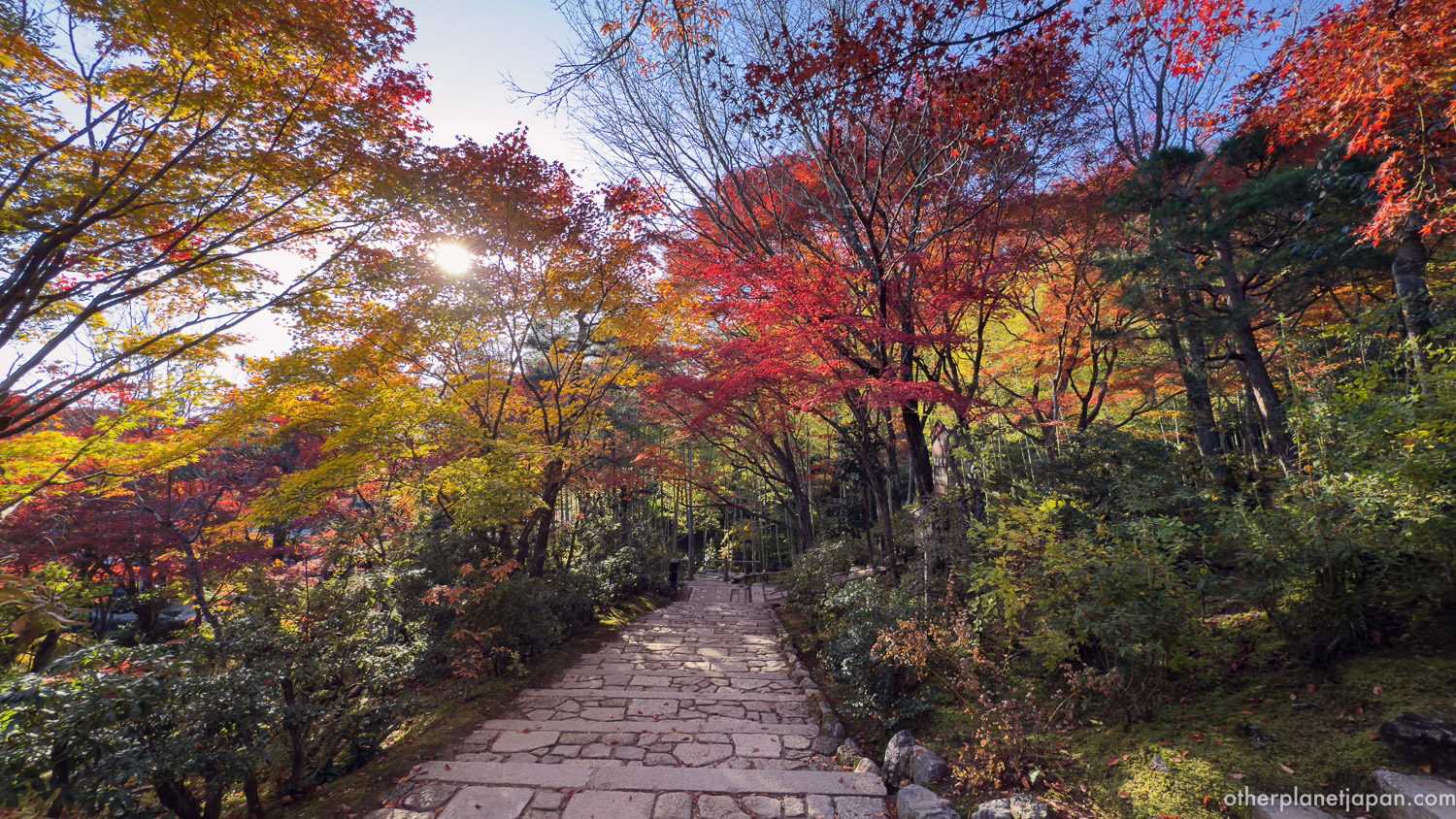
I first came to Jojakkoji in the autumn of 2025, on a photographers-only early-entry program — a limited number of visitors allowed onto the grounds before 9 a.m.
The photographer next to me told me he’d been waiting years for something like this. What he wanted, specifically, was the view from in front of the Niomon — the thatched gate — with no one in it. He kept thanking the travel agency staff who had organized the morning. He really kept thanking them.
I had signed up casually, happy enough just to get in at eight. The gap between my easy motivation and their intensity was enormous. Standing among photographers who had carried this image in their heads for years, I found myself asking a quiet question: was I supposed to be here at all?
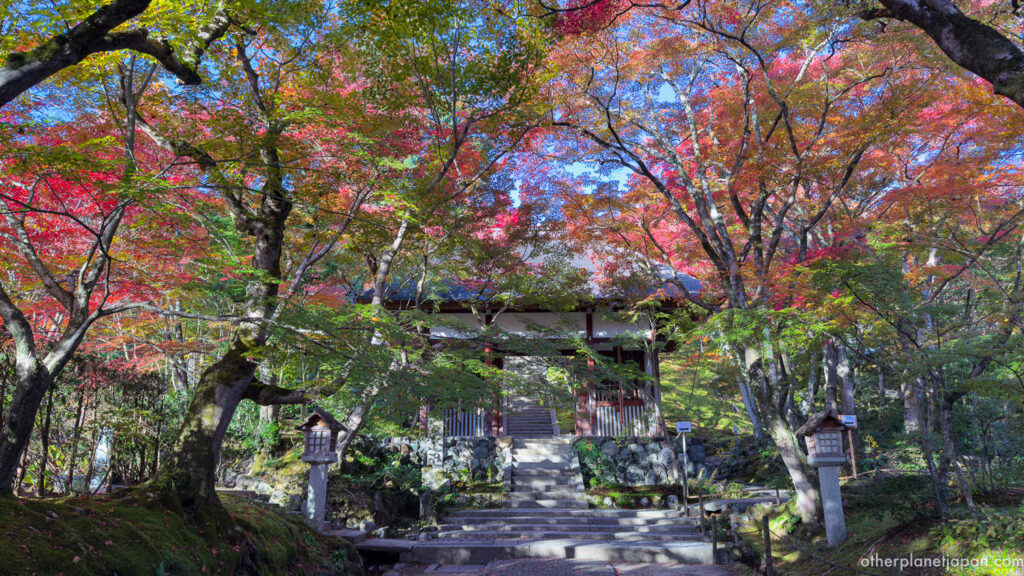
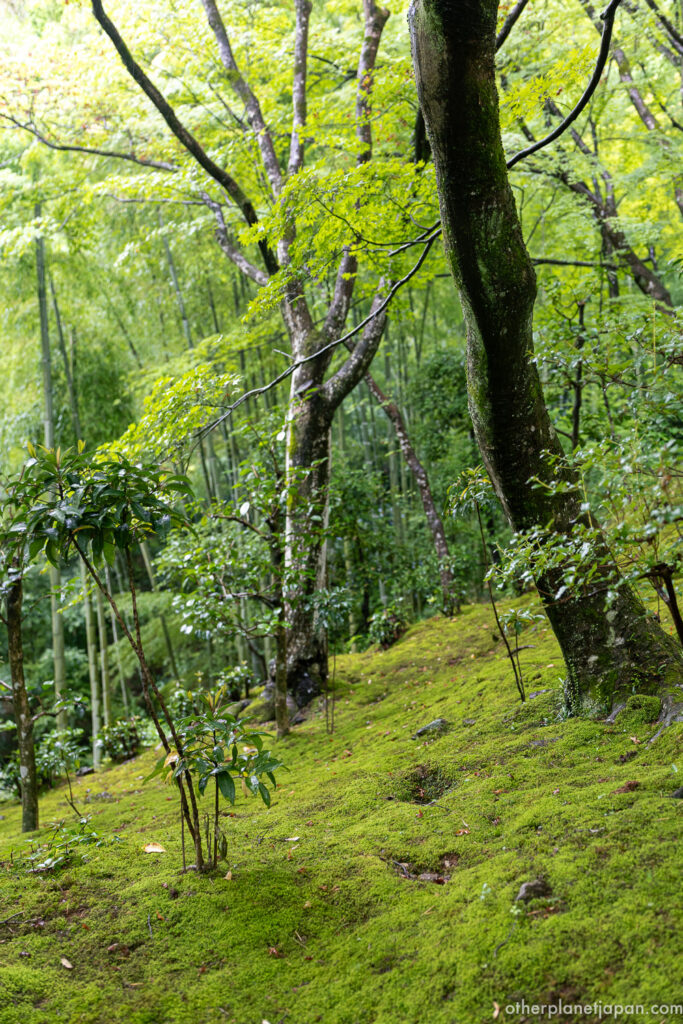
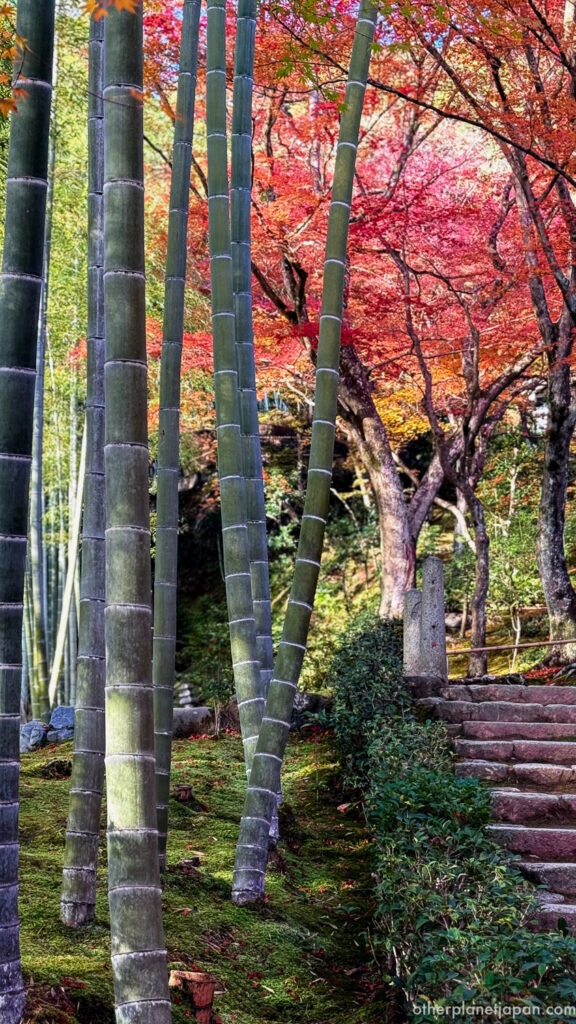
When I came back in June 2026, the place was almost empty. The Bamboo Grove is a ten-minute walk away and remains, as always, a steady stream of people. Jojakkoji, ten minutes from that stream, has silence. There is bamboo here too, by the way. Just not the kind anyone has heard of.
What Is Jojakkoji?
Standing in that silence, I looked up the name. It means something.
Jojakkoji (常寂光寺) — formally Ogurayama Jojakkoji — is a Nichiren Buddhist temple on Mt. Ogura, founded in 1596 by Nissho-shonin as a place of withdrawal. The name draws on Buddhist cosmology: Jojakko-do (常寂光土), the “land of eternal tranquil light,” is the highest of the four Pure Lands in Tendai teaching — a realm beyond change and beyond suffering. The temple’s name is an aspiration, not a description.
And the mountain it stands on carries a thousand years of Japanese literary history.
The Thatched Niomon
The first thing you see is the gate.
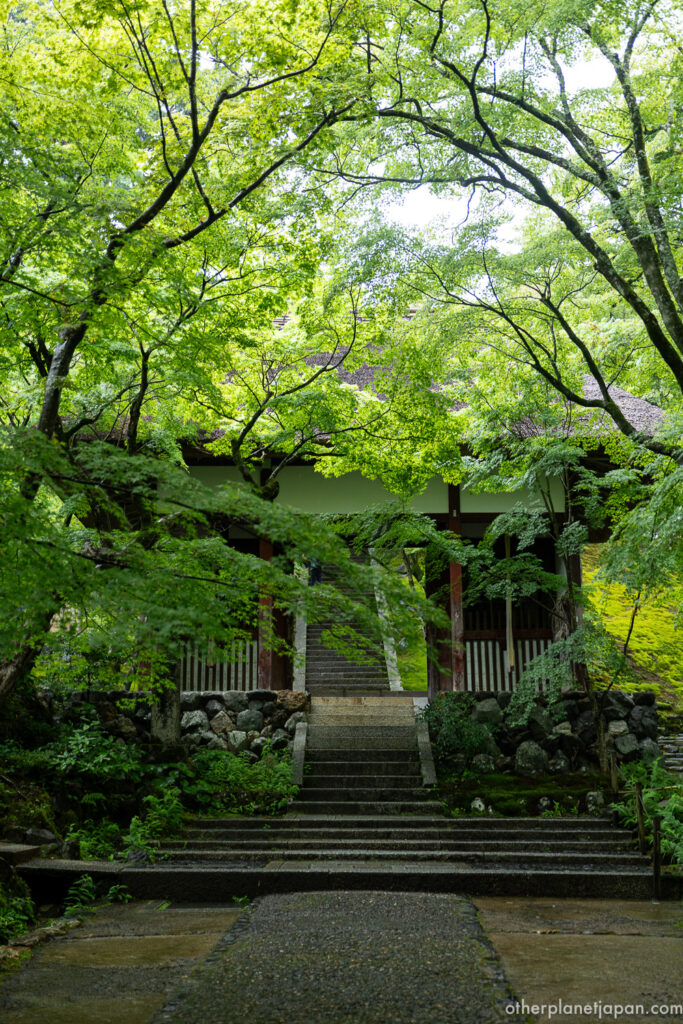
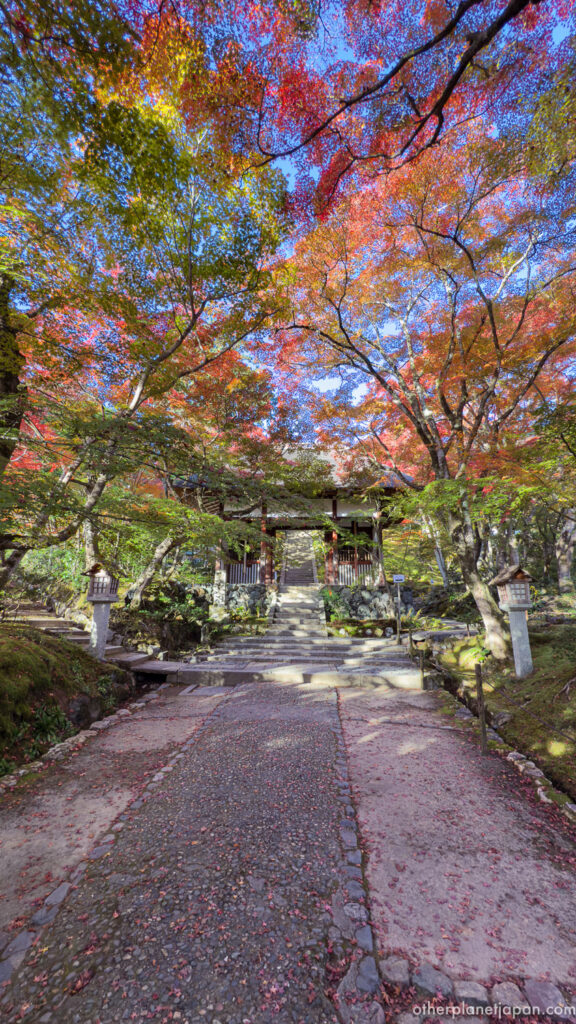
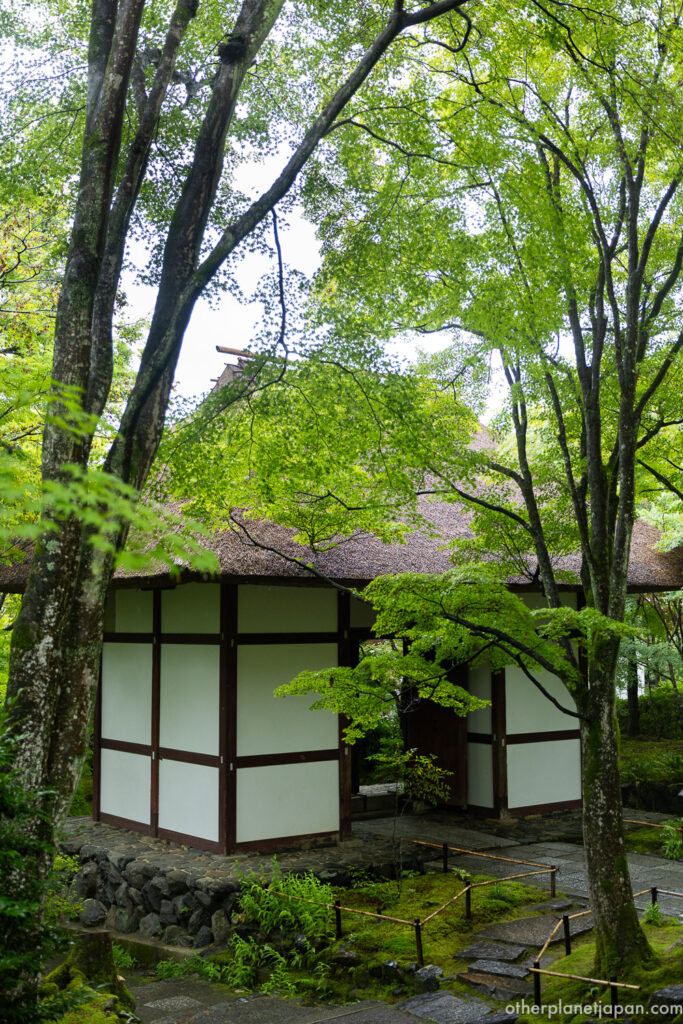
The Niomon (仁王門), with its deep thatched roof, was moved here from the south gate of Honkokuji and dates to the Muromachi period. Two Nio guardian statues stand on either side, glaring at the entrance — their job is to keep the unwelcome out. Thatched Niomon gates are unusual in Kyoto’s temple architecture, and this one gives Jojakkoji a warmth at its threshold that stone or tile would not.
This is where the photographer that morning had wanted to stand. Looking up through the maple tunnel from the foot of the Niomon, with no one else in the frame — that was the image he had carried for years.
A Temple of Moss
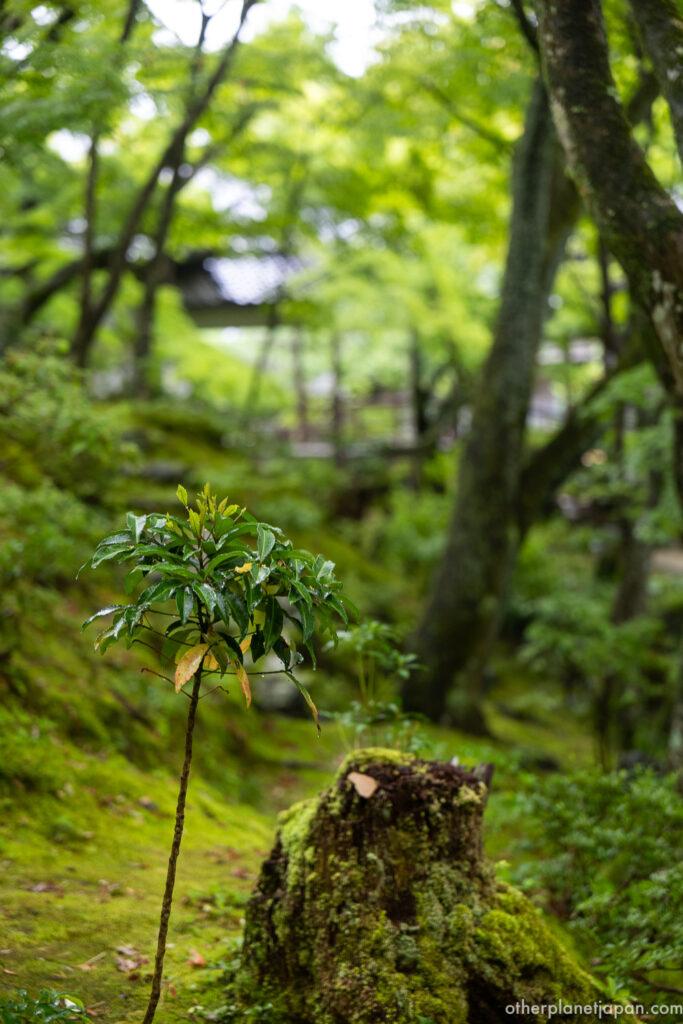
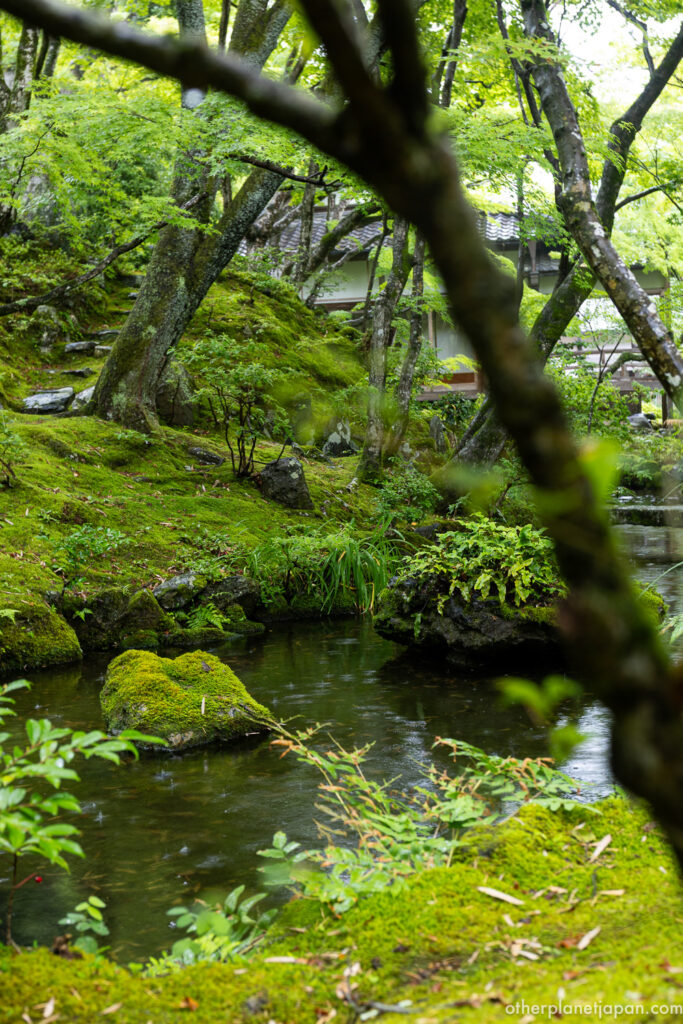
Jojakkoji is known for autumn, but look at the ground.
The moss is what stays. The hillside slopes are carpeted in it — the kind of dense, varied moss that thrives in Kyoto’s humidity. After the maples drop their leaves, after snow melts, when summer light filters through the canopy, the moss is still here. Nothing else in the temple is this constant.
Climbing to the Tahoto
Jojakkoji is a mountain temple. The path goes up.
You pass the Niomon, walk alongside the main hall, and the stone steps begin. Up through a tunnel of maples, watching your footing — the steps are old and uneven. In autumn, fallen leaves pile across the stones, and each step crushes a small drift of red.
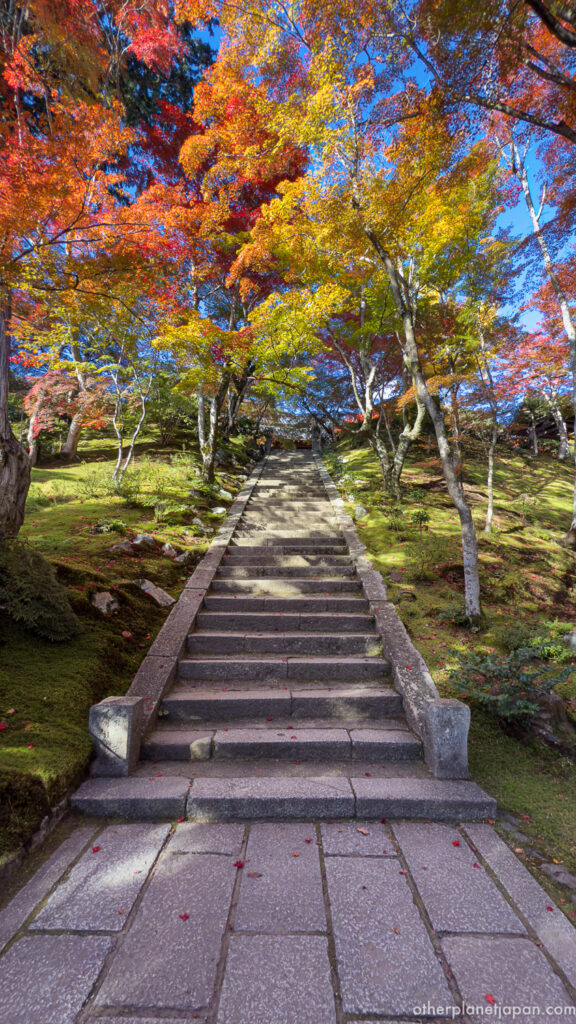
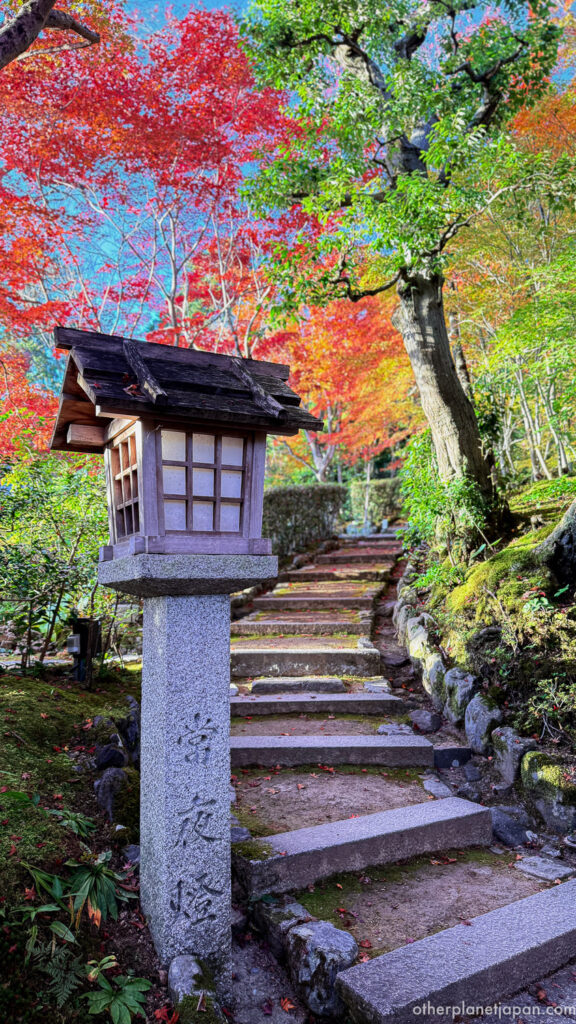
The same steps in June carry a different weight. Green replaces red, and you climb alone.
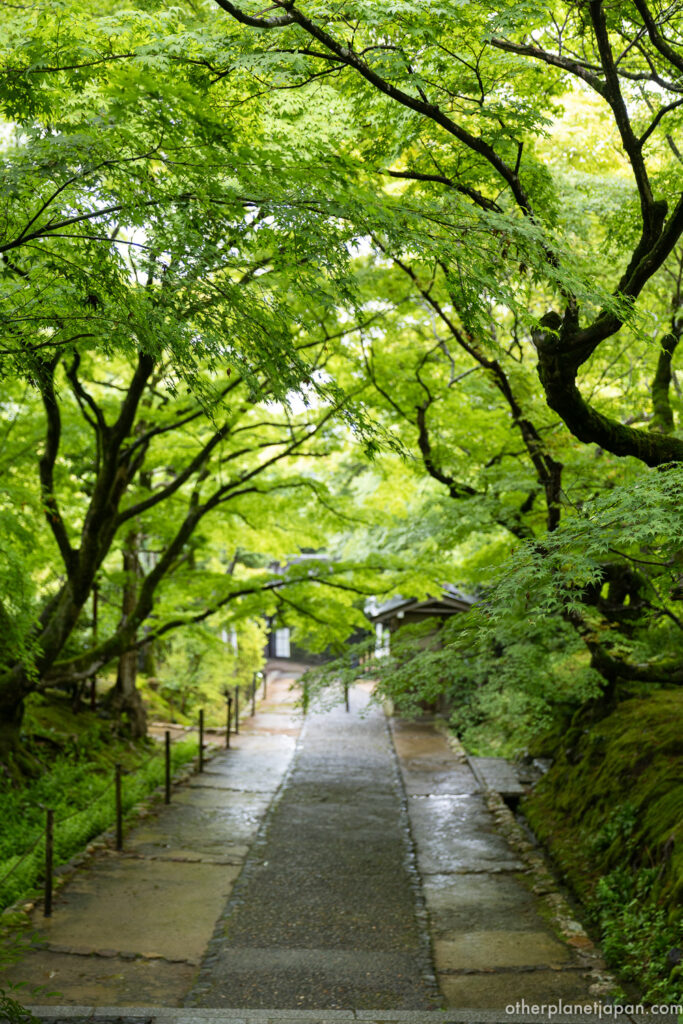
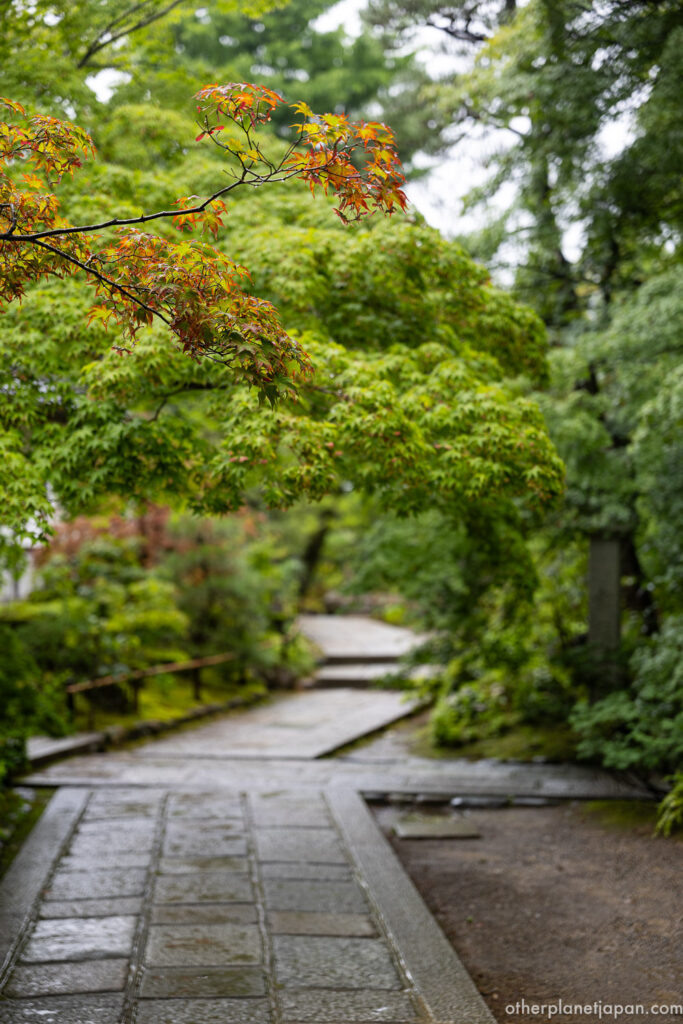
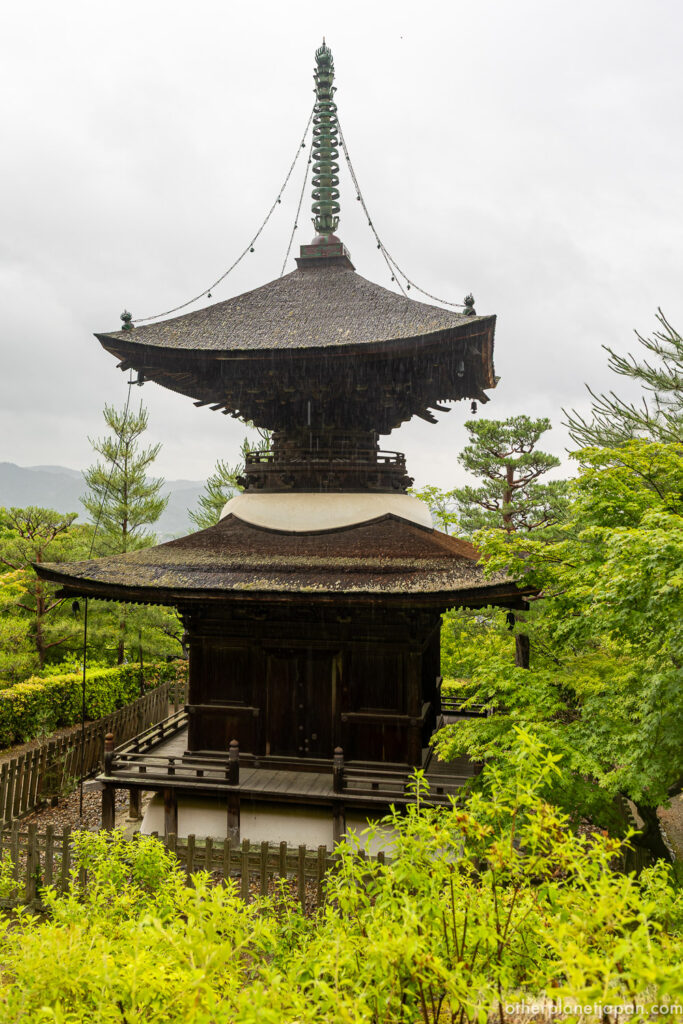
Climb far enough and the canopy opens. The Tahoto (多宝塔) — a two-storied wooden pagoda with a cypress-bark roof, built in 1620 — stands on the slope of Mt. Ogura. It is a designated Important Cultural Property. In autumn it sinks into red. In summer it disappears into green.
Continue past the pagoda — only a few minutes more — and you reach a small clearing with a view over Kyoto. You haven’t actually climbed very high. But Kyoto has strict building-height regulations, so even from this modest elevation, the city stretches out clearly toward the eastern mountains.
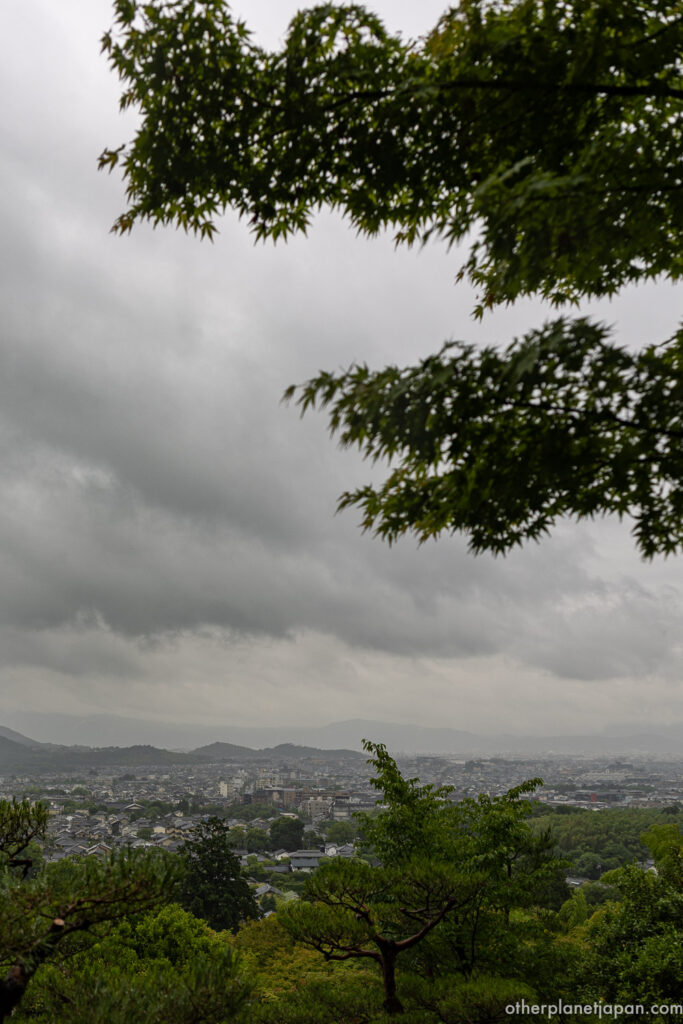
Maybe because the climb is so short, most people glance once and head back down. I thought they might have stayed a little longer.
The Mountain of Fujiwara no Teika
There are older voices on this mountain.
The poet Fujiwara no Teika (藤原定家), who lived in the late Heian and early Kamakura periods, built a mountain villa here called Shigure-tei (時雨亭). It was on this hillside, by tradition, that he selected the hundred poems of the Hyakunin Isshu — the anthology that remains, eight centuries later, the most widely loved collection of waka poetry in Japan.
A stone marker on the grounds reads “Site of Shigure-tei.” Other temples on Mt. Ogura, including Nison-in, claim the same honor — the real location is lost to time.
The maples Teika saw. The mountain he chose. Eight hundred years on, we are looking at almost the same thing.
Autumn — Why People Come
You might imagine red. You might imagine orange. What Jojakkoji gives you is everything in between.
The maples turn from mid-November through early December, depending on the year — and at their peak, the grounds hold green, yellow-green, yellow, orange, and red all at once. Not as a sequence. As a single, simultaneous fact. The color wraps around you from every direction — above, beside, underfoot — and for roughly two weeks, this compact hillside becomes one of the most saturated spaces in Kyoto.
Standing in that, I understood something I hadn’t from photographs. This is why people come back, year after year, to the same hillside.
From the main hall, the sound of sutra chanting drifts through the trees. It is there in June, when the grounds are nearly empty. It is there in November, when the paths are full. The season changes; the chanting does not. For a moment — maybe only a moment — you are aware of being somewhere that has nothing to do with the world you just walked in from.
Outside autumn, the temple is startlingly empty. I would not call that a flaw.
Autumn Special Viewing: The Main Hall, the Study, and Teika’s Talisman
In some years, there is more to see.
Jojakkoji occasionally holds a special autumn viewing that opens its normally closed main hall and study (shoin) to visitors. It was held in 2024 and 2025; for 2026, no announcement has been made. It is not held every year.
Admission is an additional ¥500. Those who enter receive an o-fuda talisman of the Buddha enshrined for Teika — small enough to fit inside a goshuin-cho. A quiet reminder of the poet who chose this mountain.
Practical Information
Everything above is the experience. What follows is how to give yourself a real shot at it — the hours, the rules, and the climb that is shorter than it looks.
Hours
Daily, 9:00 a.m. to 5:00 p.m. (last entry 4:30 p.m.). Open year-round.
Admission
Adults: ¥600. Children: ¥200. During the autumn special viewing (when held), entry to the main hall and study costs an additional ¥500.
Goshuin
The standard goshuin is pre-written paper insert (書き置き) only, with the day’s date inscribed. ¥300.
A kirie (paper-cut) goshuin is also available for ¥600.
When the autumn special viewing is held, visitors to the main hall and study receive a small o-fuda of the Buddha enshrined for Teika — included in the special viewing fee, sized to fit a goshuin-cho.
Time Required
Most visitors spend 45 minutes to 1 hour. Add another 30 minutes if the autumn special viewing is open.
Best Time of Year
Mid-November through early December for autumn color. This is also when all of Arashiyama is at its most crowded. Opening time (9:00 a.m.) is when the grounds are quietest.
Photography
Monopods and tripods are prohibited within the grounds.
How to Get There
Jojakkoji has no nearby train station, but it sits within Arashiyama’s walkable temple district. From JR Saga-Arashiyama or Keifuku Arashiyama Station, allow about 20 minutes on foot. Hankyu Arashiyama Station is roughly 30 minutes away. If you’re already in the area, the Bamboo Grove is about a 10-minute walk; Togetsukyo Bridge, about 20.
Official Website
For the latest information on hours, admission, and special viewing periods, visit the official Jojakkoji website. The site is in Japanese only — use your browser’s translation function if needed.
Frequently Asked Questions
When is the best time to see autumn leaves at Jojakkoji?
Mid-November through early December is peak color, varying by a week or so each year. Check Kyoto’s autumn forecast a few days before your visit and aim for early morning to avoid crowds.
Is Jojakkoji crowded during autumn?
Yes — and so is the rest of Arashiyama. During peak autumn, every temple in the Sagano area is busy, including Nison-in, Gio-ji, and Adashino Nenbutsuji. Arriving right at 9:00 a.m. opening is the most reliable way to see Jojakkoji with breathing room.
Can I get a hand-written goshuin?
No — goshuin at Jojakkoji are pre-written paper inserts only, though the day’s date is inscribed on each. The standard goshuin is ¥300; a kirie (paper-cut) version is ¥600.
Is the autumn special viewing held every year?
No. The special viewing of the main hall and study was held in 2024 and 2025 but has not been announced for 2026. Check the official website close to your visit to confirm. When held, entry is an additional ¥500 and includes a small Teika-related o-fuda.
Can I visit Jojakkoji with other Arashiyama sights?
Easily. The temple is about a 10-minute walk from the Bamboo Grove and sits within the Sagano temple cluster — Nison-in, Gio-ji, and Adashino Nenbutsuji are all close. See “Nearby” below for guides to other places in the area worth your time.
Nearby
Arashiyama rewards visitors who push past the obvious. A few quieter destinations within walking distance: