On Thursday, June 4, 2026, Kyoto’s rainy season officially began. The first Sunday after the announcement called for rain from morning until night. That was the Sunday I booked my visit to Saihō-ji.
No reasonable person deliberately chooses a rainy day to visit a temple. I am, for the most part, a reasonable person. I make sensible decisions about umbrellas and footwear. I check forecasts. And yet here I was, scrolling through the reservation system, looking specifically for a day with the worst possible weather—because Saihō-ji, known to everyone as Kokedera, the moss temple, is the one place in Kyoto that officially recognizes a fifth season. Not spring, summer, autumn, winter. Five. The temple’s own website lists tsuyu—the rainy season—right alongside the other four, as if daring you to come and see why.
When is Saihō-ji at its most beautiful? I came in the rain to find out.
Why Saihō-ji Is Treated Differently from Every Other Temple in Kyoto
Kyoto has more than 1,600 temples. Most of them charge somewhere between 400 and 600 yen, wave you through a gate, and let you wander. Saihō-ji charges 4,000 yen, requires a reservation, sits you down to copy a sutra before you see a single leaf, and closes by early afternoon. It does not behave like the other 1,599.
The reason is partly historical. This garden was designed in 1339 by the Zen master Musō Kokushi, one of the most accomplished garden designers in Japanese history. When the shogun Ashikaga Yoshimasa later imagined Ginkaku-ji—Kyoto’s celebrated Silver Pavilion—he is said to have used Saihō-ji as his reference. The same is said of Kinkaku-ji, the Golden Pavilion. Two of the city’s most visited gardens are, in a sense, copies. The original is here, at the foot of Mt. Arashiyama’s western slopes, behind a gate that most visitors to Kyoto never find.
There is also something most Japanese visitors don’t know. Saihō-ji is considered the birthplace of karesansui—the dry landscape garden style that Westerners usually call “Zen rock gardens.” The lower garden you walk through on a standard reservation is a pond-stroll garden. Above it, on a steep hillside that ordinary visitors never see, lies what is believed to be the earliest karesansui in Japan—also the work of Musō Kokushi. It is normally closed, reserved for monks in training. A handful of times each year, the temple opens it to a small number of visitors. More on that below.
The 4,000 yen, though—that needs its own explanation.
Kokedera is said to contain more than 120 species of moss. Moss is not a plant you can leave alone and expect to flourish. The temple’s gardeners spend their days pulling weeds, removing fallen leaves one by one, monitoring soil moisture, pruning trees overhead to calibrate the balance of light and shade, and maintaining the stone paths that thread through it all. The cost of seven centuries of unbroken, daily upkeep is built into every ticket.
The temple would also prefer you didn’t call it a ticket. Saihō-ji insists that the fee is a myōga-ryō—an offering for the privilege of religious participation—not an admission charge. You are joining a Zen practice that happens to include a garden. The structure of the visit enforces the distinction, as you’ll discover the moment you walk through the gate.
The Visit Begins with Sutra Copying, Not Sightseeing
A Silence That Is Actually Enforced
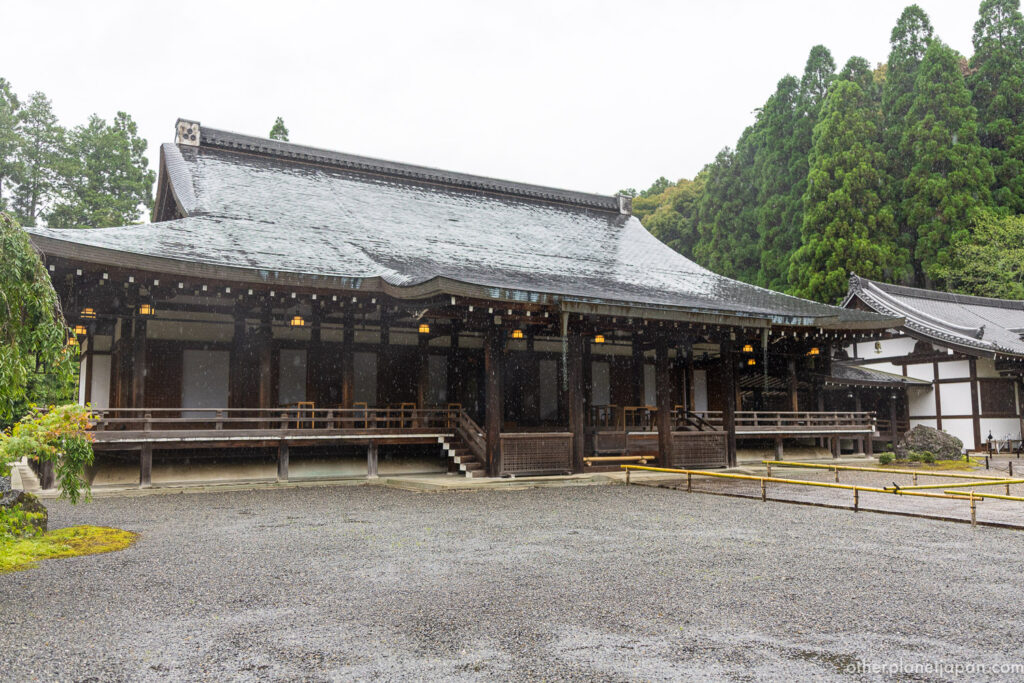
When you arrive at Saihō-ji and confirm your reservation, you are not led to the garden. You are led to the main hall. Phones go away. Talking stops.
People often imagine that Japanese temples are uniformly hushed. They are not. Most are full of school groups, tour guides with microphones, and the soft electronic chirp of camera shutters. Saihō-ji is different. While I was inside, a couple of visitors exchanged a few sentences at what they probably considered a whisper, and a staff member corrected them—promptly, firmly, and without apology. The silence resumed. It was refreshing. Because the temple limits how many visitors can enter at any one time, the hall felt spacious and unhurried. No crowds pressing in behind you, no ambient hum of a hundred people trying to be quiet and failing.
Why Sutra Copying Comes Before the Garden
Seating in the main hall is open. You can sit at a low table or directly on the floor. Beside me, two young Western women had already closed their eyes and settled into long, deep breathing—the kind of stillness you see in a serious yoga studio.
For most modern Japanese, copying a Buddhist sutra is not a daily activity. It is the sort of thing you can technically do anytime, which means most of us never get around to it. The temple hands you a sheet pre-printed with the faint outlines of the Heart Sutra and lends you a brush pen; your job is to trace each character. The characters are in Chinese kanji, but English instructions are provided—no Japanese language ability is required.
Reading the instructions, I was ambushed by a memory I had not revisited in thirty years: calligraphy class in elementary school. I was bad at it. My characters leaned, my strokes wobbled, and I disliked every minute of it.
The brush pen at Saihō-ji does not allow mistakes. There is no erasing, no backspacing, no starting over. You press the felt tip to the paper and whatever comes out, stays. I made it through most of the sutra with reasonable composure—moving quickly, not thinking too hard—until somewhere near the final lines, when I wrote a stroke in the wrong order and the character collapsed into something that looked like no kanji in any language. A brush pen is merciless. You cannot fix it. You can only keep going and hope nobody is watching.
I glanced sideways. The Western women beside me were still deep in meditation, eyes closed, breathing slowly. They had not picked up their brushes. They had not seen the crime. Japanese pride: intact, barely.
I finished my sutra in roughly two minutes. They were still breathing. They were, I suspect, doing it correctly.
You may leave your completed sutra at the temple as an offering, or take it home. If you plan to take it home, bring a small cardboard tube; the temple does not provide one.
A Goshuin That Compresses 1,300 Years into One Sheet of Paper
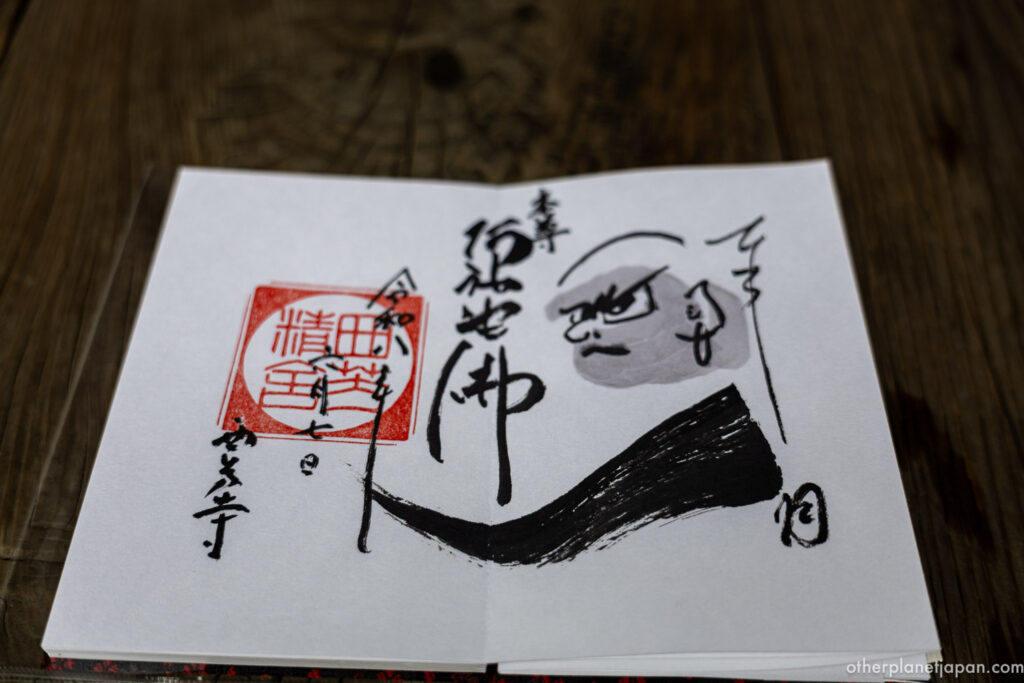
At the reception desk, a monk draws the temple’s goshuin—the inked seal and calligraphy that pilgrims collect—while you wait. On one side, Daruma Daishi appears as a quick, fierce brushstroke portrait. On the other, the calligraphy reads Amida Nyorai. When the monk handed mine to me, the faint scent of fresh ink still hung on the paper.
The pairing puzzled me. Saihō-ji is a Rinzai Zen temple. Having Amida Nyorai—the Buddha of the Pure Land school—as the principal image is distinctly unusual for a Zen temple. When I asked, a staff member explained: Saihō-ji was founded in 731 by the monk Gyōki, converted to Pure Land Buddhism by Hōnen in the Kamakura period, then revived as a Rinzai Zen temple by Musō Kokushi in 1339. The Amida Nyorai stayed. The Daruma Daishi moved in. Thirteen centuries of religious change, compressed into one sheet of paper you can carry home in your pocket.
Walking the Moss Garden in the Rain
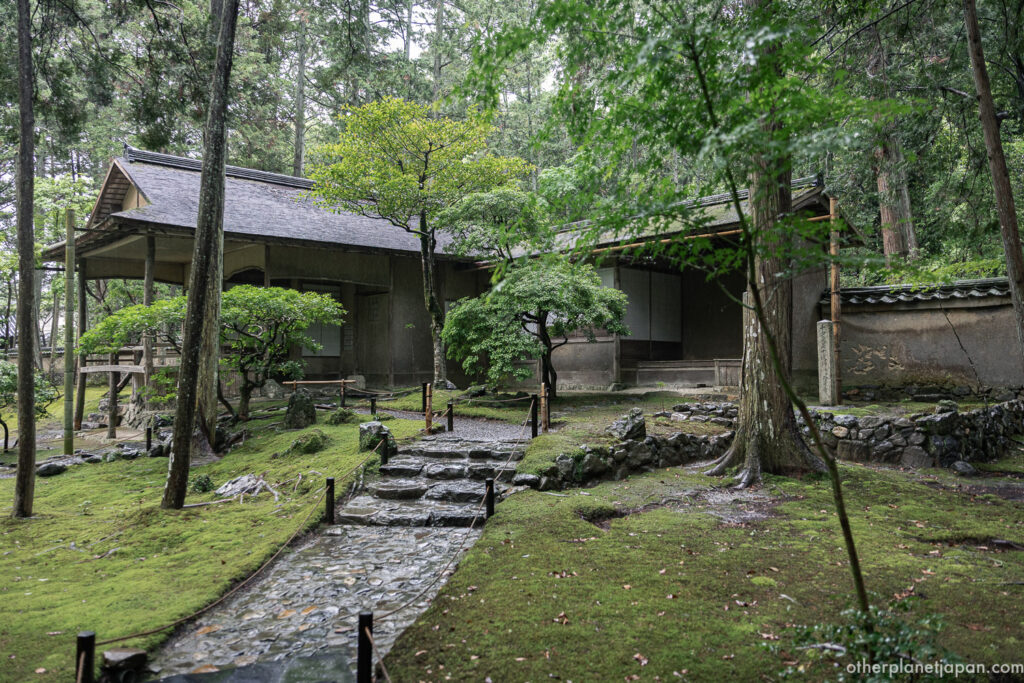
You leave the main hall through a side door and step directly into the garden. One moment you are kneeling with a brush. The next, you are standing in a forest.
The Rain Was Getting Heavier. That Was the Point.
By the time I stepped outside, the rain had grown heavier rather than easing. My umbrella was doing its best. My shoes, which I had chosen with some care that morning, were already starting to darken at the seams.
It didn’t matter. Or rather, it mattered in the right direction.
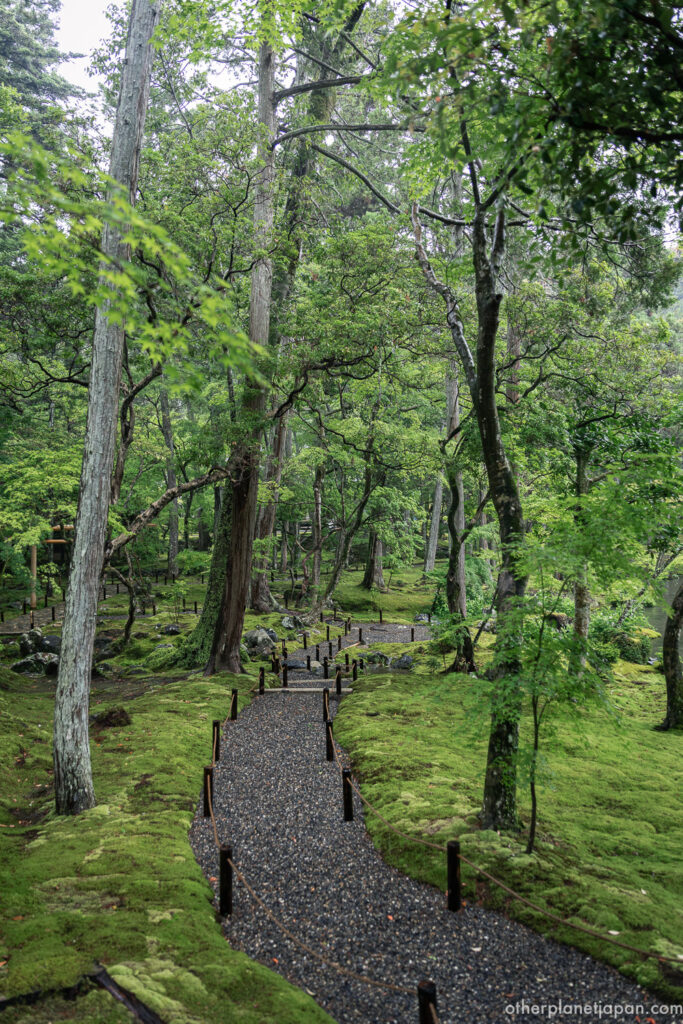
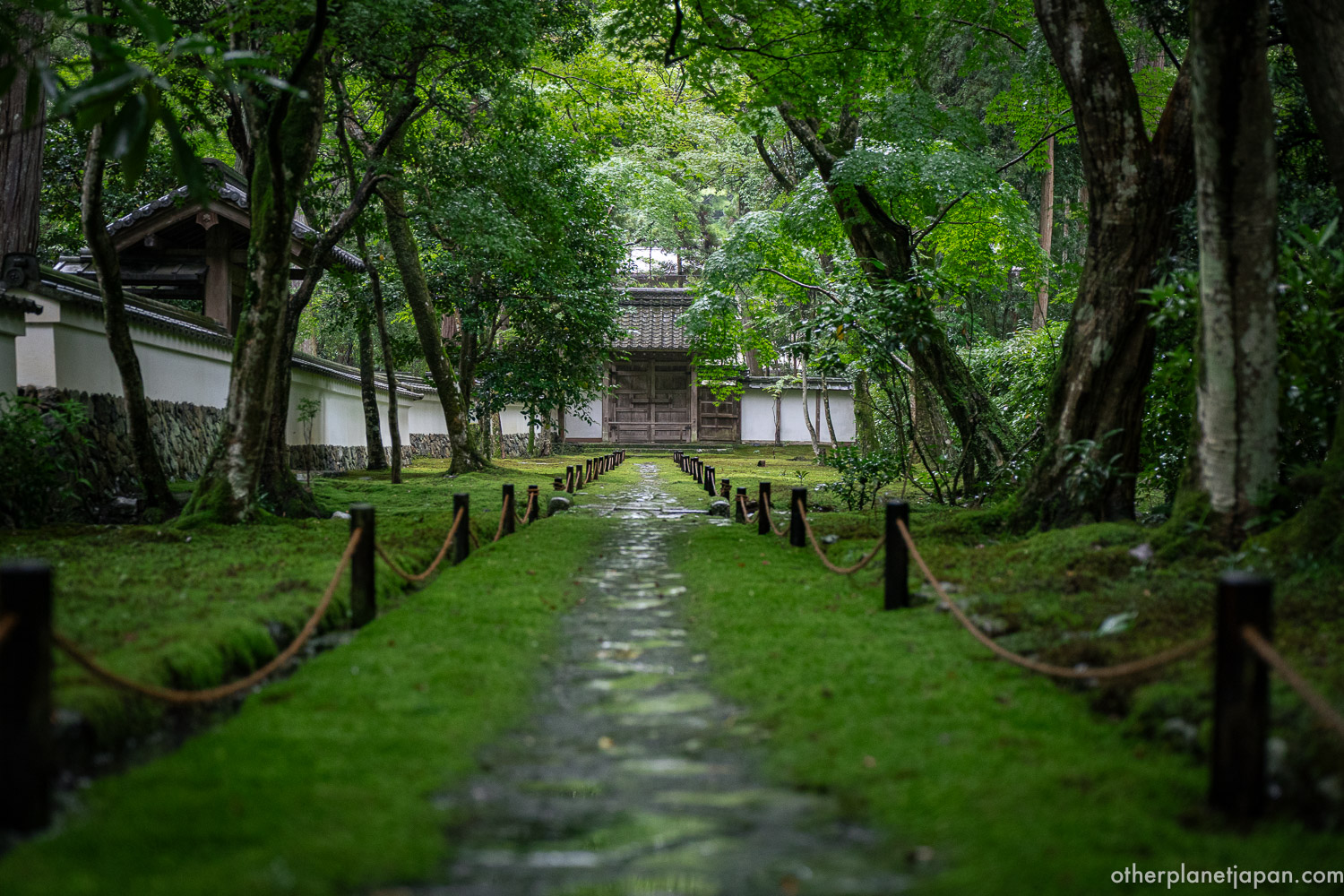
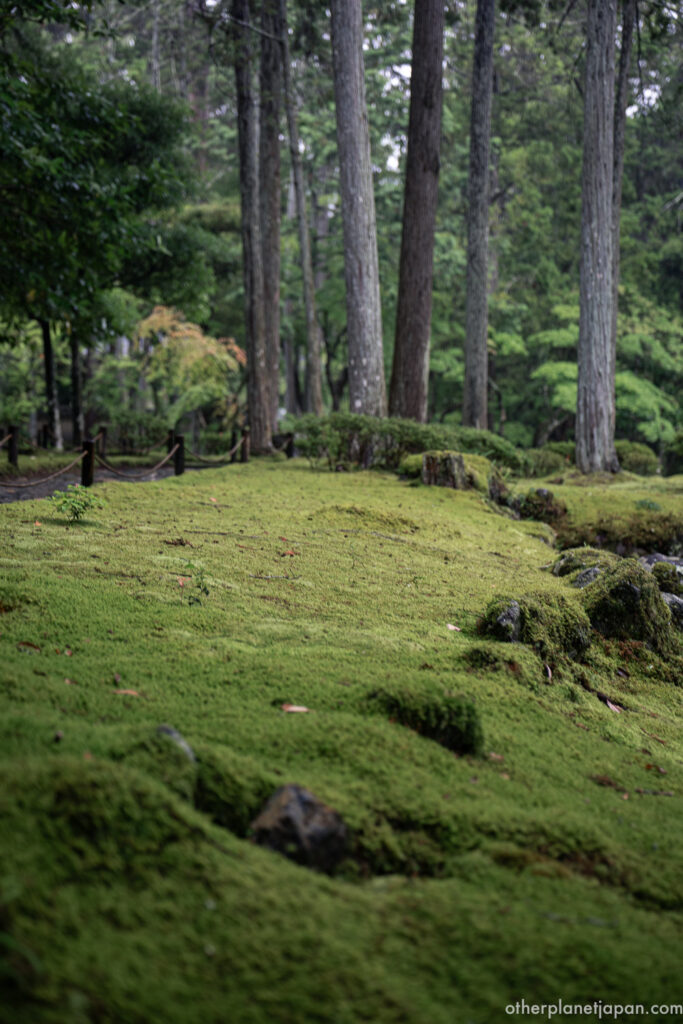
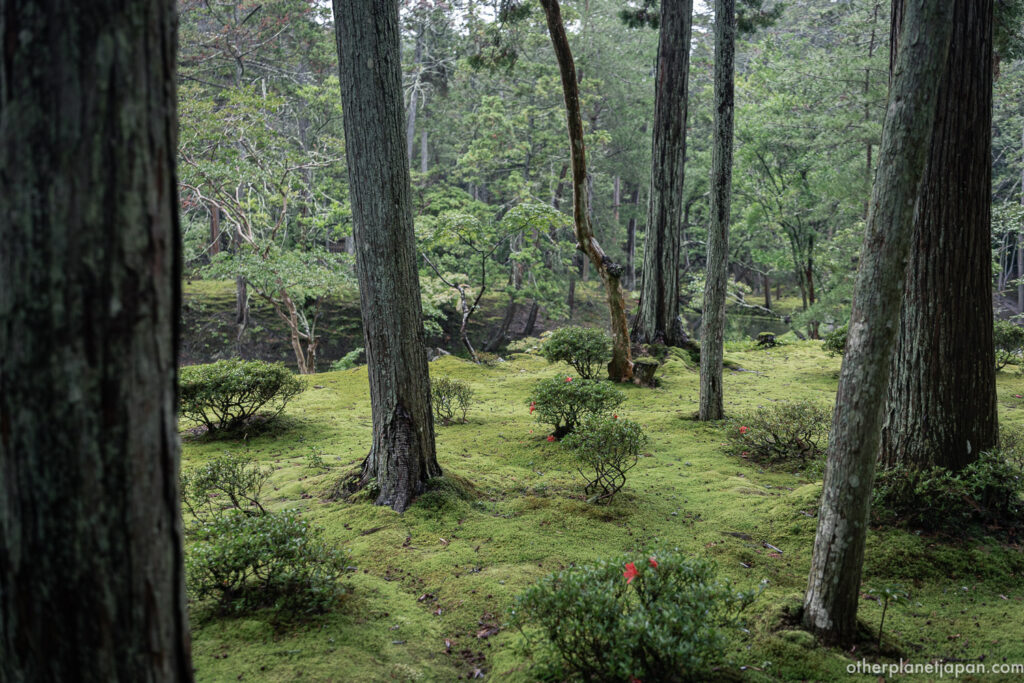
I grew up in the Japanese countryside, surrounded by mossy ground that I never paid any particular attention to. Moss was simply what was there, like soil or weeds—part of the background, never the subject. At Saihō-ji, thirty years of indifference dissolved within about thirty seconds. The moss at Kokedera looks like a thick, hand-loomed carpet that someone has rolled out across the entire forest floor. It is so dense and so finely textured that you understand—without anyone telling you—that you must not touch it. The moss has a kind of quiet nobility. You walk around it.
What surprised me was how comfortable the rain felt. The forest canopy filtered most of it. The limited number of visitors—a consequence of the reservation system—meant the paths were uncrowded. No one was jostling for position at photo spots. No one was rushing. The rain, which would have been oppressive on a city street, became part of the garden here.
120 Species I Could Not Tell Apart
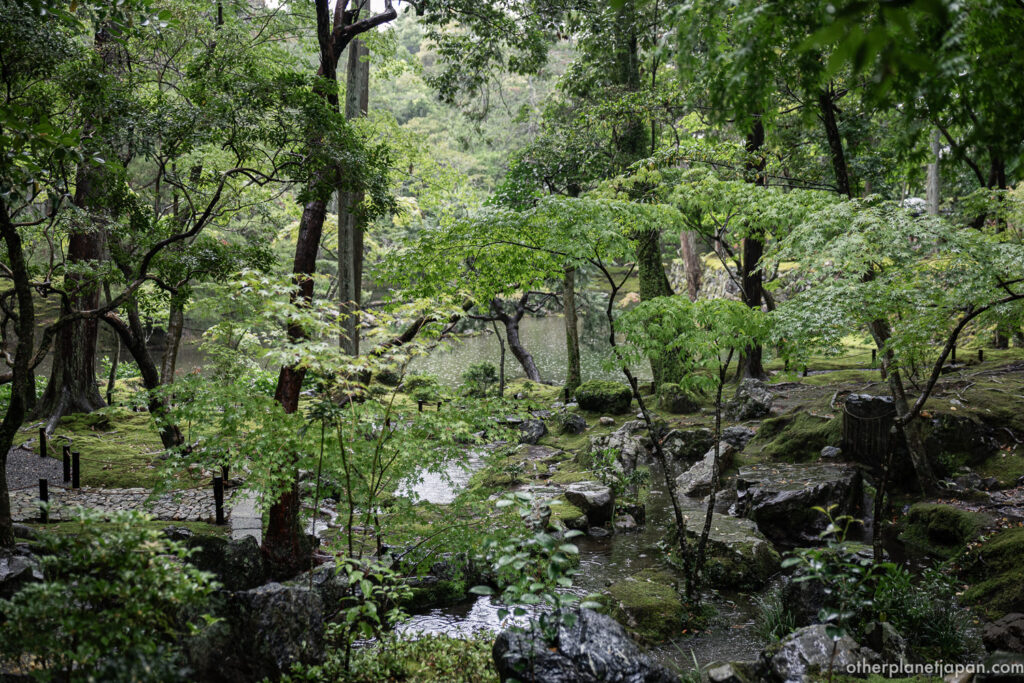
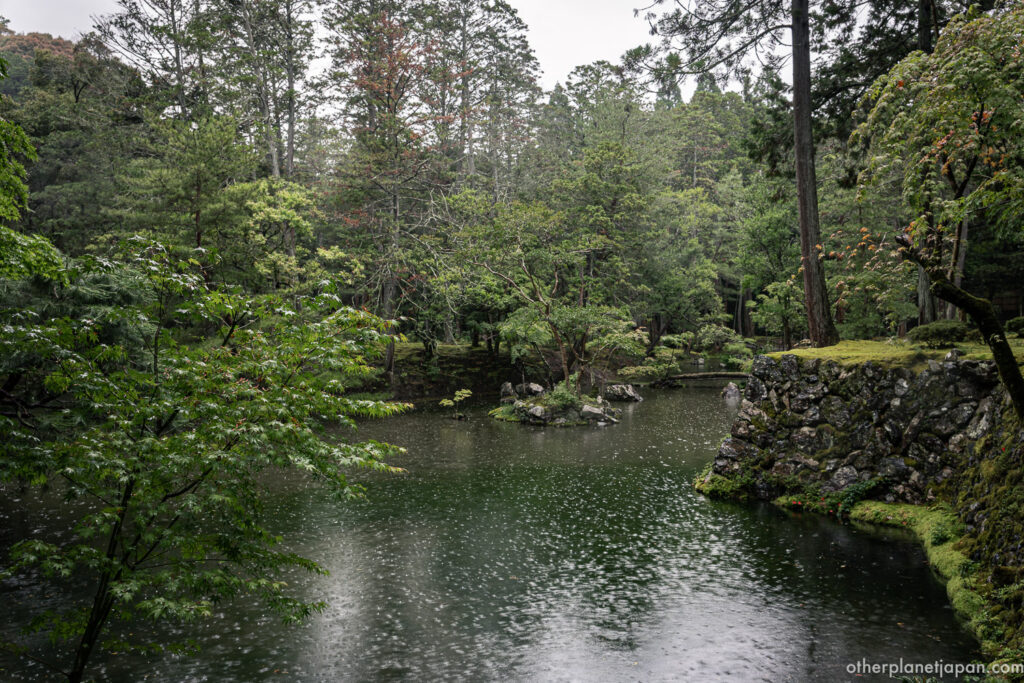
The garden’s central feature is a pond shaped like the kanji 心 (kokoro, heart), and the path traces a long, looping circuit around it. You cannot get lost. The route is fixed; the temple wants you to walk it in a particular order.
I could not tell one moss from another. There are reportedly more than 120 species in the garden, and to me they presented as one continuous green carpet with subtle variations in texture and tone—some patches cropped like velvet, others rising in tiny forests of miniature pine. The specialists can name each one. I could not. I don’t think it matters. Saihō-ji is not a garden that asks for botanical literacy. It asks for attention.
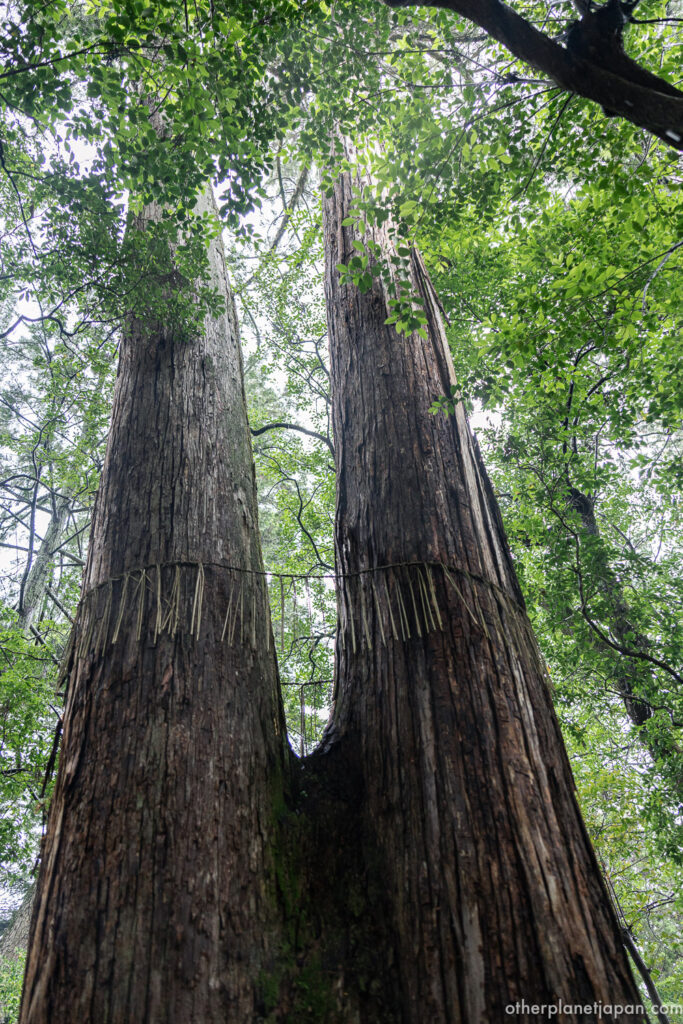
The wet trunks of the cedars had turned nearly black against the moss. Rain fell onto the pond in a rhythm that no one was conducting. The garden works at a level that has nothing to do with knowing names.
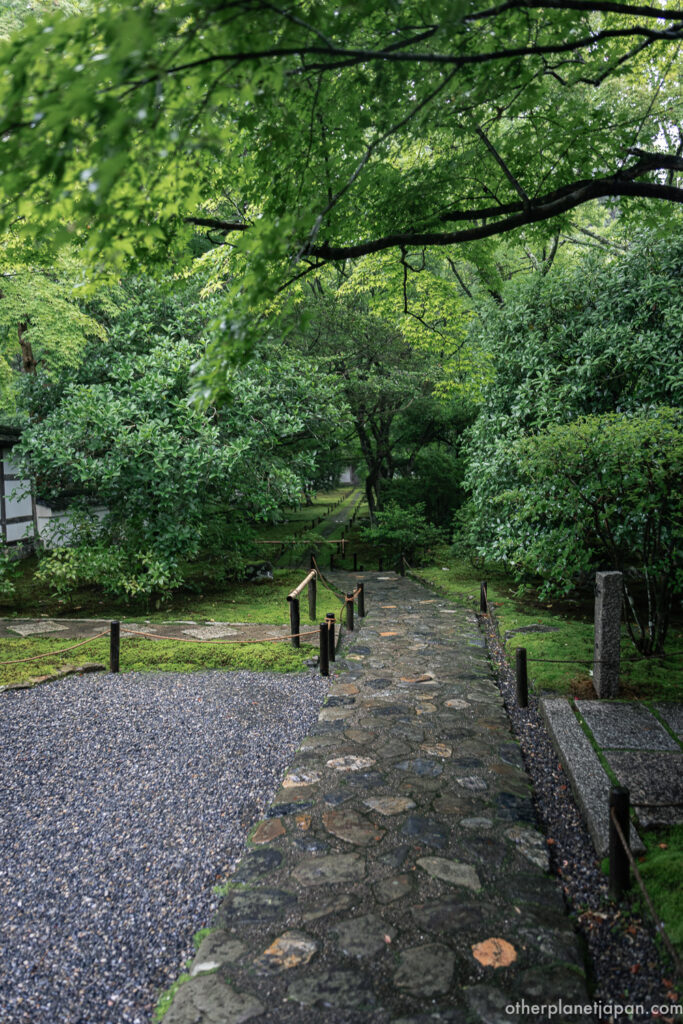
One practical note, earned the hard way: the stone paths become genuinely slippery in rain. Wear shoes with good grip. Fashion choices you might get away with at Kinkaku-ji or Fushimi Inari will betray you here, where the stones are old, uneven, and polished smooth by centuries of foot traffic.
Why the Rain Is the Right Weather
By the time I had completed the circuit, I was convinced. Kokedera is at its best in the rain.
The moss drinks the water and turns a deeper, almost luminous green. The cedar trunks darken to charcoal. The pond’s surface is in constant gentle agitation, each raindrop a small concentric event. The tourist photos you see online are mostly taken on bright days. The temple’s own decision to list tsuyu as a fifth season tells you which weather the monks themselves believe shows the garden truthfully.
If you have any flexibility in your schedule, choose a rainy day. Bring an umbrella. Wear waterproof shoes with real tread. You will have the garden largely to yourself, and you will see it as I believe it was designed to be seen.
The Special Tour: Japan’s Oldest Karesansui
While I have not yet joined this tour, it is one of the most difficult garden experiences in Kyoto to access—and one I intend to try in autumn, when the maples on the upper hillside turn.
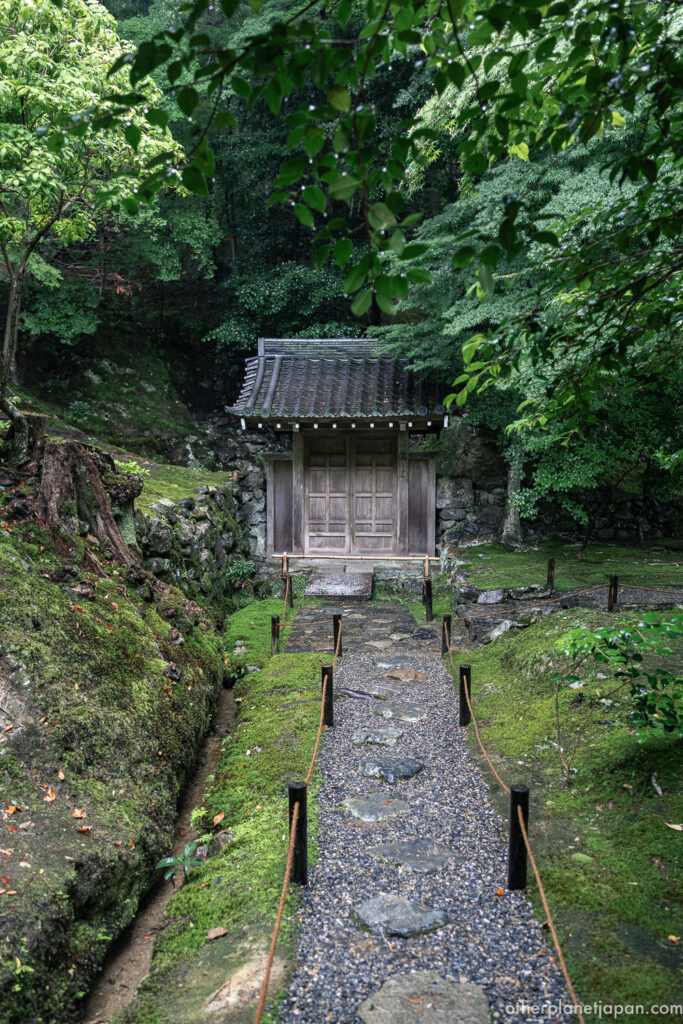
A few times each year, Saihō-ji opens the upper garden—the original karesansui designed by Musō Kokushi in 1339—to no more than 10 visitors on a monk-guided tour. The fee is 8,000 yen plus a 110 yen booking fee, and on selected dates the tour runs in English. You stand in what is considered the oldest surviving dry landscape garden in Japan, in the very place where its creator set each stone nearly seven centuries ago. For anyone seriously interested in Japanese garden design, it is among the rarest experiences available in Kyoto.
Participants must be 13 or older. The route involves stone steps, so sturdy shoes are essential. Photography is not permitted during the tour. Booking requires creating an account and providing each visitor’s name in advance. The grounds are not wheelchair accessible.
Practical Information for Visiting Saihō-ji
Reservations Are Mandatory
Saihō-ji does not accept walk-in visitors. You must reserve at least one day in advance through the temple’s official online booking system. Same-day reservations are not available. During the autumn foliage season in November and the fresh green and rainy seasons from May through June, reservations can fill several weeks in advance. Book as early as your travel dates allow.
How to Get to Saihō-ji