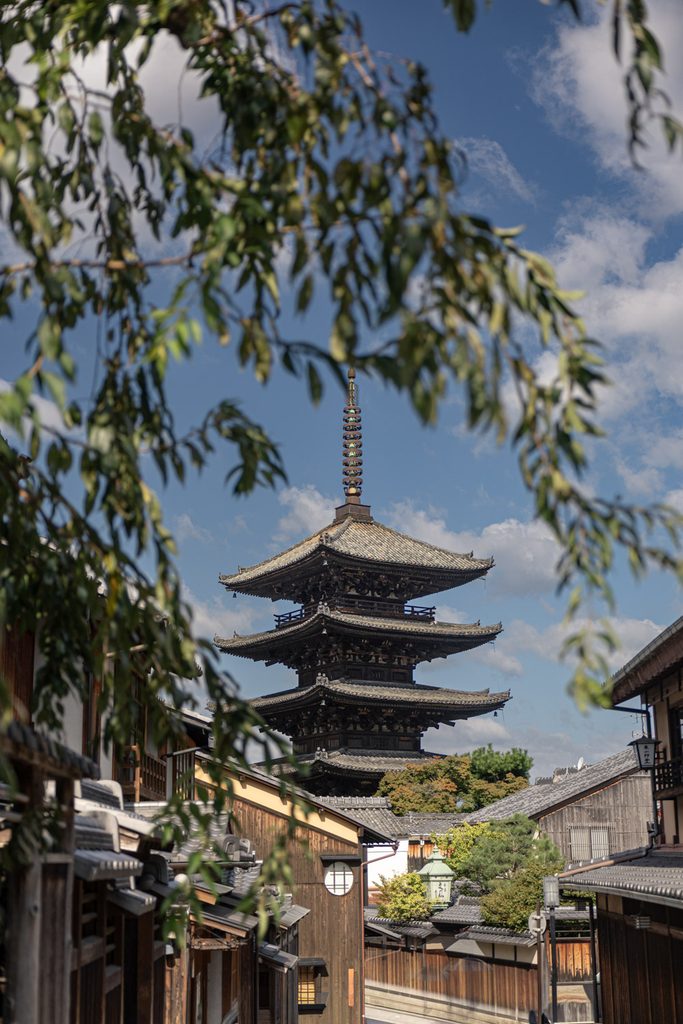
Everyone on this slope is after the same thing. Yasaka Pagoda rises over the tiled roofs of Higashiyama, five stories of dark wood against the sky, and every person walking toward it hopes to have it to themselves. I am not above this. It is the reason I set an alarm on a September morning.
A short way down the slope sits Yasaka Koshindo, a temple small enough to take in at a glance, and one that asks for the opposite of what I had come for.
Before the Gate Opened
I knew the gate opened at nine. I came before nine anyway. At night the gate is shut, which makes giving up easy, but early morning lets you hope the place might be empty. Hopes like that rarely survive this part of Kyoto. This one did, and I was honestly surprised.
A few other visitors had clearly made the same bet. None of them stayed long; the temple is compact, and it does not invite lingering. I had expected the morning air inside the grounds to be cool. Instead, the day was already warming into something closer to summer.
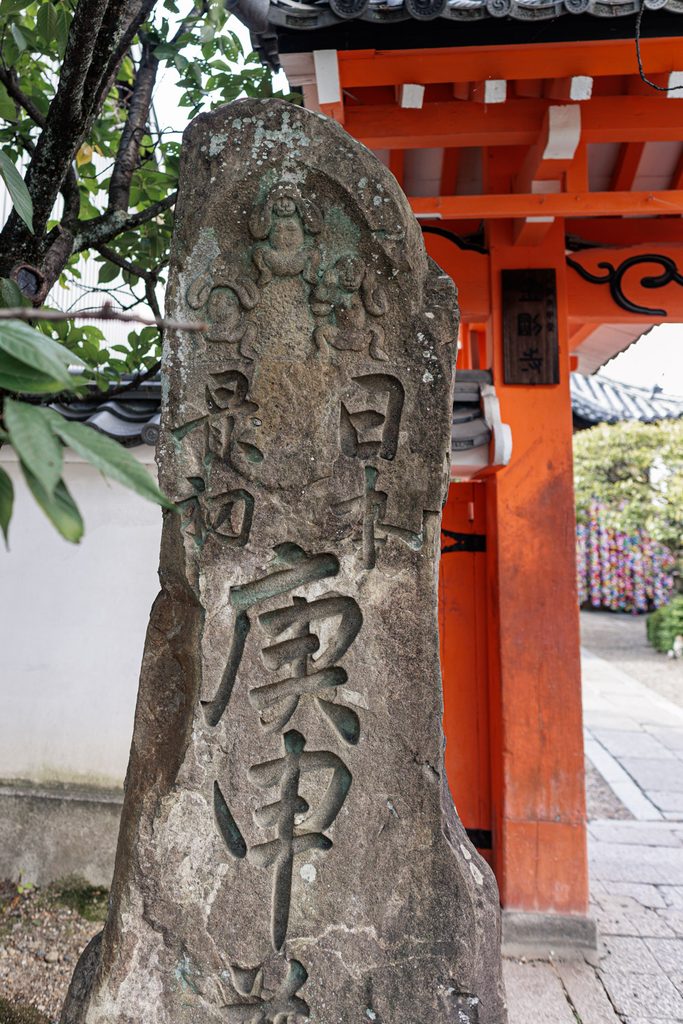
The gate itself is vermilion. On its roof ridge sit three small monkeys, one covering its eyes, one its ears, one its mouth. See no evil, hear no evil, speak no evil. Beside the gate stands an old stone pillar, green with moss at the edges, carved with more monkeys and the words “Japan’s First Koshin.”
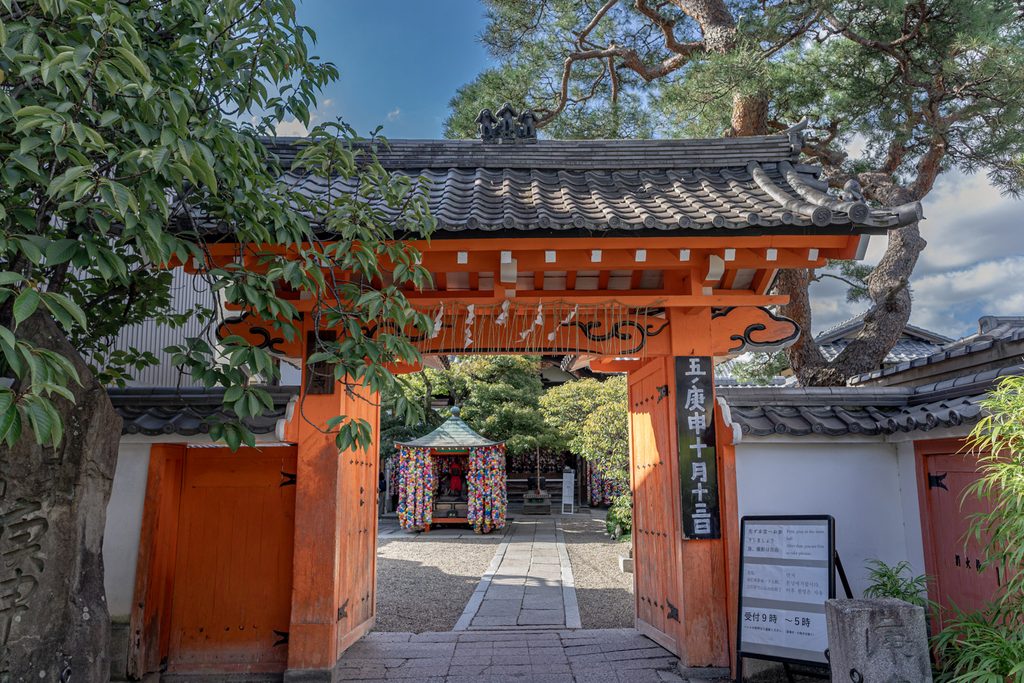
Just inside the gate is a sign in Japanese, English, and Korean: First, pray at the main hall. After that, you are free to take photos.
I have read a great many signs at a great many temples, and most of them list what you may not do. This one negotiates. It does not forbid the photograph; it simply asks you to let the temple go first. In a neighborhood where people line up for a clear shot of a pagoda, that seemed like a fair deal.
So I went to pray first. Ahead of me at the main hall stood a Japanese father and his daughter, three or four years old. He was showing her how to pray, one step at a time, and it was taking a while. When they finished, he turned to me. “Sorry for taking so long,” he said.
There was nothing to apologize for. The grounds were nearly empty. What stayed with me was something else: he never prayed himself.
Beanbags, Up Close
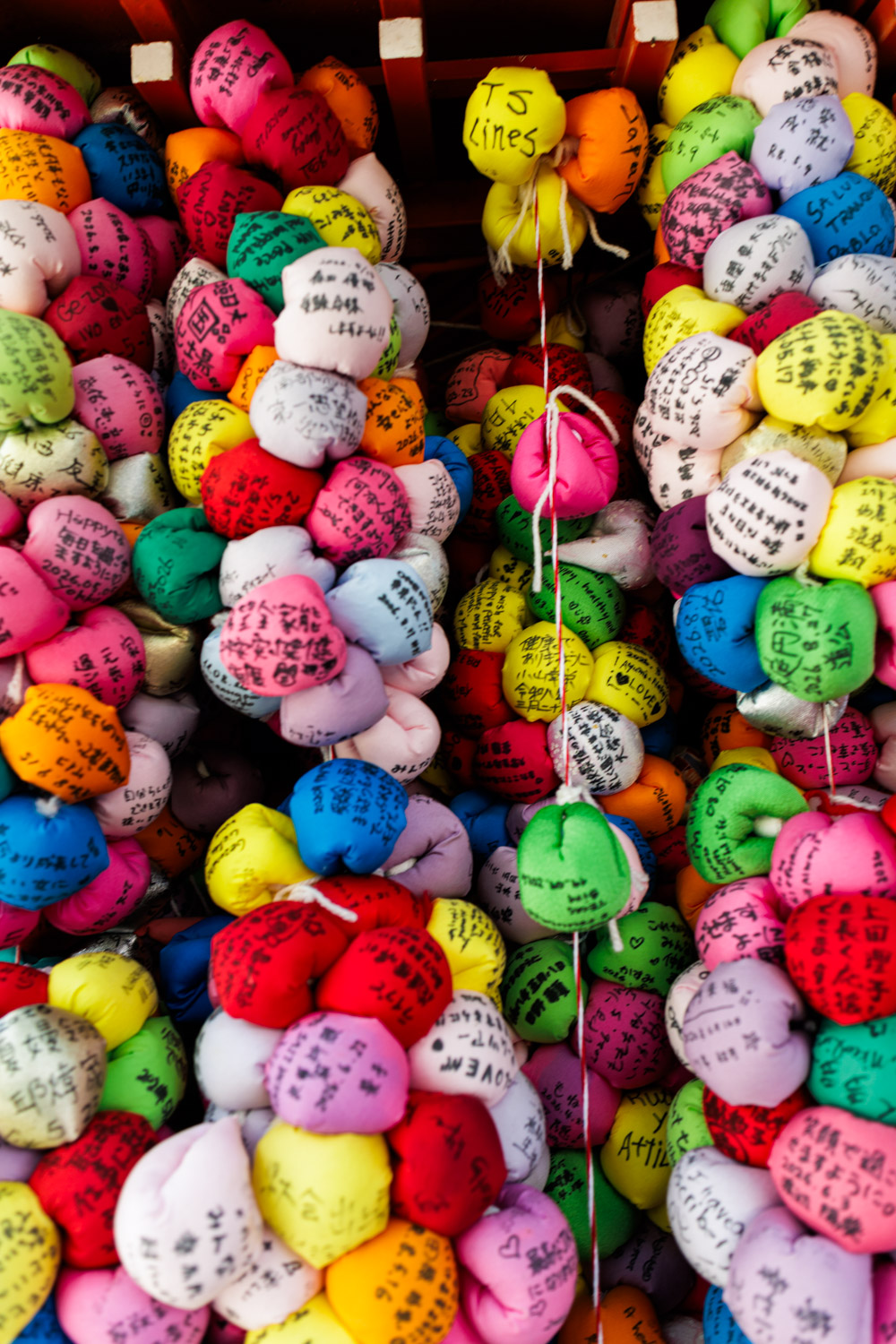
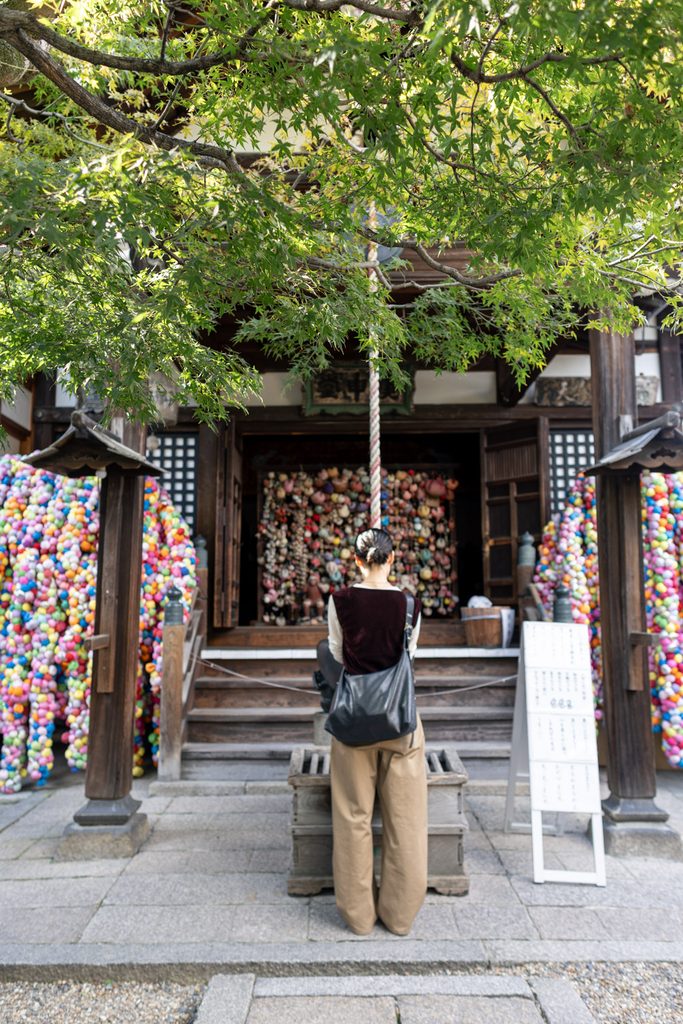
The main hall looks like a spilled toy box. Columns of bright fabric balls hang from the eaves in pink, yellow, green, and blue. They look exactly like otedama, the little beanbags Japanese children toss and catch, and for a while I took them for decoration.
They are not. Step closer and every ball is covered in handwriting: names, dates, wishes in Japanese and English, a few in scripts I could not read. More than one simply said “LOVE.”
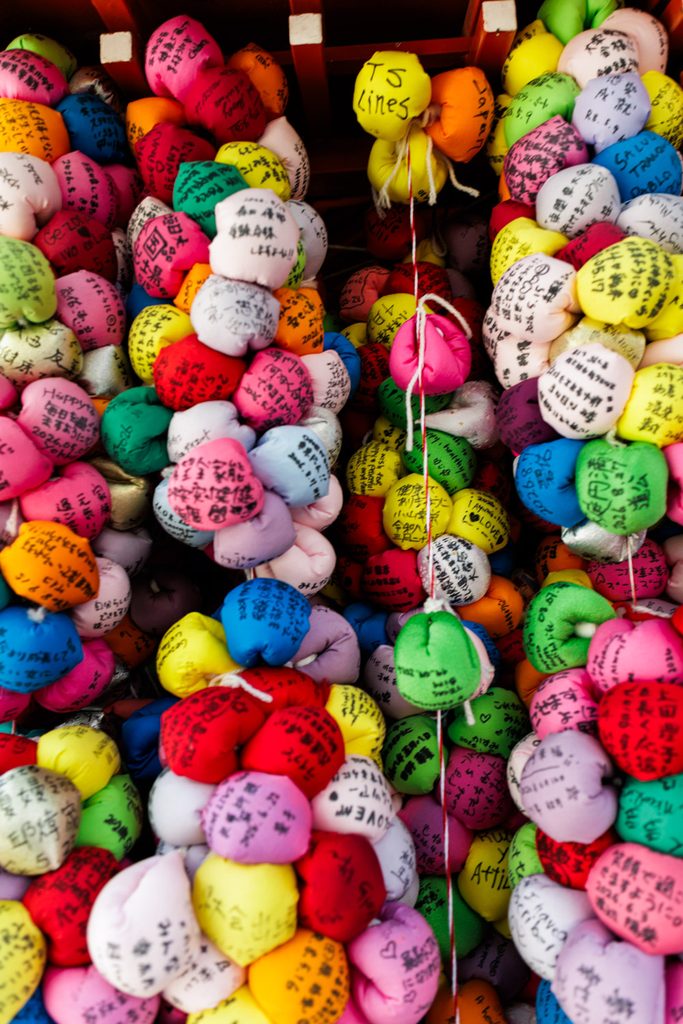
A small boy speaking French was studying one column of them, very seriously. The balls were glowing in the morning sun, and his hand began to drift toward them. His mother caught it and told him, in a hurry, not to touch. I honestly do not know whether touching is forbidden. As a child I would have reached out exactly as he did. Had he touched one, he could have answered a question I still have: do they feel like real otedama, with the soft shift of beans inside?
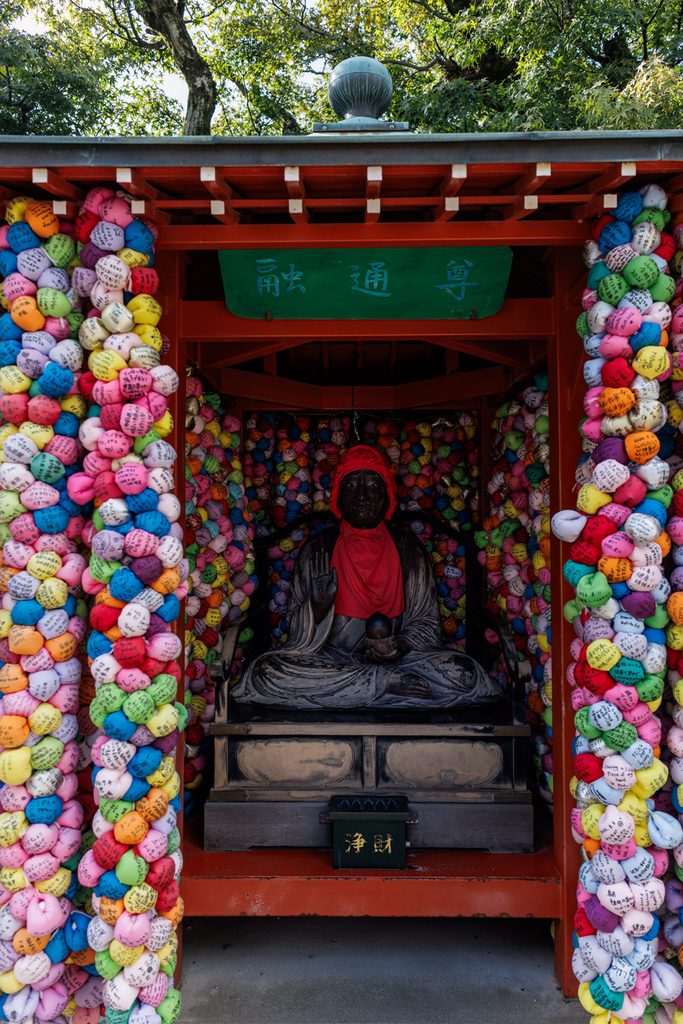
These are kukurizaru, which means “bound monkeys.” Each one is a monkey with its hands and feet tied together, so that it curls into a ball. Here the monkey stands for the restless human mind, always reaching for the next thing. You write a wish on it, give up one desire, and hang it at the temple. One wish in, one want out.
Which is where things got uncomfortable. I had set an alarm that morning to satisfy a want, and an empty frame of the most photographed street in Kyoto is about as pure a desire as a photographer can have. The temple had my number before I reached the main hall.
The Worms That Tell on You
Blame the calendar. The old East Asian calendar pairs ten heavenly stems with the twelve animals of the zodiac, which gives every day one of sixty combinations. Once every sixty days, the stem ko, linked with metal, lands on shin, the monkey. That day is Koshin, and it is why monkeys are everywhere here.
The belief behind it goes like this. Three worms called sanshi were said to live inside every person. On the night of Koshin, while you slept, they slipped out of your body and reported your misdeeds to the Heavenly Emperor, who held power over your lifespan and shortened it as punishment. The solution was simple: do not sleep. People stayed up through the night of every Koshin, a vigil known as Koshin-machi.
The temple’s principal deity, Shomen Kongo, offers a second solution. He eats the worms. A deity whose job is to devour your informants. I can think of worse patrons.
Written Straight Into the Book
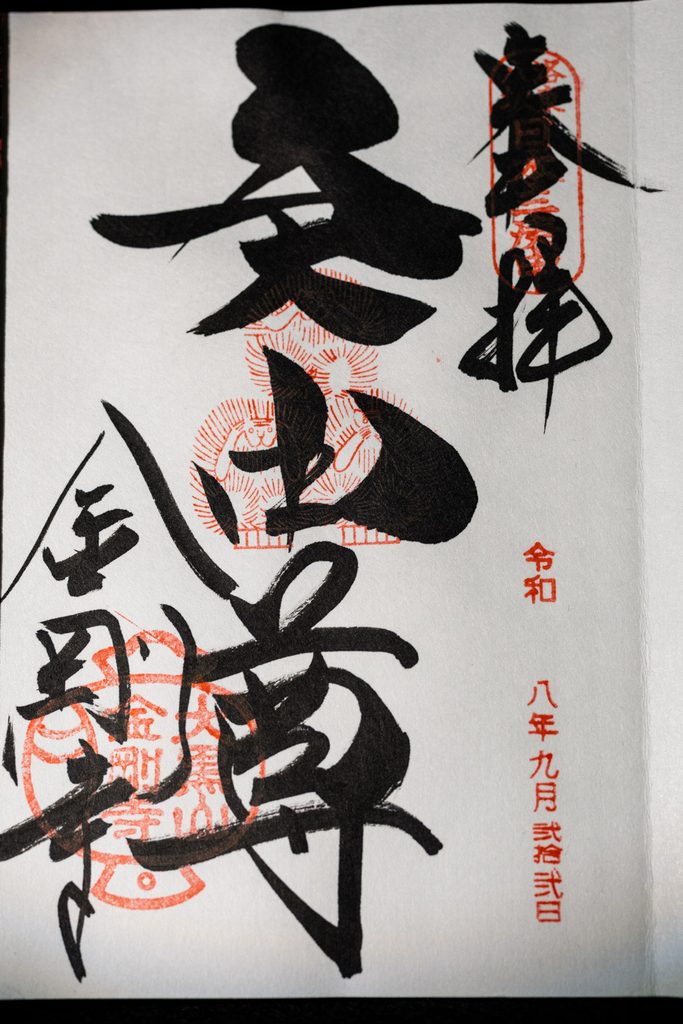
It was not yet nine. This temple is crowded most of the day, so I half expected to be handed a seal written in advance on a slip of paper, as busy temples often do. Instead, the person at the office took my book and wrote in it directly. I apologized for coming before opening hours. Judging by how little it seemed to matter, I was not the first.
The brush moved fast and black across the page. In the center went a red seal of the three monkeys, and down the side, the date in vermilion.
I had never seen these grounds so quiet. One step outside the gate, a crowd had already gathered around Yasaka Pagoda. I had taken my picture of it before coming in. There had been a few people on the street even then, but the shot had come easily. I had come for a clear frame and a seal in my book, and I left with both. I did not buy a kukurizaru that day, so I gave nothing up in return, and the question of how one feels in the hand will have to wait for another visit. By the temple’s own arithmetic, I still owe it one desire.
Visiting Yasaka Koshindo: History, Kukurizaru, and Tips
What Is Yasaka Koshindo?
Yasaka Koshindo’s formal name is Daikokuzan Enmei-in Kongoji Koshindo, and it belongs to the Tendai school of Buddhism. Its principal deity is Shomen Kongo.
In 960, the Tendai monk Jozo built a hall here so that ordinary people could worship the deity. The temple regards itself as the first place in Japan devoted to the Koshin faith. The current main hall dates to 1679. Together with the Koshindo at Shitennoji in Osaka and the Iriya Koshindo in Tokyo, which no longer exists, it is counted among Japan’s Three Great Koshin sites.
Also enshrined here is a statue of Fudo Myoo that, according to the temple, is visited by monks undertaking kaihogyo, the Tendai practice of walking the mountain paths of Mount Hiei for a thousand days.
How Kukurizaru Work
You buy a kukurizaru at the temple office, write your wish on it, and hang it in the temple grounds. The temple’s English price list notes that you can add your name and the date along with your wish.
| Item | Price |
|---|---|
| Goshuin (temple seal) | ¥500 |
| Kukurizaru, large | ¥500 |
| Kukurizaru, small | ¥500 |
| Kukurizaru, set of two (large/small) | ¥1,000 |
| Kukurizaru, set of three (large/small) | ¥1,500 |
| Kukurizaru, set of five (large/small) | ¥2,500 |
| Kukurizaru, set of nine | ¥4,500 |
Koshin Days at Yasaka Koshindo
These are the busiest days of the year. Koshin days come around every sixty days, roughly six times a year. On each one, the temple holds a goma fire ritual at 11 a.m. and 3 p.m. and keeps the Koshin-machi vigil from morning until the following morning.
Visitors are also served konnyaku, a firm jelly made from konjac root, cut into the shape of monkeys. Tradition says that if you eat three pieces facing north, in silence, you will stay healthy.
| Year | Koshin days |
|---|---|
| 2026 | October 13, December 12 |
| 2027 | February 10, April 11, June 10, August 9, October 8, December 7 |
Photography and Crowds
Pray first. Photography is allowed in the grounds, but the temple asks visitors to stop at the main hall before taking pictures.
Yasaka Koshindo and the streets around Yasaka Pagoda get very crowded as the day goes on. On my visit, the grounds were already open before the 9 a.m. reception time, and nearly empty. If you want to see the kukurizaru without a row of backs in front of them, go early.
Pairing It with Yasaka Pagoda, Kiyomizudera, and Yasui Konpiragu
Yasaka Pagoda, part of Hokanji Temple, stands just up the slope, so the two make a natural pair. From the pagoda, the stone-paved lanes of Ninenzaka and Sannenzaka lead up to Kiyomizudera, about a 10-minute walk away. See my complete guide to Kiyomizudera Temple before you go.
Head the other way, and in about five minutes you reach Yasui Konpiragu, the shrine known for cutting bad ties. Its focus on cutting ties pairs naturally with a temple about letting go.
Visiting in Kimono
The colors draw a crowd. The kukurizaru have made Yasaka Koshindo one of the most popular kimono photo spots in Kyoto, and several rental shops operate around Higashiyama. If you plan to spend the day in kimono, booking ahead lets you get dressed and out the door early, before the slope fills up.
Hours, Admission, and Access
| Reception hours | 9 a.m. to 5 p.m. |
| Admission | Free (temple grounds) |
| Goshuin | ¥500 |
| Address | 390 Kanaen-cho, Higashiyama-ku, Kyoto |
| By bus | Kiyomizu-michi stop (Kyoto City Bus), about 5 minutes on foot |
| By train | Kiyomizu-Gojo Station (Keihan Line), about 15 minutes on foot |