Every time I visit Ginkakuji, the same question comes back to me: what is wabi-sabi, actually?
I’m Japanese, and I don’t have a clean answer. It was an aesthetic once, a way of seeing, but it isn’t something I feel in daily life. If a foreign friend asked me to explain wabi-sabi on the spot, I’d probably say, “It’s too difficult a concept to translate into English.” Which is true. What I’d leave out is that I don’t fully understand it in Japanese either.
The same dodge works for “What is Zen?”, by the way. Fortunately, no one has asked me that question yet.
So I come to Ginkakuji, Kyoto’s Silver Pavilion, not to solve the riddle but to stand inside it. On this particular morning, it was raining. That turned out to be the best thing that could have happened.
Reaching Paradise Before Paying Admission
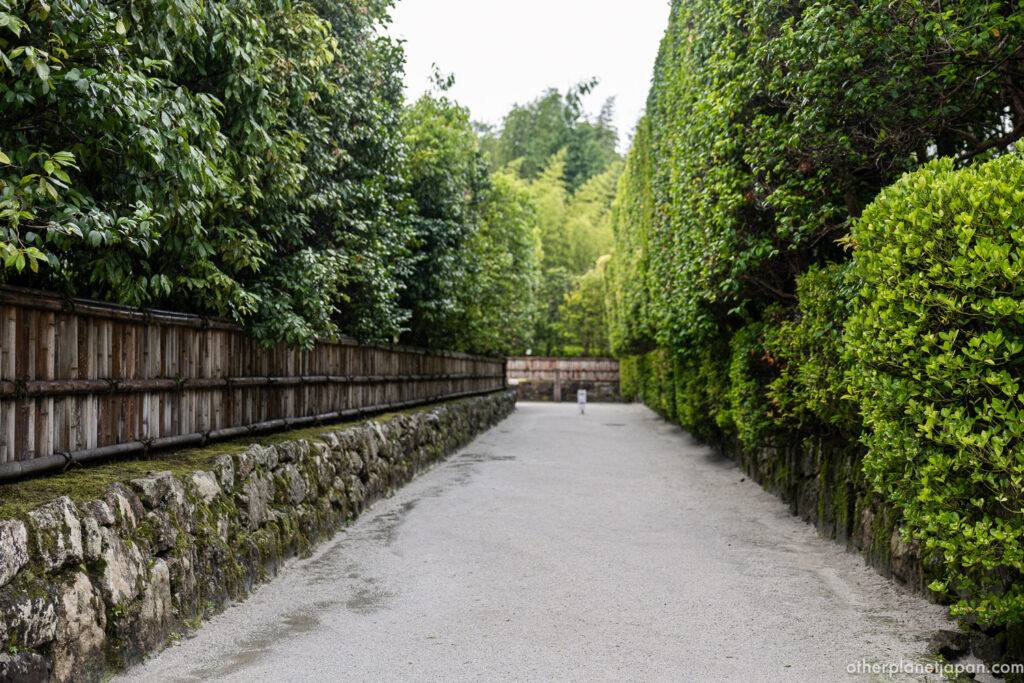
Between the outer gate and the inner gate — the one where you actually pay for admission — runs a walled lane. It’s said to trace the passage between the mundane world and the pure land, Buddhism’s paradise.
This morning, I had it to myself. Wet ground underfoot, tall hedges on both sides, only the sound of rain. I walked slowly, pleased with myself.
I had arrived, at last, in paradise.
Then I reached the ticket window. The admission fee, which I remembered as 500 yen, was now 1,000 yen. I stood there for a moment, reading the sign twice. Apparently I had not yet left the mundane world after all.
Silver That Was Never There
The absence of silver at Ginkakuji comes up regularly on Japanese TV and in newspaper columns. There are several theories. I had come this morning having forgotten all of them.
It’s not that I didn’t do my research. I did. I just forgot it. Perfect preparation, I decided as I paid my 1,000 yen, was overrated.
Here’s what I do know. Kinkakuji, the Golden Pavilion, is unmistakably gold. So why is Ginkakuji, its so-called silver counterpart, not silver at all? The building is dark, weathered wood. No foil, no shine, nothing that justifies the name on a postcard. Japanese schoolchildren learn about it as the symbol of Higashiyama culture, and even then, some of us are quietly thinking: where’s the silver?
If someone actually did coat the Silver Pavilion in silver foil, the way Kinkakuji is coated in gold, it would prove they had completely missed the point of wabi-sabi. Which is presumably why no one has done it. The refusal to shine is the answer.
Standing in the rain, watching the timber turn nearly black, I let that thought stand in for the theories I had forgotten. If you’re curious about the shining sibling, my piece on Kinkakuji, the Golden Pavilion, covers the other half of this famous pair.
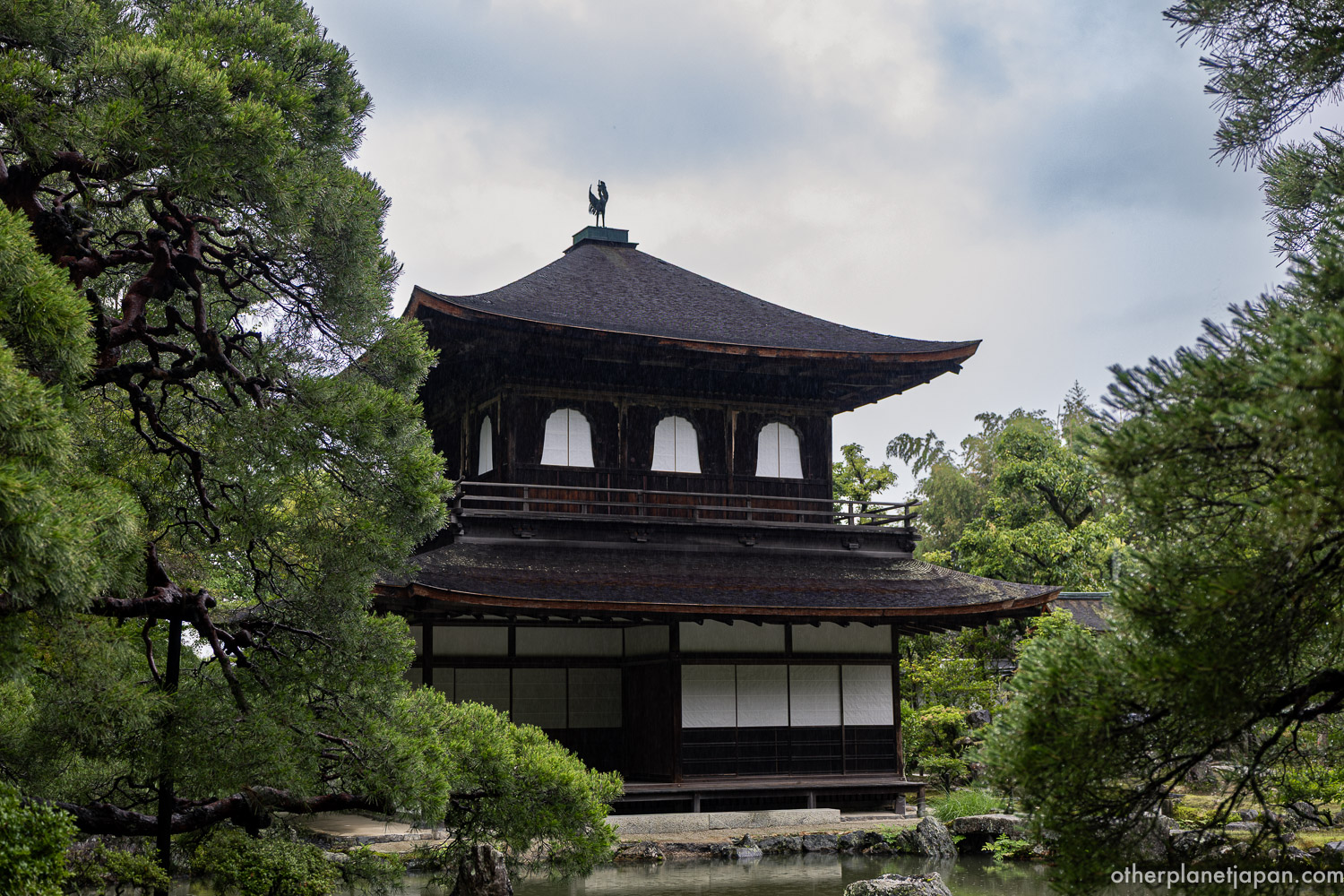
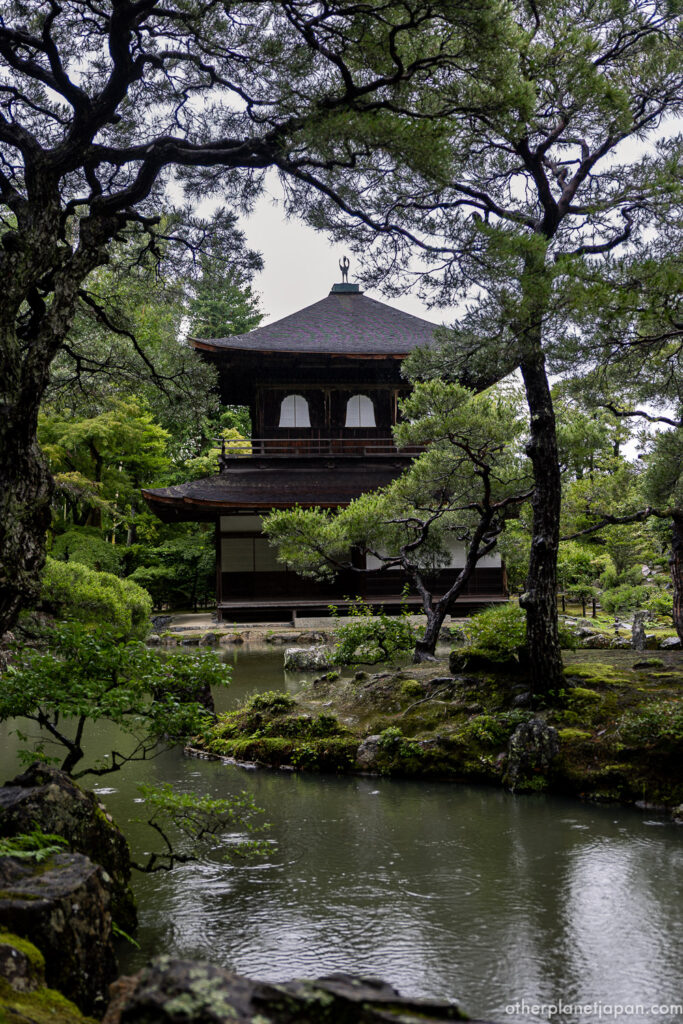
Past the inner gate, the pavilion appears almost immediately. It stops you. Not because it’s grand — it isn’t, by any measure — but because it shouldn’t still be here. This two-story wooden structure has stood since the Muromachi period, surviving half a millennium of typhoons, fires, and wars. A bronze phoenix perches on the roof. The lower floor is whitewashed plaster framed in dark timber; the upper floor opens on three arched windows. Nothing shouts. Everything holds.
The Sand That Isn’t a Beach
Then there is the sand.
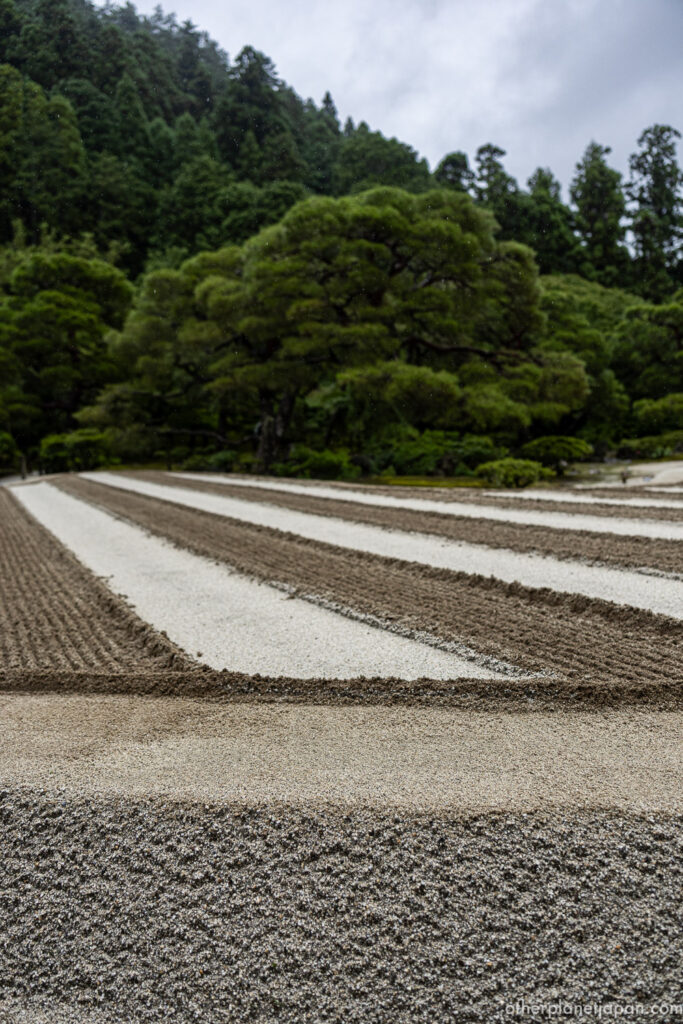
Two forms dominate the front garden. The ginshadan, a broad bed of raked sand combed into long parallel ridges. And the kogetsudai, a truncated cone rising from it like a small grey mountain. The cone is often called a moon-viewing platform. The flat bed is said to catch and scatter moonlight. Whether the original builders had exactly this in mind, the documents don’t say.
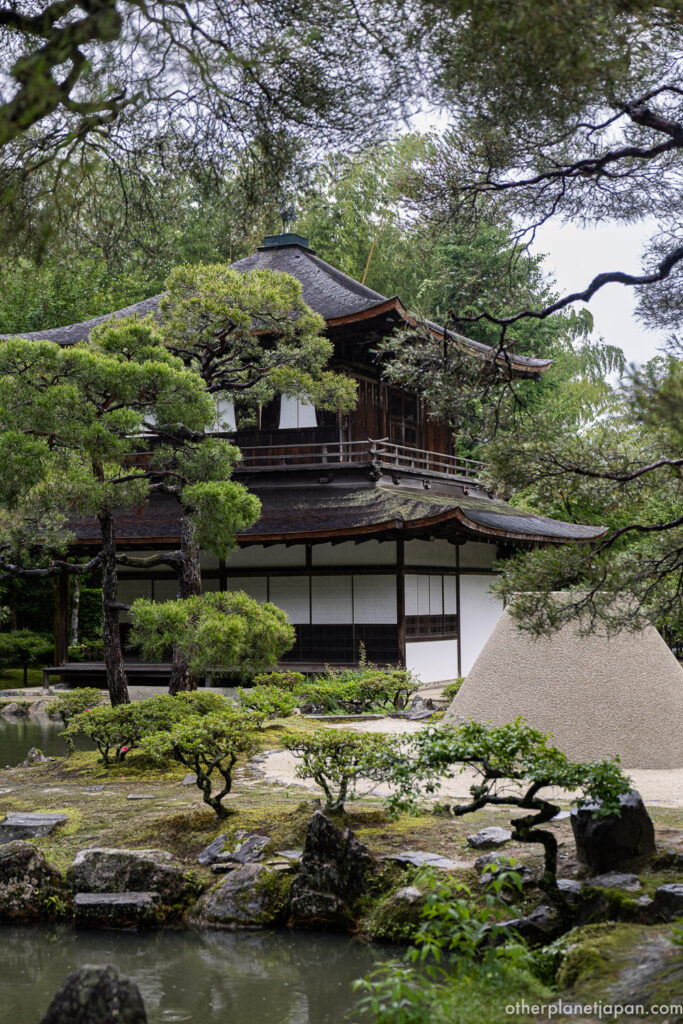
What I can tell you is that overcast light suits them. Under hard sun, sand is just bright. Under a low grey sky, every ridge throws its own soft shadow, and the whole surface reads like corduroy, like something combed that morning. It probably was.
Into the Moss, Uphill
The garden at Ginkakuji is a one-way circuit, and it climbs.
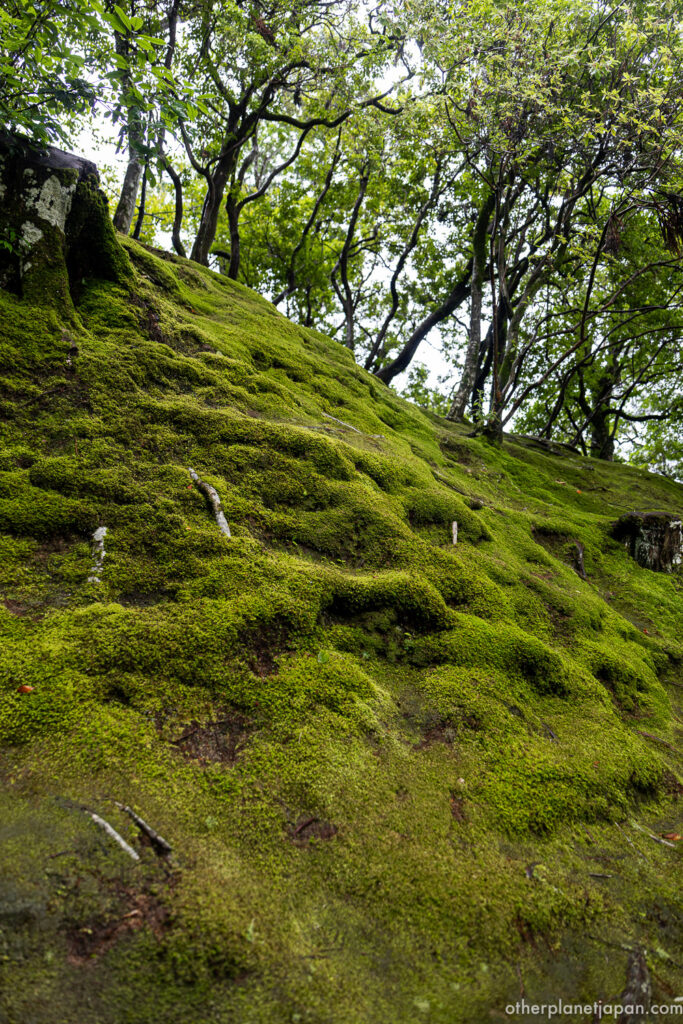
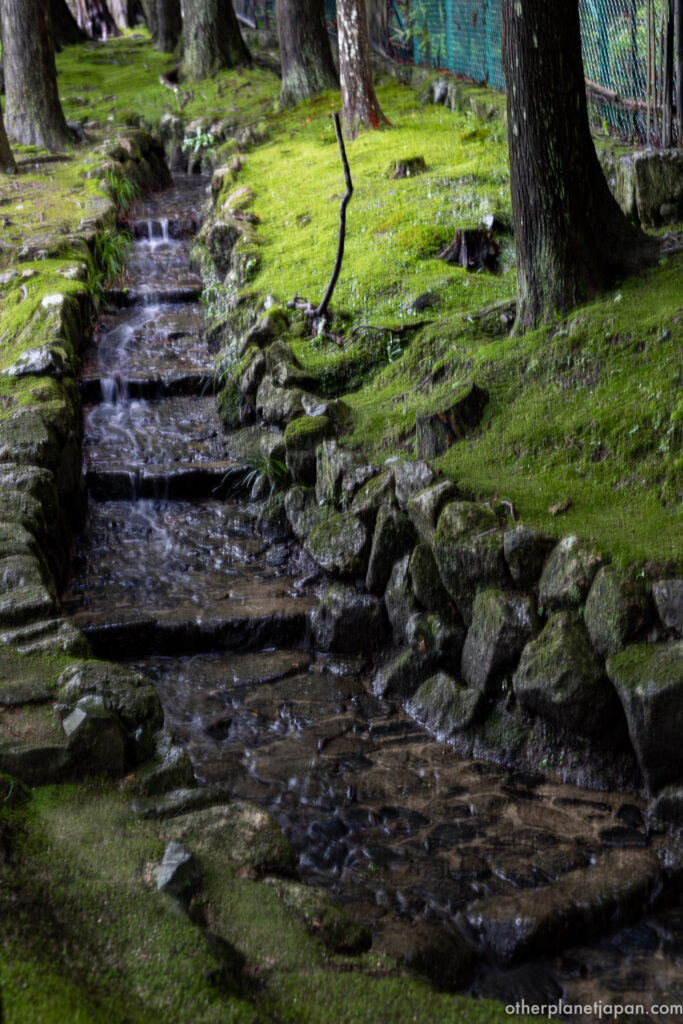
You leave the sand behind and walk up a wooded slope. This is where the rain earns its keep. The moss was luminous — that particular green that only comes when everything is wet, as if the color has been turned up from inside. Low light filtered through the canopy at a flat angle, catching the surface of each clump so that the whole hillside seemed to glow without a visible source. I stopped walking. Underfoot, through my shoes, the ground felt soft in a way dry ground never does. I’m so glad I came on a rainy day.
For the full moss experience, the destination is Kokedera, the moss temple. But Ginkakuji has something Kokedera cannot offer.
The Rocks Nobody Stops For
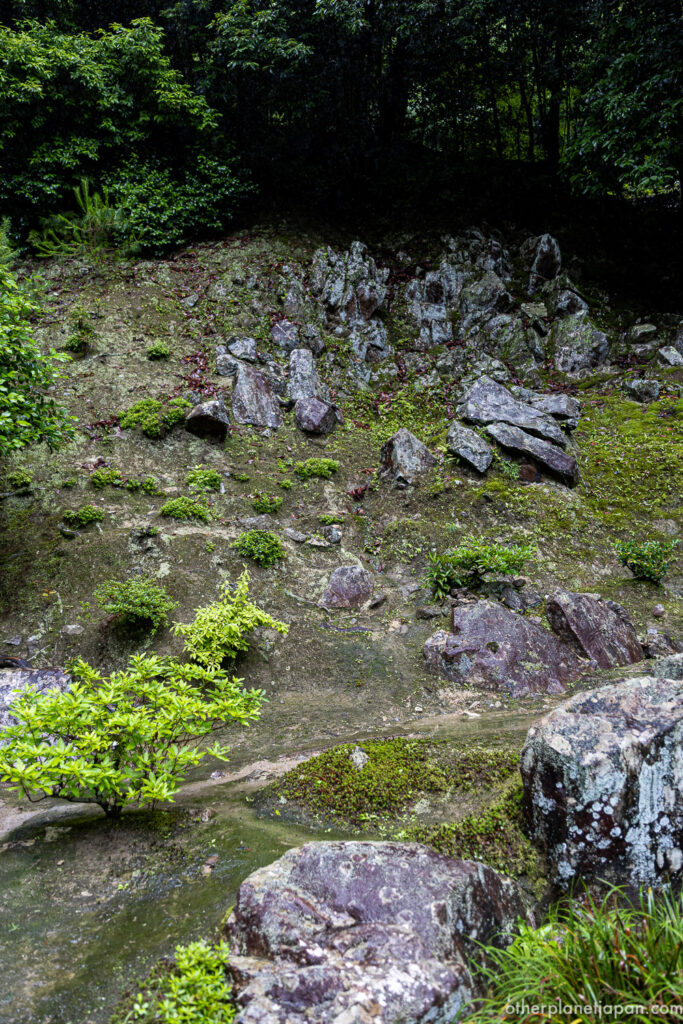
There is a rock arrangement here that almost no one stops for.
The rain had picked up. Visitors were hurrying past, heads down, umbrellas tilted. A group of Western tourists passed by, and for a moment I wanted to stop them, to explain what they were missing.
To the eye, it looks like scattered stones on a mossy slope. But this is a kare-sansui — a dry rock composition — excavated in 1931 on the site of a former teahouse, built in deliberate homage to the celebrated dry garden at Saihoji: Saihoji’s version was the teacher; this is Ginkakuji’s answer, sitting here in the rain with almost no audience.
I did not stop the Western visitors. I said nothing. Partly because my English small talk in the rain is limited. Partly because until my own recent visit to Saihoji, I had walked past this spot every time too.
Nearby is a spring, the well Yoshimasa is said to have favored for his tea. The water is still clean enough that it’s used for tea gatherings today, and the stonework around it is original.
And just beyond, a stone torii stands in the garden. The Muromachi period is beyond its reach — the torii came later — but it has weathered enough centuries to tell its own quiet story. Moss has worked its way into every joint. It leans, very slightly, in a way that the management has apparently decided not to fix.
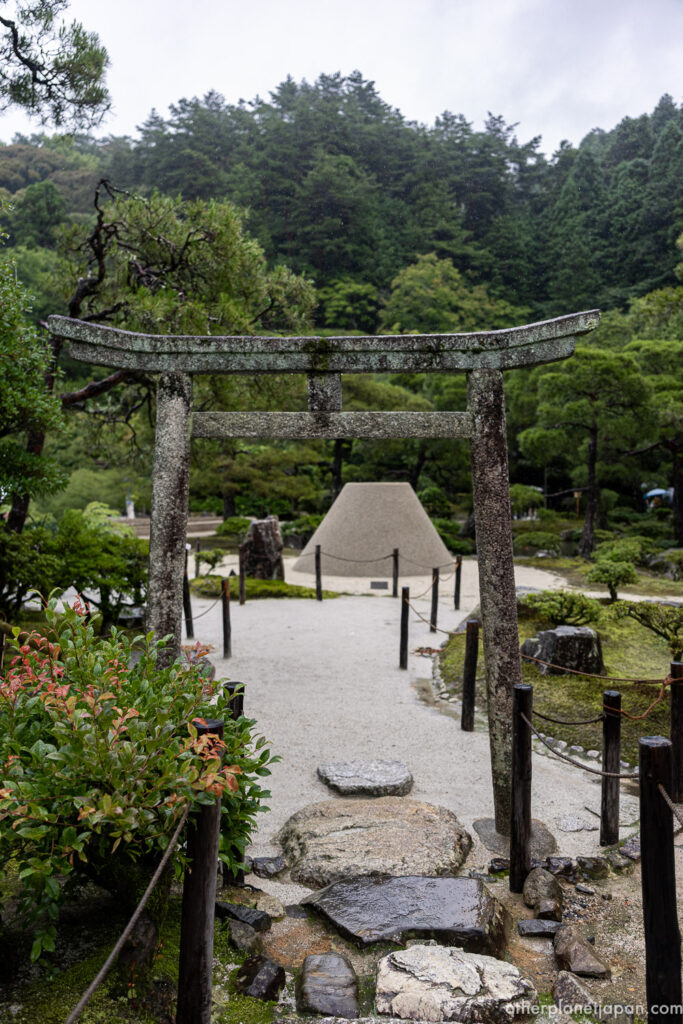
I lingered here longer than the sign probably warranted. Mostly because everyone else was leaving.
An Unfinished Cup of Tea
Most people arrive at Ginkakuji by way of the Philosopher’s Path, and you should too if you have the time. The final approach narrows into that walled lane, tall hedges on one side, low bamboo fencing on the other, funneling you toward the gate.
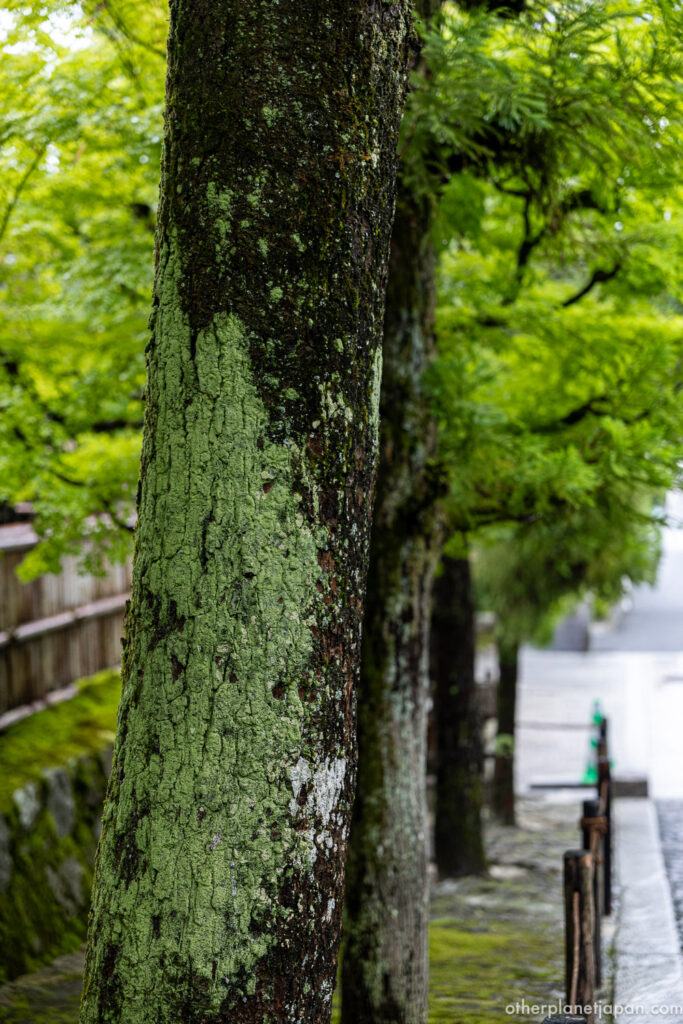
On the way out, on Ginkakuji-michi, the shopping street that leads down from the temple, I finally stopped at a yatsuhashi shop I’d somehow walked past for years. Three elderly women run it. Unmistakable old-shop feel. Yatsuhashi and tea, three hundred yen. Ginkakuji is a circuit garden with nowhere to sit. I’d been on my feet the entire visit. I sat.
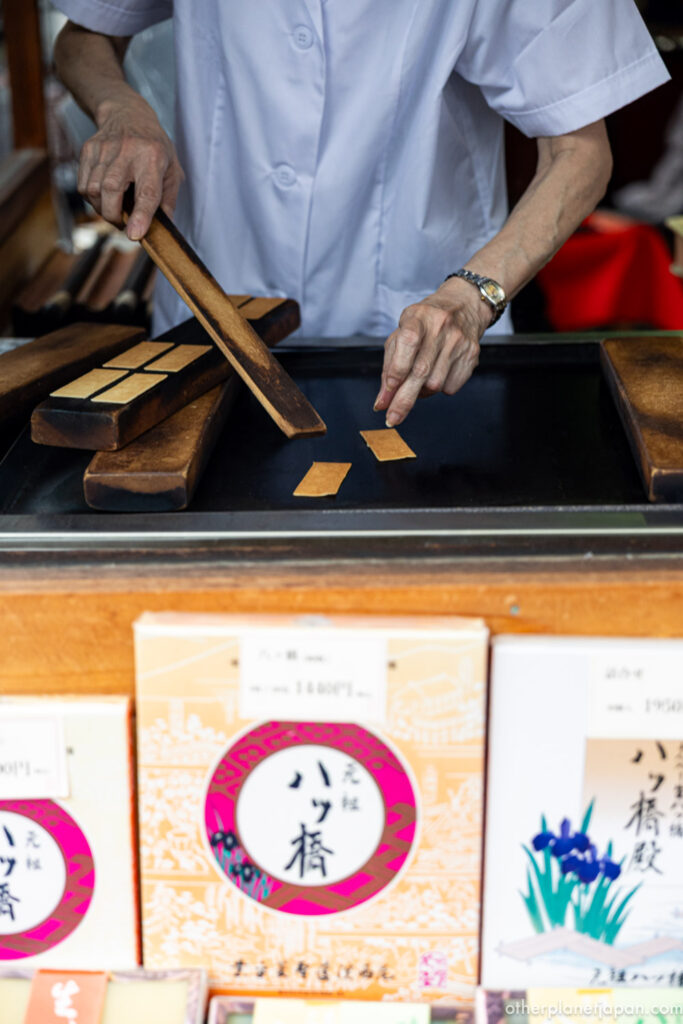
This is the only place in the neighborhood, they told me, that still makes nama-yatsuhashi — the soft, unbaked kind — entirely by hand. Kyoto’s signature souvenir was once yatsuhashi and nothing else. And there, on the counter beside me, they were toasting the soft kind over heat.
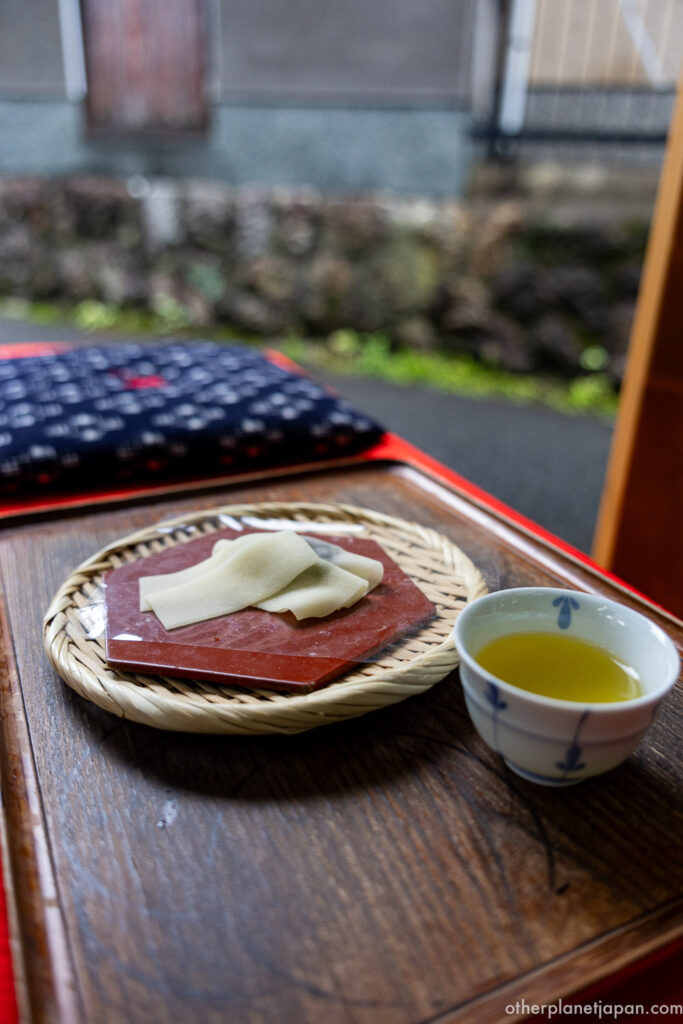
I wanted to ask why. If the raw version is what people love, why toast it? I wanted to ask how old the shop was. But the three of them were busy — pressing souvenir boxes into the hands of foreign travelers, giving directions to a cluster of school-trip students. So I let them work. Next time, I’ll ask.
The answer never came. The visit ended without resolution. Walking back down the hill, tea still warm, I thought: of course. This is the place where the silver is missing, where the most important rocks are the ones everyone walks past, where the questions I most wanted to ask went unanswered. In the historic heart of Higashiyama culture, being unfinished isn’t a failure. It might, in fact, be the point.
That, I think, is wabi-sabi — the untranslatable thing I mentioned at the start. The concept I can’t explain in English. The one I don’t fully understand in Japanese. Standing here in the rain, out of questions, I feel closer to it than I ever do with a dictionary. And if that’s as close as I get, I’ll take it.
Visiting Ginkakuji: Practical Information
| Admission | 1,000 yen — cash only |
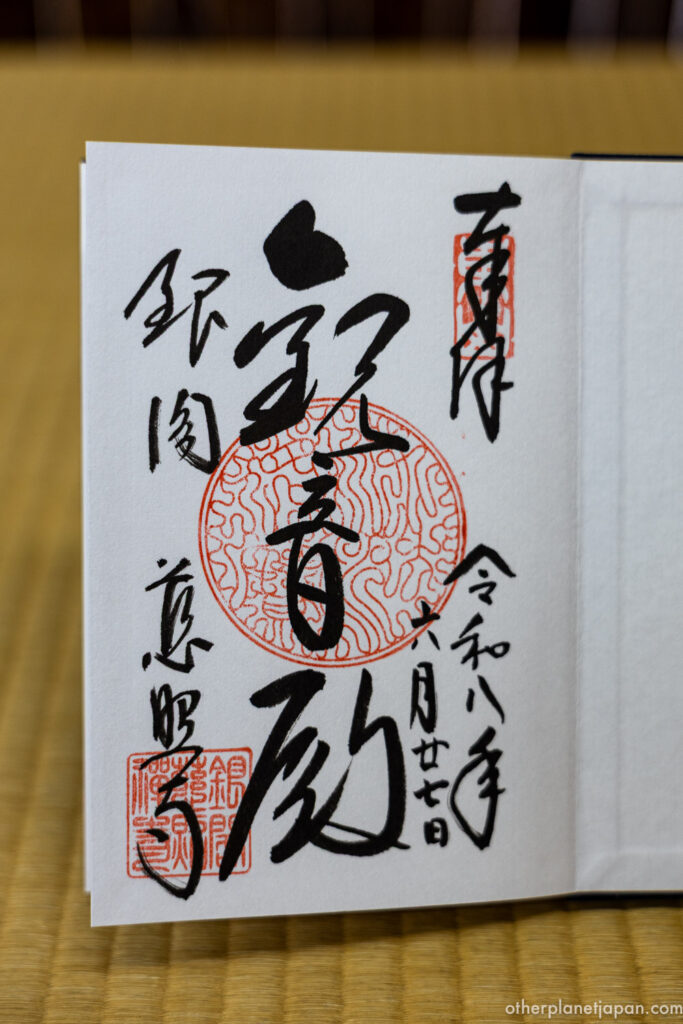
| Goshuin | 500 yen — cash only |
| Gift shop | Credit cards accepted |
Goshuin: Hand over your seal book just inside the entrance and collect it on your way out. Calligraphy is written directly into the book until 16:00; after that, and sometimes all day during peak periods, a pre-written slip is provided instead.
Bus access: The nearest stop is Ginkakuji-mae, served by lines EX100 and 105. The EX100 runs from Kyoto Station for 500 yen. Alternatively, lines 5, 7, 32, 102, 203, and 204 stop at Ginkakuji-michi for a flat 230 yen, leaving a short walk uphill to the gate.
Best time to visit: A rainy morning, honestly. The moss deepens, the timber darkens, the sand garden reads more clearly under soft light, and the crowds thin. Ginkakuji is not on the standard koyo circuit, but the grounds hold about two hundred maple trees. They begin turning in mid-November and peak in late November — a quieter alternative to the famous autumn temples nearby.
Accessibility: The flat garden areas near the sand are wheelchair- and stroller-accessible. The hillside portion of the circuit involves slopes and steps and is not.
Official site: Shokokuji: Ginkakuji