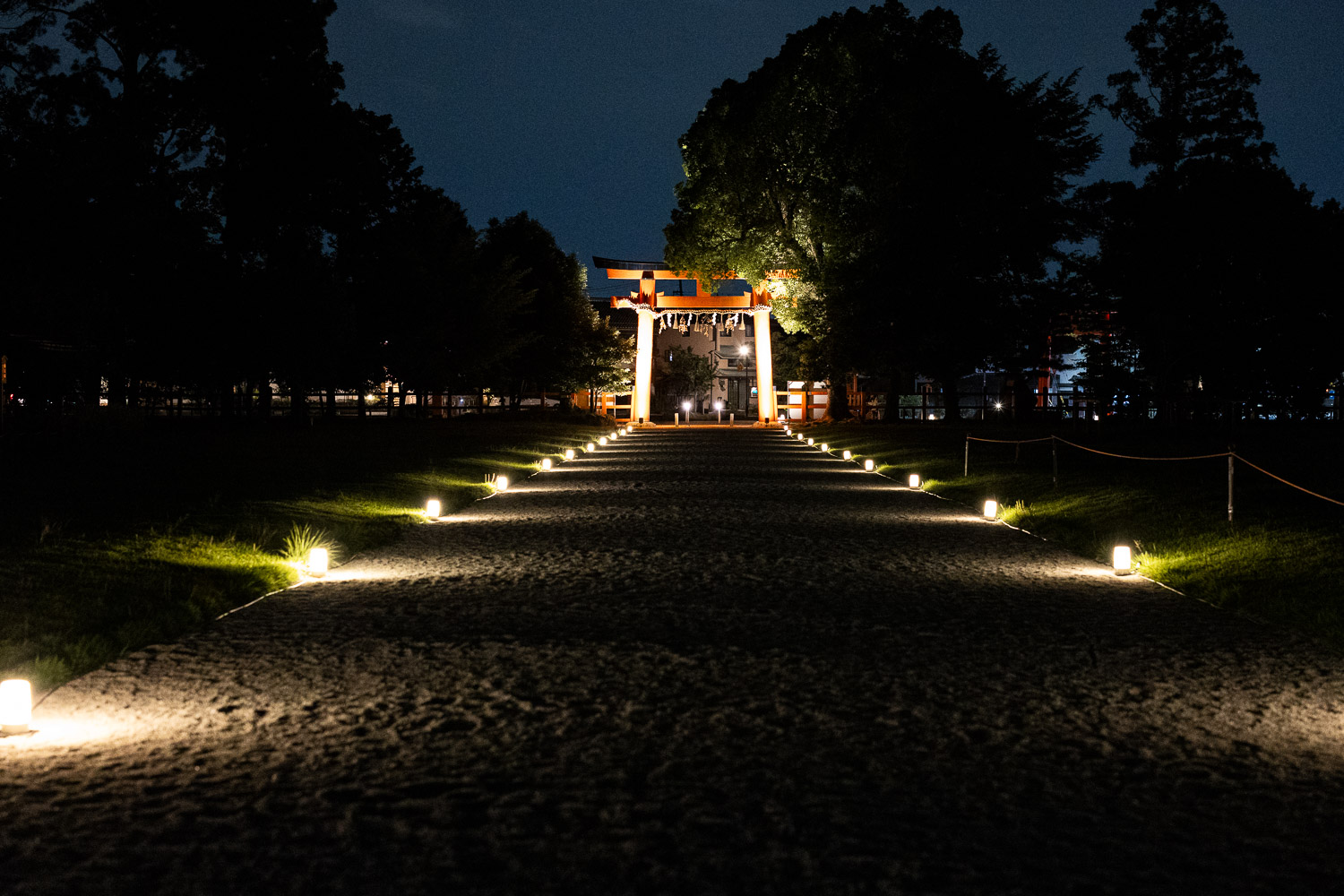
I picked July 15 for a reason.
That night was Yoiyama, the eve of the Gion Festival’s grand procession. Every human being in Kyoto, as far as I could tell, would be funneling toward Shijo-Karasuma to drink beer under the lantern-lit floats. Which meant the Kamigamo Shrine summer illumination, way up at the city’s northern edge, would be empty. I don’t live in Kyoto, but I’ve spent enough time there to think I could read its crowds. I bought my ticket feeling clever.
The feeling lasted five minutes.
The grounds were full. There was nowhere to sit. I circled the low wooden edge of the stage building where people were waiting for the evening’s kagura dance, and every spot was taken. Confused, I started looking at what people were carrying. Long, narrow paper-wrapped bundles. I knew those bundles. Chimaki — the protective talismans sold at the Gion Festival floats, a few hours south of here.
These people had come from Yoiyama. They had done the festival, hopped on the subway and a bus, and flowed north to end their night in a cool riverbed. I hadn’t outsmarted the crowd. I had followed it here.
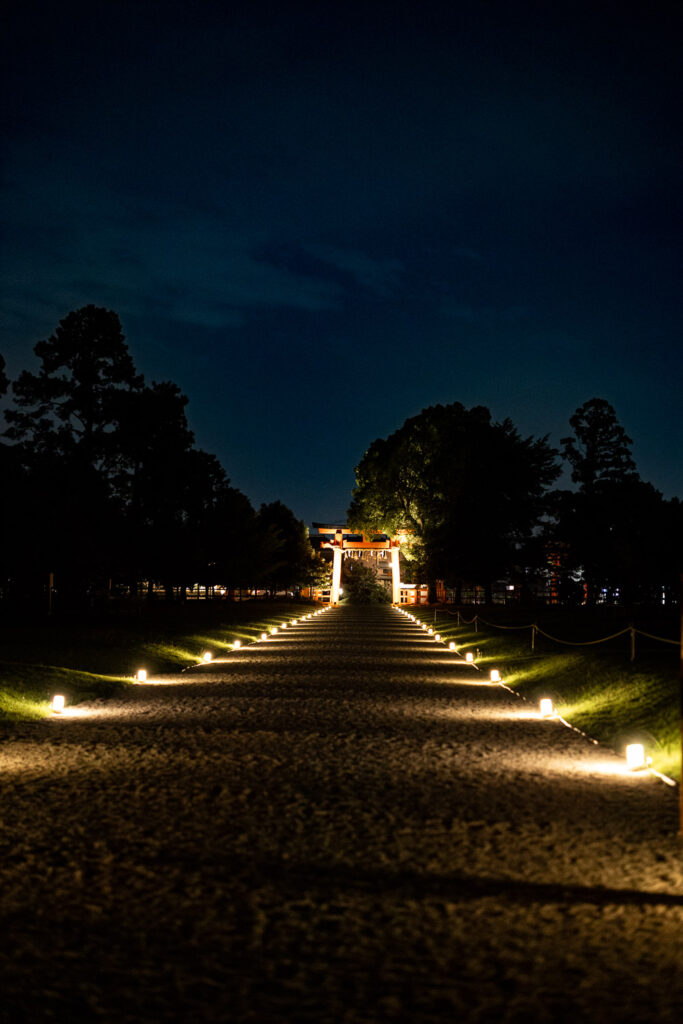
It would not be the last thing I got wrong that night. The event is formally called the Ryujin Mairi and Ashitsuke Yusuzumi, which English listings render half a dozen ways — the dragon god pilgrimage, the visit to the dragon god, cooling your feet at dusk, the refreshing evening footbath. Nobody has settled on a name, which tells you how little of the English-speaking world has been here. It runs on a logic I only worked out on the bus home. At this shrine, the question that matters is never where. It is always when.
“Where Is the White Sand Cone?”
The sand cones were white that night.
They stand in front of the Hosodono hall, a matched pair, each a little over a meter tall — two cones of sand raked to a geometric perfection that no beach ever achieves. Uplit against the dark combed gravel behind them, they looked less like sand than like snow. This is the image of Kamigamo Shrine you have probably seen, even if you didn’t know its name.
Then the priest guiding us said something strange. Visitors, he told us, sometimes come up to the shrine staff and ask: “Where is the white sand cone?”
While standing in front of it.
The explanation is simple, and I had never once thought of it. The cones change color. Freshly built, they are white. Then the rain comes, and the dust settles, and week by week they darken toward gray, then something close to black. A visitor who arrives late in the cycle stands before a dark cone and doesn’t recognize it as the thing from the photographs. So they ask where it is.
The answer isn’t “right there.” The answer is “you came at a different time.”
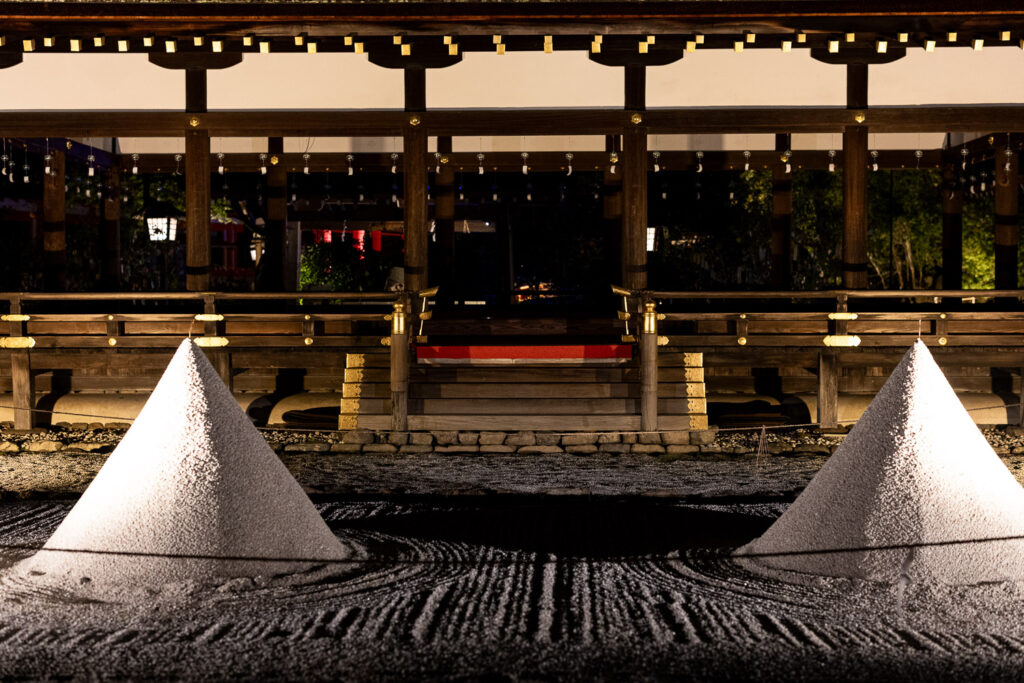
The cones are called tatesuna, and they are not decoration. Behind the shrine, to the north-northwest, rises Koyama — a conical mountain where Kamigamo’s deity, Kamo Wake-ikazuchi, is said to have descended in the age of the gods. The tatesuna are miniatures of that mountain: landing sites, built so the divine has somewhere to arrive.
And they never left Japanese daily life. The small cone of salt you may have noticed at the entrance of a restaurant in Japan, the purifying sand scattered at a building’s unlucky corners — that shape traces back to the faith around these two piles of sand. Somewhere tonight, in an ordinary doorway in an ordinary town, a tiny white mountain is quietly citing this shrine.
I happened to come on a white night. The same grounds, a few weeks later, would have shown me something else entirely.
The Sun Refuses to Set
The clock was next.
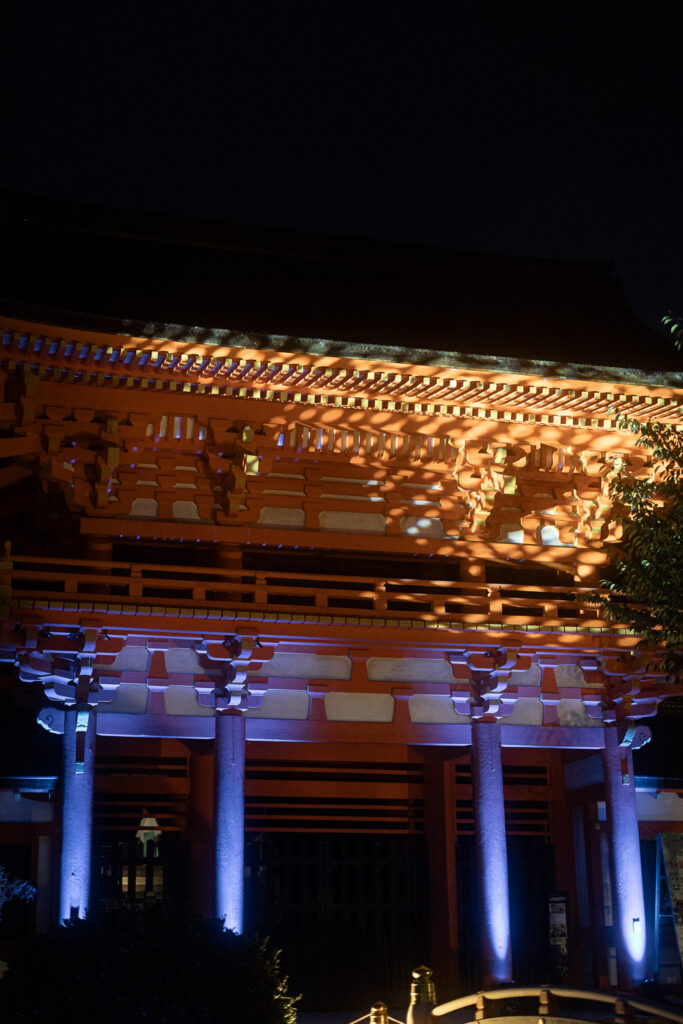
I had booked the priest-guided session, and I had booked the earliest slot. The reasoning felt airtight: get in early, enjoy it longer. What I had forgotten is that mid-July in Kyoto, the sun goes down with all the urgency of a Sunday afternoon. At 7 p.m. the sky was still bright. The illumination was technically on, but daylight was winning. The great two-story gate glowed vermilion not because of any lighting design but because it is, in fact, painted vermilion.
Meanwhile: heat. The wet, patient heat of a Kyoto July that soaks your shirt and then stays to see what else you’ve got. The kagura dance was still more than an hour away. I stood in the humidity with my expensive early ticket and waited for the planet to rotate.
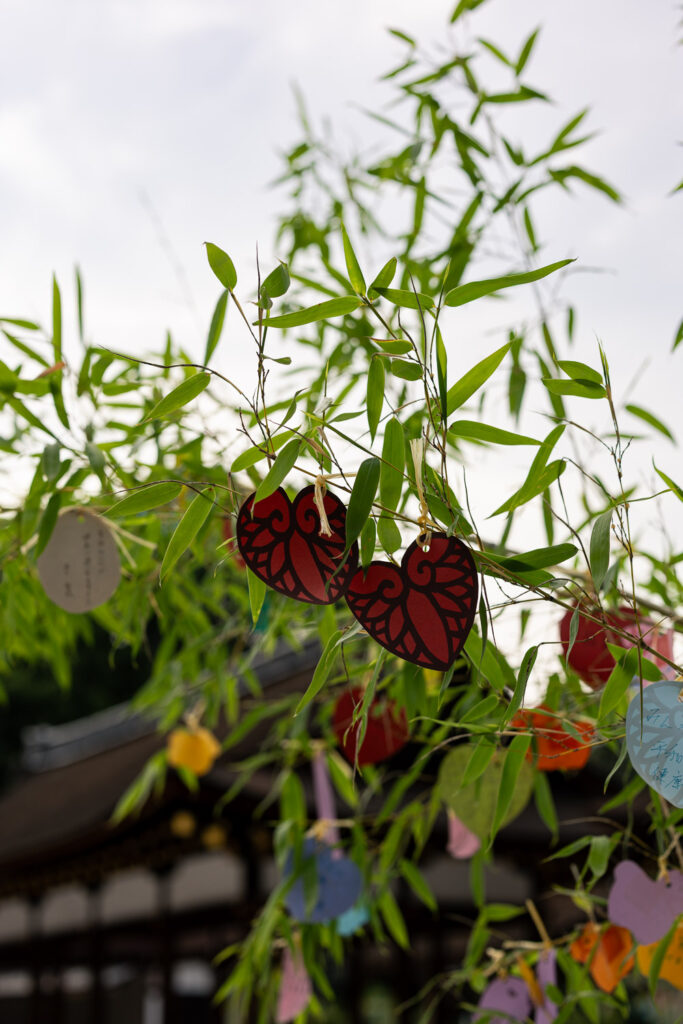
The waiting had one reward. Bamboo branches stood around the grounds, hung with paper wishes and small red ornaments shaped, I thought, like hearts. Cute, I thought. A little modern for a 2,600-year-old shrine, I thought.
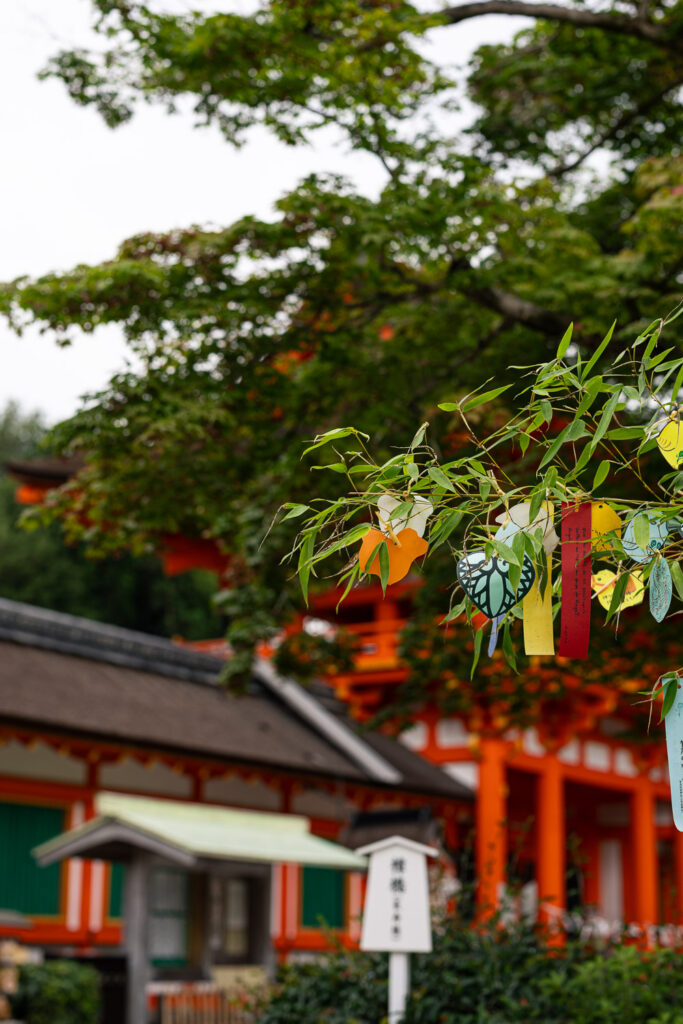
The Gate That Opens Twenty Days a Year
Deep in the grounds stands a small shrine most visitors never reach.
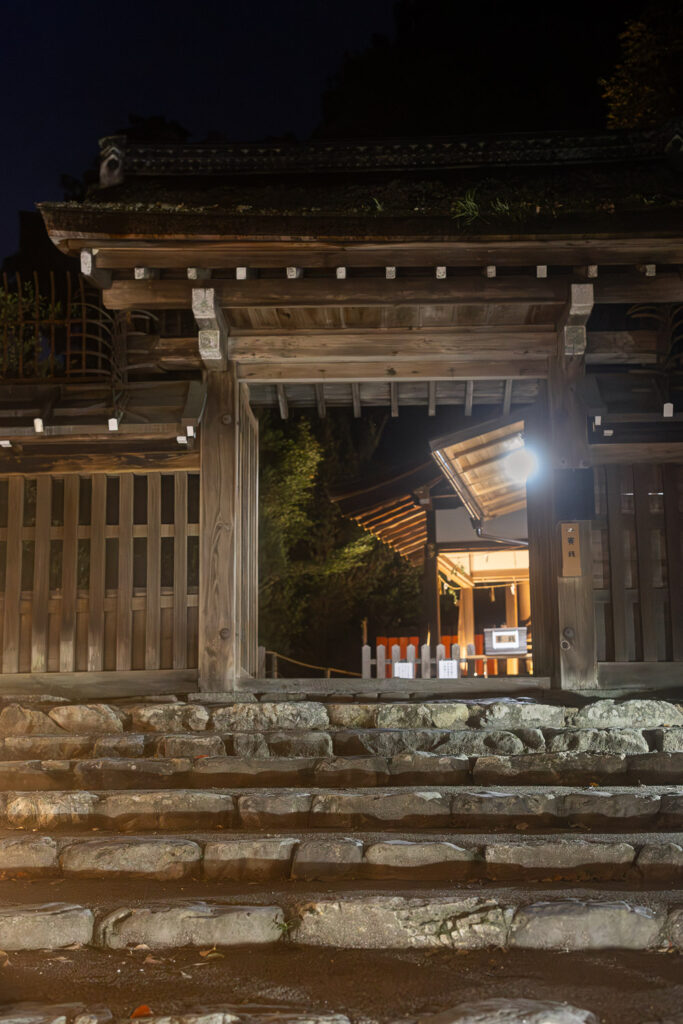
Shingu Shrine enshrines Takaokami-no-kami, a dragon deity who governs water. No one knows exactly when it was founded; records confirm it was already here in the Heian period, which gives it a floor of roughly a thousand years. For most of the year, its front gate stays shut. You pray from outside. The gate opens only on the second and fourth Sundays of each month — and, the priest added, not at all in May. He didn’t say why. May is the month of the shrine’s great Aoi Festival, so I have a guess, but a guess is all it is.
That’s about twenty days a year. During the illumination — held in the run-up to the Mizu Matsuri, the water festival on July’s fourth Sunday — it opens at night. This is the “dragon god pilgrimage” in the event’s name, and it is the rarest thing on offer here.
I climbed the stone steps. Through the open gate, the inner sanctuary was lit in a warm amber, entirely different from the cool blues of the main grounds. It was also nearly empty. The crowds that had taken every seat by the stage had not walked this far back. I had the rarest thing on the grounds almost to myself, which I would have enjoyed more if I hadn’t spent the previous hour sweating in a queue for the second-rarest.
It was here that the priest explained the little red “hearts.”
They are leaves. Futaba aoi — the twin-leafed wild ginger that is this shrine’s sacred crest, stamped into the metal fittings of every building on the grounds. In old Japanese, the plant was written afuhi, and hi meant the divine. Aoi, the priest said, means meeting the god. Legend holds that when the deity descended on Koyama, the divine instruction was to hold a festival adorned with these leaves.
So the ornament I had filed away as a cute modern heart was the oldest thing here: a plant whose name is an appointment. After that, every leaf on the grounds looked slightly different to me. This is what a good guide does. You will also need Japanese to hear any of it.
A Shrine Maiden Dances, and I Am Where I Shouldn’t Be
The Hashidono is a hall built over the stream itself.
On illumination nights it becomes a stage for the Kamo-no-Mai, a kagura dance offered to the water deity. A shrine maiden in white and vermilion, a crown of aoi leaves on her head, turns slowly with a branch of sakaki and a cluster of golden bells. The bells ring in short bursts, then stop, then ring again. Between dances, a musician stood alone on the boards and played a bamboo flute, eyes closed.
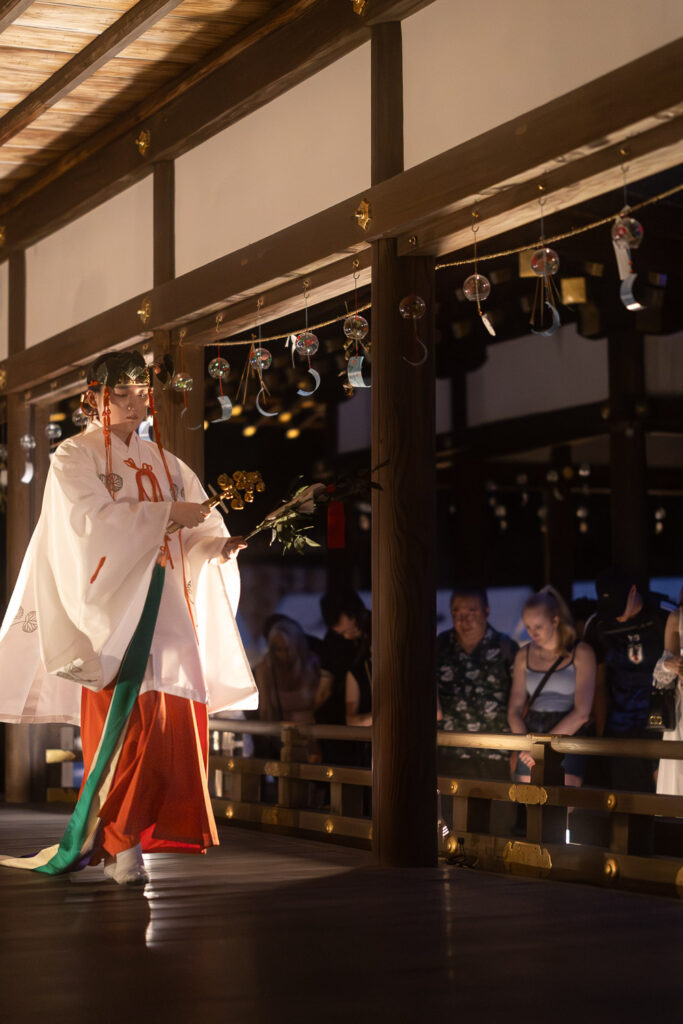
If you live in Japan long enough, you occasionally catch a kagura dance from a distance, over a sea of heads. I had never seen one from this close — close enough to hear the fabric of the sleeves move. Normally, proximity like this is not something you buy. You commission it: you request a private prayer ritual, name your intention, and the shrine performs the dance for you and the deity. It is not a ticketed experience. It is a transaction between a household and a god, and outsiders do not stand at the railing.
For a handful of nights each July, they do. I stood there feeling like a man who had wandered into a private ceremony and been handed a drink.
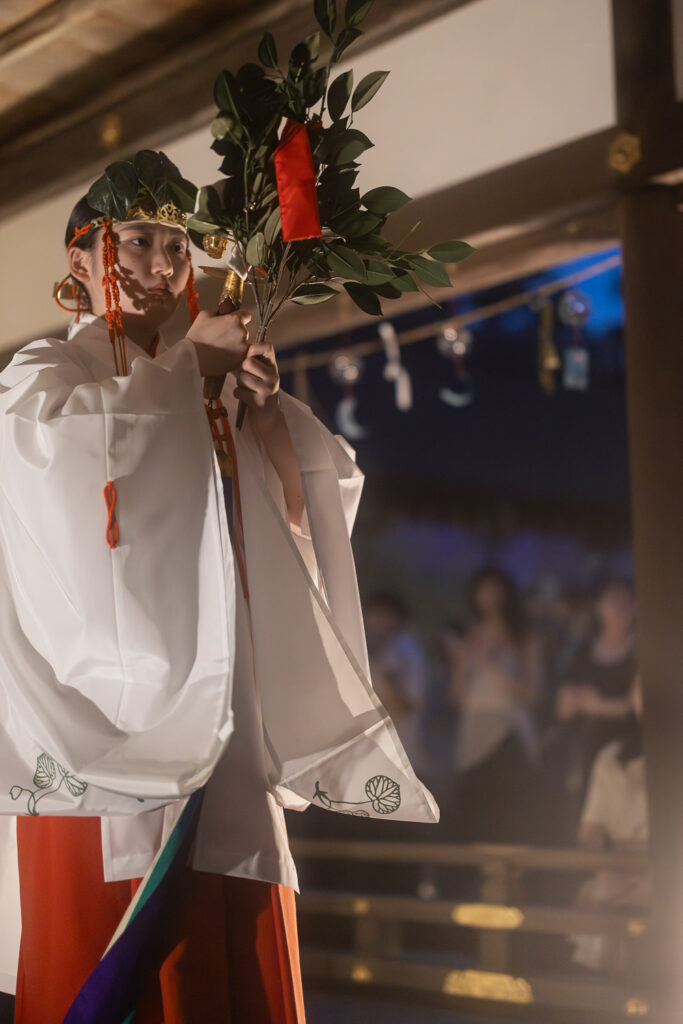
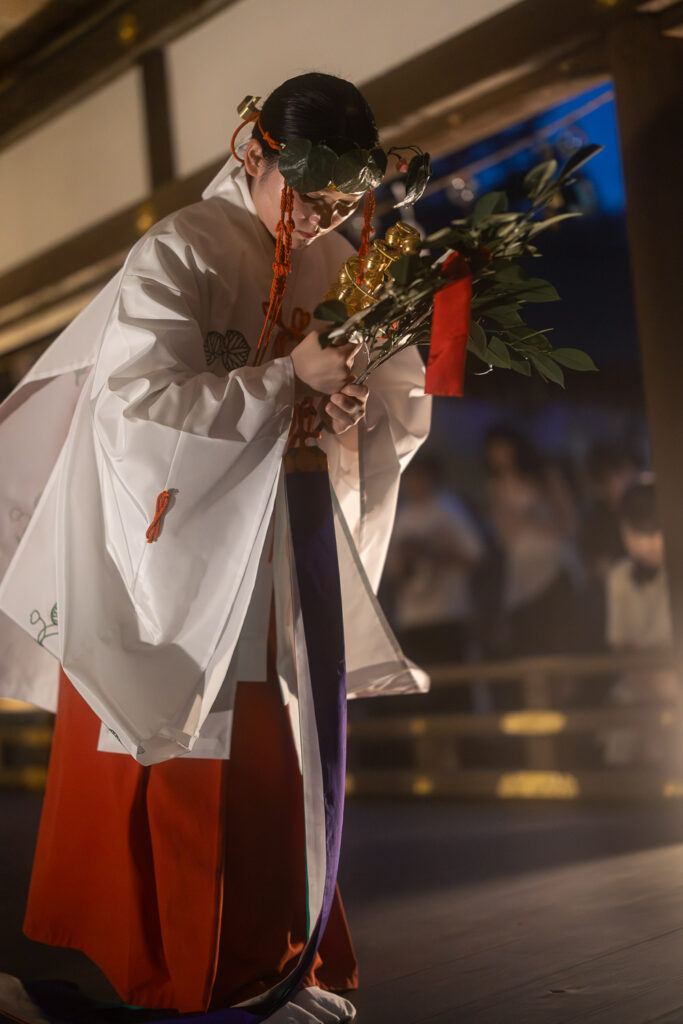
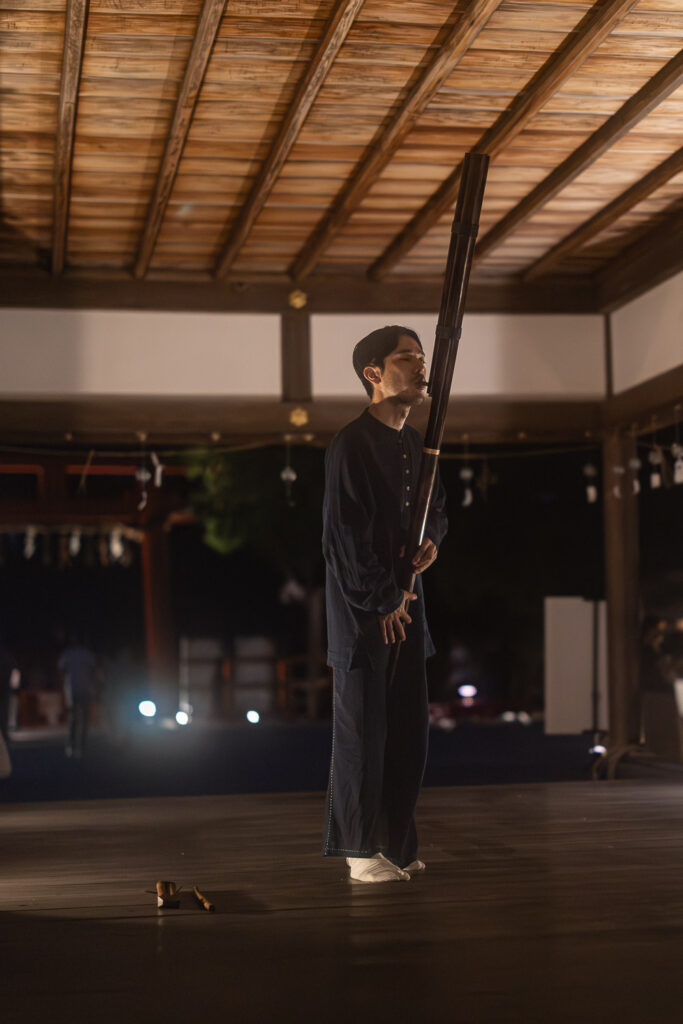
“Cold!” — Wading Into the Nara-no-Ogawa
“Tsumetai!” — Cold!
A young woman’s voice, somewhere ahead of me, the involuntary yelp of a body receiving news it did not order. I remember thinking: it can’t be that cold. It’s July. It’s Kyoto. The air is soup.
Closing time was near. I traded my shoes for a pair of the sandals stacked by the bank — hundreds of them, free to borrow — and stepped into the Nara-no-Ogawa, the clear stream that runs through the shrine grounds. This wading is the ashitsuke yusuzumi, the “cooling of feet,” and people have been doing it here for a very long time.
Cold. She was right. The stream comes down from the hills north of the shrine, and it has clearly not been informed about summer. From the ankles down I was in a different season entirely.
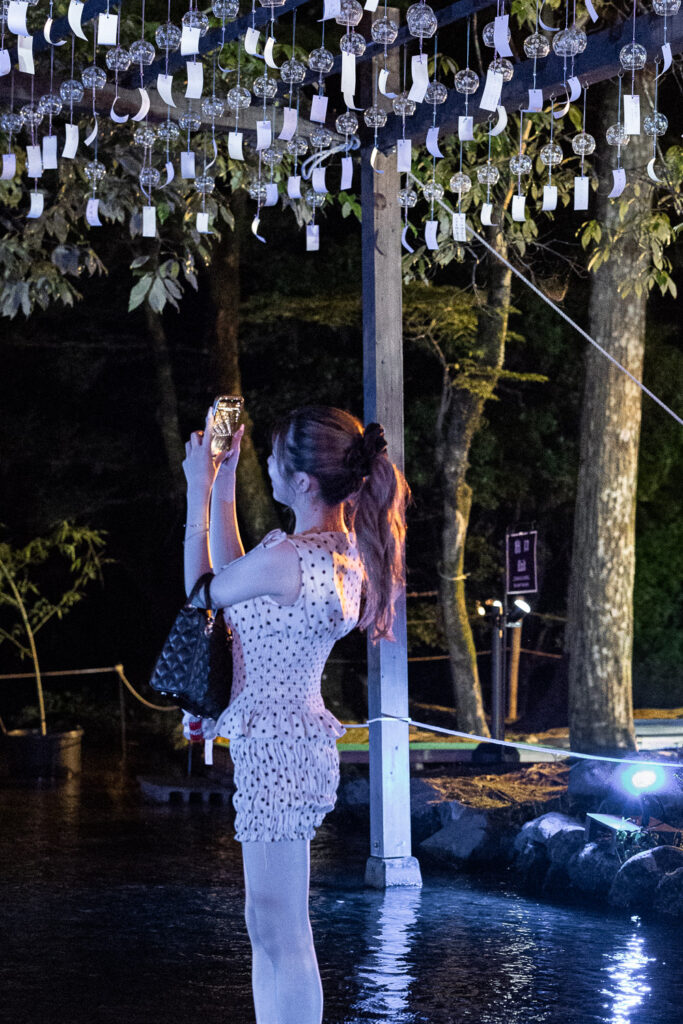
And my immediate thought, standing in that perfect water, was: I should have done this two hours ago. I’ve been robbed.
Ten minutes earlier I had been at the railing, quietly overwhelmed by my own good fortune. Now, standing in the best water in Kyoto, I was sulking. The speed of the swing embarrassed me even as it happened. Humans are shameless accountants, and I had the ledger out at a shrine. If an apology to the divine was in order, at least I was standing at one of the few places in Japan where the divine is said to be genuinely close.
But here is the thing I only worked out later, and it is the one that matters for your visit.
The regret was wrong. Cold water performs best after dark, when the air has finally loosened its grip and the lights are on the water. Step in at 6:30, while the sky is still bright and the heat still pressing, and it’s simply a cold stream. Step in late, and your ankles enter another season while the wind chimes ring above you. I thought I had mistimed the river. I had timed it perfectly, by accident. Don’t rush this part. It is the dessert course, and it belongs at the end.
What Flows Downstream
The priest’s best material wasn’t about gods at all.
Upstream of the shrine, he told us, there are farms. Farmers sometimes discard unwanted vegetables into the water, and so, from time to time, produce comes floating serenely through the sacred grounds of a UNESCO World Heritage Site. He also mentioned, in the tone of a man reporting a workplace injury, that he once tried to rescue a giant salamander from the stream and was bitten for his trouble.
I loved both stories more than any founding legend. “A clear stream running through a World Heritage Site” sounds like something preserved under glass. It isn’t. It’s a working river with farmers upstream and territorial amphibians in residence, passing through a shrine that happens to be sacred. Vegetables float through. Salamanders bite priests.
It’s the sand cones again, in liquid form. Nothing here is an exhibit. The cones darken and must be rebuilt; the river carries whatever the hills send down. This place is not preserved. It is maintained — by hand, continuously, for more than a thousand years. That, more than any national treasure designation, is what you’re actually looking at.
A Thousand Wind Chimes: Where to Hear Furin in Kyoto
Then the sun finally quit, and the grounds transformed.
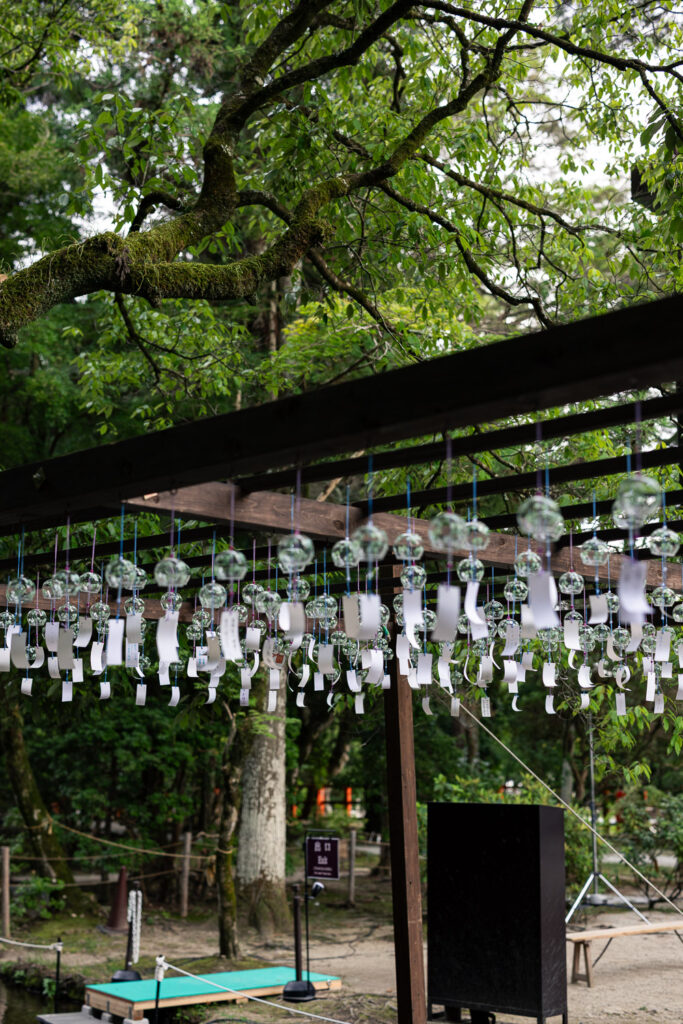
Blue and green light in the trees. The gate glowing against a black sky. And over the stream, hung from wooden frames, more than a thousand glass wind chimes, each with a paper strip trembling beneath it.
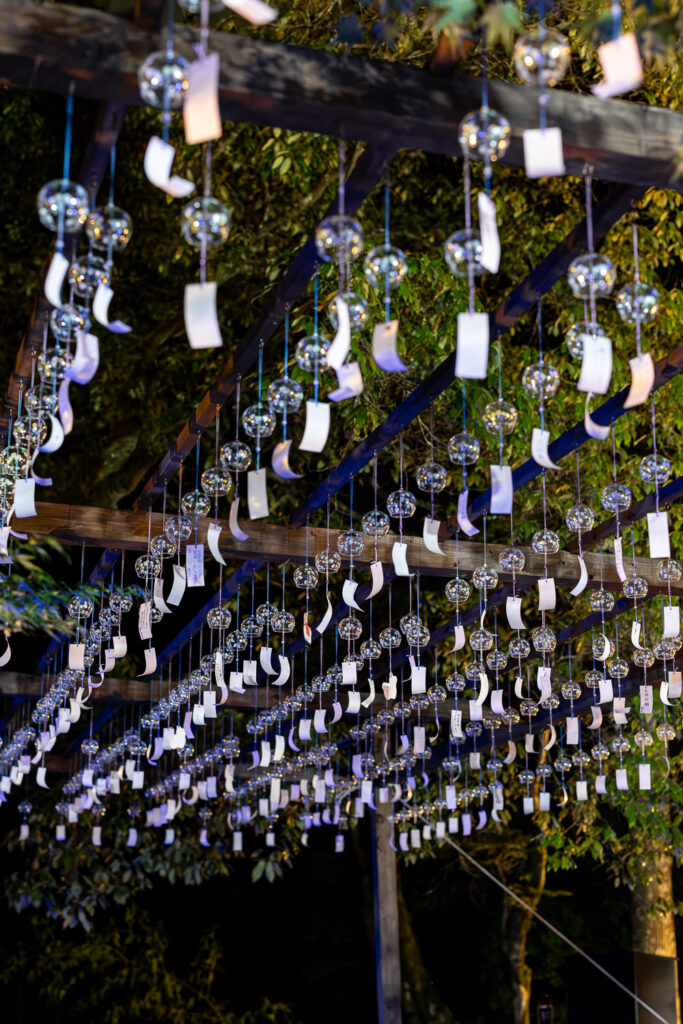
One wind chime makes a clean, small sound. A thousand make something else — not a chime anymore but a texture, a fine-grained shimmer that never quite stops, closer to rain than to bells. These are furin, and Japan has an old idea that coolness can be manufactured through the ears: the temperature doesn’t drop a single degree, and yet you feel cooler. Call it a trick. Standing under that ceiling of glass with my feet still cold from the river, I can report the trick works.
If you have seen photographs of a Japanese shrine buried under hundreds of colored glass bells, they were probably taken at Kawagoe Hikawa Shrine, near Tokyo. Kyoto has its own summer chimes — Heian Jingu hangs several hundred over a bridge in its garden from late June, and Shojuin, out in the tea hills of Ujitawara, hangs two thousand — but both charge admission and both run all summer. What Kamigamo offers is a World Heritage shrine after dark, free to enter, with the chimes lit and the stream running underneath, for less than two weeks a year.
A third option opens up in summer at Matsuo Taisha, at the western edge of the city, where eight hundred chimes hang on free-to-enter grounds from June to September.
I filmed thirty seconds of it, in the order I walked it: the sand cones, the stream under the chimes, the shrine maiden, the lantern path to the torii.
What the video cannot carry is the sound. A thousand wind chimes do not survive compression into a phone speaker, and they do not survive translation into prose either — believe me, I just tried. The only way to hold that sound is to stand under it, in July, with your feet in the water.
Which brings me to the part I would have wanted before I went. Here is everything I got wrong, converted into instructions.
Kamigamo Shrine Summer Illumination: Practical Information
When It’s Held
Ten to twelve days in mid-to-late July, timed to the run-up to the Mizu Matsuri, the water festival held on the fourth Sunday of the month. The illumination exists because of that festival, not the other way round, which is why the dates move. Exact dates change annually — recent editions ran July 14–23 (2025) and July 11–22 (2026) — so check the official Kamigamo Shrine website before planning around it.
Hours and Admission
6:00 p.m. to 8:30 p.m., last entry 8:00 p.m. Admission ¥1,200 for adults (junior high school age and up), ¥600 for elementary school children (as of 2026).
What Time to Arrive
After 7:00 p.m. I arrived at opening and spent the first hour watching an illumination lose an argument with the sun. In mid-July, Kyoto stays light until well past 7 p.m. Come later, and the same ticket buys you the event as it was designed to look.
And don’t hurry into the stream. The water is at its best after full dark, once the air has cooled. Save it for last.
How Long to Allow
Ninety minutes covers it comfortably: the grounds and the sand cones, the walk back to Shingu Shrine, a kagura performance, the stream, and time under the chimes without watching the clock. Arriving at 7 p.m. and leaving at closing gives you exactly that. If you only have an hour, skip nothing except the second lap.
Wading in the Stream
Bare feet are not allowed in the water. Sandals are provided at the riverbank in large numbers, free to borrow, so there is no need to bring your own. Do bring a small towel — nothing is provided for drying your feet, and wet feet in shoes will follow you all the way home. Note that wading may be suspended if the stream is running high after rain.
The Limited Summer Goshuin
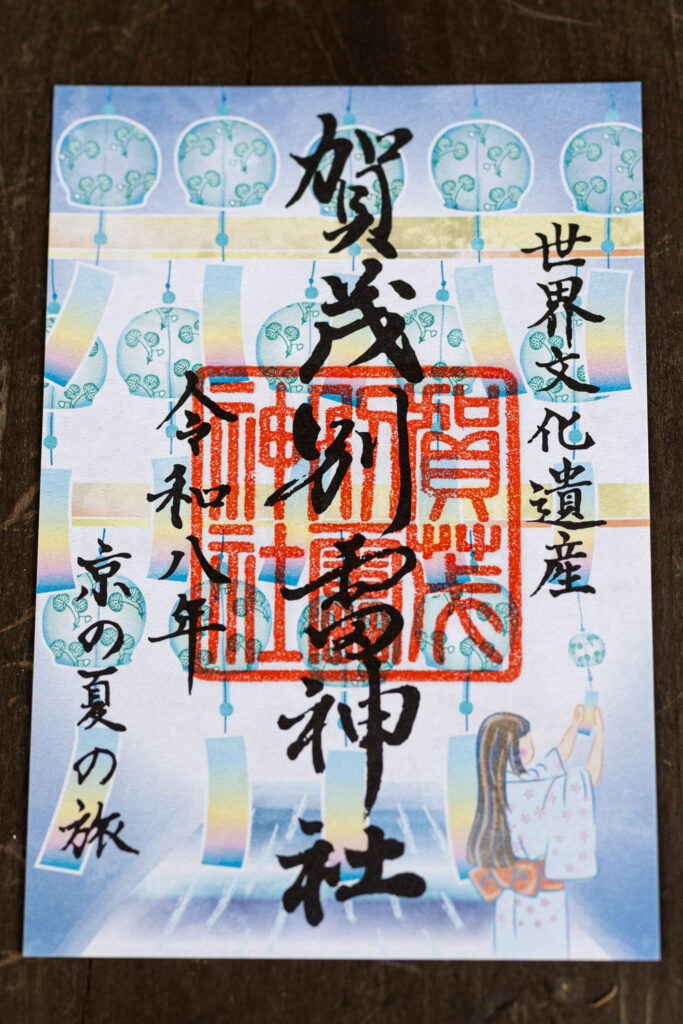
A summer-only goshuin (shrine seal) is offered during the event for ¥500. Two things to know. First, it is kakioki — pre-written on a separate sheet of paper that you tuck into your goshuin book later, not brushed into your book on the spot, so don’t queue expecting calligraphy performed before your eyes. Second, the design carries the current year’s era name and the words “Kyo no Natsu no Tabi” (Kyoto’s Summer Journey). Next year’s sheet will say something different. The one you buy exists only this July.
About the Priest-Guided Plan
Some sessions include a priest-guided visit with special access to the main sanctuary — a National Treasure that visitors normally cannot approach, opened only on occasions like this. The access itself is genuinely rare, and everything the priest told us (the darkening sand, the meaning of aoi, the vegetables, the salamander) came from that guidance.
That said, for English speakers I recommend general admission. The guidance is delivered in Japanese only, and the setting is hushed enough that even with an interpreter alongside you, whispered translation would feel out of place. General admission still gets you the grounds, Shingu Shrine’s open gate, the stream, the chimes, and the dance — which is to say, nearly everything in this article. I also can’t confirm the guided plan will be offered every year.
Getting There
Kamigamo Shrine sits at the northern edge of Kyoto city. City buses are the practical option; the nearest subway stations are a long walk away. From central Kyoto (Shijo or Kyoto Station), allow 30 to 40 minutes.