The Table at Rurikoin Temple, and the Wind That Came With It
A breeze crossed the room, then quit. A few seconds later it returned, stronger, and quit again. Just as I accepted that the pleasant part of the afternoon was over, the air moved once more, on no schedule I could detect. No electric fan has ever managed anything this erratic, and none would be forgiven for it. This is simply what a well-ventilated room does when it is built of wood on a mountainside, its panels slid open, with nothing much between the tatami and the valley air.
Nobody was complaining. The people kneeling on the mats lifted their faces each time the wind arrived, then went back to photographing a table.
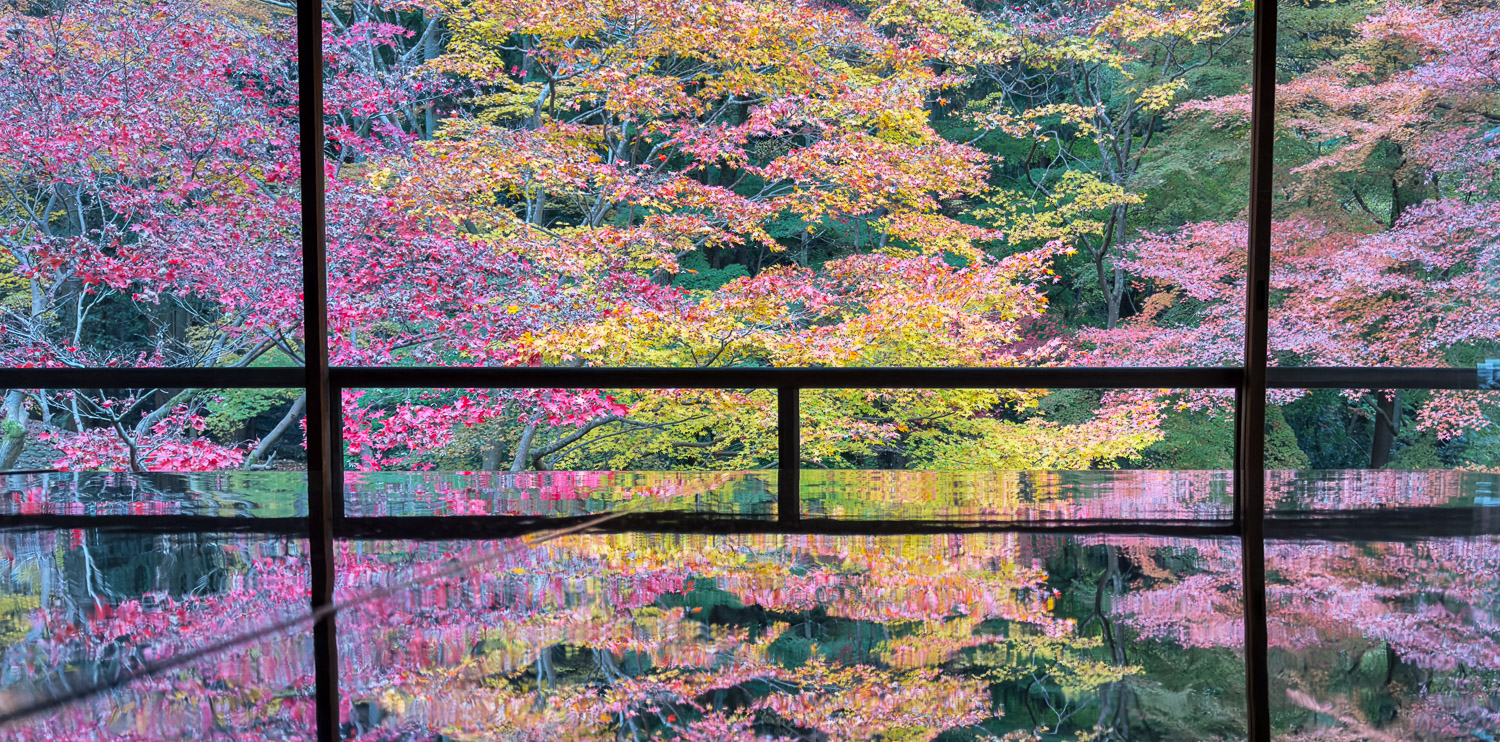
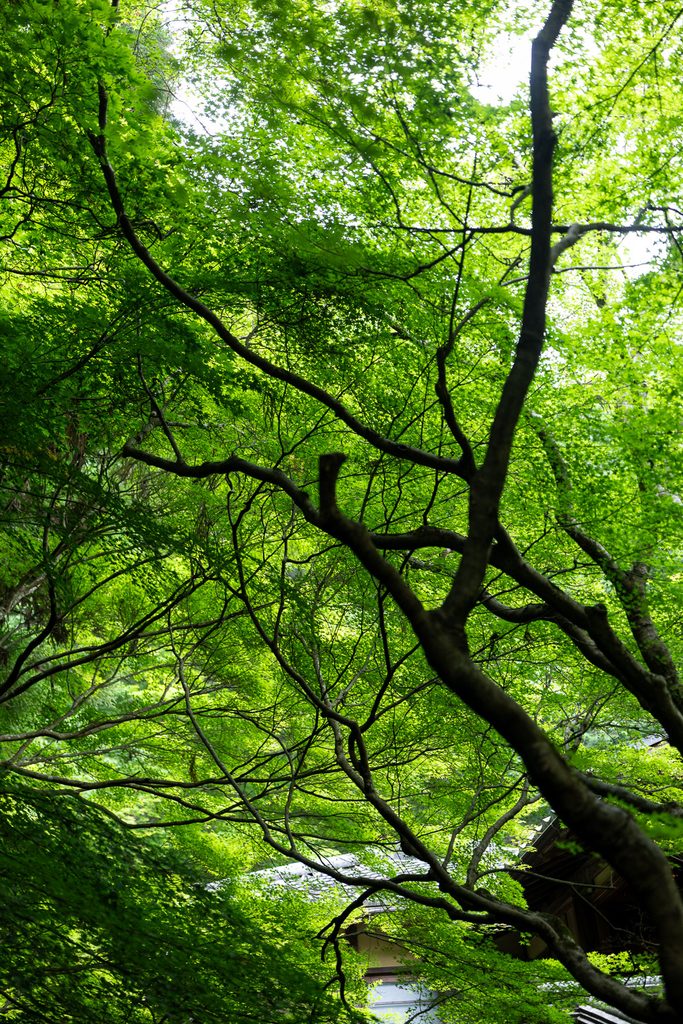
I was on the second floor of the shoin, the main study of Rurikoin Temple, in the village of Yase at the foot of Mount Hiei on Kyoto’s northern rim, and in front of me that low black table held the entire garden upside down. Most people have seen this table without knowing where it is. It circulates every November and every May, sometimes captioned as a lake, usually described as ancient, and almost always mislabeled. That afternoon it was doing its work in the fresh green of late May, and I had come specifically to find out how.
Yuka-momiji: How the Floor Reflection Actually Works
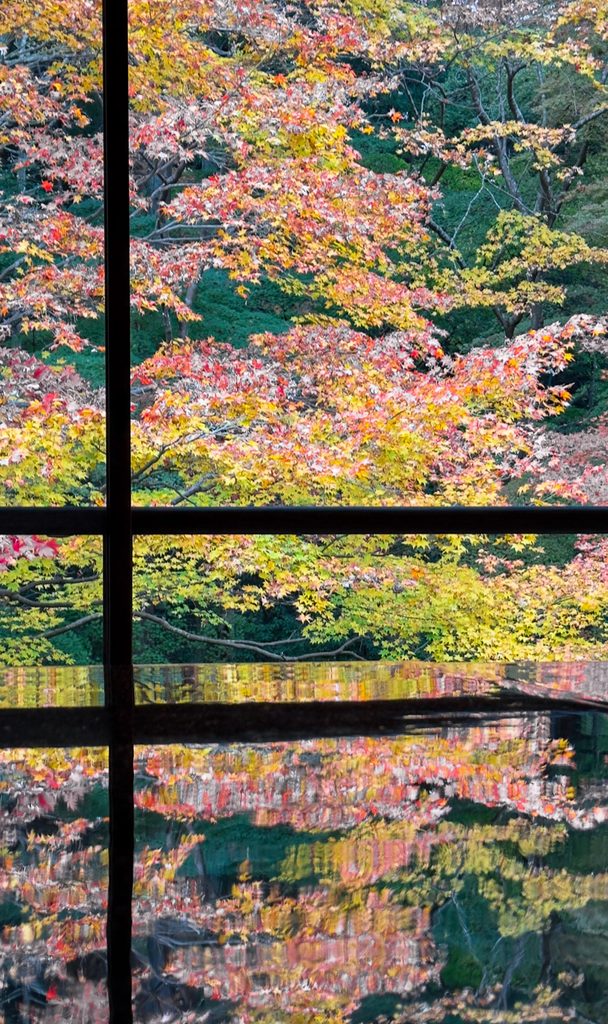
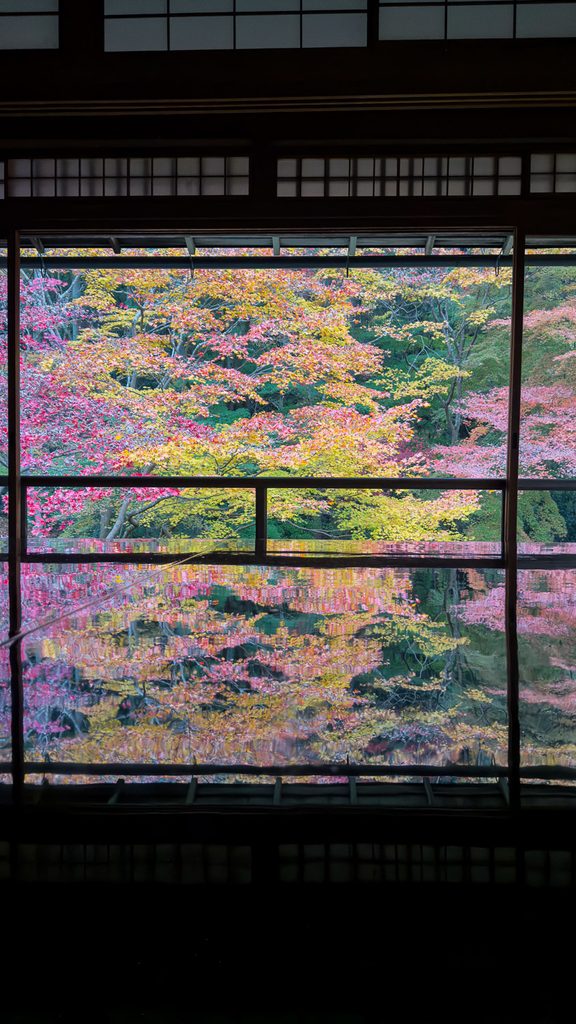
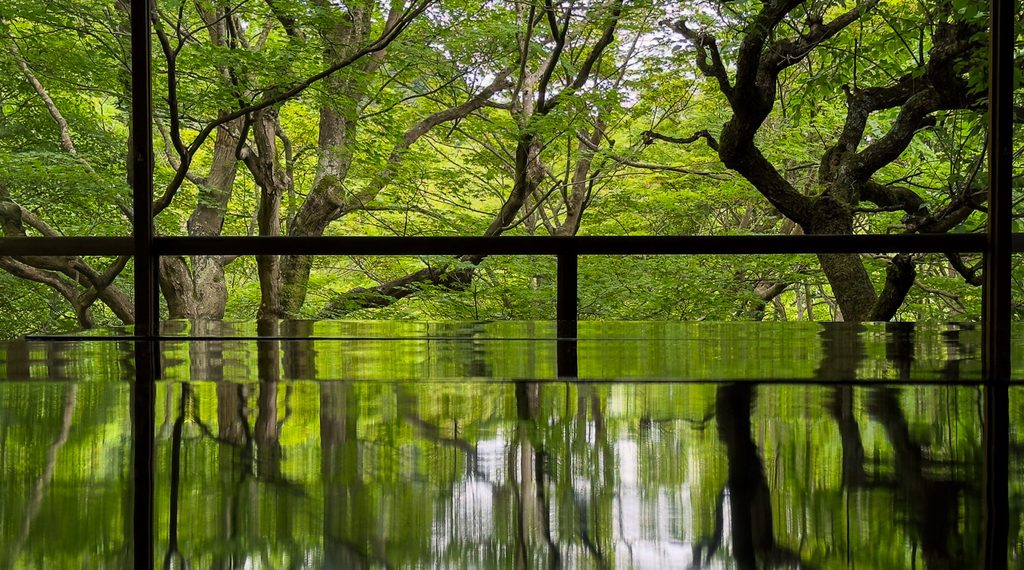
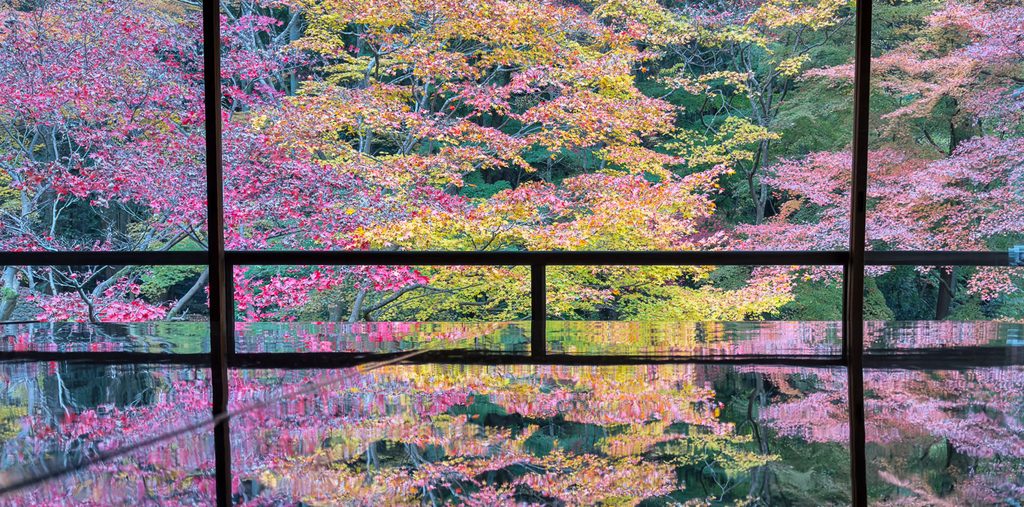
Here is the whole secret, and it took about four seconds in the room to see it. There is no water. What looks like a pond holding floating maple leaves is the ceiling-height window’s worth of garden, reflected in a tabletop lacquered and polished to a black mirror. The Japanese have a word for the effect: yuka-momiji, floor maples. It applies equally to the wide plank floors and the low writing tables that catch the same image, and once you know the word you start noticing that a handful of temples across Japan have quietly built their reputations on it.
Standing in the room explains the rest. The second floor sits level with the canopy, so the window is not looking at a garden below but into the middle of the maples themselves, and there is nothing in the frame to establish a horizon. The light is entirely borrowed: the room’s own interior is deep and unlit, the eaves cut the sky out, and the only brightness in the space arrives through that one wall of glass. A dark room, a bright window, and a surface flat enough to return the image without distortion. The illusion is not clever. It is just very well built.
And built is the word. This is sukiya architecture, the vocabulary of the tea house scaled up to a residence: slender posts of unpainted wood, plaster the color of raw silk, a coffered ceiling, transoms cut in fine lattice, and everywhere the sense that someone spent an unreasonable amount of money making things look plain. The tabletop under my elbows had the particular depth that only comes from many coats of urushi lacquer and many years of hands. Run a finger across it and there is no grain, no seam, no texture at all, which is exactly why the maples land on it whole.
Is the Green Season Unpopular? I Asked.
The room was half empty. In autumn this table runs like an assembly line; you kneel, you shoot, and after a decent interval you are politely encouraged to rotate out so the next person can kneel and shoot. On this May afternoon there was no line to rotate into. Some visitors were sitting without photographing at all, which in this room qualifies as radical behavior.
So I asked a staff member whether the fresh green season was simply less popular than the red one. Not at all, she said. Early afternoon just has these quiet spells. The empty room had nothing to do with the season and everything to do with the hour, which is the most useful sentence anyone said to me all day.
Everyone Gets the Paper. Not Everyone Gets a Seat.
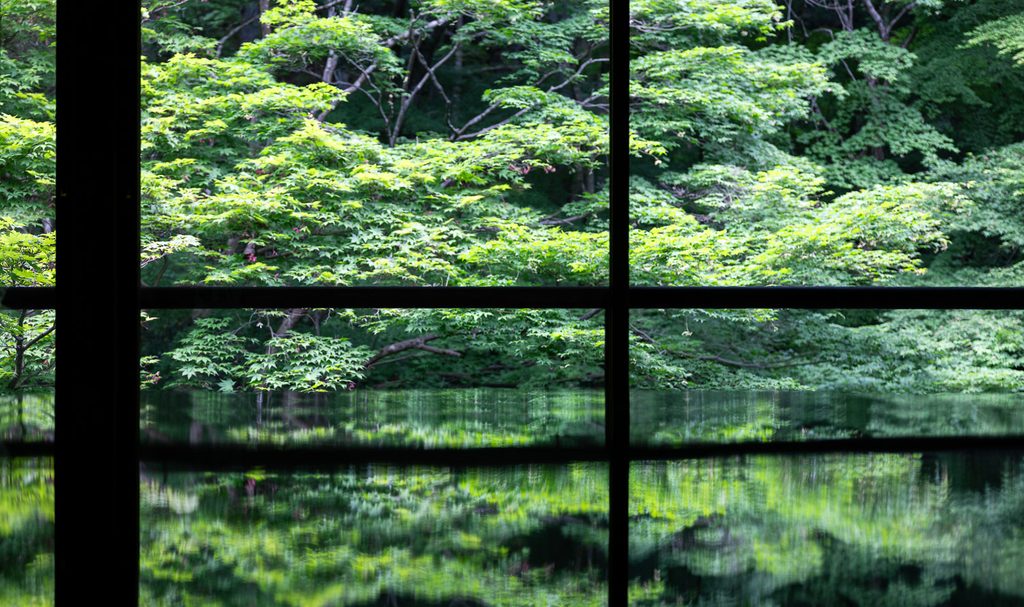
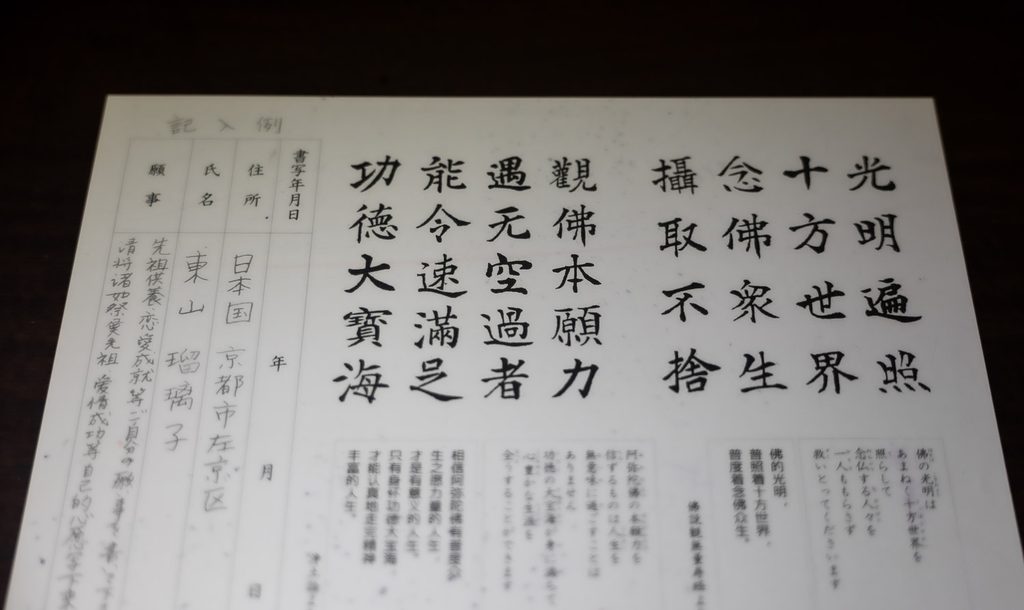
Every visitor receives a sheet of sutra-copying paper on the way in, printed with a passage in faint gray for tracing. Shakyo, copying scripture by hand, is old and slow work, and Rurikoin hands you the materials without ceremony or upcharge. Whether you actually use the paper is entirely your business. Most people take theirs home, and most of them fold it to do so, which is a small shame given what it is. Bring a document tube or an oversized file sleeve and you will get it back to your hotel flat.
The catch is the furniture. The desks set aside for copying are outnumbered many times over by the visitors holding paper, and on a busy day you simply wait for one, or you don’t get one. I didn’t. The paper is guaranteed. The desk is not.
The Mystery Was Younger Than My Email Address
A question had traveled here with me, and solving it produced the mild letdown of every explained magic act. The bigger surprise was waiting somewhere I hadn’t thought to look. This building was a luxury ryokan until the early 2000s, an exclusive inn where those polished surfaces framed the garden for paying guests over dinner. It became a temple in 2005. The ancient mystery I had been carrying around for years was younger than my email address.
The full sequence is worth knowing, because it explains the view. The land belonged to Tanaka Gentaro (1853–1922), an industrialist and politician who helped build Kyoto’s electric utility and its railways, and who kept a retreat up here in the cool of Yase. Sanjo Sanetomi, once Grand Minister of State in the Meiji government, gave the retreat its name, Kikakutei, and the plaque in his own hand still hangs at the temple. After Tanaka died the estate passed to a utility executive, and between the late 1920s and early 1930s it was rebuilt into what stands today: roughly ten acres of grounds, some 8,600 square feet of two-story sukiya residence, with the carpentry attributed to Nakamura Sotoji and the gardens to the school of Sano Toemon, two names Japanese craftsmen still say with care. Then came the ryokan years. When the inn closed, Komyo-ji, a Jodo Shinshu temple based in Gifu, bought the property to keep it intact, and reopened it as Rurikoin.
Which answers a question I should have asked years earlier: why does a temple own a room this perfectly arranged for looking at leaves? Because no monk designed it. Every angle in that shoin was calculated first for one wealthy man and then for hotel guests who expected the garden delivered to their table with the meal. Japan’s most reproduced temple photograph is, in the end, a piece of hospitality engineering.
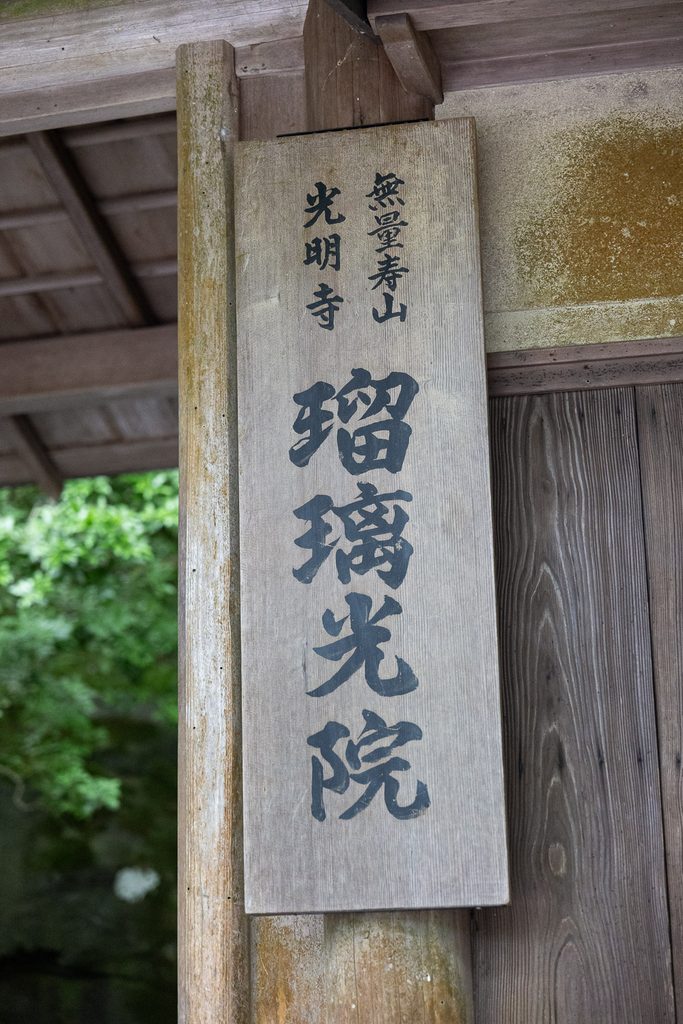
One more correction while we are here. The wooden plaque at the gate reads Muryojuzan Komyo-ji Rurikoin, and this is a temple of Jodo Shinshu, Pure Land Buddhism, whose principal image is Amida Buddha. There is no raked gravel here, no meditation hall, no koan on a wall. Rurikoin is not a Zen temple, whatever half the internet tells you.
And Yet the Bath Is From the Seventh Century
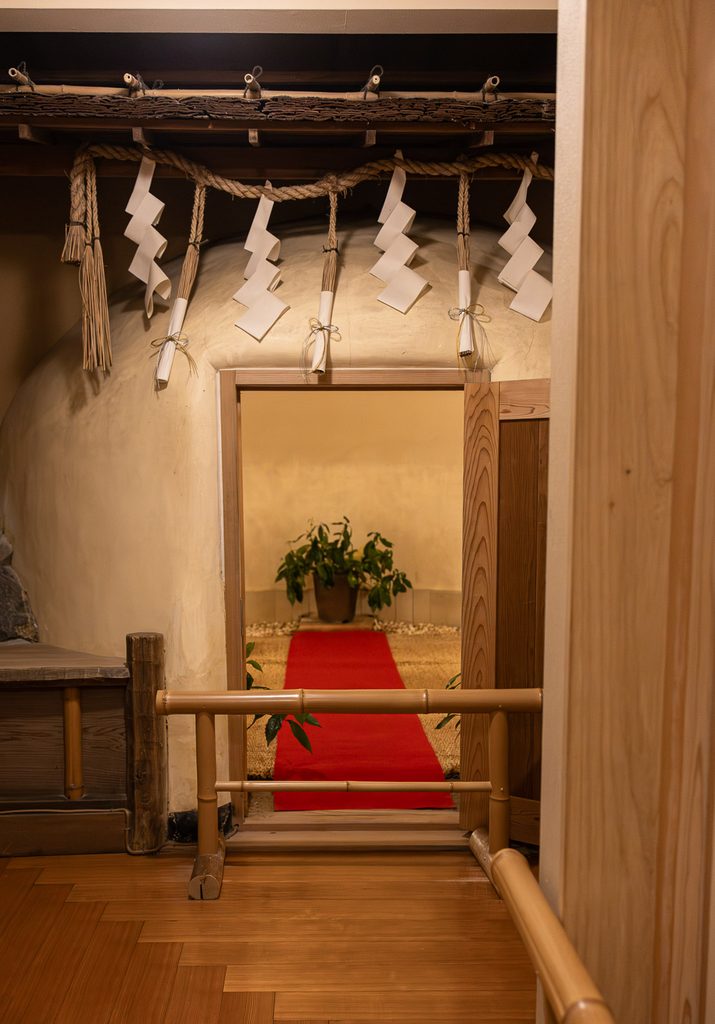
There is a bath on the grounds. A kama-buro is a domed clay steam chamber, the ancestor of every Japanese steam bath that followed, and very few survive anywhere in the country. The story attached to this one runs back to the Jinshin War of 672, when Prince Oama, later Emperor Tenmu, took an arrow in the back and had the wound treated in the steam baths of Yase. The village name can be written with the characters for arrow and back. For centuries afterward, Kyoto’s aristocracy came up this valley to recover from things.
A sacred rope hangs over the entrance, white paper streamers and all. Shinto dress, on a bath, inside a Buddhist temple. Nobody at Rurikoin appeared troubled by the arrangement, so I decided not to be either. Am I convinced the structure is thirteen centuries old? Not remotely. Go and judge it with your own eyes, then walk back up to the shoin, where the wind will still be arriving whenever it feels like it. Perhaps that part really has been broken since 672.
The Three Gardens
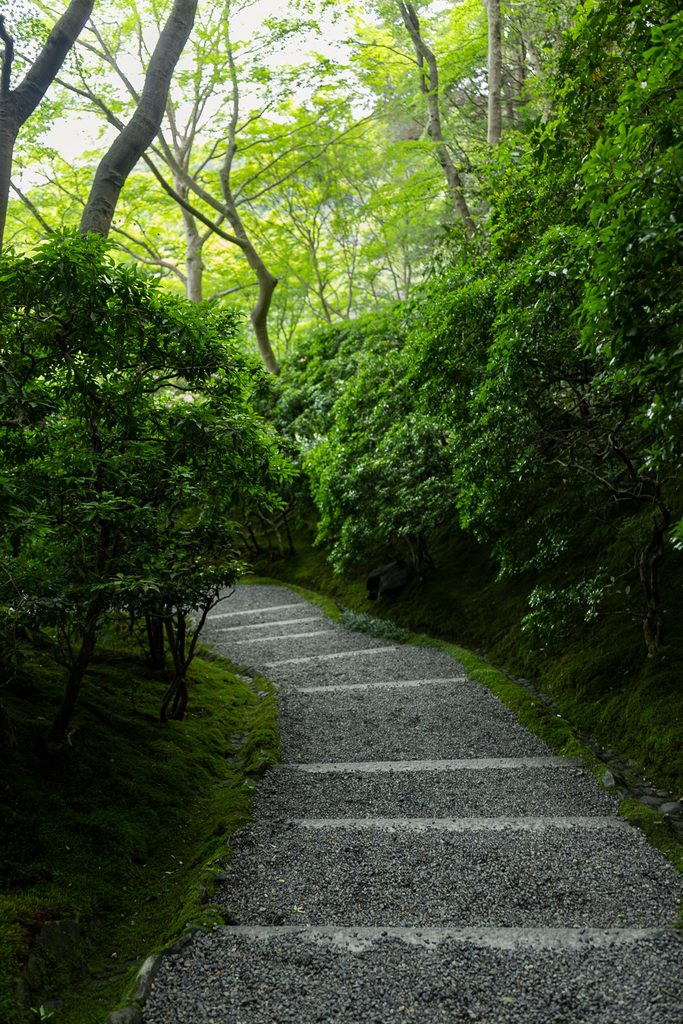
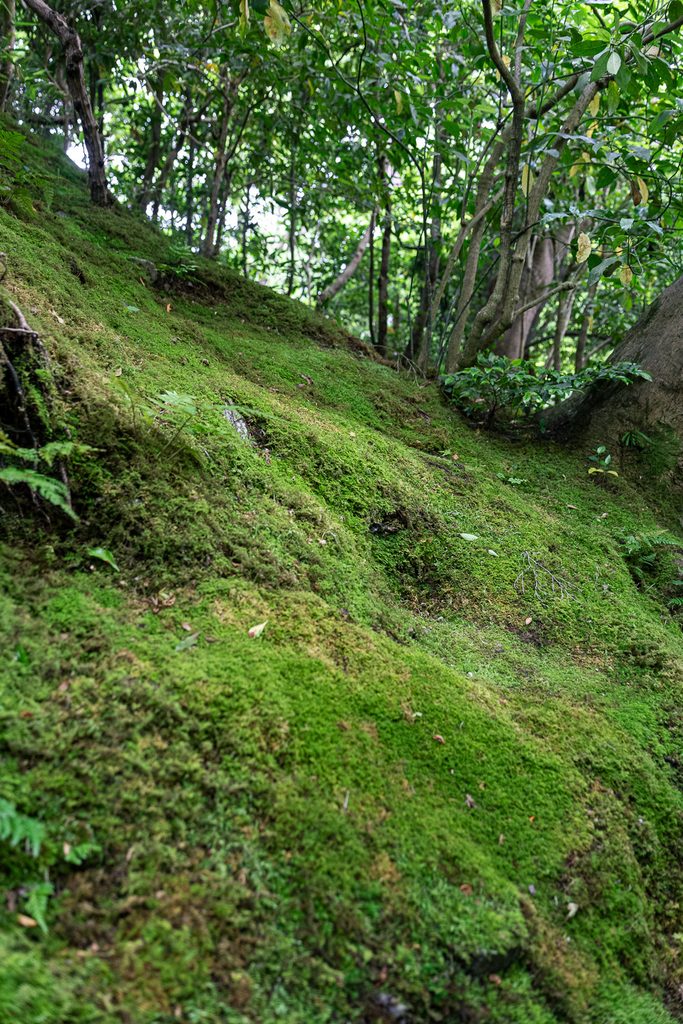
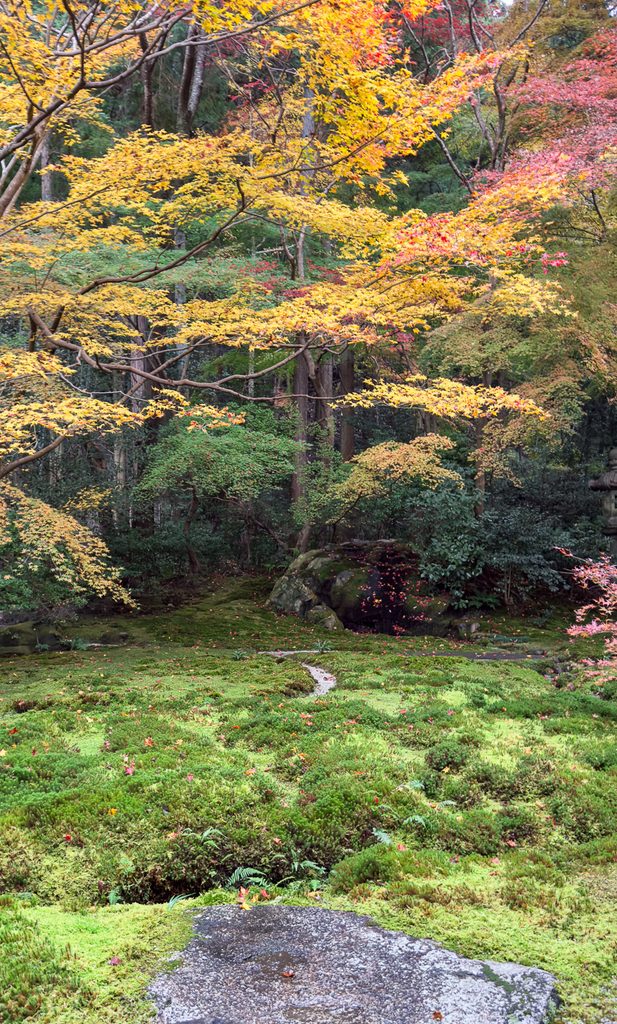
Most visitors arrive fixated on one table and leave talking about the moss. The Ruri Garden is the one the shoin looks down on, a slope of moss so evenly grown it reads as fabric, named for the deep blue-green of lapis lazuli that the temple takes its own name from. The Garyo Garden, the reclining dragon, coils around stone and running water on the lower level. And the Sanroji Garden is the one you walk through before you have seen anything else: a stone path climbing from the gate through dozens of maple varieties, past a tea house and a thirteen-tier stone pagoda, with the building staying out of sight far longer than you expect. Give it ten unhurried minutes rather than treating it as the queue for the good part.
Kikakutei Tea House and a Bowl of Matcha
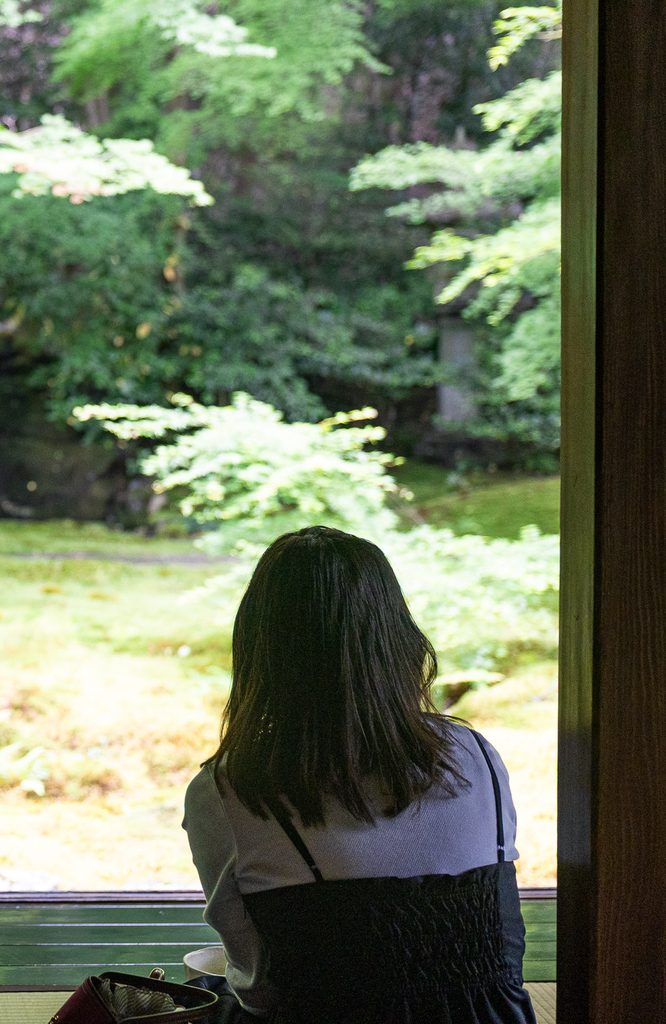
The tea room carries the name Sanjo Sanetomi gave the original retreat, and it is said to follow the taste of Kakukakusai Genso, sixth-generation head of the Sen family line of tea, in keeping with wa-kei-sei-jaku: harmony, respect, purity, tranquility. None of that vocabulary is required to enjoy what is on offer. A bowl of matcha with a seasonal sweet costs 1,000 yen and is served at first-floor seats facing the Ruri Garden, which is the one place in the building where the correct thing to do is nothing at all. If you have been fighting for tripod space upstairs, come down here before you leave.
Visiting Rurikoin Temple in 2026
Rurikoin is closed for most of the year and opens only for three special viewing periods. Outside those windows there is no way in, no exceptions, and no amount of arriving hopefully at the gate will change that.
| Spring 2026 | April 15 – May 31 |
| Summer 2026 | July 1 – August 17 |
| Autumn 2026 | October 1 – December 13 |
| Hours | 10:00 a.m. – 5:00 p.m. (last entry 4:30 p.m.) |
| Admission | 2,000 yen; students 1,000 yen with ID |
| Payment | Cash only, at the reception before the gate |
| Accessibility | Many stairs; not wheelchair accessible |
| Time needed | 1.5 to 2 hours |
The reservation rule, and how to book on a Japanese-only site
One rule matters more than everything else on this page. From November 13 to December 6, 2026, the peak foliage weeks, entry requires an advance online reservation made through the official Rurikoin website. Every other day of the year, including the rest of autumn, you walk up and buy a ticket.
The booking pages are in Japanese, and there is no working English equivalent, so plan around that rather than being ambushed by it. Open the site in Chrome or Safari and turn on automatic page translation before you start, since the form labels translate well enough to follow. You will choose a date first, then an entry time slot, then the number of people, then confirm. Two practical notes. The temple does not announce the opening date for reservations far in advance, and slots for late November weekends go quickly once they appear, so check the official site well before your trip and keep checking. And screenshot the confirmation screen rather than relying on an email you may not be able to read at the gate.
Evening viewings
In some past years the temple has added illuminated evening viewings during the green-maple season, ticketed separately and by reservation. These are not an annual fixture and have been skipped in other years, so treat them as a bonus rather than a plan and confirm on the official site before building an itinerary around one.
Getting There, and What to Pair It With
The Eizan Railway runs from Demachiyanagi Station in central Kyoto to Yase-Hieizanguchi, the end of the line, in about fifteen minutes, and the ride itself is worth the fare in either foliage season. From the station it is a five-minute walk across the Takano River to the temple gate. Kyoto Bus stops at Yase Ekimae, seven minutes on foot, and the Hieizan cable car station is also about five minutes away. There is no parking at the temple and the surrounding lanes are narrow. Do not bring a car.
Because Rurikoin takes under two hours, it works best as the first half of a day rather than the whole of one. Two pairings make sense from the same station. Kyoto Bus continues north from Yase to Ohara in a little over twenty minutes, which puts Sanzen-in and its own famous moss within easy reach for the afternoon; go temple first, Ohara second, since Ohara stays pleasant later in the day and Rurikoin does not. Alternatively, the cable car and ropeway climb from Yase to the summit of Mount Hiei and Enryaku-ji, a bigger, colder, far more austere kind of Buddhism about forty minutes above the reflection room. Either way you are using a corner of Kyoto that most visitors never reach, which is a good part of why the afternoon was quiet in the first place.