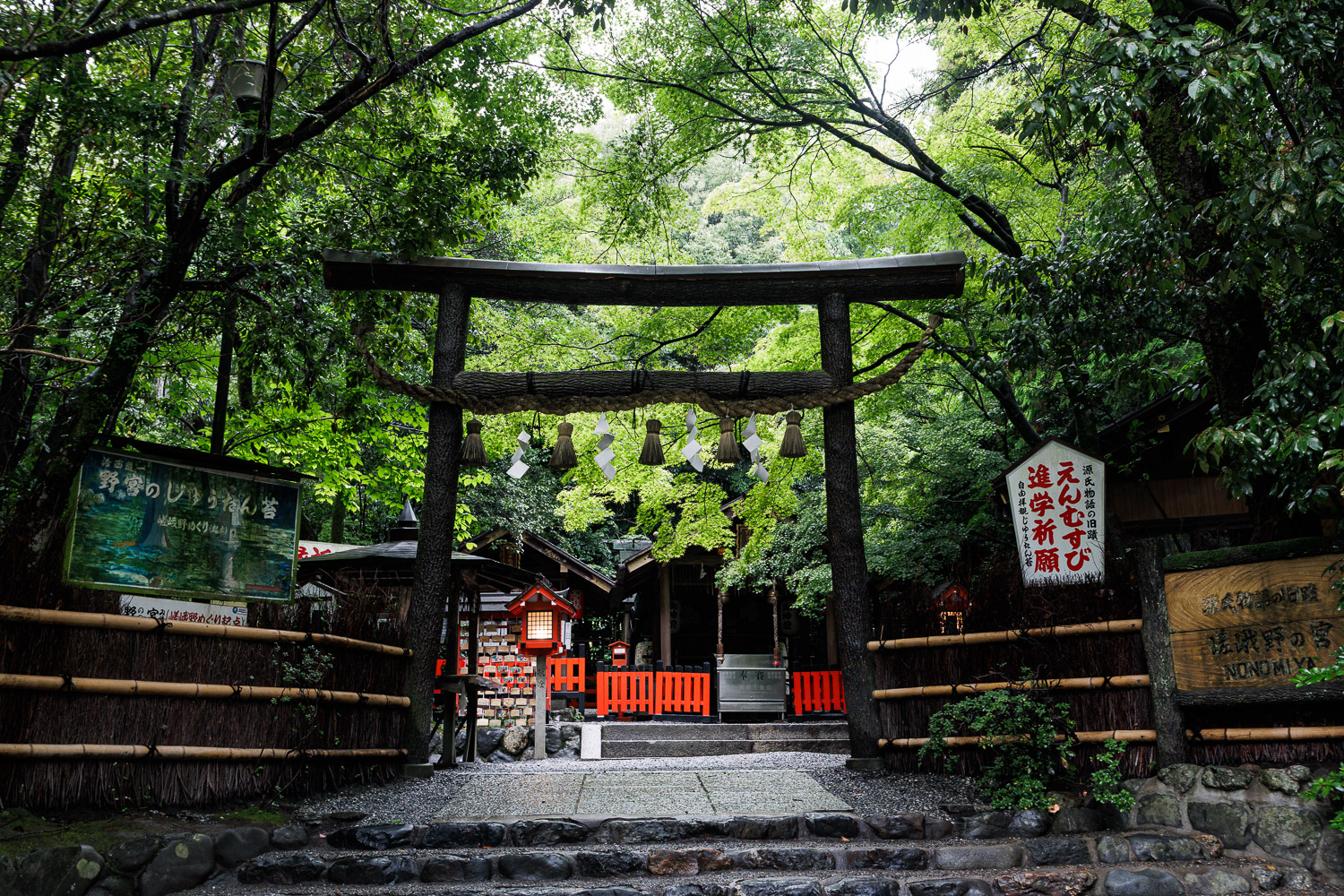
The first thing I offered the gods at Nonomiya Shrine was silence.
I tossed a coin at the offering box and the coin declined to go in. It hit the wooden rim, spun once, and settled there. No clatter against the bottom of the box. No small percussive note announcing that a visit had begun. I stood there weighing my options, which were to push it in with a finger or to leave it, and I could not decide which of the two was ruder to whoever might be listening.
It was six thirty in the morning. I had the place to myself.
Nonomiya Shrine sits partway along the Arashiyama bamboo path, and for most of the day it is one of the busiest religious sites in Kyoto. People line up to photograph the gate. So when a guidebook calls it tranquil, the guidebook is not lying, exactly. It is describing a window and selling it as a place. The quiet version of this shrine exists for about ninety minutes a day.
And for those ninety minutes, it stops being a place to look at. It becomes a place to listen to.
What Nonomiya Shrine Sounds Like at Dawn
It had rained overnight.
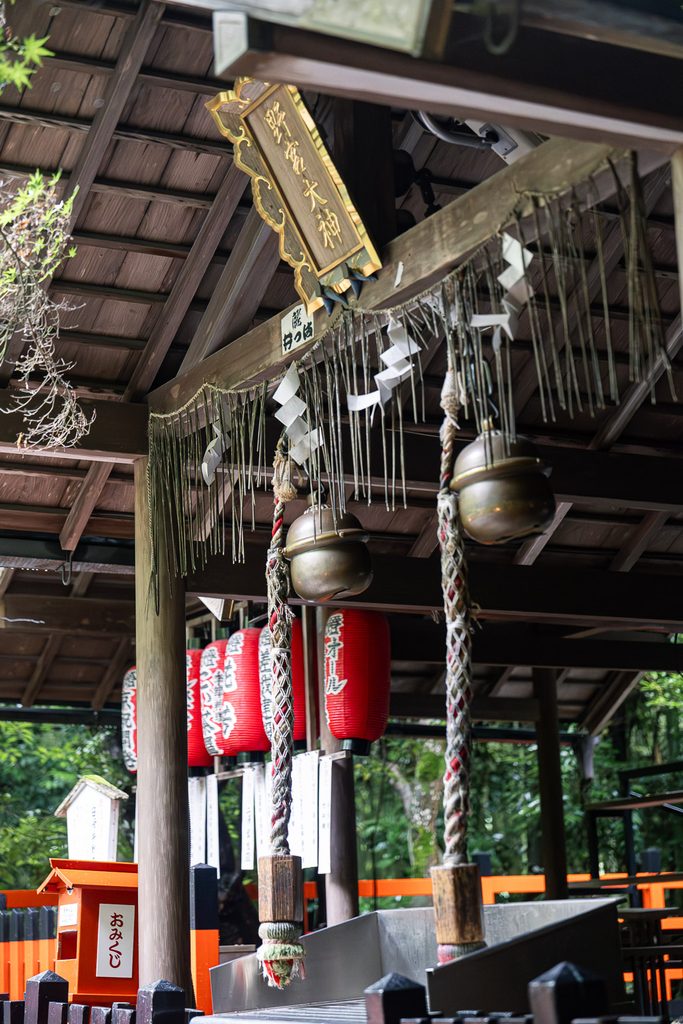
The gravel was still dark with it, and the moss had reached that deep, saturated green it only manages after weather. So I assumed the bell would sound damp too. It did not. When I pulled the rope, the sound that came out was dry, a short, hard knock of metal against metal, and it hung in the wet air for half a second.
Then I clapped twice, the way you do.
That was the discovery. The sound came back. It bounced off the trees and the timber of the hall and returned to my ears, and I stood there understanding, for the first time, that I had visited this shrine for years without once hearing my own hands. In daytime the clap is swallowed whole. Voices take it, shutters take it, the rickshaw wheels out on the path take whatever is left. It is gone before it leaves your palms.
All those years, I had been praying in a place where I could not hear myself pray.
A few people came while I lingered. Not tourists. They arrived without cameras, bowed, clapped, and were gone inside ninety seconds, and I recognized the walk immediately: the walk of someone doing a thing on the way to another thing. Kyoto’s most famous matchmaking shrine is also, for the people who live around it, a morning errand.
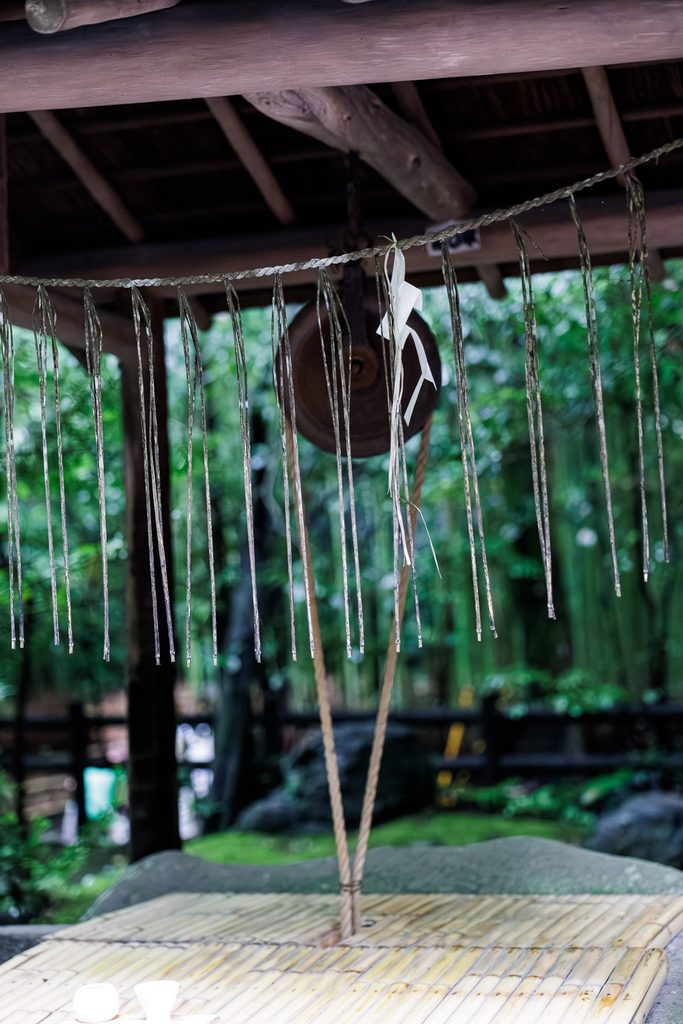
The Railway Crossing Next Door
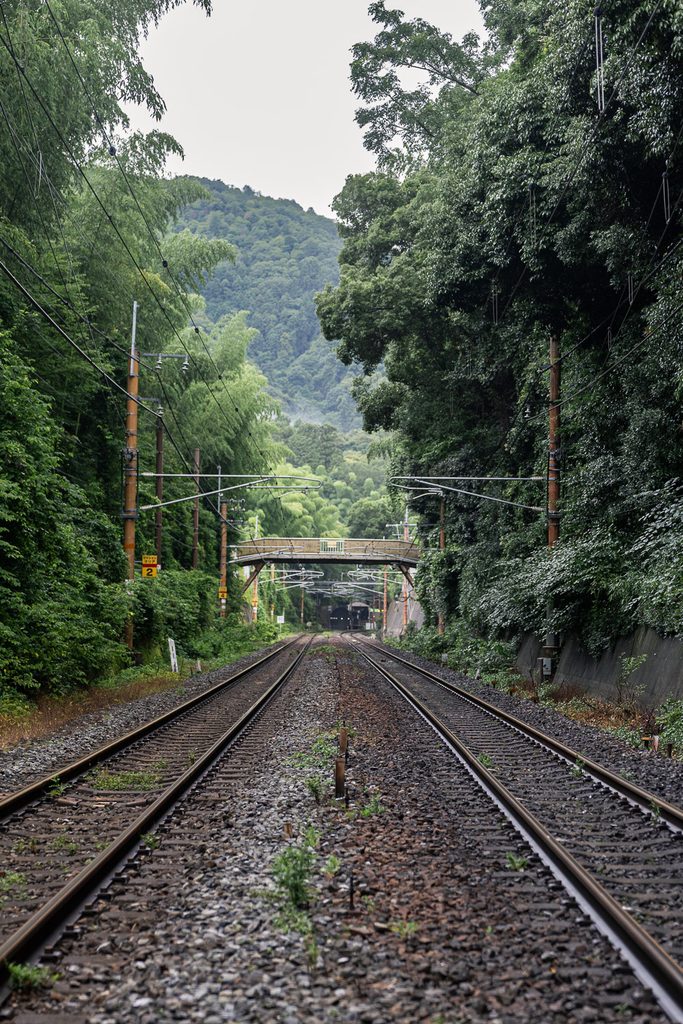
The JR line runs right past the shrine.
In the middle of the day you would never know it. The crossing bell rings against several hundred conversations and loses every round. In the morning it wins outright. The warning bell carries clean into the grounds, and when a train comes through you get the entire performance, the approach, the passing, the long thinning-out at the end of it.
Honestly, it was a little loud. If that morning had come with a volume dial, I would have eased it down a notch or two. This is what I was thinking while standing on ground where imperial princesses once purified themselves before the journey to Ise, and no, I am not proud of it.
But it never felt like an intrusion. Crossing bell, shrine bell, handclaps, birds. The morning here keeps a timetable.
Why It Is Shoulder to Shoulder by Ten
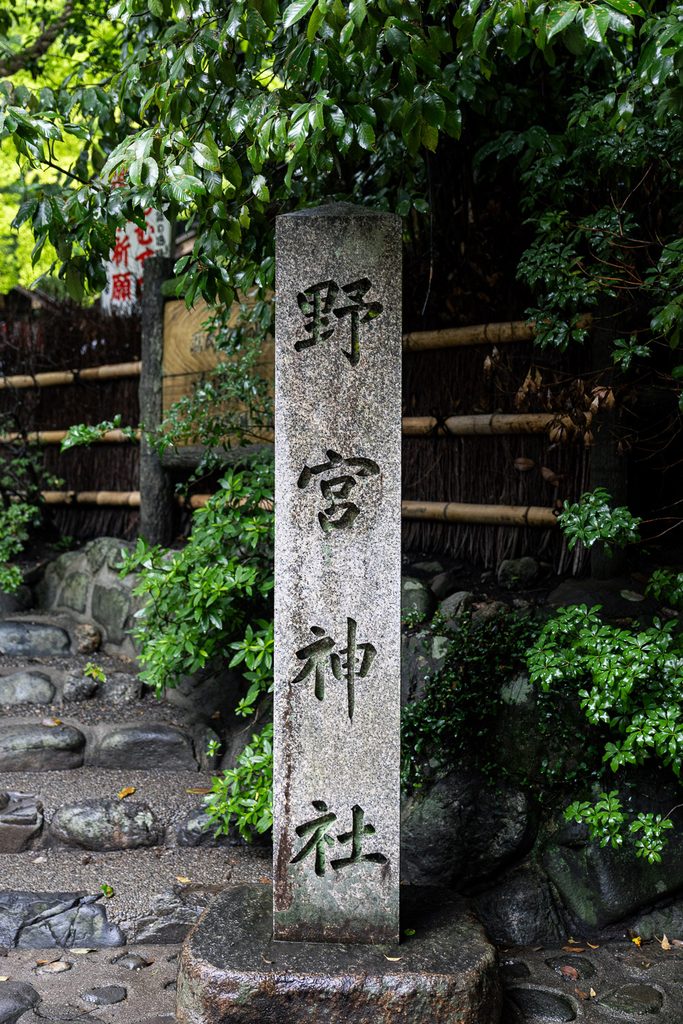
It is a problem of geometry.
The shrine sits on the bamboo path itself, which means every person who came for the bamboo walks past this gate whether they meant to or not. The people who wanted to be here and the people who merely ended up here funnel into the same small courtyard. The traffic is enormous. The site is tiny.
Then there are the rickshaws. Arashiyama’s rickshaw drivers stop at this gate all day long and explain, in bright and well-rehearsed sentences, that the god here grants good matches. Dozens of times a day. Every day. You could argue that Nonomiya’s matchmaking legend is the single most frequently narrated piece of folklore in Kyoto, and I am not sure who would argue back.
Every visit, the same thought arrives on schedule: right about now, Google Maps is telling somebody that this place is busier than usual.
The grounds of Nonomiya Shrine are open around the clock, and there is no gate to wait for. Come between six and seven thirty and it is quiet. Come at any other hour and it will not be, and no amount of planning changes that.
A Thousand Years of Purification, Behind the Bamboo
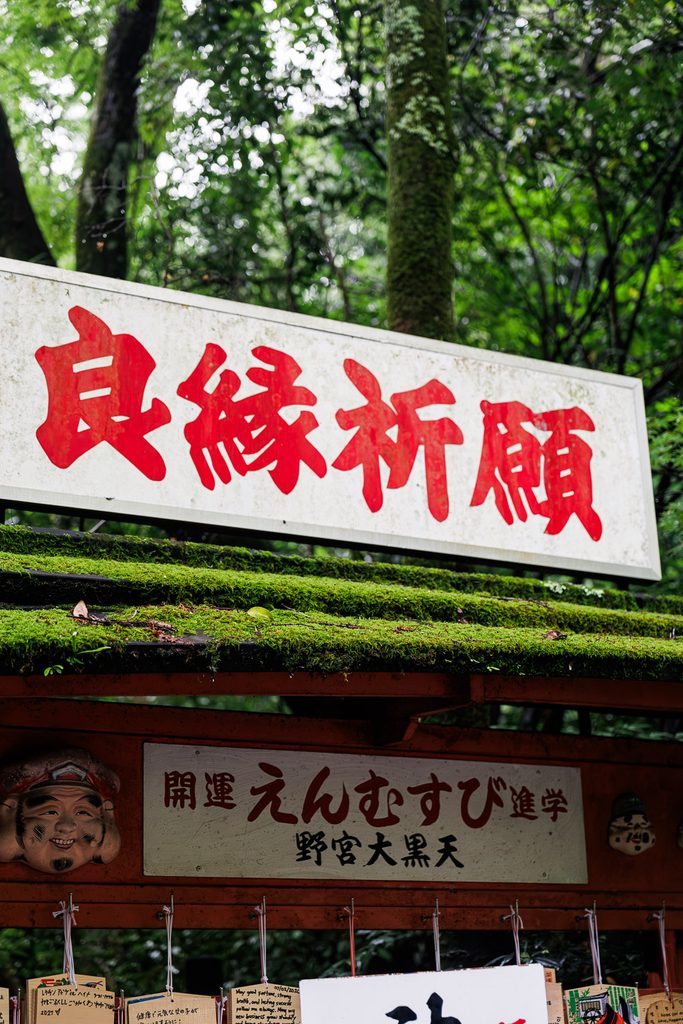
It was in that early quiet, oddly, that the history of the place finally made sense to me.
The shrine is dedicated to Nonomiya Okami, better known as Amaterasu, the sun goddess. When a new emperor took the throne, an unmarried princess of the imperial family was chosen as saio and sent to serve at Ise Grand Shrine in his place. Before she could go, she had to be purified. The site of that purification was called the nonomiya, and this shrine is said to stand where a nonomiya stood. Purification is quiet work. The place was built for the very hush I had stumbled into.
Murasaki Shikibu wrote the place into The Tale of Genji. In the tenth chapter, “Sakaki,” Lady Rokujo has withdrawn here with her daughter, and Genji comes out from the capital to see her. The two of them say goodbye badly, the way people do when neither will say the one thing that matters. It happens on this ground.
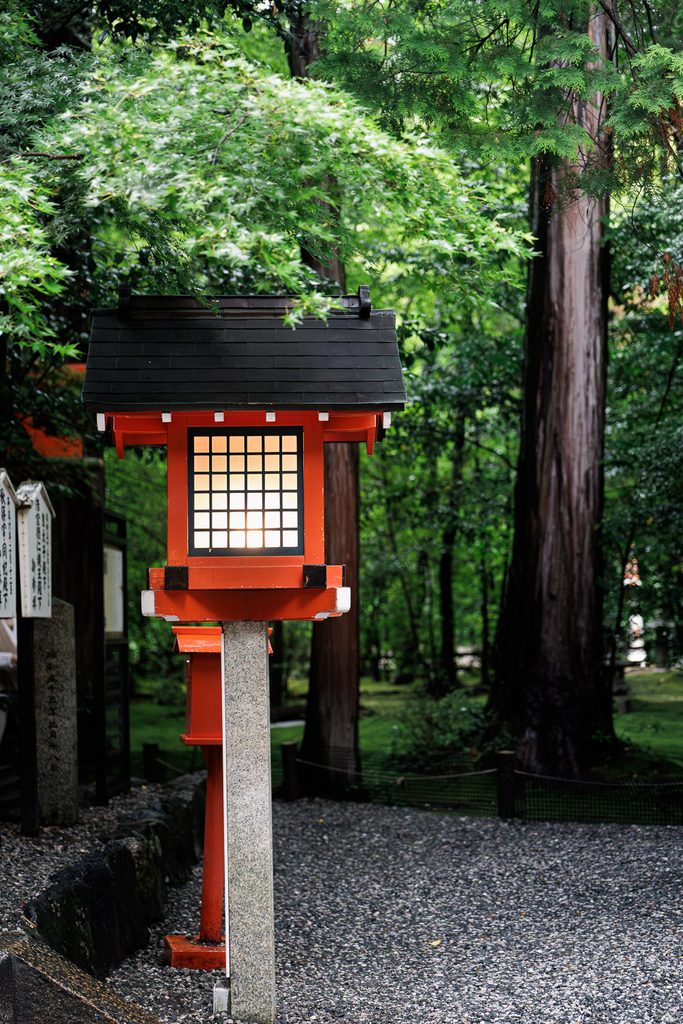
The gate out front is a kuroki torii, built of sawtooth oak with the bark left on, and it is considered the oldest style of torii in Japan. A low fence of bundled brushwood rings the grounds. Nothing here has been lacquered or improved. A thousand-year-old form simply stands there, weathering.
The courtyard holds several smaller shrines besides the main hall. Nonomiya Daikokuten is the matchmaking god everyone comes for. Around it stand Shirafuku Inari Daimyojin, for safe childbirth and success in business, Shiramine Benzaiten for the performing arts, Oyama Benzaiten for traffic safety and money luck, and Atago Okami, who guards against fire.
Pray in This Order, Not Any Other
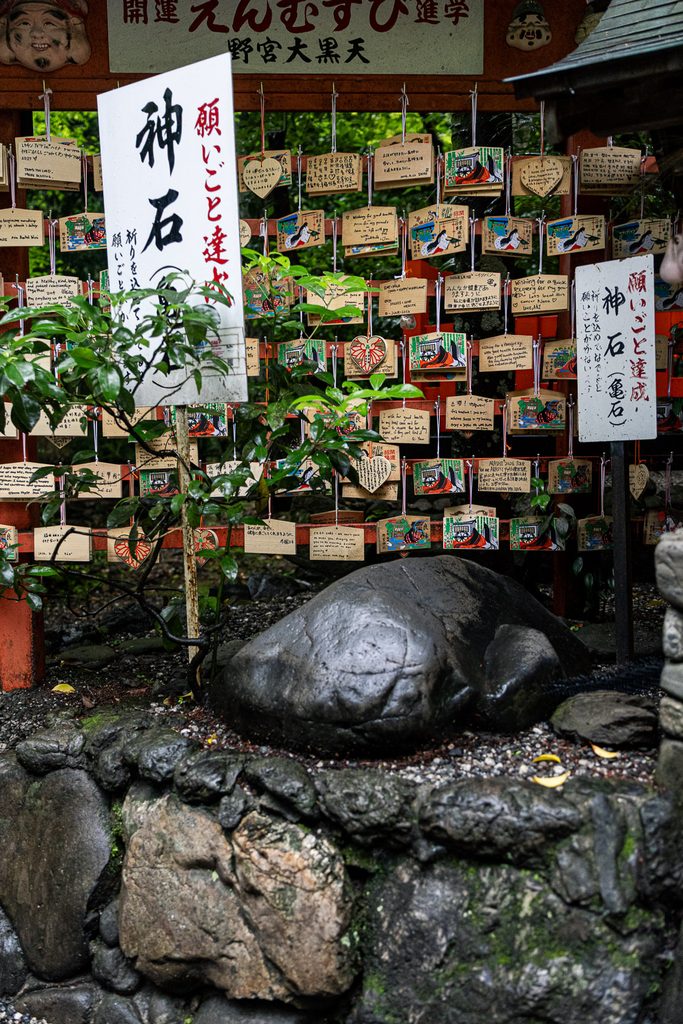
Nonomiya asks you to pray in a particular order.
You pray at the main hall first. Then you make the rounds of the smaller shrines, whichever ones apply to your life. Only after all of that do you approach the Okameishi, the dark, low, turtle-shaped stone beside Nonomiya Daikokuten, and stroke it with your wish held in mind. Done in that order, the wish is said to come true within a year. Do it first and you have patted a rock.
North of the main hall lies a moss garden called the jutan-goke, the carpet moss. In the morning it is still wet, and the color runs as deep as it ever gets.
Give the ema rack a slow read before you leave. English, Chinese, Korean, half a dozen European languages. Wishes for someone’s health. Wishes for a mother. Wishes with two names written close together. Whatever the rickshaw drivers are saying out front, the good match this shrine deals in is clearly not limited to romance.
The Bamboo Path, Five Minutes Away
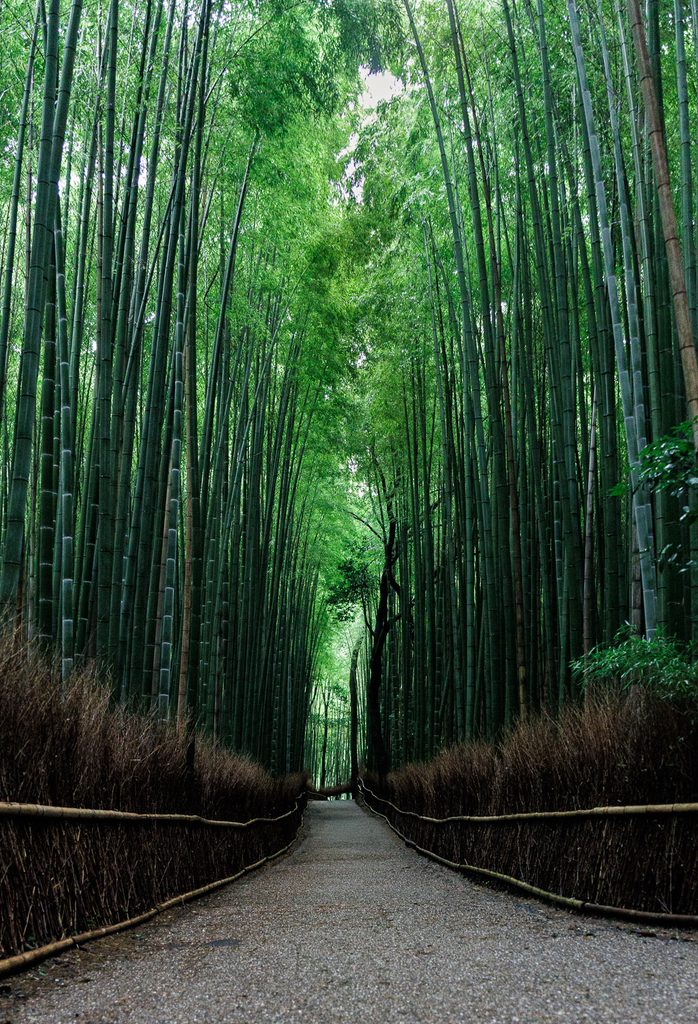
From the shrine gate to the stretch of bamboo everyone photographs is a five-minute walk.
Go early, and by early I do not mean seven. By seven the path is already filling, and the window has closed. The photograph above is not composited and not cleaned up in post. It is simply earlier than that.
The path comes out near Okochi Sanso, the hillside villa garden, which does not open until nine.
Ogura Pond: Lotus Flowers and the Kingfisher I Missed
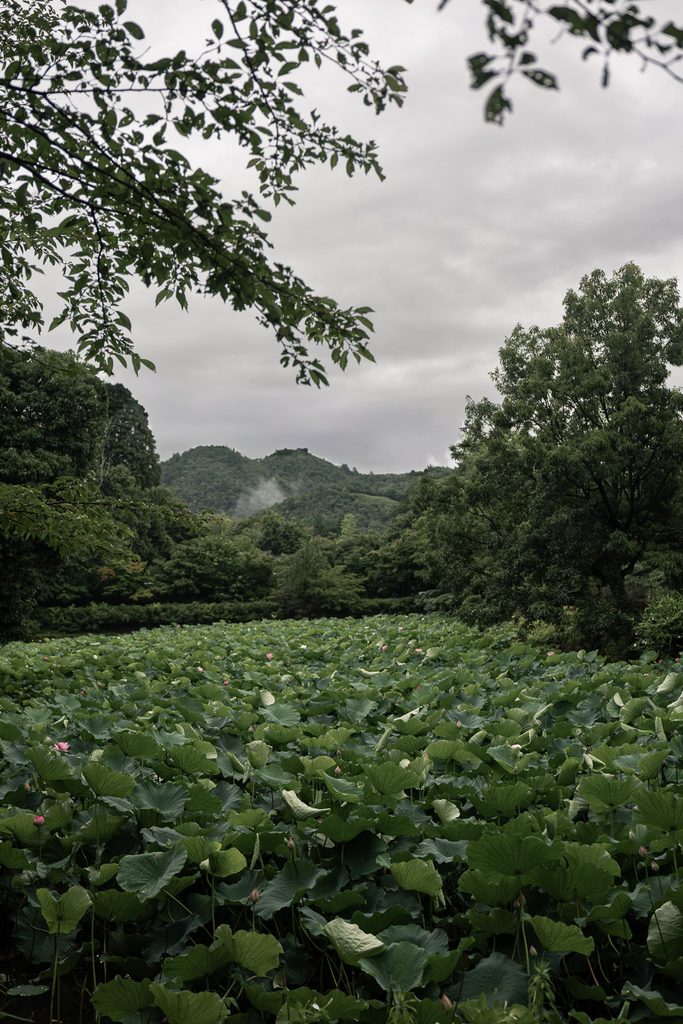
Past the bamboo, where the road tips downhill, there is a pond.
On July 5 it was solid lotus. The leaves had claimed the surface edge to edge, so completely that no water showed anywhere, and out of that green mass the pale pink flowers stood on their stems at odd, irregular heights. The sky was overcast. Mist sat in the hills behind.
If I had come across this pond as a child, I think it would have frightened me a little. A body of water whose water you cannot see is not a reassuring thing when you are eight. Instead I stood there finding it beautiful, which is either personal growth or just long exposure to Japanese aesthetics.
Photographers were spaced along the bank with lenses the length of my forearm. They were there for the kingfisher. Ogura Pond has one, or several, and among bird photographers it is a well-known spot.
I waited. I did not get it. Twice, a blue line crossed the corner of my vision, and by the time the camera came up there was nothing in the frame but leaves.
The lotus, on the other hand, I got. The lotus does not move.
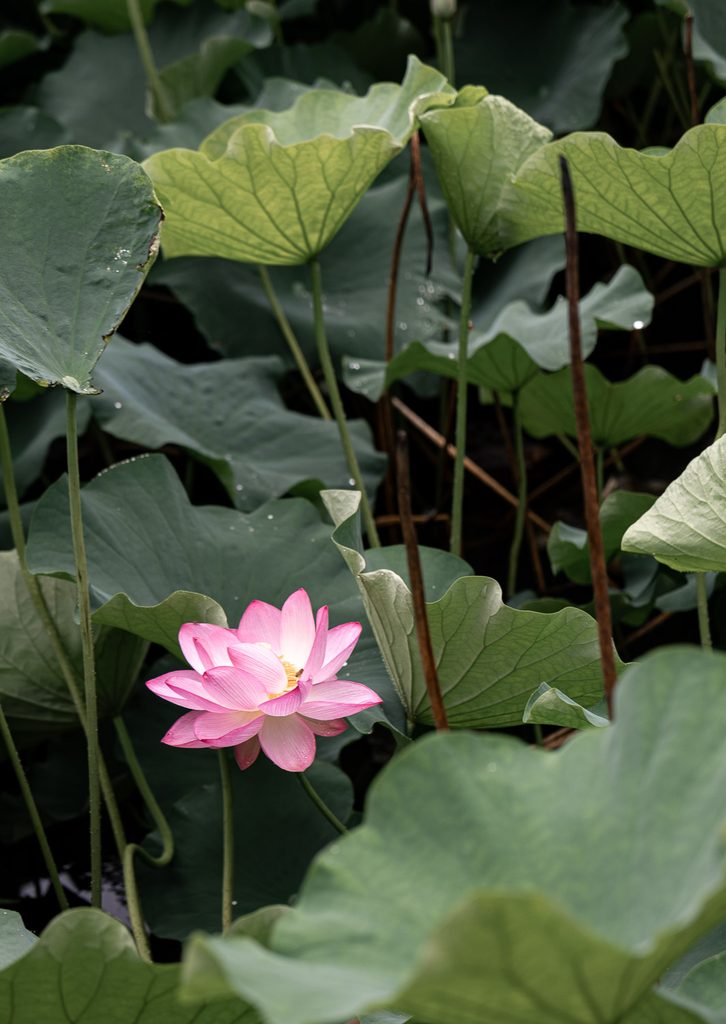
Lotus flowers open in the morning and begin closing by midday, which hands you a second reason to be out here early. The season generally runs from July into early August, shifting a little from year to year.
Mikami Shrine, Where Hair and God Are the Same Word
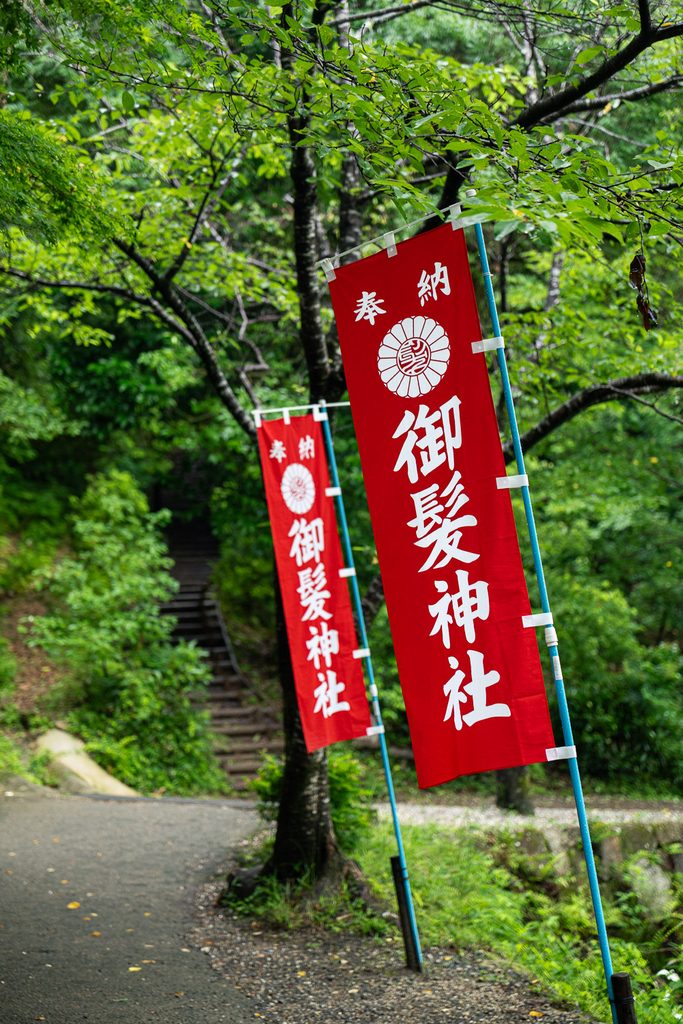
On the far side of the pond stands the only shrine in Japan dedicated to hair.
In Japanese, hair is kami. God is also kami. Two different words with two different origins, identical the moment they are spoken. Every Japanese speaker who says this shrine’s name aloud notices it, and none of us has ever quite decided whether it means anything. It is a pun you catch with your ears rather than your eyes.
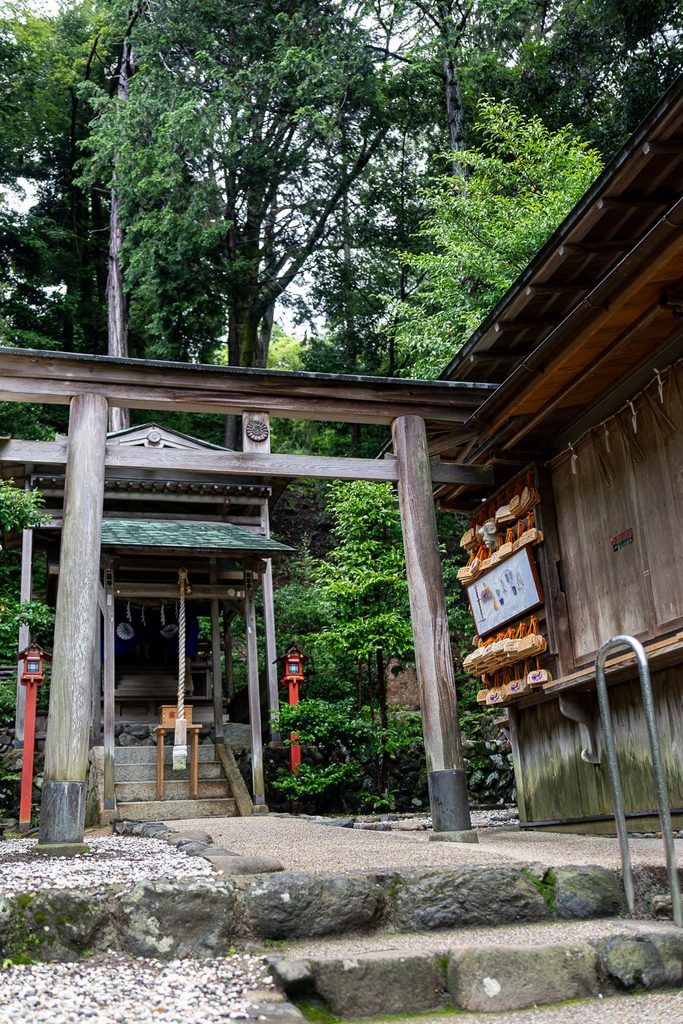
Mikami Shrine is new by Kyoto standards. It was founded in 1961 by people working in the city’s hairdressing and barbering trades, on the lower slopes of Mount Ogura.
The deity is Fujiwara no Uneme-no-suke Masayuki, a distant descendant of Fujiwara no Kamatari. According to the board of origins in the grounds, his father Motoharu kept the treasures at the imperial court during the reign of Emperor Kameyama, between 1259 and 1274, and lost one.
Motoharu took the blame. He left the capital and walked the provinces searching for the missing treasure, his third son beside him, and in 1269 the two settled in Shimonoseki. There the son took up hairdressing to keep them fed, and he is honored today as the founder of the profession in Japan. The country’s barbering trade, in other words, descends from one lost treasure.
In the grounds there is a mound called the kamizuka, where donated hair is laid to rest.
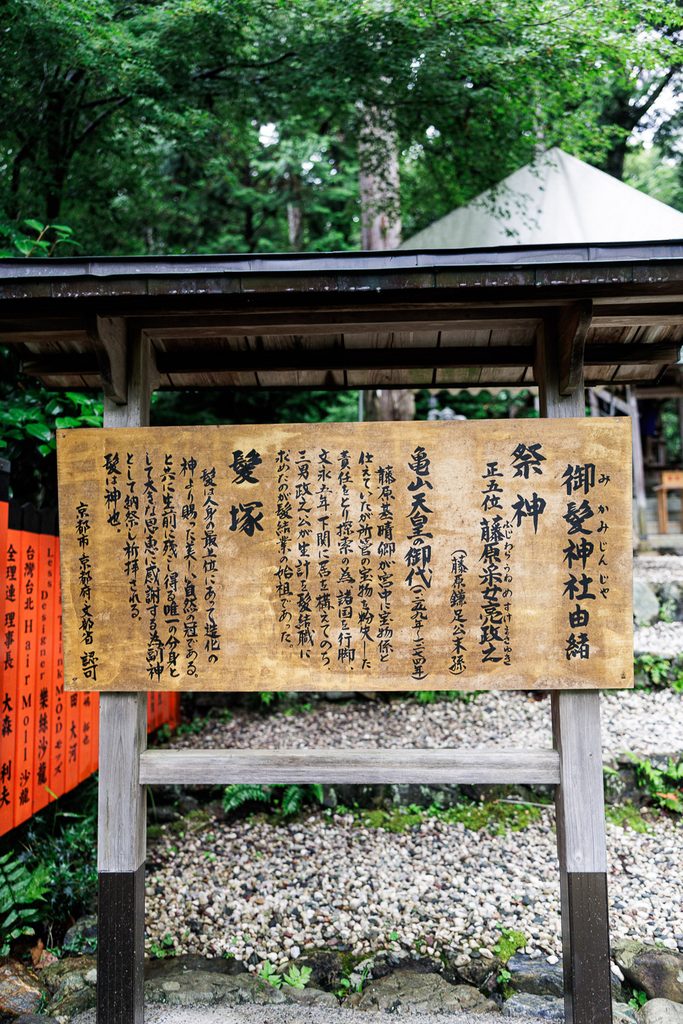
The vermilion posts along the approach carry the names of companies that make hair tonics, dyes, and wigs. I came to the ema rack expecting one kind of wish, the kind written by people asking to keep what they still have, and there were plenty of those. What I had not expected were the other ones. Stylists and barbers, asking to be better at their work. It had not occurred to me that the people who cut hair for a living would come here to pray about it.
At Nonomiya, the wishes are about the future. Here, they are about right now.
One practical note. Mikami Shrine’s official website is in Japanese only, with no English version, so it is worth saving this page before you go. The shrine office keeps hours from 9:00 to 16:00, which means an early visit gets you the shrine itself but no charms and no goshuin stamp.
The Saigu Gyoretsu Procession: October 18, 2026
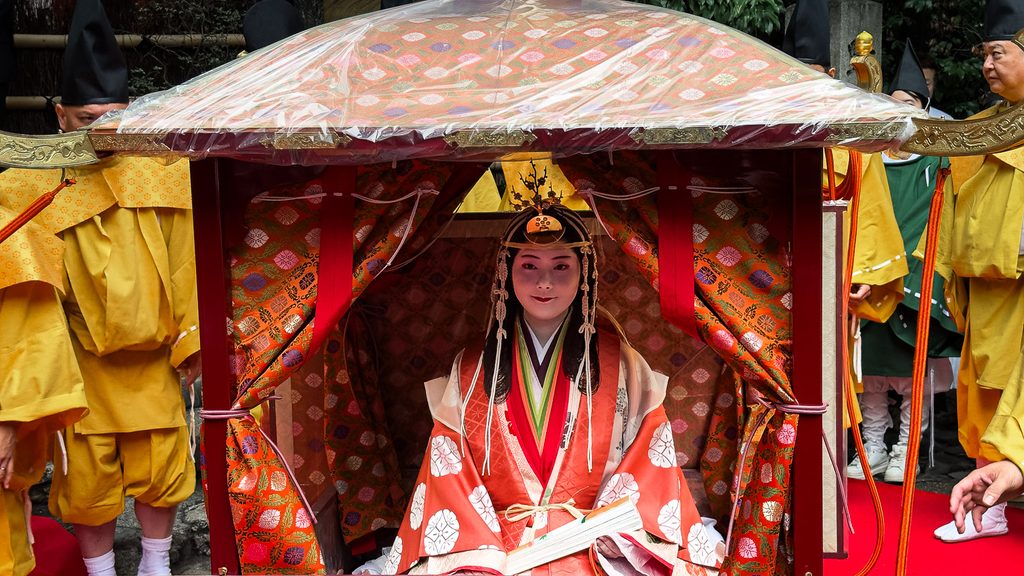
Once a year, the quietest shrine in Arashiyama becomes the busiest place in it.
The Saigu Gyoretsu recreates the saio’s journey from the capital to Ise. Around a hundred people in Heian-period costume process out of Nonomiya Shrine and through Arashiyama, with the saio herself at its center, carried in a palanquin.
Sunday, October 18, 2026, departing at noon. Free to watch, and held even in light rain.
The route runs from the shrine to JR Saga-Arashiyama Station, past the front of Tenryuji, across the Togetsukyo Bridge, and down to the north boat landing at Arashiyama Park on Nakanoshima, where a purification rite is performed at the water’s edge.
A note on the season. The procession arrives about a month before Arashiyama’s autumn foliage peaks in late November, when the whole district is at its most crowded. Nonomiya Shrine itself is not a foliage spot, so October 18 is not a compromise date. You get the pageantry without the worst of the leaf-season crush.
In the clip below, the saio walks out through the shrine gate and takes her seat in the palanquin.
I know how that moment sounds, because I have stood there for it. As the saio takes her seat, the music begins: a court flute, high and unhurried, with a drum kept deliberately low beneath it. It lasts about as long as it takes the crowd to notice it has started. Then the shutters take over. Whatever thousand-year echo was on offer that morning, nobody got more than a few seconds of it.
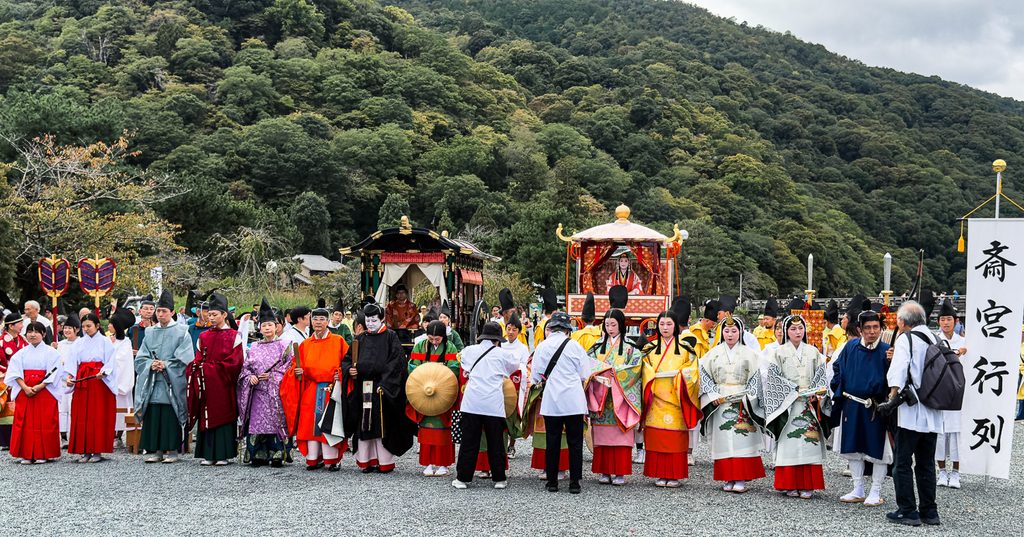
Where to actually stand
The shrine grounds are closed to visitors through the morning while the rites take place. This catches people off guard every year. If your plan was Nonomiya Shrine in the morning and the procession at noon, you will not get the first half.
Meanwhile, everyone waiting for the procession collects in front of the gate, and the area around the shrine becomes extremely crowded.
I have watched this procession two years running and made the same mistake both times. I stood near the shrine. The lanes there are narrow, the crowd closes in from both directions at once, and once it closes there is nowhere to go. You cannot move, and you certainly cannot take a photograph.
Stand near JR Saga-Arashiyama Station or around Nakanoshima in Arashiyama Park instead. Both offer space and clear sightlines, and the procession passes through both. It moves slowly. Choose the right place to wait and you will see all of it without being pressed against a single stranger.
A Morning Route, 6:00 to 9:00
| Time | Place | Notes |
|---|---|---|
| 6:00 | Togetsukyo Bridge | River mist. Almost nobody about |
| 6:30 | Nonomiya Shrine | Open around the clock. The listening hour |
| 6:50 | Bamboo path | Before it fills |
| 7:20 | Ogura Pond | Lotus at its best in the morning, July |
| 7:35 | Mikami Shrine | Visit only. Office opens at nine |
| 8:00 | Saga-Toriimoto preserved street | Old machiya townhouses, free, always open |
| 9:00 | Jojakkoji, Nison-in, Okochi Sanso | All three open at nine |
The route above runs about three hours at an unhurried pace, with roughly twenty minutes of walking between stops.
Everything you pay for opens at nine. Everything free is best before it.
Where to go once the gates open: Jojakkoji Temple and Nison-in Temple.
Nonomiya Shrine: Practical Information
Hours and admission
- Grounds: open 24 hours, no gate
- Shrine office (charms, goshuin): 9:00 to 17:00
- Admission: free
- Time needed: about 15 minutes for the shrine itself, longer if you read the ema
- Address: 1 Saga Nonomiya-cho, Ukyo-ku, Kyoto
- Official site: Nonomiya Shrine, English page
Mikami Shrine
- Shrine office: 9:00 to 16:00
- Official site: Japanese only
Getting there
- About 10 minutes on foot from JR Saga-Arashiyama Station on the Sagano Line (about 12 minutes from Kyoto Station by rapid train)
- About 10 minutes on foot from Randen Arashiyama Station
- About 15 minutes on foot from Hankyu Arashiyama Station
- About 5 minutes on foot from the Nonomiya city bus stop, route 28
- No parking