Every August, for eight days only, Kiyomizudera Temple opens its inner sanctuary to the public — a space closed even to most monks for the rest of the year. This is what Kiyomizuzaka looks like at midnight in August.
Kiyomizuzaka is still alive at this hour.
A few shops are still open — their lights spilling onto the stone pavement, staff standing quietly in doorways. On any other August night, they’d have long since closed. The crowds that come for Sennichi-mairi keep this street breathing past its bedtime. I found myself thinking about those staff members. The tradition promises a thousandfold return on merit. The overtime pay in Japan, by law, is 1.25 times the regular wage. I wanted to light a candle for them, too.
I kept walking uphill.
Inside the inner sanctuary of the Main Hall — the naijin — the air changes the moment you cross the threshold. It is dark. Not dim. Dark. The only light comes from votive candles, their orange flames shifting slowly in the stillness. Outside, the August heat had been relentless. In here, it followed me — the warmth of a hundred bodies pressed into a sacred space — and yet I didn’t want to leave. That combination shouldn’t work. It does.
I was standing somewhere I am not normally permitted to stand.
Before me: the Juichimen Senju Sengan Kanzeon Bosatsu — the Eleven-Faced, Thousand-Armed, Thousand-Eyed Kannon, the principal image of Kiyomizudera. Eleven faces to observe all directions of suffering. Forty-two arms to reach every being in need. Flanking the central image: Fujin and Raijin, the gods of wind and thunder, and the twenty-eight Bushu — the attendant deities of Kannon — arranged in rows on either side. On an ordinary day, none of this is accessible to anyone. Not to tourists. Not, in fact, to most monks.
I stopped at the candle offering table.
I usually choose the small ones. This time I reached for a larger candle — heavier, more expensive. The logic seemed sound: if one visit during Sennichi-mairi carries the merit of a thousand ordinary visits, a better candle feels like a reasonable investment.
You write your wish directly on the wax surface. I stood there, candle in hand, genuinely uncertain what to write. A handwritten sample board nearby offered guidance: twenty or so four-character phrases — family safety, prosperity of descendants, freedom from illness. The candle is cylindrical. Writing on a cylinder is harder than it sounds. I scanned for the simplest characters. Then wrote: 商売繁盛. Business prosperity.
I lit the candle and placed it in the stand.
A thousand days of merit, delivered. At least, that’s the idea.
What Is Sennichi-mairi — and Why Does It Matter?
It begins on August 9th.
For eight days — through August 16th — Kiyomizudera Temple holds Sennichi-mairi: “The Thousand-Day Pilgrimage.” A single visit during this period is said to carry the spiritual merit of a thousand ordinary visits. Kannon, it turns out, runs seasonal promotions.
The tradition is ancient. Both Lady Murasaki, author of The Tale of Genji, and Sei Shōnagon, author of The Pillow Book, are recorded as having made this pilgrimage in the eleventh century. The practice reached its peak during the Edo period, then fell into abeyance amid the anti-Buddhist policies of the Meiji era. It was revived in 1993 — the same year Kiyomizudera introduced its autumn special night illumination.
The revival wasn’t simply a scheduling decision. Sennichi-mairi carries something that cannot be replicated on a normal visit: access.
The Inner Sanctuary — Kiyomizudera’s Most Sacred Space
This is what makes Sennichi-mairi different from any other time of year.
The naijin — the innermost chamber of the Main Hall — is opened to the public for these eight days only. This is not a back corner of the building. It is the spiritual center of the entire complex, a space that ordinary visitors never enter, and that even Buddhist monks do not freely access.
At its heart is the hibutsu: the secret principal image of the Thousand-Armed Kannon. “Secret” is not a euphemism. The image is revealed once every 33 years. The last time was in 2000. The next time is 2033. Which means that right now, the number of living people who have actually seen this image is vanishingly small.
What you do see — what fills the space with presence — are the attendant figures, the votive candles, the altar, and the rope.
During Sennichi-mairi, visitors may grasp the go-shiki-no-tsuna: a five-colored rope connected to the hand of Kannon. Through the rope, you are — in the logic of the tradition — in direct contact with the bodhisattva. Whatever that means to you personally, the physical experience of standing in that darkness, holding that rope, with candle flames flickering at the periphery of your vision, is not easily forgotten.
A special charm (o-mamori) is available exclusively during this period. It sells out. Go in the morning if this is on your list.
⚠ Photography inside the naijin is strictly prohibited.
Kiyomizudera Night Illumination — August 14, 15, and 16
The final three nights belong to the light.
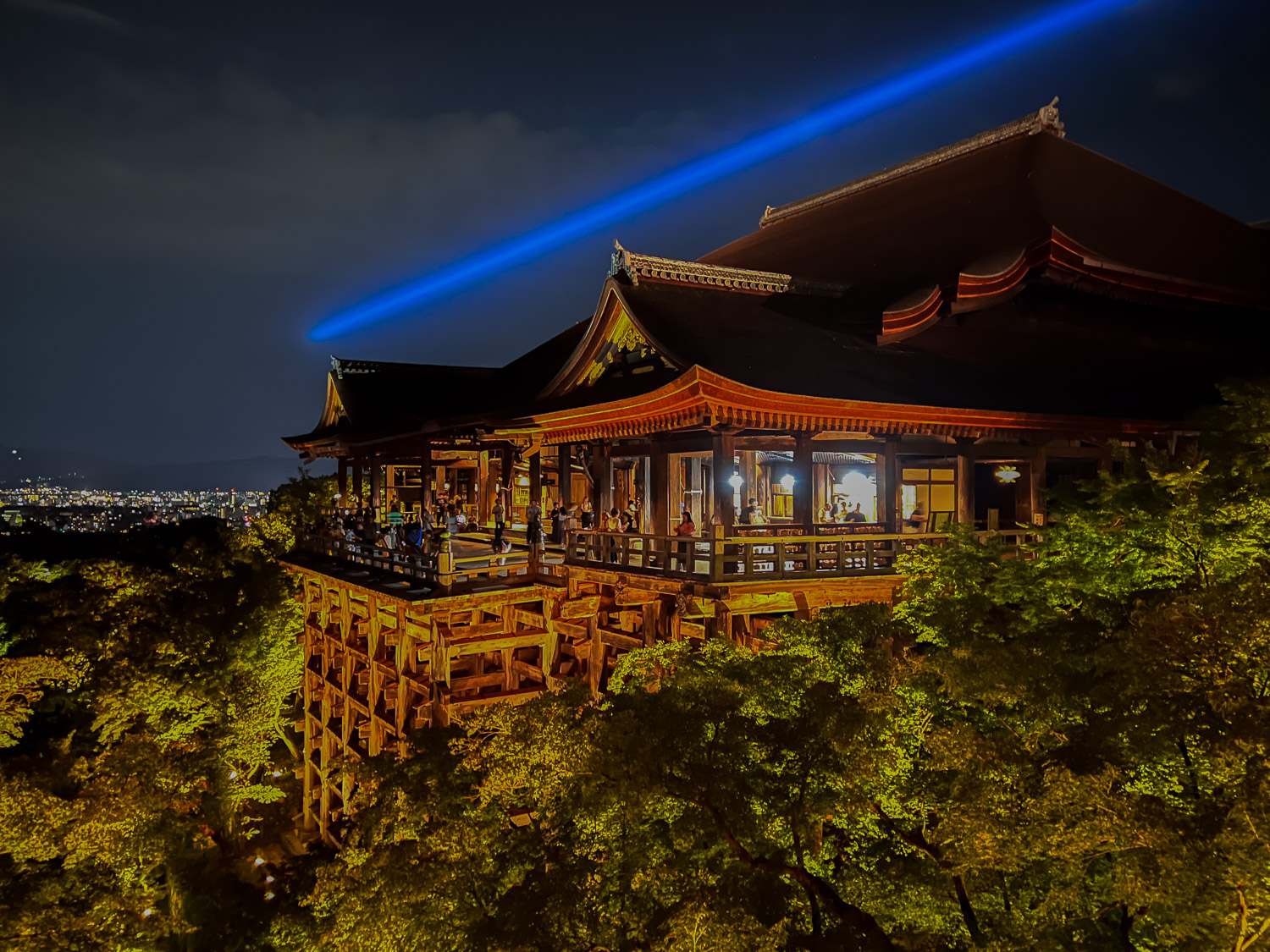
From August 14th through 16th, Kiyomizudera Temple opens for special night viewing. The Main Hall and its famous wooden stage are lit from below — the ancient timbers taking on a depth and warmth that daylight never quite reveals. Shadows collect in the bracketing above the pillars. The stage, which in daylight reads as a feat of engineering, becomes at night something closer to a vessel: dark wood floating above a valley of illuminated treetops, the city spread below in amber and grey.
The large incense burner in front of the stage — the mae-koro — never goes out, and after dark its smoke rises into the light in long, slow columns. Stand near it long enough and the smell will stay with you for days.
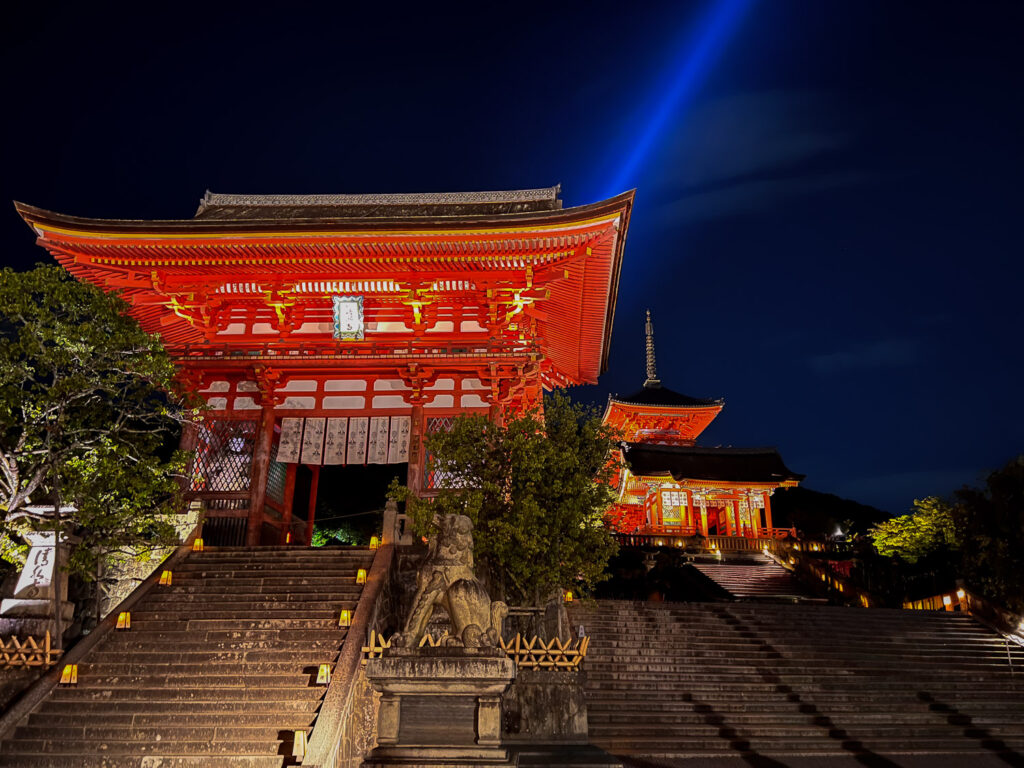
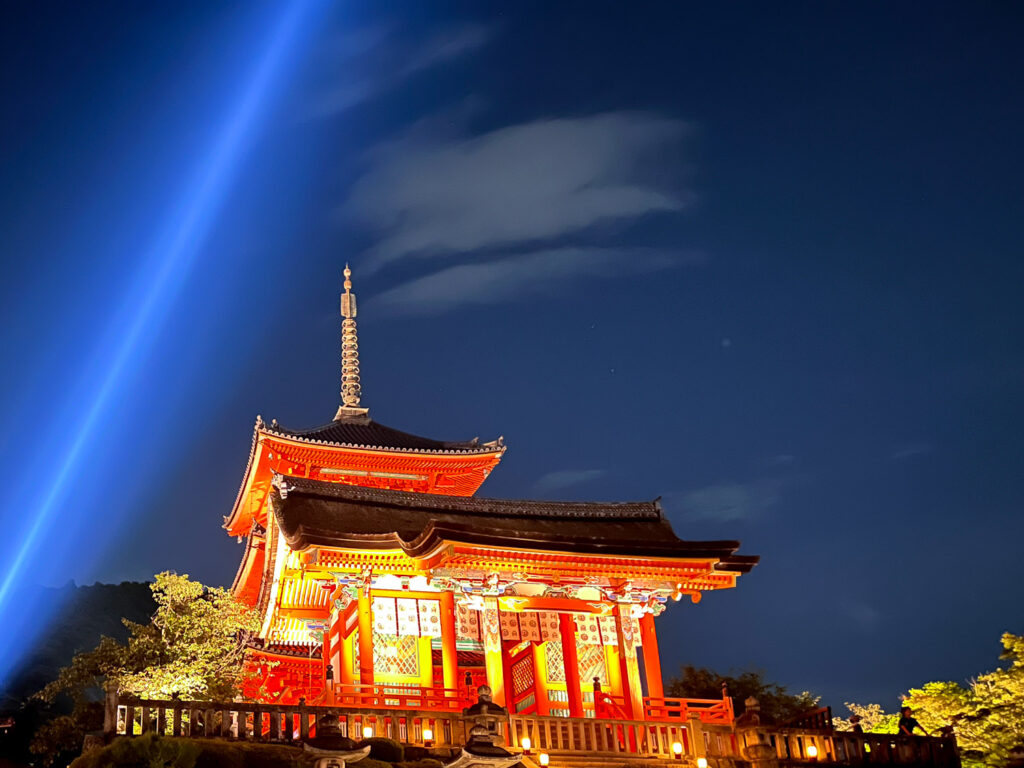
From the grounds, a single beam of blue light — the Kannon Jihi-ko, or “Compassionate Light of Kannon” — extends westward into the night sky. This light appears during all three of Kiyomizudera’s annual illumination periods. Against the August sky, with the heat still radiating from the stone underfoot, it reads differently than it does in spring or autumn. More insistent, somehow. As if the dark needs more persuading in summer.
Two formal ceremonies are held during these three days: at 11:00 a.m. and 8:00 p.m. The evening ceremony, held while the grounds are illuminated, is worth attending if your schedule allows.
The final night — August 16th — is the most crowded of the eight days. I’ve been there on the last night. The atmosphere is extraordinary and the crowd is punishing. Come earlier in the illumination period if you have the choice.
Planning Your Visit to Kiyomizudera in August
One decision defines everything.
The naijin closes at 5:00 p.m. — even on nights with illuminations. Arrive only for the evening light show and you will miss the inner sanctuary entirely. The optimal approach: enter before 5:00 p.m., spend time in the naijin, then stay as the sun goes down and the illuminations begin. One visit. Both experiences.
Should You Come During the Full Period or the Illumination Nights?
If the inner sanctuary is your priority, the first five days (August 9–13) offer more room to breathe — marginally cooler, marginally quieter. If you want the naijin and the night illumination in the same visit, target August 14–16 and plan to arrive by mid-afternoon.
Practical Information
| Period | August 9–16 (annual) |
| Night illumination | August 14, 15, 16 |
| Regular hours | 6:00 a.m. – 6:00 p.m. |
| Night illumination hours | Until 9:30 p.m. (last entry 9:00 p.m.) |
| Inner sanctuary closes | 5:00 p.m. |
| Admission | Adults ¥500 / Children (elementary and junior high) ¥200 |
| Reservations | Not required |
⚠ Dates and hours are subject to change each year. Always confirm current information at the official Kiyomizudera website.
Getting There
From Kyoto Station: City Bus Route 206, alight at “Gojozaka,” then approximately 10 minutes on foot (uphill).
From Kiyomizu-Gojo Station (Keihan Line): Approximately 25 minutes on foot.
By taxi: Approximately 15–20 minutes from Kyoto Station, around ¥1,500. Allow up to ¥2,500 during heavy traffic periods.
Crowds and Heat
August in Kyoto is hot. Accept this as a condition of the visit, not a complication.
The naijin holds many people in a small space. The heat follows you inside. Evenings are marginally cooler, and crowds on illumination nights build steadily from around 6:00 p.m. The special o-mamori, available only during this period, sells out — go in the morning if acquiring one matters to you.
What to Bring
The temperature gap between afternoon and late evening is real. August days in Kyoto are aggressive; after sunset, the grounds cool enough that a light layer becomes welcome. Carry one.
Insider Tips
The candle offering is worth doing. Candles come in different sizes; you write your wish on the surface before lighting. A sample board with suggested phrases stands nearby — useful, since the candle is cylindrical and harder to write on than expected. The staff will guide you through the process.
Photography rules. Shooting on the grounds and stage is generally permitted. Inside the naijin it is strictly prohibited, as is photography during the inner sanctuary opening. Tripods, monopods, and drones are prohibited throughout the grounds.
For the night illumination, position yourself on the stage or at Okuno-in — the projecting hall across the ravine — for the best view of the Main Hall against the illuminated valley. The view from Okuno-in after dark is one of the finest things Kyoto offers, in any season.
Frequently Asked Questions
Do I need a reservation for Sennichi-mairi?
No. Standard admission applies. Pay at the gate and enter.
Can children enter the inner sanctuary?
There is no age restriction. The naijin is dark, quiet, and reverential — use your judgment with very young children.
How is the Sennichi-mairi night illumination different from spring and autumn?
All three of Kiyomizudera’s annual illumination periods share the Kannon Jihi-ko blue light beam as a signature element. What distinguishes Sennichi-mairi is context: the inner sanctuary is open, votive candles are burning throughout the grounds, and the atmosphere carries the weight of active devotion in a way that the other seasons do not. Spring and autumn illuminations are beautiful. This one is something else.
What does “a thousand days of merit in one visit” actually mean?
There is no official doctrinal definition. In Buddhist tradition, merit (kudoku) is accumulated through virtuous acts, devotion, and practice. The claim is that a single Sennichi-mairi visit concentrates a thousandfold accumulation of that merit. Whether you approach this literally or metaphorically, the tradition has persisted for a thousand years. That, in itself, is worth something.
Is the secret Kannon image visible during Sennichi-mairi?
No. The hibutsu — the principal secret image — remains behind the closed shrine cabinet. It is revealed once every 33 years; the last opening was in 2000, and the next is expected in 2033. What Sennichi-mairi provides is access to the space directly before the altar — and the rope connected to the image’s hand.
Explore More of Kiyomizudera
→ Kiyomizudera Temple: A Local’s Complete Guide
→ Seiryu-e: When the Dragon Descends
→ Kiyomizudera at Night: Spring, Summer & Autumn Illuminations
→ Kiyomizuzaka
Kiyomizudera
1-294 Kiyomizu, Higashiyama-ku, Kyoto
Tel: 075-551-1234
Official website: https://www.kiyomizudera.or.jp/en/