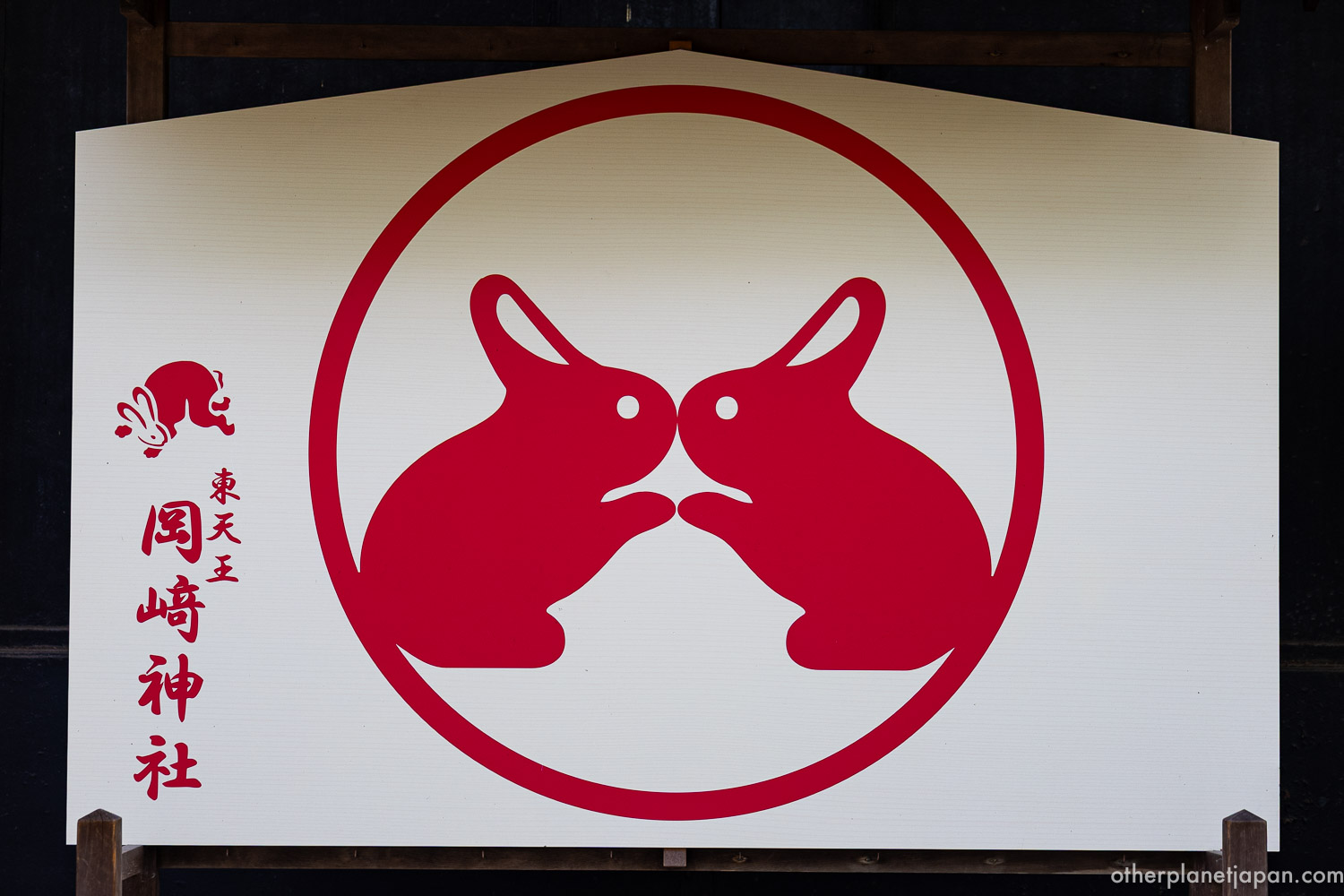
Okazaki Shrine sits quietly at the foot of Kyoto’s Higashiyama hills, a short walk from Heian Shrine and Nanzen-ji. The approach is green and the air shifts the moment you step through the torii. Most visitors come with a specific purpose — to pray for fertility, safe childbirth, matchmaking, or protection from misfortune.
And everywhere you look, there are rabbits. Stone rabbits guarding the path, rabbit-shaped omikuji lined up along the railings, hand-painted rabbits on the ema wall. This is the shrine Kyoto locals call the “rabbit shrine” (Usagi Jinja), and the reason goes back more than 1,200 years.
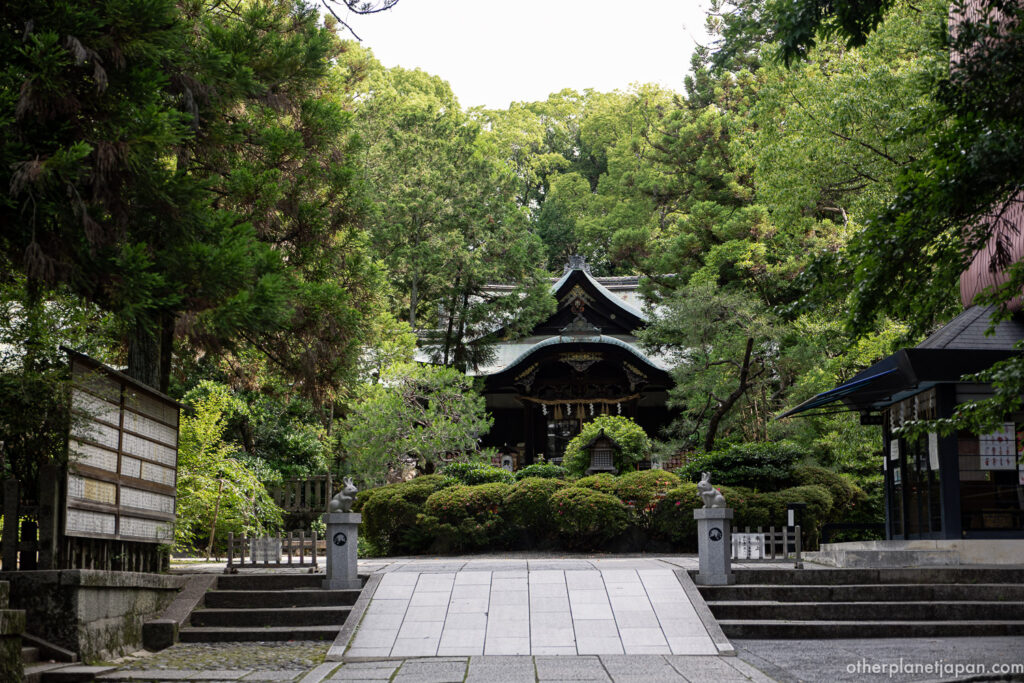
The green approach to Okazaki Shrine’s main hall
Why Rabbits? The Story Behind Okazaki Shrine
The rabbit became the symbol of Okazaki Shrine through a combination of mythology, geography, and centuries of belief.
The shrine enshrines two principal deities: Susanoo-no-Mikoto and Kushinada-hime-no-Mikoto. According to mythology, the two gods had eight children together — three daughters and five sons. Because they were blessed with many children themselves, they came to be worshipped as deities of fertility and safe childbirth.
The land around the shrine was historically home to wild rabbits. Rabbits, with their well-known reproductive abilities, were considered messengers of the resident deity. The combination of prolific gods and prolific animals made Okazaki Shrine a natural focal point for prayers about children.
The shrine’s reputation as a place of safe childbirth has historical weight. In 1178 (Jishō 2), the Empress Consort Taira no Tokuko is recorded to have prayed for safe childbirth at Okazaki Shrine. The tradition continues today, with visitors bringing maternity belts (harataobi) to be blessed.
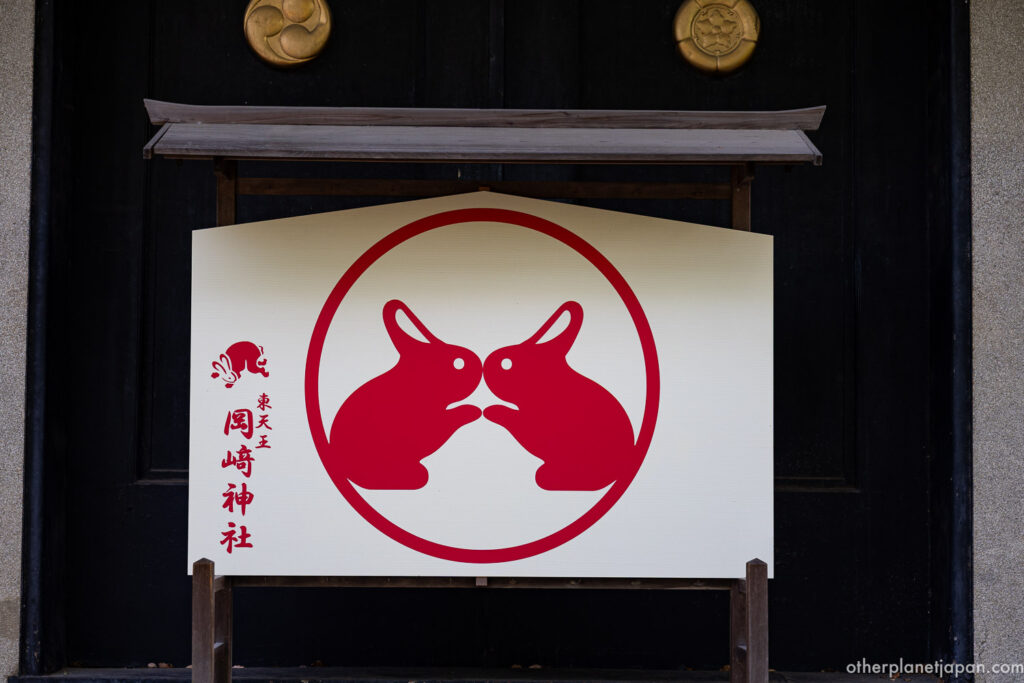
The shrine’s emblem — two rabbits within a circle
The Rabbits of Okazaki Shrine
The shrine grounds contain rabbits in many forms, each with its own role.
Komainu Rabbits (Guardian Rabbits)
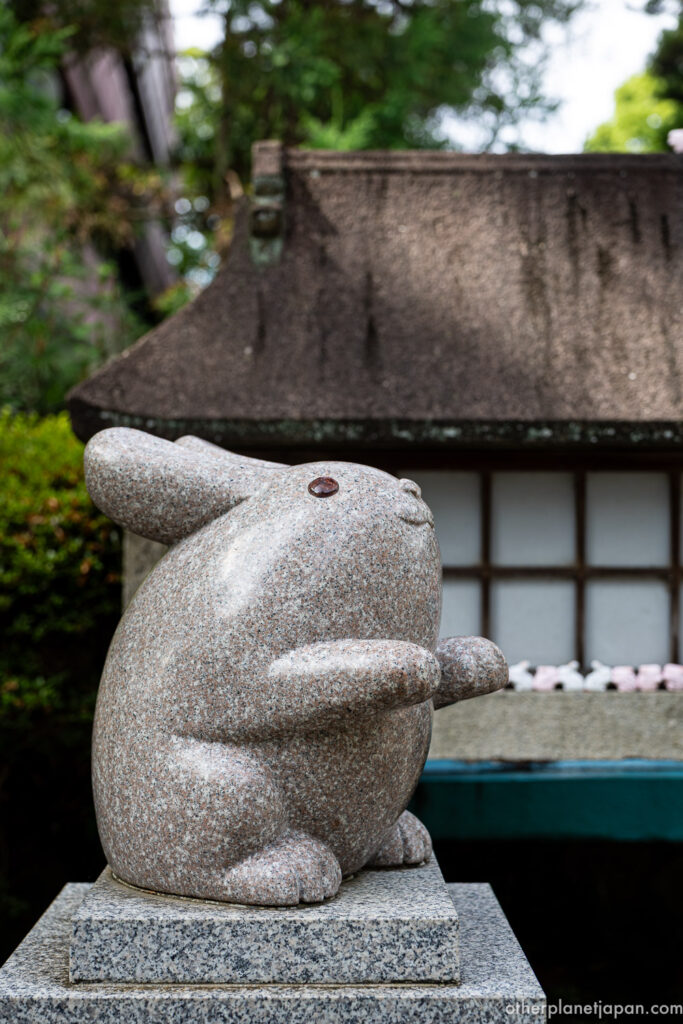
Most Shinto shrines are guarded by komainu — stone lion-dogs. At Okazaki Shrine, the main hall is guarded by stone rabbits instead. A pair sits on either side of the path, in the same posture as conventional komainu but unmistakably rabbit-shaped.
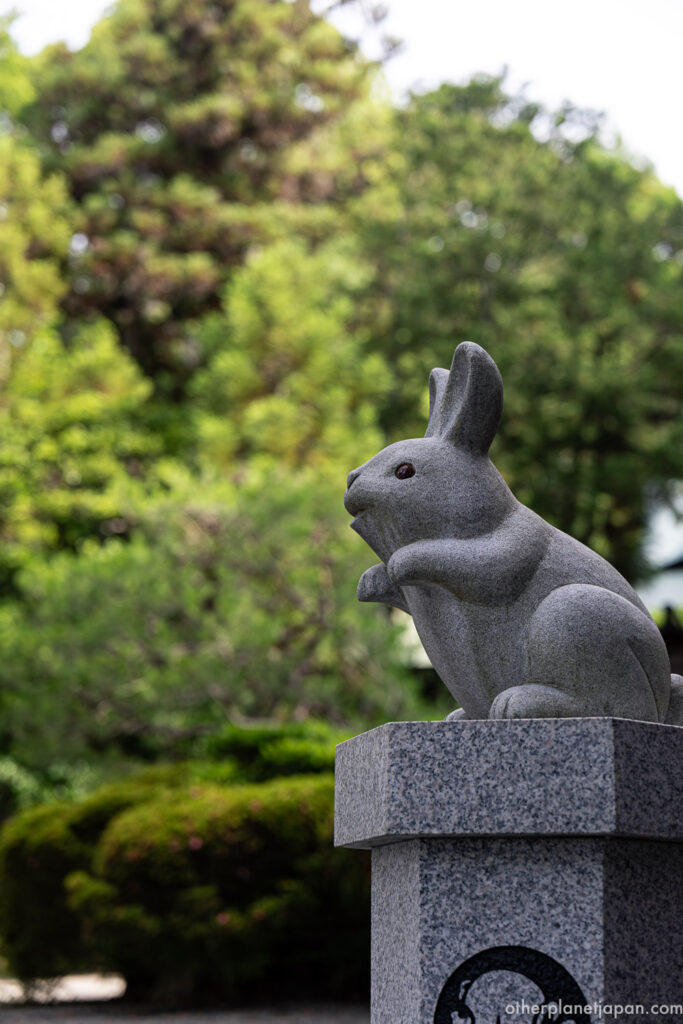
A stone rabbit guarding the main hall
The Black Granite Fertility Rabbit
Within the grounds stands a black granite rabbit statue dedicated to fertility prayers. Visitors pour water over the statue and stroke its belly while praying for children. The surface is smooth from generations of hands.
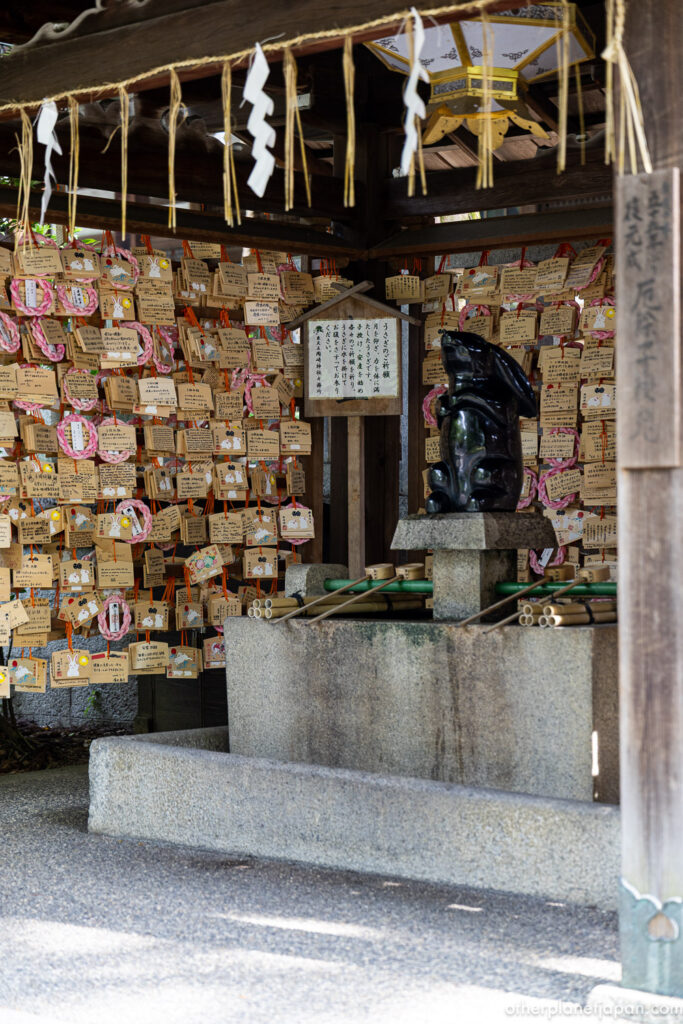
The black granite rabbit for fertility prayers
The Moon-Gazing Rabbit at the Purification Font
A black rabbit statue sits at the chōzuya (water purification pavilion), positioned as if gazing at the moon. The pose references the traditional Japanese association between rabbits and the moon.
The moon-gazing rabbit at the purification font
Ema, Omikuji, and Omamori
The ema wall is one of the most photographed corners of the shrine — and one of the most quietly moving.
The Ema Wall
Wooden prayer plaques are hung in dense overlapping layers. Many are written in Japanese, but a striking number are in English, Chinese, Korean, and other languages. Some are prayers for a child; others are reports of safe births, written by parents returning to thank the shrine. Reading them, even briefly, gives a sense of how far the shrine’s reputation has traveled.
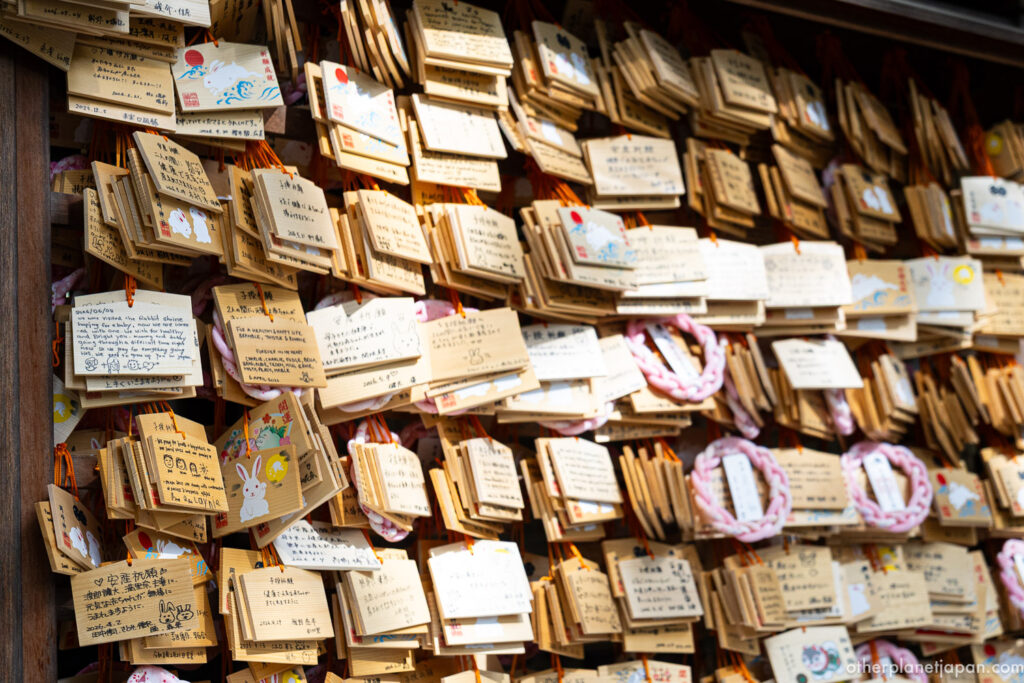
The ema wall, written in many languages
Rabbit Omikuji
The shrine office sells small white ceramic rabbits with fortunes (omikuji) tucked inside. After drawing the fortune, you can either take the rabbit home or leave it on a designated rail at the shrine. The rows of small white rabbits lined up along the vermilion railings are one of the shrine’s most distinctive sights.
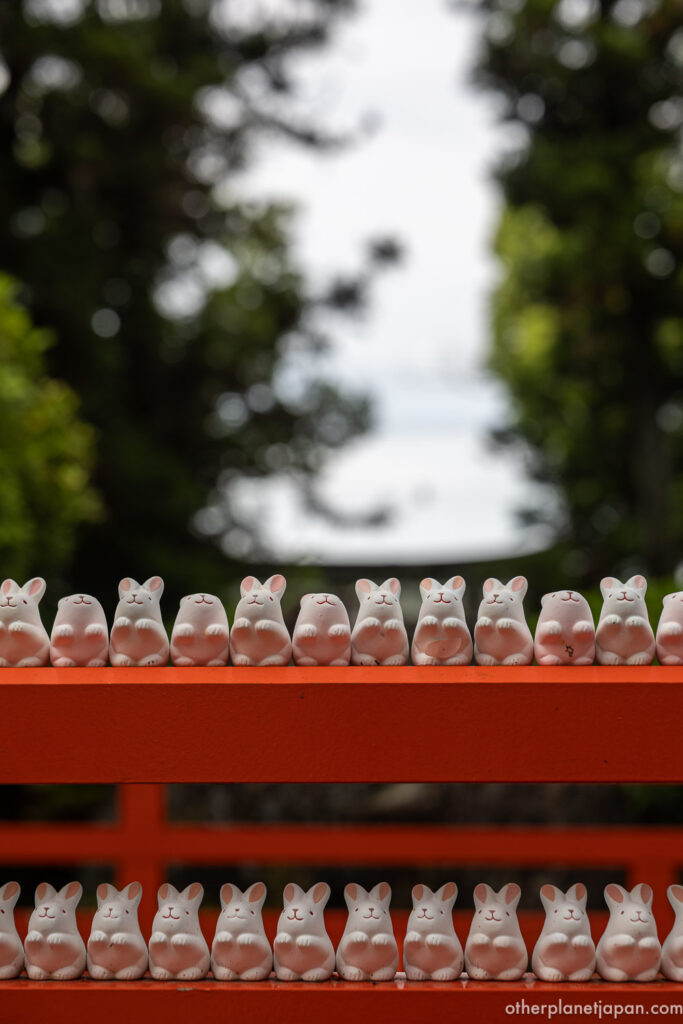
Rows of rabbit omikuji along the vermilion railing
Omamori
The shrine offers rabbit-themed amulets for fertility, safe childbirth, matchmaking, and warding off misfortune.
Beyond Fertility — Matchmaking and Warding Off Evil
Okazaki Shrine’s role extends beyond childbirth.
Matchmaking (Enmusubi)
According to mythology, Susanoo-no-Mikoto rescued Kushinada-hime-no-Mikoto from the eight-headed serpent Yamata-no-Orochi at the Hi-no-kawa River in Izumo, and the two were married. Because of this story, Okazaki Shrine is also revered as a deity of matchmaking and successful marriages.
Warding Off Misfortune (Yakuyoke)
The shrine was originally founded as a guardian shrine for the imperial capital, with prayers offered for the protection of the city and the warding off of evil. It remains a popular place for yakuyoke (warding off misfortune) prayers and for jichinsai — ground-breaking ceremonies for new buildings.
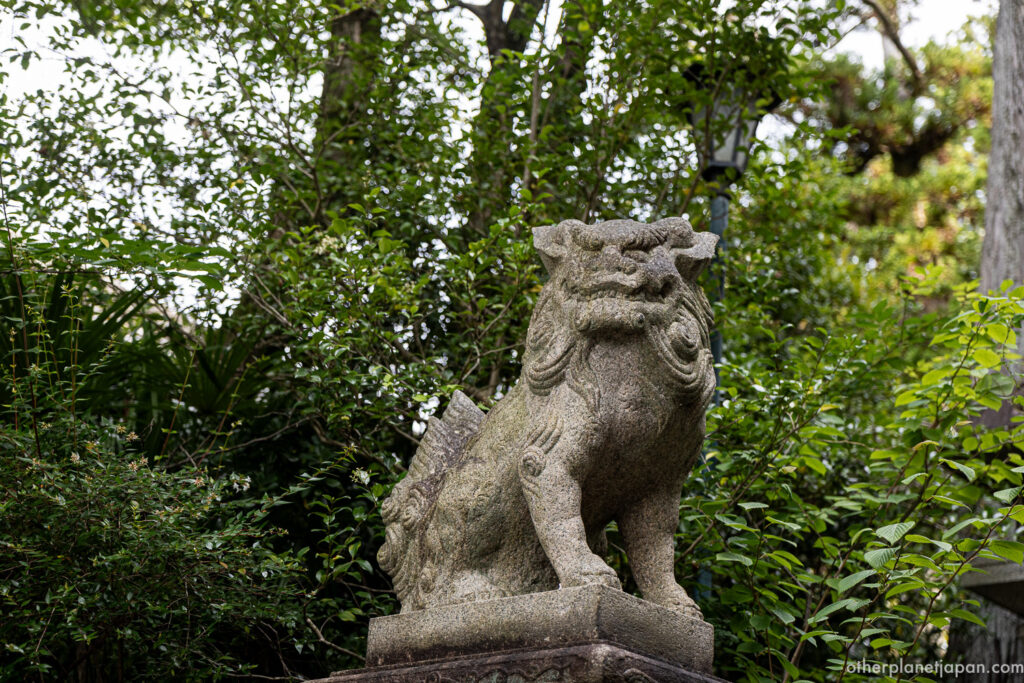
A conventional komainu also guards the shrine grounds
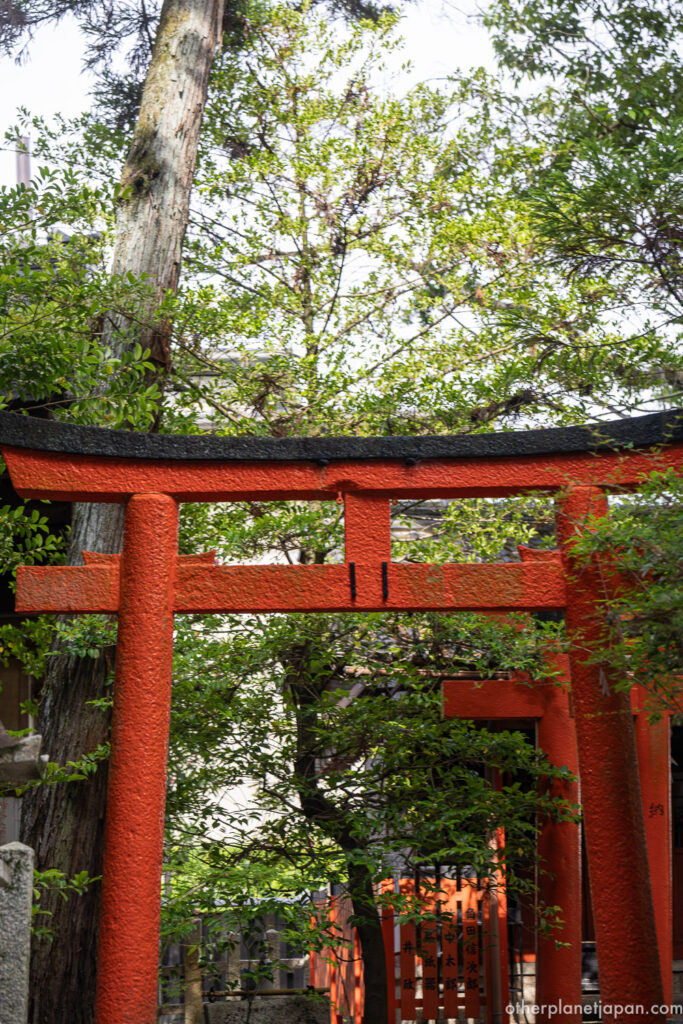
A vermilion torii gate within the shrine grounds
Practical Information
Hours
The shrine grounds are open 24 hours. The shrine office, where you can receive ema, omikuji, omamori, and goshuin (shrine stamps), is open 9:00 to 17:00.
Admission
Free.
Best Time to Visit
Early morning is the quietest. Arriving between 9:00 and 10:00 means you’ll often have the approach to yourself. The shrine is also beautiful in early summer when the surrounding trees are at their freshest green.
How to Pray for Fertility or Safe Childbirth
Visitors who wish to receive a formal blessing should inquire at the shrine office. For maternity belt blessings (harataobi), it is customary to bring your own belt. Reservations for formal prayer ceremonies are generally recommended; check the official website for details.
Photography
Photography is permitted in the outdoor grounds. Avoid photographing the interior of the main hall or active prayer ceremonies as a matter of courtesy.
Access
Okazaki Shrine is located in the Okazaki district of eastern Kyoto, near several major sightseeing destinations.
By subway: Keage Station (Tozai Line) — 20 minutes on foot.
By train: Jingu-Marutamachi Station (Keihan Line) — 25 minutes on foot.
By bus: Kyoto City Bus to “Okazaki-jinja-mae” stop, served by routes 32, 93, 203, and 204. The shrine is directly in front of the stop.
Nearby Temples
Okazaki Shrine is within easy walking distance of two of Kyoto’s most rewarding off-the-beaten-path temples:
| Temple | Walking time |
|---|---|
| Konkai-komyoji (Kurodani) | 5 minutes |
| Shinnyodo | 10 minutes |
Both temples sit on the wooded hillside directly north of the shrine. Walking from Okazaki Shrine to Konkai-komyoji and then continuing to Shinnyodo makes a natural half-day route through one of eastern Kyoto’s quietest neighborhoods.
Combining with Other Sites
Okazaki Shrine pairs naturally with a visit to Heian Shrine, Nanzen-ji, or Eikan-dō, all within walking distance. A half-day in the Okazaki district can comfortably cover the shrine along with one or two of these neighbors.
Official Website
For the latest information on prayer ceremonies, reservations, and seasonal events, visit the official Okazaki Shrine website. Note that the site is in Japanese only — use your browser’s translation function if needed.
Frequently Asked Questions
Is Okazaki Shrine worth visiting?
Yes, particularly if you are interested in fertility or safe-childbirth blessings, the cultural symbolism of rabbits in Japan, or simply a quiet shrine away from Kyoto’s main tourist routes. The site is small but unusually rich in detail.
Why is Okazaki Shrine called the “rabbit shrine”?
The shrine’s enshrined deities had eight children, making them gods of fertility and safe childbirth. The surrounding area was historically home to wild rabbits, which were considered the deity’s messengers. The combination of prolific gods and prolific animals made the rabbit the shrine’s enduring symbol.
Can I pray for safe childbirth here?
Yes. Okazaki Shrine has been a destination for safe-childbirth prayers since at least 1178, when the Empress Consort Taira no Tokuko prayed here. Visitors traditionally bring a maternity belt to be blessed. Inquire at the shrine office or check the official website for formal prayer ceremonies.
What are the shrine’s opening hours?
The grounds are accessible 24 hours, but the shrine office — where ema, omikuji, omamori, and goshuin are issued — is open 9:00 to 17:00.
How do I get to Okazaki Shrine from Kyoto Station?
The simplest route is Kyoto City Bus route 5 or 100 to “Okazaki-jinja-mae,” approximately 30 minutes. You can also take the subway Karasuma Line to Karasuma-Oike, transfer to the Tozai Line to Keage Station, and walk 20 minutes.
Is the shrine accessible for visitors with mobility limitations?
The main grounds are mostly flat, though there are a few steps near the main hall. The shrine does not have dedicated accessibility infrastructure.
Can foreign visitors leave an ema or buy omamori?
Yes. The ema wall already contains plaques in many languages, and the shrine office welcomes international visitors.