At 5:45 p.m. on September 22, I walked into Seimei Shrine thinking I was early.
The yudate kagura, the first rite of the shrine’s annual festival, wasn’t due to begin until seven. Better too early than too late. That was the theory.
Nothing was happening. Nothing would happen for an hour and fifteen minutes.
Seimei Shrine holds its festival every year on the autumn equinox and the evening before. Locals call it Seimei Matsuri, or Seimeisai, and the shrine itself often goes by Seimei Jinja. It is a neighborhood festival on a busy stretch of Horikawa Street, in grounds you could cross in a minute, and yet people come from all over Japan, and from well beyond it, to watch.
I’m not from Kyoto, which may be why it strikes me the way it does. To me, it looks like Kyoto’s festival calendar folded small and packed into two days at a single shrine. This was my second time. The impression only got stronger.
Too Early, and Not Early Enough
I wasn’t the only one who had come early. The grounds are small, and the rope around the iron cauldron drew a crowd almost at once. I had arrived far too early and only just in time, both at the same moment. So I stood still and said nothing.
At seven, the kagura began. So, I’m told, did the Omukae Chochin, the procession of paper lanterns carried by local children. I say “I’m told” because from where I stood I couldn’t see a single lantern. I had spent an hour and fifteen minutes securing a spot for one ritual, and it faced away from the other.
A Yudate Kagura Without Steam
There was no steam.
This was my second yudate kagura. The first was in deep winter, and what I remember most is a column of white steam rising off the cauldron into the cold. Here, nothing. Kyoto in September is still hot, and warm air hides steam. That’s the sensible explanation. At the time, I simply wondered whether the water was hot at all.
A priest settled the question. “Please be careful,” he told the crowd. “The water may reach you.” Boiling, then.
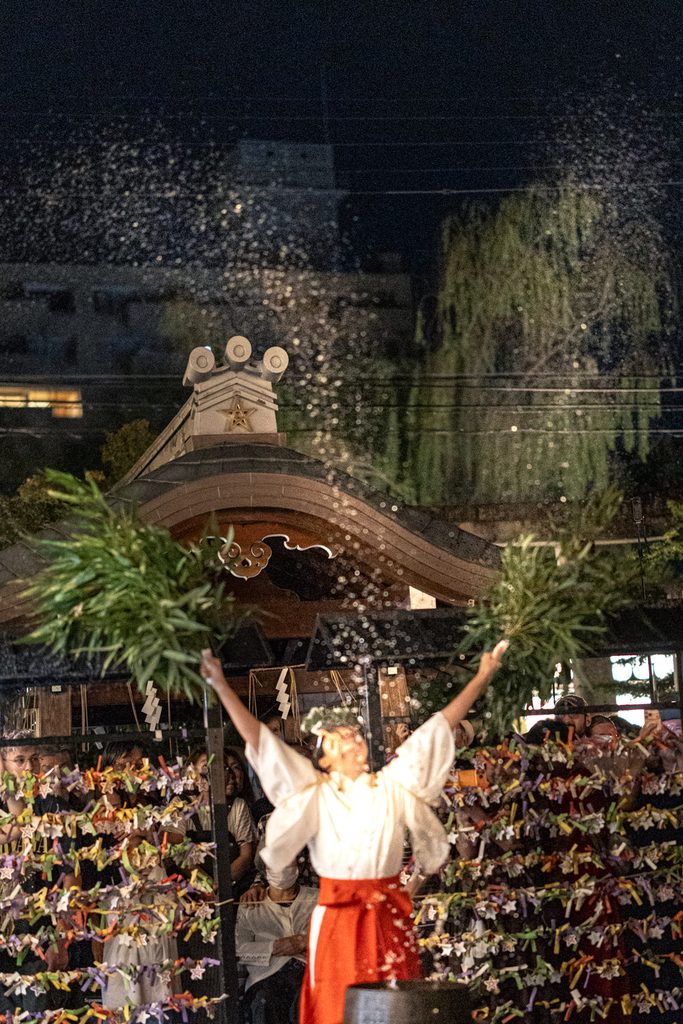
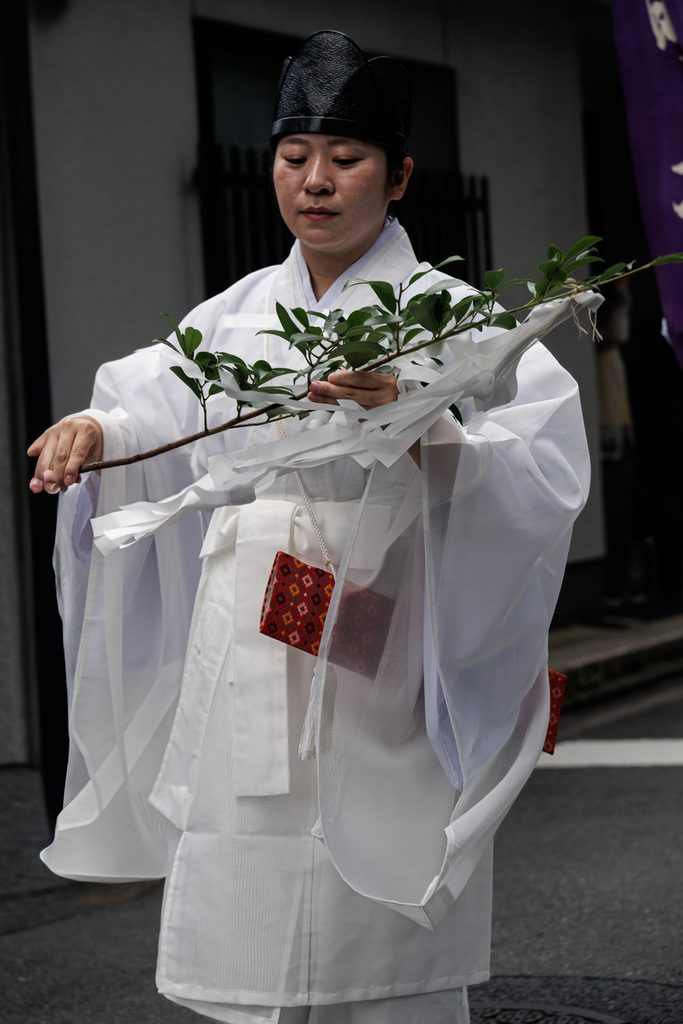
I braced myself. The shrine maiden dipped two thick bundles of bamboo leaves into the cauldron and swept them high over her head, and the spray burst apart in the lights. She swept them toward the people standing right beside me. All that bracing, and not a drop.
Yudate kagura is an old purification rite. Water is boiled in a great cauldron, and the droplets flung from the bamboo are believed to keep illness away for the year ahead. At Seimei Shrine, it is performed only on this one evening.
1 p.m., and the Grounds Overflow
The next day was the equinox.
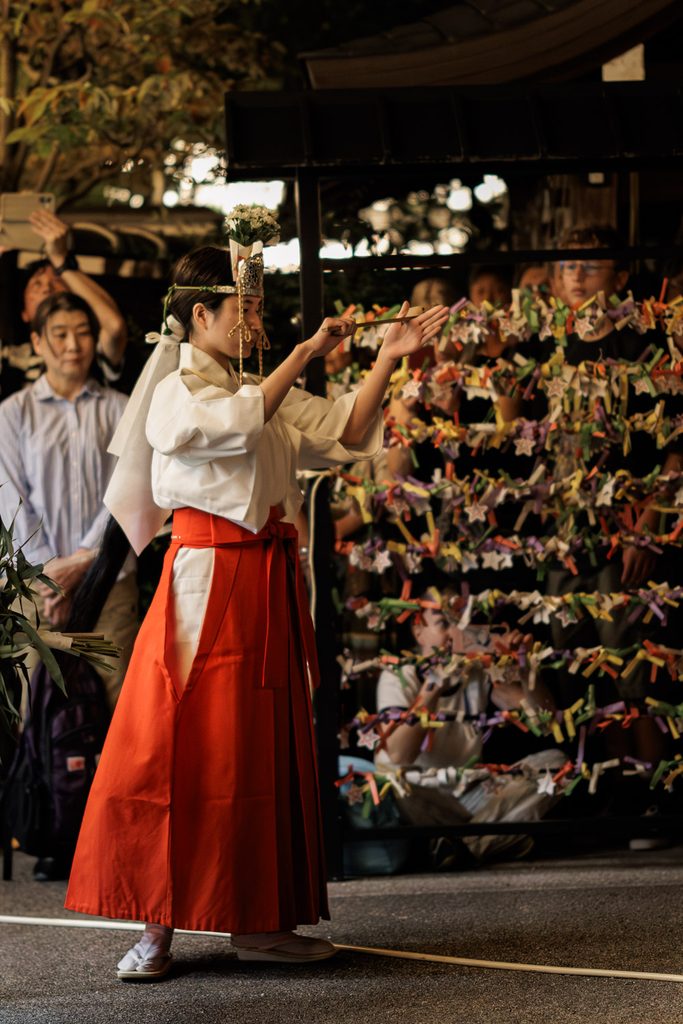
September 23 is the main festival day, and the mikoshi procession sets out at 1 p.m. By then the grounds were so full that I moved by inches. It felt noticeably busier than two years before.
It was also hot, the kind of late-September heat that makes you check the calendar. I was hunting for shade, and all I had to do was watch. The people in the procession had changed into layered costumes and were about to walk out into full sun in jika-tabi, the split-toed work boots, or in straw sandals, for miles through the neighborhood.
I felt sorry for them. Then I raised my camera.
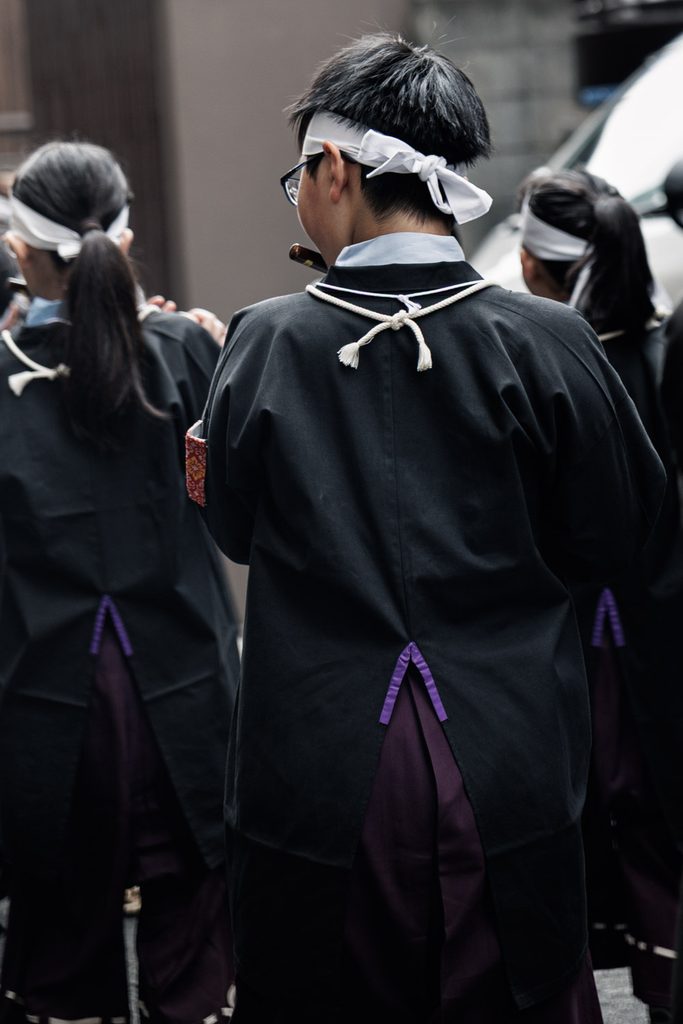
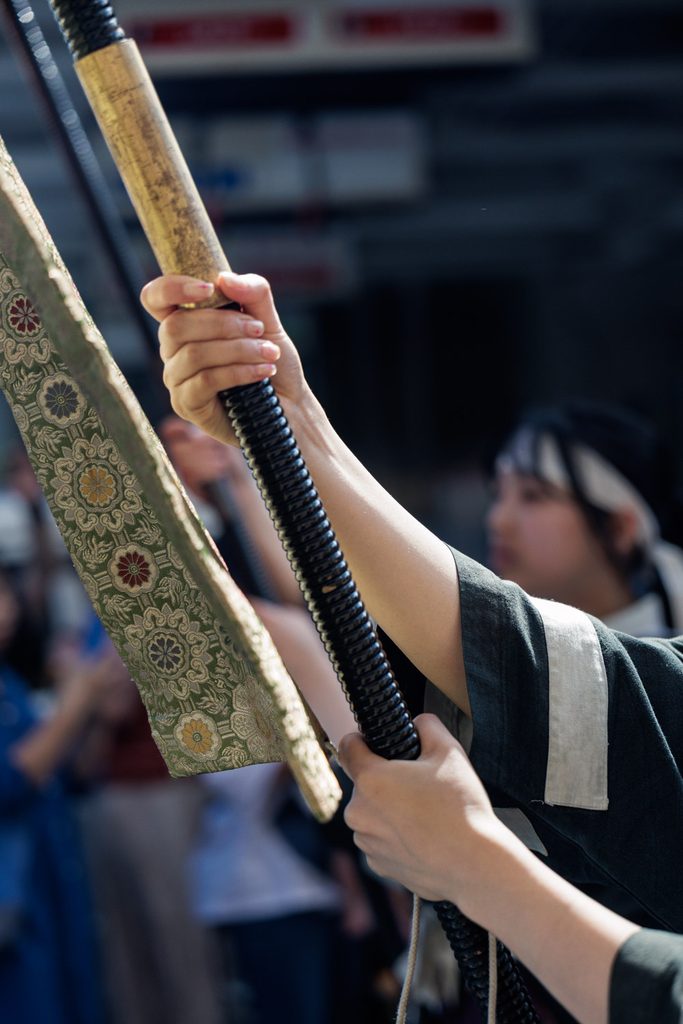
The youth drum and fife corps led the way in black coats, purple hakama trousers, and white headbands knotted at the back. A tasseled cord hung from each collar and bounced with every step.
The Mikoshi That Wouldn’t Leave
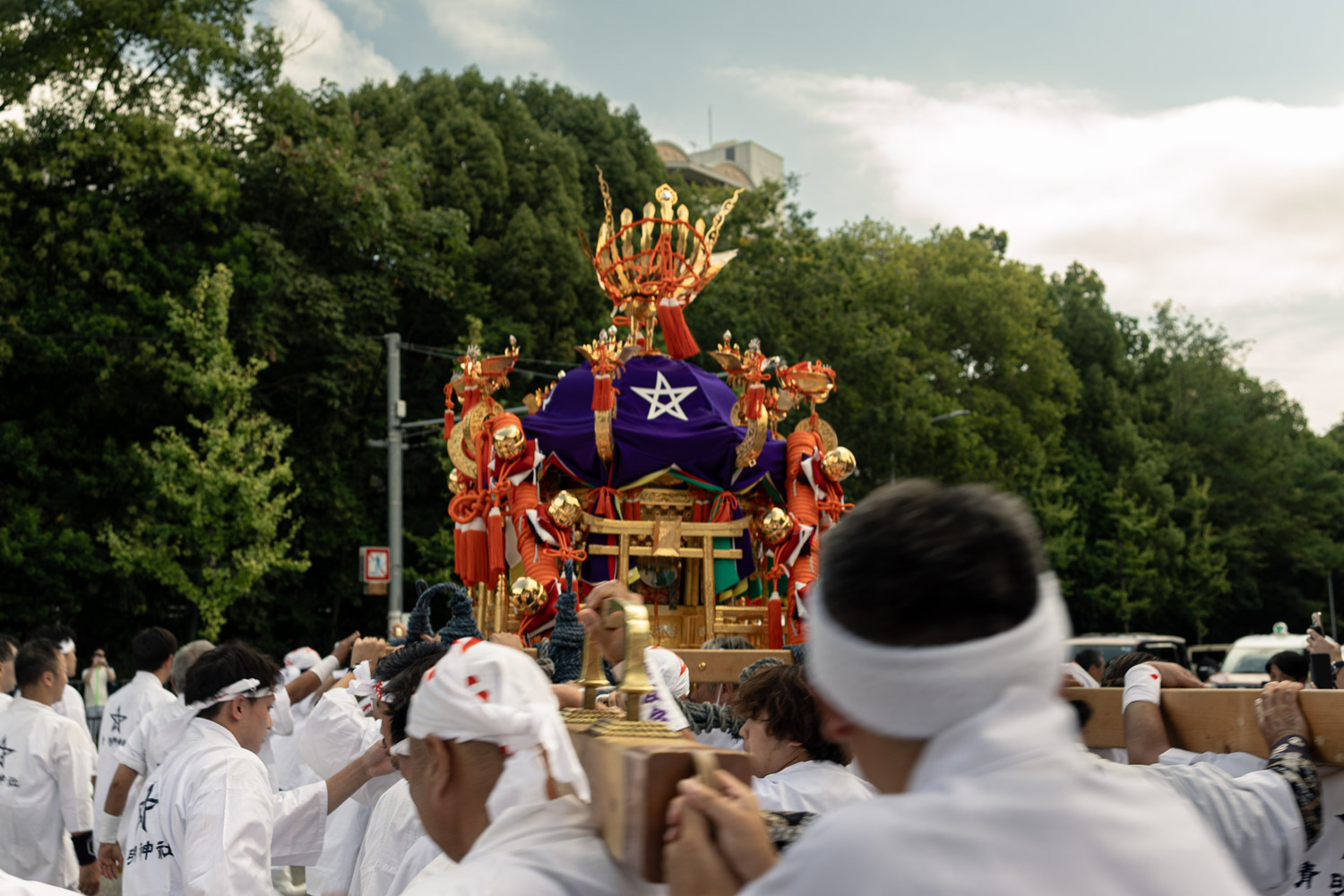
The honsha mikoshi, the shrine’s principal portable shrine, is carried by grown men, and its real test comes at the first torii on Horikawa Street. The stone gate bears the shrine’s star crest in place of the name plaque most torii carry.
The mikoshi could not make it through.
The bearers chanted. Yoi, yoi, yoi, yoi, YOIIIII. The mikoshi lurched forward, was shoved back, and the chant started again. The poles dug into their shoulders. Over and over, they seemed to punish themselves on purpose. Apparently this happens every year.
Watch long enough and the suffering starts to look like joy. These men were, after all, standing in front of Japan’s most famous onmyoji. I like to think Seimei was having a little fun with them.
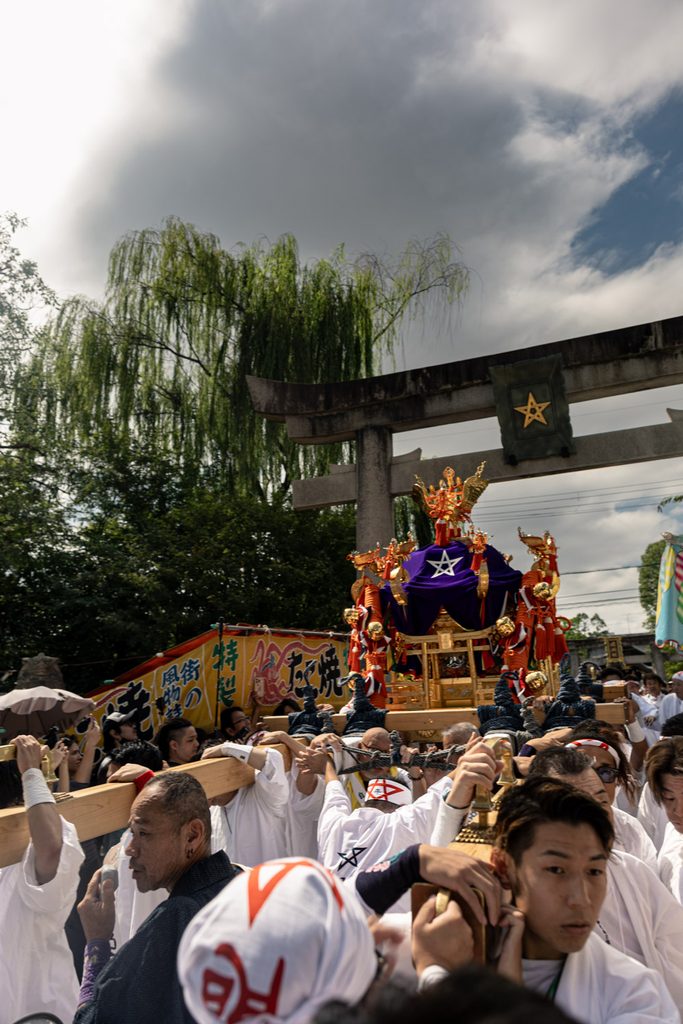
This year, the scene became a goshuin, the inscribed shrine seal that visitors collect. On September 5, the shrine began offering a limited embroidered goshuin showing the mikoshi passing through the first torii at the start of the procession, as the shrine announced on Instagram. It sold out on September 22, returned on the 23rd, and sold out again almost at once. Stitched in thread, the bearers’ struggle looks a good deal more cheerful.
Kyoto, Folded Small
What struck me, as someone from outside Kyoto, is how much of a Kyoto matsuri fits into this one small festival.
Start with the chant. That yoi, yoi at the torii sounds nothing like the mikoshi chants of Osaka or Tokyo, and visitors from elsewhere in Japan hear it and think, so this is Kyoto. Then the lanterns. The Omukae Chochin procession is, as far as I know, a Kyoto custom, and Seimei Matsuri keeps it faithfully, even if I missed it this time. There is a procession of children in costume. I’m fairly sure the drum and fife corps played the same tune I’ve heard at the Jidai Matsuri, Kyoto’s Festival of the Ages. And the night before, the yudate kagura.
The only thing missing is the Gion Matsuri’s towering floats. Even a miniature has its limits.
For the full-size versions, I’ve written about the Omukae Chochin and Mikoshi Arai at the Gion Matsuri, the Yoiyama evenings, and the Yamaboko Junko float procession.
Due Back at 4:20, Back at 5:20
The schedule said 4:20.
According to the shrine’s official route map, the procession leaves at 1 p.m., stops at Nishijin Chuo Elementary School to rest from 2:30 to 3:00, and returns to the shrine at 4:20. It came back at 5:20.
The procession stretches out as the afternoon wears on, and the adults’ mikoshi arrives last, well behind everyone else. This year it was an hour late. After that performance at the torii, I can’t say I was surprised.
The Onmyoji and the Neighborhood That Keeps Him
In Japan, Abe no Seimei’s name is remarkably familiar for a man few people ever study in school. The 2001 film Onmyoji helped. But ask Japanese people today to picture him, and most will picture Yuzuru Hanyu, the Olympic figure skating champion, in the white and green costume he wore to skate a program called SEIMEI. I suspect some of the crowd that afternoon were his fans. He did not make a surprise appearance. I don’t expect he ever will.
I had always assumed that Seimei the demon fighter was a modern invention. It isn’t: tales of him seeing and outwitting demons already appear in the Konjaku Monogatari-shu, a collection of stories compiled in the twelfth century. For a man with that many demons to his name, though, he is rarely spoken of in the same breath as the yokai themselves. Toei Kyoto Studio Park is the exception, with a haunted house named Ichijo Modoribashi, after the bridge where Seimei is said to have hidden his shikigami, the spirit servants of legend. The same park hosts the YOKAI festival I’ve written about.
The historical Seimei read the stars and advised the imperial court. The demons and the spirit servants belong to legend, though the legend is older than I thought, and nobody here seems in any hurry to separate the two. The shrine has honored him for a thousand years, and the neighborhood around it has cared for the shrine all along.
What I saw over those two days wasn’t really the mystery of an onmyoji. It was a neighborhood that carries that mystery out into its streets every September, on schedule, give or take an hour.
What Is Seimei Shrine?
It began as a house.
Seimei Shrine honors Abe no Seimei, an astronomer of the mid-Heian period and the best-known onmyoji, or practitioner of onmyodo, the court’s system of astronomy, calendar-making, and divination. He is said to have served six emperors, from Suzaku to Ichijo. He died in 1005. Two years later, in 1007, Emperor Ichijo ordered a shrine built on the site of his residence to honor his achievements and calm his spirit. It stands in the same place today.
Old records describe grounds many times larger than today’s, spread across what are now ordinary city blocks. After the Onin War, the shrine shrank under Toyotomi Hideyoshi’s rebuilding of the capital and repeated fires. Documents and treasures were scattered, and the buildings stood neglected for a long time.
The parishioners brought it back, repair by repair. In 1950, the shrine finally regained land facing Horikawa Street, a long-held wish. Novels, manga, and films have since made Seimei famous nationwide, and in 2003 the shrine marked its 1,000th anniversary.
What to See at Seimei Shrine
The grounds are small, but they reward a slower look, mostly at stars, and at one peach.
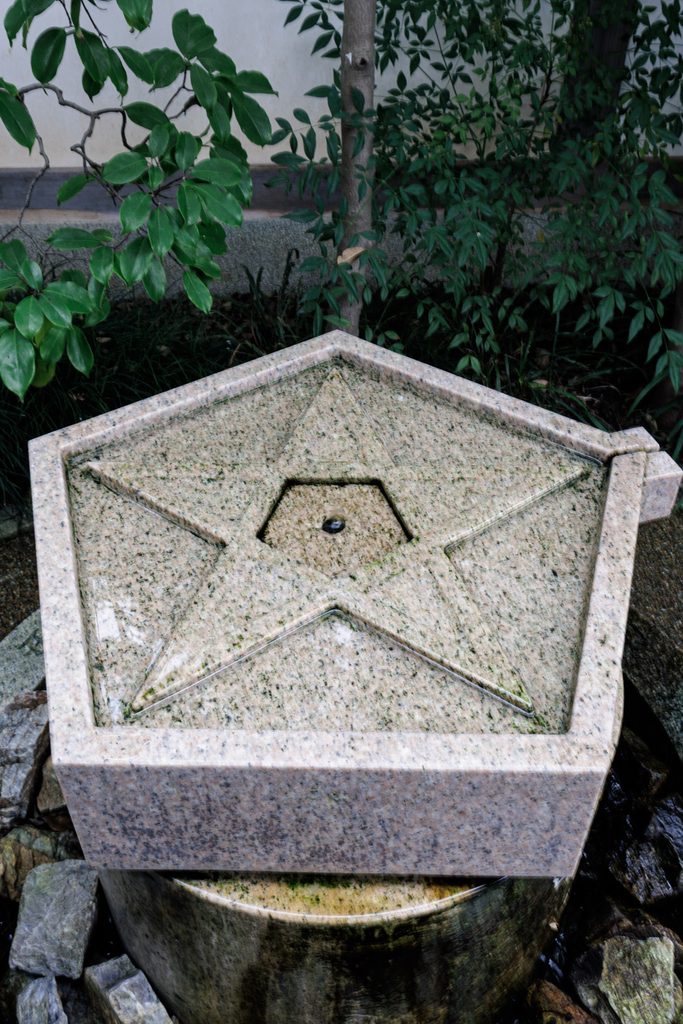
The Seimei Well. Legend says the well sprang up through Seimei’s own power and that its water cures illness. The stone basin is carved in the shape of a five-pointed star.
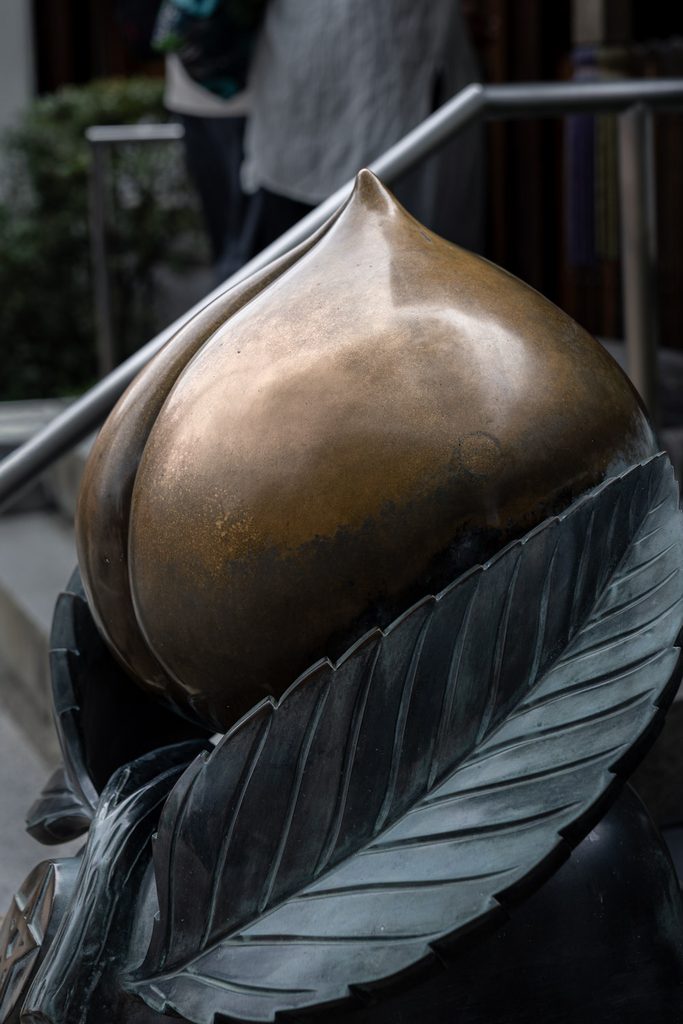
The Yakuyoke Momo, or evil-warding peach. A large bronze peach sits near the main hall, rubbed to a shine by visitors who stroke it to pass their misfortune into it. According to the leaflet that came with my goshuin, onmyodo has long regarded the peach as a fruit that wards off evil. I’ll admit I had never heard of anyone using a peach that way. The idea turns out to be ancient. In the Kojiki, Japan’s oldest surviving chronicle, the god Izanagi escapes the underworld by throwing peaches at the army chasing him. Yuzuru Hanyu is said to have rubbed this one too, praying to stay free of injury.
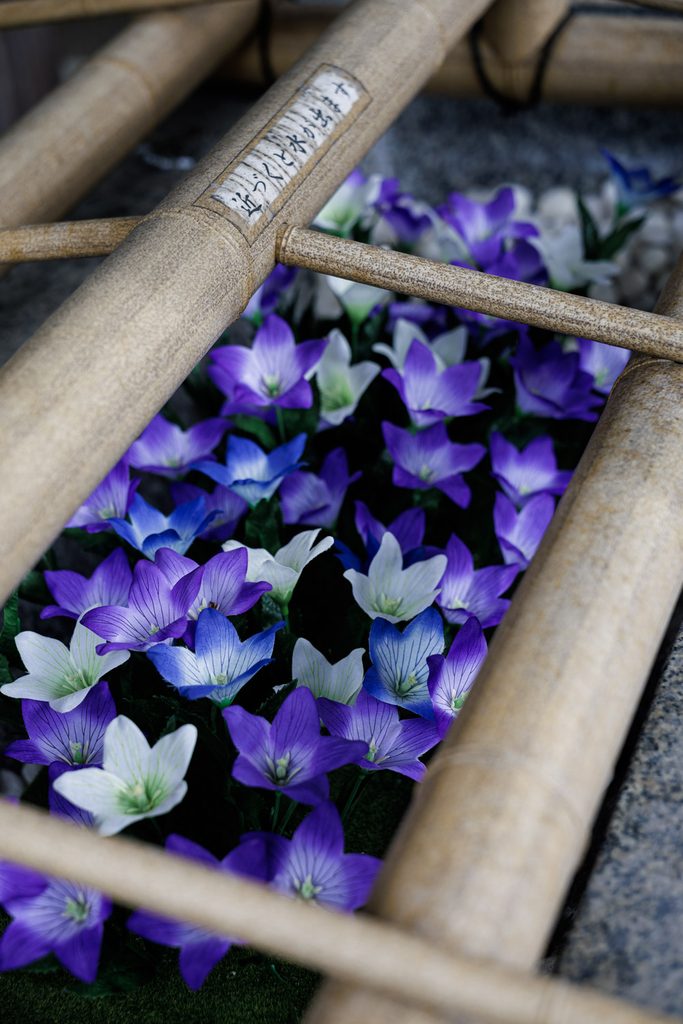
The bellflower water basin. The purification basin is filled with bellflowers, a nod to the shrine’s crest, which is known as the Seimei bellflower. A tag on the bamboo spout explains that the water runs when you come close.
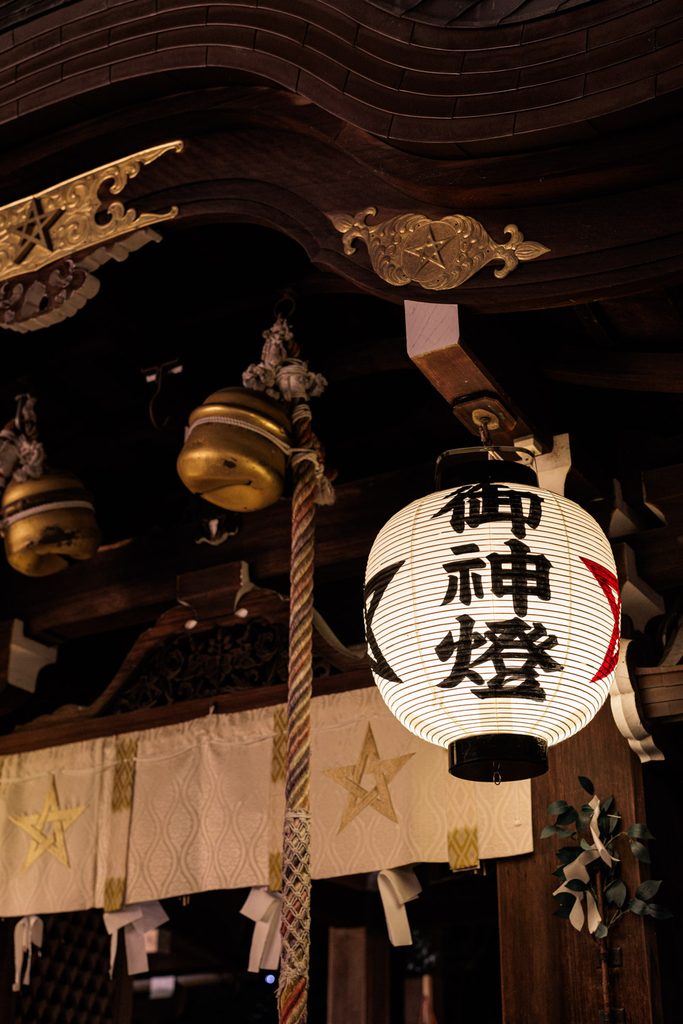
The star crest. The shrine’s crest is a pentagram drawn in a single stroke, long regarded as a charm against evil. Once I started noticing it, I found it everywhere: on the first torii, the fittings of the main hall, the curtains, the lanterns.
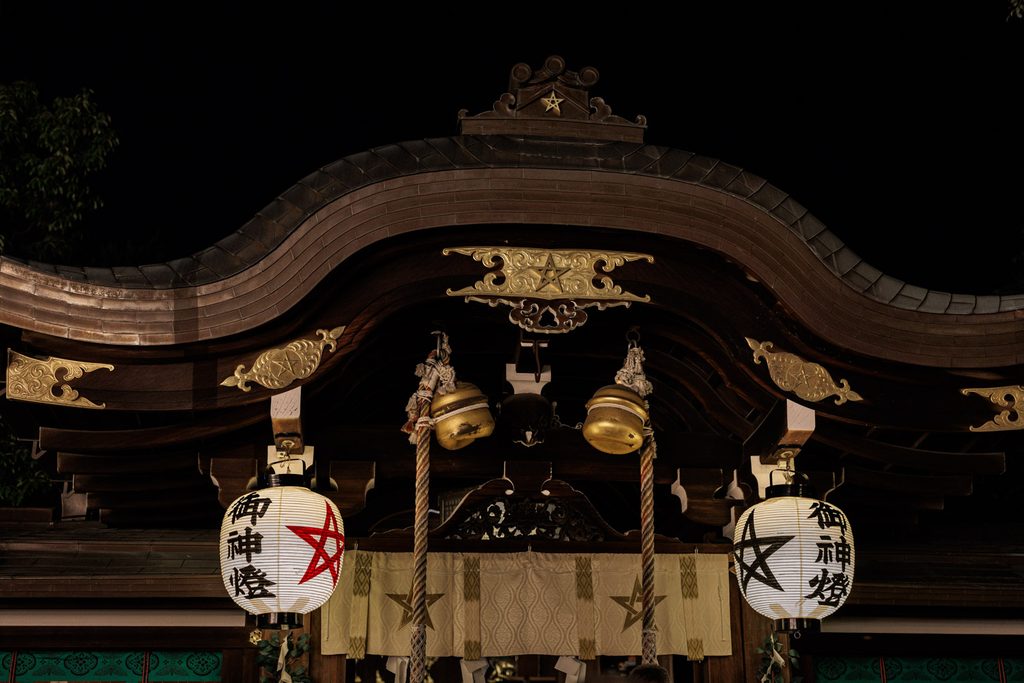
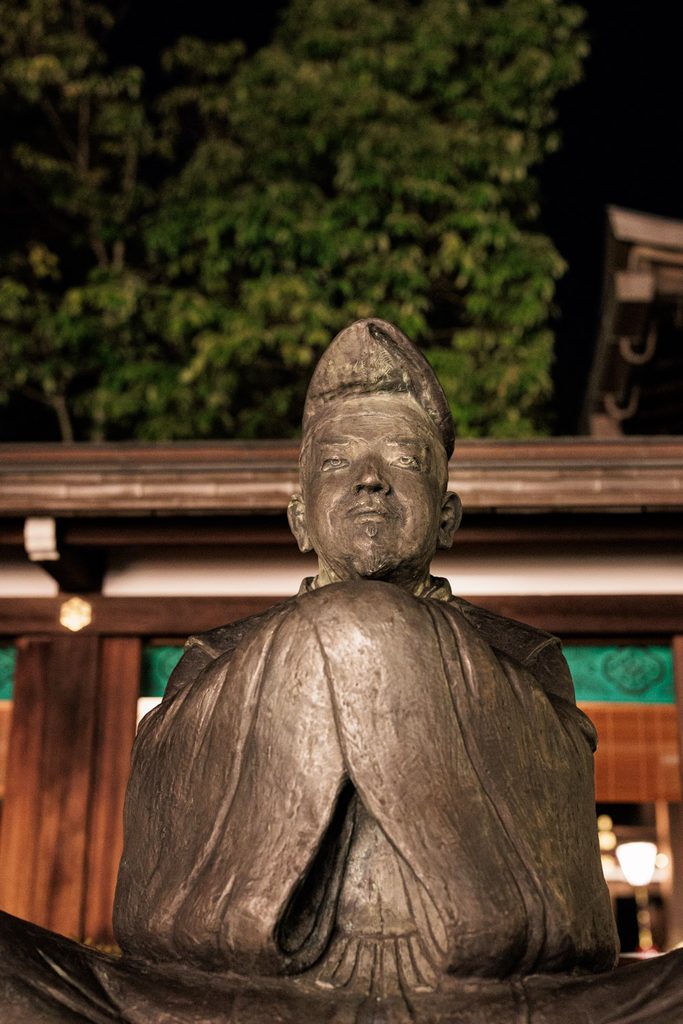
The statue of Seimei. He sits in the grounds with his hands folded into his sleeves. By day he looks like a court official. At night, I found his expression much harder to read.
Ichijo Modoribashi, old and new. In the grounds stands the old Ichijo Modoribashi, the railings of the former bridge reassembled as a small memorial. Someone was always standing at it, so I gave up on getting close, though it isn’t a place where anyone lingers. The bridge itself is a short walk south along Horikawa Street, where Seimei is said to have hidden away his twelve shikigami.
Seimei Shrine Goshuin and Goshuincho
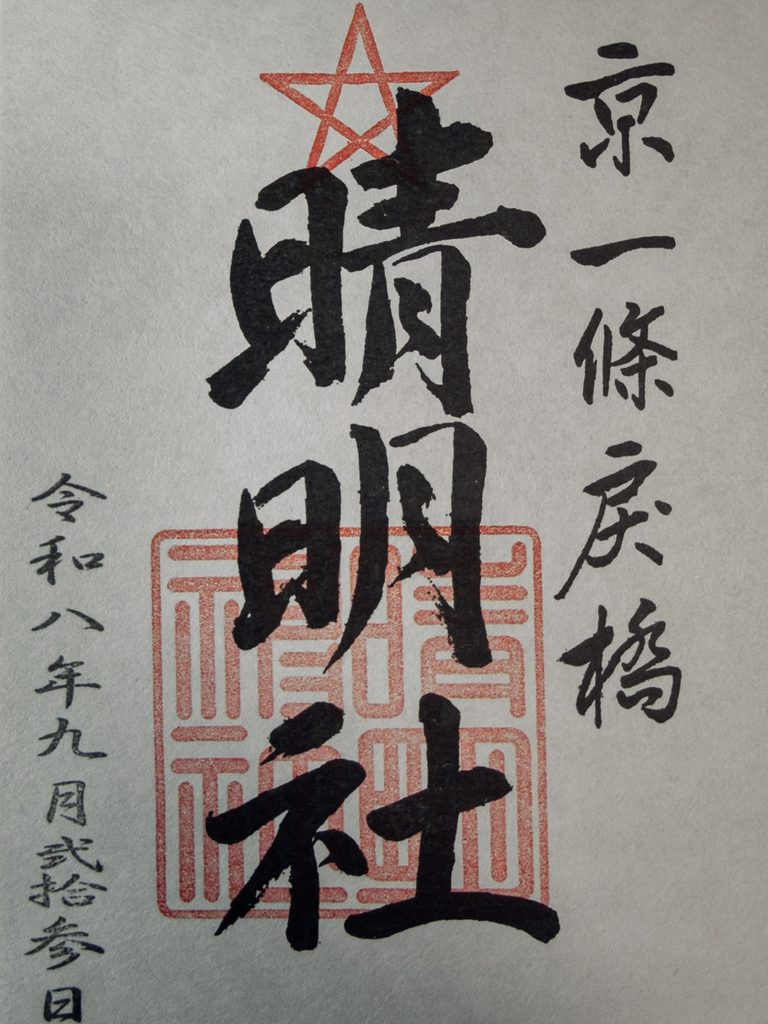
Festival day or not, Seimei Shrine offers its goshuin only on pre-inscribed sheets rather than writing them in your book. The limit is one of each type per person, and a posted chart shows which combinations are allowed. There is also a notice asking visitors not to resell them, which tells you how popular they are.
| Item | Offering | Includes |
|---|---|---|
| Standard goshuin | 500 yen | Goshuin, clear folder, shrine history leaflet |
| Embroidered goshuin (bellflower) | 1,300 yen | Embroidered goshuin, clear folder, shrine history leaflet |
| Goshuincho (goshuin book) | 3,500 yen | Original shrine design, with the shrine’s goshuin already on the first page at no extra charge |
The characters for “Seimei-sha” on the goshuin are in the hand of Tsuchimikado Haretake, head of the court’s Bureau of Onmyo and, by the shrine’s count, 34th in line from Seimei himself. Haretake lived in the late Edo period and was effectively the last head of the Tsuchimikado family’s onmyodo. The year after his death, in 1870, the bureau was abolished.
A shrine to the most famous onmyoji, and on its seal, the handwriting of the tradition’s final chapter. The one I received on September 23 carries it too.
Seimei Shrine Festival Schedule and Tips
Seimei Matsuri is held every year on the autumn equinox and the evening before. The next one is scheduled for September 22 and 23, 2027.
| Day | Time | What happens |
|---|---|---|
| Eve of the equinox (Yoimiya-sai) | 7 p.m. | Yudate kagura and the Omukae Chochin lantern procession |
| Equinox (Reisai) | 10 a.m. | Main annual rite |
| Equinox (Shinko-sai) | 1 p.m. | Mikoshi procession; rest at Nishijin Chuo Elementary School 2:30 to 3:00; scheduled return 4:20 |
Choose your ritual on the first night. I learned this the hard way. The yudate kagura and the lantern procession start at the same time, and the grounds are small. A spot with a good view of the cauldron may show you nothing of the lanterns. Decide which you want before you plant yourself.
Get a personal kagura blessing. On the evening of the yudate kagura, you can receive a kagura blessing of your own for an offering of 1,000 yen. It comes with Seimei manju, sweets first offered at the altar and then shared with worshippers.
Expect crowds and delays on the main day. The grounds are extremely crowded just after 1 p.m. Plan on the procession returning late. This year it was due at 4:20 and arrived at 5:20.
Prepare for heat. The equinox sounds like autumn. In Kyoto, it often isn’t. Bring water and something for shade.
Getting to Seimei Shrine
From Kyoto Station, take Kyoto City Bus No. 9 to Ichijo Modoribashi/Seimei Jinja-mae, about a two-minute walk from the shrine. By subway, Imadegawa Station on the Karasuma Line is roughly a 12- to 15-minute walk. The grounds are free to enter, and the main hall is generally open for worship from 9 a.m. to 5 p.m. For current information, check the Seimei Shrine official website.