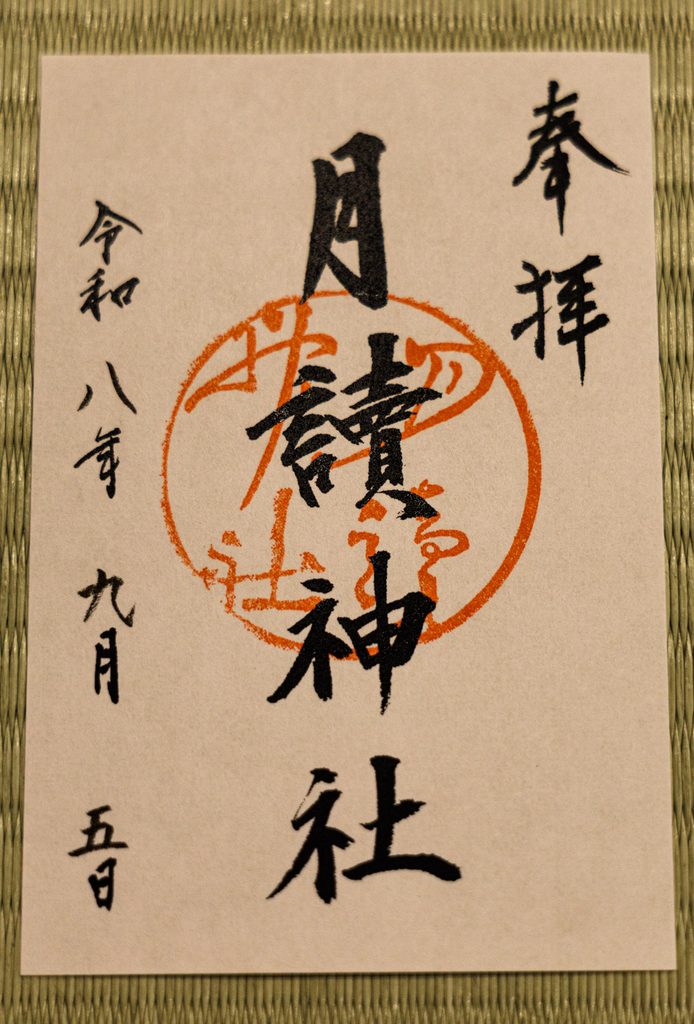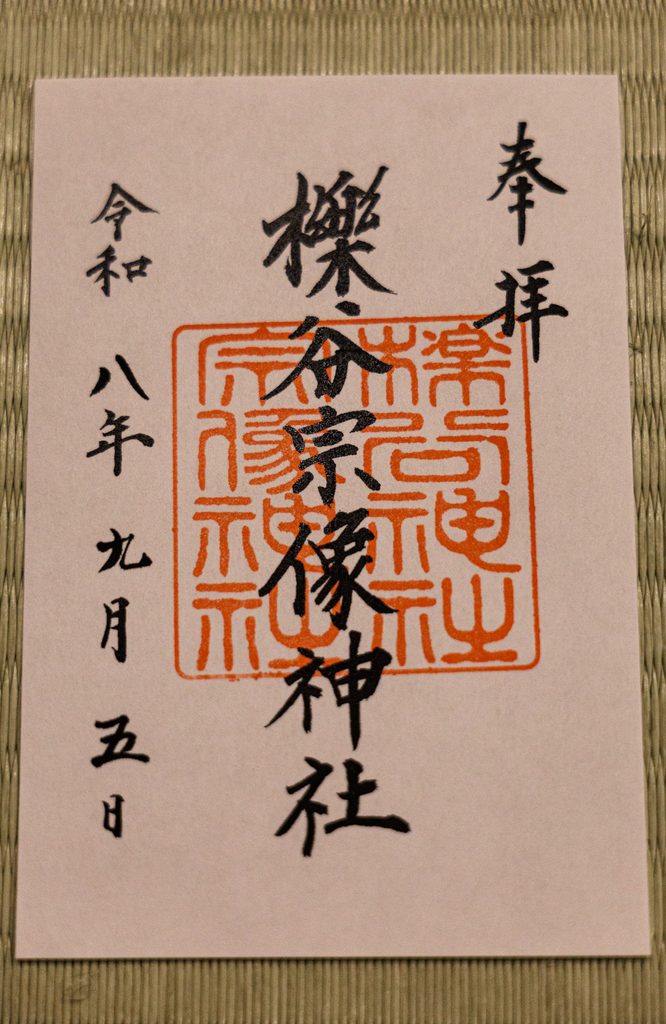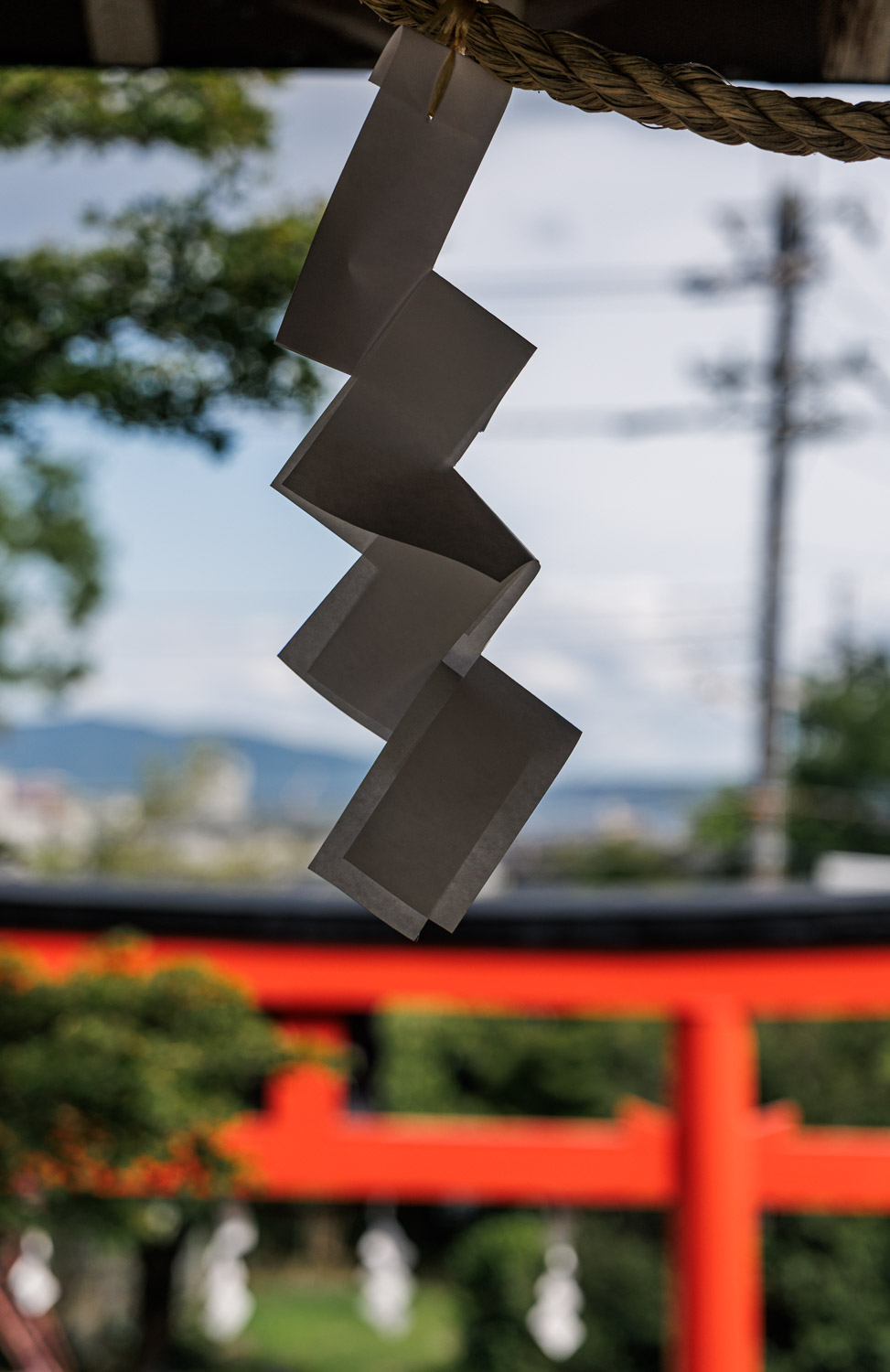
Amaterasu, the sun. Susanoo, the storm. Anyone who has read a single page of Japanese mythology knows those two, mostly because of the famous quarrel they had.
There was a third child. Tsukiyomi, the moon, born alongside them when Izanagi washed himself clean after returning from the land of the dead. In the myths, Tsukiyomi does almost nothing at all.
Shrines to him are rare, and the few that exist are scattered: a small one out on the island of Iki, another inside the Ise complex. The Tsukiyomi Shrine Kyoto keeps is three hundred meters south of Matsuo Taisha, on a residential street where children ride bicycles past the gate. I had been to Matsuo Taisha. I had never once made that turn.
The Third Sibling
His resume is one line long.
In the Nihon Shoki, Tsukiyomi is sent to visit Ukemochi, the goddess of food. He does not care for the way she produces the meal, so he kills her. Amaterasu hears about it and never speaks to her brother again. That is the whole career.
The sun lights the world. The storm slays an eight-headed serpent and gets a sword out of it. The moon loses his temper once, at dinner, and withdraws to the night side of everything.
English books usually spell him Tsukuyomi. The shrine in Kyoto uses Tsukiyomi, so that is the spelling here.
You can feel the imbalance in the geography of Japanese religion. There are thousands of shrines to Amaterasu and to Susanoo. There are so few where Tsukiyomi is the principal deity that you could almost count them.
Three Hundred Meters South of Matsuo Taisha
The walk does not feel like a pilgrimage.
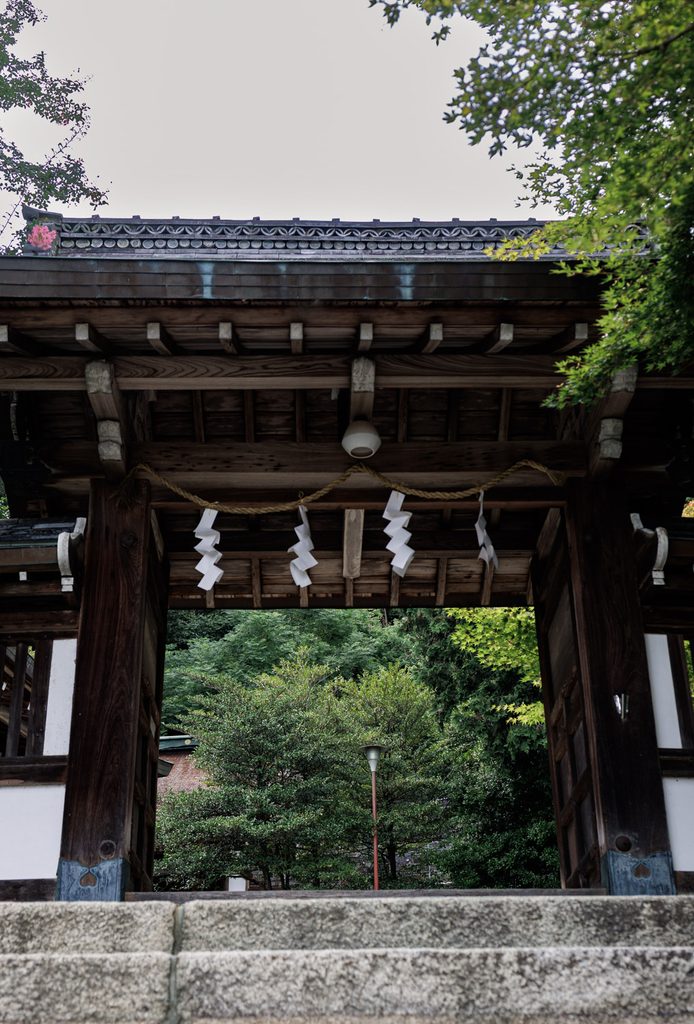
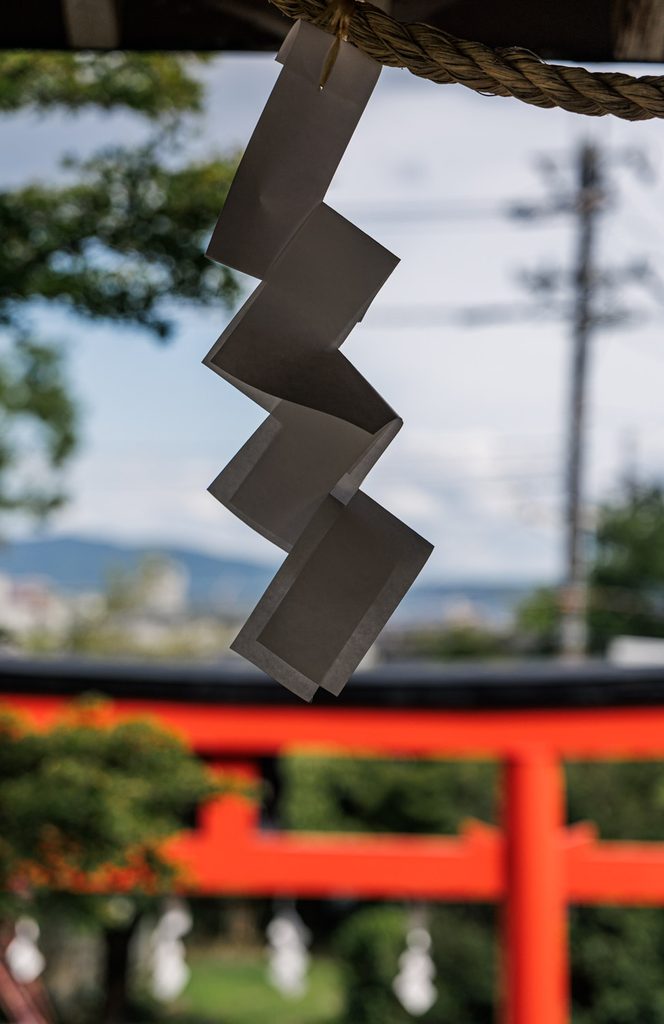
You leave the first torii of Matsuo Taisha, turn south, and follow a narrow street between houses. A bicycle passes. Somewhere behind a wall, children are shouting about something. Three minutes later there is a flight of stone steps, and above the steps a gate with a rope across it, and through the gate you can see trees and a piece of sky.
Inside, the first thing you notice is the sound. More precisely, you notice that you are noticing the absence of it. Matsuo Taisha had people in it: a wide approach, stacked sake barrels, wind chimes in summer, a line of visitors at the spring. Tsukiyomi Shrine has a main hall and a worship hall from the Edo period, two small shrines beside them, a lot of old trees, and nobody.
Which is strange, given the paperwork. Tsukiyomi Shrine is listed in the tenth-century Engishiki as a Myojin Taisha, one of the few hundred shrines the imperial court considered important enough to petition in a national emergency. It was raised to senior first rank in 906. On paper this is one of the most eminent shrines in the country.
On the morning I visited, the eminent shrine had a congregation of one.
The Holy Water You Are Not Allowed to Drink
There is a spring in the corner of the grounds.
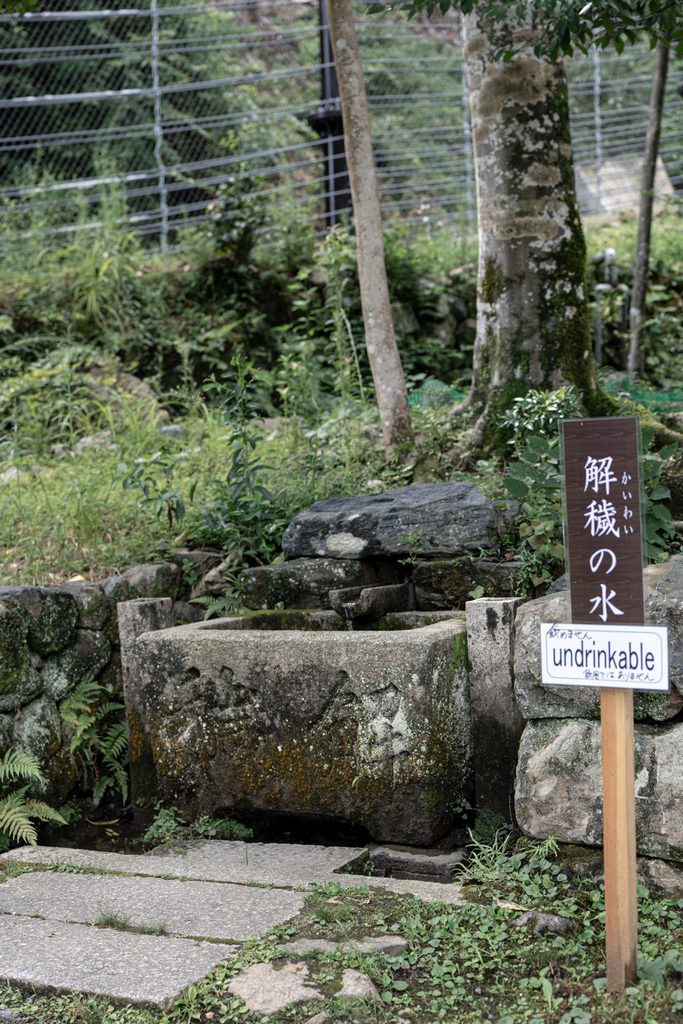
Water comes down from the mountain through a thin pipe and falls into a stone trough furred with moss. The wooden sign beside it reads Kaiwai no Mizu. The characters mean, roughly, water that dissolves defilement. This is spring water for washing off whatever you have picked up outside.
Next to that sign is a smaller white one. It says one word in English.
undrinkable
In Japan this kind of water is usually the opposite. Three hundred meters back up the road, at Matsuo Taisha, the Kame-no-i spring pours out of a stone turtle’s mouth and people arrive with bottles to carry it home. I watched an old man fill several of them. A three-minute walk turns drinkable sacred water into undrinkable sacred water.
And notice which half made it into English. Nobody translated “water that dissolves defilement.” Somebody translated “do not drink this.” I understand the priorities. Only one of those two sentences ends with a foreign visitor in a clinic. Still, I stood there for a while with a name I could read and a meaning that had been left behind. Then I rinsed my hands and went on into the grounds.
The Pile of White Stones
Then I walked to the back of the grounds and found out I had been wrong.
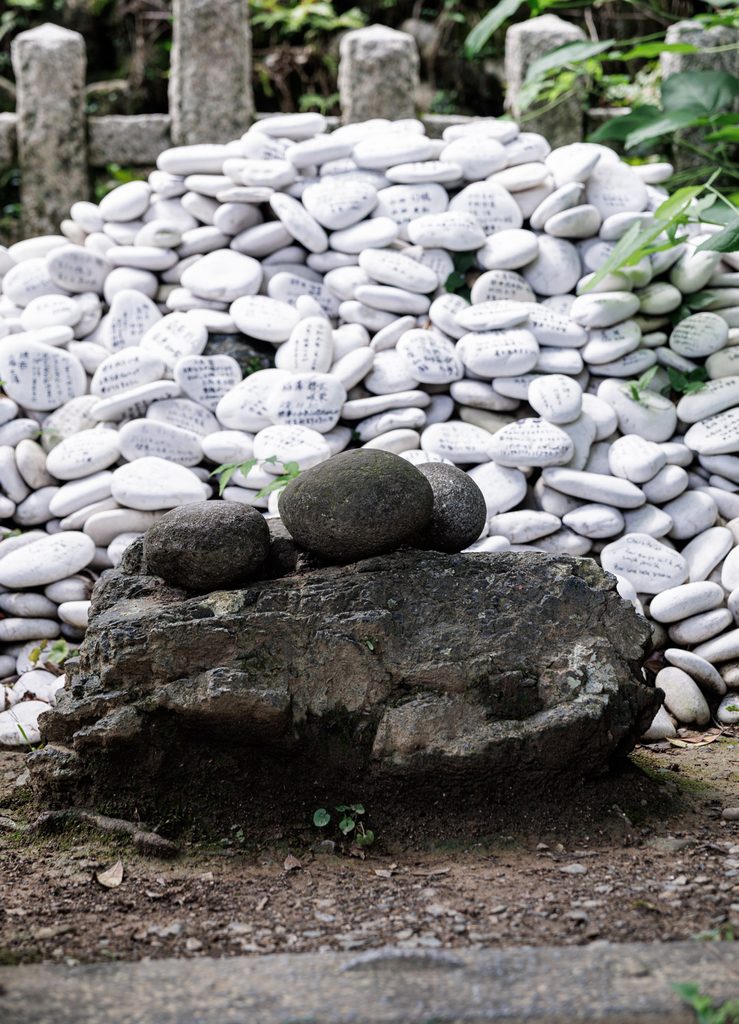
A single dark rock sits low on the ground, mossed over, roughly the size of a large suitcase. Behind it, white stones are piled into a small hill. Oval, palm-sized, hundreds of them, each one written on in black ink. Names. Dates. Wishes.
Nobody comes to this shrine, I had been thinking for twenty minutes. That was not true. It was simply not their day.
The dark rock is called Tsukinobe-ishi, and it is a birthing stone. I put my hand on it, and nearly pulled it back. To the eye it is an angular lump of rock with moss on one shoulder. Under a palm, one part of it is round. Smooth, and slightly swollen, the way a belly is. My fingers worked it out before I did. This is a stone made for stroking.
The white stones are prayer stones. A woman receives one, writes her name on it, and leaves it in front of the birthing stone. You do not take it home. You put it down and walk away, which is the exact opposite of how offerings at a Japanese shrine usually work.
Toward the right side of the pile, one stone was written in the Latin alphabet. Somebody had come up that residential street, found the office, taken a stone, written in her own language, and left it here with the rest. In the empty shrine where nobody came.
A Stone from Kyushu, a God from Iki
The birthing stone is not local.
It came from Chikushi, in northern Kyushu, six hundred kilometers away. The legend holds that Empress Jingu stroked her belly with this stone and gave birth safely, and that generations later an oracle of Tsukiyomi prompted Emperor Jomei to send a man named Iki no Kimi Ototo down to Chikushi to find it and bring it back. The Yoshu Fushi, an Edo-period gazetteer of the province, records the story.
Then I read the historical marker by the gate, and found the god had come the same way.
Tsukiyomi was not originally a Kyoto deity at all. He was worshipped by the Iki clan on the island of Iki, out in the strait between Kyushu and the Korean peninsula, and he was worshipped there as a god of the sea. In 487, an envoy named Abe no Omi Kotoshiro stopped at Iki on his way to the peninsula and received an oracle. He reported it to the court, and a shrine was founded on the Katsura riverbank. In 856 the shrine moved to the southern foot of Mount Matsuo, where it stands now, to get away from the floods.
The marker ends by noting that immigrant clans, the Hata clan above all, were probably involved in bringing this shrine to Kyoto, and that it matters for understanding how much of early Kyoto’s religion arrived from overseas.
So: a sea god, landlocked. Carried inland from an island in the strait, given a valley with a river in it, and gradually turned into a god of the moon and of childbirth. The stone made the same trip.
At the foot of that marker there is a small plaque advertising a translation app. Scan the code and the history is yours in English. The history had a door in it. The water only had undrinkable.
Ichitani-Munakata Shrine, at the Arashiyama Monkey Park Gate
Matsuo Taisha has a second sub-shrine, and it is nowhere near the first. Same parent, same origin in Kyushu, and a river valley in between.
Ichitani-Munakata Shrine is one stop away on the Hankyu Arashiyama line, then a seven-minute walk. If you insist on walking the whole way from Tsukiyomi Shrine it takes about half an hour, through a stretch of road with very little on it.
From Arashiyama station you come out at the Katsura River, ignore the Togetsukyo bridge, and follow the bank upstream. At the bottom of a stone staircase, three posts stand together.
The first is a lichen-covered stone pillar carved with the shrine’s formal name. The second is a dark wooden post reading Arashiyama Monkey Park. The third is a white board with an arrow: goshuin desk, this way.
Of those three, exactly one is in English. A cartoon macaque points helpfully up the hill to explain that the entrance to the Monkey Park is at the top of the stairs. The shrine that has been standing here for something like thirteen centuries has no English on any of its signs.
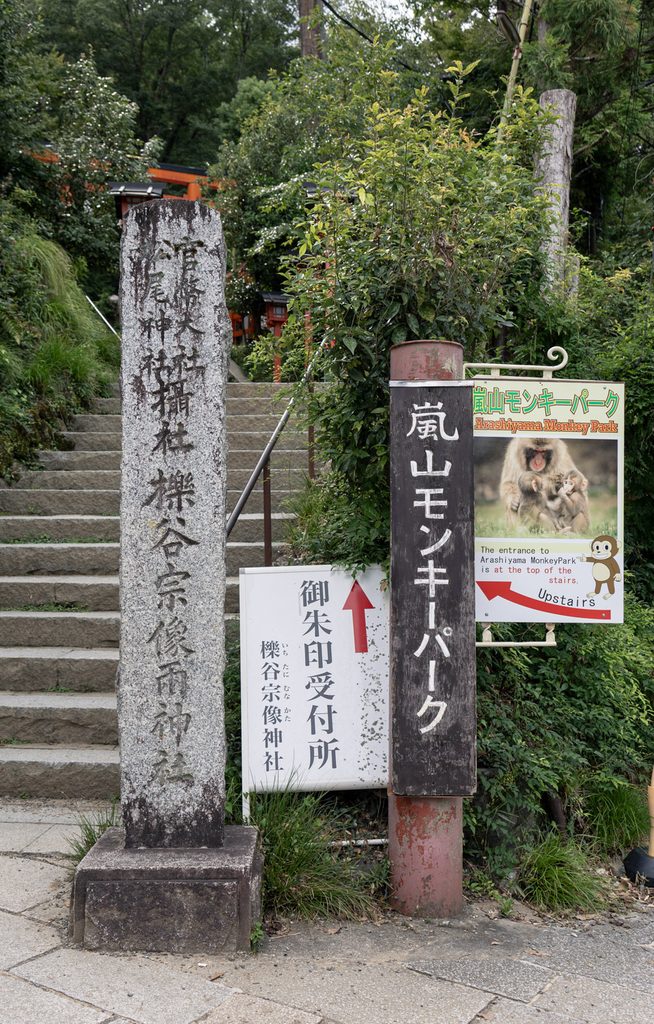
I have climbed those steps ten times. The Monkey Park is genuinely worth the money, the macaques are wild and completely unbothered by tourists, and the view from the top of the hill is the best cheap view in Kyoto. On every one of those ten visits I walked straight past this shrine.
I knew it was a shrine, and I knew it was not part of the park. That was the entire extent of my knowledge. It never crossed my mind that it belonged to Matsuo Taisha, or that anybody had been praying here since the seventh century. I found all of that out on the eleventh visit, standing in front of it with a notebook.
Climb the steps and the shrine is there before the ticket booth, inside a vermilion fence, with stone lanterns in front and maples leaning over the roof. You walk past the line of people buying tickets, pray, and come back down if you like.
Most people do not stop. Their destination is further up. For ten visits, neither did I.
Do you have to pay to see the shrine?
No, and it is worth saying plainly, because a number of English-language pages have this wrong. Several describe the Monkey Park entrance as being inside the shrine grounds, and at least one instructs you to hand over 800 yen at the shrine gate. You pay nothing to visit Ichitani-Munakata Shrine. The ticket booth sits past it, and the money is for the monkeys.
If you do want the monkeys: 800 yen for anyone 16 and over, 400 yen for children aged 4 to 15. The park runs from 9:00 to 16:00, with the summit area open until 16:30. It closes earlier if the monkeys decide to go back up the mountain, which is entirely their decision.
The Shrine That Was Paid in Fresh Coins
Two shrines share the building.
Ichitani Shrine enshrines Okitsushima-hime. The deity of Munakata Shrine, next to her under the same roof, is Ichikishima-hime. An alternate account in the Nihon Shoki treats the two as the same goddess under different names, which is the kind of thing that happens when records are kept for a thousand years by people who disagree.
These two came from Kyushu as well. The tradition holds that they were invited here from Munakata, in Chikushi, in 668. The Munakata goddesses are sea deities, guardians of the sea road to the continent.
Which leaves the same question as Tsukiyomi Shrine. What does a sea goddess protect in a valley with no sea?
A river. Both shrines are thought to have been founded to protect boat traffic on the Oi River, which is the Katsura River, which is the water running under the Togetsukyo bridge in every photograph anyone has ever taken of Arashiyama. The river made this place. Its god stands at the bottom of the monkey stairs.
There is one more entry in the record, and it is my favorite. In 870, according to the Sandai Jitsuroku, freshly minted coins were being offered to this shrine, for the straightforward reason that the government mint that stood nearby at Kadono had just made them. Ichikishima-hime was later merged with Benzaiten, who handles wealth and water and music. So when Japanese visitors come here today to pray about money, they are standing on eleven hundred years of precedent.
The shrine only became a formal sub-shrine of Matsuo Taisha in 1877, more than a thousand years after the goddesses arrived.
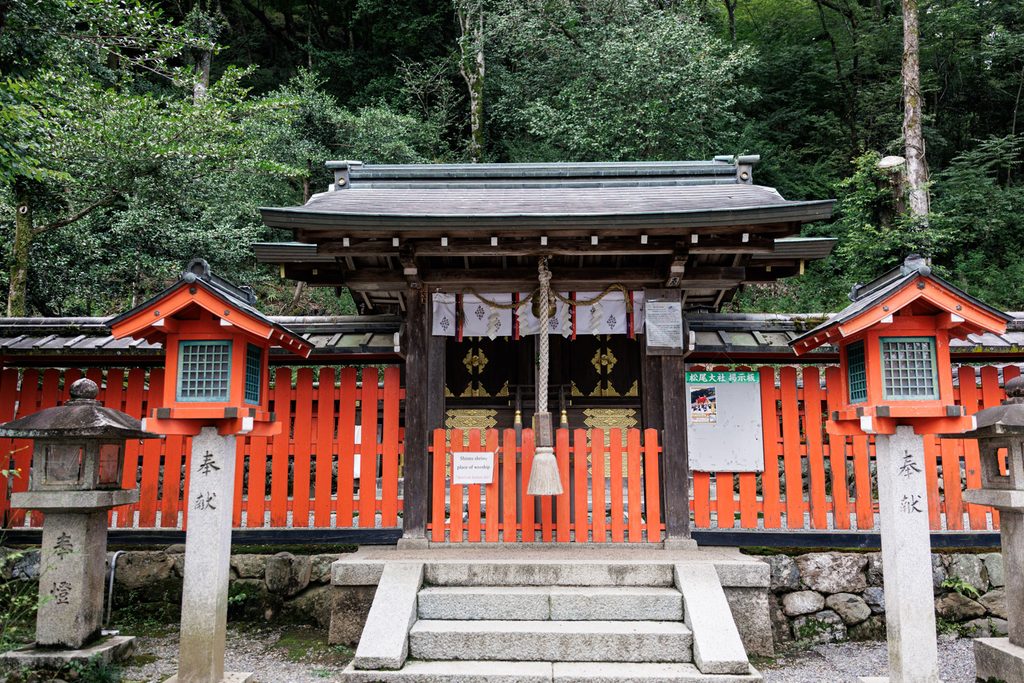
Once a Year, a Line Is Drawn Between Them
Nothing on a map connects these two shrines.
Once a year something does. On the first Sunday of September, Matsuo Taisha holds its Hassaku Festival, and a portable shrine leaves the main grounds at 8:00 in the morning. It reaches Ichitani-Munakata Shrine at 9:30. It is scheduled to leave again at 10:15, and shortly after that it is supposed to be loaded onto a boat and carried across the river above the Togetsukyo bridge.
I was there for the arrival. The little shrine grounds filled up completely with bearers, and every one of them was a woman. This mikoshi is carried by a group called the Yamabuki-kai, and a women-only team is rare in Japan. I was the only one who thought the space was too small. They folded themselves into it like people who had done this many times.
The boat did not happen. It had rained since the previous day, the Katsura was running high, and the riverside rites were called off. The mikoshi never went near the water.
At the shrine founded to protect boats on that river.
I had a whole paragraph ready about how perfect it was, the water god’s palanquin going straight from her gate onto her river, and the river took it away from me. Which is probably the correct lesson. Enshrining a god of safe passage was never a claim that the crossing is always available. You pray precisely because some days it isn’t.
You Have to Press the Button
One last thing about visiting either shrine.
Both have a shrine office. Neither has anyone sitting in it. What they have is a doorbell, and if you want a goshuin, or a prayer stone, or anything else, you press it and somebody comes out from the back.
The first time, this is harder than it sounds. You are alone in a silent shrine, and you are about to summon a human being out of a building for your personal benefit. My hand hovered. I thought about leaving.
Press it. Somebody comes out, hands you the sheet, takes the coins, and goes back to whatever they were doing.
Tsukiyomi Shrine and Ichitani-Munakata Shrine: The Basics
| Tsukiyomi Shrine | Ichitani-Munakata Shrine | |
|---|---|---|
| Japanese | 月読神社 (Tsukiyomi Jinja) | 櫟谷宗像神社 (Ichitani-Munakata Jinja) |
| Deity | Tsukiyomi no Mikoto, the moon | Okitsushima-hime and Ichikishima-hime |
| Founded | 487 | invited from Kyushu in 668 |
| Known for | safe childbirth, conception | safe passage on water, money luck |
| Admission | free | free (no Monkey Park ticket needed) |
| Gates open | 5:00–18:00 | always open |
| Shrine office | 9:00–16:00 weekdays and Sat, 9:00–16:30 Sun and holidays | same |
| Goshuin | 500 yen, pre-written | 500 yen, pre-written |
| Time needed | about 15 minutes | about 2 minutes, or 10 with a goshuin |
Getting to Tsukiyomi Shrine and Ichitani-Munakata Shrine
Tsukiyomi Shrine. Ten minutes on foot from Matsuo-taisha station on the Hankyu Arashiyama line. From the first torii of Matsuo Taisha it is three hundred meters south, about three minutes. If you are going to Matsuo Taisha at all, there is no good reason to skip it.